What is skeeter syndrome?
Skeeter syndrome is a large local allergic reaction to a mosquito bite. Proteins in the female mosquito’s saliva set off an immune overreaction, so the bite swells to several centimeters instead of staying under 10 mm (about 1/2 inch). It is not an infection, it is not contagious, and it usually clears in 3 to 10 days.
“Skeeter” is old American slang for a mosquito. Two allergists at the University of Manitoba, F. Estelle R. Simons and Zhikang Peng, used the name in the Journal of Allergy and Clinical Immunology in 1999, and it stuck. Doctors also call it a large local reaction to mosquito bites. So when you read “mosquito bite allergy” or “allergic to mosquito bites”, it usually means the same thing.
The reaction is to the saliva, not to the bite itself. While a mosquito feeds, it injects saliva into your skin, and CDC’s page on mosquito bites explains that your body reacts to that saliva with a bump and itching. In skeeter syndrome the immune system reacts far more strongly. Reviews in the medical literature link it to IgE and IgG antibodies and to immune cells aimed at saliva proteins.
Mosquito species carry different saliva proteins, too. That is why, as Cleveland Clinic’s skeeter syndrome page notes, you may react hard to some mosquitoes and hardly at all to others.
Who gets skeeter syndrome?
CDC names three groups more likely to have severe reactions to bites: children, adults bitten by a mosquito species they have not met before, and people with immune system disorders. A 2022 review in Frontiers in Immunology adds outdoor workers with heavy exposure. The 1999 report that named the condition listed young children, people with weak immune systems, and immigrants or visitors meeting the local mosquitoes for the first time.
Other allergies often come with it. In one study of 180 children, large or unusual reactions to mosquito bites were linked with atopy, the tendency toward asthma, hay fever and eczema. It was present in 35% of the children who reacted, against 12% of those who did not. Yale New Haven Health’s allergists also flag a family history of allergies and past strong reactions to bites or stings. Adults are not exempt either: a move, a trip, or a newly arrived species such as the Asian tiger mosquito can bring saliva the body has never met.
Very rarely, a severe reaction to bites is a sign of something else. The 2022 review describes extreme bite reactions, with blisters, ulcers or dead skin, in people with chronic Epstein-Barr virus infection and with some blood cancers such as chronic lymphocytic leukemia. Those reactions come with fever and feeling unwell. For that reason, a first-ever extreme reaction in an adult deserves a doctor’s visit.
How rare is skeeter syndrome?
Nobody has a good count, because few people see a doctor for a big bite. Even hospital pages disagree: Yale New Haven Health calls it relatively common but underrecognized, while University Hospitals calls it relatively rare. One pediatric allergy clinic in Turkey diagnosed 15 children with it over six years, which suggests how few cases reach a specialist. In contrast, the reaction that is truly rare is anaphylaxis: the 2022 review counts fewer than 30 reported cases from mosquitoes worldwide.
What skeeter syndrome looks like, and how big it gets
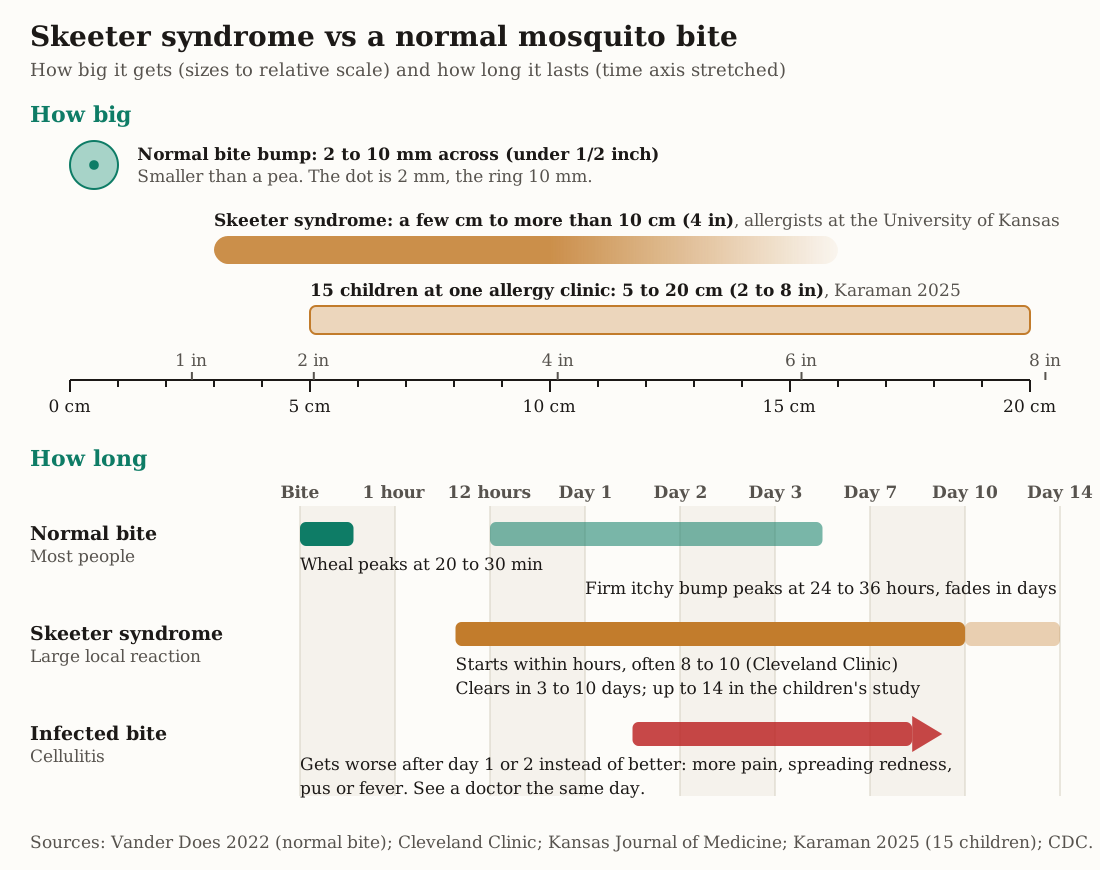
A skeeter syndrome bite is a red, warm, swollen and itchy patch, often hard to the touch. Within hours it spreads a few centimeters to more than 10 cm (4 inches) from the bite. A normal mosquito bump is 2 to 10 mm. Blisters, bruise-like spots and a low fever can come with it.
Signs that point to skeeter syndrome, from CDC and Cleveland Clinic:
- Swelling far larger than a normal bite, often across a whole cheek, hand or forearm.
- Redness, or a darker color on brown and black skin, where redness is harder to see.
- Skin that feels warm, firm or hard, and that itches or aches.
- A blister in the middle, or dark spots that look like a bruise.
- Rarely, a low fever, hives in other places, or swollen lymph nodes.
How big is a skeeter syndrome bite?
Sources give different sizes. Allergists at the University of Kansas Medical Center describe a reaction from a few centimeters to more than 10 cm across. A Yale allergist says the swelling can pass 2 to 3 inches (about 5 to 7.5 cm). In the Turkish clinic’s 15 children, the swelling measured 5 to 20 cm (2 to 8 inches), with blisters of 1 to 5 cm. That study counted a bite as skeeter syndrome when the swelling reached at least 5 to 10 cm within 24 hours, or came with a blister.
Google’s AI Overview gives 2 to 10 cm, up to 4 inches. However, none of the medical sources we read gives that range. The Cleveland Clinic page, reviewed in March 2026, gives no size at all, and neither does HCA Midwest’s hospital blog. The range does appear on a pest control company’s page. That page also says the welts reach full size within an hour, while medical sources describe swelling that builds over hours. One possible source of the mix-up: a normal bite wheal is 2 to 10 millimeters, according to the 2022 review. In practice, size alone does not settle it. How fast it came up, how it feels and how you feel matter as much.
Why are my mosquito bites so big?
Big bites mean your immune system reacts strongly to that mosquito’s saliva. Children, people with other allergies and people new to an area tend to get the biggest. Twin studies suggest that bite size and itch partly run in families, and women report bigger, itchier bites than men. On Reddit, readers describe the same pattern: bites that were never a problem, then big reactions on a first trip to southern Europe or in their mid-30s.
Can a mosquito bite blister?
Yes. CDC lists small blisters and dark, bruise-like spots among normal mosquito bite signs. Blisters are also common in skeeter syndrome: 11 of the 15 children in the Turkish study had one in the middle of the swelling. One hospital blog ties blisters to bites that were left untreated or got infected. In fact, a blister is part of the allergic reaction and is no sign of poor care on its own. A blister that fills with yellow pus, or skin around it that turns hot and more painful after day 2, needs a doctor.
How long does a skeeter syndrome bite last?
A skeeter syndrome bite usually starts swelling within hours, is worst in the first day or two, and clears in 3 to 10 days. Cleveland Clinic says symptoms usually start 8 to 10 hours after the bite. Some start sooner: one toddler in the 1999 report swelled within an hour. In one study of 15 children, healing took 7 to 14 days.
Sources agree on the start but differ on the end. Cleveland Clinic, the University of Kansas allergists and the 2022 review all give 3 to 10 days. That range goes back to the 1999 report itself, where the swelling faded over 3 to 10 days. By contrast, the 2025 study of 15 children found 7 to 14 days, and its author writes that the reaction usually resolves within 1 to 2 weeks.
The shape of the curve matters more than the exact day. Skeeter swelling grows over the first 8 to 12 hours or so, the Kansas allergists write, and then slowly shrinks. Swelling that is bigger, hotter or more painful on day 3 than on day 2 does not fit that pattern, so a doctor should check it for infection.
Does skeeter syndrome go away?
Each episode does, usually without a mark. Even so, Cleveland Clinic warns that badly scratched swelling can break open, get infected or leave a scar. The tendency itself can last: 13 of the 15 children in the 2025 study had it more than once. Many children react less as they grow, as the section on getting used to bites explains.
Skeeter syndrome vs a normal mosquito bite
A normal mosquito bite is a bump 2 to 10 mm across that itches for a few days. Skeeter syndrome is swelling of several centimeters, often warm and hard, that starts within hours and lasts up to 10 days or more. Both come from the same saliva. The difference is how hard your immune system reacts.
Table 1. A normal mosquito bite next to skeeter syndrome
Size
- Normal mosquito bite
- 2 to 10 mm (under 1/2 inch)
- Skeeter syndrome
- A few cm to more than 10 cm (4 in); 5 to 20 cm in one study of children
When it shows
- Normal mosquito bite
- A puffy bump within minutes, then a firm itchy bump about a day later
- Skeeter syndrome
- Swelling within hours, often 8 to 10 hours after the bite
Peak
- Normal mosquito bite
- 20 to 30 minutes, then again at 24 to 36 hours
- Skeeter syndrome
- Grows over the first 8 to 12 hours or more
How long
- Normal mosquito bite
- A few days
- Skeeter syndrome
- 3 to 10 days, sometimes up to 2 weeks
How it feels
- Normal mosquito bite
- Itchy
- Skeeter syndrome
- Itchy, warm, firm or hard, sometimes sore
Other signs
- Normal mosquito bite
- Sometimes a small blister or a bruise-like spot
- Skeeter syndrome
- Often a blister in the middle; rarely low fever, hives or swollen lymph nodes
Who gets it
- Normal mosquito bite
- Almost everyone
- Skeeter syndrome
- Mostly young children; also adults meeting a new species and people with immune disorders
What to do
- Normal mosquito bite
- Wash, cool, do not scratch
- Skeeter syndrome
- The same, plus raising it and asking a pharmacist; a doctor for the warning signs below
From CDC, Cleveland Clinic, the 2022 Frontiers in Immunology review, the Kansas Journal of Medicine and the 2025 study of 15 children. Times vary from person to person.
A normal bite runs on two clocks, the 2022 review explains. A wheal rises within minutes and peaks at 20 to 30 minutes. Then a firm, itchy bump of the same size peaks at 24 to 36 hours and fades over several days. Our guide to ordinary mosquito bites covers that normal kind in full, from the itch to the infected bite. If your bumps sit in lines or clusters after a night in bed, compare them with bed bug bites instead.
Skeeter syndrome or cellulitis?
Timing is the best clue. Skeeter syndrome swells within hours of a bite and mostly itches. Cellulitis, a bacterial skin infection, takes longer to build, keeps spreading for days, hurts more than it itches, and may bring fever, pus or red streaks. Looks alone can fool doctors too, so when it started matters most.
Table 2. Skeeter syndrome compared with cellulitis
When it starts
- Skeeter syndrome
- Within hours of a bite you noticed
- Cellulitis (infection)
- Later, then keeps spreading over the following days
Main feeling
- Skeeter syndrome
- Itch, sometimes soreness
- Cellulitis (infection)
- Pain and tenderness
Fever
- Skeeter syndrome
- Often none; a low fever is possible
- Cellulitis (infection)
- Fever with chills or sweats is possible
Pus or red streaks
- Skeeter syndrome
- No
- Cellulitis (infection)
- Possible: pus, a red streak spreading out, or a foul smell
Blister
- Skeeter syndrome
- Often one in the middle, within hours
- Cellulitis (infection)
- Possible
Past bites
- Skeeter syndrome
- Often the same reaction to earlier bites
- Cellulitis (infection)
- Can follow any break in the skin, including a scratched bite
Treatment
- Skeeter syndrome
- Cooling and allergy care; antibiotics are not needed
- Cellulitis (infection)
- Antibiotics from a doctor
From the 2022 Frontiers in Immunology review, the 2025 study of 15 children, the Kansas Journal of Medicine, CDC (About Cellulitis, About Mosquito Bites) and MedlinePlus.
Skeeter syndrome got its name from exactly this mix-up. In the 1999 report, five healthy children aged 2 to 4 were first treated for cellulitis. They had a low fever and were fussy, so doctors took blood cultures, and in two of them X-rays to rule out a bone infection. The cultures came back clean, the antibiotics stopped after 2 to 3 days, and the swelling faded on its own. A low fever does not prove infection, then, but it still needs a doctor’s look.
Getting this right spares people needless antibiotics. Mayo Clinic notes that skeeter syndrome is sometimes mistaken for a bacterial infection. The patient pictured in the 2022 review had been given antibiotics for suspected cellulitis on earlier episodes. This time he got better on allergy treatment alone. Likewise, the University of Kansas allergists write that antibiotics are not indicated for large local reactions.
The pen line helps here. MedlinePlus says a doctor may mark the edge of the redness to see whether it spreads past the line over the next several days. You can do the same at home with a washable pen and the date. Skeeter swelling usually stops growing after the first day or so. Redness that crosses the line after day 2 needs a doctor the same day. A pediatric allergist at University Hospitals uses the same mark: swelling that keeps spreading for more than 2 days should be checked. CDC also says to get care right away if the redness spreads quickly or a fever or chills start.
Both can also happen at once. Cleveland Clinic warns that large, swollen areas can break the skin, especially when scratched, and then become infected. If you cannot tell which one you have, a doctor’s look is worth the trip.
When should I be concerned about a mosquito bite?
Be concerned when a bite brings a fever, pus, red streaks or redness that keeps spreading after day 2: see a doctor the same day. Call 911 for trouble breathing or swallowing, swelling of the lips, tongue or throat, or hives all over. A big, itchy, warm bite in someone who feels well is usually skeeter syndrome.
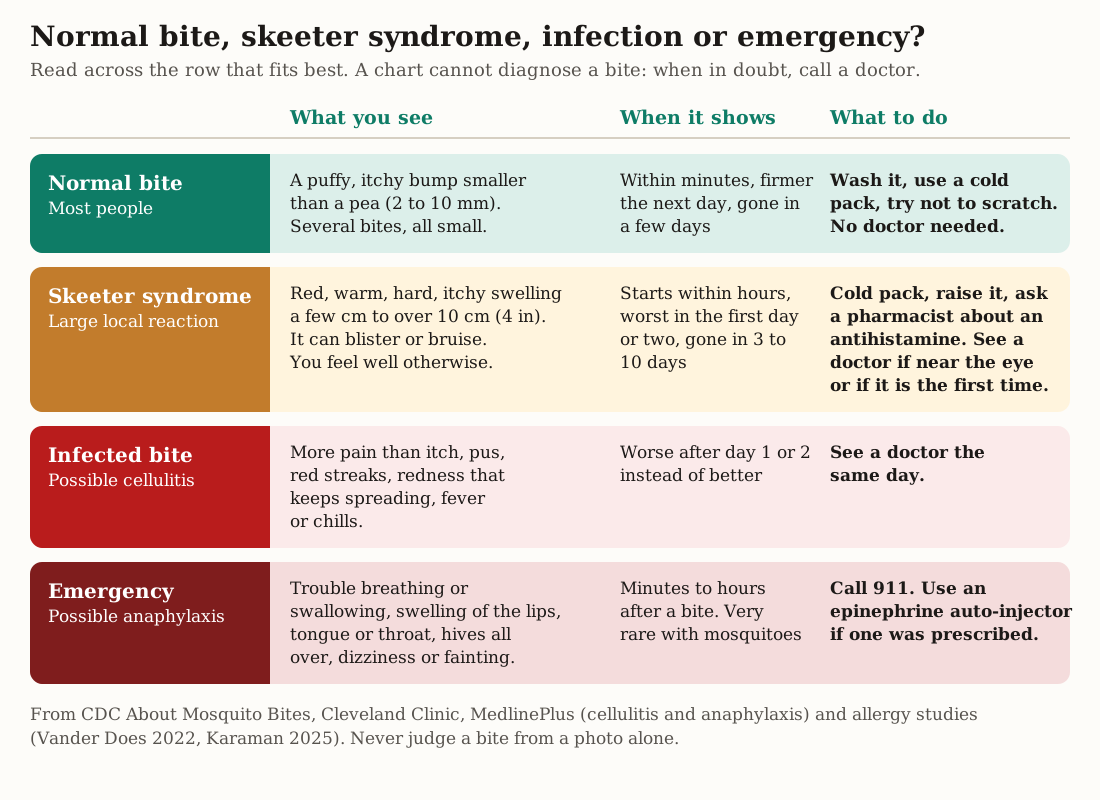
Table 3. After a mosquito bite: what you notice, how soon to act, and who to call
Trouble breathing or swallowing, wheezing, swelling of the lips, tongue or throat, hives over much of the body, dizziness or fainting
- How soon
- Now
- Who to call
- 911. Use an epinephrine auto-injector if one was prescribed, and still call
Swelling that closes an eye, or eye pain or blurred vision with a swollen eyelid
- How soon
- Same day
- Who to call
- Your doctor or urgent care. Swelling near the eye needs a look to rule out infection
Fever or chills with a red, painful bite; red streaks; pus or a foul smell; redness that crosses your pen line after day 2
- How soon
- Same day
- Who to call
- Your doctor or urgent care. These are signs of infection
Swelling that makes it hard to see, eat, walk or use a hand
- How soon
- Same or next day
- Who to call
- Your doctor. Prescription treatment may help
A fever, headache or rash in the days or weeks after bites, especially after travel
- How soon
- Within a day
- Who to call
- Your doctor. Mention the bites and where you were
Large swelling for the first time as an adult, or big reactions after every summer of bites
- How soon
- Within days
- Who to call
- Your doctor, and ask whether an allergist should see you
A big, itchy, warm swelling, you feel well, and it is shrinking by day 3
- How soon
- No visit needed
- Who to call
- Nobody. Keep up the home care and watch the pen line
From Cleveland Clinic, CDC (About Mosquito Bites, About Cellulitis), MedlinePlus (Anaphylaxis) and the Kansas Journal of Medicine. When in doubt, call: a doctor would rather hear about a bite than miss an infection.
Can a mosquito bite cause anaphylaxis?
Yes, but it is very rare. The 2022 review counts fewer than 30 anaphylactic reactions to mosquitoes reported worldwide. A Yale allergist explains why: the saliva proteins mostly stay in the skin, so the reaction stays there too, unlike a food allergen that reaches the bloodstream. AAAAI notes that such reactions are more often caused by stinging insects, and that anyone who has had one should see an allergist. Our bee sting guide explains how a whole-body reaction differs from a big local one.
What a fever after mosquito bites can mean
A fever days after bites is not part of skeeter syndrome. It can be an infection from scratching, or a germ the mosquito carried. CDC lists West Nile, dengue and Zika viruses and malaria parasites among them. Not everyone who is infected gets sick, but a fever, headache, body aches or a rash after bites, or after travel, needs a doctor. Say when and where you were bitten.
How to get rid of skeeter syndrome at home
You cannot switch the reaction off, but you can ease it while it runs its course of 3 to 10 days. Cool it, raise it, leave it alone, and ask a pharmacist about an oral antihistamine or an anti-itch cream. Most cases need nothing more, and the steps below follow CDC, Cleveland Clinic and AAAAI advice.
Home care for a big mosquito bite
Wash the bite
Clean the bite and the skin around it with soap and water, as CDC advises. Clean skin is less likely to get infected if the swelling cracks or you scratch it.
Cool it for 10 minutes
Hold an ice pack on the swelling for 10 minutes, then repeat as needed. Wrap the ice in a thin cloth so it does not touch bare skin. CDC also lists a paste of baking soda and water, left on for 10 minutes and then washed off.
Raise the swollen part
Prop a swollen hand, arm, foot or leg on a pillow above the level of the heart. The allergy group AAAAI advises raising the area and icing it to bring down swelling and pain.
Try not to scratch
Scratching breaks the skin and lets bacteria in, which can turn an allergy into an infection. Keep nails short, and cover the bite with a loose bandage or clothing at night.
Leave blisters whole
A blister in the middle of the swelling is common. AAAAI says to clean blisters gently with soap and water without breaking them. Do not pop or drain one at home.
Ask a pharmacist about itch relief
An oral antihistamine or an over-the-counter anti-itch or steroid cream may help, and both appear on CDC and Cleveland Clinic lists. Ask a pharmacist which one suits the person, follow the label, and ask before giving any medicine to a child.
Mark the edge and watch it
Trace the edge of the redness with a washable pen and write the date and time beside it. Check it morning and evening. If the redness crosses the line after day 2, or a fever starts, see a doctor that day.
A few things do more harm than good. Do not use leftover prescription creams, antibiotics or steroid tablets from home. Do not cut, pop or squeeze the swelling. Above all, never give a child a medicine meant for an adult. If a child swallows a cream, a medicine or repellent, call Poison Control at 1-800-222-1222.
What doctors do for skeeter syndrome
Doctors diagnose skeeter syndrome by looking at the bite and asking when it started. No standard blood or skin test confirms it. For bad cases they may prescribe stronger anti-inflammatory medicine, and for repeated or severe reactions they may send you to an allergist.
Expect questions about timing, recent travel and past reactions. Cleveland Clinic says there is no specific test, such as an allergy test, for the condition. Mayo Clinic adds that no simple blood test detects mosquito antibodies. Commercial mosquito tests use whole-body insect extracts with little saliva in them, and they miss most cases. In a 2026 study of 206 children, the mosquito blood test was positive in only 6 of 77 children with real reactions, about 8%, and in 10% of children with normal bites.
A better test exists, but only in research labs. The 1999 researchers confirmed their cases with a blood test for antibodies to mosquito saliva glands, and levels were far higher than in children with normal bites. Making it took the glands of about 370 mosquitoes, dissected by hand. They also advised against test bites, which risk both a disease and a bad reaction.
Treatment then follows the size of the reaction. Cleveland Clinic lists antihistamines and anti-itch creams first, with oral corticosteroids or a steroid shot for severe symptoms. Antibiotics are for a confirmed skin infection only. Your doctor chooses the medicine and the dose; this page does not give doses.
For people who react every summer, doctors sometimes suggest a non-drowsy antihistamine taken before known mosquito exposure. Mayo Clinic mentions this, and trials in the 2022 review found it shrinks bite swelling and itch. Ask your doctor or pharmacist whether it suits you or your child.
When to see an allergist
Ask for a referral if big reactions keep coming back or close an eye, or if you have had hives all over or trouble breathing after a bite. A first big reaction as an adult is another reason. Allergy shots with mosquito extract have shown promise in small trials. Even so, the 2022 review says they are not yet available as a standard treatment.
How to prevent skeeter syndrome
The only sure way to prevent skeeter syndrome is to avoid the bite. Use an EPA-registered repellent on exposed skin, wear long sleeves and treated clothing, fix window screens, and empty standing water once a week. People with frequent reactions can also ask a doctor about an antihistamine before exposure.
- An EPA-registered repellent. CDC lists six active ingredients: DEET, picaridin, IR3535, oil of lemon eucalyptus (OLE), para-menthane-diol (PMD) and 2-undecanone. Follow the label every time.
- Clothing. Loose long sleeves and long pants. Permethrin goes on clothing and gear only, never on skin.
- Screens and water. Repair holes in screens. Once a week, empty, scrub, turn over or throw out anything that holds water, such as buckets, toys, birdbaths and plant saucers.
- Timing. Many mosquitoes bite most at dawn and dusk. Aedes mosquitoes such as the Asian tiger mosquito, though, bite in daylight.
Not sure which repellent to buy? Our comparison of picaridin and DEET sets out how long each lasts and how each feels on the skin. If you prefer plant-based products, read which natural repellents actually work first. CDC says it does not know how well repellents without EPA registration work. To cut the numbers in your yard, see how to get rid of mosquitoes.
Does your body get used to mosquito bites?
Often, yes, but slowly and not for everyone. Researchers describe five stages: little reaction at first, then a delayed bump, then quick and delayed bumps, then only a quick bump, and finally almost none after years of bites. Children with skeeter syndrome often react less as they grow.
Kenneth Mellanby described these stages in the journal Nature in 1946. Decades later, Japanese researchers followed 10 people for 30 years. Four of them moved to a later stage. Six stayed at the same stage, although their delayed bumps got smaller (Oka and colleagues, 2018). So the drift toward tolerance is real, yet slow and uneven.
Tolerance can also reset. It builds against the saliva of the mosquitoes you live with, so a new region or a new species can bring big reactions back. Peng and Simons, who wrote the 1999 paper, note that natural desensitization may happen during childhood or with long-term exposure. That fits Cleveland Clinic’s view that children react more because their immune systems have not yet been desensitized. Their 1999 report flagged a catch, though. Tolerance depends on how often a child is bitten. Yet children with big reactions need to avoid bites, so it may take years.
Skeeter syndrome in toddlers and babies
Young children get skeeter syndrome most, because their immune systems have met few mosquito bites. A toddler can wake with a hand, cheek or eyelid swollen far beyond the bite. It looks alarming but usually clears within a week or two. Swelling that closes an eye, a fever, or any big reaction in a baby needs a call to the pediatrician.
In the 2025 clinic study, the children were 4 years old on average, and about half had another allergic disease, mostly hay fever. Cleveland Clinic and Mayo Clinic both say large reactions are more common in children than in adults. Most children with it feel well apart from the itch: only 1 of the 15 had a low fever. A child who is feverish, sleepy or in pain needs a doctor.
Swelling around a child’s eye
Allergists at the University of Kansas Medical Center describe a 5-year-old girl who woke with one eye swollen after mosquito bites at a botanical garden the night before. It was skeeter syndrome. Still, the doctors stress that the bite history was what told it apart from an infection around the eye. Call the pediatrician the same day for any swelling that closes an eye, or that comes with fever, eye pain or a change in vision.
Mosquito bites on babies
For babies, prevention comes first. CDC advises clothing that covers the arms and legs and mosquito netting over strollers and carriers. Sources differ on repellent for the youngest babies. CDC’s travel guidance says DEET, picaridin and IR3535 carry no age limit, while Mayo Clinic advises no DEET under 2 months and no picaridin under 6 months. CDC says no OLE or PMD under age 3, and Mayo Clinic agrees on PMD.
So ask your pediatrician and read the label. Put repellent on your own hands first and then on the child, never on a child’s hands, eyes or mouth. Before you give a baby or toddler any antihistamine or cream, ask the pediatrician or a pharmacist.
Skeeter syndrome myths and mix-ups
Five beliefs about big mosquito bites are wrong or out of date. A few of them come from well-ranked health and reference pages. Each one below is checked against a medical source.
Myth 1
Myth: “A swollen, red mosquito bite is infected and needs antibiotics.”
Truth: Skeeter syndrome is an allergic reaction. The University of Kansas allergists write that antibiotics are not indicated for large local reactions. Antibiotics are for a real infection, with fever, pus, red streaks or spreading pain.
Myth 2
Myth: “A blood test will prove whether you have it.”
Truth: Cleveland Clinic says no specific test exists. In a 2026 study of 206 children, the mosquito blood test was positive in only about 8% of those with real reactions.
Myth 3
Myth: “Children always grow out of it.”
Truth: Many do react less with time. Yet Oka and colleagues followed 10 people for 30 years, and 6 of them stayed at the same stage. Adults can also develop it after meeting new mosquitoes.
Myth 4
Myth: “Skeeter syndrome is the same thing as papular urticaria.”
Truth: Wikipedia gives papular urticaria as another name. The 2022 Frontiers in Immunology review treats them as two different reactions: groups of small itchy bumps, and one large swollen area.
Myth 5
Myth: “A big bite means the mosquito gave you a disease.”
Truth: The swelling is your reaction to the saliva, CDC explains. Mosquito-borne illness shows up as fever, headache, aches or rash days later, not as a big bite.
Medical disclaimer. This page is for general information only. It is not a medical diagnosis. If you have severe symptoms, trouble breathing, swelling of the face or throat, fast spreading redness, fever, severe pain, pus, or signs of infection, contact a doctor or your local emergency number.
Skeeter syndrome FAQ
Is skeeter syndrome contagious?
Is skeeter syndrome an autoimmune disorder?
Can a mosquito bite cause swollen lymph nodes?
Is skeeter syndrome genetic?
For everything else about mosquitoes, from their life cycle to the species in your yard, start at our mosquito guide. To compare a big bite with other bugs’ bites, use our bug bite identification chart, but remember that no chart or app can identify a bug from the bite alone.
Related guides
Mosquito bites
The normal bite: why it itches, how long it lasts, and relief.
Picaridin vs DEET
Two proven repellents side by side, for skin, kids and hiking.
Natural mosquito repellent
Which plant-based options are proven, and which are not.
How to get rid of mosquitoes
Standing water, screens and yard control that cut the bites.
Mosquitoes
The hub: life cycle, species, bites and control.
Bed bug vs mosquito bites
Lines and clusters or scattered bumps: how to tell them apart.
Bee sting
Large local swelling vs a whole-body allergic reaction.
Bug bite identification
A chart of 20 bites by look, place and timing.
Sources
- CDC, About Mosquito Bites (June 21, 2024)
- CDC Yellow Book, Mosquitoes, Ticks and Other Arthropods (repellents and children)
- Cleveland Clinic, Skeeter Syndrome (medically reviewed March 11, 2026)
- Mayo Clinic, Mosquito bites: Symptoms and causes (November 15, 2024)
- MedlinePlus Medical Encyclopedia, Anaphylaxis (reviewed January 20, 2026)
- Simons FER, Peng Z. Skeeter syndrome. Journal of Allergy and Clinical Immunology, 1999;104(3 Pt 1):705-707 (the original report)
- Imran M, Pinion A, Martinez J, Gierer S. Periorbital Edema: The Importance of a Thorough Medical History. Kansas Journal of Medicine (University of Kansas Medical Center)