What do mosquito bites look like?
A mosquito bite is a puffy, round bump that shows up a few minutes after the bite. It often has a tiny dark dot in the middle where the mouthparts went in. Most normal bumps are under 1/2 inch (12 mm) across. A day later the bump often turns harder and itchier, and it can last several days.
CDC lists four normal signs of a mosquito bite:
- Within a few minutes, a puffy, reddish bump.
- A day or so later, a hard, itchy, reddish-brown bump, or several.
- Small blisters instead of hard bumps.
- Dark spots that look like bruises.
Most bites land on skin that clothing does not cover: ankles, arms, the neck and the face. You usually get several at once, scattered rather than in neat rows. Seattle Children’s adds that a bite often looks like a hive, either one large welt or a few small ones.
Mosquito bites on darker skin
On brown or Black skin, a bite may look skin-colored, darker brown or purplish rather than red. The NHS says the lump can be harder to see on darker skin, but you should still be able to feel it. The American Academy of Dermatology describes hives, the same kind of welt, the same way: often the color of your skin, or slightly darker or lighter.
This matters most when you check for infection. Redness is harder to see on darker skin, so judge by touch and feel instead: more warmth, more pain, more swelling, or pus. Scratched bites can also leave dark marks that take a while to fade, which a 2022 review in Frontiers in Immunology calls hyperpigmentation.
Why do some mosquito bites look like bruises?
A purple or bruise-like spot is one of the normal signs on CDC’s list. It is common with bigger reactions and on the legs. A bruise-like bite that does not hurt more each day is not a warning sign by itself. Bruises that appear with no bites at all, or bleeding from the gums or nose, are a different matter and need a doctor.
A bite that turns dusky or black, blisters, or forms a hard black scab is different too, above all with a high fever or swollen glands. A Rush University dermatologist told the American Medical Association in 2026 that this can mean a rare severe mosquito bite allergy. See a doctor the same day.
Can a picture of the bite tell you what bit you?
No. Many bites, rashes and hives look alike, and the same bite looks different on two people. So a photo of a bite cannot prove that a mosquito made it. A reader on r/mosquitoes put it bluntly in a 2026 post asking the forum to stop bite photos: it is impossible to name an insect from a bite.
Better clues are when and where it happened. Itching within minutes, outdoors or near an open window at dusk, on uncovered skin, fits a mosquito. Best of all is the insect itself. If you swat one, photograph it on white paper and try our bug identifier by picture.
Why do mosquito bites itch?
Mosquito bites itch because your immune system reacts to the saliva a female mosquito pumps into your skin while she feeds. Immune cells release histamine, which swells the skin into a bump and sets off itch nerves within minutes. A second, slower reaction peaks 24 to 36 hours later, which is why a bite can itch again the next day.
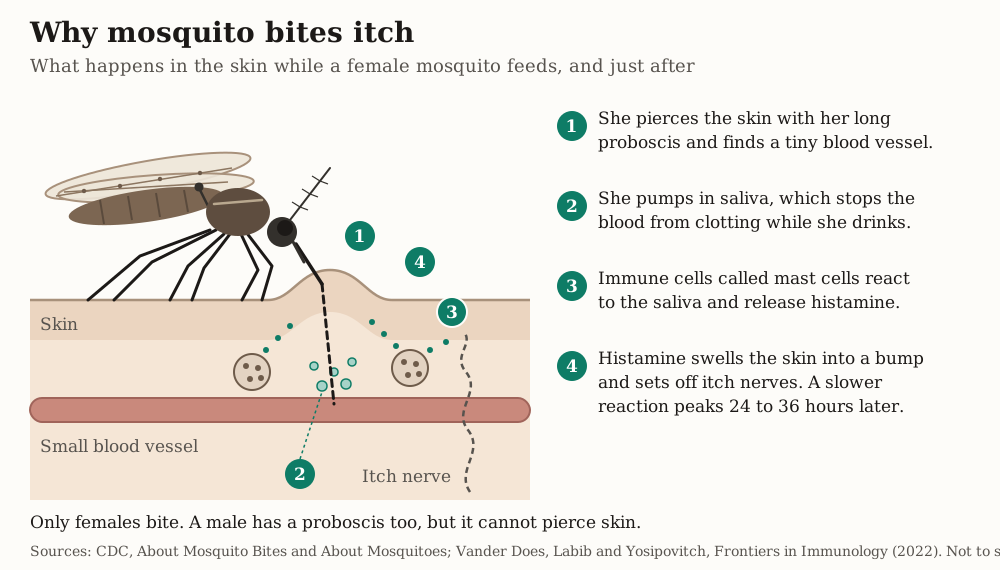
Only female mosquitoes bite, because they need protein from blood to make eggs. Both sexes drink flower nectar. CDC notes that a male’s proboscis, the long needle-like mouthpart, is not strong enough to pierce skin. So every bite you get comes from a female.
Her saliva is not an accident. According to StatPearls, it widens blood vessels and stops blood from clotting, which helps her feed fast. Your body treats those saliva proteins as foreign. The 2022 review notes that histamine is not the whole story, though: other chemicals in the skin seem to play a part too.
Why some people react more than others
The size of the reaction depends on you, not on the mosquito. CDC says stronger reactions are more common in children and in people with immune system disorders. They also happen in adults bitten by a kind of mosquito they have never met before. That is why travelers often report huge bites on vacation, even though bites at home barely bother them.
A very large, hot, swollen bite that starts within hours has a name: skeeter syndrome. It is an allergic-type reaction, not an infection. Our guide to skeeter syndrome and mosquito bite allergy covers who gets it and how to manage it.
Does your body get used to mosquito bites?
Partly, and not for everyone. Doctors describe five stages. A first-ever bite leaves only a small red spot. After more bites from the same kind of mosquito, the skin starts to react, first with the slow bump and then with both the fast and slow ones. Years later, some people have only the fast bump, and a few react not at all.
However, real life is messier. In one long-term study cited by the 2022 review, 6 of 10 people were still in the middle stage after 30 years. StatPearls adds that the effect is specific to each kind of mosquito, which fits the vacation pattern above.
How long do mosquito bites last?
Most mosquito bites itch for 3 to 4 days, and the swelling can take up to 7 days to go down. The first puffy bump is biggest 20 to 30 minutes after the bite. Then a harder, itchier bump peaks 24 to 36 hours after it and fades over the next few days.
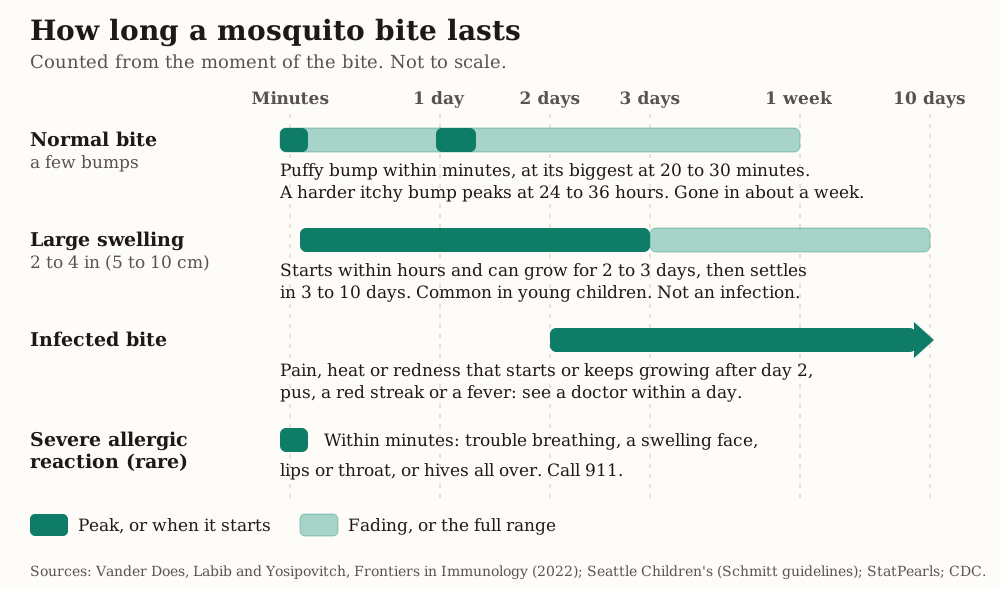
Table 1. A normal mosquito bite, from the first minute to the first week
Within minutes
- What you see
- A puffy, pale or reddish bump, 2 to 10 mm (under 1/2 inch), sometimes with a dark dot in the middle
- What you feel
- Sudden itch, sometimes a faint sting
20 to 30 minutes
- What you see
- The first bump at its biggest, often with a red or pink ring around it
- What you feel
- Itch at its first peak
24 to 36 hours
- What you see
- A harder, raised bump that may look reddish-brown, purple or bruised
- What you feel
- The itch comes back, often worse
Days 3 to 4
- What you see
- Redness fading. Some swelling can remain
- What you feel
- The itch eases
About 1 week
- What you see
- Gone, or a small dark mark where it was scratched
- What you feel
- Nothing, unless it was scratched open
Timing from the 2022 review in Frontiers in Immunology, CDC, and the Schmitt pediatric guidelines published by Seattle Children’s. Large reactions in young children follow their own timeline, shown in the diagram.
Some summaries make it sound quicker. Google’s AI Overview for bed bug bites vs mosquito bites says mosquito bites fade within 1 to 3 days, and MedlinePlus says a day or two. That is too short for most people: the itch alone usually lasts 3 to 4 days, and the swelling can last up to a week.
Why is my mosquito bite not going away?
Scratching is the usual reason. Every scratch restarts the inflammation, and the review notes that scratching can leave scars and dark marks. A large local reaction can also take 3 to 10 days to settle. StatPearls says local reactions to mosquito bites usually do not last more than 10 days.
So a bump that is still there after 10 days, keeps growing, or turns into a sore that will not heal is worth showing to a doctor. The same goes for a bite that gets worse after day 2 instead of better, which is covered below under infection. For a bite that stays itchy for weeks, a doctor can prescribe a stronger steroid cream.
Mosquito bite scars and dark marks
A bite that was scratched open can heal with a flat dark spot or a small scar. Both are more likely the longer and harder a bite is scratched. The best fix is to stop the itch early, using the steps below. If a dark mark still bothers you months later, a dermatologist can tell you what will help on your skin.
How to stop mosquito bites from itching
To stop a mosquito bite from itching, wash it, then hold something cold on it for about 10 minutes. Pressing hard on the bump for 10 seconds also helps, and costs nothing. For more relief, an anti-itch cream on the skin or a non-drowsy allergy pill can help; ask a pharmacist which suits you. Above all, do not scratch.
Mosquito bite relief, step by step
Wash the bite
Use soap and water on the bite and the skin around it. CDC lists this as the first step. It also clears away anything on your fingers before you touch the bite again.
Cool it for 10 minutes
Hold an ice pack wrapped in a thin cloth on the bite for 10 minutes, as CDC advises, and repeat when the itch comes back. For a single small bite, Mayo Clinic suggests rubbing an ice cube on it for 30 seconds.
Press it instead of scratching
Press firmly on the bump for 10 seconds with a fingertip, a fingernail or a pen cap. Both Mayo Clinic and Seattle Children's list steady pressure as a way to calm the itch. Just do not break the skin.
Add an anti-itch cream or lotion
CDC and Mayo Clinic list calamine lotion, an antihistamine cream or a hydrocortisone cream from the pharmacy. A dermatologist interviewed by the American Medical Association suggests keeping the cream in the fridge, so it goes on cold. Follow the label. For a baby, during pregnancy, or for a bite on an eyelid, ask a pharmacist first.
Ask about an allergy pill for many bites
For lots of bites or a big reaction, Mayo Clinic suggests a non-drowsy antihistamine taken by mouth. A pharmacist can tell you which one suits you and how much to take, especially for a child.
Keep nails short and cover it
Scratching is how most bites get infected. Cut a child's nails short. If the skin is already broken, wash it and cover it with a bandage, as Cleveland Clinic advises.
Check it again after 2 days
A normal bite is fading by then. Pain, heat or redness that starts or keeps spreading after day 2, pus, or a red streak means a doctor within a day.
Most bites need nothing more. Mayo Clinic notes that they usually stop itching and heal on their own in a few days. The steps above simply make those days easier. CDC’s About Mosquito Bites page lists the same basic care.
What to put on mosquito bites: what the evidence says
The best-tested treatment is also the plainest. In placebo-controlled trials, non-drowsy antihistamine pills cut both the swelling and the itch. Cold has good support too. Most creams and home remedies, on the other hand, have little or no trial evidence for mosquito bites, and a few are a bad idea.
Table 2. Mosquito bite remedies: does it help, and what the evidence says
Cold: an ice pack or cold, wet cloth
- Does it help?
- Yes. Start here
- What the evidence says
- CDC, Mayo Clinic and the NHS all advise it. The 2022 review explains that cooling calms the itch nerves
Firm pressure for 10 seconds
- Does it help?
- Yes, and free
- What the evidence says
- Mayo Clinic and Seattle Children's advise it. No trial, but it costs nothing and breaks the scratch cycle
A non-drowsy antihistamine pill
- Does it help?
- Yes. The best tested
- What the evidence says
- Placebo-controlled trials show less swelling and itch. Ask a pharmacist which one and how much
Hydrocortisone cream
- Does it help?
- Probably
- What the evidence says
- Mayo Clinic, the NHS and the American Academy of Dermatology advise it. The review's authors think it works, but it has no controlled trial for mosquito bites
Calamine or an antihistamine cream
- Does it help?
- May help
- What the evidence says
- CDC and Mayo Clinic list them. There is little trial evidence for mosquito bites
Numbing cream (pramoxine or lidocaine)
- Does it help?
- May help
- What the evidence says
- The AMA's 2026 guide and GoodRx list them. The 2022 review found little evidence for mosquito bites. Follow the label
Baking soda paste
- Does it help?
- Sources disagree
- What the evidence says
- CDC lists a paste of baking soda and water. The NHS says not to use home remedies such as bicarbonate of soda. Evidence is thin either way
Heat pen (a device that heats the skin to about 120°F, 50°C, for a few seconds)
- Does it help?
- Some evidence, with a catch
- What the evidence says
- In a 2023 study of 1,783 users, itch from mosquito bites fell 57% within a minute. Both published studies were paid for by the device makers
Hot spoon
- Does it help?
- No
- What the evidence says
- Nothing controls the temperature, so it can burn. The tested devices hold a set heat for seconds. Never use it on a child
Suction tools
- Does it help?
- Unproven
- What the evidence says
- The review found no randomized, blinded trial. Some readers swear by them; others found they did nothing
Toothpaste
- Does it help?
- No evidence
- What the evidence says
- Some sites suggest it for the cooling menthol in mint pastes. We found no published study of toothpaste on insect bites (PubMed search, October 2026). Cold does the cooling without it
Vicks VapoRub
- Does it help?
- Not advised
- What the evidence says
- It contains camphor. MedlinePlus says camphor can irritate skin and is poisonous if swallowed. Keep it away from children's hands and mouths
Rubbing alcohol
- Does it help?
- Not advised
- What the evidence says
- No evidence it eases the itch, and it stings scratched skin
Essential oils, honey, oatmeal, aloe
- Does it help?
- Unproven
- What the evidence says
- The review groups plant remedies with treatments that lack evidence. Stop any that sting or redden the skin
Sources: CDC, Mayo Clinic, the NHS, Seattle Children’s, Vander Does and colleagues in Frontiers in Immunology (2022), and the heat device studies in Acta Dermato-Venereologica (2023) and Clinical, Cosmetic and Investigational Dermatology (2011). We give no doses. Follow the label, and ask a pharmacist.
Does heat work on mosquito bites?
Heat devices have more evidence than most home remedies, but read it with care. The 2023 real-world study used a device that heats the skin to 47 to 51.5°C (117 to 125°F) for 4 to 9 seconds. Itch fell fast compared with people asked to wait 10 minutes. Still, the control group was small and not blinded, and the maker funded the work.
A hot spoon is not the same thing. Nothing tells you how hot it is, and a reader on r/AskDocs described a painful burn after using one on a bite. If you want to try heat, use a device made for it and follow its instructions. For a child, stick to cold.
How to get rid of mosquito bites overnight
You cannot make a bite vanish overnight. The second, harder bump is at its peak 24 to 36 hours after the bite, so it often looks worse the next morning. What you can do is calm the itch and swelling before bed, so you do not scratch in your sleep.
Cool the bite for 10 minutes, put on the cream you chose, and cover it with a bandage if you tend to scratch. For lots of bites, ask a pharmacist about an allergy pill at night. Swelling on the face is often worse first thing in the morning, Seattle Children’s says, and goes down after a few hours upright.
When to worry about a mosquito bite
Worry about a mosquito bite when it gets worse after day 2, or when you feel ill. Spreading pain, heat, pus or a red streak means a doctor within a day. A fever with a red, spreading bite means the same day. Trouble breathing, or swelling of the face, lips or throat, means 911. The table matches each sign to how fast to act.
Table 3. After mosquito bites: what you notice, how soon to act, and who to call
Trouble breathing or swallowing, swelling of the lips, tongue or throat, hives all over, or fainting
- How soon
- Now
- Who to call
- 911. This is a severe allergic reaction. It is rare, but it can follow a single bite
High fever, a stiff neck, confusion, muscle weakness or tremors in the 2 weeks after bites
- How soon
- Now
- Who to call
- The emergency room. CDC lists these as signs of severe West Nile illness
A red, hot, spreading bite or a red streak, with a fever or chills
- How soon
- Same day
- Who to call
- Your doctor or urgent care. This can be a spreading skin infection
Pain, heat or redness that starts more than 2 days after the bite, keeps growing after 3 days, or oozes pus
- How soon
- Within 24 hours
- Who to call
- Your doctor. These are the signs of an infected bite
A fever, aches, a rash or joint pain within 2 weeks of travel, or where dengue or West Nile is active
- How soon
- Within a day
- Who to call
- Your doctor. Say where you were. With dengue, belly pain, repeated vomiting or bleeding gums means the ER now
A swollen eyelid with a fever, eye pain or a change in vision
- How soon
- Same day
- Who to call
- Your doctor or urgent care
Bites that turn black, blister or form a hard black scab, with a high fever or swollen glands
- How soon
- Same day
- Who to call
- Your doctor. This can be a rare severe mosquito bite allergy
Pregnant, and you live in or traveled to a place with Zika
- How soon
- During office hours
- Who to call
- Your doctor or midwife, even with no symptoms
A bite still there after 10 days, or a sore that will not heal
- How soon
- Within a week or two
- Who to call
- Your doctor
A large, itchy swelling of 2 to 4 inches (5 to 10 cm) that started within hours, and you feel well
- How soon
- No visit needed
- Who to call
- Nobody. Use cold and an anti-itch cream. It can grow for 2 to 3 days and still be normal
An itchy bump that fades over a few days
- How soon
- No visit needed
- Who to call
- Nobody. This is a normal bite
Signs from CDC pages on mosquito bites, West Nile, dengue and cellulitis, the Schmitt pediatric guidelines at Seattle Children’s, and the American Medical Association. When in doubt, call: a doctor would rather hear about a spreading bite early.
Large swelling: a big reaction, not an infection
A bite that swells to the size of a palm within hours looks alarming, but it is usually a local allergic-type reaction, not an infection and not a whole-body allergy. Seattle Children’s says it is very common in young children and can keep growing for 2 to 3 days. CDC adds that it can bring a low fever, so a fever with a big bite is still worth a same-day call. Our guide to why some mosquito bites swell so much covers the sizes, the causes and what helps.
A red line or streak from a mosquito bite
A red streak running away from a bite toward the body can mean the infection is spreading along the lymph channels. Doctors call it lymphangitis. CDC lists a red streak spreading outward from the bite as a sign of infection. Seattle Children’s says this needs care the same day, and sooner with a fever. St. Louis Children’s Hospital warns that, left alone, it can lead to sepsis.
Readers on r/AskDocs post this question often, and some of those lines turn out to be scratch marks. You cannot sort that out from a photo, though. If the line is new, red and growing, show a doctor today.
Infected mosquito bite: the signs and what to do
An infected mosquito bite gets worse after the second day instead of better. Look for pain or redness that spreads, skin that feels hot, pus, a red streak, or a fever. It usually starts when scratching breaks the skin and lets bacteria in. An infected bite needs a doctor within a day, and the same day with a fever.
The mosquito does not cause the infection; your skin’s own bacteria do, once the skin is open. A family nurse practitioner at Cleveland Clinic says this is common in children, whose nails are dirty from play. Her list of warning signs: swollen lymph nodes, widely spreading redness, red streaks, pus or drainage, warmth, chills and a fever above 100°F (37.7°C).
Scratched bites can also turn into impetigo, a surface skin infection. St. Louis Children’s Hospital describes sores with soft scabs and pus, and GoodRx adds blisters or a yellow crust. Show it to a doctor, as with any infected bite.
Infected bite or just a big reaction?
Timing is the best clue. StatPearls gives a simple rule: a mosquito bite reaction develops over hours, while an infection called cellulitis develops over days. Seattle Children’s puts it more sharply. Redness that starts in the first 24 hours is always a reaction to the bite.
Table 4. A large bite reaction compared with an infected mosquito bite
When it starts
- Large reaction
- Within minutes to hours of the bite
- Infected bite
- After 1 to 2 days, often after scratching
Main feeling
- Large reaction
- Itch, sometimes warmth
- Infected bite
- Pain and tenderness that keep growing
How it changes
- Large reaction
- Peaks in 2 to 3 days, then fades
- Infected bite
- Keeps spreading, or gets worse after day 2
Pus or a red streak
- Large reaction
- No
- Infected bite
- Possible
Fever
- Large reaction
- Sometimes low
- Infected bite
- Possible, with chills
What does cellulitis from a mosquito bite look like?
CDC describes cellulitis as skin that is painful, red, swollen, warm and tender to the touch. The skin may look pitted, like orange peel, and blisters can form. It is most common on the feet and legs, which is also where many bites land. On darker skin, the redness may be hard to see, so go by warmth, pain and swelling.
Draw a pen line around the edge of the redness, as Cleveland Clinic suggests, and check it a few hours later. A red area that spreads past the line, or spreads fast, or comes with a fever or chills needs medical care right away, CDC says.
Will an infected mosquito bite heal on its own?
Do not wait to find out. Doctors treat cellulitis with antibiotics, and CDC warns that untreated cellulitis can spread and cause serious problems. Ice and anti-itch creams ease the itch, but they do nothing against bacteria. Never use antibiotics left over from an earlier illness.
Mosquito bites on the face, eyelid and lip
A mosquito bite on the face, and above all on an eyelid, can swell far more than the same bite on an arm. An eyelid can puff up enough to close the eye. Seattle Children’s says this swelling can last several days, does not harm vision, and is often worse in the morning after lying down all night.
For an eyelid or under-eye bite, hold a clean cloth soaked in cold water on it for 10 minutes. Keep creams away from the eye itself, and ask a pharmacist before using any cream on an eyelid. See a doctor the same day if the swelling comes with a fever, eye pain, a change in vision, or redness that spreads after day 2.
A bite on the lip swells at one spot and itches, like any other bite. Swelling of both lips, the tongue or the throat is different. The American Academy of Dermatology warns that swelling there can cause trouble breathing or swallowing quickly. With any breathing trouble, call 911.
Why do I have so many mosquito bites?
Several bites at once usually mean several mosquitoes, or one that was disturbed and kept trying. Seattle Children’s says a female may bite 20 times before she finds a blood vessel. Mosquitoes find people by breath, sweat, scent and body heat, so some people simply draw far more bites than the person next to them.
At a distance, mosquitoes follow smells such as breath and sweat, from up to about 115 feet (35 meters) away. Close up, body heat and movement guide them. Mayo Clinic adds floral scents to the list. Our guide to why mosquitoes bite some people more sorts the real factors from the popular ones, including blood type.
Can mosquitoes bite through clothes?
Yes, through thin clothes. Cleveland Clinic and MedlinePlus both warn that mosquitoes can bite through thin fabric. Thin, tight clothing such as leggings is the easiest to bite through. Thick or loose clothing is much harder, which is why CDC recommends loose-fitting long sleeves and long pants.
Bites in a cluster or a line
Mosquito bites are usually scattered over uncovered skin. Bites that show up in the morning in tidy rows, on skin that was against the sheets, point more to bed bugs. Cleveland Clinic describes bed bug bites as often forming a line or zigzag. Our page on bed bug bites vs mosquito bites lines up every clue.
Is it a mosquito bite or something else?
You can rarely tell a mosquito bite from a look-alike by the bump alone. The clues that work are timing and place: a mosquito bite itches within minutes, on uncovered skin, after time outdoors. Bites found every morning, bumps that come and go within a day, or an itch that is worst at night point to something else.
Table 5. Mosquito bites and their look-alikes: the clue that separates each one
Mosquito
- The separating clue
- Itches within minutes, after time outdoors or with one in the room
- Where on the body
- Uncovered skin: ankles, arms, neck, face
Bed bug
- The separating clue
- Found on waking, often in a line or zigzag
- Where on the body
- Skin left uncovered in bed: face, hands, arms, legs
Flea
- The separating clue
- A small red spot with a red halo, often with pets in the home
- Where on the body
- Lower legs and ankles
Chigger
- The separating clue
- Intense itch that starts 3 or more hours later and lasts days to weeks
- Where on the body
- Sock line, waistband, cuffs, collar
Tick
- The separating clue
- A tick still attached, or found nearby. Usually painless
- Where on the body
- Scalp, armpits, groin, waistline, behind the knees
Fire ant
- The separating clue
- A burning sting, then a white pustule within a day
- Where on the body
- Feet and legs, after standing near a mound
Spider
- The separating clue
- Rare. You saw the spider bite. Many "spider bites" are other bites or skin infections
- Where on the body
- Anywhere
Hives
- The separating clue
- Each welt fades within 24 hours while new ones appear. A welt turns pale when pressed
- Where on the body
- Anywhere, often the trunk, arms and legs
Scabies
- The separating clue
- Intense itch, worst at night, often in several people at home. A first case takes 4 to 8 weeks to start itching
- Where on the body
- Between fingers, wrists, elbows, waist, armpits
Contact dermatitis
- The separating clue
- A rash only where the skin touched something, such as a soap, a plant or metal. It can appear days later and may blister
- Where on the body
- Wherever the trigger touched, often the hands or eyelids
Heat rash
- The separating clue
- Tiny prickly spots, 2 to 4 mm, after heavy sweating. Usually clears on its own in a few days
- Where on the body
- Where sweat gets trapped, under clothes or in skin folds
Papular urticaria
- The separating clue
- Clusters of itchy bumps that keep coming back for months, mostly in children, after flea, bed bug or mosquito bites
- Where on the body
- Near the bites, and sometimes away from them
From CDC (scabies), the NHS (fleas, heat rash), UC IPM (fleas, spiders), Clemson Cooperative Extension (chiggers), the American Academy of Dermatology (hives, contact dermatitis) and Cleveland Clinic (bed bugs, papular urticaria). A doctor can confirm a rash that does not fit any row.
Each of these has its own guide. For ticks, see our guide to what to do after a tick bite. For ants, see ant bites and fire ant stings, and for bed bugs, read about what bed bug bites look like. Chiggers are among the tiny red bugs people find outdoors. To compare 20 kinds of bites at once, use our bug bite identification chart.
Itchy bumps like mosquito bites, but no mosquitoes
If itchy bumps keep coming when you have not been near mosquitoes, five skin problems are the usual causes: hives, scabies, contact dermatitis, heat rash and papular urticaria. Bed bugs and fleas, which bite indoors night after night, are the other two. Each one leaves its own clue.
- Hives come and go. The American Academy of Dermatology says a single hive usually disappears within 24 hours, while new ones appear.
- Scabies itches most at night and often spreads to others at home. CDC says the bumps show up between the fingers, on the wrists and around the waist.
- Contact dermatitis is a rash only where the skin touched something, such as a new soap, a plant or a metal snap. The dermatology academy notes it can show up days after the contact and may blister.
- Heat rash is tiny raised spots, 2 to 4 mm across, after heavy sweating. The NHS says it feels prickly or stinging, and on brown or Black skin the spots may look grey or white.
- Papular urticaria is an over-reaction to bites from fleas, bed bugs, mosquitoes or mites. Cleveland Clinic says the itchy clusters keep coming back for months, mostly in children and in summer, and new bumps can appear away from the bites.
A doctor or dermatologist can tell these apart, often in one visit. Cleveland Clinic advises a visit for a rash that has not gone after a week or spreads over a large area. Go sooner if the bumps come with swelling of the face or lips, a fever, or trouble breathing.
Mosquito bites on babies and toddlers
Children react to mosquito bites more strongly. Mayo Clinic says children are more likely to have a severe reaction than adults. Seattle Children’s adds that a red swelling of 2 to 4 inches (5 to 10 cm) is very common between ages 1 and 5, and is harmless. The care is the same as for adults, with a few extra rules.
- Cut nails short, since scratching is what turns a child’s bite into an infected one.
- Use cold first. Ask a pharmacist before any cream or medicine, because age limits apply.
- Call your doctor for advice about bites on a baby under 1 year old, as the NHS advises.
- Call the same day for a fever, a bite that gets more painful after day 2, or a red streak.
If a child swallows a camphor rub or insect repellent, call Poison Control at 1-800-222-1222 right away. For babies, CDC suggests mosquito netting over strollers and carriers. CDC also says not to use oil of lemon eucalyptus or PMD on children under 3. Mayo Clinic advises no DEET on babies under 2 months, while other guidance sets no age limit, so ask your pediatrician before using any repellent on a young baby.
Medical disclaimer. This page is for general information only. It is not a medical diagnosis. If you have severe symptoms, trouble breathing, swelling of the face or throat, fast spreading redness, fever, severe pain, pus, or signs of infection, contact a doctor or your local emergency number.
Can a mosquito bite make you sick?
Yes, but rarely in the US, and the bite itself will not show it. Infected mosquitoes can spread West Nile virus, dengue, Zika, chikungunya, malaria and eastern equine encephalitis. West Nile is the most common in the lower 48 states, and CDC says about 8 in 10 infected people never feel ill. Watch for a fever in the following weeks, not for changes in the bump.
Most mosquitoes are not infected. Seattle Children’s says that even where West Nile occurs, less than 1% of mosquitoes carry the virus. The table below is a reference for when to call a doctor. It is not a way to diagnose yourself, since these illnesses look alike at first.
Table 6. Illnesses spread by mosquitoes in the US: what to watch for after mosquito bites
West Nile virus
- In the US
- Reported in every state of the lower 48. Cases peak in late August to early September
- Signs to watch for
- Starts 2 to 6 days after the bite (up to 14). About 1 in 5 get a fever with headache, aches, vomiting or a rash
- Get help now if
- High fever, a stiff neck, confusion, muscle weakness or tremors. Less than 1% get this severe form
Dengue
- In the US
- Mostly after travel. CDC reports limited local spread in some states, and more in territories such as Puerto Rico
- Signs to watch for
- About 1 in 4 infected people get sick: fever with eye pain, aches, nausea or a rash, for 2 to 7 days
- Get help now if
- Belly pain, vomiting 3 times in 24 hours, or bleeding from the nose or gums, even after the fever ends
Zika
- In the US
- Rare. A few local outbreaks in the southern US
- Signs to watch for
- Often none. Fever, rash, headache, joint pain or red eyes for several days to a week
- Get help now if
- You are pregnant: Zika can cause serious birth defects. Tell your doctor about any exposure
Chikungunya
- In the US
- Mostly after travel
- Signs to watch for
- Starts 3 to 7 days after the bite. Fever and joint pain, which can last for months
- Get help now if
- Severe pain, or a newborn, an adult over 65, or someone with heart disease or diabetes who is ill
Malaria
- In the US
- Almost all US cases follow travel
- Signs to watch for
- Usually 7 to 30 days after the bite, sometimes a year or more. Fever, chills, headache, aches
- Get help now if
- Any fever after travel to a malaria area: see a doctor at once, even while still abroad
Eastern equine encephalitis
- In the US
- Rare
- Signs to watch for
- Starts 4 to 10 days after the bite. Most people have no symptoms
- Get help now if
- Headache, vomiting, seizures or behavior changes
From CDC pages on West Nile, dengue, Zika, chikungunya, malaria and eastern equine encephalitis, and MedlinePlus. Tell your doctor about any recent travel and any mosquito bites.
Two well-known health sites get one fact wrong here. Mayo Clinic’s mosquito bite page refers to “the viruses that cause malaria,” and Cleveland Clinic’s 2021 page calls malaria a virus. CDC and MedlinePlus describe malaria as a disease caused by a parasite. That matters because it is treated with different drugs. The full symptom list for the most common US illness is on CDC’s Symptoms of West Nile page, and the dengue warning signs are on its dengue symptoms page.
How to prevent the next bite
The surest fix for mosquito bites is fewer bites. CDC recommends an EPA-registered repellent with one of six active ingredients: DEET, picaridin, IR3535, oil of lemon eucalyptus, PMD or 2-undecanone. Add loose long sleeves, screens on windows, and no standing water in the yard, and most bites never happen.
Follow the label on any repellent, and put sunscreen on first. Permethrin goes on clothes and gear only, never on skin. To choose between the two most common ingredients, read our comparison of picaridin and DEET. For plant-based options and which ones have real evidence, see our guide to natural mosquito repellents.
Bites in daylight often come from the Asian tiger mosquito, which breeds in small containers around the house. For a yard that is never free of them, start with getting rid of mosquitoes at home.
Mosquito bite myths, corrected
At least 6 popular beliefs about mosquito bites do not hold up. Some come from social media, and some from health sites that rank well. Each one below is checked against CDC, a medical society or a published study.
Myth 1
Myth: “Toothpaste dries out a bite and stops the itch.”
Truth: We found no published study of toothpaste on insect bites. Cold, pressure and an anti-itch cream all have better support.
Myth 2
Myth: “A hot spoon works as well as a heat pen.”
Truth: The devices in the published studies hold the skin at 47 to 51.5°C for a few seconds. A spoon has no control and can burn, and both studies were paid for by the device makers.
Myth 3
Myth: “Rubbing alcohol or Vicks VapoRub stops the itch.”
Truth: Neither has evidence for mosquito bites. MedlinePlus says the camphor in Vicks can irritate skin and is poisonous if swallowed, and alcohol stings scratched skin.
Myth 4
Myth: “A big, hot, red bite on the first day is infected.”
Truth: Seattle Children's says redness that starts in the first 24 hours is always a reaction to the bite. Infections build over days, usually after scratching.
Myth 5
Myth: “A bad-looking bite means you caught a disease.”
Truth: The bump is your reaction to the saliva, not a germ. CDC says West Nile symptoms start 2 to 14 days after the bite, as a fever, not as a change in the bump.
Myth 6
Myth: “A mosquito dies after it bites you.”
Truth: No. The female uses the blood to make eggs and can feed again. CDC says adult mosquitoes live about 2 to 4 weeks.
Mosquito bite FAQ
How many times can one mosquito bite you?
Do mosquitoes bite at night or during the day?
Can you pop a mosquito bite?
Can mosquito bites show up days later?
How many mosquito bites is dangerous?
For everything else about the insect itself, from its life cycle to where it hides, start at our mosquitoes hub. For a large, hot swelling that comes back with every bite, read our guide to skeeter syndrome.
Related guides
Skeeter syndrome
When mosquito bites swell to the size of a palm, and what helps.
Bed bug vs mosquito bites
Timing, pattern and place: how to tell the two apart.
Mosquitoes
The hub: what mosquitoes are, how they live, and when they bite.
Natural mosquito repellent
Which plant-based options have real evidence behind them.
Picaridin vs DEET
The two most used repellents, side by side.
What blood type do mosquitoes like?
Why some people get bitten far more than others.
Tick bite
What to do right after a tick bite, and when to worry.
Bug bite identification
A chart of 20 bites by look, place and timing.
Sources
- CDC, About Mosquito Bites (June 21, 2024)
- CDC, About Cellulitis (August 5, 2025)
- CDC, Symptoms of West Nile (June 16, 2026)
- NHS, Insect bites and stings (reviewed June 1, 2023)
- Seattle Children's, Mosquito Bite (Schmitt Pediatric Guidelines, reviewed May 1, 2025)
- Mayo Clinic, Mosquito bites: Symptoms and causes (November 15, 2024)
- Vander Does A, Labib A, Yosipovitch G. Update on mosquito bite reaction: itch and hypersensitivity. Frontiers in Immunology (2022)