What is an Asian tiger mosquito?
The Asian tiger mosquito, Aedes albopictus, is an invasive mosquito from Southeast Asia that now lives across much of the eastern and southern US. Three features identify it: a black body about 1/4 inch (5 mm) long, one white stripe down the middle of the head and back, and white bands on the legs.
The name comes from that black and white pattern. In Europe it is also called the forest day mosquito, because it bites in the daytime. Its scientific name means “white-painted.”
Only the female bites, because she needs blood to make eggs. Both sexes also drink nectar. Unlike most mosquitoes, this one does not wait for dusk. It bites in full daylight, and it breeds in the small bits of water people leave around a house.
Our mosquito guide covers the whole group. This page is about this one species: how to know it, what it can and cannot do, and how to stop it.
How to identify an Asian tiger mosquito
To identify an Asian tiger mosquito, look at its back. A single silvery-white stripe starts between the eyes and runs down the middle of the thorax. The body and legs are black, and the legs carry bright white bands. It is small, about 1/8 to 1/4 inch (3 to 6 mm) long.
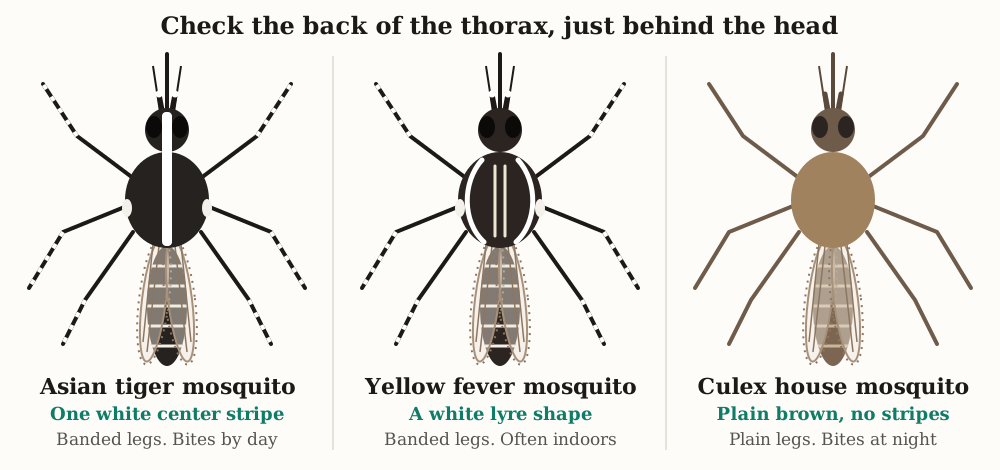
The one white stripe
The stripe is the surest mark. Many black mosquitoes have white bands on their legs, but very few have one clean white line down the center of the back. It runs from between the eyes, over the top of the head, and down the thorax, the part of the body the wings and legs attach to.
Look for smaller white marks too. The palps beside the mouth have white tips, and there are patches of white scales on the sides of the thorax and across the belly segments. Those patches are likely what people mean by a spotted mosquito.
White-banded legs
Each leg is black with white rings at the base of the foot segments. On the hind legs, the last segment is all white. At rest, the tiger mosquito often holds its hind legs up in the air, which shows off the bands.
How big is an Asian tiger mosquito?
It is small, and sources give slightly different numbers. The Illinois Department of Public Health says about 1/4 inch. California’s health department gives 1/8 to 1/4 inch. The University of California, Riverside says about 0.5 cm, which is 5 mm.
Size also depends on how well the larva ate. A crowded bucket with little food produces smaller adults. So if a “tiger mosquito” looks huge, look again. Very large mosquito-like insects are usually crane flies or gallinippers, covered below and on our crane fly page.
Zebra, striped or spotted mosquito: the names people use
People search for this mosquito by what they see: a black and white mosquito, a zebra mosquito, a striped mosquito, or a mosquito with white stripes. In most of the eastern US, a small black mosquito with white stripes that bites by day is an Asian tiger mosquito.
Maryland’s agriculture department gives a quick field test. A mosquito that bites by day and follows you into the house or car is probably a tiger. If your mosquitoes are yellow to dark brown and bite mainly at night, they are more likely native kinds raised in swamps and marshes.
What about a mosquito with white stripes on its legs only? Then check the back. If there is no center stripe, it may be another banded species from the table below. Still, older tiger mosquitoes can rub off their scales, so the stripe may look broken or faint on a worn one.
Asian tiger mosquito or a look-alike?
Six other US mosquitoes get mistaken for the Asian tiger mosquito. The thorax settles most of them. The yellow fever mosquito has a white lyre shape instead of one stripe, and Culex mosquitoes are plain brown. In Table 1, the first column gives the one check that separates each.
Table 1. Mosquitoes that get mistaken for the Asian tiger mosquito
One white stripe from between the eyes down the back
- Mosquito
- Asian tiger mosquito (Aedes albopictus)
- Legs
- Black with white bands
- Notes
- Bites by day; breeds in small containers
A white lyre or violin shape on the back
- Mosquito
- Yellow fever mosquito (Aedes aegypti)
- Legs
- Black with white bands
- Notes
- Bites by day, often indoors. The main spreader of dengue and Zika
Several thin yellowish lines on the back
- Mosquito
- Asian bush mosquito (Aedes japonicus)
- Legs
- Black with white bands
- Notes
- Another invader from East Asia; breeds in containers and rock pools
Silvery-white sides, no center stripe, no leg bands
- Mosquito
- Eastern treehole mosquito (Aedes triseriatus)
- Legs
- Dark, no bands
- Notes
- Breeds in tree holes and tires; bites by day
Brownish back with golden scales; V-shaped white bands on the belly
- Mosquito
- Inland floodwater mosquito (Aedes vexans)
- Legs
- Narrow white bands
- Notes
- Breeds in rain pools; most active in the evening
Plain brown or straw-colored back, no stripes
- Mosquito
- Culex house mosquito
- Legs
- Plain, no bands
- Notes
- Bites dusk to dawn; the main US spreader of West Nile virus
Large, with a gold stripe down the back and shaggy hind legs
- Mosquito
- Gallinipper (Psorophora ciliata)
- Legs
- White bands, shaggy
- Notes
- A big floodwater mosquito with a painful bite
Markings from the University of Florida’s Florida Medical Entomology Laboratory and University of Florida EDIS fact sheets; the Asian bush mosquito from the European Centre for Disease Prevention and Control.
The yellow fever mosquito is the twin that matters most. To the naked eye, the University of Florida says, the two differ mainly in size and in the pattern on the thorax. In California, the yellow fever mosquito is now far more widespread than the tiger, so a striped day-biter there is more often Aedes aegypti.
If you can, catch one in a clear jar or photograph it from above with the back in focus. Our bug identifier by picture works best with the thorax sharp. A photo of a bite cannot tell you which mosquito made it.
How Asian tiger mosquitoes bite and breed
Asian tiger mosquitoes bite in the daytime, stay close to home and breed in small containers. California’s health department says they especially like ankles, wrists and elbows. Most stay within about 300 feet (90 m) of where they hatched, and their eggs can survive drying out for up to 8 months.
An aggressive daytime biter
This is the mosquito that bites you while you garden at noon. California’s health department calls these invasive Aedes mosquitoes aggressive day-biters. In some southern cities, Illinois public health officials note, the tiger has become the most important nuisance mosquito.
It is also hard to swat. It bites fast, darts off, and often comes back for a second bite. Readers describe the same thing. One Reddit user in Ohio wrote that a tiger mosquito followed them to the car, got in, and tried to ambush them as they climbed in.
It also stays low. Maryland’s agriculture department says it keeps to ground level and rests under English ivy and other ground covers, under decks and shrubs, and in basement stairwells and crawl spaces. That fits its habit of biting ankles.
How far do Asian tiger mosquitoes fly?
Not far, though sources put it differently. CDC says these Aedes mosquitoes fly only a few blocks in their lifetime. The American Mosquito Control Association gives about 300 feet (90 m), and the European Centre for Disease Prevention and Control about 200 m (650 feet). Maryland’s agriculture department says 100 to 200 yards (90 to 180 m), and puts the lesson plainly: if they are biting you, they are breeding nearby.
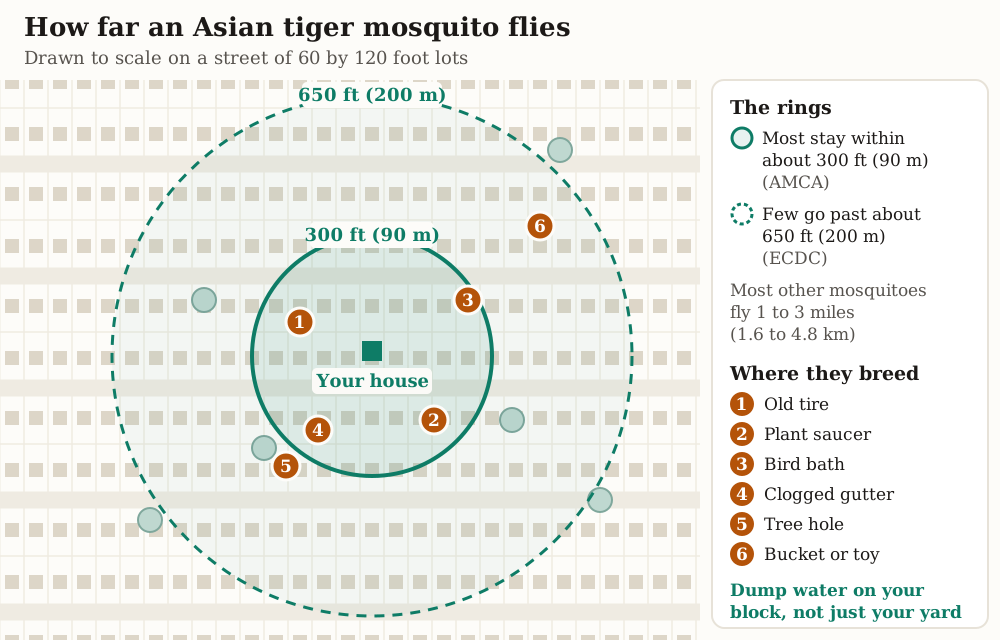
A study in Rome put numbers on it. Researchers marked female tiger mosquitoes with dust and caught them again on sticky traps. The average distance was 119 m (about 390 feet), and the farthest any went was 199 to 290 m (650 to 950 feet).
Two state fact sheets are the outliers. The Illinois Department of Public Health and Rhode Island’s Department of Environmental Management both say this mosquito usually flies no more than about 1/2 mile from where it breeds. The field studies point to much shorter trips. Either way, the practical answer is the same: the water feeding your mosquitoes is close by.
Google’s AI Overview blends the two answers into one. On October 24, 2026, it said these mosquitoes stay “within about 1/2 mile (or the length of a football field).” Those are very different distances. Half a mile is 2,640 feet, while a football field is about 300 feet between the goal lines, almost nine times shorter. The field studies agree with the football field.
Where they breed: tires, saucers and tree holes
Females lay eggs on the inside walls of containers, just above the water. Old tires, plant saucers, buckets, bird baths, clogged gutters, toys and tree holes all work. California’s health department says a bottle cap of water is enough.
Stale water suits them best. Maryland’s agriculture department says they prefer still water with dirt and rotting leaves in it over fresh water. A little goes a long way, too: Rhode Island’s environment department says one cup of water can produce thousands of mosquitoes.
The eggs are the hard part. CDC says they stick to container walls like glue and survive drying out for up to 8 months. When rain or a sprinkler raises the water, they hatch, and an egg can become a biting adult in 7 to 10 days.
Winter does not end the problem. The adults die, but the eggs wait out the cold on container walls and hatch in spring. Each new rain hatches another batch, so numbers tend to build as summer goes on. Our mosquito larvae guide shows the wigglers you may find in that water.
Are Asian tiger mosquitoes in the US? Range and history
Yes. Asian tiger mosquitoes have been reported from at least 1,368 counties in 40 states and Washington, DC, according to a survey of records from 1995 to 2016, run with CDC and published in 2017. They are most common in the Southeast, the South Central states and the Mid-Atlantic, and they have been found as far north as New Hampshire.
CDC’s estimated range map, dated 2017, shades the likely range from eastern Texas, Oklahoma and Kansas east to the Atlantic, and north to Pennsylvania, New Jersey and southern New York. Most of the northern Plains and the Mountain West are marked very unlikely. CDC adds that the map shows where the mosquito could live, not how many there are or where disease could spread.
How it got here: used tires
The first established US population turned up in Harris County, Texas, around Houston, in August 1985. It most likely came in shipments of used tires from northern Asia, according to a 1997 CDC review in Emerging Infectious Diseases. A single female had already been caught in Memphis in 1983.
From there it rode the tire trade along the interstate highways. By December 1987 it was in 92 counties in 15 states. By the mid-1990s it had reached 678 counties in 25 states. Hawaii is a separate story: the tiger mosquito arrived there sometime before 1902.
It is still moving north. Rhode Island first trapped one in 2010, and the state’s environment department says warmer winters are helping more of them survive and breed there.
Asian tiger mosquitoes in California
California is where the tiger mosquito has struggled. The University of California, Riverside says early arrivals were wiped out in 1971 and 1987, and that a 2001 introduction came in shipments of “lucky bamboo” from southern China. As of May 1, 2026, the state health department lists it in just two counties, Los Angeles and Shasta.
The invasive mosquito spreading across California is its relative. The same state list shows the yellow fever mosquito in 28 counties. Nationally, the UC Riverside page still counts the tiger mosquito in 26 states, which is also out of date.
Are Asian tiger mosquitoes dangerous?
Asian tiger mosquitoes are a serious nuisance, but in the US their disease risk is low. They can carry dengue, chikungunya and Zika, yet CDC says the yellow fever mosquito is more likely to spread those viruses. US outbreaks of dengue and chikungunya have been small and limited to small areas.
Why the difference? CDC explains that the tiger mosquito feeds on animals as well as people. Because some of its bites go to animals, it passes a human virus from person to person less often. The yellow fever mosquito, by contrast, lives close to people and prefers to bite them.
In the lab, the tiger mosquito can carry a lot. A 1997 CDC review found it was a competent vector of at least 22 viruses in experiments, including dengue, West Nile and eastern equine encephalitis. Abroad, it has driven real outbreaks, including chikungunya in Italy in 2007 and local dengue cases in France, the European Centre for Disease Prevention and Control reports.
What about the long list of diseases?
Many pages, and Google’s AI Overview, list eight: dengue, Zika, West Nile, chikungunya, yellow fever, eastern equine encephalitis (EEE), La Crosse and dog heartworm. The list is not wrong, but it mixes very different things. Some entries come only from lab tests, others from wild mosquitoes that tested positive, and only one from a US outbreak in people.
A “competent vector in the lab” means scientists fed the mosquito a virus and showed it could pass it on. That does not mean it spreads the virus in your yard. In most cases, another mosquito does that job in the US. Table 2 sorts the list by what has actually happened here.
Table 2. The Asian tiger mosquito's disease list, sorted by what has happened in the US
Dengue
- What the US record shows
- One outbreak linked to it, on Hawaii Island in 2015 to 2016
- Main US spreader
- Yellow fever mosquito on the mainland, CDC says
Chikungunya and Zika
- What the US record shows
- It can carry both and spread chikungunya in Italy in 2007. US chikungunya outbreaks have been small
- Main US spreader
- Yellow fever mosquito, CDC says
West Nile virus
- What the US record shows
- Found in wild tiger mosquitoes in the US
- Main US spreader
- Culex house mosquitoes
La Crosse virus
- What the US record shows
- Found in wild tiger mosquitoes in the US
- Main US spreader
- Eastern treehole mosquito
Eastern equine encephalitis (EEE)
- What the US record shows
- Lab tests, plus one find in the wild in CDC testing from 1987 to 1995, at a Florida tire dump in 1991
- Main US spreader
- Other mosquito species
Yellow fever
- What the US record shows
- Lab tests only. The disease is not established in the US
- Main US spreader
- None: it does not spread here
Dog heartworm
- What the US record shows
- It can pass this worm to dogs
- Main US spreader
- Several mosquito species
From CDC, the 1997 CDC review in Emerging Infectious Diseases, the Illinois and Rhode Island state fact sheets, UC Riverside and the University of Florida.
Has the tiger mosquito caused disease in the US?
Yes, at least once. Hawaii Island had a dengue outbreak from September 2015 to March 2016, with 264 confirmed cases. When the state and CDC tested mosquitoes there, dengue virus turned up only in Asian tiger mosquitoes: 15 of 185 pools of females tested positive, all of them this species.
That corrects older pages that still say it has never caused human disease in the US. Both the 1997 CDC review and the UC Riverside page say so, and both were written before Hawaii. Even so, it was a rare event. On the mainland, CDC still treats the yellow fever mosquito as the bigger threat.
Pets have their own risk. The tiger mosquito can spread dog heartworm, a parasitic worm. It can also carry La Crosse virus, and a University of Florida fact sheet links its arrival to more cases in Appalachia. Still, the eastern treehole mosquito is the main carrier.
What happens if you get bit by an Asian tiger mosquito?
For most people, an Asian tiger mosquito bite is an ordinary mosquito bite. CDC describes a puffy, reddish bump a few minutes after the bite, then a harder, itchy bump a day or so later. The trouble with this species is the number of bites, because it bites in the daytime and often more than once.
Sources disagree on how much the bite stings. The Illinois Department of Public Health says it is not especially irritating to most people. Readers often say the opposite. One New Yorker on Reddit called it a “heck of a pinch” compared with local mosquitoes. People simply react differently.
One group may react more. CDC says severe reactions can happen in children and in adults bitten by a mosquito species they have not met before. So in a place where the tiger mosquito has just arrived, some people may get larger bumps than they are used to.
Our mosquito bite guide covers relief, how long bites last and the signs of an infected bite. If a bite swells into a large, hot, red patch, read about skeeter syndrome, the mosquito bite allergy.
Can an Asian tiger mosquito kill you?
The bite itself will not. The rare danger is a severe allergic reaction, which needs emergency care, or a virus such as dengue. In the US, both are uncommon. Most people deal with nothing worse than itching.
How to get rid of Asian tiger mosquitoes
To get rid of Asian tiger mosquitoes, find and empty every container that holds water within about 300 feet (90 m) of your home, once a week. It costs nothing, and it works better than spraying. Scrub the containers, because the eggs stay glued to the walls. Then ask the neighbors to do the same.
Clearing tiger mosquitoes: step by step
Walk the yard after it rains
Look in and under everything that can hold water, even a spoonful. A bottle cap of water is enough. Check plant saucers, buckets, toys, boat tarps, old tires and wheelbarrows. Maryland's agriculture department adds portable basketball stands, which its inspectors flag, and plastic chairs and bins stored upside down, because their handles and lips still hold water.
Dump and scrub once a week
Empty every container, then scrub the inside wall or turn it upside down. The eggs are glued just above the waterline, and CDC says they can survive drying out for up to 8 months. So a dumped bucket with its eggs still on it will hatch again after the next rain.
Fix the water you forget about
Clear clogged gutters and downspouts, drain sagging tarps and pool covers, and change the water in bird baths and pet bowls at least once a week. Ridged black drain pipe on a downspout holds water in every groove, so Maryland's agriculture department suggests smooth PVC pipe or a screen over the end. Look high as well. The American Mosquito Control Association reports these mosquitoes breeding in tree holes more than 40 feet up.
Treat water you cannot dump
Screen a rain barrel, and stock an ornamental pond with fish that eat mosquito larvae. For other water you cannot dump, use an EPA-registered larvicide labeled for mosquito larvae, such as one with Bti, exactly as the label says. Our guide to mosquito larvae shows what you are looking for in the water.
Ask the neighbors to do the same
Most of these mosquitoes stay within about 300 feet (90 m) of where they hatched. That covers several yards around yours. Illinois public health officials urge neighbors to work together on breeding sites, from buckets to abandoned junk. Maryland's agriculture department goes further and suggests a cleanup day with the neighbors or your homeowners association.
Cover up and use repellent in the daytime
Wear socks, long pants and sleeves outdoors in the day, not just at dusk. Use an EPA-registered repellent on exposed skin, as the label directs. Ankles, wrists and elbows are favorite targets.
Report them where your district asks
In California, the state health department asks people to contact their local vector control agency if they are being bitten during the day. Elsewhere, your county mosquito control district or health department can tell you whether it wants reports.
Give it two weeks. Maryland’s agriculture department says to expect some mosquitoes for up to two weeks after the last container is gone, because the adults already flying live out their lives. Bites that stop slowly do not mean the cleanup failed.
Spraying does less than people hope. The Illinois Department of Public Health says a backyard fog or mist works only for a short time, and the mosquitoes come back when it clears. It adds that truck fogging gives little control of a daytime mosquito like this one, and that bug zappers and sound devices do little.
A barrier spray is the last step, not the first. Maryland suggests one only if adults are still thick after the containers are removed or treated. It kills tigers on contact and may keep working for up to three weeks, with a licensed pest professional if needed.
For traps, yard sprays and indoor problems, see our full guide on getting rid of mosquitoes. If you would rather try plants first, our page on mosquito repellent plants explains what the evidence shows.
Should you report Asian tiger mosquitoes?
In some places, yes. California’s health department asks people to contact their local vector control agency if they are being bitten during the day. Day biting there usually means an invasive Aedes mosquito, which the districts track.
Outside California, ask your county mosquito control district or health department whether it wants reports of the mosquito itself. Breeding sites are another matter. Illinois public health officials ask residents to report tire piles and other water-holding junk to local health officials.
Maryland offers a house call. If bites go on two weeks after you clear and treat the water, call its agriculture department at 410-841-5870. It will schedule an inspector to find the source.
Repellent for a daytime biter
Wear repellent in the daytime, not just at dusk. CDC and EPA list six skin repellent ingredients: DEET, picaridin, IR3535, oil of lemon eucalyptus (OLE), PMD and 2-undecanone. Choose an EPA-registered product and follow the label, which gives the protection time.
Cover the ankles. Socks and long pants keep off many of these daytime bites, and permethrin-treated clothing adds more. Permethrin goes on clothes and gear only, never on skin. Light colors help as well, since the Illinois and Rhode Island fact sheets say this mosquito is drawn to dark clothing, sweat and the carbon dioxide you breathe out.
State fact sheets name different DEET strengths. Illinois says 10 to 25% is enough for most situations, while Rhode Island says at least 20% and no more than 30%. Illinois also notes that more DEET protects for longer, but that going past 50% adds no extra time. Neither figure is a rule, so let the product label guide you.
For children, follow the label and ask your pediatrician. The CDC Yellow Book and EPA set no age limit for DEET, picaridin, IR3535 or 2-undecanone, but OLE and PMD should not be used under 3 years. Mayo Clinic advises no DEET under 2 months. For babies under 2 months, CDC points to netting over strollers and carriers.
Our comparison of picaridin vs DEET explains which one to pick and why. For plant-based options that actually hold up, see natural mosquito repellent.
Asian tiger mosquito myths, corrected
At least 6 common claims about the Asian tiger mosquito are wrong or out of date. Some come from forums, and some from official pages that have not been updated. Here is what each gets wrong.
Myth 1
Myth: “They don't need standing water. They lay eggs in plants.”
Truth: A Reddit post said this, and it is wrong. The eggs go on the walls of containers just above the water, and they hatch only when water covers them. The water can be tiny, such as a plant saucer or a bottle cap, which is why it is easy to miss.
Myth 2
Myth: “Stay inside at dusk and you will avoid them.”
Truth: The Illinois public health fact sheet still advises cutting time outdoors from dusk to dawn, though its own text says this mosquito feeds in daylight. Daytime is when it bites, so repellent and socks matter at noon too.
Myth 3
Myth: “They fly in from miles away.”
Truth: Field studies put most trips under about 200 m (650 feet). Many other mosquitoes travel 1 to 3 miles, but this one is raised on your block.
Myth 4
Myth: “Fogging the neighborhood will get rid of them.”
Truth: Illinois public health officials say truck fogging gives little control of a daytime mosquito, and a backyard fog lasts only a short time. Removing water is what works.
Myth 5
Myth: “It has never caused disease in the US.”
Truth: The UC Riverside page and a 1997 CDC review say so, but both predate the 2015 to 2016 dengue outbreak on Hawaii Island, where the virus was found only in Asian tiger mosquitoes.
Myth 6
Myth: “Tiger mosquitoes are huge.”
Truth: They are small, about 1/4 inch (5 mm). A very big mosquito-like insect is usually a crane fly, which cannot bite, or a gallinipper.
When to call someone
Most Asian tiger mosquito bites need nothing more than relief for the itch. Get help in 4 cases: an allergic reaction, an illness in the weeks after bites, a swallowed repellent or pesticide, or a mosquito problem you cannot fix by clearing water. Here is who to call.
- 911 for trouble breathing, a swelling face, lips or throat, or fainting after bites.
- Your doctor for a fever, a bad headache, joint pain or a rash in the weeks after bites, above all after travel, or for a bite that looks infected.
- Poison Control, 1-800-222-1222, if a child swallows repellent or anyone swallows a pesticide.
- Your local vector control district if you are bitten by day in California, or to report tire piles and other breeding sites.
- Maryland’s agriculture department, 410-841-5870, if bites go on two weeks after you have cleared the water in Maryland.
- Your vet about heartworm prevention for dogs where these mosquitoes are common.
- A licensed pest professional if bites keep coming after you and your neighbors have cleared the water.
Medical disclaimer. This page is for general information only. It is not a medical diagnosis. If you have severe symptoms, trouble breathing, swelling of the face or throat, fast spreading redness, fever, severe pain, pus, or signs of infection, contact a doctor or your local emergency number.
Pest control disclaimer. Photo-based identification can help, but it is not always perfect. For dangerous spiders, large infestations, or anything you are unsure about, contact a licensed pest control professional.
Asian tiger mosquito FAQ
How long do Asian tiger mosquitoes live?
Do Asian tiger mosquitoes come inside the house?
Do Asian tiger mosquitoes bite dogs?
Are they releasing mosquitoes to get rid of Asian tiger mosquitoes?
Why are there so many tiger mosquitoes right after it rains?
Related guides
Mosquitoes
The hub: every mosquito guide on the site, by kind and by problem.
Mosquito bites
What is normal, how to stop the itch, and when a bite needs a doctor.
Skeeter syndrome
When a bite swells up huge: the mosquito bite allergy, explained.
How to get rid of mosquitoes
The full plan for the yard and the house.
Mosquito larvae
The wigglers in a bird bath or bucket, and what to do about them.
Picaridin vs DEET
Which repellent to choose, and what the research says.
Crane fly
The giant mosquito look-alike that cannot bite.
How long mosquitoes live
Adults, eggs and the one stuck in your bedroom.
Sources
- CDC, Potential Range of Aedes Mosquitoes (July 1, 2024)
- CDC, About Mosquito Bites (June 21, 2024)
- California Department of Public Health, Aedes aegypti and Aedes albopictus Mosquitoes, with the county list updated May 1, 2026
- Illinois Department of Public Health, Asian Tiger Mosquito
- Maryland Department of Agriculture, Avoid Asian Tiger Mosquitoes
- University of California, Riverside, Center for Invasive Species Research, Asian Tiger Mosquito
- Moore CG and Mitchell CJ, Aedes albopictus in the United States: Ten-Year Presence and Public Health Implications, Emerging Infectious Diseases 3(3) (1997)
- Hasty JM and others, Entomological Investigation Detects Dengue Virus Type 1 in Aedes albopictus during the 2015-16 Outbreak in Hawaii, American Journal of Tropical Medicine and Hygiene (2020)