Part 1 of 4
The evidence
Do mosquito repellent plants really work?
Not as living plants. Every field test of a potted “mosquito plant” since 1994 has found no drop in bites or mosquito numbers. The plants do contain repellent oils, but a leaf releases only a trace. Crushed leaves help for minutes, extracted oils for up to about 2 hours, and registered repellents for several hours.
The newest test is also the most careful. In 2026, the Sacramento-Yolo Mosquito and Vector Control District published a 16-week trial in the Journal of Medical Entomology. First, the team let mosquitoes choose between clean air and air that had passed over a potted plant. They tried six plants sold as repellents: citronella-scented geranium, lemongrass, lavender, rosemary, white sage and yarrow. None of the six pushed mosquitoes away.
Next, they ringed mosquito traps with nine pots of the two top-ranked plants, citronella-scented geranium and prostrate rosemary. They did this on a farm and in a city neighborhood. Across 44,527 mosquitoes, the plant traps caught no fewer than the bare traps. Trimming the plants to release more scent changed nothing. A battery device that releases a registered repellent, by contrast, cut catches by 43 to 89%.
Extension experts agree. A UF/IFAS agent in Florida put it simply. Unless you extract the oils and use them like a spray, she said, the plants do little just sitting in the garden. Maryland Extension agrees. Asked in July 2026 whether any plants repel mosquitoes, its answer began: “In a garden setting, no.”
Why do so many lists of mosquito repellent plants say otherwise? Mostly because the oil works and people assume the plant does too. A 2019 review of 62 trials of plant repellents found only 6 done in the field, and Clemson’s Home and Garden Information Center points out that none tested landscape plantings. Meanwhile, the scent a plant gives off drifts away on the slightest breeze.
Another common claim is that citronella grass and lemongrass mask the carbon dioxide you breathe out. We found no test showing a plant does that. The National Pesticide Information Center says citronella oil masks scents that attract insects, but that is the oil at repellent strength. A potted plant gives off only a trace, and in the 2026 trial, pots of citronella-scented geranium did not lower catches at all.
Readers say the same thing in their own words. On Reddit’s gardening forum, a gardener in south Texas planted three big citronella plants, a large lemongrass, basil and marigolds by the patio. They didn’t help at all, the gardener reported. Another asked whether citronella plants work “just by existing”. The honest answer, from the trials, is no.
Plants that repel mosquitoes, rated on an evidence ladder
Of 12 common mosquito repellent plants, only two have cut mosquito numbers as living plants. Hoary basil and lantana did it by about 27 to 40%, in African huts and houses. Three others give an oil found in EPA-registered repellents: citronella grass, catnip and the lemon eucalyptus tree. The rest have little or no testing.
We rated each plant on four rungs, because “does it work?” depends on what you do with it. The first rung is a living plant left in a pot or a bed. Next come crushed or bruised leaves. Rung three is the extracted oil in a lab test, and rung four is an EPA-registered product, which the EPA has checked for safety and effectiveness. Most claims about mosquito repellent plants jump from rung three straight back to rung one.
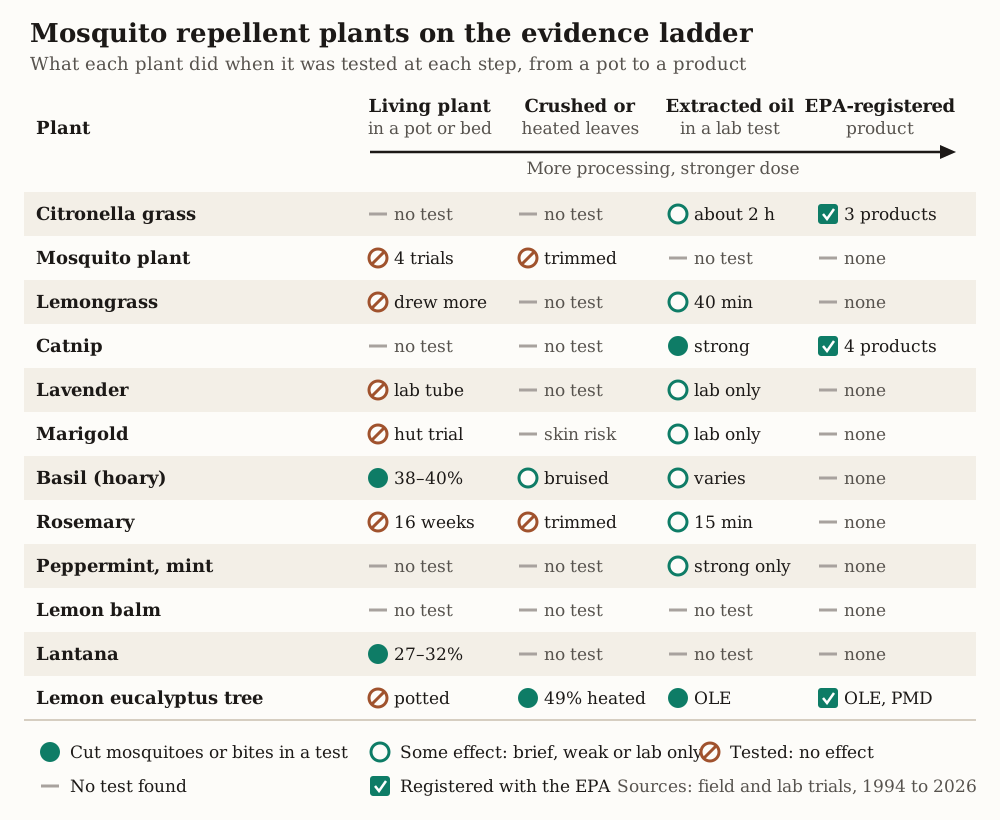
Table 1. Twelve mosquito repellent plants on the evidence ladder
Citronella grass
- Main scent compound
- Citronellal, citronellol, geraniol
- Living plant
- Not tested as a plant
- Crushed leaves or oil
- Oil repels for about 2 hours, then evaporates
- Registered product?
- Yes, oil of citronella (3 products)
- Dogs and cats (ASPCA)
- Not listed; its relative lemongrass is toxic
Citronella-scented geranium (mosquito plant)
- Main scent compound
- Geraniol, citronellol
- Living plant
- Failed in 4 field tests (1994 to 2026)
- Crushed leaves or oil
- Trimmed plants still failed
- Registered product?
- No
- Dogs and cats (ASPCA)
- Toxic (geraniums)
Lemongrass
- Main scent compound
- Citral
- Living plant
- Potted plant drew mosquitoes slightly in a lab test
- Crushed leaves or oil
- Oil lasted about 40 minutes on skin
- Registered product?
- No
- Dogs and cats (ASPCA)
- Toxic
Catnip
- Main scent compound
- Nepetalactone
- Living plant
- Not tested as a plant
- Crushed leaves or oil
- Oil strongly repellent in lab tests
- Registered product?
- Yes, catnip oil (4 products)
- Dogs and cats (ASPCA)
- Toxic to cats (stomach upset)
Lavender
- Main scent compound
- Linalool, linalyl acetate
- Living plant
- Potted plant did nothing in a lab test
- Crushed leaves or oil
- Linalool diffusers repel; lavender oil only in lab tests
- Registered product?
- No
- Dogs and cats (ASPCA)
- Toxic
Marigold
- Main scent compound
- Thiophenes
- Living plant
- Potted wild marigold did not repel
- Crushed leaves or oil
- Sap can blister skin in sunlight
- Registered product?
- No
- Dogs and cats (ASPCA)
- Pot marigold safe; Tagetes not listed
Basil
- Main scent compound
- Linalool, eugenol
- Living plant
- Potted hoary basil cut entries about 38 to 40%
- Crushed leaves or oil
- Bruised leaves helped in enclosed spaces
- Registered product?
- No
- Dogs and cats (ASPCA)
- Safe
Rosemary
- Main scent compound
- Camphor, 1,8-cineole
- Living plant
- Failed a 16-week field trial
- Crushed leaves or oil
- Oil lasted about 15 minutes on skin
- Registered product?
- No
- Dogs and cats (ASPCA)
- Safe
Peppermint and other mint
- Main scent compound
- Menthol, menthone
- Living plant
- Not tested
- Crushed leaves or oil
- Only strong oil repelled; none at 5 to 10%
- Registered product?
- No; exempt oil, not checked
- Dogs and cats (ASPCA)
- Toxic
Lemon balm
- Main scent compound
- Citral, citronellal
- Living plant
- Not tested
- Crushed leaves or oil
- No mosquito test found
- Registered product?
- No
- Dogs and cats (ASPCA)
- Safe
Lantana
- Main scent compound
- Caryophyllene and others
- Living plant
- Potted plants cut entries about 27 to 32%
- Crushed leaves or oil
- Not tested
- Registered product?
- No
- Dogs and cats (ASPCA)
- Toxic
Lemon eucalyptus tree
- Main scent compound
- Citronellal; refined into PMD
- Living plant
- Potted tree did not repel
- Crushed leaves or oil
- Heated leaves cut entries about 49%
- Registered product?
- Yes, OLE and PMD (6 products each)
- Dogs and cats (ASPCA)
- Toxic (eucalyptus)
A few notes on reading the table. Scientists ran the hut trials in Kenya against malaria mosquitoes, inside houses at night, so they say little about a breezy American patio. Lab oil tests use doses far stronger than a leaf gives off. And “not tested” means we found no trial, not proof that the plant is useless.
Part 2 of 4
Plant by plant
Does the citronella plant repel mosquitoes?
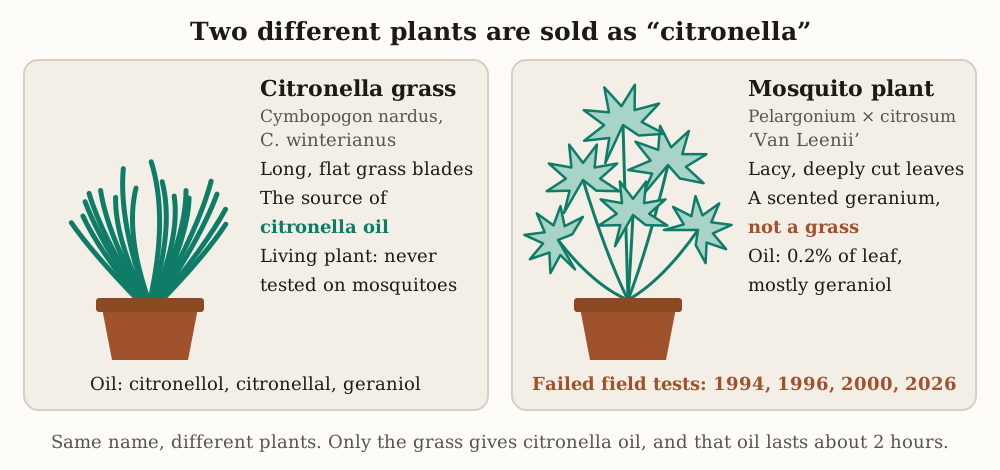
The plant sold as a “citronella plant” or “mosquito plant” does not repel mosquitoes. It has failed field tests in 1994, 1996, 2000 and 2026. Citronella oil, which comes from a different plant, a tropical grass, does repel, but only for about 2 hours on skin, and candles cut bites by about 42% at best.
What is the mosquito plant?
The mosquito plant is a scented geranium, Pelargonium × citrosum ‘Van Leenii’, also sold as citrosa or citronella geranium. It has lacy, deeply cut leaves that smell of lemon when you rub them. When it reached North America, sellers claimed it repelled mosquitoes within a 10 square foot (0.93 square meter) area by giving off citronella oil.
University of Guelph researchers tested that claim in 1996. They found the plant gives only 0.2% of its fresh weight as oil, and that oil is mostly geraniol, at about 35%. They found no trace of the oil from citronella grass. In other words, it is a rose-scented geranium hybrid with a lemony note, not a source of citronella. In their field test, people treated with the plant were bitten as often as people with nothing.
Three more trials agree. In Florida in 1994, people standing among the plants got as many mosquito landings as people without them. Worse, more southern house mosquitoes rested on its leaves than on paper leaves of the same shape. In Illinois in 2000, the plant did not cut landings either. Finally, the 2026 California trial found no effect from nine pots, trimmed or not.
So when gardeners on Reddit ask whether the citronella plant is a myth, the trials give a plain answer. As a mosquito repellent, it is. The top reply in one such thread gave the reason: most of the oil stays inside the leaf until you bruise it. Others said it works only when they crush the leaves and rub them on, and even then weakly. That fits the chemistry, since the leaves yield only 0.2% oil. One gardener whose yard stays clear also has no standing water nearby, which is the likelier reason. Still, it is a pretty, lemon-scented geranium for a sunny pot.
Citronella grass vs lemongrass
Citronella oil comes from two grasses, the National Pesticide Information Center explains. They are mainly Cymbopogon nardus and Cymbopogon winterianus. Its main compounds are citronellol, citronellal and geraniol. Lemongrass, C. citratus, is a close cousin used in cooking. Both are tall, clumping grasses with a lemon smell when cut, and both die in frost. However, they are different species with different oils: lemongrass oil is mostly citral.
Nobody has tested a living citronella grass plant against mosquitoes, as far as we could find. Its oil has been a registered US repellent since 1948. Today the EPA lists three registered skin products with it, and many more sold without registration under the minimum-risk exemption. For those, the EPA says plainly that nobody has evaluated them for effectiveness.
As a skin repellent, the oil starts strong and fades fast. A review in Malaria Journal found that citronella repellents protect for about 2 hours. After that, the oil has evaporated. In a well-known 2002 test, most plant-based repellents protected for under 20 minutes, while a 23.8% DEET product lasted about 5 hours.
Do citronella candles work?
A little. In a 1995 field test in Ontario, people sitting by 3% citronella candles got about 42% fewer bites than people with no candle. Yet plain unscented candles also cut bites by about 24%, so much of that effect came from the flame, not the scent. Indoors, citronella candles repelled only 14% of mosquitoes in a later study, against 68% for a citronella diffuser.
Does lemongrass repel mosquitoes?
A growing lemongrass plant does not repel mosquitoes. In the 2026 lab test, only 30.6% of mosquitoes chose the clean-air side over a potted lemongrass, a small but real lean toward the plant. The oil does repel briefly: Clemson notes it protected for about 40 minutes in skin tests.
That lab result surprised the researchers, since many lists call lemongrass the best patio plant for mosquitoes. One Florida garden column, reposted by a California mosquito district, even calls it the No. 1 plant to use. The trial does not show lemongrass draws mosquitoes into a yard, but it gives no support for keeping them away.
Grow lemongrass for the kitchen, in full sun, where it reaches 2 to 4 feet (0.6 to 1.2 m). It is a perennial only in USDA zones 8b to 11. Keep it away from pets: the ASPCA lists it as toxic to dogs, cats and horses because of its oils and cyanogenic glycosides.
Catnip and nepetalactone: does catnip repel mosquitoes?
Catnip oil is the strongest plant repellent on this list. Its main compound, nepetalactone, repelled mosquitoes better than DEET in a 2001 lab test, and the EPA now lists four registered skin repellents made with catnip oil. The growing plant, however, has never been tested in a yard or on a patio.
Many garden pages, Garden Design among them, say a study found catmint ten times more effective than DEET. That claim comes from Iowa State entomologists who reported it to the American Chemical Society in 2001. They put mosquitoes in a glass tube, half coated with nepetalactone, and counted where they settled. It took about a tenth as much nepetalactone as DEET to get the same effect. The test used purified oil in a tube, not a plant in a bed.
Later work filled in the picture. In 2005, USDA scientists in Florida found catnip oil was the better spatial repellent, acting through the air, while DEET was better on skin. Then, in 2021, a team at Lund and Northwestern universities showed why it works. Nepetalactone triggers TRPA1, an irritant sensor in mosquitoes, and it does not trigger the human version.
Cats may already use it. A 2021 study in Science Advances found that when cats rub their faces on catnip or silver vine, they coat their fur with a related compound, nepetalactol, which repelled tiger mosquitoes. For people, the practical route is a registered catnip oil repellent, not a pot of catnip.
Catnip is a hardy perennial in USDA zones 3 to 9 and spreads easily, so a pot keeps it in check. The ASPCA lists it as toxic to cats: many cats love it, but eating a lot can cause vomiting and diarrhea.
Does lavender repel mosquitoes?
A lavender plant does not repel mosquitoes. In the 2026 lab test, potted English lavender sent only 38.3% of mosquitoes to the clean-air side, no better than a sunflower. Its main compound, linalool, does repel when concentrated: linalool diffusers cut mosquitoes by 93% indoors and 58% outdoors in a 2009 trial.
The gap between those two numbers is the whole story of mosquito repellent plants. A diffuser holds 20 grams (about 0.7 ounce) of pure linalool and releases it all evening. A lavender bush releases a whiff when you brush it. Garden Design repeats the idea that lavender oil hinders a mosquito’s sense of smell; we found no study showing a lavender plant does that in a garden.
Lavender needs full sun and sharp drainage, and English lavender is hardy in USDA zones 5 to 9. It is a fine pollinator plant. But the ASPCA lists it as toxic to dogs, cats and horses, because of linalool and linalyl acetate, with nausea and vomiting as the usual signs.
Do marigolds repel mosquitoes?
There is no good evidence that marigolds repel mosquitoes. In a 2002 trial in Kenya, potted Mexican marigold, Tagetes minuta, did not reduce mosquitoes in experimental huts. Marigold oil shows some repellency in lab tests, but the common garden marigold has not been field-tested against mosquitoes at all.
Marigolds earned their reputation in vegetable gardens, against pests that eat plants. Mosquitoes do not eat leaves, so a scent that turns away a plant-eater may not matter to them. Rutgers entomologists note that a study found less biting in tents where whole marigold plants had been stored. Even so, they expect any effect would need large numbers of plants placed with care.
Do not rub marigold leaves on your skin. NC State Extension warns that the sap of African marigold, Tagetes erecta, reacts with sunlight. On broken skin, it can cause redness, burning and blisters. Pot marigold, Calendula, is a different plant, and the ASPCA lists it as non-toxic to dogs and cats.
Does basil repel mosquitoes?
Basil has the best evidence of any living plant here, but not the basil in your kitchen. In Kenya, potted hoary basil (Ocimum americanum) cut the mosquitoes coming into test huts by 39.7%. A year later, it cut them by about 38% in real village houses. Sweet basil, O. basilicum, has not been tested this way.
Those trials matter because they are the only ones where a living, uncut plant clearly did something. Still, keep the setting in mind. The huts were small and closed, and about 6 in 10 mosquitoes came in anyway. Rutgers adds that lemon basil and hoary basil worked best when lightly bruised, and only in small enclosed spaces.
Basil is safe to grow around pets: the ASPCA lists it as non-toxic to dogs and cats. It is an annual that needs warmth and full sun. So a pot of hoary or lemon basil by a screened porch door is a reasonable experiment, as long as you still wear repellent.
Does rosemary repel mosquitoes?
Rosemary does not repel mosquitoes as a growing plant. It was one of the two plants chosen for the 2026 California field trial, and nine pots around a trap made no difference over 16 weeks, trimmed or untrimmed. As an oil on skin, rosemary protected for only about 15 minutes in the tests Clemson cites.
Its scent comes mainly from camphor and 1,8-cineole. Those compounds repel and even kill insects at high doses in the lab, but a shrub on a patio releases nothing close to that. Rosemary is a woody evergreen in USDA zones 8 to 10, where it reaches 4 to 5 feet (1.2 to 1.5 m). It is non-toxic to dogs, cats and horses, the ASPCA says, which makes it a safe herb to keep anyway.
Does peppermint or mint repel mosquitoes?
No study shows a mint plant repels mosquitoes. Peppermint oil, which is mostly menthol and menthone, repelled yellow fever mosquitoes only at high strength in a 1999 USDA skin test, and not at all at 5 or 10%. The oil can also irritate skin, and the EPA has not checked unregistered peppermint products for effectiveness.
Garden Design calls mint “an excellent nontoxic option”. The ASPCA disagrees: it lists garden mint as toxic to dogs, cats and horses, with vomiting and diarrhea after large amounts. Peppermint spreads fast by runners, so grow it in a pot. It is hardy in USDA zones 5 to 9.
Does lemon balm repel mosquitoes?
We found no test of lemon balm, as a plant or an oil, against mosquitoes. It appears on lists because its leaves smell of lemon, and its oil does contain citral and citronellal, the same family of compounds as lemongrass and citronella. That is a reason to test it, not proof that it works.
Lemon balm is a mint-family perennial, hardy in USDA zones 3 to 7, that grows in sun or part shade. On the plus side, the ASPCA lists it as non-toxic to dogs, cats and horses, so it is one of the safer lemon-scented herbs for a yard with pets.
Lantana, lemon eucalyptus and the rest of the list
Two more plants have real test data. Potted lantana cut mosquitoes entering Kenyan huts by about 32% and houses by about 27%, but it is toxic to pets and invasive in warm climates. The lemon eucalyptus tree gives the CDC-backed repellent OLE, yet a potted tree did not repel. Nobody has tested most other listed plants.
Lantana
Lantana camara is the other living plant with a measured effect, alongside hoary basil, in the same Kenyan trials. That makes it tempting, but think twice. The ASPCA lists it as toxic to dogs, cats and horses, with vomiting, labored breathing and liver failure in livestock. Rutgers warns it is poisonous to children and dogs and can become invasive in warmer regions.
Lemon eucalyptus tree
Oil of lemon eucalyptus (OLE) is the best-known plant-based repellent the CDC recommends. It comes from the leaves of Corymbia citriodora, refined to concentrate PMD, its active compound. Pure lemon eucalyptus essential oil is not the same product and is not registered. In the 2002 Kenyan trial, a potted lemon eucalyptus did not repel at all.
Some garden pages blur this. One lawn-care list says the tree itself has the CDC’s blessing, and a flower shop’s list says the common blue gum, Eucalyptus globulus, produces OLE. Neither is right. The CDC’s advice covers the registered, refined product, and OLE comes from Corymbia citriodora, not blue gum.
Smoke is another matter. Leaves heated on a traditional stove cut mosquitoes in village houses by about 49%, in a follow-up trial. That is a smoke treatment, though, not a garden plant, and the ASPCA lists eucalyptus as toxic to pets.
Bee balm, sage, alliums and other list plants
Bee balm, sage, alliums and garlic, floss flower, tansy, thyme, oregano and nasturtium all appear on popular lists of plants that repel mosquitoes. We found no field test of any of them as a living plant against mosquitoes. Two others, white sage and yarrow, were in the 2026 lab screen, and neither pushed mosquitoes away. Grow these for pollinators and the kitchen, and judge any mosquito effect as unproven.
Lemon thyme is often sold for rubbing on skin. Yet thyme oil irritated skin in the 1999 USDA tests, and nobody has measured how long a rubbed leaf protects.
Chrysanthemums, neem, pennyroyal and pitcher plants
Chrysanthemums make some lists because pyrethrins, a real insecticide, are extracted from the dried flowers of certain kinds. That is a processed spray that kills on contact. No trial has shown a pot of garden mums keeps mosquitoes away, and the ASPCA lists chrysanthemums as toxic to dogs, cats and horses.
One lawn-care page claims neem is ten times more effective than DEET. We found no such test. In fact, potted neem had no effect at all in the 2002 Kenyan hut trial.
Pennyroyal, a small mint on a few lists, needs a warning instead. It is rich in pulegone, a compound that can damage the liver, so its oil is dangerous to swallow for people and pets alike.
Pitcher plants do eat insects, but far too few to matter, and their leaves hold water. The purple pitcher plant even has its own mosquito, Wyeomyia smithii, whose larvae grow only in the water inside its leaves.
Part 3 of 4
Safety and planting
Can you rub the leaves on your skin?
Crushed leaves give some protection, but only briefly and with real risks. Clemson says the leaves must be crushed or the oils rubbed on skin for any effect, and plant oils on skin lasted roughly 15 to 40 minutes in the tests it cites. Some leaves, such as marigold, can blister skin in sunlight.
Leaf rubbing is old and widespread. One Reddit gardener grows wax myrtle just to rub a handful of leaves on before working outside. It may buy a few minutes, but nobody knows how many, because a leaf has no tested dose. For a child, or anywhere mosquito-borne disease is a concern, that is not good enough.
Are mosquito repellent plants safe for dogs and cats?
Many mosquito repellent plants are not. The ASPCA lists lemongrass, lavender, geraniums, mint, eucalyptus and lantana as toxic to dogs and cats. Geraniums include the mosquito plant, often sold as the citronella plant. Catnip is on its list for cats. It lists basil, rosemary, lemon balm and pot marigold as non-toxic. Most poisonings cause stomach upset.
Table 2. Pet safety of common mosquito repellent plants, from the ASPCA plant list
Basil
- ASPCA listing
- Non-toxic to dogs and cats
- What it can cause
- Nothing listed
Rosemary
- ASPCA listing
- Non-toxic to dogs, cats and horses
- What it can cause
- Nothing listed
Lemon balm
- ASPCA listing
- Non-toxic to dogs, cats and horses
- What it can cause
- Nothing listed
Pot marigold (Calendula)
- ASPCA listing
- Non-toxic to dogs and cats
- What it can cause
- Nothing listed
Catnip
- ASPCA listing
- Toxic to cats
- What it can cause
- Vomiting and diarrhea if eaten in quantity
Lemongrass
- ASPCA listing
- Toxic to dogs, cats and horses
- What it can cause
- Stomach upset in pets
Lavender
- ASPCA listing
- Toxic to dogs, cats and horses
- What it can cause
- Nausea, vomiting, not eating
Geraniums, including the mosquito plant
- ASPCA listing
- Toxic to dogs, cats and horses
- What it can cause
- Vomiting, not eating, low energy, skin irritation
Mint, including peppermint
- ASPCA listing
- Toxic to dogs, cats and horses
- What it can cause
- Vomiting and diarrhea after large amounts
Eucalyptus
- ASPCA listing
- Toxic to dogs, cats and horses
- What it can cause
- Drooling, vomiting, diarrhea, weakness
Lantana
- ASPCA listing
- Toxic to dogs, cats and horses
- What it can cause
- Vomiting, diarrhea, labored breathing, weakness
The garden marigold, Tagetes, is not on the ASPCA list, so ask your vet if a pet chews it. Concentrated oils are a bigger risk than leaves. That applies to sprays and diffusers made from these plants too, since pets can lick oil off their fur.
Where to plant them if you grow them anyway
If you want mosquito repellent plants for their scent, put them within arm’s reach of where you sit, so you can brush or pick them. Use pots with drainage holes and no standing saucer, and keep toxic plants out of reach of pets. Most need full sun, at least 6 hours a day.
A few practical choices follow from the table. In a cold climate, catnip (zones 3 to 9), lemon balm (3 to 7) and peppermint (5 to 9) come back each year. Citronella geranium, lemongrass and basil are tender, so most people grow them as annuals. For part shade, NC State lists peppermint and lemon balm, while lavender and rosemary want full sun. With pets, start with basil, rosemary and lemon balm.
Indoors, no study shows a houseplant clearing a room of mosquitoes. A pot by a window still needs a screen. Florida readers, in particular, should check the next section: in a humid yard, some plants do more to help mosquitoes than to stop them.
Plants that attract mosquitoes
Plants that hold water are the real problem. UF/IFAS tells Florida gardeners to flush bromeliad cups with a hose and empty plant saucers, because mosquitoes breed in them. Flowers matter too: both sexes drink nectar, and Rutgers entomologists note that garden impatiens are highly attractive to mosquitoes that feed on the blooms.
Lush, humid plantings also help adult mosquitoes live longer, Rutgers adds, which can mean more bites. On Reddit, one gardener described a 6-foot potted ficus on a covered patio that filled with mosquitoes every few hours, with no standing water nearby. So if you have a shady, damp corner, thinning dense shrubs and fixing water traps will do more than adding mosquito repellent plants.
Part 4 of 4
What to do instead
What keeps mosquitoes away instead
Two things work far better than mosquito repellent plants. One is an EPA-registered repellent on your skin. The other is emptying standing water every week, so fewer mosquitoes hatch near you. A registered spatial device can help at a patio, cutting catches by 43 to 89% in the 2026 trial where the plants did nothing. Plants come last, as a bonus.
This plan starts with what costs nothing. Rutgers entomologists note that a single yard full of water-holding containers can make a whole neighborhood miserable, so start with your own. Our guide to mosquito larvae in standing water shows what to look for in a bucket or birdbath.
A patio plan that does not rely on plants
Empty standing water every week
Tip out plant saucers, buckets, toys and tarps, refresh birdbaths and pet bowls, and flush the cups of bromeliads with a hose. UF/IFAS experts note that even the water in a bottle cap can breed mosquitoes. This step costs nothing and does more than any plant.
Treat water you cannot empty
For a rain barrel or pond, cover it with screen or use a larvicide made for mosquitoes, such as one with Bti, as its label directs. The label is the law. Mosquito-eating fish suit a permanent ornamental pond.
Put a registered repellent on your skin
Use a repellent with an EPA registration number on the label: DEET, picaridin, IR3535, oil of lemon eucalyptus, PMD or 2-undecanone. These have been checked for safety and for how long they protect. Follow the label on children.
Use a registered device near the seating if you need more
In the 2026 California trial, a battery device that gives off metofluthrin cut mosquito catches by 43 to 89%. Metofluthrin is an EPA-registered repellent that works through the air. Use any device exactly as its label says, outdoors only where the label allows.
Grow the plants you like, close to where you sit
Keep scented herbs in pots by the chairs, brush or pick them for the smell, and enjoy them for cooking and pollinators. Treat any effect on mosquitoes as a bonus, not a plan.
Do bat houses or plants by the door help?
Not much. A gardener on Reddit asked the classic version of this question. Mosquitoes came every summer, worst after rain, and the house had no screens, since every window doubles as a door. Which plants could go by the doors? Several replies said to build a bat house instead. Bats do eat flying insects. Yet the American Mosquito Control Association reports that mosquitoes made up less than 1% of the gut contents of wild bats. And no test has shown a plant by a door keeping mosquitoes out of a house.
Two other points from that thread matter. First, a puddle that dries within a day cannot raise mosquitoes. The EPA puts the cycle from egg to adult at 4 days to a month. So mosquitoes after rain come from water that stays: clogged gutters, tree holes, tarps or a neighbor’s yard. Second, a fan is cheaper than new screens. In a 2003 Michigan study, wind from an electric fan sharply cut the mosquitoes reaching a trap baited with carbon dioxide.
For your skin, our guide to natural mosquito repellents that are EPA- and CDC-backed covers oil of lemon eucalyptus, PMD and the scents worth trying. If you are choosing between the two main synthetic options, see picaridin vs DEET. For the yard, read how to get rid of mosquitoes around the house and yard, which also covers yard sprays and when they make sense.
Wondering why the mosquitoes find you and not your neighbor? That has nothing to do with your plants; our page on which people mosquitoes prefer sorts the evidence from the myths. For everything else about the insect itself, start at our mosquito guide.
Pest control disclaimer. Photo-based identification can help, but it is not always perfect. For dangerous spiders, large infestations, or anything you are unsure about, contact a licensed pest control professional.
Mosquito repellent plants FAQ
What is the best plant to keep mosquitoes away?
How do the Amish keep mosquitoes away?
Do coffee grounds keep mosquitoes away?
Do citronella plants come back every year?
Are there indoor plants that repel mosquitoes?
Do any plants repel both mosquitoes and flies?
How many plants does it take to make a difference?
What smell do mosquitoes hate the most?
Related guides
Natural mosquito repellent
Which plant-based repellents for skin are EPA-registered and CDC-backed, and which are not.
How to get rid of mosquitoes
Standing water, larvicides, traps and yard sprays, ranked for the house and the yard.
Mosquitoes
The full guide: what mosquitoes are, how they live and why only females bite.
Picaridin vs DEET
The two leading skin repellents compared on protection time, feel and safety.
Larvae in standing water
What wrigglers in a bucket or birdbath look like, and how to stop them.
What blood type do mosquitoes like?
Why some people get bitten more, and the retracted study behind the blood type claim.
Natural ant repellent
The same honest test for ants: peppermint, cinnamon, vinegar and the rest, rated.
Sources
- US EPA, Skin-Applied Repellent Ingredients (catnip oil, oil of citronella, OLE, PMD and others)
- US EPA, Regulation of Skin-Applied Repellents (unregistered products not evaluated for effectiveness)
- ASPCA Animal Poison Control Center, Toxic and Non-Toxic Plant List
- UF/IFAS, Florida experts break down the buzz on the myth of mosquito-repelling plants (August 6, 2025)
- Clemson Cooperative Extension, Home and Garden Information Center, Can Plants Repel Problematic Insects? (J. Jordan, June 2, 2025)
- Novelo M and others. Evaluation of 2 ornamental plants, Citronella-Scented Geranium and prostrate rosemary, for spatial repellency of host-seeking mosquitoes. Journal of Medical Entomology 63(4) (2026)
- Matsuda BM and others. Essential oil analysis and field evaluation of the citrosa plant Pelargonium citrosum as a repellent against Aedes mosquitoes. J Am Mosq Control Assoc 12(1):69 (1996)
- Seyoum A and others. Repellency of live potted plants against Anopheles gambiae from human baits in semi-field experimental huts. Am J Trop Med Hyg 67(2):191 (2002)