Picaridin vs DEET: the short answer
Picaridin vs DEET is close to a tie on protection. In a two-year field trial in Cambodia, 20% picaridin and 20% DEET showed no real difference, and each blocked more than 96% of bites from disease-carrying mosquitoes. The differences that matter are how each feels, what it does to your gear, and how much history it has.
Both are synthetic chemicals, and both go on bare skin. Neither kills insects. Instead, each one makes it hard for a mosquito or a tick to find you. So the choice is less about which one works and more about which one you will actually wear all day.
DEET and picaridin compared, point by point
First made
- DEET
- By the US Army in 1946; sold to the public since 1957
- Picaridin
- By Bayer in the 1980s; in US stores since 2005
Strengths for skin
- DEET
- 5% to 99%
- Picaridin
- 5% to 20% in the US
Typical label hours at 20%, mosquitoes
- DEET
- About 8 (16 to 25% products)
- Picaridin
- About 8 (20% products)
Ticks
- DEET
- Repels them; label times vary
- Picaridin
- Repels them; 20% labels often claim 8 to 14 hours
Smell and feel
- DEET
- Faint chemical smell; many find it oily
- Picaridin
- Nearly odorless; feels lighter
Plastics and synthetic fabrics
- DEET
- Can damage some, such as lenses, watch faces and vinyl
- Picaridin
- Does not dissolve plastics
Age limit, EPA
- DEET
- None
- Picaridin
- None
Pregnancy and breastfeeding
- DEET
- Safe as labeled, CDC says
- Picaridin
- Safe as labeled, CDC says
Registered products in the US
- DEET
- More than 500
- Picaridin
- About 40
Europe
- DEET
- Approved; approval extended in 2024
- Picaridin
- Approved (as icaridin) to 2032
What is DEET, and what is picaridin?
DEET (N,N-diethyl-meta-toluamide) is the oldest modern bug repellent. The US Army developed it in 1946, and the public has used it since 1957. Picaridin is the newer option: Bayer designed it in the 1980s, and it reached US stores in 2005. Each one is a lab-made chemical that you put on bare skin to keep biting insects off.
What is DEET?
DEET is a colorless liquid with a faint smell. The name is short for its chemical name, N,N-diethyl-meta-toluamide. According to the EPA, about one-third of Americans use it every year, and more than 500 registered products contain it. Strengths for skin run from 5% to 99%. You will find it in sprays, lotions, sticks and wipes.
Its long record is the main reason doctors trust it. The EPA reviewed DEET in full in 1998, then again in 2014. Both times, it found that normal use does not present a health concern, children included. The EPA’s DEET page sums up both reviews.
What is picaridin, and is it made from pepper?
Picaridin is a synthetic repellent in the piperidine family of chemicals. Bayer built it with molecular modeling to resemble piperine, a natural compound in the plants that give us black pepper. That is where the pepper story comes from. However, picaridin is made in a lab, and no pepper goes into it.
Outside the US, it is called icaridin, and you may also see the code KBR 3023. The EPA first registered it in 2001. Since it had long been popular in Europe and Australia, it was not new when it reached US shelves. About 40 registered products contain it today, at 5% to 20%.
How do DEET and picaridin work?
Both confuse an insect’s sense of smell. Mosquitoes find you by the carbon dioxide you breathe out and the chemicals on your skin. DEET makes it hard for them to smell you, the EPA says. Similarly, picaridin seems to block a mosquito from sensing its target, and it stimulates sense organs on the antennae.
As a result, the mosquito lands less often and bites less often. Nothing dies, though. That is why a mosquito may still hover near you, and why a spot you missed still gets bitten.
Which lasts longer? Picaridin vs DEET protection hours
On protection time, picaridin vs DEET is a draw at the same strength, and picaridin often wins on the label. We grouped every product in the EPA’s repellent database by strength. At 16 to 25%, a typical DEET product claims 8 hours against mosquitoes, and a typical 20% picaridin product also claims 8. Below 10%, picaridin labels claim more.
These are the times the EPA approved for labels, based on tests the makers submitted. The EPA’s repellent search tool lets you look up any product by ingredient and hours. In our count, only 212 of 505 DEET listings gave a set time for mosquitoes, while nearly every picaridin listing did.
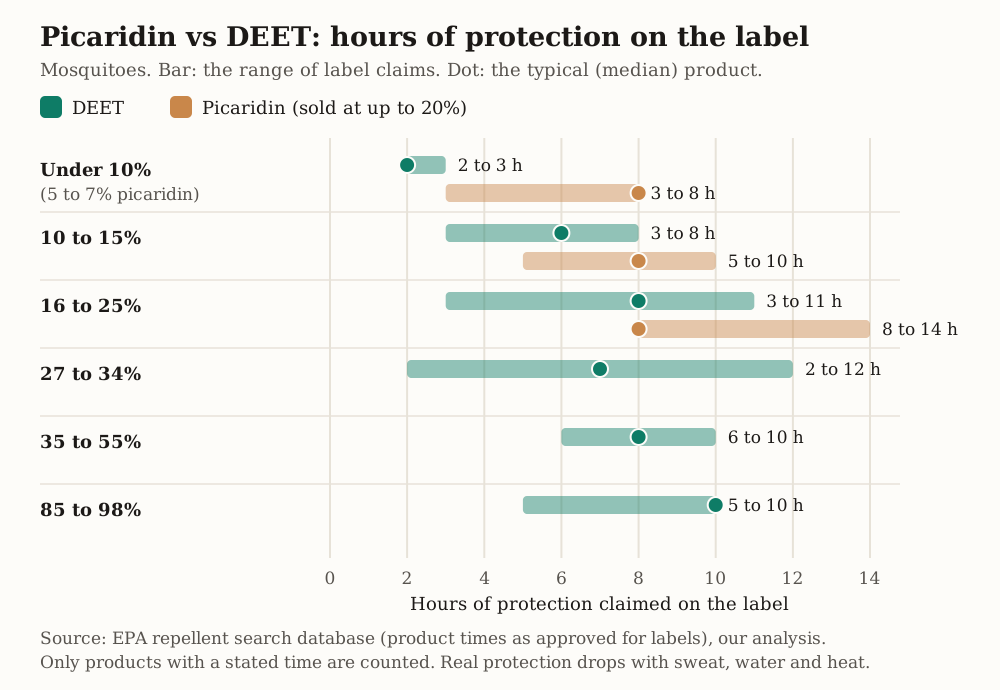
Table 1. Label hours against mosquitoes, by strength
Under 10%
- DEET: range (typical)
- 2 to 3 hours (2), 14 products
- Picaridin: range (typical)
- 3 to 8 hours (8), 4 products
10% to 15%
- DEET: range (typical)
- 3 to 8 hours (6), 7 products
- Picaridin: range (typical)
- 5 to 10 hours (8), 11 products
16% to 25%
- DEET: range (typical)
- 3 to 11 hours (8), 61 products
- Picaridin: range (typical)
- 8 to 14 hours (8), 18 products
27% to 34%
- DEET: range (typical)
- 2 to 12 hours (7), 22 products
- Picaridin: range (typical)
- Not sold this strong
35% to 55%
- DEET: range (typical)
- 6 to 10 hours (8), 13 products
- Picaridin: range (typical)
- Not sold this strong
85% to 98%
- DEET: range (typical)
- 5 to 10 hours (10), 18 products
- Picaridin: range (typical)
- Not sold this strong
Our analysis of the EPA repellent search database (last updated by the EPA in June 2019), read on October 24, 2026. Each registration counted once. “Typical” is the median.
Two things stand out. First, extra DEET buys little after about 25%. Second, the ranges are wide, because the formula matters as much as the percentage. Slow-release formulas can last longer even at a lower strength, CDC’s Yellow Book notes.
What the head-to-head tests found
Label times come from each maker’s own tests. Studies that put both on the same people at the same time are a fairer test. In most picaridin vs DEET trials, picaridin matched DEET at similar strengths, and in one African trial it did slightly better against malaria mosquitoes.
Table 2. Published tests of picaridin vs DEET
Van Roey and others, 2014
- Where and how
- Cambodia, 2-year field trial
- What was compared
- 20% picaridin, 10% picaridin, 20% DEET
- Result
- 20% picaridin and 20% DEET equal (about 96% and 98% of bites blocked over 5 hours); 10% picaridin lower, about 92%
Frances and others, 2004
- Where and how
- Northern Australia, field
- What was compared
- 19.2% picaridin, 20% DEET, 35% DEET gel
- Result
- Against Culex: picaridin over 95% for 5 hours, both DEETs for 7 hours. Against Anopheles: all weak after 1 hour
Costantini and others, 2004
- Where and how
- Burkina Faso, field, over 49,000 mosquitoes
- What was compared
- Picaridin, DEET, IR3535
- Result
- After 10 hours, picaridin gave the most protection against malaria mosquitoes, then DEET, then IR3535
Barnard and Xue, 2004
- Where and how
- Florida, USDA lab
- What was compared
- 10% picaridin, 15% DEET, 7% DEET and others
- Result
- 10% picaridin and 15% DEET each lasted 7.2 hours or more, 1.5 times as long as 7% DEET
Badolo and others, 2004
- Where and how
- Burkina Faso, lab
- What was compared
- Picaridin and DEET at matched doses
- Result
- Equal against malaria mosquitoes; picaridin 1.1 to 2 times as strong against yellow fever mosquitoes
The Cambodia study is the clearest. Over two years, volunteers wearing 20% picaridin or 20% DEET were bitten at about the same low rate, with no fall-off over the 5-hour sessions. However, some mosquitoes shrugged off both repellents more than others. Asian tiger mosquitoes, for example, were repelled less than yellow fever mosquitoes.
No single study settles every case. A 2013 Swiss review of 102 studies found DEET at 20% or more gave the longest protection against Aedes mosquitoes, up to 10 hours. Against malaria mosquitoes, it found DEET, picaridin, IR3535 and PMD from lemon eucalyptus all gave 4 to 10 hours on average.
You may also read that studies show picaridin is slightly more effective than DEET. The Appalachian Mountain Club page at the top of Google says so. Its link, however, leads to a 2018 NPR interview in which one entomologist, Dan Strickman, gave picaridin the edge. That is an expert’s view, not a trial. In the trials above, picaridin did a little better in the two Burkina Faso tests, while DEET lasted longer against Culex in Australia. In the two-year Cambodia trial, they tied.
Does a higher percentage work better?
A higher percentage lasts longer, but it does not repel harder. The American Academy of Pediatrics gives simple numbers. About 10% DEET protects for about 2 hours, and 30% for about 5. Likewise, 5% picaridin lasts 3 to 4 hours, and 20% picaridin 8 to 12.
The ceiling is real, though. Above about 50%, DEET adds little extra time, CDC’s Yellow Book says. At the other end, products under 10% may protect for only 1 to 2 hours. So for a long hike, a 20% to 30% product is plenty, and for a short evening, a lower strength is fine.
Picaridin vs DEET for ticks
Both repel ticks, and CDC lists both for tick bites. On labels, 20% picaridin products often claim 8 to 14 hours against ticks. Few DEET labels give a tick time below 85% strength, and the ones that do say 2 to 5 hours. The research is thin, however: the Swiss review found no standard test for tick repellents at all.
A thread on Reddit’s r/hiking that ranks on Google asks just this. The poster has used 40% DEET for years and has read that picaridin works as well on ticks. Is the switch fair? On the labels, yes, as the times above show. A 2021 Wilderness Medical Society tick guideline also rated picaridin as comparing well with DEET. Still, that rests on few direct tests.
The replies are worth reading, too. Most hikers answered with a routine, not a winner: permethrin on clothes, picaridin on skin, and for some, DEET on socks and shoes. In a cross-post on r/njhiking, one hiker kept finding ticks while using DEET. After treating clothes with permethrin, the hiker found none. That matches CDC advice to treat boots, pants, socks and tents with 0.5% permethrin.
So in tick country, do not rely on skin repellent alone. Treat your clothes with permethrin, use DEET or picaridin on bare skin, and check your body when you get home. Our guide to keeping ticks off you covers the whole routine, including the shower and dryer steps.
Smell, feel and what DEET does to your gear
On smell and feel, the picaridin vs DEET contest has a clear winner. Picaridin is nearly odorless, the EPA notes, and it does not dissolve plastics. DEET has a faint chemical smell, and many people find it oily. It also softens some plastics, rubber and vinyl, including eyeglass lenses, watch faces and some synthetic fabrics.
The National Pesticide Information Center lists what DEET can damage. The list includes contact lenses, eyeglass frames and lenses, watch crystals, combs, painted and varnished surfaces, and certain synthetic or treated fabrics. DEET does not harm cotton or wool. By contrast, the authors of the 2014 Cambodia trial note that picaridin does not dissolve plastics or coatings, and that people find its feel and smell more pleasant.
In practice, that matters most for hikers, anglers and anyone with expensive gear. The top reply in a ranking r/hiking thread warned that DEET ruins sunglasses, shoes and ultralight jackets and tents. It even eats a car’s clear coat, the hiker added. Some of that goes too far, since NPIC names certain synthetic fabrics, not all of them. The paint warning holds, though: painted and varnished surfaces are on its list. DEET on your fingers can reach sunglasses, a watch face or a synthetic jacket. For that reason, if you choose DEET, apply it before you handle gear, and wash your hands after.
Is DEET safe? Is DEET bad for you?
DEET is safe when you follow the label. The EPA has reviewed it twice, in 1998 and 2014, and found no risks of concern for people, children included. About a third of Americans use it each year. Serious reactions are rare, and most follow swallowing it or heavy misuse, not normal use on the skin.
The common side effects are mild. If DEET gets in your eyes, it can sting and make them water. If it stays on the skin for a long time, it can cause redness, a rash or swelling, the National Pesticide Information Center says. Swallowing it can cause nausea and vomiting.
Why do people say not to use DEET?
The worry traces back to seizure reports, mostly in children. In 2001, Greek doctors reviewed 17 published cases of brain toxicity in children linked to DEET. They argued that DEET should be avoided in children. Their paper is still quoted today, often without the context that followed it.
That context is the scale of use. NPIC estimates the seizure rate at about 1 in 100 million users between 1961 and 1998. Most cases followed drinking DEET or using it against the label. The EPA and its scientific advisers called the child seizure reports inconclusive, with no proven causal link.
A US registry backs that up. From 1995 to 2001, it logged 296 moderate or serious cases linked in time to DEET use. The 2010 analysis found no clear link between how severe a case was and the strength of the DEET. Given how widely DEET is used, the authors judged the risk of serious nerve effects to be quite low.
A second scare came from the lab. In 2009, a study in BMC Biology suggested DEET blocks the same nerve enzyme that some insecticides and nerve agents attack. However, a 2014 study in PLoS One found DEET to be a very weak blocker of that enzyme. In insects, it acts mainly on a different nerve target.
The other reasons are practical. Some people dislike the smell and the oily feel, and DEET damages some gear. Those are fair reasons to prefer picaridin. They are not evidence that DEET is unsafe.
Does DEET cause cancer?
No study has shown that it does. NPIC says researchers have found no evidence that DEET causes cancer in animals or people. The EPA lists it as “not classifiable as a human carcinogen,” which means there is not enough evidence either way. For picaridin, the EPA went further: it is “not likely” to cause cancer.
What happens if you don’t wash off DEET?
Usually nothing serious, but skin can get irritated. People who left DEET on for long periods have had redness, a rash and swelling, NPIC says. The body clears what it absorbs: nearly all DEET taken in through the skin is gone within 24 hours. Still, every label tells you to wash treated skin once you are back inside.
Is picaridin safe? Side effects of picaridin
Picaridin is safe when used as labeled, and its side effects are few. In EPA testing, it did not cause skin allergies and showed low toxicity. Less than 6% of what you put on is absorbed through the skin, and the body clears almost all of it within a day. The main side effect is eye irritation if it gets in your eyes.
Skin irritation from picaridin is very uncommon, NPIC says, though rare allergic rashes have been reported. When the EPA registered it, the agency found no developmental or cancer effects in its animal studies. The one honest caveat is time. Picaridin has been sold in the US only since 2005, though longer in Europe and Australia. DEET has been on US shelves since 1957.
What is safer, DEET or picaridin?
On safety, picaridin vs DEET has no official winner. The EPA and CDC treat both as safe and effective when used as labeled, and neither agency ranks one above the other. Picaridin is gentler on the nose and on gear. DEET, by contrast, has the longer safety record. If you have had a skin reaction to one, simply try the other.
DEET and picaridin for children, babies and pregnancy
In the US, the EPA sets no age limit for DEET or picaridin, and no strength limit for DEET on children. CDC says both are safe in pregnancy and while breastfeeding. For babies, though, picaridin vs DEET advice differs by source. Mayo Clinic says no DEET under 2 months and no picaridin under 6 months, so check the label and ask your pediatrician.
Advice for the youngest children differs by source
EPA and CDC Yellow Book
- DEET
- No age limit and no strength limit
- Picaridin
- No age limit
American Academy of Pediatrics
- DEET
- Use sparingly until age 2; extra care with newborns
- Picaridin
- Protects by strength: 5% for 3 to 4 hours, 20% for 8 to 12
Mayo Clinic
- DEET
- Not on babies under 2 months
- Picaridin
- Not on babies under 6 months
Health Canada
- DEET
- None under 6 months; up to 10% from 6 months to 12 years
- Picaridin
- Not on babies under 6 months
The table shows why parents get mixed messages. The EPA bases its view on animal tests that showed no extra risk for the young. Canada and some US clinics take a more cautious line for babies. For a young baby, CDC, the AAP and Health Canada all point to the same first step: clothes that cover the arms and legs, and netting over the stroller or carrier.
Two numbers you will see online are not in these sources. Some summaries say the AAP caps DEET at 30% for children over 2 months. Its current page for parents, updated in June 2024, gives neither number. Instead, it asks for sparing use until age 2 and extra care with newborns. Others say picaridin is fine from 2 months. No source in the table gives that age: the EPA sets none, while Mayo and Health Canada both say 6 months.
- Apply it for them. Put repellent on your own hands, then spread it on the child.
- Skip their hands. Children rub their eyes and put their hands in their mouths.
- Use only what the outing needs. A lower strength is enough for a short trip outside.
- Wash it off. Bathe the child or wash treated skin when you come in.
- Store it locked away. Keep every repellent out of a child’s reach.
DEET and picaridin during pregnancy
CDC says EPA-registered repellents are safe and effective for pregnant and breastfeeding women when used as directed. There is a real trial behind that for DEET. In it, 897 pregnant women in their second and third trimesters used 20% DEET daily to prevent malaria. Researchers found no rise in birth defects and no problems in the babies’ first year.
If a bite worries you, our guide to mosquito bites and when to see a doctor lists the warning signs. A child with large, swollen bites may have skeeter syndrome, a bite allergy that repellent helps prevent.
DEET or picaridin? Which one to choose
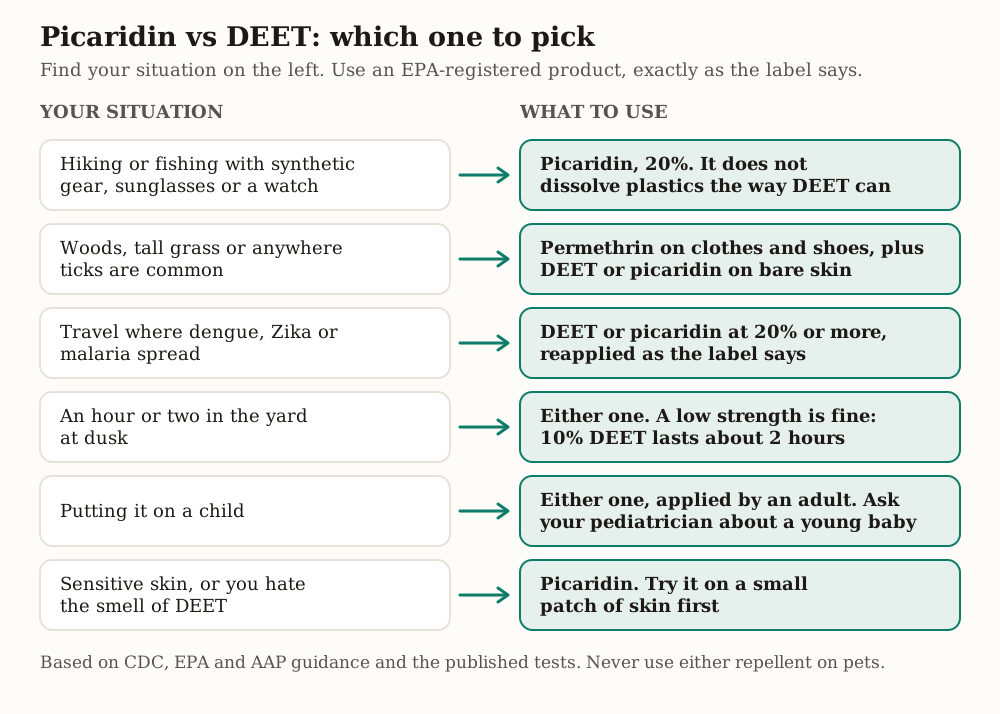
The picaridin vs DEET choice comes down to the outing, not the brand. For hiking with synthetic gear, sensitive skin or a dislike of the smell, pick picaridin. Where ticks or disease-carrying mosquitoes are common, use either one at 20% or more, plus permethrin on clothes. For a short evening in the yard, any registered product at a lower strength will do.
Picking a repellent for the outing
Hiking or fishing with synthetic gear, sunglasses or a watch
- What to use
- Picaridin, up to 20%
- Why
- It does not dissolve plastics, and 20% labels claim 8 hours or more
Woods, tall grass or tick country
- What to use
- Permethrin on clothes, plus DEET or picaridin on skin
- Why
- Permethrin kills ticks on the fabric; skin repellent covers the rest
Travel where dengue, Zika or malaria spread
- What to use
- DEET or picaridin at 20% or more
- Why
- Both matched in field trials; reapply as the label allows
An hour or two in the yard
- What to use
- Either one, at a lower strength
- Why
- About 10% DEET lasts about 2 hours, AAP says
Sensitive skin, or you hate the smell
- What to use
- Picaridin; test a small patch of skin first
- Why
- Nearly odorless; skin irritation is very uncommon
A child
- What to use
- Either one, applied by an adult
- Why
- No EPA age limit; ask your pediatrician about a young baby
A long, sweaty day
- What to use
- Either one; carry it with you
- Why
- Sweat and water shorten protection; reapply as the label allows
Should you get bug spray with or without DEET?
Get whichever one you will actually use, as long as it is EPA-registered. A “DEET-free” label is fine if the bottle lists picaridin, IR3535 or oil of lemon eucalyptus instead. Be careful, though: some DEET-free sprays rely on essential oils that wear off in under an hour. Check the active ingredient, not the slogan.
Parents feel this confusion most. “Do you use deet or deet free? I keep finding conflicting evidence,” one mother wrote on Reddit’s r/Mommit in 2026, about a daughter who reacts badly to bites. Patches and wristbands are not the answer, though. CDC’s Yellow Book calls repellent wristbands ineffective, and a vitamin B patch had no effect at all in a 2015 lab test.
Spraying skin repellent on bedding, curtains or a stroller indoors is not the answer either. Labels say not to spray in enclosed areas. For a baby, use netting over the stroller instead.
Traveling where dengue, Zika or malaria spread
For travel, pack a 20% to 30% DEET product or a 20% picaridin product. Both did well against disease-carrying mosquitoes in field trials. Bring it from home, CDC’s Yellow Book suggests, and look for the same ingredient names abroad. Remember that the yellow fever mosquito, which spreads dengue and Zika, bites by day, mostly after sunrise and around sunset.
The Australian trial is a useful warning, however. There, some malaria mosquitoes got past both repellents within an hour. So repellent is one layer, not the whole plan. Long sleeves, screens or nets, and any travel medicine your doctor advises all matter too.
Picaridin vs permethrin, and DEET vs permethrin
Permethrin is not a rival to DEET or picaridin. It goes on clothes, shoes and gear, never on skin, and at 0.5% it repels and kills ticks and mosquitoes that touch the fabric. DEET and picaridin go on bare skin and only repel. So the best setup for ticks uses both: permethrin on clothes, and DEET or picaridin on skin.
Use only a permethrin product labeled for clothing and gear. In one r/CampingandHiking thread, a camper described mixing a 13% farm-store concentrate for clothes. Farm concentrates are made for other jobs, so check that the label lists clothing before you use one. The label is the law. Treat clothes 24 to 48 hours before a trip so they dry, CDC’s Yellow Book says. Spray-on permethrin lasts through several washes. By contrast, DEET on clothing washes out the first time. Keep permethrin away from cats, which are very sensitive to it, and away from ponds and streams.
Cat owners in these threads ask about this, and one hiker skips permethrin for that reason. Penn State Extension draws the line at wet spray. Never spray permethrin around cats, it says, because it is extremely toxic to them. Once the permethrin has dried, though, treated clothes are safe to wear around cats. So spray outdoors, away from pets, and let the clothes dry for at least 2 hours, or up to 4 in humid weather.
The same facts appear on our tick page, which compares all three for ticks in detail. If you are heading into tall grass, read how to prevent ticks before you go.
IR3535 and oil of lemon eucalyptus: the other registered options
DEET and picaridin are two of six skin repellents that CDC recommends. The others are IR3535, oil of lemon eucalyptus (OLE), PMD and 2-undecanone. In EPA label data, 7.5% IR3535 products typically claim 2 hours, while 20% products claim about 8. OLE and PMD are not for children under 3, CDC says.
Registered OLE is the main plant-based choice with real testing behind it. It is not the same as pure lemon eucalyptus essential oil, which CDC does not recommend. Our guide to natural mosquito repellents compares the plant options and how long each lasted in tests. For the garden plants people hope will help, see what repellent plants can and cannot do.
Picaridin vs DEET myths, corrected
Myth 1
Myth: “Picaridin is a natural repellent made from black pepper.”
Truth: Picaridin is made in a lab. Bayer designed it in the 1980s to resemble piperine, a compound in the plants that give us black pepper, the National Pesticide Information Center says. No pepper goes into it.
Myth 2
Myth: “100% DEET protects five times longer than 20% DEET.”
Truth: Higher strength adds hours, not strength, and only up to a point. CDC's Yellow Book says DEET protection tends to peak at about 50%. In the EPA label data, products above 85% typically claim 10 hours, against 8 for 16 to 25%.
Myth 3
Myth: “DEET is banned in Europe.”
Truth: It is not. The EU approved DEET for skin repellents, and in November 2024 it extended that approval while a renewal review finishes. Picaridin, sold there as icaridin, is approved too.
Myth 4
Myth: “DEET kills mosquitoes and ticks.”
Truth: Neither DEET nor picaridin kills anything. Both work by making it hard for a mosquito or tick to find you. Permethrin, used on clothing, is the one that kills on contact.
How to apply DEET or picaridin
Apply a thin layer to bare skin only, and put sunscreen on first. CDC says sunscreen goes under repellent, and the two should be separate products. DEET can lower a sunscreen’s SPF by about a third, CDC’s Yellow Book notes, so you may need to reapply sunscreen more often. Then wash it all off with soap and water at the end of the day.
Putting on DEET or picaridin, step by step
Check the label first
Look for the active ingredient, its percentage, an EPA Reg. No., and the words mosquitoes or ticks. Note how often the label lets you reapply.
Put sunscreen on before repellent
CDC says sunscreen goes on first and repellent second. Use two separate products, since sunscreen needs reapplying more often than repellent does.
Cover exposed skin only
Spread a thin, even layer on bare skin. Never put it under clothing, and never on cuts, wounds, sunburn or irritated skin.
Spray your hands, then your face
Do not spray straight at your face. Spray your palms, then rub it on, keeping it away from your eyes and mouth and going light around the ears.
Apply it for children
An adult puts repellent on their own hands, then spreads it on the child. Keep it off a child's hands, eyes and mouth, and never let a child apply it.
Reapply only as the label allows
Sweat, swimming and rubbing wear it off sooner. If bites start, reapply, but not more often than the label says.
Wash it off when you come in
Wash treated skin with soap and water once you are indoors for good. Then wash treated clothes before you wear them again.
Do you have to wash off picaridin?
Yes, once you are indoors for good. The EPA advises washing treated skin and clothes with soap and water after any repellent, picaridin included. Wash your skin before bed, and wash treated clothes before you wear them again.
Is DEET banned in Europe? Is picaridin allowed?
DEET is not banned in Europe. The EU approved it for skin repellents from 2012, and in November 2024 the European Commission extended that approval while a renewal review finishes. Picaridin is allowed too: the EU approved icaridin from February 2022 to January 2032.
The EU did attach one condition to icaridin. When each product is assessed, regulators must pay particular attention to children under 2. In practice, individual products and their labels are approved country by country, so strengths and age rules on European bottles can differ from US ones.
Canada is the country with the clearest limits. There, adults can use DEET up to 30%, and children aged 6 months to 12 years up to 10%. Health Canada says no DEET and no icaridin for babies under 6 months. That is stricter than the US rule, not a ban.
For everything else about the insect itself, from bites to breeding sites, start at our complete guide to mosquitoes. To cut the numbers around your home, see getting rid of mosquitoes in the yard and house.
Pest control disclaimer. Photo-based identification can help, but it is not always perfect. For dangerous spiders, large infestations, or anything you are unsure about, contact a licensed pest control professional.
Not medical advice. This page is general information about insect repellents. It is not a diagnosis or a treatment plan. Ask your doctor or pediatrician which repellent is right for a baby, a pregnancy or a skin condition, and follow every product label.
Picaridin vs DEET FAQ
Is picaridin the same as icaridin?
Can I use DEET or picaridin on my dog or cat?
Do DEET and picaridin repel fleas or bed bugs?
Are DEET and picaridin bad for the environment?
Is it OK to use DEET every day?
Related guides
Natural mosquito repellent
Which plant-based options carry EPA registration, and how long the rest lasted in tests.
How to prevent ticks
Permethrin clothing, skin repellents and the tick check routine after a walk.
Mosquito bites
What a normal bite looks like, how long it lasts, and when to see a doctor.
Getting rid of mosquitoes
Standing water, screens and when a yard treatment is worth it.
Skeeter syndrome
Big, swollen bites in children: the allergy, the warning signs and prevention.
Mosquitoes
The full guide: how they find you, where they breed and the diseases they carry.
Repellent plants
What citronella, lavender and other plants can and cannot do on a patio.
Asian tiger mosquito
The striped daytime biter that shrugs off repellent more than most.
Sources
- US EPA, DEET (1998 reregistration and 2014 interim review; children)
- US EPA, Find the Repellent that is Right for You (repellent search database)
- National Pesticide Information Center, DEET General Fact Sheet
- National Pesticide Information Center, Picaridin General Fact Sheet
- CDC, Preventing Mosquito Bites (August 2024)
- CDC Yellow Book, Mosquitoes, Ticks, and Other Arthropods (April 2025)
- American Academy of Pediatrics, HealthyChildren.org, How to Choose an Insect Repellent for Your Child (June 2024)
- Health Canada, Personal Insect Repellents