This page covers how to get rid of mosquitoes where you live: the yard, the house and the products that go with them. For the bites themselves, see our guide to mosquito bites. For what to put on your skin, our natural mosquito repellent guide compares the options that work.
How to get rid of mosquitoes, step by step
How to get rid of mosquitoes comes down to 8 steps, and the first 6 cost little or nothing. Every mosquito starts life in standing water, so removing that water is the biggest single step. EPA calls egg and larva control the most effective and least costly way to control mosquitoes. Sprays come last, and only if bites continue.
The mosquito control plan in 8 steps
Dump standing water every week
Walk the yard once a week and after every rain. Empty plant saucers, buckets, toys, trash cans, wheelbarrows and kiddie pools, then turn them over or cover them. Change the water in birdbaths and pet bowls. Scrub the inside of containers too, because some mosquitoes glue their eggs to the walls.
Cover, fill or fix what keeps refilling
Clean clogged gutters, cover rain barrels tightly or with fine mesh, and store old tires where rain cannot reach them. Pull tarps tight, fill tree holes and level low spots that hold water for days. Fix dripping faucets and air conditioner drains, and screen open vent pipes.
Treat water you cannot dump with Bti
Put a Bti dunk or Bti granules in ponds, fountains, rain barrels and pool covers. Bti kills mosquito larvae and leaves people, pets, fish and birds alone. Follow the label for how much to use. Replace a dunk about every 30 days and granules every 1 to 2 weeks. Only some Bti products are allowed in drinking water, so check the label first.
Mow and trim where adults rest
Adult mosquitoes spend the day in tall grass and dense shrubs. Keep the lawn short, cut back overgrown plants near the house and seating areas, and let the breeze through.
Seal the house
Repair torn screens, keep doors and garage doors shut, and cover gaps around windows, vents and crawl spaces. Indoors, empty and scrub vases, plant saucers and pet bowls every week.
Run a fan where you sit and sleep
A fan blowing across you scatters the carbon dioxide and body odor that mosquitoes follow. Use a box fan on the patio and a fan aimed at the bed.
Hunt the ones already inside
Close the door, put one light near a plain wall, and check curtains, closets and the underside of furniture. Swat or vacuum what you find. A spray labeled for flying insects indoors is a last step for the stragglers.
Spray or call for help only if bites continue
If mosquitoes still drive you indoors once the water is gone, call your local mosquito control program. A barrier spray from a licensed applicator, or one you apply exactly as the label says, comes last.
The order matters. A spray kills the adults flying today, but a birdbath left full refills the yard within 2 weeks. Our rule is the same as for every pest: if exclusion and sanitation are successful, insecticide treatments are not required. For the basics of the insect itself, start at our mosquito hub.
Find and dump standing water: the yard checklist
Mosquitoes lay their eggs in or next to standing water, and the young live in it until they can fly. EPA puts the full cycle from egg to adult at about 2 weeks, though it can range from 4 days to a month. So a check every 7 days catches most batches before they can fly. Some species breed in water as small as a bottle cap.
How often is often enough? CDC’s rule is once a week: empty and scrub, turn over, cover or throw out anything that holds water. AMCA is stricter for flowerpot saucers and pet dishes, at no more than 2 days. You may also see “every 3 to 5 days” for birdbaths. No agency we read gives that figure, but a shorter gap never hurts in hot weather, when the cycle can be as short as 4 days.
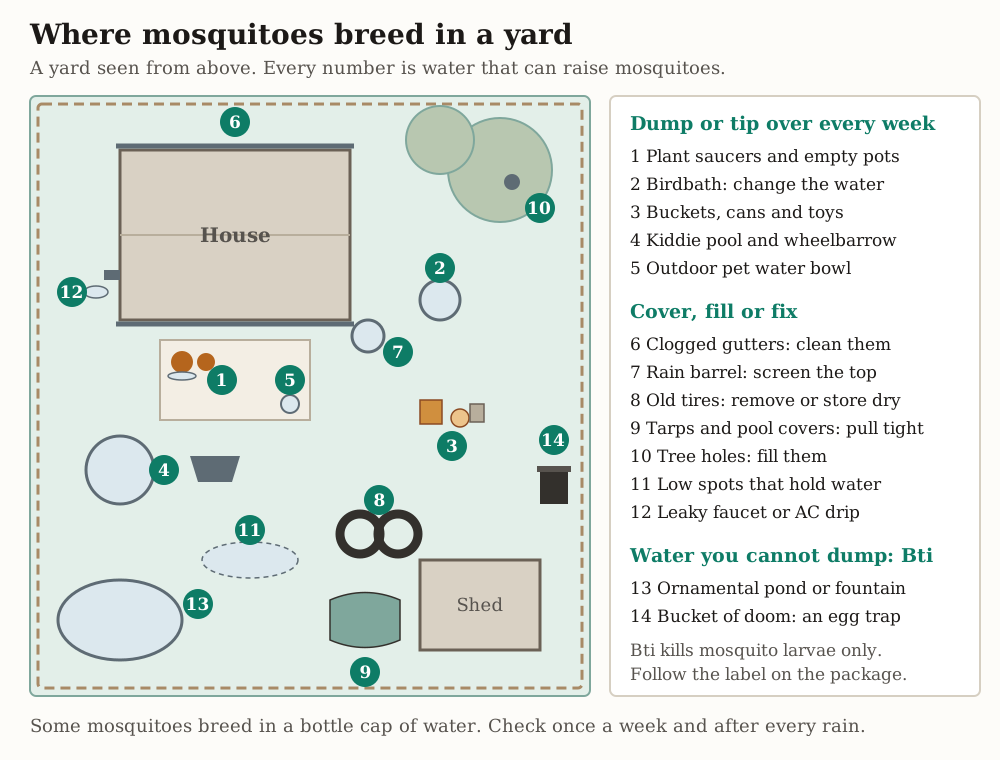
Some of the worst spots are easy to miss. Clogged gutters hold water for weeks, and so do old tires, which also stay warm. A tarp or pool cover with a sag in it is a pond. Rot holes in old trees fill with rain, so check high as well as low. Low spots in the lawn that stay wet for more than 3 days can also produce mosquitoes, the Metropolitan Mosquito Control District (MMCD) in Minnesota warns. Open vent and plumbing pipes count too. CDC says to cover them with mesh finer than a mosquito, and to repair cracks in a septic tank.
Colin Purrington, whose mosquito checklist ranks for this search, adds a few more. Flexible downspout extenders come second on his list after gutters, because their ridges hold water even when the pipe slopes downhill. Kids’ toys hold pockets of rain even upside down, so store them in the garage. Stand wheelbarrows on end. For a birdbath you want to keep, he suggests a small bubbler that keeps the water moving, or Bti.
Dumping is not always enough. Asian tiger mosquitoes and their relatives glue their eggs to the inside of a container, just above the waterline. EPA says mosquito eggs can survive dry conditions for a few months. So scrub buckets, saucers and birdbaths, or turn them upside down, and the next rain will not hatch them.
Ponds and pools need a different plan. Small fish such as goldfish eat the larvae, and MMCD notes that shaded ponds with no pump to move the water breed the most. A pool that is chlorinated and circulating is fine too. An abandoned pool or hot tub is the problem. Found wrigglers already? Our mosquito larvae guide shows what they look like at each stage.
Mow and trim where adults rest
Adult mosquitoes hide from the sun on the underside of leaves, in tall grass and in dense shrubs. CDC adds dark, humid spots under patio furniture, a carport or the garage. MMCD suggests keeping grass under 2 inches (5 cm) and cutting back overgrown plants. That will not stop breeding, but it gives the adults fewer places to wait near the patio. Then add a fan, covered below.
Mosquito dunks and Bti for water you cannot dump
Bti is a soil bacterium that kills mosquito larvae. EPA says its toxins affect only the larvae of mosquitoes, black flies and fungus gnats. Home products come as floating rings called dunks and as granules called bits. One dunk treats about 100 square feet (9 square meters) of water and lasts about 30 days, the New York State Department of Health (NY DOH) says.
Use it on water you cannot drain: an ornamental pond, a fountain, a rain barrel, a pool cover or a ditch on your own land. Bti is short for Bacillus thuringiensis subspecies israelensis. Check for that last word on the label, since it names the strain that targets mosquito larvae.
Read the label before you treat a rain barrel or cistern that anyone drinks from. EPA says some Bti products are allowed in certain drinking water and others are not. CDC’s advice keeps larvicides to water that will not be used for drinking.
How mosquito dunks and bits work
Larvae eat the bacteria as they feed, and the toxins kill them. A dunk floats and dissolves slowly, so it keeps working for about a month. According to NY DOH, it starts killing larvae within hours, and you should see a difference in about 48 hours. Break a dunk into pieces for water smaller than 100 square feet, as the label directs. The granules suit small spots such as plant saucers, and they are the same product our fungus gnat guide uses on houseplants. They wear out sooner than a dunk, though: the best-known brand says to reapply its granules every 7 to 14 days.
Bti does not touch adults or pupae. Pupae do not feed, EPA notes, so a few adults may still emerge for several days. EPA also reports no documented mosquito resistance to Bti, even after decades of use. Another larvicide, methoprene, disrupts the life cycle so larvae never become adults, and it lasts longer. However, the National Pesticide Information Center rates methoprene very highly toxic to freshwater invertebrates, so Bti is the gentler choice for a pond full of life.
Are mosquito dunks safe for pets, birds and fish?
Yes, for normal use. EPA says Bti has no toxicity to people and minimal toxicity to honey bees. NY DOH adds that dunks suit backyard ponds and fountains where fish, frogs and tadpoles live. Studies show only minimal irritation when someone eats one or touches it, so keep it out of your eyes and wash your hands. If a dog chews a dunk, call your vet to be safe.
There is one honest catch. Bti is not perfectly selective. In a 2024 lab study, it also killed the larvae of a non-biting midge at the higher doses tested. Midge larvae are food for fish and other wildlife. That is why some gardeners object to dunks in natural ponds. So treat only water where you have actually seen larvae, and leave wetlands to your local mosquito control program.
The bucket of doom: a mosquito trap that uses Bti
The bucket of doom turns a mosquito breeding site into a trap. Fill a bucket about halfway with water, add a few handfuls of leaves or straw, and let it steep for a couple of days. Female mosquitoes find the brew hard to resist, so they lay their eggs there. Add Bti, and every larva that hatches dies.
- Use a dark bucket in the shade. EPA notes that the yellow fever mosquito, a container breeder, prefers dark containers in shade, with wide openings and decaying leaves in the water.
- Use a piece of a dunk, sized for a small container as the label directs, and replace it about every 30 days.
- Cover the top with wire mesh if children or pets play nearby, with holes wide enough for mosquitoes. UNC Charlotte suggests chicken wire.
- Never let the Bti run out. Without it, the bucket becomes the best mosquito nursery in the yard. Write the date on the lid.
- Do not skip the Bti and plan to dump the water later, as some forum posts suggest. In hot weather, EPA says, egg to adult can take just 4 days. One late dump breeds a new batch.
Does it work? The UNC Charlotte writer who made the method popular reported fewer bites, but kept no counts. Home testers who tried a dunk in a bucket report the same, fewer bites over a few months, with no counts either. The closest tested version is the CDC’s autocidal gravid ovitrap, an egg-laying trap that kills the females that enter it. In Puerto Rico, three of these traps at about 85% of homes cut female yellow fever mosquitoes by more than 80%. Still, EPA notes that container mosquitoes breed in many scattered spots. So the idea works, but as a street-wide effort, not one bucket.
Keep mosquitoes out of the house: screens, doors and vents
Most mosquitoes in a house flew in through a gap. Tight window and door screens of 16 to 18 mesh keep them out, the American Mosquito Control Association (AMCA) says. AMCA also names attic soffits and bathroom exhaust vents as entry points. Garages count too, because mosquitoes like to rest there and slip in when the door to the house opens.
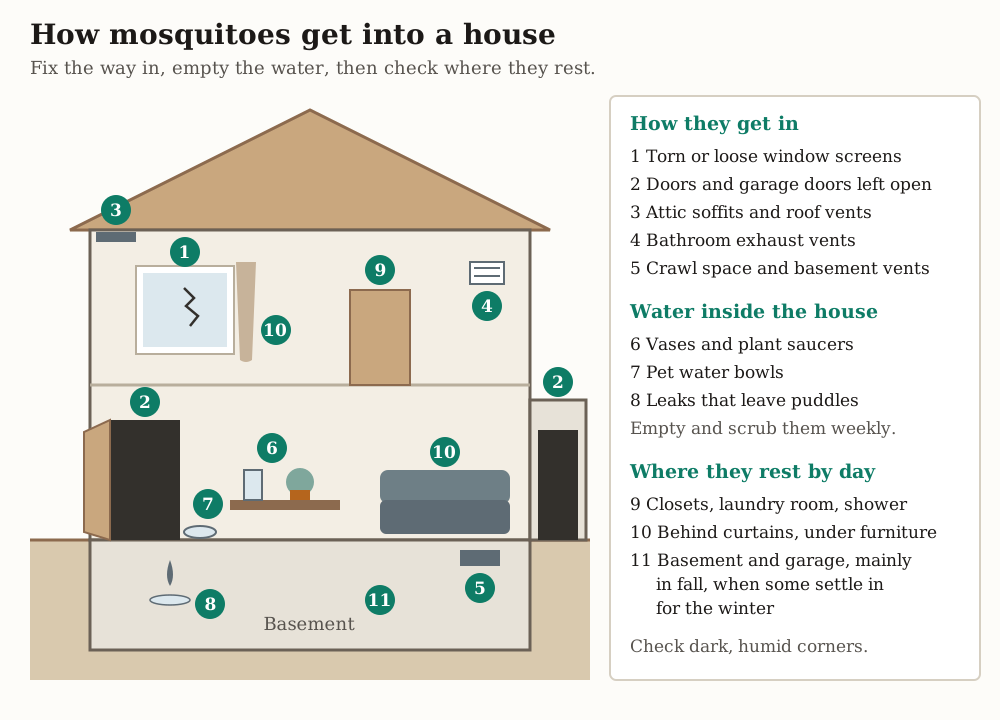
- Patch or replace torn screens, and check that the frames sit tight in the window.
- Keep doors shut, including the garage door and the door from the garage into the house.
- Cover gaps around windows and doors, as EPA advises, and screen attic and crawl space vents.
- Run the air conditioner with windows closed on hot nights, rather than opening an unscreened window.
- Use netting over a crib or baby carrier where screens are poor. EPA recommends it for beds and carriers.
- Fit a self-closing screen door if children or pets leave the back door open. Readers with kids recommend the magnetic kind that snaps shut on its own.
Do fans keep mosquitoes away?
Yes, and the evidence is good. In a Michigan wetland, researchers found that wind from an electric fan sharply cut the number of mosquitoes reaching a trap baited with carbon dioxide. The stronger the breeze, the bigger the effect, up to about 8 mph (3.7 m/s). The researchers recommend fans for protecting people and pets in the backyard.
Most guides say a fan works because mosquitoes are weak fliers that struggle against a breeze. That is only part of the story. The same 2003 study found that the bigger effect is dilution. The breeze spreads out the carbon dioxide and body odor that mosquitoes follow, so they lose the trail before they reach you. In their earlier test, a fan pushing air past a DEET-treated screen cut landings on a person by 75%, compared with no fan and no DEET.
So aim the fan across the people, not at the sky. On a patio, set a box fan low, at or below table height, and point it at the chairs. Many yard mosquitoes bite ankles and rest under patio furniture, so low air does the most. Indoors, a fan aimed at the bed helps with the one mosquito you cannot find.
How to get rid of mosquitoes in the house
Knowing how to get rid of mosquitoes in the house starts with one question: how did they get in? A mosquito indoors either flew in through a gap or hatched from water inside. So find the way in and the water first, then kill the ones you can see. One mosquito in the bedroom needs a swatter, not a spray. Several every day for a week means a torn screen, an open door or a breeding spot nearby.
Why do I suddenly have mosquitoes in my house?
Usually something changed: a screen tore, a door got propped open, or a vase or plant saucer sat full for a week. In late summer and fall there is a second reason. Some mosquitoes, including common house mosquitoes, spend the winter as adult females. They look for shelter in culverts, garages, attics and houses, and AMCA says they can live as long as 6 months. In our keyword data, searches for mosquitoes in the house peak in September.
Check what you are seeing, too. Tiny black “mosquitoes” around houseplants are usually fungus gnats, and fuzzy ones near the sink are drain flies. A huge, long-legged “mosquito” on the wall is usually a crane fly, which cannot bite. None of the three bites people, so none of them needs mosquito control. Swarms of slim flies near water or a porch light are often midges, and most kinds of midge do not bite either.
How to find a mosquito in your room
- Close the door so it stays in one room.
- Turn off the lights except one, placed near a plain wall. Then wait a few minutes.
- At dusk, try the window instead. Readers report that with the room lights off, mosquitoes settle on the brighter window, where they are easy to swat.
- Shine a flashlight along the wall at a low angle. A resting mosquito casts a long shadow.
- Check where they rest: curtains, the ceiling corners, the headboard, under the bed and furniture, and dark, humid spots such as under sinks, closets, the laundry room and the shower.
What kills mosquitoes instantly in the house?
A fly swatter, a handheld vacuum or an electric swatter racket kills a mosquito the moment you reach it. For several at once, an aerosol labeled for flying insects indoors knocks them down fast, AMCA notes. These sprays usually contain pyrethrins or a pyrethroid, and they leave no lasting protection. Keep windows and doors closed while it works, and follow the label on how long to stay out.
Readers report that a fine mist of plain water wets a mosquito’s wings and slows it enough to swat. Skip the glass cleaner or rubbing alcohol that some forum posts suggest, though. Neither is registered to kill mosquitoes, alcohol is flammable, and the mist settles on your pillow.
Foggers need more care: everyone, pets included, leaves the room, and fish tanks get covered. Never use a yard or outdoor product inside the house. The spray only buys a quiet night, so the screens and the water still need fixing. CDC puts it plainly: an indoor insecticide alone will not keep a home free of mosquitoes. If they keep coming after that work, a pest control professional can treat inside.
What can I put in my room to stop mosquitoes?
A fan aimed at the bed, a bed net and closed, screened windows do the most. Empty any water in the room: vases, plant saucers, a pet bowl, a forgotten glass. Scrub them once a week. Mosquito coils help a little outdoors in still air, AMCA says. But they burn and give off smoke, so keep them out of the bedroom and follow the label. Ultrasonic plug-ins are a waste of money. AMCA says at least 10 studies found that ultrasonic devices do not repel mosquitoes.
How long will a mosquito live inside your house?
Long enough to bite you more than once. Most adult female mosquitoes live 2 to 3 weeks, according to AMCA, and some that shelter for the winter live for months. Waiting it out is not a plan. Our guide to how long mosquitoes live gives the numbers by species and season.
Mosquito traps and bug zappers: what the evidence says
Bug zappers kill plenty of insects but few mosquitoes. In two University of Notre Dame studies, mosquitoes made up only 4.1% and 6.4% of the catch. Yards with a zapper had no fewer mosquitoes than yards without one, AMCA reports. In a separate backyard study, only 0.13% of the insects killed were female mosquitoes, the ones that bite.
The reason is simple. Zappers draw insects with ultraviolet light, and biting mosquitoes hunt by carbon dioxide, heat and body odor. They still prefer you to the zapper. Traps that copy those cues, or that catch females when they lay eggs, do better.
Mosquito traps and gadgets compared: what each one does to mosquito numbers
Bug zapper (UV light and grid)
- Does it cut mosquitoes?
- No
- The catch
- Mosquitoes were 4 to 6% of the catch, with no drop in yard mosquitoes; kills many harmless insects
Carbon dioxide trap
- Does it cut mosquitoes?
- Sometimes
- The catch
- Catches measurable numbers, but AMCA calls the data sparse; needs propane, net emptying and upkeep; set it away from where people sit, since it draws mosquitoes in
Egg-laying trap or bucket of doom
- Does it cut mosquitoes?
- Yes, as a group effort
- The catch
- Over 80% fewer females when most homes on a street had them; one alone does little
Repellent coil or heated repellent device
- Does it cut mosquitoes?
- Repels nearby only
- The catch
- A pyrethroid vapor that protects a seated group in still air, AMCA says; a breeze carries it away. Use outdoors as the label directs
Homemade sugar and yeast bottle
- Does it cut mosquitoes?
- Not shown
- The catch
- We found no field test showing it lowers mosquitoes in a yard
Ultrasonic device
- Does it cut mosquitoes?
- No
- The catch
- At least 10 studies found no effect, and a 2007 Cochrane review found no evidence that they prevent bites
Bat house or purple martin house
- Does it cut mosquitoes?
- No
- The catch
- Mosquitoes were under 1% of bat diets and absent from martin diet samples
Egg-laying traps did best in a North Carolina study of suburban yards. Combined with a barrier spray and breeding-site cleanup, two kinds of egg trap cut female Asian tiger mosquitoes by 74% and 80% against untreated yards. That only works where the mosquitoes are container breeders. Our Asian tiger mosquito guide shows how to spot the black and white daytime biter that these traps target.
Mosquito spray for yards: what is in it, and is it worth it?
A yard spray, often called a barrier treatment, coats shrubs and shady plants where adult mosquitoes rest. It does work for a while. In the North Carolina study, a barrier spray with breeding-site cleanup cut female Asian tiger mosquitoes for about 3 weeks. A 2019 review of 44 studies found barrier sprays effective, though rain and equipment changed the results.
After that, mosquitoes from untreated water fly back in, and the spray needs repeating. That is why it comes after the water work, not instead of it. The Minnesota district goes further: most urban and suburban yards will not need adult mosquito control at all.
What is in a mosquito yard spray?
Mosquito yard sprays by active ingredient class
Pyrethroids
- Examples
- Bifenthrin, lambda-cyhalothrin, deltamethrin, permethrin
- How it works
- A residual barrier on leaves that kills resting mosquitoes for weeks
- The catch
- Bifenthrin is highly toxic to fish and very highly toxic to bees
Pyrethrins
- Examples
- Natural pyrethrins, often with a synergist added
- How it works
- A fog or mist that knocks down flying mosquitoes
- The catch
- A knock-down treatment with no lasting barrier
Organophosphates
- Examples
- Malathion, naled
- How it works
- Used mostly by public mosquito control programs
- The catch
- A broad-spectrum insecticide; label limits apply
Minimum-risk "natural" sprays
- Examples
- Garlic, cedar and other plant oils
- How it works
- Repel or kill on contact
- The catch
- Exempt from EPA registration, so no EPA review of whether they work
Larvicides (not sprays for adults)
- Examples
- Bti, methoprene
- How it works
- Kill or stop larvae in water
- The catch
- The better tool when the water is on your land
Brand names change, so read the active ingredient on the label, not the front of the bottle. A “mosquito and tick” yard spray is usually a pyrethroid. For the tick side, see our tick control guide. Automatic misting systems that spray on a timer may broadcast pesticide when no mosquitoes are around, AMCA warns.
Mosquito sprays, bees and pollinators
Pyrethroids do not pick their target. The National Pesticide Information Center rates bifenthrin very highly toxic to bees and highly toxic to fish. MMCD tells homeowners who spray to avoid flowering plants and weeds, and to keep a buffer from any water. A spray that lands on blooms kills the bees, butterflies and fireflies that use them.
- Skip anything in flower, including clover and weeds in the lawn.
- Keep sprays away from ponds, streams and storm drains.
- Spray in the evening, when mosquitoes leave their daytime resting spots, as MMCD advises, and follow the label on wind.
- Treat only your own yard. Drift onto a neighbor’s garden or hives is a real risk.
Is it worth spraying your yard for mosquitoes?
Sometimes. A spray makes sense for a wedding or a party. It can also help in a bad season, once the standing water is gone and bites still keep you indoors. It does not make sense as a monthly habit while the gutters and birdbath still breed mosquitoes. In that case you pay to kill the adults while the water keeps making more.
Mosquito control districts and pros: when to call
Sometimes how to get rid of mosquitoes is not a job you can finish alone. Many states, counties and cities run public mosquito control, and AMCA counts about 734 organized programs in the US. They track mosquitoes, treat ditches and wetlands, and answer calls from residents. Call them before you hire anyone, especially when the water is not on your land.
- A ditch, drain or swampy area that holds water for a week or more. AMCA says not to clear ditches yourself, because wetland rules may protect them.
- A neglected pool or a yard full of containers next door.
- Old tires. Some districts collect them, as Minnesota’s does at no cost.
- Heavy biting with no water in sight. Many species fly 1 to 3 miles (1.6 to 4.8 km), so the source may be far away.
To find yours, search for your county name with “mosquito control”, or ask the county health department. Some programs also stock ponds and ditches with mosquito fish, AMCA notes.
Hiring a mosquito control company
A licensed pro makes sense if you want a barrier spray but would rather not handle pesticides. A good service starts by walking your yard for standing water, not by spraying. Before you sign, ask:
- Are you licensed to apply mosquito pesticides in this state? Ask for the license number.
- Which product, by name and active ingredient, and is it EPA-registered?
- Will you remove standing water or treat it with a larvicide, or only spray?
- How do you protect bees and ponds, and will you skip plants in flower?
- When can children and pets go back out?
- For a “natural” plan, what evidence shows that this product works?
No university or government source we read publishes prices, so we do not quote one. Get two or three written quotes and compare what each visit includes.
Home remedies that do not work: vinegar and Dawn, coffee grounds, dryer sheets
Most home remedies for mosquitoes fail for the same reason. They target the adults you can see and ignore the water that makes new ones. Some have a little evidence at close range. None of them replaces dumping standing water. Here is what the research says about the five you hear most.
Myth 1
Myth: “Vinegar and Dawn dish soap kill mosquitoes.”
Truth: We found no study showing that a vinegar and dish soap spray lowers mosquitoes in a yard. A soapy spray only reaches the insects it soaks, not the adults hiding in shrubs or the larvae in water. It is not an EPA-registered mosquito product, and it fixes none of the water that breeds them.
Myth 2
Myth: “Coffee grounds, or burning coffee, keep mosquitoes away.”
Truth: The idea comes from a 2015 lab study. Water mixed with strong coffee extract put off Asian tiger mosquitoes from laying eggs in it, and fewer of their eggs hatched. That was coffee in the water, not grounds on a patio or smoke in the air. A home test of grounds sprinkled around patio chairs found no drop in bites. Dumping the water does the same job for free.
Myth 3
Myth: “Dryer sheets in your pocket stop bites.”
Truth: We found no published test of dryer sheets against mosquitoes. In a 2013 test of wearable products, citronella wristbands and a vitamin B1 skin patch gave no real protection either. Scent is not the same as a registered repellent.
Myth 4
Myth: “Citronella candles keep a patio clear.”
Truth: They help a little. In tests, 5% citronella candles cut mosquitoes by about 14% indoors, while diffusers of the same oil did better. The American Mosquito Control Association says citronella candles protect no better than other candles that make smoke.
Myth 5
Myth: “Bats and purple martins will eat the mosquitoes for you.”
Truth: Both eat flying insects, but few of them are mosquitoes. AMCA reports that mosquitoes made up less than 1% of the gut contents of wild bats. In a 3-year diet study of purple martins, not one of 350 food samples held a mosquito.
Plants work the same way as candles: a little, up close, and mostly when you crush the leaves. Our guide to mosquito repellent plants rates the usual list against the evidence. Readers say the same thing: one gardener with a yard full of wild mint still has plenty of mosquitoes. For protection that lasts, the repellent on your skin matters far more than anything in the garden.
Protecting yourself while you fix the yard
Learning how to get rid of mosquitoes in the yard cuts bites, but even a well-kept yard has some. So protect yourself while the water work takes effect. Use an EPA-registered repellent with DEET, picaridin, IR3535, oil of lemon eucalyptus, PMD or 2-undecanone. CDC advises no oil of lemon eucalyptus or PMD under 3 years, and netting over strollers for young babies. For a baby, follow the label and ask your pediatrician.
Wear long, loose, light clothes, and take extra care around dusk and dawn, when many mosquitoes are most active. To choose between the two most common repellents, see picaridin vs DEET. If you are bitten, our mosquito bite guide covers what is normal and when to see a doctor.
Pest control disclaimer. Photo-based identification can help, but it is not always perfect. For dangerous spiders, large infestations, or anything you are unsure about, contact a licensed pest control professional.
Getting rid of mosquitoes: FAQ
What smells do mosquitoes hate?
Do mosquito dunks kill adult mosquitoes?
Why are there still wigglers in the water after I added a mosquito dunk?
Why does my yard have so many mosquitoes?
Does cold weather kill mosquitoes?
Related guides
Mosquitoes
The hub: what mosquitoes are, how they live, and every mosquito guide on the site.
Larvae in standing water
Wrigglers, tumblers and egg rafts: what you found in the birdbath, and what to do next.
Natural mosquito repellent
Which natural repellents have evidence, and which ones fade in minutes.
Repellent plants
Citronella, lavender, catnip and marigolds rated against the research.
How long mosquitoes live
Adults, males, overwintering females, and one stuck in your house.
Asian tiger mosquito
The striped daytime biter that breeds in buckets and saucers.
Sources
- CDC, Mosquito Control at Home
- US EPA, Bti for Mosquito Control
- New York State Department of Health, Guidance when using Mosquito Dunks (PDF)
- National Pesticide Information Center, Bifenthrin General Fact Sheet
- Metropolitan Mosquito Control District (Minnesota), Resident's Guide
- American Mosquito Control Association, FAQs (bug zappers, traps, ultrasonic devices, bats, purple martins)
- UNC Charlotte Urban Institute, Try the bucket of doom to eliminate mosquitoes without harmful pesticides (2022)
- Hoffmann EJ, Miller JR. Reassessment of the role and utility of wind in suppression of mosquito host finding. Journal of Medical Entomology (2003)