What is a crane fly?
A crane fly is a true fly with a slim body, two narrow wings and six very long legs that snap off easily. Scientists count more than 15,700 kinds worldwide and about 1,640 in North America. Most adults are 3/8 to 1 1/2 inches (1 to 4 cm) long, and none of them bite.
Crane flies belong to the order Diptera, like house flies and mosquitoes. Older books put them all in one family, Tipulidae, and counted that way they are the largest family of flies. Today most specialists split them into four families, grouped as the superfamily Tipuloidea. The large crane flies, Tipulidae in the narrow sense, hold about 4,400 of the species.
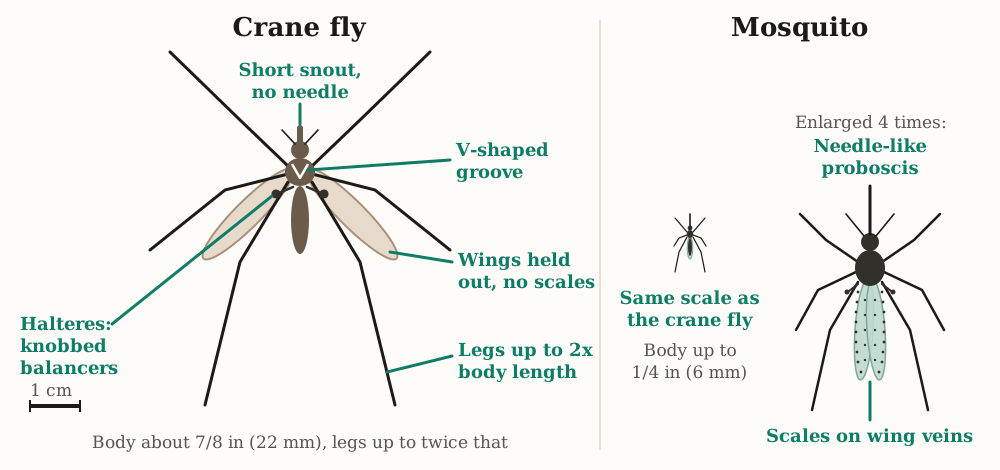
Up close, three features identify an adult: a short snout instead of a needle, a V-shaped groove on the back of the thorax, and wings with no scales. The larvae are gray-brown, legless grubs with tough skin. People call them leatherjackets.
Our guide to mosquitoes covers the insects that really bite. This page is about the harmless giant that gets blamed for them.
How many kinds of crane flies are there?
The count depends on the source and the year. In 1998, a University of Florida note called Tipulidae the largest family of flies, with about 12,000 species worldwide and 1,500 in North America. The Catalogue of the Craneflies of the World, updated in August 2026, now lists 15,768 species and subspecies, and 1,639 of them live in North America.
In between sits a 2019 fact sheet from the Orange County Mosquito and Vector Control District in California, known as OC Vector. It gives 14,000 described species worldwide, over 1,500 in North America and more than 400 in California alone.
The Missouri Department of Conservation gives a smaller North American figure: more than 500 species. That number counts only the narrow family Tipulidae. For a sense of scale, Cornell University says New York alone has more than 250 native species, and only two of the crane flies there are lawn pests.
Crane fly vs mosquito: how to tell them apart
Look at the head first. A mosquito has a long, thin needle pointing forward, and a crane fly has only a short snout. It is also far bigger: its body is often 3/4 inch (2 cm) or more, against 1/8 to 1/4 inch (3 to 6 mm) for a common mosquito. Its legs can reach twice its body length.
The Antelope Valley mosquito district in California has a quick rule: if it is bigger than a quarter, it is not a mosquito. A US quarter is about 1 inch (24 mm) across.
Table 1. Crane fly or mosquito: the checks in order
Mouthparts
- Crane fly
- Short snout (rostrum) ending in a small bump (nasus), no needle
- Mosquito
- Long, needle-like proboscis pointing forward
Groove on top of the thorax
- Crane fly
- V-shaped groove
- Mosquito
- None
Scales on the wings and body
- Crane fly
- None; wings clear or lightly patterned, body plain tan, brown or orange-brown
- Mosquito
- Scales along the wing veins and edges; the body is often marked with white or colorful scales
Body length, legs not counted
- Crane fly
- 3/8–1 1/2 in (10–38 mm)
- Mosquito
- About 1/8–1/4 in (3–6 mm)
Legs
- Crane fly
- Up to twice the body length, and they break off easily
- Mosquito
- Long, but in proportion, and they stay on
Legs at rest
- Crane fly
- All kept down
- Mosquito
- Long hind legs often raised in the air
Whole insect, legs and all
- Crane fly
- Usually bigger than a US quarter; over 10 in (25 cm) in the largest species
- Mosquito
- Smaller than a quarter, about 1 in (24 mm), apart from the rare giants below
Halteres (balancers behind the wings)
- Crane fly
- Long stalks with a knob, easy to see
- Mosquito
- Present, but tiny
Flight
- Crane fly
- Slow and bobbing, bumps into walls
- Mosquito
- Quick and direct, lands lightly on skin
Wings at rest
- Crane fly
- Often held out at an angle
- Mosquito
- Folded flat over the back
Bites people
- Crane fly
- Never
- Mosquito
- Females do
Features from the Missouri Department of Conservation and OC Vector’s look-alike sheet; crane fly size from University of Minnesota Extension. Mosquito size as on our mosquito guide; Missouri allows up to 1/2 inch for big species. The quarter rule is the Antelope Valley mosquito district’s. Inch figures are rounded.
Check the head: snout or needle?
The mouthparts settle it fastest. A female mosquito has a proboscis, a long tube she pushes into skin to draw blood. In its place, the bigger insect has a rostrum, a short snout with soft mouthparts at the tip. The Missouri Department of Conservation describes it as a snout, not a piercing tube.
The snout ends in a small bump called the nasus. Beside it sit two finger-like palps, which the fly moves like antennae to feel its way. Many adults have no working mouthparts and cannot feed at all.
Male mosquitoes also have a proboscis, but they drink only nectar. Their antennae look bushy, like a feather. So a male mosquito is the closest look-alike of all, and he does not bite either.
Check the back and the wings
Next, look at the top of the thorax, the part between the head and the wings. The bigger fly has a V-shaped groove there, and you can often see it with a phone zoom. Mosquitoes have no such groove. Then check the wings. A mosquito has tiny scales along its wing veins and edges, while the bigger fly’s wings are bare.
Halteres: the knobs behind the wings
Both insects have halteres. These are two small balancers behind the wings, all that is left of a second pair of wings. Oregon State calls them specialized smaller wings, and Missouri says they work like gyroscopes in flight. On the big fly they are long stalks with a knob, so they are easy to spot. On a mosquito you need a lens. Halteres tell you that you have a true fly, but not which fly.
How it flies and how it rests
Watch it move. The big one flies slowly and unsteadily with its legs dangling, and it bounces off walls and ceilings. Missouri’s field guide calls the flight weak and wavering. A mosquito, by contrast, flies straight in and lands lightly. At rest, many crane flies hold their wings out at about 45 degrees to the body, while a mosquito folds its wings flat over its back.
Look at the legs too. A resting crane fly keeps all six down, but a mosquito often lifts its long hind legs into the air.
How big is a crane fly?
Most crane flies have a body 3/8 to 1 1/2 inches (10 to 38 mm) long, and the legs reach up to twice that. Published sizes vary a lot, mostly because some measure the body, some the wings and some the legs. Table 2 sorts the figures by what each one measures.
Table 2. Size figures for crane flies, and what each one measures
Body length, most species
- The figure
- 3/8–1 1/2 in (10–38 mm)
- Who gives it
- University of Minnesota Extension
European lawn crane fly, body only
- The figure
- 14–19 mm males, 19–25 mm females (about 1/2–1 in)
- Who gives it
- PNW Insect Management Handbook
A typical body, with legs nearly twice as long
- The figure
- Around 1 in (2.5 cm)
- Who gives it
- St. Charles Park District, Illinois (2019)
Wingspan, tip to tip
- The figure
- 1/2–2 1/2 in (1–6.5 cm); up to 11 cm (4 1/4 in) in Holorusia
- Who gives it
- Wikipedia
Adult size in Google's AI Overview
- The figure
- Up to about 1.2 in (3 cm); 1 to over 1.5 in for mosquito hawk
- Who gives it
- Google, October 2026
Lengths that fit a leg span better than a body
- The figure
- 2.5–3 in (European crane fly); body up to 2.5 in
- Who gives it
- Cornell (2026); Chesapeake Bay Program field guide
Common crane flies (Tipula), body only
- The figure
- 13–20 mm (0.5–0.8 in)
- Who gives it
- OC Vector, Orange County, California (2019)
Giant western crane fly (Holorusia hespera), body
- The figure
- 35 mm (1.4 in)
- Who gives it
- OC Vector (2019)
The largest species
- The figure
- Body over 2 in (5 cm); leg span over 10 in (25 cm)
- Who gives it
- Matthew Bertone, NC State, in Entomology Today
Inch and metric figures as each source gives them, rounded where we converted.
Google’s AI Overview for crane fly gives adults “up to about 1.2 inches (3 cm)”. That suits a typical body, but it is too low as a top figure. Minnesota’s range runs to 1 1/2 inches, and OC Vector measures the giant western crane fly at 1.4 inches (35 mm). The largest species pass 2 inches. At the other end, Cornell lists the European lawn species at 2.5 to 3 inches long. The PNW handbook measures that same fly’s body at 14 to 25 mm, so Cornell’s number fits a leg span.
So a big one with its legs spread can cover your palm. That is why so many people call it a giant mosquito. One Connecticut Reddit user in August 2026 described a “huge mosquito looking dude” about the size of a palm, and the replies named a crane fly.
Does a crane fly bite or sting?
No. A crane fly cannot bite or sting a person, and it carries no disease. It has no piercing mouthparts, no stinger and no venom. NC State’s Matthew Bertone says of the adults that “none are blood-feeding, and none of them attack people.” Indoors or out, it is harmless.
So what is the pointed tip on some crane flies? That is the female’s egg-laying tube, which she pushes into damp soil. The Missouri Department of Conservation calls it harmless. Males have small claspers at the tip instead.
Can a mosquito hawk sting you? No. The pointed tail only looks like a stinger. If you felt a bite at the same moment, something else did it, and a real mosquito is the usual answer. For what a bite should look like and when to worry, see our mosquito bites guide.
You may also read that crane flies are the most venomous insects in the world but cannot bite. That is an old urban legend, because crane flies have no venom at all. The story probably grew from the name daddy long legs, which crane flies share with cellar spiders. Our cellar spider guide covers that myth.
Does a crane fly eat mosquitoes?
No. Despite the names mosquito hawk and mosquito eater, an adult crane fly does not hunt mosquitoes or any other insect. It does not have the mouthparts to catch or chew prey. Most adults live only a few days and eat little or nothing, though some sip water, dew or flower nectar.
Entomologists at NC State and Drexel University made this point in a 2015 Entomology Today article: no predatory adult has ever been found. The two Pacific Northwest lawn species drink water but do not feed at all, the PNW Insect Management Handbook says.
There is one small grain of truth. Some of the larvae that live in streams and ponds eat other small insects, and Missouri’s field guide says that can include mosquito larvae. That happens underwater and out of sight. It does nothing about the mosquitoes biting you on the porch.
Do crane flies keep mosquitoes away, then? No. A yard full of crane flies has just as many mosquitoes as one without them. For what actually cuts mosquito numbers, starting with emptying standing water, see how to get rid of mosquitoes.
Why is it called a mosquito hawk?
It is called a mosquito hawk because it looks like a mosquito three or four times bigger. People guessed that something shaped like that must hunt mosquitoes, the way a hawk hunts mice. Mosquito hawk, mosquito eater and skeeter eater are all regional American names, and none of them is accurate.
Many of these names also belong to other insects, which is where real confusion starts. Table 3 sorts them out.
Table 3. Folk names and what they mean
Mosquito hawk
- Usually means
- A crane fly, in much of the US
- Also used for
- Dragonflies, in some places
Mosquito eater, skeeter eater
- Usually means
- A crane fly
- Also used for
- Elephant mosquitoes, whose larvae really do eat mosquito larvae
Gallinipper, American giant mosquito
- Usually means
- Psorophora ciliata, a big biting mosquito
- Also used for
- Crane flies, in old Ozark and Southern speech
Daddy long legs
- Usually means
- Cellar spiders and harvestmen, in the US
- Also used for
- Crane flies, in Britain and Ireland
Leatherjacket
- Usually means
- A crane fly larva
- Also used for
- Nothing else
From the University of Florida, the Missouri Department of Conservation, Loyola University New Orleans and a 2020 review in the journal Insects. Local names vary from town to town.
Gallinipper causes the most trouble. In the South it names a real giant mosquito that bites hard, but the Missouri Department of Conservation records “gallynipper” as an old Ozark name for crane flies too. So a neighbor who mentions gallinippers could mean either insect. The giant mosquito section below shows how to tell.
Are mosquito hawks and dragonflies the same?
No. They are different insects that share a name in some places. A Loyola University New Orleans nature column notes that many people there call dragonflies mosquito hawks. Unlike crane flies, dragonflies really do catch flying insects, mosquitoes included. A dragonfly has four stiff wings held out flat and short legs. Crane flies have two wings and legs longer than their bodies.
Is a crane fly a daddy long legs?
In Britain and Ireland, yes: daddy long legs is the everyday name for a crane fly. In the US the name usually means a cellar spider or a harvestman, and both have eight legs and no wings. When a Scottish Reddit user asked about a “giant mosquito” in October 2026, commenters said crane fly. The poster replied that they had always called the flying ones daddy long legs.
Crane fly life cycle: how long do they live?
A crane fly spends almost its whole life as a larva, usually for most of a year, in wet soil, mud or water. The adult stage is the short last chapter. Adults live from a day or two up to about two weeks, long enough to mate and lay eggs, and most species have one generation a year. A female mosquito, by contrast, can live 2 to 4 weeks.
- Egg. Shiny black and about 1 mm (1/25 inch) long. A female lays up to 300, in damp soil or water. They hatch in about 1 to 2 weeks: 10 to 15 days for the lawn species, 6 to 14 days in OC Vector’s fact sheet.
- Larva, the leatherjacket. It grows through four stages to about 1 to 1 1/2 inches (2.5 to 4 cm), feeding on roots and rotting plants.
- Pupa. It rests just under the surface for about a week, sometimes a few months. Before the adult comes out, the pupa wriggles up, so an empty skin is left sticking out of the grass.
- Adult. It mates within about a day. A female of the European lawn species lays her eggs within about two days, and then she dies.
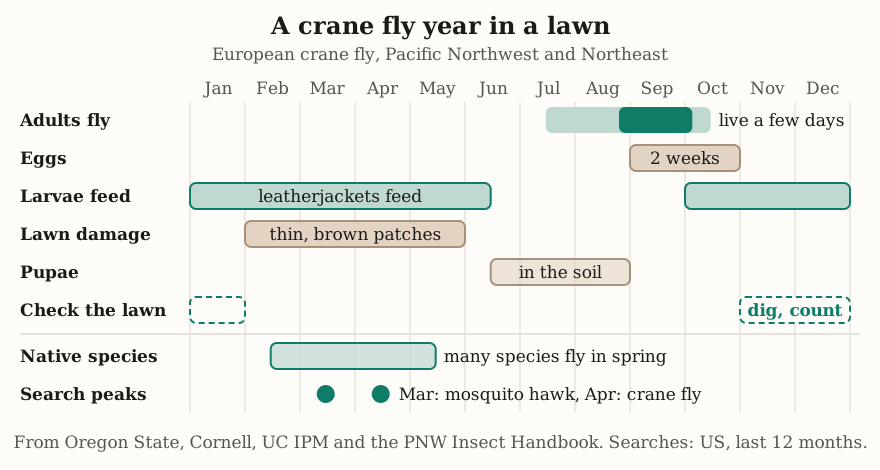
Sources disagree on how long adults live. OC Vector gives the shortest figure: on average, only 1 to 3 days. The PNW Insect Management Handbook gives 2 to 14 days for the European lawn species. Wikipedia, the Chesapeake Bay Program and the Coachella Valley mosquito district all give 10 to 15 days. Meanwhile, an Oregon State photo caption says about a month, though the same bulletin puts adults above ground for only the first two weeks of September. Either way, the one in your house will not live long.
Mosquitoes run the other way. Their water stages take about one to two weeks, and adults live about 2 to 4 weeks. Our mosquito larvae guide shows the wigglers, and how long mosquitoes live gives the numbers.
When do crane flies come out?
Crane flies come out in two main waves. Many native species fly in spring, from about February to May, which is when US searches peak: mosquito hawk in March and crane fly in April. The European crane flies that damage lawns fly in late summer and early fall, mostly from late August to October.
Spring is when most people notice them. Mississippi State entomologist Blake Layton calls crane flies among the first insects to become active in large numbers each spring. Different species fly in spring, summer and fall, Missouri’s field guide adds, so a few turn up in almost any warm month. In Orange County, California, OC Vector says most adults appear in late winter and early spring, and a few species in fall.
Late summer brings the second wave. In the Pacific Northwest, adults of the European species can emerge from July to mid-October, and Oregon State says most are out in the first two weeks of September. In New York, Cornell records both lawn species from late July to early September. The marsh species adds a second flight there in late April and early May.
Search data shows the spring wave clearly. Over the last 12 months of US searches, mosquito hawk peaked in March at about 17 times its December low. Crane fly peaked in April at almost 6 times its December low.
Why are crane flies in my house?
Crane flies end up indoors by accident. They fly toward lights at night, then slip in through an open door, a torn screen or a gap by a window. Once inside, they bounce along walls and ceilings looking for a way out. They cannot breed indoors, and they die within days.
What attracts crane flies? Mostly light. University of Minnesota Extension says they are drawn to light and often rest on the outside of buildings and on window screens. A wet lawn or field nearby adds more, because that is where the larvae grow.
Why is there a giant mosquito in my house? In most US homes, it is a crane fly, especially on a spring or fall evening with the porch light on. Utah State University’s pest guide notes that crane flies cannot survive indoors for long, so the problem ends on its own. If the insect bit you, though, it was not a crane fly.
Crane fly larvae: leatherjackets and lawn damage
Crane fly larvae, called leatherjackets, are gray-brown, legless grubs that grow to about 1 to 1 1/2 inches (2.5 to 4 cm) long. Most live in water, mud or rotting wood and do no harm. Two invasive species from Europe eat lawn grass and can kill whole patches.
A leatherjacket keeps its head pulled back into its body, so it can look headless. Small fleshy points ring the rear end. In spring, after heavy rain, you may find them crawling across a sidewalk or driveway.
Some stream species grow far bigger than the lawn grubs. The St. Charles Park District in Illinois says crane fly larvae feed for about 10 months and can reach almost 3 inches (7.5 cm). Because those water larvae need fairly clean water, finding them in a creek is a good sign. OC Vector’s California figures sit in between: up to 2 inches (50 mm) for common crane fly larvae and 2.4 inches (60 mm) for the giant western crane fly.
Which crane flies damage lawns?
Only two do, and both came from Europe. The European crane fly, Tipula paludosa, was found in British Columbia in 1965. It now ranges south into northern California, with outbreaks east of the Cascades in Spokane and Bend. The common crane fly, Tipula oleracea, has two generations a year, so it can fly in spring and fall.
In the Northeast, Cornell first found both species damaging turf in New York in 2004. Its 2026 fact sheet says they are now established in most of the lower 48 states. Even so, they are a problem mainly where winters are mild and wet. Mississippi State notes they are not common in the Deep South, and UC IPM finds damage in California mostly in Humboldt and Del Norte counties.
The names are confusing. Oregon State calls T. paludosa the common European species and T. oleracea the marsh species, while the PNW handbook calls them the European and the common crane fly. The larvae are almost impossible to tell apart, so the advice is the same for both.
What crane fly damage looks like
Damage shows in late winter and spring, when the larvae are biggest and eat the most. Grass thins from about February and can die out in patches by April and May, most often in low, wet spots. Birds, skunks and raccoons digging in the lawn are a strong clue, since they are hunting the larvae.
How to check a lawn for crane fly larvae
Pick the spot
Look where the grass is thinning, in low and wet areas, and where birds or skunks have been digging. Sample at the edge of a damaged patch, not in the bare middle, where the larvae have already moved on.
Pick the time
In the Pacific Northwest, Oregon State says to check from November to January, before the damage shows. Elsewhere, UC IPM suggests starting in March, once the weather warms, and checking through April.
Cut a square of sod
Use a square-end shovel to cut a piece 1 foot by 1 foot (30 by 30 cm) and 1 to 2 inches (3 to 5 cm) deep. Flip it upside down.
Count the larvae
Pull the thatch and the top inch of soil apart and count the gray-brown grubs. That number is your count per square foot.
Repeat and average
Check 3 or 4 spots and take the average. One square can mislead you.
Compare with the threshold
Oregon State and the PNW Insect Management Handbook act only above 25 larvae per square foot in a well-kept lawn. Below that, water, mow and feed the grass and let it outgrow the damage.
Thresholds differ by source. Oregon State and the PNW handbook act above 25 larvae per square foot in well-kept turf. UC IPM cites 25 to 50 from Washington state. It also notes that vigorous turf handled 40 per square foot, while weak turf showed damage at 15. In other words, healthy grass is the real defense.
What to do about crane flies
For adult crane flies, do nothing, or carry one outside in a cup. They do no harm and die within days, and sprays are no use against them. Act only if your lawn shows real larval damage. Even then, start with water, drainage and mowing, not insecticide.
A crane fly in the house
- Cup it. Put a cup over it on the wall, slide a card under it, and let it go outside. A leg may come off, and that is normal.
- Or leave it. It will not bite, breed or spread germs, and it will die in a few days.
- Close the gaps. Keep doors shut on spring and fall evenings, and fix torn window screens.
- Turn off lights you do not need. Outdoor lights draw crane flies to the walls and doors at night.
- Skip the spray. Mississippi State says insecticide sprays are not very useful against crane flies.
Crane fly larvae in the lawn
Start with what costs nothing. Most of the fix is lawn care that helps the grass outgrow the larvae and makes the soil less welcoming to eggs.
- Dry out the wet spots. Eggs and young larvae need damp soil. In the Northwest, Oregon State suggests cutting back irrigation around Labor Day, when the adults are laying eggs.
- Fix drainage where water pools, and water less in chronically wet areas.
- Mow at 2 to 3 inches (5 to 8 cm) and leave the clippings, as Oregon State advises.
- Remove heavy thatch and aerate, since the larvae feed just under the thatch, UC IPM says.
- Reseed bare patches so weeds do not move in.
- Try beneficial nematodes. UC IPM says Steinernema feltiae can cut larvae by up to 50% when applied to warm, moist soil.
Is it a crane fly or a giant mosquito?
Most giant mosquitoes are crane flies, so check two things: a needle on the head, and whether it tried to bite. A real giant does live in the eastern US, the gallinipper, Psorophora ciliata. Its wingspan is only about 1/4 inch (6 to 7 mm), yet it looks huge beside a normal mosquito, and it bites hard.
Gallinippers are floodwater mosquitoes, sometimes called the American giant mosquito. Their eggs can wait in damp, low ground for months or even years, then hatch together when it floods. In June 2026, UF/IFAS Extension in Okaloosa County, Florida wrote that their numbers often jump one to two weeks after heavy rain. They also fly fast and travel farther than most mosquitoes.
NC State mosquito biologist Michael Reiskind wrote that they can be up to three times bigger than common mosquitoes. As larvae, they eat other mosquito larvae.
To spot one, look for shaggy, banded back legs, a yellow stripe down the back and a yellow band on the needle, the University of Florida says. In September 2026, a Reddit user in northwest Ohio posted a “very large mosquito” that had latched onto an arm. The top reply named a gallinipper and warned that it can bite through denim.
A gallinipper bite hurts more than most, but there is no evidence it makes people sick. UF/IFAS Extension says gallinippers do not play a major role in spreading disease in Florida. Some have tested positive for viruses such as West Nile, yet the University of Florida’s species profile found no study showing they pass them to people. Treat the bite like any mosquito bite. If a bite swells into a large, hot patch, our skeeter syndrome guide explains when to see a doctor.
The elephant mosquito: a giant that does not bite
The other big mosquito in the US is the elephant mosquito, Toxorhynchites rutilus. Its genus holds the largest mosquitoes known, with a wingspan around 12 mm (1/2 inch) and shiny, colorful scales. The needle curves down like an elephant’s trunk and is built for nectar, so it cannot take blood. Its larvae eat other mosquito larvae in tree holes and containers.
A 2020 review in the journal Insects notes that these mosquitoes are also called mosquito eaters. Unlike the mosquito hawk, this one earns the name, at least as a larva.
Table 4. Big mosquito or crane fly?
Needle on the head
- Crane fly
- No, a short snout
- Gallinipper
- Yes, straight, with a yellow band
- Elephant mosquito
- Yes, curved down like a trunk
Bites people
- Crane fly
- No
- Gallinipper
- Yes, painfully
- Elephant mosquito
- No
Wingspan, tip to tip
- Crane fly
- 1/2–2 1/2 in (1–6.5 cm)
- Gallinipper
- About 1/4 in (6–7 mm; Wikipedia gives 7–9 mm)
- Elephant mosquito
- About 1/2 in (12 mm)
Body length
- Crane fly
- 3/8–1 1/2 in (10–38 mm)
- Gallinipper
- Up to 3 times the size of a common mosquito
- Elephant mosquito
- Up to about 1/4 in (7 mm)
Look
- Crane fly
- Gray, tan or brown, clear wings, very long legs
- Gallinipper
- Yellow and dark, shaggy banded hind legs
- Elephant mosquito
- Shiny, colorful scales, active by day
Where you meet it
- Crane fly
- Lawns, wet ground, porch lights
- Gallinipper
- After floods, east of the Rockies
- Elephant mosquito
- Near tree holes and water-filled containers
Gallinipper facts from the University of Florida and Reiskind; elephant mosquito facts from a 2020 review in Insects and Wikipedia; crane fly wingspan from Wikipedia.
If it really is a mosquito, our mosquito guide covers the common US kinds. The Asian tiger mosquito page covers the small black-and-white one that bites by day.
Other bugs that look like mosquitoes
Besides crane flies, the insects most often mistaken for mosquitoes are midges, winter crane flies, fungus gnats, drain flies and mayflies. None of these 5 bite. One check separates each from a mosquito, and it is in the first column of Table 5. The look-alike that does bite is the biting midge, or no-see-um.
Table 5. Bugs that look like mosquitoes
Front legs held up at rest, feathery antennae on males, no wing scales
- Insect
- Non-biting midge
- Where you see it
- Swarms near ponds and lakes; porch lights
- Bites?
- No; adults have no mouthparts
Like a small crane fly, out in the cold months
- Insect
- Winter crane fly
- Where you see it
- Lights and windows, winter and spring
- Bites?
- No
Tiny and dark, 1/16–1/8 in (1.5–3 mm)
- Insect
- Fungus gnat
- Where you see it
- Houseplant soil and nearby windows
- Bites?
- No
Fuzzy and moth-like, wings held like a roof
- Insect
- Drain fly
- Where you see it
- Bathroom and kitchen drains
- Bites?
- No
Four wings held upright like a butterfly, two long tails
- Insect
- Mayfly
- Where you see it
- Near rivers and lakes, sometimes in huge swarms
- Bites?
- No; adults cannot eat
Far smaller than a mosquito and hard to see
- Insect
- Biting midge (no-see-um)
- Where you see it
- Wet ground and shorelines
- Bites?
- Yes
Features from the Missouri Department of Conservation, OC Vector and the San Mateo County and Napa County mosquito districts.
Midges fool more people than any other look-alike, because they are the right size. Missouri’s field guide gives two quick checks. A resting midge holds its front legs up and forward, like a second pair of antennae, while many mosquitoes raise their back legs. Also, a midge’s wings have no scales. A cloud of them over a bush at sunset is a swarm of males, and they cannot bite.
Winter crane flies are a separate family that looks like a small crane fly. The Napa County mosquito district says they are common in winter and spring, are drawn to lights, and are often reported as mosquitoes.
Tiny dark flies over houseplants are fungus gnats, and our fungus gnat guide covers the fix. Fuzzy flies by the sink are drain flies, which breed in the film inside the pipe. Mayflies and caddisflies both swarm lights near water; our caddisfly page shows how to tell those two apart.
Still not sure? A sharp photo of the head and wings settles most cases. Try the bug identifier by picture with the insect on a white card.
Crane fly myths, corrected
At least 8 common claims about crane flies are wrong. Two come from WebMD’s guide, which ranks near the top of Google for the name. Here is what each one gets wrong.
Myth 1
Myth: “Mosquito hawks eat mosquitoes.”
Truth: No predatory adult crane fly has ever been found, two specialists told Entomology Today in 2015. Most adults barely eat.
Myth 2
Myth: “A crane fly is a giant mosquito.”
Truth: It is a different family of flies. A mosquito has a long proboscis and scaled wings; a crane fly has a short snout and bare wings.
Myth 3
Myth: “Crane flies are male mosquitoes.”
Truth: A different family of flies. Male mosquitoes are real and do not bite, but they are small, with bushy antennae and a proboscis. OC Vector lists this among five false beliefs, with biting, stinging, eating mosquitoes and being poisonous.
Myth 4
Myth: “Crane flies bite or sting.”
Truth: They have no piercing mouthparts and no stinger. The pointed tip on a female is for laying eggs in soil.
Myth 5
Myth: “Daddy long legs are the most venomous insects, but cannot bite.”
Truth: An urban legend. Crane flies have no venom and are not poisonous. The name is shared with cellar spiders, whose mild venom does not harm people.
Myth 6
Myth: “The halteres are a crane fly's antennae.”
Truth: WebMD's guide calls them antennae. They are a reduced second pair of wings used for balance, Oregon State explains. The antennae are on the head.
Myth 7
Myth: “Crane flies fly badly because they have only one pair of wings.”
Truth: WebMD links the two, but every true fly has one pair of wings, including mosquitoes and house flies, which fly well. The wing count is not the reason it flutters.
Myth 8
Myth: “Every crane fly is a lawn pest.”
Truth: Only two invasive species do real lawn damage, Oregon State says. Most species have larvae that live in water, mud and rotting wood.
Pest control disclaimer. Photo-based identification can help, but it is not always perfect. For dangerous spiders, large infestations, or anything you are unsure about, contact a licensed pest control professional.
Crane fly FAQ
Are crane flies good or bad?
Should I let crane flies live?
Do crane flies lay eggs in your house?
Why do crane fly legs fall off so easily?
Is a crane fly a male mosquito?
Can I sleep with a crane fly in my room?
Related guides
Mosquitoes
The hub: every mosquito guide on the site, from bites to repellents.
Asian tiger mosquito
The small black-and-white mosquito that bites by day.
Mosquito bites
What a normal bite looks like, how long it lasts, and when to see a doctor.
Fungus gnats
The tiny mosquito-like flies over houseplants, and how to stop them.
Mosquito larvae
The wigglers in buckets and birdbaths, and how to clear them.
How to get rid of mosquitoes
What works in the house and the yard, starting with standing water.
Drain flies
The fuzzy flies by the sink, and why bleach does not stop them.
Cellar spider
The other daddy long legs, and the venom myth they share.
Sources
- Missouri Department of Conservation, Large Crane Flies (field guide)
- UC IPM, Crane Flies, Pest Management Guidelines: Turfgrass
- Kowalewski A and others, Managing Crane Fly in Lawns, Oregon State University Extension EM 9296 (2020)
- Worth M and Wickings K, European Crane Flies (Tipula paludosa and Tipula oleracea), Cornell CALS Ornamental IPM Fact Sheet (May 2026)
- Ragasa EV and Kaufman PE, A Mosquito Psorophora ciliata, University of Florida EDIS EENY-540 (2012)
- Mertz L, Mosquito Hawk? Skeeter Eater? Giant Mosquito? No, No, and No, Entomology Today, Entomological Society of America (2015)
- Oosterbroek P, Catalogue of the Craneflies of the World, statistics (last modified August 31, 2026)
- Donald CL, Siriyasatien P and Kohl A, Toxorhynchites Species: A Review of Current Knowledge, Insects (2020)