What is a caddisfly?
A caddisfly is an insect in the order Trichoptera, a name that means “hairy wings”. There are about 14,500 known species worldwide. Each caddisfly spends most of its life underwater as a larva, often inside a case it builds from silk and sand or plant bits. It then comes out of the water as a short-lived, moth-like adult.
Caddisflies are close cousins of moths and butterflies. Both groups spin silk, and they split from a shared ancestor about 150 to 200 million years ago. The easy way to tell them apart is the wings. A moth’s wings are covered in tiny scales, while a caddisfly’s wings are covered in fine hairs.
They live wherever there is clean fresh water, on every continent except Antarctica. In fact, most of the caddisflies at your window came from the nearest river, lake or creek. Sources differ on how many kinds live in North America, because new species are still being described:
How many caddisfly species are there?
Wikipedia
- World
- About 14,500 described
- North America
- Not given
Missouri Dept. of Conservation
- World
- About 15,000, in 50 families
- North America
- About 1,500 north of Mexico
NC State University (ENT 425)
- World
- About 14,000, in 43 families
- North America
- About 1,500, in 28 families
Macroinvertebrates.org
- World
- Over 16,000
- North America
- 1,887
Orkin
- World
- Not given
- North America
- About 1,200 in the US
Caddisfly at a glance
Scientific name
- Caddisfly
- Order Trichoptera
Adult size
- Caddisfly
- Often about 1/2 in (13 mm); about 1/16–1 1/2 in (2–38 mm) across all species
Adult look
- Caddisfly
- Moth-like, tan to brown or black, hairy wings folded like a tent, long thin antennae
Larva
- Caddisfly
- Caterpillar-like, underwater, often in a case of sand, pebbles, sticks or leaves
Where
- Caddisfly
- Streams, rivers, lakes and ponds; adults rest on plants near the water
Harmful?
- Caddisfly
- No bite, no sting, no disease. Swarms can trigger allergies in a few people
Adult life
- Caddisfly
- A few weeks, by most accounts
Good sign?
- Caddisfly
- Yes. Caddisflies need clean, oxygen-rich water
Is a caddisfly a fly, a moth or a mayfly?
A caddisfly is none of the three, even though it looks like a moth and has “fly” in its name. True flies have only one pair of wings, and a caddisfly has two. Mayflies are a separate order too. They hold their wings straight up and have two or three long tails, which a caddisfly never has. The look-alike table below shows each difference.
Sedge, periwinkle, shadfly: other names for caddisflies
The caddisfly has more local names than most insects, because anglers, kids at the creek and river towns all named it. You may have searched for one of these:
Other names for the caddisfly
Caddis, caddis fly, caddis bug
- Who uses it
- Everyone
- What it means
- The adult, or the whole insect
Sedge, sedge fly, rail fly
- Who uses it
- Anglers, and the UK
- What it means
- The adult
Caddis worm, cod-worm
- Who uses it
- Older books and anglers
- What it means
- The larva. The word goes back at least to 1653
Periwinkle
- Who uses it
- The Pacific Northwest
- What it means
- The larva in its case
Rock roller
- Who uses it
- Western anglers
- What it means
- The larva
Shadfly
- Who uses it
- Some regions
- What it means
- The adult
Sandfly
- Who uses it
- Buffalo and the Niagara River
- What it means
- The adult swarms (not a biting sand fly)
Trout candy
- Who uses it
- Anglers
- What it means
- Any stage, because trout love them
One more name causes confusion online. “CADDIS” is also the name of a US EPA tool for diagnosing polluted streams, and Caddis is an eyewear brand. Neither has anything to do with the insect.
Are caddisflies harmful?
No. A caddisfly cannot bite or sting, does not carry disease, and does not damage your house, garden or clothes. Most adults have weak, reduced mouthparts and eat little or nothing in their few weeks of life. The only real health issue is allergy: in heavy swarms, their shed hairs can bother the eyes, nose and lungs of sensitive people.
So a caddisfly that lands on you, your food or your dog is not a threat. It is simply drawn to light and movement, and it often bumps into people by accident. Likewise, the piles of dead ones by the door in the morning are harmless to sweep up.
Do caddisflies bite or sting?
No. Adult caddisflies have no stinger, and their mouthparts are too small and soft to bite. Iowa State University Extension puts it simply: they “can’t bite or feed on landscape plants”. The larvae have chewing jaws for leaves and tiny prey underwater, but they do not bite people.
If you have bites after an evening by the water, something else did it. Mosquitoes, biting midges (no-see-ums) and black flies all live near the same rivers. Our guide to bug bites explains how to read the clues, and why a bite alone cannot name the insect.
Caddisfly allergies: the one real health problem
Caddisfly allergy is real, though uncommon. In a 1994 study of a Manitoba hydroelectric plant, 28 of 57 workers took part, and about half reported eye, nose and sinus symptoms or wheezing at work. Also, 61% reacted to a caddisfly skin-prick test. The first case of caddisfly asthma was reported back in 1929, according to a 2018 review of insect allergies.
The trigger is not a bite. Instead, it is the fine hairs and bits of wing that adults shed when they swarm in huge numbers. Those particles float in the air like pollen. In a 2025 survey along the Colorado River in Bullhead City, Arizona, some residents also reported breathing trouble during heavy swarms.
For most people, a few caddisflies at the window will never cause a problem. The risk rises if you have asthma or hay fever and you live, work or camp right beside a river during a big hatch.
How to identify an adult caddisfly
An adult caddisfly is a slim, moth-like insect, often about 1/2 inch (13 mm) long, with four hairy wings folded like a tent over its back. Its antennae are thin and often as long as its body or longer. Most are tan, brown, grey or black. Most of all, look for no tails, no coiled tongue and no powdery scales.
Is it a caddisfly? Check these
Check each clue below to narrow down what you saw.
Wings folded like a pitched roof over the back when it rests
Upright wings mean a mayfly.
Wings covered in fine hairs, not powdery scales
They do not leave dust on your fingers.
Antennae thin and long, often longer than the body
Feathery antennae point to a moth.
No tails at the tip of the body
Two or three tails mean a mayfly or a stonefly.
Dull colours: tan, brown, grey or black, sometimes with pale spots
Seen near a river, lake or pond, and at lights at night
Weak, fluttery flight, often running quickly on walls and screens
Caddisfly, moth, mayfly or stonefly?
Four insects get mixed up at porch lights near water. Check the wings first, then the tail. A caddisfly is the only one with hairy, tent-like wings, long antennae and no tails. A moth has scaly wings, a mayfly holds its wings upright, and a stonefly lays them flat with two tails.
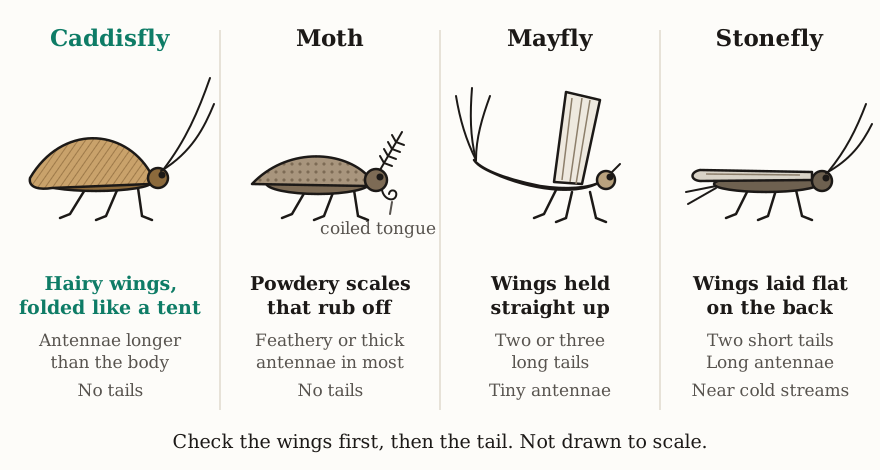
Caddisfly or a look-alike? The feature that separates them
Wings at rest
- Caddisfly
- Tent-like roof over the back
- Moth
- Flat, folded or roof-like
- Mayfly
- Held straight up, like a sail
- Stonefly
- Flat on the back
Wing surface
- Caddisfly
- Fine hairs
- Moth
- Powdery scales that rub off
- Mayfly
- Clear, veined
- Stonefly
- Clear or smoky, veined
Tails
- Caddisfly
- None
- Moth
- None
- Mayfly
- Two or three, long
- Stonefly
- Two, short
Antennae
- Caddisfly
- Long and thin, often longer than the body
- Moth
- Feathery, thick or thin
- Mayfly
- Tiny bristles
- Stonefly
- Long and thin
Mouth
- Caddisfly
- Reduced, no coiled tongue
- Moth
- Coiled tongue in most
- Mayfly
- None that work
- Stonefly
- Reduced
Where you see it
- Caddisfly
- Near water, at lights
- Moth
- Anywhere, at lights
- Mayfly
- Near water, often in vast hatches
- Stonefly
- Near cold streams, on rocks
Two smaller look-alikes turn up indoors. A drain fly also holds fuzzy wings like a roof, but it is only 1/16 to 1/5 inch (1.5 to 5 mm) long, has just two wings, and lives in your sink or shower drain. A green lacewing folds its wings like a tent too, but its wings are clear with a net of green veins, and it has golden eyes.
How big are caddisflies?
Many caddisflies at a porch light are about 1/2 inch (13 mm) long, wings included. Across all species, they range from about 1/16 inch (2 mm) to about 1 1/2 inches (38 mm). The sources differ because some measure the body, some the wing, and some only the species in their region:
Caddisfly size, by source
Iowa State University Extension
- Size given
- About 1/2 in (13 mm)
- What it measures
- The adults in an Iowa river swarm
University of Kentucky
- Size given
- Adults up to 1 in (25 mm); larvae up to 1 1/2 in (38 mm)
- What it measures
- Kentucky species
Missouri Dept. of Conservation
- Size given
- Adults to about 1 1/2 in (38 mm); larvae with case 1/2–1 in (13–25 mm)
- What it measures
- Missouri species
The Wildlife Trusts
- Size given
- Forewings 2–28 mm; largest over 3 cm (1 1/4 in)
- What it measures
- UK species
Macroinvertebrates.org
- Size given
- Larvae 2–40 mm (1/16–1 1/2 in)
- What it measures
- North American larvae
Caddisfly larvae: the insects that build their own houses
A caddisfly larva is a soft, caterpillar-like insect that lives underwater, usually 1/2 to 1 inch (13 to 25 mm) long in its case. Most species glue sand, tiny stones, sticks or leaf bits together with silk into a tube they carry. Others build a fixed shelter with a silk net, and a few roam free.
What caddisfly larvae look like
Out of its case, a caddisfly larva looks like a small pale grub or caterpillar. It has a hard, dark head, three pairs of legs near the front, and a soft body behind. At the tail end is a pair of hooks, which grip the inside of the case. Many species also have thin, thread-like gills along the belly.
The antennae are there, but they are tiny and hard to see without a lens. (One river group’s article calls the larvae “antenna-less”, but identification keys such as Macroinvertebrates.org describe the antennae as small and inconspicuous.) There are no long tails. That detail alone separates it from most other larvae in a stream.
What caddisfly cases are made of, and why
Each caddisfly larva spins silk from glands near its mouth, then sticks whatever is around it onto the silk. The case protects the soft body from fish and hides it on the stream bed. It also helps the larva breathe: by wiggling inside, it pumps fresh water through the open tube and over its gills.
As the larva grows, it adds new material to the front of the case, so the tube gets wider at the head end. If you take one from a creek, you will often see the newest, cleanest grains at the front. Different families build in different styles:
Common caddisfly case types
Stone or sand tube
- What it looks like
- A neat tube of sand grains or tiny pebbles
- Where it lives
- Fast streams with gravel beds
Stick or “log cabin”
- What it looks like
- Twigs and plant bits laid along or across the tube
- Where it lives
- Slow streams and ponds
Leaf case
- What it looks like
- Flat leaf pieces, sometimes in a spiral
- Where it lives
- Ponds, marshes and quiet pools
Snail-shell spiral
- What it looks like
- A tiny coiled tube of sand, like a snail shell
- Where it lives
- Streams and lake shores
Purse case
- What it looks like
- A small flat silk pouch, sometimes with sand
- Where it lives
- Microcaddisflies, often on rocks
Fixed retreat with a net
- What it looks like
- A tunnel glued to a rock, with a silk net to catch food
- Where it lives
- Riffles in rivers
No case
- What it looks like
- A free-living, often green larva
- Where it lives
- Cold, fast streams
A photo of a case usually tells you the family. It rarely settles the species, because many caddisflies build in the same style.
Caddisfly larva or mayfly or stonefly nymph?
People flipping stones in a creek often meet all three, and anglers call all of them “nymphs”. The quickest check is the tail. A caddisfly larva has no long tails, just two small hooks. A mayfly nymph has three tails in most species, and a stonefly nymph has two.
Caddisfly larva or a stream look-alike?
Tail end
- Caddisfly larva
- Two small hooks, no tails
- Mayfly nymph
- Usually three long tails
- Stonefly nymph
- Two tails
Case
- Caddisfly larva
- Often lives in a case or a silk shelter
- Mayfly nymph
- Never
- Stonefly nymph
- Never
Gills
- Caddisfly larva
- Thread-like, under the belly (or none)
- Mayfly nymph
- Leafy plates along the sides
- Stonefly nymph
- Tufts near the legs, or none
Body
- Caddisfly larva
- Soft, grub-like behind the legs
- Mayfly nymph
- Flat or slim, all firm
- Stonefly nymph
- Flat, all firm
Wing pads
- Caddisfly larva
- None
- Mayfly nymph
- Yes, on the back
- Stonefly nymph
- Yes, on the back
What do caddisfly larvae eat?
Most caddisfly larvae eat dead leaves, algae and other bits of plant matter, which makes them part of a stream’s recycling crew. Some spin silk nets in the current to catch drifting food. A smaller number are hunters that catch other tiny water animals. As a result, a single river can hold caddisflies in every feeding role.
Caddisfly larvae in an aquarium or garden pond
A caddisfly larva in a fish tank almost always arrived on a new plant, a rock or a bucket of pond water. It is usually harmless to fish and people, and some keepers like watching it build. Even so, a few kinds nibble soft aquarium plants, and a few predatory ones may take tiny fry or shrimp.
To remove it, lift the case out with a net and return it to a stream or pond, or move it to its own container. In a garden pond, caddisfly larvae are a good sign. They eat fallen leaves, feed frogs and fish, and do no harm.
“Caddisfly larvae” in your house are almost always household casebearers
If you find small, flat, grey cases crawling up a wall, hanging from the ceiling or lying on the floor, they are almost certainly household casebearers, not caddisflies. The household casebearer (Phereoeca uterella) is a small moth whose larva builds a case shaped like a pumpkin seed, about 1/3 to 1/2 inch (8 to 14 mm) long.
Caddisfly larvae live only in water. They cannot crawl through a house, and they die if they dry out. The one well-known exception is a European woodland species that lives in damp leaf litter. Therefore, a case on a dry bedroom wall is not a caddisfly.
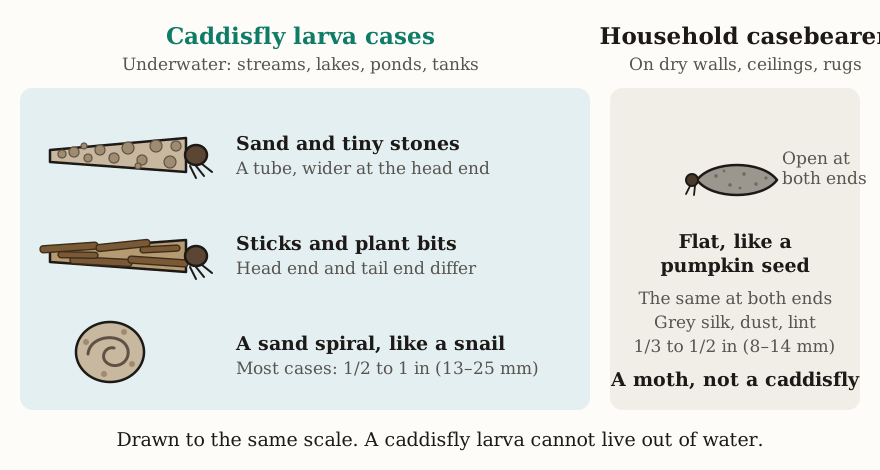
Caddisfly larva or household casebearer?
Where you find it
- Caddisfly larva
- Underwater in a stream, lake, pond or tank
- Household casebearer
- On walls, ceilings, under spider webs, on rugs
Case shape
- Caddisfly larva
- A tube, wider at the head end
- Household casebearer
- Flat, like a pumpkin or melon seed, wide in the middle
Case ends
- Caddisfly larva
- Different: head end and tail end
- Household casebearer
- The same at both ends; the larva can come out of either
Case material
- Caddisfly larva
- Sand, pebbles, sticks, leaves
- Household casebearer
- Grey silk with dust, sand, lint and hair stuck on
Case size
- Caddisfly larva
- Usually 1/2–1 in (13–25 mm)
- Household casebearer
- 1/3–1/2 in (8–14 mm)
What it is
- Caddisfly larva
- An aquatic insect (Trichoptera)
- Household casebearer
- A moth larva (Tineidae, the clothes moth family)
What it eats
- Caddisfly larva
- Plant matter and tiny prey underwater
- Household casebearer
- Old spider webs, and wool or other animal fibres
Where in the US
- Caddisfly larva
- Wherever there is clean fresh water
- Household casebearer
- Humid areas, mostly the Southeast and the Gulf Coast
On Reddit’s r/whatsthisbug, this mix-up comes up again and again. Often, a poster calls the cases “caddisfly larvae”, and the answers correct it to household casebearer. The UF/IFAS fact sheet on the moth says the larvae feed mostly on old spider webs and will eat wool. Vacuuming the cases and clearing old webs is usually enough to control them.
Because the casebearer is a relative of clothes moths, our clothes moth guide covers how to protect wool and stored fabrics. And if what you found on the floor is a small, hard, brown capsule instead of a soft case, it may be one of the fly pupae that turn up after a dead mouse or old food.
The caddisfly life cycle
A caddisfly goes through four stages: egg, larva, pupa and adult. In most species, the whole cycle takes about one year, and almost all of it is spent underwater as a larva. The adult that reaches your porch light is the last stage, and it lives a few weeks at most to mate and lay eggs.
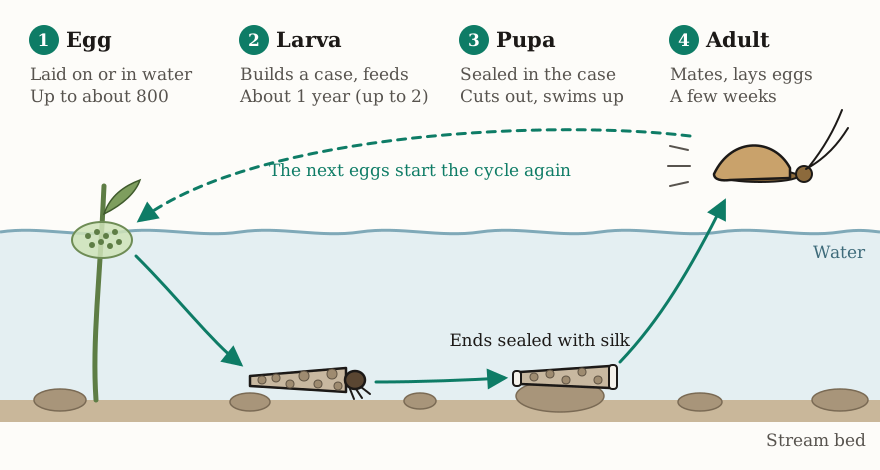
- Egg. The female lays a jelly-like mass or string of eggs on or in the water, or on plants just above it. Some females dive underwater to lay. One female can lay up to about 800 eggs.
- Larva. The larva hatches, builds its case or net, and feeds and grows for months. In most species this lasts about a year, and in cold northern or mountain water it can take two.
- Pupa. When it is fully grown, the larva seals its case, or spins a silk cocoon, and turns into a pupa underwater. The pupa has strong jaws for one job: cutting its way out.
- Adult. The pupa swims or crawls to the surface, splits its skin, and flies off as an adult. Huge numbers can emerge on the same few evenings, which is the “hatch” anglers wait for.
This kind of change, with a separate pupa stage, is called complete metamorphosis. Our guide to the pupa stage shows how it compares in moths, beetles and flies.
How long do caddisflies live?
A caddisfly lives about one year in total, and nearly all of it as a larva underwater. The adult stage is short. Most sources say a few weeks, but the figures range from “a few days” to “about a month”:
How long an adult caddisfly lives, by source
Orkin
- Adult lifespan given
- “Not more than a few days”
Missouri Dept. of Conservation
- Adult lifespan given
- “A few weeks”
Wikipedia
- Adult lifespan given
- “A few weeks” in some species
University of Kentucky
- Adult lifespan given
- “About a month”
The real answer depends on the species and the weather. Orkin’s “few days” is the outlier. No other source we read supports it, and it may come from confusing caddisflies with mayflies, whose adults often live only a day or two.
When do caddisflies come out?
In the US, adult caddisflies fly from spring to fall, with the biggest swarms on warm summer evenings. Each species has its own short season, so a river can have several waves a year. In the UK, The Wildlife Trusts list adults from February to November. Every swarm is temporary, and it passes on its own.
The timing shifts with the water temperature. In 2012, for example, Iowa State University Extension found swarms in mid-May, about two to three weeks earlier than usual after a warm spring. Fly anglers fish caddis hatches from about April to October, and some rivers have a well-known fall hatch they call the October caddis.
Why caddisflies swarm your house
Caddisflies swarm homes near a river, lake or canal because that is where they hatch, and they fly toward lights at night. Thousands can come off the water on the same evenings. They then gather at the brightest lights nearby: porch lights, windows, storefronts and campers. They cannot breed indoors, so the swarm always comes from the water.
Some places get far bigger swarms than others. A 2026 Entomology Today report on a study in the Journal of Medical Entomology says dams, dikes and reservoirs can make swarms worse. Still water collects the leaf litter that larvae eat, and changing flows reshape the river bed in their favour. Mass emergences have been recorded on the St. Lawrence, the Mississippi and the Winnipeg rivers.
The best-studied case is Bullhead City, Arizona, on the Colorado River. There, a net-spinning caddisfly called Smicridea fasciatella fills the air at sunrise and sunset on summer days, in a flurry that looks almost like snow. In 2021, 68% of surveyed residents called it intolerable. By 2024, after years of outreach and river management by the local pest abatement district, 61% said the swarms were tolerable at certain times of year.
So if you see more caddisflies this year, your house has not changed. The river had a good year, the hatch was strong, or the lights near you got brighter.
How to get rid of caddisflies
You cannot stop caddisflies hatching from a river, but you can make your home far less attractive to them. Light is the main draw. Turn off or dim outdoor lights during swarm season, use yellow or warm bulbs, and close the blinds at night. Those three steps cost little or nothing, and they work on every species.
How to stop caddisflies swarming your house
Turn off outdoor lights at dusk
During the weeks the swarm is on, switch porch and yard lights off, or put them on motion sensors so they are not lit all night.
Swap bright white bulbs for yellow bug lights or warm LEDs
Insects are less drawn to them. Orkin also suggests moving lights away from the house where you can.
Close blinds and curtains after dark
Indoor light through a window draws them to the glass and in through any gap. Blackout curtains help in the worst weeks.
Check screens, door sweeps and gaps
Caddisflies get indoors through open doors and torn screens, not by breeding inside.
Sweep or vacuum the dead ones in the morning
They are harmless to handle, and you can put them in the trash or the compost.
Use a fan on a porch or patio
The Bullhead City Pest Abatement District says moving air breaks up swarms, because they need still air to gather.
Wait it out
Each wave lasts a few weeks at most. The next one may come from a different species later in the year.
If lights, screens and curtains keep them out, no insecticide is needed. A spray only kills the ones already on the wall, and a new wave flies in from the river the next night. If you still choose one, use an EPA-registered product labelled for outdoor flying insects, on the house only, and follow the label exactly. The label is the law.
What does not work
Repellent sprays do not work. Iowa State University Extension says there “isn’t a repellent” for caddisflies. Bug zappers are no help either, because they use light to draw insects in, and light is what brings caddisflies to your home. Foggers kill only what is in the air at that moment.
Above all, do not try to clean the swarm away by “fixing” the water. A swarm is a sign of a healthy river, not a dirty one.
Why caddisflies are good news for a river
Caddisflies need clean, cool, oxygen-rich water, so lots of them usually mean a healthy river. Scientists count caddisflies, mayflies and stoneflies together in the EPT index, one of the most common tests of stream health. A stream with many kinds of all three is usually clean. When pollution lowers the oxygen, caddisflies are among the first to disappear.
They also hold the river’s food web together. Caddisfly larvae turn dead leaves into food for fish, and trout swallow them case and all. Adults feed trout, salmon, birds, bats and spiders, and they carry the river’s energy onto land. If your town has big hatches, the river is doing its job.
Caddisfly silk: underwater tape
Caddisfly silk sticks underwater, which almost no glue made by people can do well. University of Utah bioengineer Russell Stewart has studied it for years as a model for a surgical adhesive, “a wet Band-Aid” for closing wounds inside the body. In 2026, his team studied the main silk gene in 18 larvae of a Utah net-spinning species.
Caddisflies and fly fishing
To anglers, caddisflies are among the most important trout foods, and many call them sedges. Fly patterns copy every stage: the larva in or out of its case, the pupa swimming up, and the adult on the water. That is why a search for “caddis fly” often shows fly shops before field guides.
Hatches run from about spring to fall, often in the evening. Anglers fish the pupa as an “emerger” when the hatch starts, and switch to a dry fly such as an elk hair caddis once adults are on the surface. For the rest of the year, trout pick larvae off the stream bed. Some western anglers call the larvae “rock rollers”.
Caddisfly myths
Myth 1
Myth: “Caddisflies bite.”
Truth: They cannot. Their mouthparts are too small and soft, and they have no stinger.
Myth 2
Myth: “They are breeding in my house.”
Truth: They cannot breed indoors. Their larvae need open fresh water, so every caddisfly inside came in from outdoors.
Myth 3
Myth: “That flat case on my wall is a caddisfly larva.”
Truth: It is a household casebearer, a small moth. Caddisfly larvae live only in water.
Myth 4
Myth: “A big swarm means the river is dirty.”
Truth: It is the opposite. Caddisflies need clean, oxygen-rich water.
Myth 5
Myth: “Caddisflies are a kind of fly.”
Truth: They are their own order, Trichoptera, closer to moths than to flies.
Myth 6
Myth: “The “sandflies” by the river bite.”
Truth: In Buffalo and along the Niagara River, “sandfly” often means the caddisfly, which cannot bite. The true sand flies that bite are tiny flies of beaches and warm regions.
Myth 7
Myth: “They only live one day.”
Truth: That is closer to the mayfly. An adult caddisfly lives a few weeks by most accounts.
When to call someone
Most caddisfly problems need nobody but a light switch, because the insects cannot bite, sting or infest a home. Call for help only for an allergic reaction, symptoms that return every swarm season, a rented home with broken screens, or a swarm so big that it affects a whole street, a town or a business.
Who to call about caddisflies
911
- When
- Trouble breathing, or swelling of the face, lips or throat
- Why
- An allergic reaction can be an emergency
Doctor or allergist
- When
- Eye, nose or chest symptoms every caddisfly season
- Why
- They can test for insect allergy and help you plan
Landlord
- When
- You rent, and screens or door sweeps are torn or missing
- Why
- Repairs that keep insects out are often the owner's job
Your city or local pest abatement district
- When
- Swarms affect a whole street, a park or a marina
- Why
- Some river towns, like Bullhead City, manage swarms as a community
Licensed pest professional
- When
- A business with large lit walls or signs
- Why
- They can advise on lighting and, rarely, a labelled treatment
Pest control disclaimer. Photo-based identification can help, but it is not always perfect. For dangerous spiders, large infestations, or anything you are unsure about, contact a licensed pest control professional.
Caddisfly FAQ
Do caddisflies come inside to lay eggs?
Do caddisflies eat clothes?
Can you keep caddisfly larvae as pets?
What is caddisfly jewelry?
Do people eat caddisflies?
Is a caddisfly the same as a dobsonfly or a fishfly?
Related guides
Drain flies
Tiny fuzzy flies with roof-like wings that breed in sink and shower drains.
Clothes moths
The household casebearer's relatives, and how to protect wool and stored fabric.
Fly pupae
The small hard brown capsules on a floor, and the source they point to.
Pupa
What a pupa is, and how the stage differs in moths, beetles and flies.
Fungus gnats
Small dark flies from wet houseplant soil, and the plan that ends them.
Bug bite identification
Bites after an evening by the river? What the clues can and cannot tell you.
If you are still not sure what you found, try our free insect identifier with a clear photo, or run through six quick checks for naming any bug.
Sources
- UF/IFAS Featured Creatures IN129, Household casebearer, Phereoeca uterella
- Kraut A, et al. Occupational allergy after exposure to caddis flies at a hydroelectric power plant. Occupational and Environmental Medicine (1994)
- Kausar MA. A review on respiratory allergy caused by insects. Bioinformation (2018)
- Entomology Today, Caddisfly swarms: harmless, but really annoying (2026)
- Iowa State University Extension, Yard and Garden, Caddisflies: another one of life's frustrations (2012)
- Missouri Department of Conservation, Field Guide, Caddisflies
- Missouri Department of Conservation, Field Guide, Caddisfly larvae
- NC State University, ENT 425 General Entomology, Order Trichoptera
- University of Kentucky Entomology, Kentucky Critter Files, Caddisflies
- Macroinvertebrates.org, Order Trichoptera (larvae)
- US EPA, CADDIS, Step 1. Define the case (EPT index)
- ScienceDaily, Glue, fly, glue: caddisflies' underwater silk adhesive (University of Utah, 2010)
- University of Utah, Caddisfly silk gene evolves quickly without losing adhesive power (2026)
- Chesapeake Bay Program, Field Guide, Caddisflies
- Wikipedia, Caddisfly