What are fly pupae?
Fly pupae are flies in the stage between maggot and adult, inside a hard brown case. A house fly pupa is about 1/3 inch (8 mm) long and rounded at both ends, like a grain of brown rice. It does not eat or move, and in 2 to 6 days of warm weather a fly pushes out of one end.
The case is the maggot’s own last skin. When a maggot is fully grown, it stops eating, shrinks into a barrel shape, and its skin hardens and darkens around it. Inside, the true pupa forms and turns into a fly. That case is called a puparium. Orkin compares it to a butterfly cocoon, and the Illinois Department of Public Health calls it a cocoon, but it contains no silk: it is the maggot’s own skin. Our guide to what a pupa is explains how a puparium differs from a cocoon or a chrysalis.
New cases are cream or yellowish, then turn red, brown and finally nearly black as they age. Anglers call them “casters” and use them as bait. Pet owners buy them to hatch as live food for lizards and spiders. In a house, though, they mean flies are on the way.
Are they fly pupae? Check these
Check each clue below to narrow down what you saw.
Oval capsules with both ends rounded, about the size of a grain of rice
A pointed end means a mouse dropping.
Smooth and shiny, with faint rings around the body
Hairy or bristly means a carpet beetle skin.
Cream, red-brown, dark brown or black, often a mix of colors in one batch
They darken as they age.
Hard and dry. They do not crumble when you press one
Droppings crumble.
No legs, no head, no movement
Something pale that moves is a maggot that has not pupated yet.
Usually in a group, on a floor, under a rug or near the trash
The source is usually a few feet away.
Some may be empty, with one end missing like a popped lid
Those flies have already hatched.
Does one maggot make one fly?
Yes. Each maggot forms one pupa, and each pupa releases one fly. So twenty full cases on the floor mean up to twenty flies. Empty cases, with a round cap missing at one end, have already hatched. Those flies are probably at your windows now.
Fly pupae or something else?
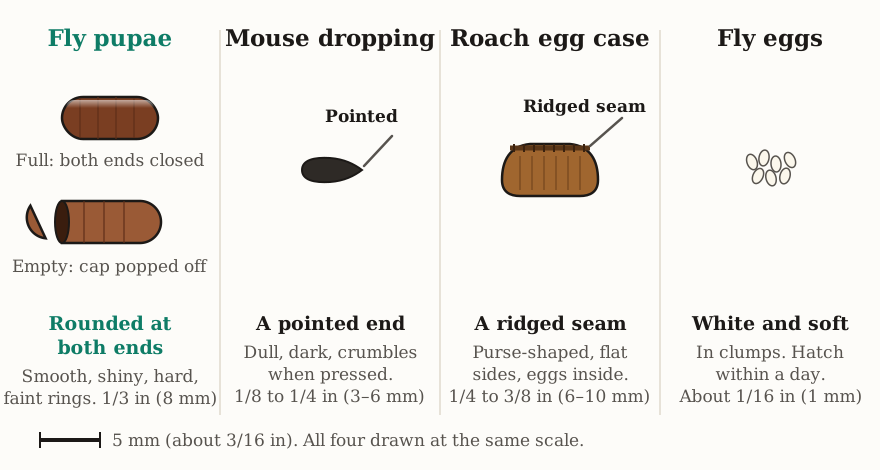
Brown capsules on a floor can also be mouse droppings, cockroach egg cases or carpet beetle skins. Pupae are the only ones that are smooth, shiny and rounded at both ends, about 1/3 inch (8 mm) long. Mouse droppings have a pointed end, and roach egg cases have a ridge along the top.
Fly pupae or a look-alike? The feature that separates them
Smooth, shiny, both ends rounded, faint rings
- What it is
- Fly pupa
- Size
- About 1/3 in (8 mm) for a house fly
- What it means
- Maggots fed nearby
At least one pointed end, dull, crumbles when crushed
- What it is
- Mouse dropping
- Size
- 1/8–1/4 in (3–6 mm)
- What it means
- Mice. Do not sweep or vacuum (see below)
Bigger, blunt ends, like a small raisin
- What it is
- Rat dropping
- Size
- 1/2–3/4 in (13–19 mm)
- What it means
- Rats
Purse-shaped, with a ridged seam along one edge
- What it is
- Cockroach egg case
- Size
- About 1/4–3/8 in (6–10 mm)
- What it means
- Roaches; 30 or more eggs inside
Hairy or bristly, hollow, papery
- What it is
- Carpet beetle shed skin
- Size
- The size of the larva
- What it means
- Carpet beetle larvae in fabric or lint
Tiny, six-sided, sand-like piles
- What it is
- Drywood termite pellets
- Size
- Under 1/25 in (1 mm)
- What it means
- Termites in wood above
White, soft, in clumps
- What it is
- Fly eggs
- Size
- About 1/16 in (1 mm)
- What it means
- Flies laid eggs here; maggots within a day
Inside a fuzzy silk cocoon, often on a ceiling
- What it is
- Pantry moth pupa
- Size
- About 1/4–7/16 in (6–11 mm)
- What it means
- Infested flour, cereal or birdseed
Sizes are typical, from the sources listed at the end. If yours match a row other than the first, our guides to German cockroaches, carpet beetles and drywood termites take it from there.
Fly pupae vs mouse droppings
This is the most common mix-up, and people argue about it online. On Reddit’s r/CleaningTips, one thread with more than 70 comments split between the two answers. The test is the ends. Mouse droppings have at least one pointed end and look dull, like small dark grains of rice. Pupae are rounded at both ends, smooth and a little shiny, with faint rings.
Mouse droppings also turn up along walls, in drawers and behind appliances, where mice run, rather than in one patch. If they are droppings, do not sweep or vacuum them. That can lift dust from mouse urine and droppings into the air. Follow the CDC clean-up steps further down instead.
Fly pupa or cockroach egg?
A cockroach egg case is shaped like a small purse, with a ridged seam along one edge where the young will split it open. A German cockroach’s is light brown and about 1/4 to 1/3 inch (6 to 8 mm) long, and the female carries it until just before it hatches. An American cockroach’s turns almost black and is glued near food. A fly pupa has no seam, no ridge and no flat side.
If you are still not sure, our photo bug identifier can tell you in a few seconds.
Which fly made them?
Most pupae found indoors belong to house flies or blow flies. House fly pupae are about 1/3 inch (8 mm) long. Blow fly pupae are a little longer and usually mean a dead animal nearby. Fruit fly pupae are tiny, about 1/8 inch (3 mm), and sit near fruit or drains rather than on open floors.
Whose pupae are they?
About 1/3 in (8 mm), red-brown to black, rounded
- Fly
- House fly
- Where you find them
- Floors, under rugs, near bins
- Usual source
- Trash, food waste, pet waste, compost
About 3/8 in (9–10 mm), red-brown to black
- Fly
- Blow fly (bluebottle, greenbottle)
- Where you find them
- Floors, below a wall, ceiling or chimney
- Usual source
- A dead mouse, rat or bird, or a full trap
About 1/2 in (12 mm), dark
- Fly
- Flesh fly
- Where you find them
- Same as blow flies
- Usual source
- A dead animal
About 1/8 in (3 mm), yellowish brown, two horns at one end
- Fly
- Fruit fly
- Where you find them
- Sides of the fruit bowl, bin rims, sink corners
- Usual source
- Overripe fruit, a drain, a recycling bin
Flat, oval, with two breathing horns, coating a surface
- Fly
- Phorid fly
- Where you find them
- Near drains, under a floor slab
- Usual source
- A broken drain pipe or rotting matter
Very small, in the slime
- Fly
- Drain fly
- Where you find them
- Inside drains
- Usual source
- The film inside the pipe
Very small, in soil
- Fly
- Fungus gnat
- Where you find them
- Potting soil
- Usual source
- Wet houseplant soil
Large, dark, flat larvae and pupae
- Fly
- Black soldier fly
- Where you find them
- Compost bins, outdoors
- Usual source
- Compost; harmless
Sizes are typical. Cluster flies are not on this list because they never breed indoors. Three of these have their own guides: phorid flies, drain flies and fungus gnats.
House fly pupae
These are the most common kind on a floor. They are about 1/3 inch (8 mm) long, bluntly rounded at both ends, and change from yellow to red, brown and black as they age. The flies that come out are gray, about 1/4 inch long, with four dark stripes on the back. They came from moist rotting matter, most often a trash can, compost pail or pet waste.
Blow fly pupae and a dead animal
Blow fly pupae look like house fly pupae, only a little bigger: about 3/8 inch (9 to 10 mm) for the common green bottle fly. The flies that hatch are shiny metallic blue or green. Finding them indoors, says the University of Wisconsin’s insect lab, “often indicates a dead mouse”. Purdue adds dead rodents in wall voids or ceilings, and traps or glue boards left too long.
Flesh flies come from the same places. They are unusual because the female does not lay eggs. She deposits live young maggots, 40 to 80 at a time.
Fruit fly pupae
Fruit fly pupae are tiny, about 1/8 inch (3 mm), yellowish brown and seed-like, with two little horns at one end. Fruit fly maggots crawl out of the food to a drier spot to pupate, so you find the pupae on the sides of the fruit bowl, the rim of a bin or the corner of a sink. The whole cycle takes about 10 days in a warm kitchen.
To stop them, throw out overripe fruit, rinse recycling, and clean the drain and the bin. Wipe the pupae off with a damp cloth. They will not survive in the trash.
Black soldier fly pupae in compost
Large, dark, flattened maggots and pupae in a compost bin are usually black soldier flies. The larvae reach about 1 inch (27 mm) long. The adults are black and wasp-like, but Oregon State Extension notes that they do not bite or carry disease, and they rarely come indoors. They are good for compost, so leave them.
Why are there fly pupae in my house?
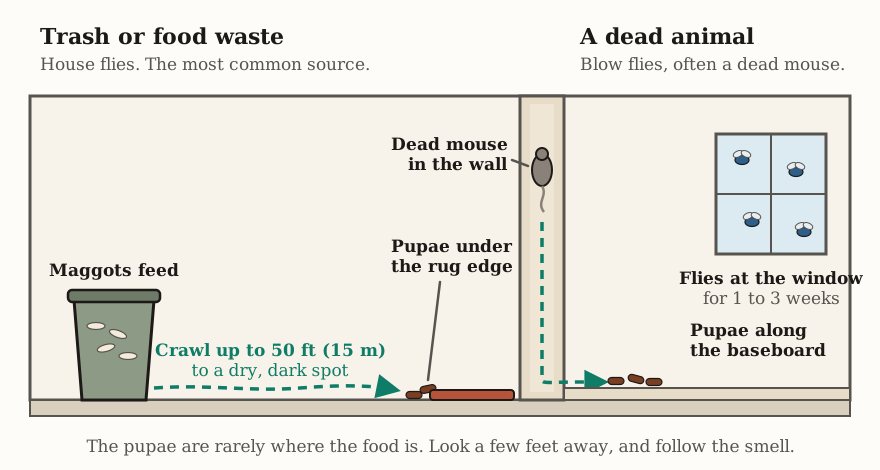
Pupae on a floor mean maggots fed somewhere close by and then crawled away to pupate. A full-grown house fly maggot can crawl up to 50 feet (15 m) looking for a dry, cool, dark spot. So the source is usually in the same room or the next one, not where the pupae are.
The usual sources:
- A trash can or kitchen bin, especially one with meat scraps, used diapers or a torn bag underneath.
- Food waste: a forgotten bag of potatoes, spilled pet food, a compost pail, food under an appliance.
- Pet waste: litter boxes, a dog run, a missed accident on a rug.
- A dead animal: a mouse, rat or bird in a wall, ceiling, attic, chimney or crawl space, or in a trap that was never checked.
- Damp, dirty fabric: a wet towel or rug with food on it, as one Reddit user found.
A dead mouse in the wall
A sudden crop of pupae with no obvious trash, often with big metallic blue or green flies at the windows, usually means a dead animal. You may notice a rotten smell too. In a University of Wolverhampton study inside a house, blow fly maggots traveled up to about 28 feet (8.5 m) from where they started, and they used ceiling spaces to move between rooms and floors. That is why pupae can show up a room away from the body.
Most of the time, the body is in a wall, under a floor, in the attic, or behind a stove or fridge. If you set mouse traps or glue boards recently, check them first. If you cannot find it, the problem ends on its own: Texas A&M says flies may keep emerging for 1 to 3 weeks, after which they should disappear.
Where to look for the source
Start with the spot where the pupae are thickest and work outward. Check every bin, under and behind the fridge and stove, under the sink, the pet’s bowl and litter box, and any cupboard with root vegetables. Then sniff along walls, closets and baseboards. If one area smells worse, or flies gather at one window, the source is usually near it.
How long until fly pupae hatch?
House fly pupae hatch in about 2 to 6 days in warm weather, but they can take 17 to 27 days in a cool room. Blow fly pupae take about 7 to 10 days. Fruit fly pupae take about 4 days. So if you find full cases, expect flies within a week unless you remove them.
How long house fly pupae take to hatch, by source
University of Florida (UF/IFAS)
- Pupa stage
- 2–6 days
- Conditions
- At 90–99F (32–37C)
University of Florida (UF/IFAS)
- Pupa stage
- 17–27 days
- Conditions
- At about 57F (14C)
LSU AgCenter
- Pupa stage
- 2–6 days
- Conditions
- Depending on temperature
UC Davis Bohart Museum
- Pupa stage
- 3–6 days
- Conditions
- Depending on temperature
UNH Extension
- Pupa stage
- 3 days to 4 weeks
- Conditions
- Depending on temperature and humidity
The sources agree once you account for heat: a few days in summer, several weeks in a cool room.
How long other fly pupae take
Green bottle fly (a blow fly)
- Pupa stage
- About 7 days at 81F (27C); about 10 days at 70F (21C)
- Source
- UF/IFAS
Blow flies
- Pupa stage
- About 8 days
- Source
- NC State Extension
Flesh fly
- Pupa stage
- About 16 days
- Source
- UF/IFAS
Fruit fly
- Pupa stage
- About 4–5 days in warm weather
- Source
- Insects Limited
Phorid fly
- Pupa stage
- About 7 days
- Source
- Penn State
Fungus gnat
- Pupa stage
- About 5–6 days
- Source
- Ohio State
Drain fly
- Pupa stage
- 20–40 hours
- Source
- Oklahoma State
Are they empty or full?
Look at the ends. An empty case has a round cap missing at one end, or the cap is hanging open, and it feels light and hollow. The fly pushed it off with a balloon-like sac on its head, called a ptilinum. A full case is closed at both ends and feels firm. Full cases still need to go, because each one will release a fly.
How long does it take a maggot to turn into a fly?
A house fly takes about 7 to 10 days from egg to fly in warm weather. The egg hatches in 8 to 20 hours, the maggot feeds for about 4 to 7 days, and the pupa lasts 2 to 6 days. Blow flies take a little longer. So yes, maggots turn into flies, and the pupa is the step in between.
Can fly pupae crawl?
No. A pupa has no working legs and cannot move. The maggots crawled to that spot before they pupated. If you see something small, pale and moving on the floor, it is a maggot that has not pupated yet. Those will form more pupae within a day or so.
How to get rid of fly pupae
Sweep or vacuum the pupae, then find and remove the source, or new ones will keep appearing. Sprays are rarely needed: UC IPM says that in most home situations, pesticides are not needed or recommended. The fix costs almost nothing. It takes a broom, a bag and some cleaning.
How to get rid of fly pupae in the house
Sweep or vacuum every pupa
Check under rugs, furniture edges and along baseboards. Seal them in a bag and put it in an outdoor bin with a lid. Empty the vacuum outside afterward.
Find the source
Check bins, food storage, pet areas and under appliances, then follow any smell to walls, closets, the attic or the crawl space.
Remove it
Throw out the spoiled food or trash. If it is a dead animal you can reach, follow the CDC steps below. If you cannot reach it, call a wildlife or pest professional.
Clean the spot
Wash bins with hot, soapy water and let them dry. Virginia Tech notes that boiling water kills maggots in a garbage can cheaply. Clean up any fluid where a dead animal lay.
Deal with the flies that hatch
Open a window, use a fly swatter, or hang a sticky fly strip. Blow flies that hatch indoors usually die quickly, the University of Wisconsin's insect lab notes.
Keep it from coming back
Use bins with tight lids, empty them often, rinse recycling, bag meat scraps, and pick up pet waste daily.
What kills fly pupae?
Removing them is what works. Sweep them up and throw them out, and the flies inside never hatch. Extension guides do not recommend spraying them. They point to the maggot’s food as the target: UC IPM calls removing the place where larvae grow “the preferred method”.
Should you spray for fly pupae?
Usually not. If sanitation and exclusion are successful, insecticide treatments are not required. Texas A&M puts it plainly: insecticides alone are rarely successful. A spray does nothing about the trash or the dead animal, so the next batch of maggots will still come. If flies keep coming after the source is gone, use a product registered by the EPA for flies indoors, and follow the label exactly. The label is the law.
Are fly pupae dangerous?
The pupae themselves are not. They cannot bite, sting or move, and they do not eat. The risk is the flies and their source. House flies can carry germs such as Salmonella, Shigella and E. coli from garbage and waste to food. So clean the source, keep food covered, and wash hands after handling bins or a dead animal.
Keep pets and children away from a dead animal and the area around it until it is cleaned.
Fly pupae on farms, and as bait or pet food
On farms and stables, the pupae are where natural pest control happens. Two kinds of tiny parasitic wasps, Muscidifurax and Spalangia, lay an egg inside a fly pupa, and a wasp hatches out instead of a fly. Farms buy and release them. Cornell warns that spraying can kill these wasps while hardly touching the flies.
Anglers buy bluebottle fly pupae as “casters” for fishing bait. Reptile and spider keepers buy house fly pupae to hatch as live food.
Fly pupae myths
Most myths about them come from how suddenly they appear. One day there is nothing, the next there are dozens. Here are seven common myths, each with what is actually true. The biggest is that they are eggs, when they are really the last stage before the fly.
Myth 1
Myth: “Those brown things are fly eggs.”
Truth: Fly eggs are white, soft and about 1/16 inch (1 mm) long. Brown capsules are pupae, the last stage before a fly.
Myth 2
Myth: “The flies came from nowhere.”
Truth: Flies do not just appear. Every pupa means a maggot fed on something nearby.
Myth 3
Myth: “Cleaning the floor solves it.”
Truth: It removes the pupae you can see. The source is still there, and it will send more maggots.
Myth 4
Myth: “Fly pupae are mouse droppings.”
Truth: Droppings have a pointed end and crumble. Pupae are rounded at both ends and hard.
Myth 5
Myth: “Spraying the pupae kills the problem.”
Truth: Extension guides target the source, not the pupae. A spray leaves the trash or dead animal in place.
Myth 6
Myth: “All flies lay eggs.”
Truth: Flesh flies deposit live maggots instead. Some extension pages still say they lay eggs.
Myth 7
Myth: “Cluster flies at the window mean pupae in the house.”
Truth: Cluster flies grow up on earthworms outdoors and only shelter indoors. They do not breed inside.
When to call someone
Most cases end with a broom and an emptied bin. Call for help when you cannot find or reach the source, when you rent and the source is in the building, or when flies keep coming more than 3 weeks after you removed the source.
Who to call about fly pupae
Nobody
- When
- You found the source and removed it
- Why
- New pupae should stop within a few days
Wildlife or pest professional
- When
- You smell a dead animal you cannot reach
- Why
- It has to be found and removed from the wall, ceiling or attic
Landlord
- When
- You rent and the source is in a wall, attic, shared bin or drain
- Why
- Removal and repairs are usually the owner's job
Plumber
- When
- Pupae keep appearing near a drain or floor slab
- Why
- A broken drain pipe can feed phorid and drain flies
Doctor, or Poison Control 1-800-222-1222
- When
- Someone swallowed a cleaning product or pesticide
- Why
- The chemical, not the pupae, is the risk
Pest control disclaimer. Photo-based identification can help, but it is not always perfect. For dangerous spiders, large infestations, or anything you are unsure about, contact a licensed pest control professional.
Fly pupae FAQ
Why do I keep finding fly pupae in my house?
How many flies will come out?
Can fly pupae survive in the vacuum?
Are fly pupae the same as maggots?
Why are there fly pupae on my bed?
Are fly pupae black or brown?
Can you buy fly pupae?
Related guides
Pupa
What a pupa is, and how a fly's puparium differs from a cocoon or a chrysalis.
Phorid flies
Tiny humpbacked flies whose flat pupae collect near drains and rotting matter.
Drain flies
Fuzzy moth flies that breed and pupate in the slime inside your drains.
Fungus gnats
Small dark flies from wet houseplant soil, and the plan that ends them.
German cockroach
The roach whose light brown egg cases get mistaken for fly pupae.
Carpet beetles
Bristly shed skins and fuzzy larvae, the other small brown things on floors.
Sources
- UF/IFAS Featured Creatures IN205, House fly, Musca domestica (archived copy, 2025)
- UF/IFAS Featured Creatures EENY-502, Common green bottle fly, Lucilia sericata
- UF/IFAS Featured Creatures EENY-495, Red-tailed flesh fly
- UC IPM, Flies (Pest Notes 7457)
- University of Wisconsin-Madison Insect Diagnostic Lab, Blow flies indoors (2022)
- Purdue Extension E-234, Flies in and around homes
- NC State Extension, Blow fly biology and management (2024)
- UNH Extension, House fly fact sheet
- LSU AgCenter, House fly
- Cornell NYS IPM, Fruit flies
- Cornell Biological Control, Muscidifurax raptor
- CDC, How to clean up after rodents (2024)
- National Park Service, Conserve O Gram 3/12, Identifying mouse and rat damage
- UF/IFAS Featured Creatures EENY-002, German cockroach
- Texas A&M AgriLife Extension ENTO-050, Indoor flies and their control