What are termites?
Termites are small social insects that live in colonies and feed on wood and other plant material. They digest cellulose, the tough fiber in wood, paper and cardboard. Scientists now class them as a group of cockroaches, in the order Blattodea. About 45 species live in the continental US, and nearly 30 of them can damage wood, according to the University of Arizona.
A termite colony works like a family business. Workers do the feeding and building, soldiers guard the tunnels, and a king and queen produce the young. Once a colony is mature, it sends out winged swarmers to start new colonies. Those swarmers are the termites most people ever see.
In nature, termites are recyclers. They break down dead trees, stumps and fallen branches and return them to the soil. The trouble starts when a colony finds the wood in a house, because to a termite a floor joist is just another fallen log.
Are termites ants?
No. They are sometimes called “white ants”, but the two are not closely related. Ants are a kind of wasp, while termites descend from cockroaches. A 2007 study by Inward, Beccaloni and Eggleton in Biology Letters, titled “Death of an order”, concluded that termites are “social cockroaches”, and most entomologists now agree.
The confusion is easy to understand. Both live in colonies, and both send out winged swarmers in spring. But a termite’s body is straight, with no narrow waist, and its antennae are straight like a string of beads.
What do termites look like?
Termites look different depending on their job in the colony. Workers are cream-colored, wingless and about 1/8 inch (3 to 4 mm) long. Soldiers look like workers with a large brown head and jaws. Swarmers are darker, often brown to black, and about 3/8 inch (10 mm) long including their wings.
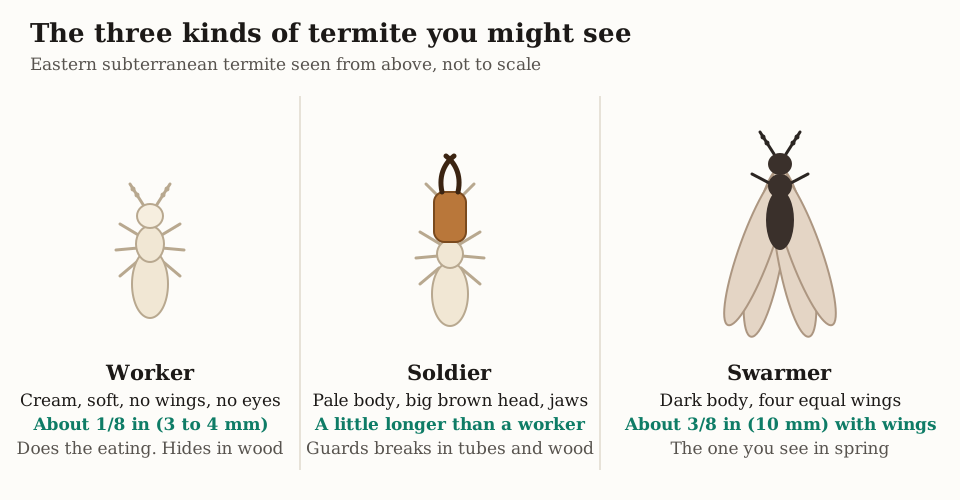
Termite castes: what each one looks like
Soft, cream or white body, no wings, looks like a grain of rice with legs
- Caste
- Worker
- Size
- About 1/8 in (3–4 mm)
- Where you see it
- Inside broken wood or a broken mud tube
Same body, but a big brown or orange head with dark jaws
- Caste
- Soldier
- Size
- About 1/6–1/5 in (4–5 mm) in Formosan termites
- Where you see it
- Guarding a break in a tube or in wood
Dark brown to black body, four long, equal wings
- Caste
- Swarmer (alate)
- Size
- About 3/8 in (10 mm) with wings for the eastern subterranean termite; 1/2–5/8 in (12–15 mm) for Formosan
- Where you see it
- By windows, lights, sinks and tubs, in spring
No wings, short wing stubs, dark body
- Caste
- A swarmer that has dropped its wings
- Size
- Shorter than with wings
- Where you see it
- On floors and sills after a swarm
Huge, swollen pale body
- Caste
- Queen
- Size
- Much larger than the others
- Where you see it
- Only deep inside the nest
Sizes are from UF/IFAS and Texas A&M, and they vary by species, so treat them as typical. Sources disagree on workers: UF/IFAS gives about 1/8 inch, while Texas A&M gives 1/4 to 3/8 inch.
Is it a termite? Check these
Check each clue below to narrow down what you saw.
Straight antennae that look like a string of tiny beads
Bent, elbowed antennae mean an ant.
A thick body with no pinched waist between the middle and the back
A narrow waist means an ant or a wasp.
If it has wings: four wings, all the same length, and much longer than the body
An ant's front wings are longer than its back pair.
Wings that snap off easily and lie around in small piles
Piles of wings indoors mean a swarm came out inside.
Workers that are soft, pale and almost see-through, never black and shiny
Shiny black wingless insects are ants.
How big is a termite?
Most termites a homeowner sees are 1/8 to 1/2 inch (3 to 13 mm) long. Workers are the smallest, at about 1/8 inch. Swarmers of the common eastern subterranean termite are about 3/8 inch with wings. Formosan swarmers are a little bigger, at 1/2 to 5/8 inch, and drywood and dampwood swarmers are bigger again.
Can you see termites with the naked eye?
Yes, but you rarely do. Workers are big enough to see, but they avoid light and open air and stay inside wood, soil and mud tubes. So most people see swarmers, shed wings or damage, never the workers. Workers have no eyes at all, and they find their way by touch and smell.
What do baby termites look like?
Young termites look like small, pale workers. They do not have a grub-like larva the way beetles and flies do. They hatch as tiny versions of the adults and molt as they grow. So “termite larvae” in a broken piece of wood are almost always workers, and seeing them there means an active colony.
Termite or flying ant?
Check three things: the antennae, the waist and the wings. A termite has straight antennae, a thick waist and four wings of equal length. A flying ant has bent, elbowed antennae, a narrow pinched waist, and front wings longer than the back pair. Color and size will not tell them apart.
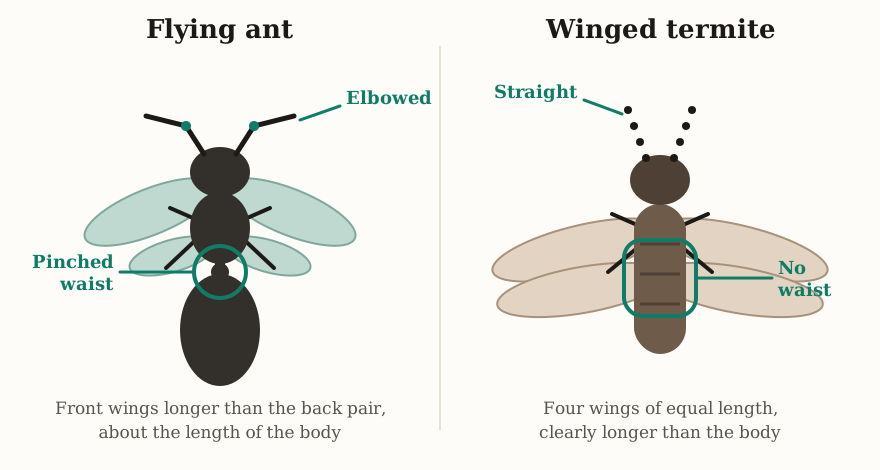
Termite or a look-alike? The feature that separates them
Straight, beaded antennae, thick waist, four equal wings
- What it is
- Termite swarmer
- What it means
- A colony nearby. Check where they came from (see below)
Elbowed antennae, pinched waist, front wings longer
- What it is
- Flying ant
- What it means
- Ants mating. Outdoors, no action. Indoors, a nest in the house
Elbowed antennae, pinched waist, large and black or red-black, no mud in its tunnels
- What it is
- Carpenter ant
- What it means
- Ants nesting in damp wood. Clean, sawdust-filled tunnels, never mud
Long, slim body, swollen front feet, lives in silk tunnels outdoors
- What it is
- Webspinner
- What it means
- Harmless. Spins silk tunnels on bark, rocks and leaf litter, and does not attack houses
No wings, large and alone, with an elbowed antenna and a pinched waist
- What it is
- Ant queen
- What it means
- One ant looking for a nest site
If the antennae are bent, it is an ant. Our guide to flying ants covers which ant swarms in which month, and the one on carpenter ants explains how their damage differs from termite damage.
Which kind of termite is it?
The US has four kinds of termite that matter to a homeowner: subterranean, Formosan, drywood and dampwood. Where you live narrows it down fast. The eastern subterranean kind lives in almost every state. Formosan colonies are in the Southeast, Hawaii and parts of California. Drywood colonies live in warm southern and coastal areas, and dampwood mostly along the Pacific coast. Florida has the most of all: 20 established species, says UF/IFAS.
The kind matters because each one is treated differently. Subterranean and Formosan termites live in the soil, so treatment goes into the soil. Drywood termites live inside the wood itself, so treatment goes into the wood or the whole building.
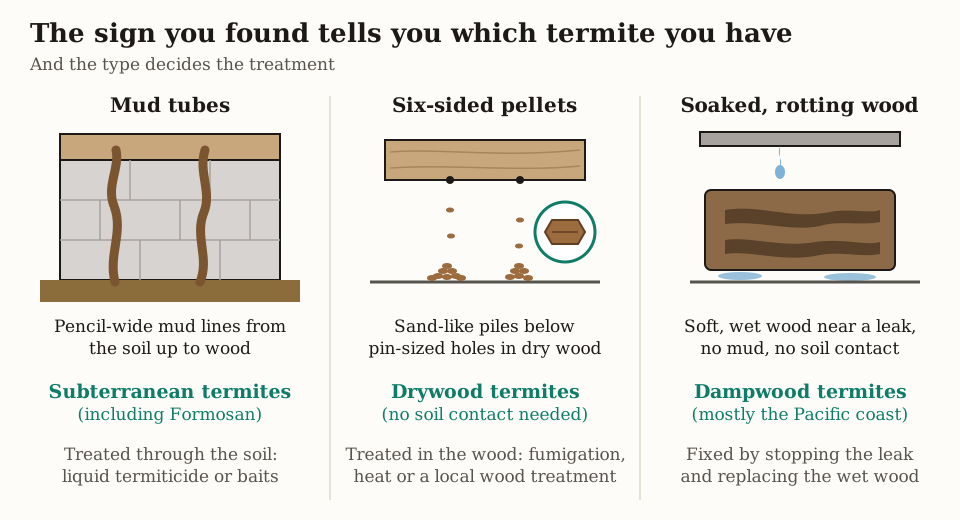
The four US termites: how to tell which one you have
Mud tubes, black swarmers in daytime in spring
- Type
- Eastern subterranean (and other native subterranean termites)
- Where in the US
- Nearly every state, most common in the South and East
- What it leaves
- Mud tubes; mud-lined tunnels along the grain
- How it is treated
- Liquid termiticide in the soil, or bait stations
Mud tubes, swarms of tan, amber swarmers at dusk around lights, many soldiers
- Type
- Formosan subterranean
- Where in the US
- Southeast from Texas to Virginia, Hawaii, southern California
- What it leaves
- Large mud tubes, sometimes a hard “carton” nest in a wall
- How it is treated
- Same as subterranean, sooner and more thorough
Six-sided pellets below tiny holes, no mud
- Type
- Drywood
- Where in the US
- California and the West Coast, Arizona, Florida, the Gulf coast, Hawaii
- What it leaves
- Piles of hard pellets like coarse sand
- How it is treated
- Fumigation (tenting), heat, or treating the wood
Very large swarmers, soaked or rotting wood, no mud
- Type
- Dampwood
- Where in the US
- Mostly the Pacific coast and mountains; a few kinds in coastal Florida
- What it leaves
- Rounded pellets in wet wood
- How it is treated
- Fix the leak and replace the wet wood
Subterranean termites
Subterranean termites nest in the soil and travel up into houses through mud tubes. They cause most termite damage in the US. The eastern subterranean termite, Reticulitermes flavipes, is the one most Americans have. Its colonies hold 100,000 to 1,000,000 insects, and they forage up to 150 feet (46 m) from the nest.
They need moisture, so they keep to the soil and build tubes of soil and saliva over anything dry or exposed. A tube about the width of a pencil running up a foundation is their signature. Inside the house, they eat the soft parts of wood along the grain and leave the tunnels lined with mud.
Formosan termites
Formosan termites, Coptotermes formosanus, are an invasive subterranean termite from southern China and Taiwan. They are the most destructive termite in the US because their colonies are huge. An average colony holds about 350,000 workers, and they can eat a foot of a 2x4 in about 25 days.
According to UF/IFAS, they are established across the Southeast, in Hawaii and in southern California, and have been found as far north as Virginia and inland to Tennessee. Their swarmers are tan to amber, about 1/2 to 5/8 inch with wings, and fly after sunset toward lights. A crowd of soldiers with oval orange heads at a break in a mud tube points to Formosan termites.
Drywood termites
Drywood termites live inside dry wood with no contact with the soil. In the West, the western drywood termite swarms on sunny days, from late September through November in southern California. In the Southeast, the most common kind swarms at night toward lights. A swarmer flies into a crack in an attic, a window frame or furniture, and the colony stays in that piece of wood. Colonies are small, often a few thousand, but a house can have many of them.
The clue is their droppings. They push hard pellets out of small holes, 1 to 2 mm (under 1/16 inch) across. The pellets pile up below like coarse sand or ground coffee. Under a magnifier, each pellet has six flat sides, which no other house pest makes.
Dampwood termites
Dampwood termites live in wood that is wet or already rotting, such as logs, stumps and wood next to a leak. They are the largest kind in the US: Pacific dampwood swarmers are 3/4 to 1 inch (19 to 25 mm) long with wings, by Washington State and Oregon State figures. In the Pacific Northwest and northern California, they swarm in late summer and fall, often after rain, and fly to lights at dark. Florida has its own dampwood termites in coastal woodlands and mangroves, which rarely bother houses.
They rarely damage a dry, sound house. Finding them indoors almost always means a leak or water damage, and fixing the water fixes the termite problem.
Termite swarmers: what a swarm means
A swarm is how a mature termite colony starts new ones. Winged males and females fly out, pair up, drop their wings and look for a place to start a nest. One swarmer, or a few that die on a sill, does not mean your house is infested. A swarm from inside a wall, or piles of wings indoors, does.
Swarmers cannot damage wood themselves. The University of Kentucky notes that swarmers that come out inside a house only live for about a day, and you can remove them with a broom or vacuum. Most die without starting a colony.
The real question is where they came from. Use this as a guide:
What a termite swarm means
One or two swarmers inside, near an open door, window or light
- What it likely means
- They flew in from outside
- What to do
- Keep one in a jar. Watch for more, and check for tubes and wings
A swarm in the yard, a woodpile or a stump
- What it likely means
- A colony in the yard
- What to do
- No emergency. Inspect the foundation for mud tubes. Consider an inspection
Many swarmers coming out of a wall, floor, baseboard or window frame
- What it likely means
- A colony feeding inside the house
- What to do
- Call for a professional inspection this week
Piles of shed wings on sills or floors, again and again
- What it likely means
- A swarm happened indoors
- What to do
- Same as above
Dead swarmers in a sink, tub or by a bathroom window
- What it likely means
- A colony nearby, often under the slab
- What to do
- Inspection, especially if you have no termite contract
Collect a few swarmers in a jar or a zip bag, or tape them to an index card. An inspector can tell the species from them, and you can check them against the ant features above.
When do termites swarm?
Most termites swarm in spring, but the month and time of day depend on the species and the region. The eastern subterranean kind flies in daytime, on warm, still afternoons after rain, from late winter in Florida to late spring in the North. Formosan swarmers fly after sunset, around lights, from April to June. Drywood and dampwood swarms mostly come in late summer and fall, though some drywood termites in Florida fly in spring.
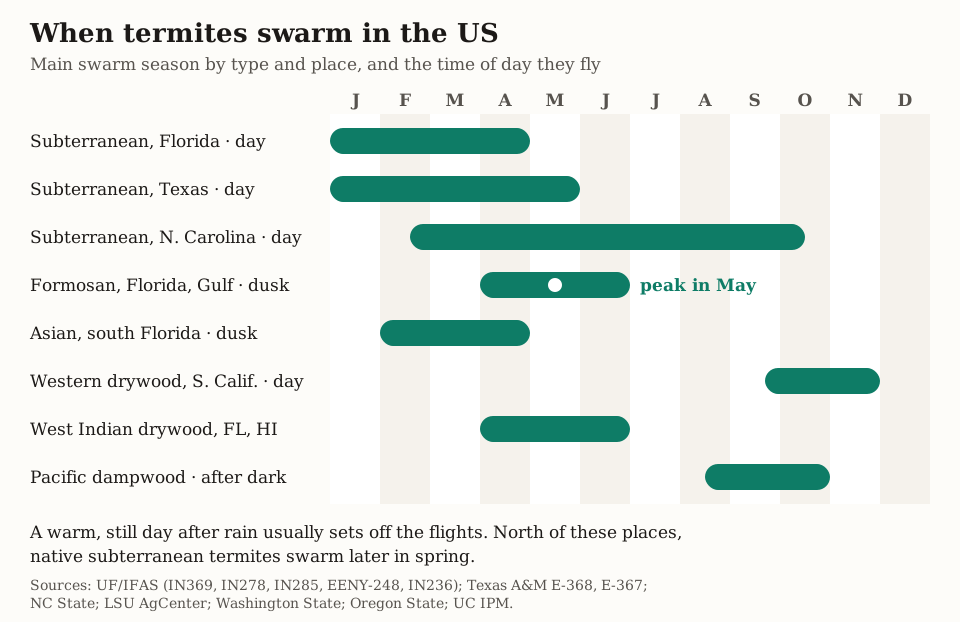
The weather sets the exact day. A warm day after rain often triggers swarms across a whole town at once, which is why pest companies get many calls in the same week. Latitude sets the month: Texas A&M reports native swarms in January and February in South Texas, but not until April or May in the Panhandle.
Can termites swarm at night?
Yes. Texas A&M puts it simply: Formosan termites swarm at night and are attracted to lights, while native subterranean termites swarm during the day, usually in the afternoon. The common southeastern drywood termite and the Pacific dampwood termite also fly toward lights after dark, so you find them around porch lights, windows and screens. A swarm at a porch light on a warm May evening in Louisiana or Florida suggests the Formosan kind.
Signs of termites in a house
The clearest signs of termites are mud tubes on a foundation or wall, piles of shed wings, small piles of six-sided pellets, and wood that sounds hollow or crushes easily. Mud points to the subterranean kind. Pellets point to drywood. Bubbling paint, sagging floors and sticking doors can be signs too, but water causes those more often.
Signs of termites, and what each one tells you
Mud tubes
- What it looks like
- Brown, dirt-colored tunnels about the width of a pencil, running up a foundation, pier, pipe or wall
- Which termite
- Subterranean or Formosan
- How sure it is
- Very sure. Break one open: live, pale workers mean an active colony
Shed wings
- What it looks like
- Small piles of identical, see-through wings on sills, floors and in cobwebs
- Which termite
- Any swarming termite
- How sure it is
- Sure, if they are the four equal-length kind
Pellets (frass)
- What it looks like
- Hard, tiny, six-sided pellets in piles below pinholes
- Which termite
- Drywood
- How sure it is
- Very sure under a magnifier
Hollow or crushed wood
- What it looks like
- Wood that sounds papery when tapped, or gives way to a screwdriver, with mud or layers inside
- Which termite
- Subterranean (mud), drywood (clean, smooth chambers with pellets)
- How sure it is
- Fairly sure, if you see mud or pellets inside
Blistered or bubbling paint, rippled drywall
- What it looks like
- Wavy, swollen surface with pinholes
- Which termite
- Subterranean feeding just behind it
- How sure it is
- Possible. Water damage looks the same
Sticking doors or windows, sagging floors
- What it looks like
- Frames that swell or shift
- Which termite
- Possible late sign
- How sure it is
- Weak alone. Moisture is more common
Clicking or rustling in a wall
- What it looks like
- Soldiers bang their heads to warn the colony
- Which termite
- Any
- How sure it is
- Weak. Hard to hear and easy to mistake
How to check your house for termites
Walk the outside of the house first, then the inside, with a flashlight and a flat screwdriver. It takes about an hour. Look at the places termites reach first: where soil, wood and moisture meet.
Walk the foundation
Look for mud tubes on the concrete, brick, piers, pipes and steps. Check behind shrubs and under decks and porches.
Check wood that touches soil
Probe deck posts, fence posts near the house, door frames and siding at ground level with a flat screwdriver. Sound wood resists. Damaged wood gives way.
Look under the house
In a crawl space, check the tops of the foundation walls, piers and the wood resting on them. In a basement, check the sill plate where the house sits on the foundation.
Check the rooms on the ground floor
Look along baseboards, door frames and window sills, and in bathrooms and kitchens where pipes come through the floor. Look for wings on sills and in light fixtures.
For drywood termites, look up as well as down
Check the attic, window frames, eaves and wooden furniture for pinholes and pellet piles.
Test any pellets
Sweep up a pile, then look again in a few days. UC IPM suggests this test: new pellets in the same spot mean the termites are still active.
The pellet test comes from UC IPM’s drywood termite guide. If you find mud tubes or live termites, stop there. Do not break up everything or spray. An inspector needs to see the activity to judge it.
Termite droppings or something else?
Termite droppings, called frass, come only from drywood and dampwood termites. Drywood pellets are hard, under 1/25 inch (1 mm) long, and have six flat sides with ridges. Subterranean termites leave no piles of droppings, because they use theirs to build mud tubes. So a pile of “droppings” with no pinhole above it is usually something else.
Termite pellets or a look-alike?
Six flat sides, ridges along each pellet, all the same size, below a pinhole
- What it is
- Drywood termite pellets
- Size
- Under 1/25 in (1 mm)
- What it means
- Drywood termites in the wood above
Rounded at both ends like a football, no clear ridges, in wet wood
- What it is
- Dampwood termite pellets
- Size
- A little larger
- What it means
- Dampwood termites and a moisture problem
Coarse, fibrous shavings mixed with insect parts
- What it is
- Carpenter ant sawdust
- Size
- Fluffy, not hard grains
- What it means
- Carpenter ants nesting in damp wood
Fine, flour-like powder below many tiny round holes
- What it is
- Powderpost beetle frass
- Size
- Powder; holes 1/32–1/8 in
- What it means
- Wood-boring beetles
Flat, blunt ends with ridges down the sides
- What it is
- Large cockroach droppings
- Size
- About 2 mm across
- What it means
- American or smoky brown cockroaches
Specks like coarse black pepper in cabinet corners
- What it is
- German cockroach droppings
- Size
- Under 1 mm
- What it means
- German cockroaches
Tapered to a point at the ends, crumble when dry
- What it is
- Mouse droppings
- Size
- 1/8–1/4 in (3–6 mm)
- What it means
- Mice. Do not sweep or vacuum them dry
If yours are brown capsules about 1/3 inch long and rounded at both ends, they may be fly pupae instead. Roach droppings are often mistaken for termite frass, and our guide to German cockroaches shows what theirs look like.
Termite damage or wood rot?
Both make wood soft and crumbly. Look inside the damage. Subterranean termite tunnels follow the grain and are lined or packed with mud. Drywood termite tunnels cut across the grain, are smooth and clean, and hold pellets. Rot has no tunnels at all: the wood cracks into small cubes, or turns stringy and pale, and stays damp.
A woodpecker on the siding is not a termite sign by itself. Woodpeckers drum on corners to make noise, and they hunt carpenter bee larvae far more often than termites. Our guide to carpenter bees shows their round entrance holes.
Are termites dangerous?
Termites are not dangerous to people. They do not sting, they do not live on people, pets or beds, and no extension guide links them to disease. Soldiers can nip a finger if you handle infested wood, and Texas A&M says even the Formosan soldier’s bite and sticky defensive fluid are harmless to humans. The danger is to wood, slowly: a colony can weaken floors, framing and sill plates over months and years.
How fast do termites damage a house?
Slowly, by most accounts. PestWorld puts it at about 1/5 ounce (5 g) of wood a day for a colony of 60,000 subterranean termites, roughly 2.3 feet of 2x4 a year. A large Formosan colony eats far faster, about a foot of 2x4 in 25 days. Serious damage usually means years of feeding nobody noticed.
That slowness matters for you. The University of Kentucky says that because termites damage wood slowly, taking an extra day, week or month to choose a company makes little difference. You have time to get quotes.
How much damage do termites cause?
Nobody knows the exact figure, and the numbers online disagree by billions. The famous “$5 billion” began as the pest industry’s estimate of what Americans spend to control termites, not the damage itself. Three University of Florida pages cite one 2012 review, by Rust and Su, for three different numbers, and that paper’s published abstract gives no dollar figure at all. What every source agrees on is the scale: billions of dollars a year in the US, mostly from subterranean termites.
Termite damage and control costs, as different sources state them
EPA
- Figure
- “Billions of dollars in structural damage” a year, plus over $2 billion to treat
- What it counts
- No single figure
NPMA (2005), as cited by Texas A&M researchers
- Figure
- $5 billion a year
- What it counts
- The cost to control termites in the US
Su (2002), as cited by the same researchers
- Figure
- Up to $11 billion a year
- What it counts
- Control plus building repairs, US
PestWorld (NPMA)
- Figure
- More than $5 billion, about $6.8 billion adjusted for inflation
- What it counts
- Called damage; no study named
UF/IFAS IN369
- Figure
- $20 billion a year
- What it counts
- US control and repairs, citing Rust and Su 2012
UF/IFAS IN278
- Figure
- Over $30 billion a year
- What it counts
- US subterranean termites, citing Rust and Su 2012
UF/IFAS IN1277
- Figure
- $40 billion a year
- What it counts
- Worldwide, citing Rust and Su 2012
Does homeowners insurance cover termite damage?
Usually not. The standard homeowners policy form used by most US insurers, ISO’s HO-3, lists damage from “birds, vermin, rodents, or insects” among the losses it does not cover. The one narrow exception in that form is a sudden collapse caused by insect damage that was hidden from view and that you did not know about. Insurers treat ordinary termite damage as a maintenance problem, not an accident. That is why a termite contract and regular inspections matter more than insurance. Check your own policy to be sure.
Can a house with termites be saved?
Almost always. Treatment kills or blocks the colony, and a carpenter replaces or reinforces the damaged wood. Houses with old, repaired termite damage are bought and sold every day. The cases that get expensive are long-ignored infestations in sill plates and floor joists, where a structural engineer should look before you buy.
What to do if you find termites
Do not panic, and do not spray. Store-bought bug spray kills the few you can see and leaves the colony untouched. Collect a few, take photos, leave any mud tubes in place, and get two or three professional inspections. You have time: termites work slowly.
What to do when you find termites
Collect a few
Put swarmers or workers in a jar, a zip bag or a pill bottle, or stick them to clear tape. Dead ones are fine.
Take photos
Photograph the termites, the wings, the tubes or the pellets, with a coin for size, and note exactly where you found them.
Leave the evidence in place
Do not knock down mud tubes or sweep up pellets before the inspection. Vacuum swarmers if you need to.
Do not spray
Bug spray, foggers and home remedies only kill the termites they touch. They can also drive the colony to feed somewhere else, out of sight.
Work out which kind
Mud means subterranean termites. Six-sided pellets mean drywood. The treatment table further down shows what each needs.
Get two or three inspections
Ask each company what species it found, where, what it plans to use, and what the warranty covers, all in writing.
Renting? Tell your landlord
Tell your landlord in writing, with photos, and do not treat it yourself. Treating the building is the owner's job.
Should I worry if I find one termite?
Not much. A single swarmer, alive or dead, usually flew in from outside. Readers on Reddit describe this all the time, and the pest professionals answering give the same advice: one swarmer can show up anywhere, so look for more swarmers, piles of wings, mud tubes or pellets. If you find none of those, keep the termite in a jar and stay alert during swarm season.
A single worker is different. Workers never leave their tunnels, so a pale, wingless termite in the house means it came out of wood or soil nearby. Find where.
Buying a house with termite damage
A termite report is a normal part of buying a home in much of the South and West. Old, treated and repaired damage is common and not a reason to walk away by itself. Ask for the treatment records and any transferable warranty. If the report mentions damage to sill plates, joists or a sagging floor, get a structural engineer before you close.
How termites are treated
Subterranean termites are treated through the soil, with a liquid termiticide or bait stations. Drywood termites are treated in the wood, by fumigating the whole building, heating it, or treating the infested boards. EPA puts it bluntly: products that only kill on contact have not shown they can protect a building. Pick the treatment that fits the type.
Termite treatment options compared
Liquid soil termiticide
- For which termite
- Subterranean, Formosan
- How it works
- A trench and rods inject hundreds of gallons into the soil along the foundation, making a treated zone termites cannot cross safely
- How long it protects
- At least 5 years in EPA's tests; extension estimates run from about 5 to 12 or more
- DIY?
- Not practical. Needs drills, injectors and high-capacity tanks
Bait stations
- For which termite
- Subterranean, Formosan
- How it works
- Termites carry a slow-acting bait back to the colony; the bait stops them molting
- How long it protects
- Only while stations are checked and stocked. Killing the colony takes about 3 months, sometimes much longer
- DIY?
- Store kits exist, but Texas A&M could not show the cheap ones work
Wood treatment (borate)
- For which termite
- Mostly prevention, on bare wood during construction
- How it works
- Soaks into bare wood and poisons termites that eat it
- How long it protects
- Protects the treated surface, but may not reach the core of thick lumber (Texas A&M)
- DIY?
- Rarely useful on a finished house
Fumigation (tenting)
- For which termite
- Drywood across a whole building
- How it works
- The house is sealed under a tarp and filled with gas
- How long it protects
- Kills what is there now, but leaves no protection
- DIY?
- No. Licensed fumigators only
Heat
- For which termite
- Drywood
- How it works
- The wood is heated to at least 120F (49C) for at least 33 minutes
- How long it protects
- Kills what is there now, no protection
- DIY?
- No
Spot treatment (foam, local injection)
- For which termite
- Drywood in one board; subterranean in one spot
- How it works
- Product is injected into the galleries
- How long it protects
- Only the treated spot
- DIY?
- UC IPM says home-use products are not effective for drywood termites
Can you treat termites yourself?
Only for something small and separate from the house. The University of Kentucky calls termite treatment a job for professionals, with one possible exception: a mailbox post or another small wooden object not attached to the house. A proper soil treatment uses hundreds of gallons of termiticide, injected along the foundation, under slabs and inside foundation walls, with drills and long rods most people do not own.
Texas A&M tested do-it-yourself bait stations from hardware stores and could not show that they control termites. For drywood termites, UC IPM says the products that work are not sold for homeowner use, and for Formosan termites, UF/IFAS says over-the-counter products are unlikely to work.
If you do use a termite product, use only one registered by the EPA for that use, and follow the label exactly. The label is the law. Store-bought sprays that “kill on contact” are not termite treatments.
Do home remedies kill termites?
Vinegar, salt water, dish soap, boric acid powder and orange oil all kill the insects they touch. None of them reaches the colony, so the rest keep feeding out of sight. UC IPM questions how well orange oil works even on drywood colonies, and Texas A&M says orange oil sprays have not been shown to control termites in houses. Save your money for an inspection.
What kills termites instantly?
Almost any insect spray, boiling water or a vacuum kills the ones you can see right away. That is the problem: the ones you see are a tiny part of the colony. The colony keeps eating. To stop them, you need a soil treatment or baits for the subterranean kind, or a whole-wood treatment for drywood.
How long does termite treatment last?
A liquid soil treatment should protect for at least 5 years, the minimum EPA asks products to show in testing. Extension estimates vary widely: Texas A&M says about 5 years, while Mississippi State says the better products last 8 to 12 years or longer. Baits protect as long as the stations are checked and stocked. Fumigation and heat kill drywood termites but leave no protection, so new swarmers can move in later.
Is termite treatment safe for kids and pets?
Used as the label says, they pose no significant hazard to people or pets, according to the University of Kentucky, because EPA reviews each product’s health studies before it can be sold. Texas A&M advises that children and pregnant women leave the house during the treatment, and that the house be aired out for 1 to 2 hours afterward. Keep pets off treated soil until it is dry. For questions about a specific product, call the National Pesticide Information Center at 1-800-858-7378. If someone swallows a pesticide, call Poison Control at 1-800-222-1222.
Choosing a termite company: quotes, warranties and bonds
Get at least two or three inspections and written quotes, and compare what is being treated, not only the price. Each quote should name the termite species, the treatment method and product, the area treated, the warranty, and the yearly renewal fee. A company that pushes you to sign the same day is a red flag.
Ask every termite company
Check each clue below to narrow down what you saw.
Which termite did you find, and where? Show me.
Mud points to subterranean termites, pellets to drywood.
What product will you use, and how much of the house will you treat?
Get the product name and the treated area in writing.
Is the warranty a re-treat warranty, or does it also pay for repairs? What does it exclude?
Some contracts exclude Formosan termites or moisture problems.
What does the yearly renewal cost, and what happens if I stop paying it?
With baits, protection stops when the contract lapses.
Are the company and the technician licensed in this state?
States license termite work separately from general pest control.
Prices vary by house size, foundation type, termite species and method. As a very rough guide, Mississippi State Extension puts the first treatment for most single-family homes at $1,000 to $2,000, with a renewal fee of about $200 to $300 a year. Quotes that readers share on Reddit fall in the same range.
Price usually follows the length of the foundation in linear feet, not the square footage. So a 2,000 square foot house has no single price: a one-story house has a longer foundation to treat than a two-story house of the same size.
What is a termite bond?
A termite bond, or termite contract, is a warranty from a pest company. Paying the yearly renewal usually buys a free annual inspection and re-treatment if termites come back. Some contracts also pay for repairs; Mississippi State calls the two kinds “damage repair” and “re-treat only”. With baits, protection stops when the contract lapses. Texas A&M suggests a yearly renewal should not cost more than about 20% of the original treatment. A bond can often transfer to a new owner when you sell, which buyers value.
How to prevent termites
Termites need moisture and a hidden path to wood. Take those away. Fix leaks and drainage, keep soil, mulch and firewood away from the house, and leave at least 6 inches (15 cm) of bare foundation between the soil and any wood. Then a mud tube shows up before it reaches the house.
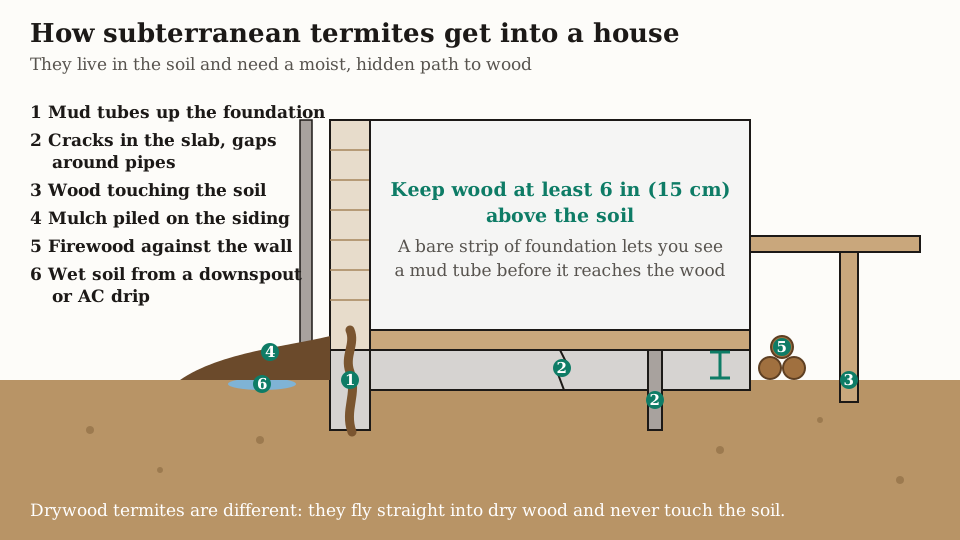
How to make a house less attractive to termites
Fix the water
Repair leaks, keep gutters clean, extend downspouts away from the foundation, and stop air conditioner drips from wetting the soil.
Keep wood off the soil
Building codes in many states require at least a 6 inch (15 cm) inspection gap between the soil and the siding, and NC State says higher is better. UC IPM recommends 12 inches. Use concrete bases for deck posts and steps.
Pull back the mulch
UF/IFAS suggests a thin layer, under 2 inches, within a foot of the foundation; Mississippi State prefers a mulch-free strip about 2 feet wide. Either way, keep it off the siding and door frames.
Move firewood and lumber
Stack it off the ground and several feet away from the house, never against a wall.
Seal and ventilate
Seal gaps where pipes and wires enter the slab. Keep crawl space vents open and clear.
Remove old wood
Pull up stumps, old form boards and buried wood scraps near the house.
Get inspected
UF/IFAS, NC State and the University of Arizona recommend a professional inspection every year. UC IPM suggests every 3 to 5 years in California.
Is preventive termite treatment worth it?
It depends where you live. In the Southeast, the Gulf coast, Hawaii and much of California, termite pressure is heavy, and many homeowners keep a contract running. In the northern Midwest, the Northeast and the Mountain West, they are less common, and a regular inspection may be enough. If your neighbors have had termites, treat that as a strong reason to check yours.
What attracts termites to a house?
Moisture and wood in contact with soil. Leaky pipes, poor drainage, mulch against the siding, wood steps or posts set in the ground, and firewood stacked against the house all draw subterranean colonies. Drywood swarmers are attracted to exposed, unpainted wood in attics, eaves and window frames, and to lights during swarms.
Pest control disclaimer. Photo-based identification can help, but it is not always perfect. For dangerous spiders, large infestations, or anything you are unsure about, contact a licensed pest control professional.
Termites FAQ
How long do termites live?
Do termites come back after treatment?
Do termites go away on their own?
Can termites spread from house to house?
What smell do termites hate?
What is a termite's worst enemy?
Do termites come out at night?
Are termites active in winter?
Related guides
Flying ants
Winged ants at the window: which species swarms when, and the three checks that rule out termites.
Carpenter ants
Big black ants that nest in damp wood. Clean galleries and coarse sawdust, never mud.
Carpenter bees
Round half-inch holes in decks and eaves, and why woodpeckers follow them.
Fly pupae
Small brown capsules on the floor that get mistaken for droppings and pellets.
German cockroach
The roach whose pepper-like droppings get mistaken for termite frass.
How to get rid of ants
If the swarmers turned out to be ants: why bait beats spray.
What bug is this?
Name a bug in six checks when you are not sure it is a termite at all.
Sources
- EPA, Termites: How to Identify and Control Them (updated 2026)
- EPA, PR Notice 96-7, Termiticide labeling
- University of Kentucky Entomology, ENTFACT-604, Termite control: answers for homeowners
- UC IPM Pest Notes 7415, Subterranean and other termites
- UC IPM Pest Notes 7440, Drywood termites
- UF/IFAS EDIS IN369, Native subterranean termites
- UF/IFAS EDIS IN278, Formosan subterranean termite
- UF/IFAS EDIS IN1277, Termite prevention and control
- Texas A&M AgriLife, E-368, Subterranean termites
- Texas A&M AgriLife, ENT-2002, Frequently asked questions about subterranean termite control
- Mississippi State Extension, Common questions about termites and termite control
- University of Arizona Cooperative Extension, AZ1356, Termite management for homeowners
- National Pesticide Information Center, Termites
- Insurance Information Institute, sample homeowners policy HO 00 03
- Inward, Beccaloni and Eggleton, Death of an order, Biology Letters (2007)
- Rust and Su, Managing social insects of urban importance, Annual Review of Entomology (2012)