What is a pupa?
A pupa is the stage in an insect’s life between the larva and the adult, when the insect stops eating and its body is rebuilt. Only insects with complete metamorphosis have one. That covers more than 80% of described insect species, including butterflies, moths, beetles, flies, bees, wasps, ants and fleas.
Most pupae barely move, but they are very much alive. The insect breathes, and inside the hard skin the wings, legs and eyes of the adult take shape. When the work is done, the skin splits and the adult climbs out.
The word comes from the Latin pupa, meaning girl or doll. Linnaeus picked it because many pupae look like a baby wrapped in swaddling clothes. Say it PYOO-puh. The plural is pupae, said PYOO-pee, although “pupas” is also correct.
Pupa words and what they mean
Pupa
- What it means
- The insect in this stage
- Example
- “A pupa was in the soil.”
Pupae
- What it means
- More than one pupa
- Example
- “The pupae hatched in May.”
Pupal
- What it means
- Describes the stage
- Example
- “The pupal stage lasts 10 days.”
Pupate
- What it means
- To turn into a pupa
- Example
- “Caterpillars pupate in fall.”
Pupation
- What it means
- The change into a pupa
- Example
- “Pupation takes a few hours.”
Eclosion
- What it means
- The adult coming out
- Example
- “Eclosion happens at dawn.”
What is another name for a pupa?
It depends on the insect. A butterfly pupa is called a chrysalis. A mosquito pupa is nicknamed a tumbler, because it tumbles through the water when you disturb it. The hard brown case of a house fly pupa is a puparium. A cocoon, on the other hand, is not another name for a pupa. It is the silk case some pupae lie inside.
Where the pupa fits in an insect’s life cycle
The pupa is the third of four stages: egg, larva, pupa and adult. Insects with this cycle, called complete metamorphosis, look completely different as young and as adults, so they need the pupa to rebuild. About 11 insect orders work this way. Insects such as cockroaches skip the pupa entirely.
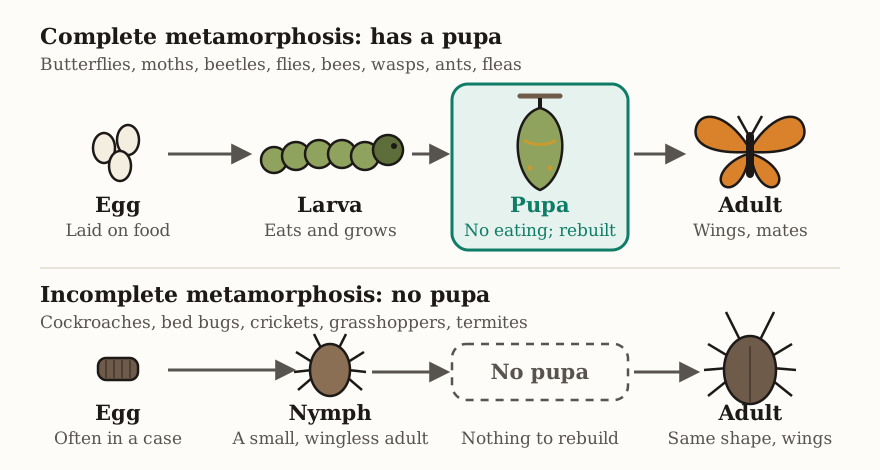
The larva is the eating stage. It may be a caterpillar, a maggot or a grub, and it grows by shedding its skin several times. When it is fully grown, it stops eating, finds a safe place and sheds its skin one last time. What is underneath is the pupa.
Insects with incomplete metamorphosis grow up another way. Their young, called nymphs, already look like small wingless adults. They grow a little with each molt, and the last molt makes them adults. There is no resting stage, because there is nothing to rebuild. Young grasshoppers are a good example: each molt brings slightly bigger wing pads, until the last one gives them full wings.
Which insects have a pupa stage?
Yes
- Life cycle
- Egg, larva, pupa, adult
- Insects
- Butterflies, moths, beetles, ladybugs, flies, mosquitoes, gnats, bees, wasps, ants, fleas, lacewings, caddisflies
No
- Life cycle
- Egg, nymph, adult
- Insects
- Cockroaches, bed bugs, stink bugs, crickets, grasshoppers, termites, earwigs, dragonflies, lice, mayflies
No
- Life cycle
- Egg, then young that look like small adults
- Insects
- Silverfish
Pupa-like, but not a true pupa
- Life cycle
- Resting stages with wing buds
- Insects
- Thrips, whiteflies, male scale insects
Which insects have a pupa stage?
Eleven orders of insects have a pupa. The ones you are most likely to meet are beetles, flies, butterflies and moths, and bees, wasps and ants. The rest are fleas, lacewings and antlions, caddisflies, scorpionflies, snakeflies, dobsonflies and alderflies, and a small group of parasites called twisted-wing insects.
Do cockroaches and bed bugs have a pupa?
No. Cockroaches, bed bugs, stink bugs, crickets and termites hatch as nymphs and grow straight into adults. So a “roach pupa” does not exist. A small brown capsule near a cockroach is more likely an egg case, which holds many eggs in a row. A brown capsule on its own is often a fly pupa, covered below. Silverfish skip metamorphosis altogether.
Thrips and whiteflies are the odd ones out. They have resting stages that some guides call pupae, and thrips even have a “prepupa”. However, UC IPM notes that neither has a true pupal stage, and young whiteflies keep feeding the whole time.
Larva vs pupa: what is the difference?
A larva eats and moves, and a pupa does neither. The larva comes first. It is the caterpillar, maggot or grub that feeds and grows. The pupa comes next. It is the closed, still stage in which the larva’s body becomes an adult’s. So a maggot is not a pupa, but it turns into one.
What happens inside a pupa?
Inside the pupal skin, the insect digests much of its larval body and builds an adult from small groups of cells that were waiting all along. In a monarch this takes about 8 to 15 days in summer. Hormones set the timing: when juvenile hormone runs low, the next molt makes a pupa instead of a bigger larva.
Those waiting cells are called imaginal discs. A caterpillar carries a set for each adult part, such as the wings, legs, eyes and antennae. While the caterpillar feeds, they stay small. Once it pupates, enzymes break down most of its tissues, and the discs use that material to grow.
Does a caterpillar really turn into soup?
Only partly. You may have read that the caterpillar dissolves into a liquid soup. Ask Dr. Universe, a Washington State University science site, says it turns “into a liquid, soupy substance”. It is a good story, but not quite true.
Some parts are kept and remodeled. They include the gut, the breathing tubes and parts of the nervous system. In 2013, researchers used CT scans to look inside living painted lady pupae (Lowe and colleagues, Journal of the Royal Society Interface). They could see the breathing tubes about 12 hours after the pupa formed, and they found less rebuilding than expected.
Is a pupa alive?
Yes. It breathes through small holes along its sides called spiracles, and it burns stored fat while it changes. Many pupae also twitch or wiggle when touched, because they keep some of the larva’s belly muscles. It does not eat or drink, though. As a result, it lives on whatever the larva stored up.
Do insects remember being larvae?
At least one moth does. In 2008, Blackiston and colleagues trained tobacco hornworm caterpillars to avoid a smell by pairing it with a mild shock (PLoS ONE). The moths that grew from caterpillars trained late in life still avoided the smell. Caterpillars trained when younger did not keep the lesson. So some memory can pass through the pupal stage.
Pupa vs chrysalis vs cocoon
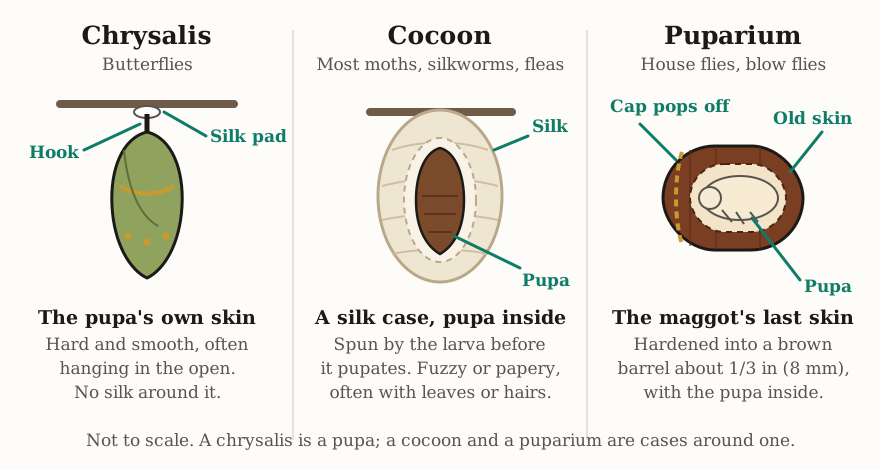
Four words get mixed up here. A pupa is the insect itself at this stage of life, and a chrysalis is simply a butterfly’s pupa. By contrast, a cocoon is a silk case that a larva spins around itself before it pupates. Last, a puparium is a fly’s old larval skin, hardened into a case.
Pupa, chrysalis, cocoon or puparium? The separating feature
The insect's own body at this stage
- What it is
- Pupa
- Made by
- Every insect with complete metamorphosis
A smooth, hard skin, often hanging, with no silk around it
- What it is
- Chrysalis (a butterfly pupa)
- Made by
- Butterflies
Fuzzy or papery silk, with a pupa hidden inside
- What it is
- Cocoon
- Made by
- Most moths, silkworms, fleas, caddisflies, some wasps and ants
A brown, barrel-shaped shell made of the last larval skin
- What it is
- Puparium
- Made by
- House flies, blow flies, fruit flies and their relatives
A bare, shiny brown pupa in the soil
- What it is
- Pupa with no case
- Made by
- Hornworm moths, many other moths, many beetles
What is a chrysalis?
A chrysalis is a butterfly pupa. The caterpillar spins a small pad of silk, hooks its tail end into it and sheds its skin one last time. Underneath, a new skin hardens into the chrysalis. Its tail hook is called the cremaster. Swallowtails also loop a thin silk belt around the middle to hold themselves upright.
A chrysalis is not a case the caterpillar builds. It is the pupa’s own skin, which is why you can sometimes see the shape of the wings and antennae on it. The word comes from the Greek chrysos, gold, after the gold dots on chrysalises like the monarch’s. For more than one, say chrysalises or chrysalides.
What is a cocoon?
A cocoon is a case of silk that a larva spins around itself before it pupates. The silk comes from glands near its mouth, and many larvae weave in leaves, soil, wood or their own hairs. The pupa forms inside and stays there. Most moths spin one. Fleas, caddisflies and many wasps make cocoons too.
A silkworm’s cocoon holds a single thread of 600 to 1,500 meters (about 2,000 to 4,900 feet), and that thread becomes silk cloth. Not every moth makes a cocoon, though. Hornworm moths, for example, dig into the soil and pupate bare.
Do any butterflies make cocoons?
A few do. Most sources say only moths make cocoons, but apollo butterflies (Parnassius) are the exception. They pupate inside a silk cocoon, as McCorkle and Hammond reported in 1985 (Journal of the Lepidopterists’ Society). Skippers also tie leaves together with silk and pupate in that shelter. So “a cocoon means a moth” is a good rule, but not a law.
What is a puparium?
A puparium is the hard brown case around the pupa of a house fly or blow fly. When the maggot is grown, its last skin shrinks into a barrel shape and hardens. The true pupa then forms inside. That is why fly pupae look like smooth brown capsules with no legs or wings showing at all.
The three types of pupae
Entomologists sort pupae into three types by how the legs and wings sit. Obtect pupae have them glued flat to the body. Exarate pupae have them free, like a pale, folded-up adult. Coarctate pupae are exarate pupae hidden inside a puparium. Most pupae are exarate.
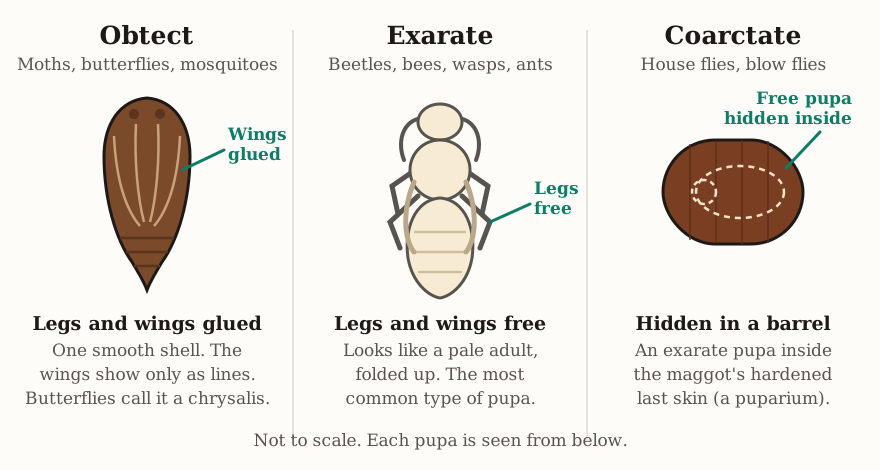
The three types of pupae
Glued to the body in one smooth shell
- Type
- Obtect
- Who has it
- Butterflies, most moths, mosquitoes, midges, crane flies
Free, folded against the body, easy to see
- Type
- Exarate
- Who has it
- Beetles, bees, wasps, ants, fleas, lacewings
Hidden inside a hard brown barrel
- Type
- Coarctate
- Who has it
- House flies, blow flies, fruit flies
There is a second, rarer split, by the jaws. Most pupae cannot move their jaws, but caddisflies and a few others can. They use them to cut their way out of the case, and some caddisfly pupae then swim to the surface before the adult comes out.
What does a pupa look like?
Most pupae are oval, smooth and brown, green or cream, from a few millimeters to over 2 inches (50 mm) long. Fresh pupae start pale and darken within hours. Butterfly pupae are often green or brown to match their surroundings, while moth and fly pupae are usually brown and shiny.
What common pupae look like
Jade green with gold dots, hanging by a black stalk
- Size
- About 1 in (25 mm)
- Whose pupa it is
- Monarch butterfly
- Where
- Under leaves, on fences and eaves
Shiny brown with a loop like a jug handle
- Size
- 1 3/4–2 1/2 in (45–64 mm)
- Whose pupa it is
- Tomato hornworm moth
- Where
- 3–6 in deep in garden soil
Dark brown to mahogany, plain
- Size
- 5/8–7/8 in (15–21 mm)
- Whose pupa it is
- Cutworm moth
- Where
- 1–5 in deep in soil
A big tan silk bag on a twig
- Size
- Cocoon about 3 in (76 mm)
- Whose pupa it is
- Cecropia moth
- Where
- Trees and shrubs, in winter
Pale cream to green, legs and wing cases free
- Size
- About 1/2 in (14 mm)
- Whose pupa it is
- Japanese beetle
- Where
- In soil, in a small earth cell
Orange and black, stuck to a leaf
- Size
- About 1/4 in (6 mm), our estimate
- Whose pupa it is
- Lady beetle
- Where
- On leaves near aphids
Reddish-brown capsule, rounded ends
- Size
- About 1/3 in (8 mm)
- Whose pupa it is
- House fly
- Where
- Near trash, under rugs and furniture
Tan teardrop on a leaf
- Size
- About 1/2 in (13 mm)
- Whose pupa it is
- Hover fly
- Where
- On leaves, or in soil
Dark comma that wriggles in water
- Size
- Tiny
- Whose pupa it is
- Mosquito
- Where
- Buckets, birdbaths, gutters
White or tan oval, carried by ants
- Size
- Varies by species
- Whose pupa it is
- Ants
- Where
- In the nest, under stones
Sizes are typical, not exact.
Can you name an insect from its pupa alone? Sometimes. A gold-dotted green chrysalis is almost always a monarch, and a tomato hornworm pupa’s handle is hard to miss. Most brown moth pupae look alike, however, and even experts struggle with them. If you are not sure, keep it and see what comes out, or try our free photo bug identifier.
Butterfly pupa
A butterfly pupa, or chrysalis, is usually smooth and hangs in the open. A monarch chrysalis is jade green with gold dots and about 1 inch (25 mm) long. Black swallowtail pupae are green or brown depending on the surface. In one study, 97% were brown on a rough red surface, but only 2% on rough green.
Moth pupa
A moth pupa is usually a hard, shiny, brown shell, either bare in the soil or inside a cocoon. Hornworm pupae have a loop that holds the moth’s long tongue. Giant silk moths, such as the cecropia and polyphemus, spin large cocoons on twigs or among dead leaves and stay in them all winter.
Beetle pupa
A beetle pupa looks like a pale, soft adult with its legs, antennae and wing cases folded against the body. Most form in soil, wood or stored food. Some, including mealworm pupae, can snap the gaps between their belly segments shut. These “gin traps” pinch small attackers such as ants.
Fly pupa
A fly pupa looks like a small brown capsule with rounded ends. A house fly’s is about 1/3 inch (8 mm) long, cream when new and dark reddish brown later. Maggots crawl away from their food to pupate, so you often find them a few feet from the source. Gnat and drain fly pupae are far smaller and hide in soil or slime.
Mosquito pupa
A mosquito pupa is a dark, comma-shaped swimmer that hangs at the water’s surface and breathes through two short tubes on its back. When you disturb it, it dives in a tumbling jerk, which is why people call it a tumbler. It does not eat, and it turns into a mosquito in about 2 to 3 days in warm weather.
Ant, bee and wasp pupae
These pupae look like pale adults, folded up. Bees and wasps keep theirs in wax or paper cells. Ants carry theirs around the nest, and the white “ant eggs” you see when you lift a stone are mostly pupae. Some ants wrap them in tan silk cocoons, while fire ant pupae are bare.
How long does the pupa stage last?
For most insects in warm weather, the pupa stage lasts about 3 days to 3 weeks. House flies take 2 to 6 days, monarchs 8 to 15 days, and many moths 2 to 4 weeks. Cold slows every pupa down, and insects that spend the winter as pupae may wait 8 or 9 months.
How long the pupa stage lasts
Drain fly
- Pupa stage
- About 20–40 hours
- Notes
- In the slime inside drains
Mosquito
- Pupa stage
- About 2–3 days
- Notes
- Longer in cool water
House fly
- Pupa stage
- 2–6 days
- Notes
- Faster when hot
Fungus gnat
- Pupa stage
- About 4–6 days
- Notes
- In potting soil
Phorid fly
- Pupa stage
- About 7 days
- Notes
- Near drains and rotting matter
Indianmeal (pantry) moth
- Pupa stage
- 7–8 days at 86F (30C); 15–20 days at 68F (20C)
- Notes
- Often on walls or ceilings
Clothes moth
- Pupa stage
- 8–10 days in summer; 3–4 weeks in winter
- Notes
- In a silk cocoon or case
Monarch butterfly
- Pupa stage
- 8–15 days in summer
- Notes
- Clear just before it hatches
Lady beetle
- Pupa stage
- 3–12 days
- Notes
- On leaves
Carpet beetle
- Pupa stage
- About 8–17 days, by species
- Notes
- Among fibers, lint and dust
Japanese beetle
- Pupa stage
- 1–3 weeks
- Notes
- In soil
Hornworm moth
- Pupa stage
- 2–4 weeks in summer; 8–9 months in winter
- Notes
- In soil
Flea
- Pupa stage
- 1–2 weeks; the adult can wait up to 12 months
- Notes
- In carpet, inside a cocoon
Times are typical at room or summer temperatures.
Pupae that wait out the winter
Many insects get through winter as pupae, in a pause called diapause. In that state, development nearly stops until warmth or longer days restart it. Late-summer swallowtail chrysalises, cecropia moth cocoons and hornworm pupae in the soil all wait until spring this way. So a chrysalis from August that has not hatched by October may simply be waiting, not dead.
The 30-year “pupa” that is not one
You may read that some pupae can wait 30 years. The record is real, but the stage is not a pupa. In 2001, Jerry Powell reported yucca moths that came out after 30 years in a resting state (Annals of the Entomological Society of America). They had spent those years as fully grown larvae, sealed in hard cysts. They pupated only at the end.
Found a pupa? What it is and what to do
Where you found it usually tells you what it is. Brown capsules about 1/3 inch (8 mm) long on a floor are almost always fly pupae. Silk cocoons on a ceiling are often pantry moths, and a shiny brown pupa in garden soil is usually a moth. Most need nothing more than a broom and a clean-up.
Found a pupa? Start with where it was
Floor, under furniture, near the trash
- What it probably is
- Fly pupae, often many
- What to do
- Sweep them up and find the food source (see our fly pupae guide)
Ceiling, upper walls or shelf edges in the kitchen
- What it probably is
- Indianmeal (pantry) moth cocoons
- What to do
- Find and throw out the infested food
Closet, on wool or in crevices
- What it probably is
- Clothes moth cocoons or cases
- What to do
- Clean and check wool and stored fabric
Carpet, pet bedding, debris-covered specks
- What it probably is
- Flea cocoons
- What to do
- Vacuum often, and ask a vet about treating the pet
Under a rug or along carpet edges, with bristly brown skins
- What it probably is
- Carpet beetles
- What to do
- Vacuum edges and check wool rugs
Drains, sink or tub
- What it probably is
- Drain fly or phorid fly pupae
- What to do
- Clean the slime inside the drain
Garden soil
- What it probably is
- Moth or beetle pupae
- What to do
- Rebury it, or keep it to see what hatches
Standing water
- What it probably is
- Mosquito pupae
- What to do
- Tip the water out
On a leaf, orange and black
- What it probably is
- Lady beetle pupa
- What to do
- Leave it. It eats aphids
On a leaf, a tan teardrop
- What it probably is
- Hover fly pupa
- What to do
- Leave it. It eats aphids too
A hairy cocoon on bark or siding, in the Northeast
- What it probably is
- Browntail or tussock moth
- What to do
- Do not touch it (warning below)
A big cocoon on a twig in winter
- What it probably is
- Cecropia or polyphemus moth
- What to do
- Leave it. It is harmless
Each of the indoor ones has its own guide: clothes moths, carpet beetles, phorid flies and fungus gnats.
Brown capsules on the floor: fly pupae
Small, reddish-brown capsules about 1/3 inch (8 mm) long, scattered on a floor, are fly pupae. Maggots leave their food and crawl to a drier spot to pupate, so the source is usually a few feet away: a trash can, pet food or a dead mouse in a wall. Each full case will release one fly, so sweep them all up and find the source. Our guide to fly pupae covers how to tell them from mouse droppings and roach egg cases, which fly made them, how soon they hatch, and the step-by-step clean-up.
Cocoons on the ceiling or walls
Small silk cocoons where the ceiling meets the wall, or along shelf edges, are usually Indianmeal moths. Their larvae live in flour, cereal, nuts, birdseed and pet food. When they are grown, they leave the food and climb, so the cocoons can be far from the source. Find the infested package and throw it out. Then clean the shelves and store dry food in sealed containers.
A pupa in your garden soil
A shiny brown pupa you dig up in spring or fall is usually a moth, often a cutworm or a hornworm. It cannot hurt you or your plants while it rests. If you grow tomatoes and want fewer hornworms, crush it, since tilling destroys up to 90% of them. Otherwise, rebury it a few inches deep.
Some gardeners keep a pupa in a jar of slightly damp soil to see what hatches. Give the adult a stick to climb, so it can hang and spread its wings. Expect a wait: a pupa dug up in fall may not hatch until late spring.
Pupae worth leaving alone
Several pupae turn into insects that protect your garden, so they are worth leaving alone. Lady beetle pupae are orange and black and fixed to leaves, like the pupa of the orange ladybug. Hover fly pupae are tan teardrops about 1/2 inch (13 mm) long. Lacewing cocoons are small white silk balls on leaves. All three become predators of aphids. On a hornworm, white cocoons like grains of rice belong to a tiny wasp, so leave that caterpillar on the plant.
Can a pupa hurt you?
No. A pupa has no working mouth or stinger, and it does not eat. The worst it can do is wiggle in your hand. A few cocoons are a different story, though, because the caterpillar wove its hairs into the silk. Browntail moth, tussock moth and puss caterpillar cocoons can all leave an itchy rash.
Is my pupa or chrysalis dead?
A pupa that wiggles when you touch it is alive. Some never move, though, so stillness alone proves nothing. Keepers also look for one that stays firm and keeps its color. A monarch chrysalis that turns dark all over is usually about to hatch, and you will see the orange wings through it the day before.
The Monarch Larva Monitoring Project lists the warning signs. White, silk-like threads hanging from a chrysalis mean a parasitic fly has left it. Small black dots can mean a tiny wasp is inside. A chrysalis that turns black without clearing, or leaks, is usually diseased. Remove it. Monarch Health, a University of Georgia project, advises cleaning the container with a 20% bleach solution before you reuse it.
Butterfly keepers sometimes re-hang a chrysalis that falls, tying dental floss to the silk just above the cremaster, never to the cremaster itself. Wait until the chrysalis has hardened before you handle it, because a fresh one is soft. If you raise monarchs, the project advises raising a few at a time, one per container, and releasing them close to where you found them.
Who to call
Who to call about a pupa you found
Nobody
- When
- One pupa, in the garden or outdoors
- Why
- It is harmless, and most become moths, beetles or flies
Pest or wildlife professional
- When
- Fly pupae keep appearing and you smell a dead animal you cannot reach
- Why
- The animal has to be found and removed
Landlord
- When
- You rent and the source is in a wall, attic or crawl space
- Why
- Removing it is usually the owner's job
Vet
- When
- Fleas in the house
- Why
- The pet needs treatment, or fleas keep hatching
Doctor, or 911
- When
- A rash after touching a hairy cocoon, or any trouble breathing
- Why
- The hairs, not the pupa, cause the reaction
Still not sure what you found? Our six checks for naming any bug work on adults, and the insect identifier takes a photo of almost anything.
How the adult gets out
The adult splits the pupal skin along a seam, pulls itself free and hangs to dry, which takes several hours for a butterfly. This is called eclosion. A butterfly pumps fluid into its crumpled wings to stretch them, then lets them harden before it can fly.
Insects in cases need a trick to get out. Silk moths use an enzyme to loosen one end of the cocoon. A fly inflates a balloon-like sac on its forehead to push the cap off its puparium.
Soon after it comes out, a butterfly or moth drips a red or orange fluid. This is meconium, the waste left over from the pupa. In tortoiseshell butterflies and their relatives it is bright red. Arthur Shapiro wrote in 1981 that it once caused “superstitious terror” among European peasants, who feared a rain of blood. It is waste, not blood.
Pupa myths
Seven myths about pupae turn up again and again, in picture books, cartoons and even some science sites. Each one is listed below with what is actually true. The biggest is that a pupa is an empty shell, when it is really the living insect.
Myth 1
Myth: “A pupa is just a shell.”
Truth: It is the living insect. It breathes, often moves, and is building an adult inside.
Myth 2
Myth: “The caterpillar turns completely to soup.”
Truth: Most tissue breaks down, but the imaginal discs, the gut, the breathing tubes and parts of the nervous system carry through.
Myth 3
Myth: “Chrysalis and cocoon mean the same thing.”
Truth: A chrysalis is a butterfly's pupa. A cocoon is a silk case around a pupa, usually a moth's.
Myth 4
Myth: “Only moths make cocoons.”
Truth: Apollo butterflies pupate in silk cocoons, and fleas, caddisflies and many wasps make them too.
Myth 5
Myth: “Cockroaches have a pupa.”
Truth: Cockroaches, bed bugs and crickets grow from nymphs straight into adults. There is no pupa.
Myth 6
Myth: “Mosquito dunks kill every stage in the water.”
Truth: Bti, the bacteria in mosquito dunks, only works on larvae that eat it. Washington State's Department of Health says it “does not affect mosquito pupae or adults”.
Myth 7
Myth: “A pupa can live 30 years.”
Truth: The record belongs to yucca moth larvae resting in cysts. The true pupal stage is short.
Pest control disclaimer. Photo-based identification can help, but it is not always perfect. For dangerous spiders, large infestations, or anything you are unsure about, contact a licensed pest control professional.
Pupa FAQ
Is a butterfly a pupa?
What does a pupa turn into?
Can two butterflies be in the same cocoon?
Can fly pupae crawl?
Why do fleas keep appearing after I treated the house?
Do pupae need food or water?
Why are some pupae green and others brown?
Related guides
Tomato hornworm
The big green caterpillar whose shiny brown pupa, with its jug handle, turns up in garden soil.
Clothes moths
Small silk cocoons and cases in the closet, and how to stop the larvae that make them.
Fly pupae
Brown capsules on the floor: how to tell them from mouse droppings, and find the source.
Phorid flies
Tiny humpbacked flies whose flat brown pupae collect near drains and rotting matter.
Fungus gnats
Gnats whose pupae sit in potting soil for about 4 to 6 days before the next wave flies.
Drain flies
Fuzzy moth flies that pupate in the slime inside your drains.
Orange ladybug
Ladybug larvae and pupae on your plants, and which orange beetles bite.
Sources
- Monarch Joint Venture, What's the difference between a chrysalis and a cocoon?
- Monarch Larva Monitoring Project, What is wrong with my monarch?
- Amateur Entomologists' Society, Endopterygota (insects with complete metamorphosis)
- Ferris Jabr, How Does a Caterpillar Turn into a Butterfly?, Scientific American (2012)
- Lowe T, Garwood RJ, Simonsen TJ, Bradley RS, Withers PJ. Metamorphosis revealed: time-lapse three-dimensional imaging inside a living chrysalis, Journal of the Royal Society Interface 10 (2013)
- Blackiston DJ, Silva Casey E, Weiss MR. Retention of memory through metamorphosis, PLoS ONE 3(3): e1736 (2008)
- McCorkle DV, Hammond PC. Observations on the biology of Parnassius clodius, Journal of the Lepidopterists' Society 39(3) (1985)
- Powell JA. Longest insect dormancy: yucca moth larvae metamorphose after 20, 25, and 30 years in diapause, Annals of the Entomological Society of America 94(5) (2001)
- Shapiro AM. On meconium, Journal of Research on the Lepidoptera 20(2) (1981)
- UC IPM Pest Notes 7419, Fleas
- UF/IFAS Featured Creatures EENY-026, Indianmeal moth
- University of Wisconsin-Madison Insect Diagnostic Lab, Blow flies indoors (2022)
- LSU AgCenter, House fly
- Washington State Department of Health, Bti for mosquito control
- Maine CDC Health Advisory 2026PHADV008, Browntail moth (2026)