What are grasshoppers?
Grasshoppers are insects in the order Orthoptera, suborder Caelifera, with short antennae, chewing mouths and hind legs built for jumping. Most US species are 1/2 to 1 inch (13 to 25 mm) long. About 620 kinds live in North America, and nearly 400 of them live in the 17 western states.
They are close cousins of crickets and katydids, which share the order Orthoptera. The quick way to tell them apart is the antennae. A grasshopper’s are short, usually less than half the length of its body. Crickets and katydids have thread-like antennae as long as the body or longer.
Every grasshopper goes through three stages: egg, nymph and adult. There is no pupa. The young, called nymphs or hoppers, look like small adults without wings. Most US species have one generation a year. They hatch in spring, grow up by midsummer and die at the first hard frost.
Only a few kinds cause most of the trouble. The US Department of Agriculture counts just 12 pest species among the nearly 400 in the West. In Texas, five species do about 90 percent of the damage, according to Texas A&M AgriLife. If you are not sure what you found, our six checks for naming any bug can help.
Is it a grasshopper? Check these
Check each clue below to narrow down what you saw.
Six legs, with the back pair much bigger, built for jumping
Front legs folded for grabbing prey mean a praying mantis.
Antennae short and thick, less than half as long as the body
Antennae as long as the body or longer mean a katydid or cricket.
A saddle-shaped plate behind the head
In pygmy grasshoppers this plate runs back over the whole body.
Narrow, leathery front wings folded along the back
Young grasshoppers have short wing pads instead of wings.
Active by day, in grass, weeds, gardens and along roads
A big green one singing at night is usually a katydid.
Jumps or flies a short way when you get close
Lubbers crawl instead: they are too heavy to fly.
Green, brown, tan, gray or yellow, often with bars or stripes on the hind legs
The same species can come in green and brown forms.
Grasshopper scientific name and classification
There is no single scientific name for “grasshopper”. The word covers a whole suborder, Caelifera, with thousands of species. Britannica counts about 11,000 worldwide. The biggest family, Acrididae, the short-horned grasshoppers, has more than 6,700 species on its own (Song and colleagues, 2018).
Where grasshoppers sit in the tree of life
Kingdom
- Name
- Animalia
- What it means
- An animal
Phylum
- Name
- Arthropoda
- What it means
- Jointed legs and a hard outer skeleton, so an invertebrate
Class
- Name
- Insecta
- What it means
- An insect: six legs, three body parts
Order
- Name
- Orthoptera
- What it means
- Grasshoppers, crickets and katydids
Suborder
- Name
- Caelifera
- What it means
- The grasshoppers: short antennae
Main family
- Name
- Acrididae
- What it means
- Short-horned grasshoppers and locusts
Other US families
- Name
- Romaleidae, Tetrigidae
- What it means
- Lubbers, and the tiny pygmy grasshoppers
So a grasshopper is an insect, an arthropod and an invertebrate. It is not a mammal and has no backbone. Lubbers are placed in their own family, Romaleidae, by most recent sources, while some older guides keep them in Acrididae.
How big are grasshoppers?
Most US species are 1/2 to 1 inch (13 to 25 mm) long, and some reach 3 inches (76 mm). Pygmy grasshoppers are the smallest, mostly under 3/4 inch (19 mm). The biggest in the country is the eastern lubber: females are often 2 to 2.8 inches (51 to 71 mm) and sometimes 3.5 inches (89 mm), according to UF/IFAS.
Females are usually bigger than males. In pygmy grasshoppers, males are often only two-thirds the length of females.
The giants live in Central and South America. A University of the West Indies guide cites a 1986 study on the genus Tropidacris. It gives these giants a body of about 4 inches (10 cm) and wings about 7 inches (18 cm) across. Britannica says some exceed 11 cm (4.3 inches). Sources differ on the exact record, but nothing that big lives in the US.
What colors are grasshoppers?
Most are green, olive, tan, brown, gray or black, colors that match grass and soil. Some are bright on purpose: the rainbow grasshopper is red, yellow, blue and black. Many band-winged grasshoppers look brown at rest, then flash yellow, red or black hind wings when they fly.
One species can come in more than one color. A 2015 review of color change in these insects and their relatives found that green forms develop mostly in humid conditions and brown forms in dry ones. It also found that insects raised in the cold come out darker. That is why a “brown grasshopper” and a “green grasshopper” can be the same kind.
A pink grasshopper is a rare color form called erythrism, caused by a genetic change. It is the same species as its green or brown relatives.
Can grasshoppers fly?
Most adults can fly. They have two pairs of wings: narrow, leathery front wings and wide, fan-shaped hind wings that do most of the lifting. The young cannot fly, because their wings are still small pads. Lubbers are too heavy to fly even as adults.
Flights are usually short. A red-legged grasshopper flies 30 to 40 feet (9 to 12 m), about 3 or 4 feet above the plants. A Carolina grasshopper flies 2 to 36 feet (0.6 to 11 m) on its own, and farther when the wind carries it. In migrations, swarms can travel 15 miles (24 km) or more in a day, says UC IPM.
How do grasshoppers make noise?
Many males “sing” to attract females by rubbing a row of tiny pegs on the hind leg against a raised vein on the front wing. Band-winged grasshoppers also crackle or buzz as they fly. Crickets and katydids sound different, because they rub their wings together instead.
The flight crackle surprises people. One reader in Maine said a band-winged grasshopper “sounds like the clicking of an electric wire when it flies”. That sound comes from the stiff hind wings snapping in the air, and it is a common reason people think they have seen a locust.
Common grasshoppers in the US
The grasshoppers people photograph most often in the US are the differential grasshopper, the eastern lubber, the gray bird grasshopper, the two-striped grasshopper and the obscure bird grasshopper. That ranking comes from our count of 385,722 research-grade US records on iNaturalist, covering 566 species. Most of them are 1 to 2 inches (25 to 51 mm) long.
The iNaturalist count shows which kinds people notice and photograph, not which are most numerous. Big, colorful and slow kinds, like lubbers, are easy to photograph, so they rank high. Small grass feeders are common but rarely posted.
Grasshoppers you are likely to see in the US
Black chevrons, like a herringbone, on the hind thigh; yellow-green body
- Grasshopper
- Differential grasshopper (Melanoplus differentialis)
- Adult size
- 1 1/8–1 3/4 in (29–44 mm), up to 2 in
- Where
- Gardens, fields and roadsides, mostly in the Midwest, South and Plains
Two pale stripes from the eyes to the wing tips
- Grasshopper
- Two-striped grasshopper (M. bivittatus)
- Adult size
- About 1 3/4 in (44 mm)
- Where
- Most of the US, especially the West and Plains; a top garden pest
Bright red hind shins, yellow underside
- Grasshopper
- Red-legged grasshopper (M. femurrubrum)
- Adult size
- 7/8–1 1/4 in (22–32 mm)
- Where
- Most of North America
Reddish brown, a strong flier
- Grasshopper
- Migratory grasshopper (M. sanguinipes)
- Adult size
- 7/8–1 1/8 in (22–29 mm)
- Where
- West and Plains crops and rangeland
Black hind wings with a pale yellow edge; flies up from dirt roads like a moth
- Grasshopper
- Carolina grasshopper (Dissosteira carolina)
- Adult size
- Wingspan 3–4 in (76–102 mm)
- Where
- Across North America; dusty, bare ground
Big, tan with an olive or pink cast; flies up into trees
- Grasshopper
- American bird grasshopper (Schistocerca americana)
- Adult size
- 1 1/2–2 1/8 in (38–54 mm)
- Where
- Eastern US; spends winter as an adult
Big and gray, flies clumsily like a bird
- Grasshopper
- Gray bird grasshopper (S. nitens)
- Adult size
- 1 1/2–2 1/2 in (38–64 mm)
- Where
- Southwest and California
Yellow or tawny with black, can't fly; young are black with a stripe
- Grasshopper
- Eastern lubber (Romalea microptera)
- Adult size
- 2–2.8 in (51–71 mm), sometimes 3.5 in
- Where
- Southeast: North Carolina to Florida and central Texas
Huge, heavy body, short wings, cannot fly
- Grasshopper
- Plains lubber (Brachystola magna)
- Adult size
- 1 3/4–2 in (44–51 mm)
- Where
- Great Plains and Texas
Black and yellow, flashes pink or red wings
- Grasshopper
- Horse lubber (Taeniopoda eques)
- Adult size
- 2–3 in (51–76 mm)
- Where
- Arizona and the desert Southwest
Red, yellow, blue and black; does not run from you
- Grasshopper
- Rainbow grasshopper (Dactylotum bicolor)
- Adult size
- 1–1 1/2 in (25–38 mm)
- Where
- Southwest, including Arizona and Colorado
Back plate runs to the tip of the body
- Grasshopper
- Pygmy grasshoppers (Tetrigidae)
- Adult size
- Mostly under 3/4 in (19 mm)
- Where
- Damp edges of creeks, ponds and wetlands
Sizes are from Texas A&M AgriLife, the University of Wyoming field guide, the Missouri Department of Conservation, UF/IFAS and University of Arizona Extension. Each species varies, and females run bigger than males. For a bug that fits none of these rows, our insect identifier can name it from a photo.
Lubber grasshoppers
Lubbers are the giant, slow, flightless members of the group, found in the South and West. The eastern lubber grows to 2.8 inches (71 mm) or more. Adults are yellow or tawny with black markings, and the young are almost all black with a yellow, orange or red stripe. They crawl more than they jump.
When alarmed, a lubber spreads its wings, hisses and squirts a foul-smelling froth from the breathing holes on its sides. UF/IFAS says the spray reaches at least 0.6 inch (15 mm). The froth is a warning to birds and lizards, not a danger to your skin, but wear gloves if you pick lubbers up.
The eastern lubber is native to the southeastern US. It is not an invasive species, even though many new Florida residents are told it is. The black, striped young and the big yellow adults are the same insect at two ages.
Band-winged grasshoppers that look like moths
Band-winged grasshoppers are brown or gray at rest and almost invisible on bare ground. When they fly, they open bright hind wings, often yellow, red or black with a pale edge, and many crackle in the air. The Carolina grasshopper, with black hind wings edged in yellow, is the one most often mistaken for a moth.
They fly up in front of you on dirt roads, gravel drives and vacant lots, land a few yards away and vanish again. That flash-and-hide trick is their defense. They are not locusts, and they rarely bother gardens.
Baby grasshoppers
A baby grasshopper, called a nymph, looks like a tiny adult with no wings. A newly hatched nymph can be about 1/5 inch (5 mm) long. It sheds its skin five or six times, growing a bit and gaining bigger wing pads each time, and becomes a winged adult in about 30 to 60 days.
Many gardeners first notice them as dozens of tiny green or brown hoppers in early summer. That is the hatch, and it is the best time to act. Lubber young look very different from their parents: shiny black with a bright stripe, often in a cluster on one plant.
Do grasshoppers bite?
Grasshoppers can bite, but rarely, and only when held. Their jaws are made for chewing leaves, so a large one may give a sharp pinch. The University of Kentucky’s entomology program says their jaws “are not strong enough to do any damage.” Grasshoppers have no venom and no stinger.
A pinch from a big grasshopper or lubber can startle you, and readers have described one clamping onto a dog’s paw. It may leave a small red mark. Wash it with soap and water, as you would any small scrape.
A grasshopper may also spit a brown liquid when you grab it. People call it “tobacco juice”, but it has nothing to do with tobacco. It is partly digested plant food, brought up to make a predator let go. It can stain skin and clothes, and it washes off.
Do grasshoppers sting?
No grasshopper can sting. The pointed tip some people see at the end of a female’s body is her ovipositor, the tool she uses to dig into soil and lay eggs. In grasshoppers it is short and blunt. It cannot pierce your skin and carries no venom.
Are grasshoppers dangerous or poisonous to people?
They are not dangerous to people. They have no venom, and we found no health or extension source that links them to any human disease. Touching one is safe. A few brightly colored kinds, like lubbers and the rainbow grasshopper, taste bad or are toxic to animals that eat them.
Are grasshoppers dangerous to dogs, cats, chickens and pet lizards?
Most kinds are natural food for many animals, including birds, coyotes, cats and dogs. Lubbers are the exception. UF/IFAS says birds and lizards that eat eastern lubbers may gag, throw up and can die. The National Park Service at Big Bend reports small mammals “vomited violently and even died” after eating them.
We found no veterinary or extension page on dogs or cats eating lubbers, so we can’t say how many it takes to make a pet sick. Keep pets away from lubbers, and never feed wild lubbers or rainbow grasshoppers to a pet lizard or spider. If your pet ate one and seems unwell, call your vet or the ASPCA Animal Poison Control Center at (888) 426-4435. A fee may apply.
Chickens and guinea hens hunt them eagerly, and that helps in a garden. One thing to know: the Merck Veterinary Manual lists these insects as carriers of a few roundworms and tapeworms of poultry. It is a reason to keep an eye on flock health, not a reason to stop them hunting.
Grasshopper or something else?
The quickest check is the antennae. A grasshopper’s are short, less than half its body length. Katydids and crickets have antennae as long as their body or longer, and their ears are on their front legs, not on the body. A locust is not a different insect at all: it is a grasshopper in its swarming phase.
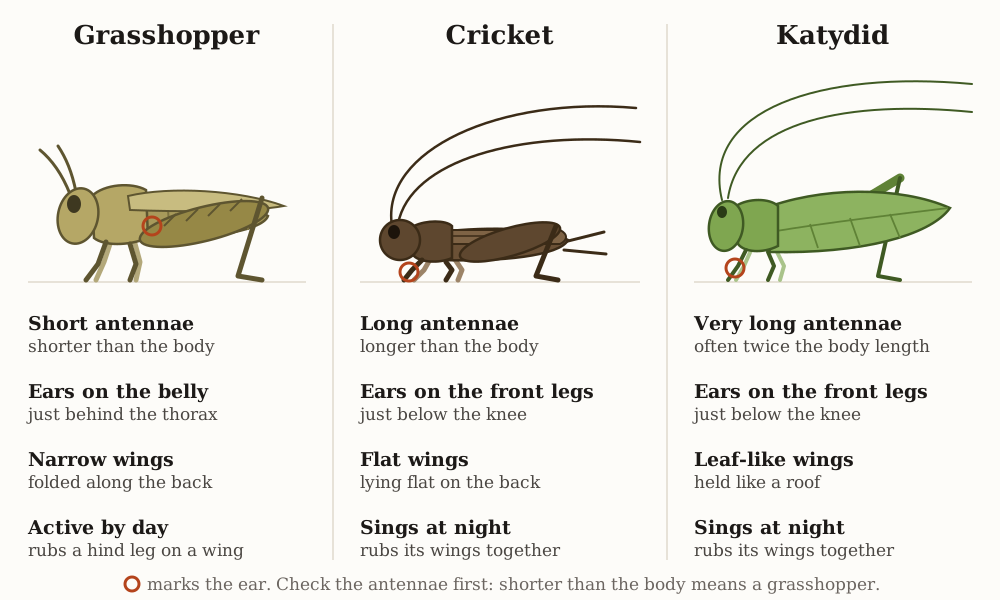
Grasshopper or look-alike? The feature that separates them
Short antennae, big hind legs, active by day
- What it is
- Grasshopper
- Where you see it
- Grass, weeds, gardens, roadsides
Very long thread antennae, leaf-like wings held like a roof
- What it is
- Katydid
- Where you see it
- Trees and shrubs; comes to porch lights at night; sings at night
Long antennae, wings flat on the back, two tail feelers
- What it is
- Field or house cricket
- Where you see it
- Under things outdoors, sometimes indoors; chirps at night
Humped back, no wings, very long legs and antennae
- What it is
- Spider cricket (camel cricket)
- Where you see it
- Damp basements and garages
Grasshoppers in huge, moving swarms that change color
- What it is
- Locust
- Where you see it
- Africa, Asia, Australia; no swarming locust lives in North America today
Front legs folded for grabbing, a triangle-shaped head that turns
- What it is
- Praying mantis nymph
- Where you see it
- Gardens; it eats insects, so let it be
Wide head, clear wings, a loud buzz from the trees, no jumping legs
- What it is
- Cicada (often called a “locust”)
- Where you see it
- Trees in summer
Back plate covers the whole body, under 3/4 inch
- What it is
- Pygmy grasshopper
- Where you see it
- Mud and damp soil near water
Grasshopper vs cricket
Crickets have long antennae, wings that lie flat on the back, and two feelers at the tail. A grasshopper has short antennae and narrow wings folded along the back. Crickets chirp by rubbing their wings together and are mostly active at night. Their short-horned cousins are active by day and sing by rubbing a leg on a wing.
A female cricket has a long, needle-like egg-laying tube. A female grasshopper’s is short and stubby. If a jumping insect is in your basement, it is almost certainly not a grasshopper, because grasshoppers need sun and green plants. Our spider cricket guide covers the humpbacked jumper that lives in damp basements.
Grasshopper vs katydid
Katydids have antennae that usually reach past the tip of the body, while a grasshopper’s are less than half its length. Katydids are often bright green with broad, leaf-like wings held like a tent. The Missouri Department of Conservation notes their ears are “little oval holes” in the front legs.
Katydids sing at night, from trees and shrubs. A female has a flat, sword-like egg-laying blade. A big green “grasshopper” that lands on your window screen at night is usually a katydid. Older guides call katydids “long-horned grasshoppers”, but they belong to the cricket side of the family tree.
Grasshopper vs locust: do grasshoppers turn into locusts?
Some do. A locust is a grasshopper species that changes body color, shape and behavior when crowded, then forms swarms. A 2009 study in Science found that crowding desert locusts for just 2 hours switched on swarming behavior, driven by about three times more serotonin in their nervous systems.
So “locust” names a phase, not a separate kind of insect. Most grasshopper species never make the switch. North America had one true locust, the Rocky Mountain locust, which swarmed across the Plains in the 1800s. Its last living specimen was collected in 1902, says entomologist Jeffrey Lockwood of the University of Wyoming.
Today’s US outbreaks are ordinary species in big numbers, not locust swarms. Desert locust swarms in Africa and Asia are on another scale. The UN Food and Agriculture Organization says one square kilometer of swarm can hold up to 80 million adults.
In much of the US, people also call cicadas “locusts”. Cicadas are not close relatives. They have clear wings, cannot jump, and make the loud buzzing in summer trees.
Grasshopper vs praying mantis
A young praying mantis can look like a grasshopper nymph, but its front legs are folded and spiked for grabbing prey. Its head is a triangle that swivels to watch you. A grasshopper has walking front legs and big jumping hind legs. Mantises eat other insects, including grasshoppers, so leave them in the garden.
Grasshopper life cycle and lifespan
Grasshoppers have three life stages: egg, nymph and adult. Eggs spend the winter in pods 1/2 to 2 inches (13 to 51 mm) underground. The young hatch in spring, molt five or six times, and become adults in about 30 to 60 days. Most adults live 2 to 3 months and die at the first hard frost.
A grasshopper's year
Egg
- What happens
- A female lays pods of 20 to 120 eggs in firm, undisturbed soil
- When
- Late summer and fall; eggs wait out the winter
Hatch
- What happens
- Young dig out when the soil warms to about 50–55F (10–13C)
- When
- Spring, from March in Florida to early July in Iowa
Nymph
- What happens
- Five or six molts; wing pads grow each time
- When
- 30 to 60 days
Adult
- What happens
- Wings full size; mates, feeds and lays eggs
- When
- Midsummer to fall
Death
- What happens
- Adults die out
- When
- At the first hard freezes in late fall
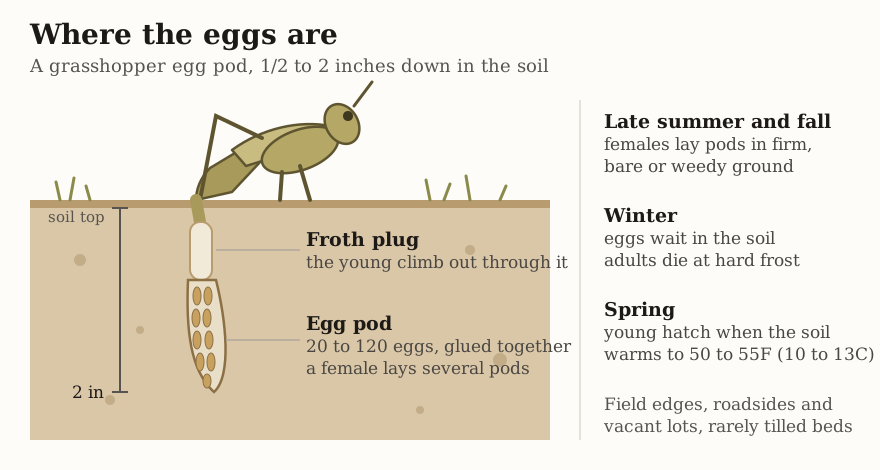
A female lays about 200 eggs in a season, and sometimes 400, says Texas A&M AgriLife. She pushes the tip of her body into the ground and lays the eggs in a curved pod glued together with froth. A froth plug above the pod gives the young an easy way out in spring.
The eggs are rarely in a dug garden bed. Females prefer firm, bare or weedy ground that nobody tills or waters: field edges, fencerows, ditches, roadsides and vacant lots. That is why they seem to “come from nowhere” in early summer. They come from the land around the garden.
A few species break the pattern. The American bird grasshopper and pygmy grasshoppers spend the winter as adults, so you can see them on warm winter days. Lubbers lay fewer, bigger pods: UF/IFAS counts one to three pods per eastern lubber female, with 25 to 50 eggs each. Our guide to what a pupa is explains why grasshoppers, like crickets and cockroaches, skip the pupa stage.
How long do grasshoppers live?
A grasshopper lives about a year from egg to death, but most of that is as an egg in the soil. The active life is short: 30 to 60 days as a nymph, then about 2 to 3 months as an adult. Sources give different adult lifespans because they measure different things.
Grasshopper adult lifespan, by source
UC IPM
- Lifespan given
- 2 to 3 months
- What it measures
- Adults, garden species in California
University of Wyoming
- Lifespan given
- 51 to 52 days on average
- What it measures
- Migratory grasshopper adults in the lab
University of Wyoming
- Lifespan given
- 9 to 11 weeks
- What it measures
- How long adults stay in a field
Utah State University
- Lifespan given
- Several weeks
- What it measures
- Adults at residential sites
Missouri Department of Conservation
- Lifespan given
- One season
- What it measures
- Most species, which die at hard freezes
One recent extension bulletin, Texas A&M’s 2024 Grasshoppers and Their Control, says most species “produce up to three generations per year”. That conflicts with its own 2004 edition and with every other source we checked, which say most US grasshoppers have one generation a year. We treat it as an error.
When do grasshoppers come out?
In most of the US, the young appear from April to July and adults peak from July to September. In our count of US iNaturalist records, nymphs peak in June and adults in August. Lubbers in Florida hatch earlier, in March and April. A hard frost ends the season in fall.
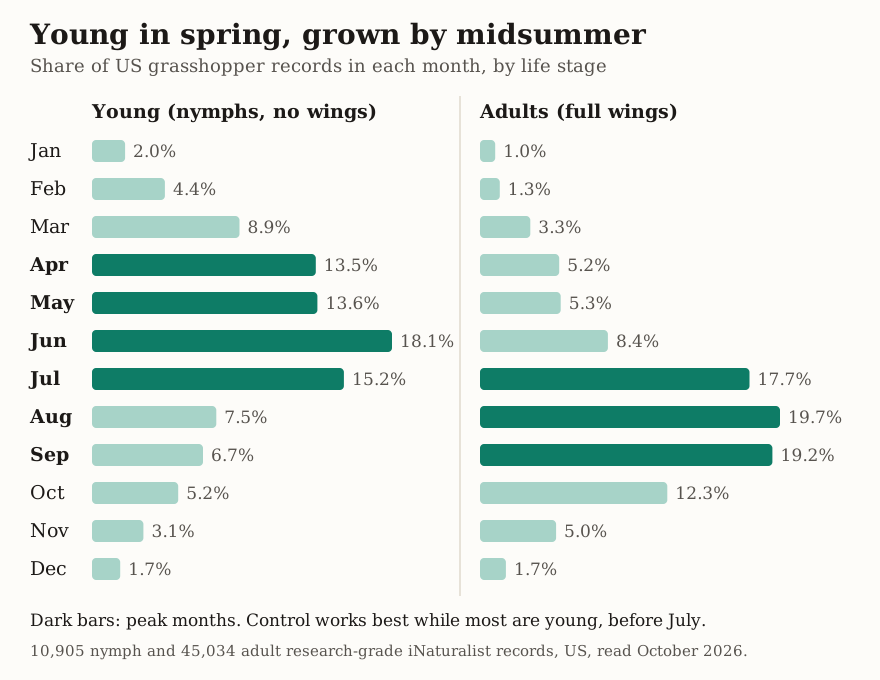
The chart above is our own analysis of 10,905 nymph and 45,034 adult records that observers labeled by life stage. It matches the extension calendars. Colorado State says control works best in May at low elevations and early June higher up. Utah sees hatching from mid-May to late June, and Iowa from mid-June to early July.
Search interest follows the same curve. On Google Trends, US searches for grasshoppers climb from March, peak in July and August, and fall to their lowest in December.
What do grasshoppers eat?
They eat plants: grasses, broadleaf weeds, crops and garden flowers. An adult eats about half its body weight in green plants every day, says the University of Wyoming. In gardens they favor lettuce, carrots, beans, sweet corn and onions. Squash and tomato leaves are less popular, according to Colorado State University.
Some species stick to grasses, others to broadleaf plants, and many eat both. When fresh leaves run short, they also eat dead insects, dung and even each other. So the answer to “herbivore, omnivore or carnivore?” is mostly herbivore, with some scavenging on the side.
They eat every part of a plant above ground: leaves, flowers, fruit, seed heads and stems. On tomatoes, they chew holes in the fruit as well as the leaves. If big holes in tomatoes come with dark droppings and missing leaves, check for a tomato hornworm too.
Numbers matter. Texas A&M says 13 grasshoppers per square yard can eat as much forage as a cow. The eastern lubber feeds on at least 100 plant species from 38 plant families, including citrus, vegetables, lantana and oleander.
What eats grasshoppers?
Birds are their main predators. Horned larks and kestrels feed on them heavily, as do chickens and guinea hens. Spiders, praying mantises, robber flies, frogs, lizards, snakes, rodents and coyotes eat them too. Blister beetle larvae eat their egg pods underground.
Robber flies alone can kill 11 to 15 percent of some grasshopper populations, says the University of Wyoming. Some flies lay eggs inside them, and long horsehair worms sometimes crawl out of a dead one. UC IPM says those worms cannot infect people, pets or birds.
A fungus called Entomophaga grylli can wipe out whole populations in humid weather. Infected insects climb to the top of a stem and die there, head up, clinging on. If you see dead hoppers hugging the tips of grass, that is the fungus at work.
Where do grasshoppers live?
They live in sunny, open places with plenty of plants: grasslands, prairies, pastures, field edges, roadsides, vacant lots and gardens. They are most varied in the dry West and the Great Plains. Colorado alone has more than 100 species, Texas about 150 and California more than 200.
Bird grasshoppers fly up into trees, while band-winged grasshoppers favor bare, dusty ground. One US species, the Zayante band-winged grasshopper of a small sand-hill area in Santa Cruz County, California, has been listed as endangered since 1997.
Why are there so many grasshoppers this year?
Hot, dry weather causes most grasshopper outbreaks. Dry springs and summers let more young survive, and a long, warm fall lets females lay more eggs. Big outbreaks come every 8 to 10 years and can last two or three years, says UC IPM. A cold, wet spring kills many newly hatched grasshoppers.
They move into yards when the weeds and range grasses around them dry out. That is why a garden can look fine in June and be stripped in July. The green, watered garden is the best food left.
California is the exception. There, UC IPM says populations build “especially after a wet spring”, because rain grows more food in the foothills. When those plants dry, the grasshoppers move down into gardens. Utah State notes that its populations run high for about 7 to 10 years, then drop for a few.
Grasshoppers in the house
A grasshopper inside your house got in by accident, through an open door, on clothes or on a plant. It cannot set up an infestation indoors, because the eggs are laid only in soil and the young need fresh green plants to grow. Put it outside or let it go.
Some readers report young hoppers coming out of a potted plant brought indoors for winter, which fits eggs laid in its soil outdoors. They still cannot breed inside. A jumping insect in a basement or bathroom at night is more likely a cricket, a camel cricket or a katydid.
Are grasshoppers bad for your garden?
A few are not a problem: they are food for birds, spiders and lizards, and part of a healthy yard. Many become a problem in outbreak years, when they can strip a vegetable bed in a week. Established shrubs and perennials usually grow back the next year. Seedlings and leafy crops often do not.
To judge your numbers, count them. Stand at the edge of the garden, pick a spot about 1 foot (30 cm) square, and count the ones that jump out. Do it in several spots, take the average and multiply by 9. That gives grasshoppers per square yard.
How many grasshoppers is too many?
Up to 10
- What it means
- Normal
- What to do
- Nothing, or hand-pick from favorite plants
11 to 20
- What it means
- Light
- What to do
- Cover the plants you care most about
21 to 40
- What it means
- Threatening
- What to do
- Cover crops, act on young ones, think about bait
More than 40
- What it means
- Severe
- What to do
- Expect losses; protect what matters most and plan for next spring
The bands are Texas A&M’s scale for adults at the edge of a field, which works as a yardstick for gardens. Count young nymphs as one-third of an adult. The USDA has used 8 per square yard as an action threshold on rangeland, and the University of Wyoming notes that this number alone does not mean spraying should start.
How to get rid of grasshoppers in a garden
The best protection is a barrier plus good timing. Cover the plants you value with metal window screen or fine netting, hand-pick what you can, and act in spring while they are small, usually May or June. Once swarms of adults arrive, UC IPM says there is “almost nothing you can do” to save unprotected plants.
Start with what costs nothing, and save bait for big numbers.
How to get rid of grasshoppers in a garden, step by step
Count them
Use the square-foot count above. Under about 10 per square yard, live with them and pick a few by hand.
Cover what you value
Put metal window screen or fine insect netting over a frame, so it does not touch the leaves. Hungry hoppers chew through cloth and plastic row covers, say UC IPM and Montana State. Crops that need bees may need hand pollination while covered.
Hand-pick early or late
They are slow in the cool of the morning and evening. Knock them into a bucket of soapy water. Wear gloves for lubbers.
Act while they are young
Look for hatching nymphs from April to June, along roadsides, fence lines and weedy edges next to the garden. Young ones are far easier to control than adults.
Manage the edge
Either keep a lush, watered strip of grass around the garden for them to eat instead, or cut down tall weeds right next to your plants. Sources disagree on which is better (see below).
Bring in birds
Chickens and guinea hens eat them eagerly. Keep chickens out of the vegetables, because they eat those too.
Use bait only for big numbers
Spread an EPA-registered grasshopper bait around the garden edge before they move in, following the label exactly. Reapply after rain.
Plan for next year
In fall, after the first frost, work bare, weedy ground where you saw females laying eggs. Mulch bare soil in midsummer so they have fewer places to lay.
The edge question has two good answers. UC IPM, Utah State and South Dakota State suggest a green trap strip: tall grass you water and never mow, so the hoppers stop there. Texas A&M and UF/IFAS suggest removing tall grass and weeds around the plants you want to protect, so they have less cover. If grasshoppers arrive from dry fields next door, try the green strip. If weeds grow right up to your beds, clear them.
Should you spray for grasshoppers?
Usually not. If screens, hand-picking and good timing protect your plants, insecticide treatments are not required. Sprays last only a few days, adults are hard to kill, and new ones fly in. UC IPM warns that carbaryl and pyrethroid sprays are very toxic to bees and to the predators that eat grasshoppers.
If numbers are very high, a bait is the safer choice. They must eat it, so it is less hazardous to bees than a spray, says UC IPM. Choose an EPA-registered product labeled for grasshoppers and follow the label exactly: the label is the law. Spread it in the hatching areas while grasshoppers are young, not on the plants you eat.
Two label traps catch gardeners. First, most products sold under the Sevin name switched from carbaryl to other insecticides in 2018, says Texas A&M AgriLife, so read the active ingredient, not the brand. Second, in California, carbaryl products have been restricted-use pesticides since August 1, 2020, so most homeowners there cannot buy them.
Colorado State says insecticides applied in bands that cover half the area, or less, work well on small acreages. For rangeland outbreaks, landowners in the western states can ask their State Plant Health Director about the USDA program.
Natural ways to get rid of grasshoppers
The natural methods that work are physical: metal screen or fine netting, hand-picking into soapy water, birds, and acting on the young in spring. Sprays made from garlic, hot pepper or neem do little against grasshoppers in outbreak numbers. Texas A&M rates neem’s active ingredient as only “marginally effective”.
A bait made from Nosema locustae, a natural grasshopper disease, has long been the organic option. It kills slowly, works only on young nymphs, and Colorado State says it “does not equally infect all grasshopper species”. UC IPM and Iowa State say it is unlikely to help in home gardens. Many gardeners also report that it has become hard or impossible to buy.
How to get rid of lubber grasshoppers
Lubbers are easier to remove by hand than other kinds, because they cannot fly and move slowly. UF/IFAS advises picking them off with gloves and dropping them into a bucket of soapy water. Start in early spring, when the black, striped young gather in clusters on a few plants.
Adult lubbers are hard to kill with sprays, and readers in Florida report that sprays failed on them. One reader in Jacksonville wrote that after removing about 150 to 200 by hand one year, they saw only three the next.
What does not work, and common myths
Most grasshopper myths are about danger or quick fixes. In fact, grasshoppers do not sting, the big ones in the US are not locusts, and no kitchen spray stops an outbreak. Here are nine common claims, checked against extension and research sources.
Myth 1
Myth: “Grasshoppers sting.”
Truth: The pointed tip on a female is her egg-laying tool. It cannot pierce skin.
Myth 2
Myth: “Grasshoppers never bite.”
Truth: They can pinch if held, and a big one can hold on. The pinch is harmless and carries no venom.
Myth 3
Myth: “Black lubbers are invasive.”
Truth: The eastern lubber is native to the Southeast. The black, striped young grow into the yellow adults.
Myth 4
Myth: “A huge grasshopper must be a locust.”
Truth: Big US species, such as lubbers and bird grasshoppers, are not locusts. No swarming locust lives in North America today.
Myth 5
Myth: “Grasshoppers can jump 20 times their body length.”
Truth: This figure is everywhere online, but we found no study of US grasshoppers that measures it. They do jump well, and that is all the evidence supports.
Myth 6
Myth: “Flour, garlic spray or diatomaceous earth will stop an outbreak.”
Truth: Readers and extension experts report these fail at high numbers. Diatomaceous earth also washes off in the rain.
Myth 7
Myth: “Ladybugs or mint plants keep grasshoppers away.”
Truth: Ladybugs eat aphids, not hoppers, and no repellent plant is proven to stop them.
Myth 8
Myth: ““Tobacco juice” is poison.”
Truth: It is partly digested plant food, spat up as a defense. It stains but does no harm.
Myth 9
Myth: “Tilling your garden bed kills the eggs.”
Truth: Females rarely lay eggs in dug beds. The eggs are in the firm, weedy ground around the garden.
When to call someone
Most grasshopper problems are yours to handle, with screens, hand-picking and timing. Call your county extension office when you can’t tell which grasshopper you have or need local timing for bait. Call a vet if a pet ate a lubber and seems sick, and a doctor for any bite that brings swelling or trouble breathing.
Who to call about grasshoppers
County extension office
- When
- You need the local hatch date, the right bait or an ID
- Why
- They know your region's species and timing
Your vet, or ASPCA Animal Poison Control, (888) 426-4435
- When
- A pet ate a lubber or a bait and seems unwell
- Why
- Lubbers are toxic to some animals that eat them; a fee may apply
Poison Control, 1-800-222-1222
- When
- A person swallowed or was splashed with an insecticide
- Why
- Free, 24 hours a day
911 or a doctor
- When
- Swelling of the face or throat, trouble breathing, or spreading redness after any bite
- Why
- An allergic reaction or infection needs care
State Plant Health Director (USDA)
- When
- Grasshoppers are damaging rangeland in a western state
- Why
- The federal rangeland program works through them
A licensed pesticide applicator
- When
- Large acreage where bait or bands make sense
- Why
- They can use products homeowners can't
Not sure it is a grasshopper at all? Upload a photo to our free bug identifier for an answer in seconds.
Pest control disclaimer. Photo-based identification can help, but it is not always perfect. For dangerous spiders, large infestations, or anything you are unsure about, contact a licensed pest control professional.
Grasshopper FAQ
Should I kill a grasshopper?
What does it mean when a grasshopper is in your house?
Are grasshoppers nocturnal?
Can you eat grasshoppers?
Do grasshoppers die in winter?
Are grasshoppers endangered?
Why do grasshoppers spit brown liquid?
Do grasshoppers eat other insects?
Related guides
Spider cricket
The humpbacked, wingless jumper in damp basements, a grasshopper relative that never chirps.
Tomato hornworm
The other big chewer of tomato plants, and how to tell its damage apart.
Japanese beetles
A summer garden pest that skeletonizes leaves, with a control plan that also starts early.
Cicada killer
The giant wasp that hunts the cicadas many people call locusts.
What is a pupa?
Why grasshoppers grow up without ever forming a pupa.
Bug bite identification
What different bites look like, and when a bite needs a doctor.
Sources
- Colorado State University Extension, fact sheet 5.536, Grasshopper Control in Gardens and Small Acreages, W.S. Cranshaw and R. Hammon (reviewed 2025)
- UC IPM, Pest Notes: Grasshoppers, UC ANR Publication 74103, M.L. Flint (2013)
- University of Wyoming, Field Guide to Common Western Grasshoppers, R.E. Pfadt
- University of Wyoming, Rangeland Grasshopper Management, DeBrey, Brewer and Lockwood (1993)
- Texas A&M AgriLife Extension, Grasshoppers and Their Control, ENTO-PU-015 (2024)
- UF/IFAS Featured Creatures EENY-006, Eastern Lubber Grasshopper, T. Saracino and N.C. Leppla
- Missouri Department of Conservation field guide, Short-Horned Grasshoppers
- Utah State University Extension, Tips to Help Reduce Grasshopper Grazing (2025)
- Iowa State University Extension, Grasshoppers in the Home Garden, D. Lewis (2023)
- USDA APHIS, Grasshoppers and Mormon Crickets in Western States (2026)
- University of Kentucky Entomology, Will it hurt me?
- Anstey, Rogers, Ott, Burrows and Simpson, Serotonin mediates behavioral gregarization underlying swarm formation in desert locusts, Science 323 (2009)
- J.A. Lockwood, Insect Lore, Encyclopedia of the Great Plains, University of Nebraska-Lincoln
- Texas A&M AgriLife Extension, Insects in the City, When is Sevin not Sevin? (2018)
- iNaturalist, US research-grade records of grasshoppers (Caelifera), read October 2026