What is a spider cricket?
A spider cricket is a wingless cricket in the family Rhaphidophoridae, with a humped back, long thin legs and antennae longer than its body. Most found in US homes are 1/2 to 1 inch (13 to 25 mm) long without the legs, tan to dark brown, and live in damp, dark places such as basements and crawl spaces.
The long legs and the way it sits low and still make it look like a spider at first glance. That is where the name comes from. It is a true insect, though, with six legs, two antennae and a body in three parts.
Worldwide there are more than 1,100 described species, on every continent except Antarctica. About 150 live in North America north of Mexico, according to the Missouri Department of Conservation. Most are outdoor animals of caves, logs and leaf litter. Only a few come indoors. If you are not sure what you found, our six checks for naming any bug are a good place to start.
Is it a spider cricket? Check these
Check each clue below to narrow down what you saw.
Six legs, with the back pair much longer and thicker than the rest
Eight legs means a spider, not a spider cricket.
Two antennae, usually longer than the whole body
Spiders have no antennae at all, only two short feelers by the jaws.
A humped, curved back, with the head tucked down
The hump is where the name camel cricket comes from.
No wings at all, at any age
A cricket with wings folded on its back is a house or field cricket.
Tan, light brown or dark brown, often with darker bands on the legs
In dim light they can look almost black.
Silent. It never chirps
Chirping in the basement means a house or field cricket.
Jumps when disturbed, often toward you
It is escaping, not attacking. See why below.
Spider cricket, camel cricket, cave cricket: what’s the difference?
There is no difference. These are three names for the same group of insects. “Camel cricket” comes from the humped back, “cave cricket” from where many species live, and “spider cricket” from the long legs. “Spricket” is a nickname that blends spider and cricket.
People also use local names. You may hear sprickets, criders, humpback crickets, camelback crickets or sand treaders. In New Zealand, close relatives are called cave weta. Every one of these is a member of the same family, Rhaphidophoridae.
Is a spider cricket a spider or a cricket?
A spider cricket is a cricket. Spiders have eight legs, no antennae and a body in two parts. A spider cricket has six legs, two long antennae and three body parts, like every insect. It is a distant cousin of the house cricket and the grasshopper, in the order Orthoptera.
How big is a spider cricket?
Most spider crickets in US homes are 1/2 to 1 inch (13 to 25 mm) long, measured without the legs or antennae. Large ones reach 1 1/2 inches (38 mm). With the legs stretched out, a big one can span the palm of your hand, which is why so many people think they have found a giant spider.
The antennae make it look bigger still. They are usually longer than the body. In one native species, Animal Diversity Web measured antennae of 44 to 52 mm (about 1 3/4 to 2 inches), three times the body length.
Why the sizes online do not match
Sources give different sizes because some measure one species and some measure the whole family. Two popular figures are wrong for a US basement. Read this table before you trust a number:
Spider cricket size, by source
Missouri Dept. of Conservation
- Size given
- To about 1 in (25 mm)
- What it measures
- Body only, US species
Clemson Extension
- Size given
- 1/2–1 1/2 in (13–38 mm)
- What it measures
- Body only, US species
Texas Invasives
- Size given
- 13–15 mm (about 1/2 in)
- What it measures
- Greenhouse camel cricket only
Animal Diversity Web
- Size given
- 14.5 mm (males), 16 mm (females), antennae 44–52 mm
- What it measures
- One native species, Ceuthophilus latens
PestWorld
- Size given
- 1/2–1 1/2 in (13–33 mm)
- What it measures
- The inch figure is right, but 1 1/2 inches is 38 mm, not 33
Wikipedia, Orkin
- Size given
- Up to 5 cm (2 in)
- What it measures
- The upper limit for the whole family, not the ones in US homes
Which spider cricket is in your basement?
In the eastern US, the spider cricket in your basement is most likely the greenhouse camel cricket, an insect from Asia. In a 2014 survey of US homes led by Mary Jane Epps of NC State University, 88% of houses with an identifiable camel cricket had the Asian kind. Only 12% had native camel crickets.
The study, published in the journal PeerJ, used photos and specimens from 163 households. Its title sums it up: the invader was “too big to be noticed”. In other words, a large foreign insect had spread through American basements and nobody had tracked it.
The spider crickets found in US homes
Greenhouse camel cricket (Diestrammena asynamora, also called Tachycines asynamorus)
- Where it comes from
- Japan or China; first found in a Minnesota greenhouse in 1898
- Where it turns up
- Basements, garages and yards, mostly in the eastern US
- What to know
- Most common in homes in the 2014 survey. Lives in yards too
Native camel crickets (Ceuthophilus and related genera, about 150 North American species in all)
- Where it comes from
- North America
- Where it turns up
- Caves, logs, wells, crawl spaces, every region
- What to know
- 12% of homes with an identifiable cricket. The National Park Service counts at least 33 Ceuthophilus cave cricket species
Japanese camel cricket (Diestrammena japanica)
- Where it comes from
- Asia
- Where it turns up
- Reported only from the Northeast (Massachusetts, Pennsylvania, New Jersey)
- What to know
- Rare. Six or seven tentative records, from photos only
Can you tell them apart from a photo?
Usually not. Scientists separate them by the spines and spurs on the lower legs and by color pattern. The University of Wisconsin-Milwaukee field station notes that some are “very hard to tell apart, except by an expert with a microscope”. The good news is that it does not matter at home. Every kind is harmless, and the same steps get rid of all of them.
Where in the US are spider crickets found?
Spider crickets live in every region of the US. Native kinds occur across North America, and the Missouri Department of Conservation lists them statewide. The 2014 survey had reports from 39 states and Washington, DC. Its authors found the Asian greenhouse camel cricket “widespread and abundant in the eastern United States”, where damp basements are common. The rarer Japanese camel cricket turned up only in the Northeast.
Do spider crickets bite?
No. Spider crickets do not bite people, sting or carry venom. They have small chewing mouthparts for dead plants, fungi and dead insects, not for skin. Mary Jane Epps, who led the 2014 survey, put it plainly in an NC State news release: camel crickets “don’t bite or pose any kind of threat to humans.”
The fear comes from the jump. A spider cricket can land on your arm or face, and the legs feel prickly for a second. That is a scare, not a bite. If you did feel a pinch and then found a mark, look for another cause. Our bug bite identification guide explains which bites leave which signs, and why no one can name a bug from a photo of a bite.
Do spider crickets sting?
No. The long spike on the back end of a female is an ovipositor, an egg-laying tube she pushes into soil. It is not a stinger and cannot pierce skin. On some females it is more than half the length of the body, which makes it look more dangerous than it is. Males do not have one.
Are spider crickets poisonous?
No. Spider crickets have no venom and are not poisonous to touch. The Missouri Department of Conservation calls them “completely harmless”. No source we read links them to any disease. Wash your hands after handling any insect, as you would after gardening.
Are spider crickets dangerous to dogs and cats?
We found no veterinary or extension report of a spider cricket harming a dog or cat. Cats and dogs often chase and eat them. The bigger danger is what you put down to kill them. Keep sticky traps and any insecticide where pets cannot reach them, and note that a pet can eat an insect that was sprayed.
If a pet eats an insecticide or a trap, call your vet or the ASPCA Animal Poison Control Center at (888) 426-4435. A fee may apply.
Is it bad to have spider crickets in your house?
It is not dangerous, but it is a sign. Spider crickets need damp air, so a basement full of them is a basement with a moisture problem. As the UW-Milwaukee field station puts it, “A basement that has camel crickets is a basement that has dampness issues.” Fix the damp and you fix most of the crickets.
Why do spider crickets jump at you?
A spider cricket jumps to escape, and it cannot see you well. Its eyes probably tell only light from dark. When a light goes on or a foot lands nearby, it leaps blindly, about 10 times its own height or more. In a narrow basement or stairwell, that jump often lands on you, so it feels like an attack.
No study has tested whether they aim at people. Still, the escape jump is well recorded. The University of Maryland’s Michael Raupp watched one clear the edge of a bathtub in “a leap more than ten times its own height”. The cricket is not chasing you. It is trying to get away, and it guessed wrong.
Can spider crickets see?
Barely. Their eyes probably sense light and dark but do not form clear images. Instead, a spider cricket finds its way with its long antennae, the hairs on its legs and two short feelers at the tail called cerci. Some cave species are blind, according to the University of Maryland’s Michael Raupp. The ones in houses are not blind, but they rely far more on touch.
Do spider crickets chirp?
No. Spider crickets have no wings, and crickets chirp by rubbing their wings together. They also have no ears. The National Park Service notes they lack the eardrum-like organs other crickets use and feel vibrations through their legs and antennae instead. So if you hear chirping in the basement, it is a house cricket or a field cricket.
Can spider crickets fly?
No. Spider crickets have no wings at any stage of life. They move by walking and jumping. A cricket-like bug that flies is a different insect, such as a house cricket, a field cricket or a cockroach.
Spider cricket or something else?
Count the legs and look for antennae first. A spider cricket has six legs, two long antennae and a humped back, and it has no wings. Spiders have eight legs and no antennae. A house or field cricket has wings and a flat back, and a cockroach runs instead of jumping.
Spider cricket or look-alike? The clue that separates them
Eight legs, no antennae, two body parts
- Look-alike
- Wolf spider
- What it is
- A spider. Hairy, brown to gray, 1/2–2 in, hunts on the ground and builds no web
Wings on the back, flat back, chirps at night
- Look-alike
- House cricket
- What it is
- A true cricket, 1 in or less, yellowish brown with three dark bands across the head
Shiny black or dark brown, wings, chirps
- Look-alike
- Field cricket
- What it is
- A true cricket, mostly outdoors, sometimes in garages in fall
Huge round head, striped belly, west of the Rockies
- Look-alike
- Jerusalem cricket
- What it is
- A different family, 1–2 1/2 in. It can bite if handled
Flat, shiny body, runs fast, does not jump
- Look-alike
- American cockroach
- What it is
- A roach. Long antennae, but no hump and no jumping legs
Fifteen pairs of long legs, very fast
- Look-alike
- House centipede
- What it is
- A centipede that eats spider crickets
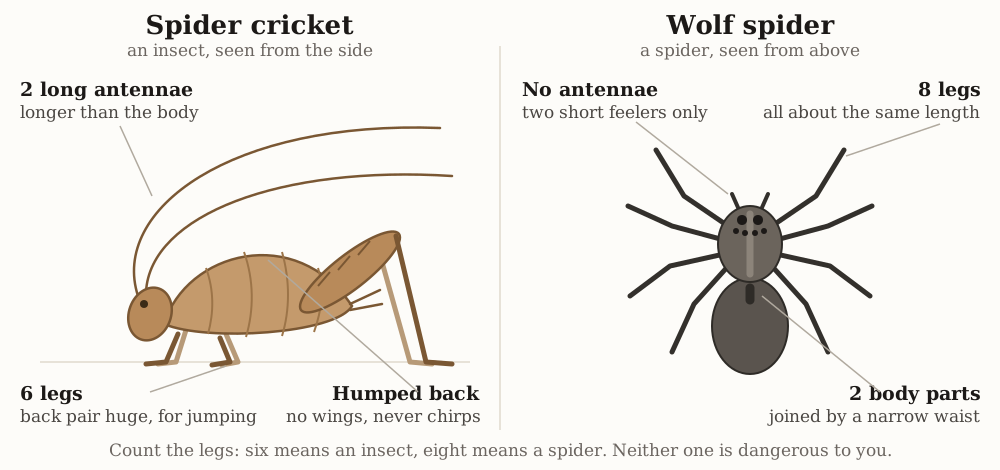
Spider cricket vs wolf spider
Both are brown, leggy and found in basements, and both make people jump. However, a wolf spider has eight legs and no antennae, and its body is in two parts. A spider cricket has six legs, two antennae as long as its body, and a humped back. See our wolf spider guide if yours has eight legs.
Spider cricket vs house cricket
A house cricket has wings folded flat on its back and chirps at night. It has no hump, and its legs look normal for its size. A spider cricket is silent, wingless and humped, with hind legs far longer than its body.
Spider cricket vs Jerusalem cricket
A Jerusalem cricket is a different insect, sometimes called a potato bug. It has a large round head and a shiny brown belly with dark stripes, and it is 1 to 2 1/2 inches long. It lives only west of the Rocky Mountains. UC Davis says it can bite when handled but is otherwise “essentially harmless”. A spider cricket has a small, tucked head and much longer legs.
Spider cricket vs camel spider
The names cause mix-ups, but these are unrelated. A camel spider is a desert arachnid with eight legs and huge jaws. A camel cricket is the same insect as a spider cricket, with six legs and no venom.
Why are there spider crickets in my house?
Spider crickets come indoors for damp, dark shelter and food. They move in most in late summer and early fall, and during hot, dry spells or very wet weather. Basements, crawl spaces, garages and laundry rooms suit them best, because the air there stays cool and humid.
Outdoors they live under stones, logs, mulch and leaf piles. When the weather turns extreme, they follow the cool, damp air into the nearest gap. According to NC State Extension, problems start “when we have extremes in weather conditions”. Some also come inside to spend the winter.
What attracts spider crickets?
Damp air is the main draw. After that, they look for:
- Dark, quiet places, such as boxes, storage shelves and the gap behind a washer.
- Food, such as mold and fungi on damp walls, dead insects and other organic debris.
- Shelter close to the house, such as mulch, firewood, brick piles and leaf piles.
How do spider crickets get in?
They walk in through gaps. The usual ones are the space under a house or garage door, cracks in the foundation, gaps around windows, and openings for pipes, wires and vents. Crawl space and dryer vents without screens are common entry points, too.
Are spider crickets breeding in my basement?
Sometimes, but not usually. Iowa State says they rarely reproduce indoors except where it stays dark and damp all year. The UW-Milwaukee field station says they rarely breed inside “unless conditions are perfect”. Cornell Cooperative Extension says they can breed indoors year-round. The difference is the room: a wet, dark basement suits them, and a dry one does not.
Look at sizes to tell. Young spider crickets look like small adults, so finding tiny ones and full-size ones together, especially in winter, suggests a group is living there. Dark smears of droppings on walls or boxes are a sign of heavy numbers, according to NC State.
What does it mean if you see one spider cricket?
One spider cricket in late summer usually means one wandered in. It is not an infestation. Several a week, or crickets in winter, point to a damp space they like. Use this table to decide how much to do:
How many spider crickets is too many?
One now and then, late summer or fall
- What it means
- A wanderer from outside
- What to do
- Put it outside or vacuum it. Check door sweeps
Several a week in the basement or garage
- What it means
- The space is damp and has gaps
- What to do
- Dehumidifier, sticky traps, seal gaps
Many, in tiny and full sizes, or in winter
- What it means
- A group is living there
- What to do
- All of the above, plus clear clutter off the floor
Dark smears on walls, chewed boxes or fabric
- What it means
- Heavy, long-term numbers
- What to do
- Fix the moisture source. Consider a professional
Where do spider crickets live?
Outdoors, spider crickets live in cool, damp, dark places: caves, under rocks and logs, in leaf piles, hollow trees, wells and holes in the ground. They are active almost only at night. Indoors, they choose basements, crawl spaces, garages, sheds, laundry rooms and shower areas.
Cave crickets play a real role underground. They leave caves at night to feed, then return to rest. Their droppings, eggs and bodies feed other cave animals, which is why the National Speleological Society named cave crickets its 2023 Cave Animal of the Year.
What do spider crickets eat?
Spider crickets are scavengers that eat almost anything. They feed on dead insects, fungi, decaying leaves, roots and fruit, and other organic debris. They also eat each other. In a basement, the mold on damp walls and dead bugs on the floor are often enough to keep a group going.
Do spider crickets damage clothes or boxes?
They can, but only a little. Several extension services, including NC State and Clemson, say large numbers can damage fabrics or garments packed in boxes on the floor, mostly when other food runs short. Others, including the Missouri Department of Conservation and the University of Minnesota, say they do no real damage. In short, store things off the floor and you have little to lose.
No extension source we read says they harm the structure of a house. Their droppings can stain walls, stored tools and boxes.
What eats spider crickets?
Plenty of animals do. Outdoors, many predators eat them. Indoors, house centipedes and spiders catch them, and cats hunt them. When grabbed, a spider cricket can drop a leg and escape, which is why you sometimes find one with five legs. Our house centipede guide explains why that predator may be in your basement for the same reason.
Do spider crickets eat spiders?
Not as hunters. Spider crickets scavenge dead insects, which can include a dead spider, but they do not chase live ones. The traffic goes the other way: spiders hunt crickets, and the cellar spiders in a damp basement feed on the insects that share it.
Spider cricket life cycle and lifespan
A spider cricket lives about one to two years. Females lay eggs in soil in early spring, and the young hatch a few weeks later. They look like small adults and grow through summer. Many spend the winter as young or adults, NC State Extension says, and some come indoors to do it.
There is no larva or pupa stage. The young simply get bigger with each molt until they are adults. The National Park Service says a female may lay 30 to 60 eggs in her life. Then the cycle starts again in spring.
Spider cricket lifespan, by source
National Park Service (cave crickets)
- Lifespan
- 1 to about 2 years
UW-Milwaukee field station
- Lifespan
- Up to 2 years
Animal Diversity Web (Ceuthophilus latens)
- Lifespan
- Adults probably live 2 to 3 months in summer (an estimate, adult stage only)
When do spider crickets come out?
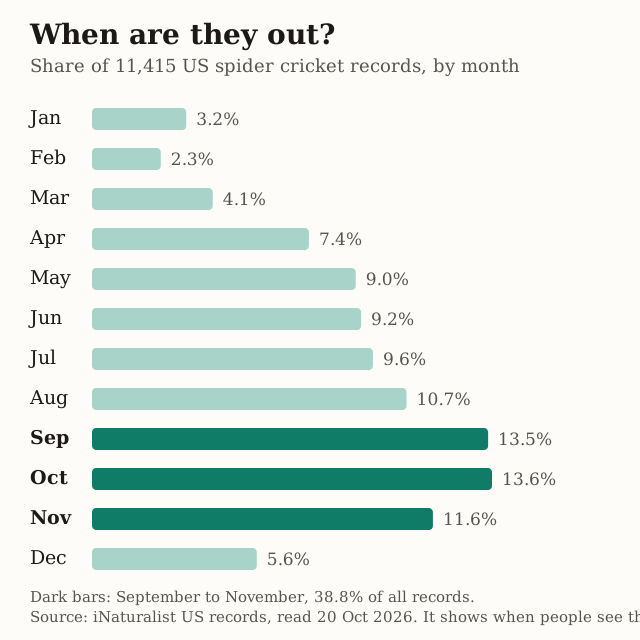
Spider crickets are most noticeable from late summer to late fall. Of 11,415 US sightings on iNaturalist, 38.8% fall in September, October and November, and February is the quietest month. Google searches for “spider cricket” follow the same curve, peaking from late August to November.
That matches the University of Maryland’s observation that the yearly home invasion begins “late in summer and early autumn”. So the best time to dry and seal the basement is early summer, before the numbers climb.
How to get rid of spider crickets
To get rid of spider crickets, dry the space first. Run a dehumidifier to keep the air below 60% humidity, set sticky traps in corners and behind appliances, and seal gaps under doors. Outside, pull mulch 12 inches back from the foundation. Spraying is a last resort and rarely needed once the space is dry.
Start with what costs nothing, then add tools as needed. Most homes need only the first five steps.
How to get rid of spider crickets, step by step
Catch the ones you see
Vacuum them up and throw the bag away, or trap one under a cup and put it outside. A dish of soapy water near where they gather also drowns them.
Measure the humidity
A cheap humidity meter tells you where you stand. The EPA advises keeping indoor humidity below 60%, ideally between 30% and 50%.
Dry the space
Run a dehumidifier in the basement and empty it often. Fix leaking pipes, vent the dryer outside, and point gutters and downspouts away from the walls.
Set sticky traps
Put glue boards, the kind sold for cockroaches and mice, in corners and behind appliances, as NC State Extension advises. Behind the washer and along the walls are good spots. They also show you where the crickets come from.
Seal the gaps
Fit a tight door sweep under house and garage doors. Caulk gaps around windows, the foundation and pipes, and screen crawl space and dryer vents.
Clean up outside
Keep mulch and ground cover at least 12 inches (30 cm) from the foundation. Move firewood, bricks, boards and leaf piles away from the house.
Clear the floor
Store boxes, clothes and paper off the floor, in sealed plastic bins. That removes hiding places and protects anything they might chew.
Should you spray for spider crickets?
Usually not. If drying, sealing and trapping work, insecticide treatments are not required. Clemson Extension advises spraying indoors only “when the population is large or when camel crickets threaten valuable items”, and it says to focus on the outside of the house. Iowa State calls spraying floors indoors “a last resort of limited benefit”.
If you do use a pesticide, choose one registered by the EPA for crickets and follow the label exactly. The label is the law. Treat a band around the outside foundation, not open rooms. In crawl spaces, NC State says baits in corners or along the sill plate work best, though some are hard for homeowners to buy.
Spraying without drying rarely lasts. One Reddit user in r/Delaware wrote that six days after an exterminator sprayed, they were “seeing more now than before”.
Natural ways to get rid of spider crickets
The natural ways are the main ways: dry air, sticky traps, sealed gaps and a tidy yard. A dish of soapy water catches some. Cats and house centipedes eat them too. No natural spray or scent is proven to repel spider crickets.
What does not work, and common myths
Most of what fails against spider crickets goes after the ones you can see and leaves the damp alone. Here are 8 common beliefs, several of them repeated on Reddit, and what the sources say about each.
Myth 1
Myth: “It is a spider.”
Truth: It is a cricket, an insect with six legs and two antennae. Spiders have eight legs and no antennae.
Myth 2
Myth: “Spider crickets bite.”
Truth: They have chewing mouthparts for dead matter and do not bite people. The scientist who led the 2014 survey says they “don’t bite or pose any kind of threat to humans”.
Myth 3
Myth: “The spike on the tail is a stinger.”
Truth: It is the female's egg-laying tube, and it cannot pierce skin.
Myth 4
Myth: “They mean your house is dirty.”
Truth: They mean it is damp. A spotless basement can still have them if the air is humid.
Myth 5
Myth: “They eat holes in your clothes.”
Truth: Large numbers can nibble fabric stored on damp floors, mostly when food is short. Clothes kept in dry rooms are at little risk.
Myth 6
Myth: “One spray around the house fixes it.”
Truth: Without drying the space, they keep coming. Iowa State calls indoor floor spraying “a last resort of limited benefit”.
Myth 7
Myth: “Ultrasonic plug-ins keep them out.”
Truth: None of the extension guides we read recommends them, and one Reddit user in r/newjersey said the crickets “just kept coming”.
Myth 8
Myth: “Glue traps attract more bugs.”
Truth: Sticky traps catch what walks onto them. Use them to find where the crickets come in, then seal that spot.
When to call someone
Most spider cricket problems end with a dehumidifier, traps and a door sweep. Call for help when water is getting into the house, when you rent and cannot fix the damp yourself, or when you still catch many after a month of dry air and sealed gaps.
Who to call about spider crickets
Landlord
- When
- You rent, and the basement is damp or has leaks
- Why
- Damp and leaks are usually the owner's repair
Waterproofing or drainage contractor
- When
- Water seeps through walls or pools on the floor
- Why
- The crickets will return until the water stops
Licensed pest professional
- When
- Many crickets after a month of drying, traps and sealing
- Why
- They can treat the perimeter and crawl space with products homeowners cannot easily buy
Doctor, or 911
- When
- A bite with trouble breathing, swelling of the face or throat, fever or spreading redness
- Why
- Spider crickets do not bite, so the cause is something else
Vet or ASPCA, (888) 426-4435
- When
- A pet ate insecticide or a sticky trap
- Why
- The insecticide, not the cricket, is the risk
Not sure it is a spider cricket at all? Upload a photo to our free bug identifier for an answer in seconds.
Pest control disclaimer. Photo-based identification can help, but it is not always perfect. For dangerous spiders, large infestations, or anything you are unsure about, contact a licensed pest control professional.
Spider cricket FAQ
Do crickets eat spiders?
Are crickets dangerous?
Are there poisonous kinds of crickets?
Are crickets scared of humans?
Should I kill a spider cricket?
What kills spider crickets instantly?
What do spider crickets hate?
Do spider crickets come back every year?
Related guides
Wolf spider
The eight-legged basement hunter people most often confuse with a spider cricket.
Centipede
The fast, many-legged predator that hunts spider crickets in damp basements.
Cellar spider
The long-legged spider in the basement corner, living in the same damp spaces.
Camel spider
A desert arachnid with a confusingly similar name, and no relation.
Silverfish
Another damp-loving bug found in the same basements and bathrooms.
Millipede
The slow, many-legged invader that also points to a damp foundation.
Grasshoppers
The short-horned, sun-loving relatives that jump in gardens, not basements.
Sources
- NC State Extension, Camel Crickets, M. Waldvogel, P. Alder and C. Hayes (revised June 14, 2023)
- Epps MJ, Menninger HL, LaSala N, Dunn RR. Too big to be noticed: cryptic invasion of Asian camel crickets in North American houses, PeerJ 2:e523 (2014)
- NC State University News, camel cricket survey (September 2014)
- Missouri Department of Conservation, Camel Crickets (Cave Crickets)
- Clemson Cooperative Extension, HGIC 2405, Camel Crickets
- Clemson Cooperative Extension, House and Field Crickets
- University of Maryland Extension, Crickets
- National Park Service, Cave Cricket (2023 Cave Animal of the Year)
- University of Wisconsin-Milwaukee Field Station, BugLady, camel crickets (2022)
- Michael Raupp, University of Maryland, Bug of the Week: Five-legged cricket in the bathtub (2017)
- Cornell Cooperative Extension Nassau County, Cave or Camel Crickets
- Iowa State University Extension, Yard and Garden, Camel Crickets (1992)
- UC Davis Bohart Museum, Information No. 008, Jerusalem Crickets
- US EPA, A Brief Guide to Mold, Moisture and Your Home
- Animal Diversity Web, University of Michigan, Ceuthophilus latens