A camel spider is not actually a spider
In practice, this is the fact that reorders everything else. Camel spiders sit in their own order, Solifugae, which holds more than 1,000 described species across roughly 147 genera and 16 families. Spiders, meanwhile, belong to a different order, Araneae. Both are arachnids, so they are cousins rather than the same thing.
Meanwhile the name problem runs deeper, because this one animal collects nicknames. Sun spider, wind scorpion, solifuge, sun scorpion and jerrymander all describe the same group. None of them is a spider and none is a scorpion, so every common name it has is misleading in one direction or another.
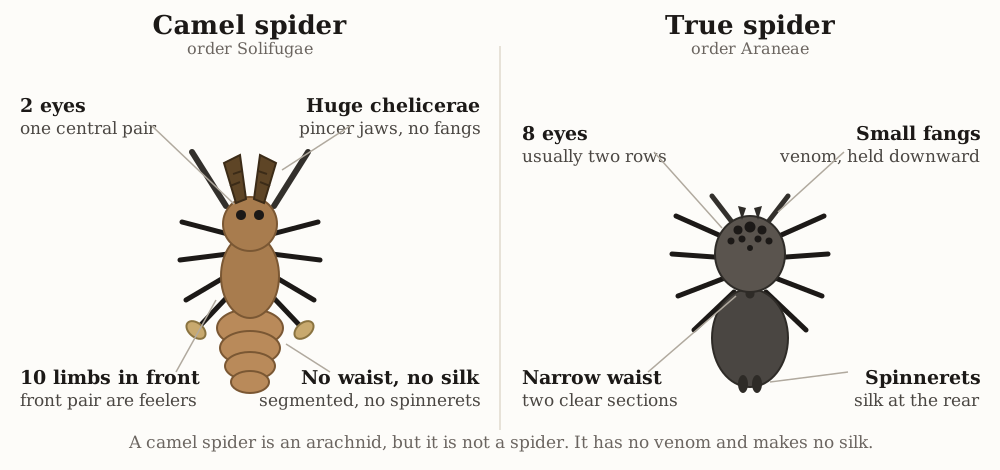
Telling a camel spider from a true spider
Check each clue below to narrow down what you saw.
One central pair of eyes
Two large median ocelli sitting together. Most true spiders carry eight eyes arranged in two rows.
Enormous pincer jaws
The chelicerae work like a crab claw and can be nearly as long as the front body section. A spider's fangs are small and point down.
Looks like it has ten legs
It has eight. The front pair are pedipalps, used as feelers and grabbers, and counting them is the usual error.
No narrow waist
The body runs in one broad line with a visibly segmented abdomen. Spiders pinch sharply between the two sections.
No web and no silk
Solifuges have no spinnerets. If the animal made the web you are looking at, it is not a camel spider.
Fan-shaped organs under the hind legs
Called malleoli or racquet organs, these chemical sensors are unique to the order and settle the identification.
The camel spider myths, one by one
In fact, almost every widely repeated claim about this animal is false. BugGuide puts it plainly, describing the camel spider as steeped in superstition and urban legend. Here is each claim against what the record actually shows.
Myth: “They run at 25 miles per hour.”
Truth: About 10 mph is the highest figure in the scientific literature, and the Burke Museum's Rod Crawford notes that carefully measured speeds came in under 1 mph. Fast for an arachnid, slower than you.
Myth: “They grow as big as a human torso.”
Truth: The largest species reach 12 to 15 cm including legs. The famous photo used forced perspective, with two dead specimens held close to the lens so they filled the frame.
Myth: “They scream when they chase you.”
Truth: They have no way to scream. Some species stridulate, which produces a faint rasping, and that is the whole of it.
Myth: “They inject an anesthetic and eat your flesh while you sleep.”
Truth: Solifuges have no venom glands and no anesthetic. No documented case exists, and the story always happened to a friend of a friend.
Myth: “They chase people across the desert.”
Truth: They chase your shadow. Solifugae means those that flee from the sun, so an animal caught in the open runs for the nearest shade, which is the patch you are standing in.
Myth: “They eat camel stomachs.”
Truth: The name comes from this story rather than the story coming from observation. Solifuges eat insects, spiders, scorpions and the occasional small lizard.
Myth: “They are the deadliest spider in the desert.”
Truth: They are not deadly and not spiders. With no venom at all, a camel spider is less medically significant than the common house spider.
The photo that started it
In 2004 an image circulated from Iraq showing what looked like two vast arachnids hanging together, apparently the length of a soldier's leg. It travelled by forwarded email, then by forum, and it is still the mental picture most people carry.
However, the trick was simply forced perspective. Two dead solifuges were held close to the camera lens, so they filled the frame while the person behind them shrank into the background. Move the same animals back to arm's length and they look like what they are, which is a pair of palm-sized arachnids.
Then the timing did the rest. Soldiers deploying to unfamiliar deserts passed the story along, and a good scare story spreads faster than a correction. That is how the rest of the list, the screaming and the 25 mph sprint and the flesh eating, attached itself to a real animal that does none of it.
How big do camel spiders really get?
Large for an arachnid, and nowhere near the legend. So the biggest species measure roughly 12 to 15 cm, or 5 to 6 inches, including the legs. Body length on its own reaches about 7 cm at the extreme, and most species sit closer to 5 cm overall.
| Subject | Typical measurement | Note |
|---|---|---|
| The viral claim | Human torso length | Forced perspective photography, not a real measurement |
| Largest solifuge species | 12 to 15 cm (5 to 6 in) including legs | Middle East, North Africa and southern Africa |
| Typical solifuge | About 5 cm (2 in) overall | The animal most people actually encounter |
| US southwest species | Roughly 2.5 to 4 cm (1 to 1.5 in) | Much smaller than the ones in the photos |
| Common house spider | Around 1 cm body, wider leg span | For scale, in most homes |
Put simply, a large camel spider covers the palm of your hand. That is genuinely striking in person, and it explains why the photographs are unsettling even when nothing is exaggerated.
Do camel spiders bite, and does it matter?
They can bite, though it is uncommon and it nearly always follows handling. The important part is what is missing: solifuges have no venom glands and no delivery apparatus, so nothing is injected. The Burke Museum is explicit that they have no venom and not even an anesthetic.
Instead, what remains is mechanical. The chelicerae are proportionally the largest jaws of any arachnid, and on a big specimen they can break skin. So a bite behaves like a small pinching cut rather than like a venomous sting: it hurts at the time, it may bleed a little, and it settles.
For context on the bites that do matter, our bug bite identification guide compares the common culprits. The black widow and brown recluse pages cover the two US spiders whose venom really counts.
Why a camel spider runs straight at you
This behavior convinced a generation of soldiers that the animal was hunting them, and the explanation is almost disappointing. After all, Solifugae comes from the Latin for those that flee from the sun. These are nocturnal desert animals, and daytime heat is genuinely dangerous to them.
So a solifuge caught in the open makes for the nearest shade. When you are standing in a desert at midday, the nearest shade is the shadow you cast. The animal sprints toward it, you step aside, and the shadow moves with you, so it sprints again. From the outside that looks exactly like pursuit.
Understanding this also defuses it. Stand still and let the shadow stay put, or move so your shadow falls somewhere the animal can reach, and the chase ends immediately.
Where camel spiders live, including the United States
Solifuges occupy hot, dry country across the Americas, southern Europe, Africa, the Middle East and south Asia. Australia and Madagascar have none. So the animal is far more widespread than the war stories imply, and it is not exclusive to Iraq or Afghanistan.
They live in the United States too, which surprises people who assume the animal is foreign. Look for them across the dry southwest: California, Arizona, New Mexico, Nevada, Texas, and parts of Utah and Colorado. American species are much smaller than the Middle Eastern ones. Most run about an inch to an inch and a half, so they rarely read as the creature from the photo.
What they eat, and how long they live
Camel spiders are generalist predators, and they hunt by running prey down instead of building a web. Their diet covers insects, spiders, scorpions and occasionally small lizards or rodents. The chelicerae then cut the prey apart, which is what those oversized jaws are for.
Their sensory kit is unusual. Fan-shaped organs called malleoli hang beneath the last pair of legs and read chemical traces from the ground, which helps locate prey in the dark. No other arachnid order carries them, so they are a reliable identification feature as well as a useful tool.
Most species live about a year and breed once in that time. Females lay somewhere between 50 and 200 eggs, and some guard them. The young then pass through a postembryo stage and nine or ten nymphal stages.
Found something else with too many legs? Our spider identifier works through the common families, and the insect identifier gives an answer from a photo.
Pest control disclaimer. Photo-based identification can help, but it is not always perfect. For dangerous spiders, large infestations, or anything you are unsure about, contact a licensed pest control professional.
Frequently asked questions
What is a camel spider?
Are camel spiders poisonous?
How fast can a camel spider run?
How big do camel spiders get?
Do camel spiders bite?
Do camel spiders chase people?
Can camel spiders scream?
Do camel spiders eat camels?
Do camel spiders numb you and eat your flesh while you sleep?
Are there camel spiders in the United States?
Is a camel spider actually a spider?
How many legs does a camel spider have?
What do camel spiders eat?
Are camel spiders dangerous to humans?
Why is it called a camel spider?
How long do camel spiders live?
Are camel spiders aggressive?
Related guides
Spider identifier
Work out which spider you are looking at from markings, eyes and web type.
Wolf spider
The large, fast, ground-hunting spider most often confused with a camel spider in the US.
Black widow spider
One of the two US spiders whose venom genuinely matters, and how to recognize it.
Brown recluse spider
Violin marking, six eyes, and the range where it actually lives.
Bug bite identification
If something bit you, narrow down what it likely was.