How long do mosquitoes live?
Adult mosquitoes live about 2 to 4 weeks, depending on the kind, the temperature and the humidity, according to CDC’s page on mosquitoes. Females often outlive males, which last about a week. Before that, each one spends about 1 to 2 weeks growing up in water.
You will see other numbers, and some are far apart. When we checked on October 24, 2026, Google’s AI answer said females live about 6 to 8 weeks (42 to 56 days) “under typical conditions” and males about 10 days. It cited CDC for adults in general and a county page for the female figure. Earlier that same day, it had said 2 to 6 weeks.
The Cumberland County, New Jersey, mosquito facts page does say six to eight weeks for females, but under ideal conditions, and it names no study. So the AI answer turned “ideal” into “typical”. Neither figure matches CDC, whose current page says adults live about 2 to 4 weeks.
Other sources land lower. The American Mosquito Control Association (AMCA) puts most females at 2 to 3 weeks. A Coachella Valley district says most females live less than 2 weeks, while a pest company gives the average female about 6 weeks.
Why the spread? Each source counts something different. Some give how long a mosquito can live in a cage with food. Others give how long most wild ones do live, with birds, spiders, wind and swatting in the way. Then a few count the rare females that live through winter. So when people ask how long do mosquitoes live, the honest answer has three parts, and the table below keeps them apart.
Mosquito lifespan by sex, kind and season, with the source for each figure
Any adult, the general figure
- How long the adult lives
- About 2 to 4 weeks; females often longer than males
- Source
- CDC, About Mosquitoes
Male
- How long the adult lives
- About a week; many die within several days
- Source
- CDC malaria biology page (archived); Purdue Extension
Female, most kinds, in summer
- How long the adult lives
- 2 to 3 weeks for most
- Source
- AMCA
Female Culex house mosquito, summer
- How long the adult lives
- A few weeks
- Source
- AMCA
Female Anopheles, outdoors
- How long the adult lives
- Most no longer than 1 to 2 weeks; some about 3 weeks
- Source
- CDC malaria biology page (archived)
Female Anopheles, in a lab cage
- How long the adult lives
- Up to a month or longer
- Source
- CDC malaria biology page (archived)
Female Culex or Anopheles that overwinters
- How long the adult lives
- Up to about 6 months
- Source
- AMCA; Purdue Extension
Aedes egg, dried out on a container wall
- How long the adult lives
- Survives up to 8 months before hatching
- Source
- CDC, Aedes life cycle
Female, Cumberland County, NJ, facts page
- How long the adult lives
- About 6 to 8 weeks under ideal conditions; males 10 days or less
- Source
- Cumberland County Mosquito Control (no study named)
Female, as Google's AI answer put it (October 24, 2026)
- How long the adult lives
- 6 to 8 weeks under typical conditions; does not match CDC's 2 to 4 weeks
- Source
- Google AI Overview, citing the county page
The last row is Google’s AI answer, not a source, and CDC’s own page does not support it. The county page and the pest control pages that give 6 weeks to 2 months do not name a study.
How long do female and male mosquitoes live?
Female mosquitoes live longer than males. Most females live 2 to 3 weeks in summer, the AMCA says, and some survive for months over winter. Males usually live about a week. In fact, Purdue Extension says most males die within several days. Only the females bite.
The gap comes from what each one does. A male feeds on nectar, mates, perhaps with several females, and that is his whole job. By contrast, a female has to find blood, digest it, lay eggs and then do it again. So she needs to live longer, and she does.
This also explains why males hatch first. Males usually come out of the water 2 to 3 days before the females from the same batch of eggs, Purdue says, so they are ready when the females appear. For more on telling them apart, see our guide to mosquitoes and why only females bite.
Even so, you may see males near you. A 2023 study found that males of a few kinds, mainly the yellow fever and Asian tiger mosquitoes, swarm around people and land on skin. They cannot bite, though. Repellent on the skin kept the males away as well.
How long Aedes, Culex and Anopheles mosquitoes live
The three common kinds of US mosquitoes live about the same few weeks as adults, but they get through winter in different ways. Aedes, such as the Asian tiger mosquito, survive winter as eggs. Culex house mosquitoes and Anopheles mosquitoes survive it as adult females. In a lab, any of them can outlive its wild cousins by weeks.
Aedes. These are the day-biting container mosquitoes. A 2013 review in Parasites & Vectors pooled 410 survival studies. The Asian tiger mosquito lived longer than the yellow fever mosquito, both in the lab and outdoors. Our Asian tiger mosquito guide covers the one most people notice.
Culex. The common house mosquito bites from dusk to dawn and rests in cool, damp, shady places. The AMCA says Culex usually live only a few weeks in summer. However, the females that come out in late summer find shelter and wait until spring.
Anopheles. These are the mosquitoes that can carry malaria, though malaria rarely spreads in the US. An archived CDC page says a female can live up to a month, or longer in captivity, but most do not live longer than 1 to 2 weeks in nature.
Why mosquitoes live longer in a lab than outdoors
Ask how long do mosquitoes live in a lab, and the answer is longer than outdoors. A mosquito in a cage has food, steady warmth and nothing hunting it. Outdoors, most die of something else long before old age. In the 2013 review, outside causes such as predators and weather killed yellow fever mosquitoes 4.5 times faster than age and temperature did, and Asian tiger mosquitoes 3 times faster.
Scientists cannot follow one wild mosquito for its whole life. Instead, they estimate the chance that a mosquito lives through one more day. The archived CDC page says those estimates usually run from 70% to 90%. That sounds high, but it adds up fast, as the chart shows.
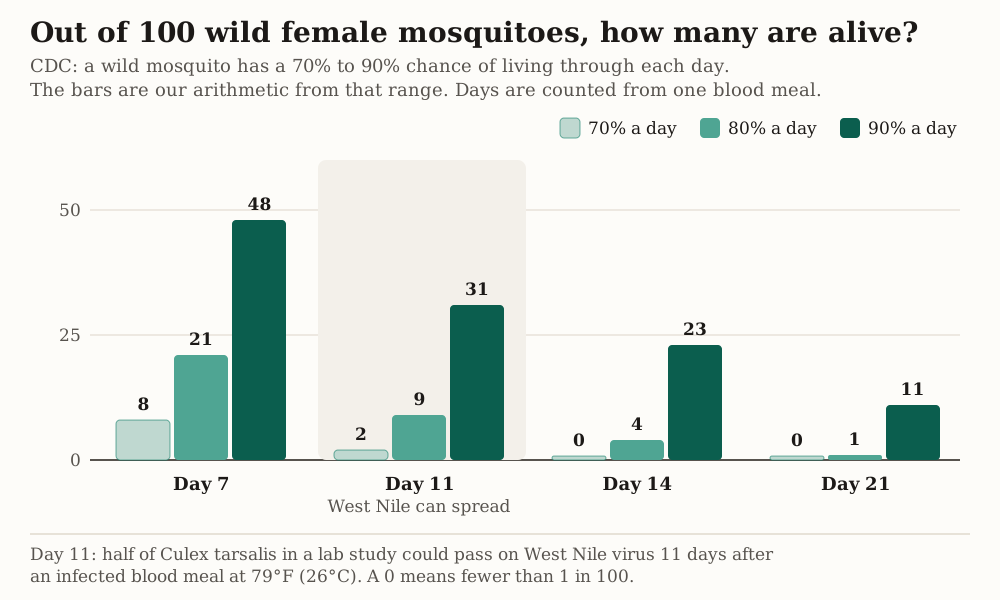
At 80% a day, only about 21 of 100 females are still alive after a week, and about 4 after two weeks. Even at 90% a day, under a quarter make it to two weeks. So the average wild female lives roughly 3 to 10 days, by our math. The “2 to 4 weeks” figure is the span a healthy female can reach, not the life most of them get.
How long do mosquitoes live in winter?
In winter, the answer to how long do mosquitoes live changes completely. A female that overwinters can live up to about 6 months, far longer than a summer mosquito. Culex and Anopheles females mate in late summer, then hide in garages, attics, culverts, caves and houses. There they stay dormant, a state called diapause, until spring. Aedes mosquitoes skip this and wait out the cold as eggs instead.
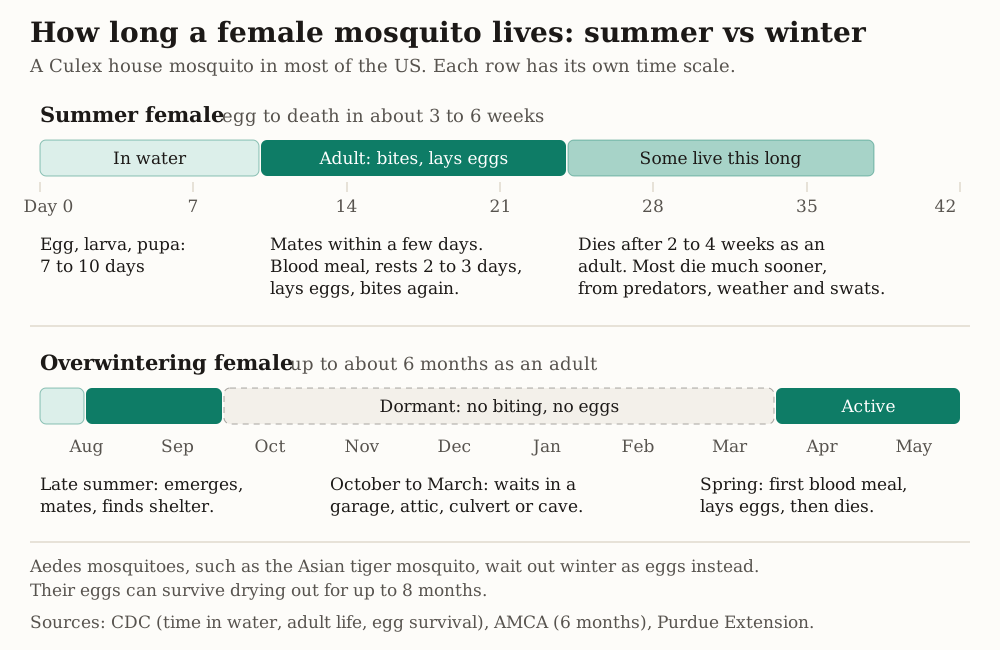
A dormant female does not bite or lay eggs. Purdue Extension says she needs a long spell of cold before her eggs can develop. Then, when spring warms up, she comes out, takes her first blood meal, lays her eggs and dies. Overwintering Anopheles females are among the first mosquitoes to bite people each year, Purdue notes.
Aedes eggs can last even longer than an overwintering adult. CDC says eggs stuck to the inside of a container can survive drying out for up to 8 months, and they hatch once rain or a sprinkler covers them. That is how a pot that sat dry all winter can be full of larvae a week after the first spring rain.
If you are asking where mosquitoes go in winter and when they come back, our complete guide to mosquitoes has the season month by month.
How long is a mosquito’s whole life, from egg to death?
In summer, a mosquito’s whole life, from egg to death, lasts about 3 to 6 weeks. The time in water is about 7 to 10 days for Aedes and Culex and 10 to 14 days for Anopheles, CDC says. Then comes about 2 to 4 weeks as a flying adult. A female that overwinters can stretch that to about 6 months or more.
The four stages are egg, larva, pupa and adult, and the first three live in water. The EPA says the water stages typically take about two weeks, but they can range from 4 days to as long as a month, depending on conditions. Warm water speeds everything up.
Larvae, the “wigglers”, spend about 4 to 14 days feeding, and pupae, the “tumblers”, spend about 1 to 4 days changing into adults. Our guide to mosquito larvae, eggs and pupae shows what each stage looks like and where to find it.
How temperature and humidity change a mosquito’s lifespan
Heat speeds a mosquito’s life up, and cold slows it down until it stops. In warm weather, eggs become adults in about a week. In cool weather, the same trip can take a month. Very hot, dry air shortens adult life, and long cold spells kill adults that have not found shelter.
The limits differ by kind. The 2013 review found the yellow fever mosquito slows down below about 57 to 59°F (14 to 15°C) and struggles to take a blood meal. It also lives less than a day at about 39°F (4°C) or above about 108°F (42°C). For the Asian tiger mosquito, the same limits are about 23°F (-5°C) and 104°F (40°C).
Humidity matters too. CDC lists it next to temperature as a reason lifespans vary. That may be why resting mosquitoes pick cool, dark, damp spots, such as thick grass, shrubs and a shady garage.
How long does a mosquito live in your house?
A mosquito in your house lives from a few days to a few weeks, depending on whether she can feed. With nothing to eat, most die within a week. If she can bite you, or find sugar from fruit or plants, she can live 1 to 4 weeks. In a cool garage or attic in fall, an overwintering female can stay for months.
Those figures come from studies, not guesses. In a five-lab test of nine mosquito species, most kinds kept on water alone had only 0% to 20% alive after 7 days, while 60% to 90% of those given sugar water were alive. In Kenyan village houses, caged malaria mosquitoes fed every day lived 7 to 10 days on average. Given both blood and sugar in a test hut, they averaged 33 days.
Some mosquitoes are built for life indoors. The yellow fever mosquito, found in parts of the US, mostly in the South, lives and bites inside homes as well as outdoors. In a 2-year study in Thailand and Puerto Rico, 86% to 95% of the blood-fed females scientists caught were found inside houses. The Culex house mosquito also comes indoors to feed at night.
So waiting it out is not a plan. One mosquito in the bedroom can keep biting for days. Our guide to getting rid of mosquitoes in the house and yard shows how to find her and stop more from getting in.
How long can a mosquito live without blood or food?
Without blood, a mosquito can live for weeks, as long as it has sugar. Both sexes live on nectar, and males never drink blood at all. Without any food, though, a mosquito lasts only a few days. In lab tests, 80% to 100% of adults kept on water alone were dead within a week.
Blood is for eggs, not for energy. A female needs it to make each batch of eggs, but she runs on sugar. In fact, a 2003 study in a test hut in Kenya found malaria mosquitoes lived longer on sugar alone, 29 days on average, than on blood alone, 14 days.
The yellow fever mosquito is the exception. It feeds on people often and takes little sugar. The 2013 review notes field observations that it cannot survive more than 2 to 3 days without a blood meal in tropical heat.
Do mosquitoes die after they bite you?
No. A mosquito does not die after it bites you. Unlike a honey bee, she leaves nothing behind in your skin. After a full meal she rests for 2 to 3 days while her eggs develop, lays them on or near water, and then looks for blood again. Purdue Extension says she may repeat this several times in her life.
A Culex female may lay a raft of 100 to 300 eggs every third night for the rest of her life, according to the AMCA. So after biting you, a female can live out the rest of her 2 to 4 weeks. Some kinds can even lay their first batch without any blood, a trick called autogeny.
How many times can one mosquito bite you?
There is no fixed number, but it can be more than once a day. In a 2-year study of yellow fever mosquitoes in Thailand and Puerto Rico, females took about 0.6 to 0.8 human blood meals a day. Many took two meals for one batch of eggs: 42% in Thailand and 32% in Puerto Rico.
A female that gets brushed off before she is full also tries again, which is how one mosquito leaves a row of bumps. Our guide to what mosquito bites look like and how long they last explains the itch.
Why a mosquito’s lifespan matters for West Nile and other diseases
For disease, the question of how long do mosquitoes live is the whole story. A mosquito can only spread a virus if she lives long enough. After she drinks infected blood, the germ needs days to grow and reach her saliva. That wait is called the extrinsic incubation period. If she dies first, she cannot pass anything on. That is why the oldest females are the risky ones.
For West Nile, the wait depends on heat. In a 2015 University of California study, half of Culex tarsalis mosquitoes could pass on the virus 11 days after an infected meal at 79°F (26°C). At 57 to 64°F (14 to 18°C), transmission had barely begun 18 days after the meal. The authors expected very few mosquitoes to live long enough at those cool temperatures.
Other germs follow the same rule. Dengue virus took about 15 days on average at 77°F (25°C) but only 6.5 days at 86°F (30°C), in a 2012 analysis of eight studies. For malaria, CDC gives about 9 to 18 days. Now look back at the chart: at 80% daily survival, only about 9 in 100 females live 11 days.
That is also why hot weather matters. Heat shortens the wait, so more mosquitoes live long enough to become infectious.
Medical disclaimer. This page is for general information only. It is not a medical diagnosis. If you have severe symptoms, trouble breathing, swelling of the face or throat, fast spreading redness, fever, severe pain, pus, or signs of infection, contact a doctor or your local emergency number.
How to use a mosquito’s short life against it
A mosquito’s short life is its weak spot. Since egg to adult takes about a week, emptying standing water once a week stops each new batch before it can fly. And since most adults live only days to weeks, every batch you stop shrinks the next one fast. The five steps below cost nothing.
5 ways to use a mosquito's lifespan against it
Dump standing water once a week
Egg to biting adult takes about 7 to 10 days in summer. So tipping out buckets, toys, plant saucers, birdbaths and tarps every week kills the larvae before they can fly.
Scrub the inside of containers
Aedes eggs stick to container walls just above the waterline and survive drying out for up to 8 months. Scrub the walls when you empty a pot or bowl, or the eggs hatch at the next rain.
Keep mosquitoes from resting indoors
Fix torn screens and keep the garage door shut at dusk. The AMCA says the garage is a favorite resting spot, and a mosquito that gets in from there can bite you for days.
Check sheltered spots in fall
Before the first frost, screen attic vents and seal gaps around the garage. These are the places where females wait out winter and then bite in early spring.
Wear a repellent when they are out
Outdoors, a repellent on your skin cuts the bites that keep each female going. Use one with an EPA-registered active ingredient, such as DEET or picaridin, and follow the label.
For the full plan, including the yard, see our guide to mosquito control at home.
What kills mosquitoes instantly?
A swat, or an indoor flying-insect spray labeled for mosquitoes. A spray kills only the mosquitoes it hits, though, and it does nothing about the water they came from. If you use one, pick an EPA-registered product and follow the label, which is the law. Empty the water first, because that is where the next batch is.
What do mosquitoes hate most?
A registered repellent on your skin. The EPA registers six active ingredients for skin, including DEET, picaridin and oil of lemon eucalyptus, and each label gives its protection time. Our guide to natural mosquito repellents that work compares them.
Mosquito lifespan myths, corrected
At least 6 common answers to how long do mosquitoes live, and where they live, are wrong or out of date. Several come from pages that rank on Google for this question. Here is each one, and what the evidence says.
Myth 1
Myth: “Female mosquitoes live 6 to 8 weeks under typical conditions.”
Truth: Google's AI answer said so on October 24, 2026. Its source, a New Jersey county page, says 6 to 8 weeks under ideal conditions. CDC's current page says adults live about 2 to 4 weeks, and most wild females die sooner than that.
Myth 2
Myth: “The average female mosquito lives about 6 weeks.”
Truth: A pest company page says so. The AMCA puts most females at 2 to 3 weeks, and CDC's daily survival estimates put the average wild female at well under 2 weeks, by our math.
Myth 3
Myth: “A mosquito dies after it bites you.”
Truth: That is honey bees. A female mosquito rests, lays eggs and bites again, often several times in her life.
Myth 4
Myth: “All mosquitoes die in winter.”
Truth: Culex and Anopheles females hide in sheltered spots for months, and Aedes eggs wait through winter. Both start the next year's mosquitoes.
Myth 5
Myth: “Mosquitoes breed in damp houseplant soil.”
Truth: Mosquito larvae need standing water, such as a full plant saucer. Tiny flies coming out of the soil itself are usually fungus gnats.
Myth 6
Myth: “Pour vinegar or bleach down the drain to kill mosquitoes breeding there.”
Truth: Small flies that breed in the slime inside a drain are usually drain flies, not mosquitoes. A mosquito in the bathroom most likely came in from outside.
Not sure the small flies in your kitchen are mosquitoes at all? Compare them with fungus gnats in houseplants and fuzzy drain flies. And the giant “mosquito” on the wall in spring is usually a harmless crane fly, the “mosquito hawk”. It cannot bite, and it does not eat mosquitoes either.
Pest control disclaimer. Photo-based identification can help, but it is not always perfect. For dangerous spiders, large infestations, or anything you are unsure about, contact a licensed pest control professional.
Mosquito lifespan FAQ
How long do mosquito larvae live?
How many eggs does one mosquito lay in her life?
How long do Asian tiger mosquitoes live?
When do mosquitoes die off for the year?
Related guides
Mosquitoes
The hub: what mosquitoes are, how they live, and why only females bite.
Larvae, eggs and pupae
The water stages, what they look like, and what to do when you find them.
How to get rid of mosquitoes
Yard and house steps that work, with sprays last.
Mosquito bites
What a normal bite looks like, how long it lasts, and when to see a doctor.
Asian tiger mosquito
The black and white day biter, and how its eggs survive winter.
Natural repellents
Which natural options are proven, and which only smell nice.
Crane fly
The giant look-alike that cannot bite and lives a few days to about two weeks.
Sources
- CDC, About Mosquitoes (May 14, 2024)
- CDC, Symptoms of West Nile (June 16, 2026)
- CDC, Malaria Biology: Anopheles Mosquitoes (archived copy, December 2022)
- US EPA, Mosquito Life Cycle (updated January 23, 2026)
- American Mosquito Control Association, FAQs
- Purdue Extension, Public Health and Medical Entomology, Mosquitos
- Yee DA and others, No evidence that salt water ingestion kills adult mosquitoes, Journal of Medical Entomology (2021)
- Okech BA and others, Influence of sugar availability and indoor microclimate on survival of Anopheles gambiae under semifield conditions in western Kenya, Journal of Medical Entomology (2003)