What do mosquito larvae look like?
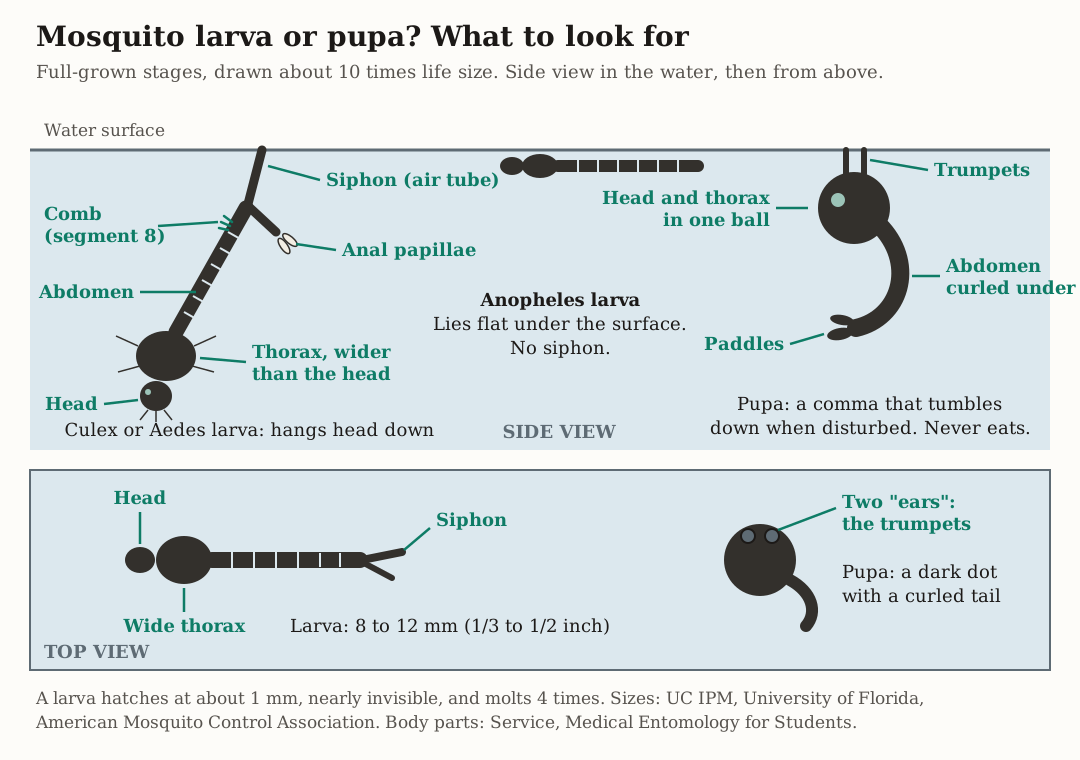
Mosquito larvae look like tiny, dark, wormlike wrigglers, 1 to 12 mm (up to 1/2 inch) long. They have no legs, a small head, a thorax wider than the head, and a slim tail end. Most hang head down just under the surface, held up by a short breathing tube. When something moves above them, they jerk downward in quick S shapes, then float back up.
A mosquito larva is the water-living young of a mosquito, a fly in the family Culicidae. These are the baby mosquitoes people find in a bucket. Three features identify one: no legs at all, a round thorax that is wider than both the head and the abdomen, and an air tube called a siphon at the rear. That tube touches the surface like a snorkel while the rest of the body hangs below.
Most are black or brown, and the youngest are nearly invisible. You usually spot them by their movement first. Missouri’s Department of Conservation describes them wriggling downward with jerking movements when disturbed, which is where the name wriggler comes from.
How big are mosquito larvae?
A newly hatched larva is about 1 mm (1/25 inch) and nearly invisible, UC IPM notes. It molts four times, and each stage between molts is called an instar. By the fourth instar, a common larva reaches 8 to 12 mm, about 1/3 to 1/2 inch. Then it stops eating and turns into a pupa.
Size of a mosquito larva at each stage
First instar, just hatched
- Length
- About 1 mm (1/25 inch)
- What you notice
- Hard to see. Specks that twitch near the surface
Second and third instars
- Length
- Between the two
- What you notice
- Visible wrigglers, growing after each molt
Fourth instar, full grown
- Length
- 8 mm (Aedes aegypti, University of Florida) to almost 1/2 inch (AMCA)
- What you notice
- Clear head, wide thorax and siphon
Predatory kinds (Toxorhynchites, Psorophora)
- Length
- Much larger than other larvae
- What you notice
- They eat other mosquito larvae
AMCA: American Mosquito Control Association. Missouri’s field guide gives the whole range as less than 1/4 inch to more than 1/2 inch, because a few kinds are giants.
Why do some larvae lie flat?
Those are Anopheles larvae. They have no siphon, so they lie flat and parallel just under the surface and breathe through openings on the abdomen, as CDC explains. They also feed at the surface. Culex and Aedes larvae hang at an angle instead. Two less common kinds, Mansonia and Coquillettidia, push their siphon into water plants and rarely come up at all.
What do mosquito larvae eat?
Mosquito larvae eat algae, bacteria, yeasts and other tiny living things in the water. Brushes beside the mouth filter food from the water, so they feed almost nonstop. That is why dirty water full of leaves suits them best. A few kinds, including the giant Toxorhynchites, eat other mosquito larvae.
What do mosquito pupae look like?
Mosquito pupae look like dark, rounded commas floating at the surface. The head and thorax form one ball, two short breathing tubes called trumpets touch the surface, and the abdomen curls underneath. They are called tumblers because they roll and dive when disturbed. In summer, the pupa stage lasts only 1 to 4 days.
A pupa does not eat. Inside its case, the larva is rebuilt into a flying adult, which then splits the case and rests on the water until its body hardens. Seen from above, a pupa looks like a dark dot with two little ears. One reader on Reddit asked what the “sea monkey looking things” in a birdbath were. The top answer was simple: mosquito pupae.
Pupae matter for one reason. Because they do not eat, Bti and other larva treatments do not touch them, so a few adults may still fly out after you treat. Dumping the water is the only fix that removes them. Our guide to insect pupae of every kind compares the mosquito tumbler with other pupae.
What do mosquito eggs look like?
Mosquito eggs are 1 mm or less, brown or black, and come in three main forms. Culex lays rafts of 100 to 300 eggs stuck together on the water. Aedes glues single black eggs to the inside of containers, just above the waterline. Anopheles lays single boat-shaped eggs that float on the water, each with a float on both sides.
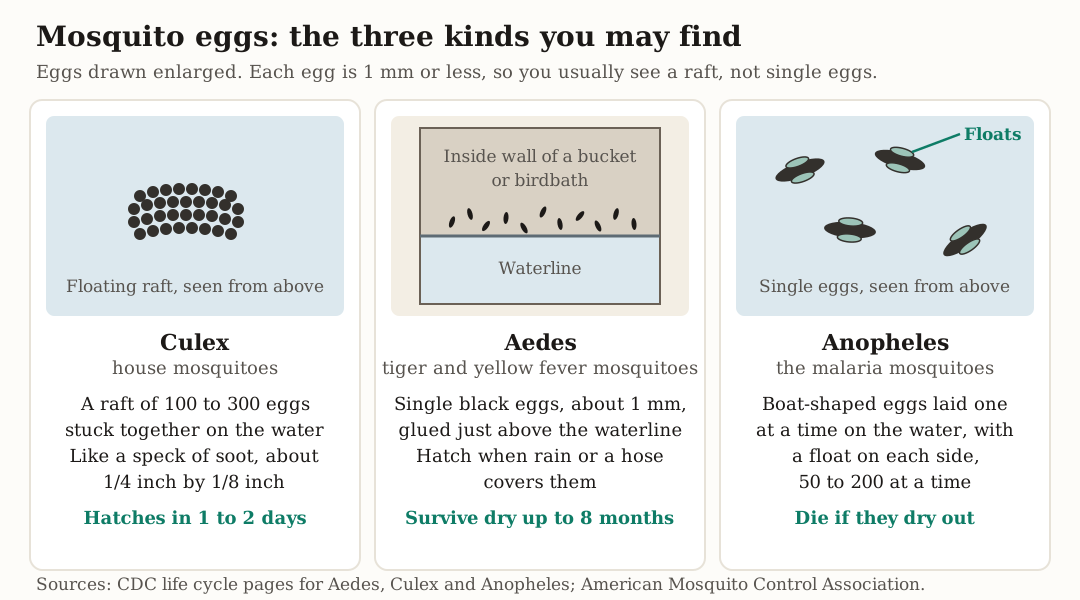
A Culex raft looks like a speck of soot floating on the water, about 1/4 inch long and 1/8 inch wide, the American Mosquito Control Association says. The female lays it at night and can lay another every third night. Larvae hatch from it in 24 to 48 hours, almost all at once.
Aedes eggs are the ones that cause repeat problems. According to CDC’s page on the Aedes life cycle, they stick to container walls like glue and can survive drying out for up to 8 months. Then they hatch when rain or a sprinkler covers them. The Asian tiger mosquito lays this way, which is why it thrives in buckets and plant saucers. Our guide to the black and white tiger mosquito covers it in detail.
Anopheles eggs are the opposite. They are laid one at a time on open water, 50 to 200 at a time, and they die if they dry out, CDC says. Anopheles prefers marshes and the edges of shallow creeks, so you rarely see its eggs in a bucket.
Can you see mosquito eggs?
You can see a Culex egg raft easily, as a dark sliver floating in a bucket or birdbath. Single eggs are much harder to spot. Each is about 1 mm, and Aedes eggs look like tiny black specks or dirt on the wall of a container. When first laid, Aedes eggs are white but turn shiny black within minutes, the University of Florida notes.
How do mosquitoes reproduce?
Adults mate within a few days of leaving the water. A female then takes a blood meal, because she needs the protein to make eggs, and rests for a few days while they develop. Next, she lays them on or beside water. Each batch holds roughly 30 to 300 eggs depending on the kind, and a yellow fever mosquito can lay up to five batches in her life.
So do mosquitoes need blood to make babies? Most do. A few kinds can make one small batch without blood, using food stored as larvae. Males never bite at all, and both sexes drink nectar for energy. Our complete guide to mosquitoes explains the adults in full.
The mosquito life cycle, from egg to biting adult
The mosquito life cycle has four stages: egg, larva, pupa and adult, and the first three live in water. EPA says the cycle “typically takes up two weeks”, but it can range “from 4 days to as long as a month,” depending on conditions. Warm water speeds every stage, and cool water slows it.
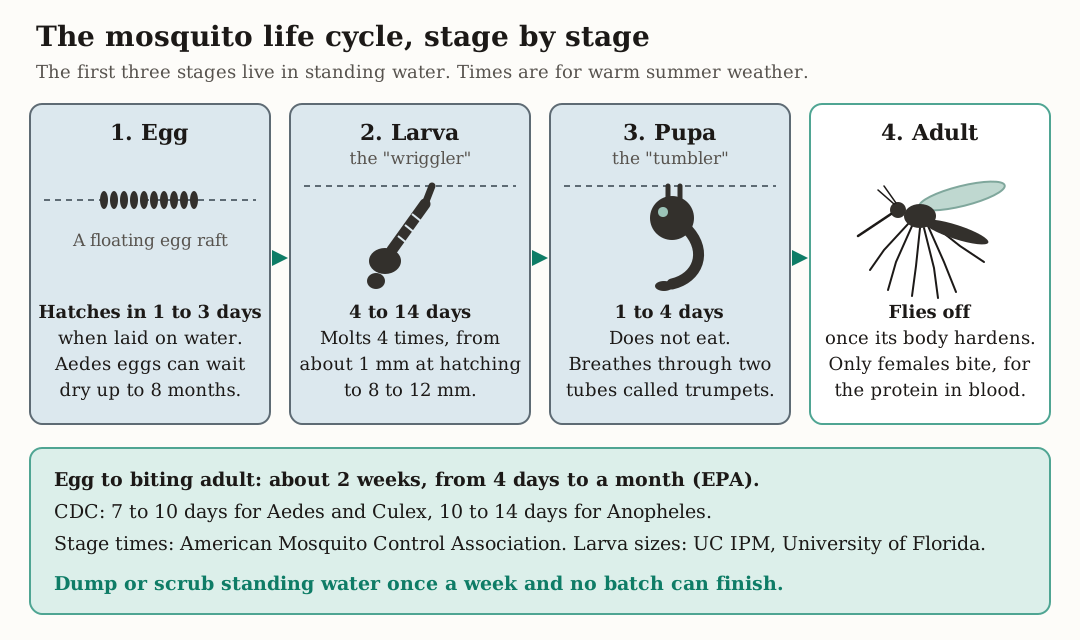
CDC gives tighter numbers by kind of mosquito. An Aedes or Culex egg takes 7 to 10 days to become an adult, and an Anopheles egg takes 10 to 14 days. Both fit inside the range EPA gives for the whole cycle.
How long until mosquito larvae turn into mosquitoes?
Larvae spend about 4 to 14 days in the water, then 1 to 4 days as pupae, the American Mosquito Control Association says. So wrigglers you find today could be flying in under a week in hot weather. Big ones, with tumblers mixed in, may be adults within a day or two.
Sources differ on the pupa stage, and the gap is mostly temperature. EPA gives two days to a week, and UC IPM gives 1 to 2 days in summer. In cool climates, by contrast, the larval stage can stretch to several weeks or months, and some kinds spend the winter as larvae.
One popular summary mixes these numbers up. Google’s AI Overview for how long mosquitoes live credits EPA with 7 to 14 days from egg to adult and 1 to 4 days as a pupa. Those are not EPA’s figures. The 1 to 4 days for pupae is AMCA’s number. EPA’s own page gives about two weeks for the whole cycle and two days to a week for the pupa.
Once out, an adult lives about 2 to 4 weeks, CDC says. Our page on how long mosquitoes live, indoors and out covers adult lifespan and winter.
Where do mosquitoes lay eggs and breed?
Mosquitoes breed in almost any still water that stands for more than a few days. Larvae need at least about 4 days of calm water to develop, so a container refilled weekly cannot finish a batch. Some kinds use a pool as small as a bottle cap, while others prefer ponds, ditches and marshes.
Container breeders are the ones near your door. Aedes mosquitoes, including the Asian tiger mosquito, lay in buckets, plant saucers, tires, toys, birdbaths, vases and rain barrels. CDC notes they need only a small amount of water. Culex mosquitoes use bigger, longer-lasting water: unkept swimming pools, storm drains, ditches and ponds, as well as buckets and birdbaths.
Places people find wrigglers most often include these: a birdbath not changed in a week, a sagging pool or grill cover, a clogged gutter, a wheelbarrow, a pet water bowl left outside, and plant cuttings rooting in a jar of water. One Reddit user found them in the water of a pothos cutting indoors.
Big, open water is a different story. EPA notes that fish and dragonfly nymphs keep permanent ponds, lakes and streams fairly free of larvae. Larvae are also usually absent from fast-flowing water. The trouble spots are the shallow, still edges: marshes, clogged ditches, puddles and corners full of plants.
Mosquito larvae in a pool or pool cover
A pool that is chlorinated and running its pump will not breed mosquitoes. Instead, the risk is a neglected pool that has turned green, or rainwater sitting on top of a cover. UC IPM says to keep water off pool covers, and CDC says to drain and turn over kiddie pools. For a big pool that cannot be fixed yet, CDC suggests a larvicide used as labelled. Some local mosquito control districts will also inspect it or stock fish for free.
Is there such a thing as a mosquito nest?
No. Mosquitoes build no nests. What people call a mosquito nest is usually an egg raft floating in a bucket, or a container so full of larvae that the water seems to move. Adults rest in tall grass, shrubs and dark corners, but they do not build anything there.
Mosquito larvae or something else? Look-alikes in water
Several harmless creatures share birdbaths and buckets with mosquito larvae. The quickest test is position: a mosquito larva hangs from the surface by its tail and has no legs. Worms on the bottom, anything with legs or gills, and anything living in a drain are something else. The table gives the one feature that separates each.
Wrigglers in water and how to tell them apart
No legs, wide thorax, hangs head down from the surface by a tail tube, darts down when disturbed
- What it is
- Mosquito larva
- Where you find it
- Still water in containers, birdbaths, gutters, ponds
Comma shape, two small "ears" on top, tumbles when disturbed
- What it is
- Mosquito pupa
- Where you find it
- Same water as the larvae
Thin red, olive or clear worm with a dark head and tiny stub legs, on the bottom or in a silt tube
- What it is
- Midge larva (bloodworm)
- Where you find it
- The bottom of ponds and other still water; harmless
Grayish, about 1/4 inch, with a short tube at one end, in slime rather than open water
- What it is
- Drain fly larva
- Where you find it
- Sink and shower drains, wet organic film
Plump maggot with a tail-like breathing tube that stretches many times its body length
- What it is
- Rat-tailed maggot (drone fly)
- Where you find it
- Foul, stagnant water rich in rotting matter
Six legs, leaf-like gills along the sides, 2 or 3 tails
- What it is
- Mayfly nymph
- Where you find it
- Clinging to rocks in streams and ponds
Six legs at the front, hides in a tube of sand or plant bits
- What it is
- Caddisfly larva
- Where you find it
- Streams and ponds
Very long, thin, hair-like worm that ties itself in knots
- What it is
- Horsehair worm
- Where you find it
- Pet bowls, troughs, pools; harmless to people and pets
Midge larvae are the closest match, and Missouri’s field guide even lists “blind mosquito larvae” as one of their names. The red ones, called bloodworms, are sold frozen as fish food. Unlike mosquito larvae, they live on the bottom, and the adult midges do not bite people.
A horsehair worm in a pet bowl is a shock, but it is harmless. It came out of a cricket or similar insect that fell into the water, Missouri’s conservation department explains, and it does not infect pets or people. The rat-tailed maggot is the young of the drone fly, a bee-like pollinator. Its “tail” is a snorkel that can stretch up to 10 times its body length, Entomology Today reports.
Wriggling things in the soil of a houseplant, rather than in water, are usually fungus gnat larvae. And a huge “mosquito” on the wall is often a harmless crane fly. Still unsure what you found? Take a sharp, close photo and try our photo bug identifier.
What to do when you find mosquito larvae
If you find mosquito larvae, dump the water on dry ground today. That kills larvae and pupae for free. Then scrub the container, because Aedes eggs stay glued to the walls for up to 8 months. For water you must keep, use an EPA-registered Bti product. After that, repeat the round once a week, as CDC advises, since no batch can grow up in under about 4 days.
6 steps when you find wrigglers
Check that they are mosquito larvae
Look for thin, legless wrigglers that hang head down from the surface and jerk downward when your shadow falls on them. Comma-shaped tumblers are pupae. Red worms on the bottom are midge larvae, which are harmless.
Dump the water on dry ground
Tip the bucket, birdbath, saucer or toy onto dry soil or pavement, away from drains and ponds. Larvae cannot live out of water, so this kills them and the pupae for free. Do not pour it into another container.
Scrub the walls
Wipe or brush the inside of the container, mostly the band just above the waterline. Aedes eggs are glued there and can survive dry for months. A hard scrub removes them before the next rain hatches them.
Store it so it cannot refill
Turn buckets, wheelbarrows and pots upside down, drill drain holes in tire swings, and pull tarps and pool covers tight. Cover rain barrels and cisterns tightly, or use wire mesh with holes smaller than a mosquito, as CDC advises. Fill tree holes, and cover open vent and plumbing pipes.
Treat water you have to keep
For a pond, fountain, rain barrel or pool cover you cannot empty, use an EPA-registered Bti product as its label directs. Bti kills the larvae that eat it and leaves people, pets, fish and birds alone. CDC limits larvicides to water that will not be used for drinking.
Check again every week
A new batch takes about a week or two to reach the flying stage in summer. CDC's rule is once a week: empty and scrub, turn over, cover or throw out anything that holds water, from tires and toys to trash cans. That stops every batch before it can fly.
Should I kill mosquito larvae?
Yes, in anything around your home: buckets, birdbaths, gutters, toys, pool covers and plant saucers. Every larva left there becomes a biting adult in days. Natural ponds and wetlands are different. Fish, dragonfly nymphs and other predators already eat larvae there, and a large wet area is a job for your local mosquito control district.
Bti for water you cannot dump
Bti is a soil bacterium sold as floating dunks and granules. It kills mosquito larvae that eat it, and EPA says its toxins affect only the larvae of mosquitoes, black flies and fungus gnats. EPA also reports no toxicity to people. New York’s health department says dunks start killing larvae within hours, with a clear difference in about 48 hours, and last about 30 days.
Use it in ponds, fountains, rain barrels and pool covers, and follow the label for how much. Our guide to getting rid of mosquitoes in the yard and house covers dunks, the bucket of doom trap, screens and the rest of the plan.
Mosquito fish in ponds: helpful, but check the law first
Mosquito fish (Gambusia affinis) are small, guppy-like fish that eat mosquito larvae near the surface. Males reach about 1 1/4 inches and females about 2 3/4 inches. They are native to the Southeast. Even so, they have been stocked worldwide, and they work best in closed, man-made ponds that do not connect to streams.
Releasing them is restricted in several states. Washington bans their release except by public health agencies, the state’s wildlife department says. California requires a permit, and UC IPM warns never to put them into streams, ponds and lakes. Where they escaped, they have wiped out rare native fish and harmed frogs.
They may not even beat the locals. The Missouri Department of Conservation says mosquitofish are rarely better at eating mosquitoes than the native fish they push out. So ask your local mosquito control district first. Some give out fish for free and place them where they are allowed.
What kills mosquito larvae? Soap, oil, bleach and other myths
No safe home product kills mosquito larvae instantly. The fastest fix is dumping the water on dry ground, because larvae cannot survive out of water for long. Bti works within hours. Dish soap and oil work slowly or not at all at home doses. In a 2018 lab test, half the larvae were still alive after about 12 hours under an oil film.
That study, published in Scientific Reports, tested olive oil and a soap-like surfactant on full-grown larvae in small tubes of water. Both did kill them in the end. Still, half the larvae needed about 12 hours to die under oil and about 18 hours with the surfactant. A pond or birdbath is far harder to cover than a test tube.
Real life matches the lab. On Reddit, one person mixed “a bunch of dish soap and rubbing alcohol” into a plant jar and found the wrigglers “still alive.” Meanwhile, the oil that does work, mineral larvicidal oil, is an EPA-registered product, and EPA notes it drowns pupae too. Kitchen oil, motor oil and bleach are not made for the job, so leave them out.
Myth 1
Myth: “A few drops of dish soap kill mosquito larvae instantly.”
Truth: In a 2018 lab test, a soap-like surfactant took about 18 hours to kill half the larvae in a small tube. Dumping the water works faster and costs nothing.
Myth 2
Myth: “A film of cooking oil is a safe home fix.”
Truth: Oil does smother larvae slowly, but only EPA-registered larvicidal oils are made for it. Even a pest company that suggests oil warns against using it in ponds or birdbaths, since it can harm fish and birds.
Myth 3
Myth: “A splash of bleach is the quick answer.”
Truth: Bleach is not labelled as a mosquito larvicide, and it is unsafe for pets and birds that drink from the water. Dump the water and scrub the container instead.
Myth 4
Myth: “Vinegar or cinnamon oil clears a birdbath.”
Truth: We found no study showing these work at home doses, and neither is a registered mosquito larvicide. Changing the water weekly does the same job.
Myth 5
Myth: “Mosquito dunks kill every stage in the water.”
Truth: Bti only works on larvae that eat it. Pupae do not eat, so a few adults can still emerge for a day or two after you treat the water.
Myth 6
Myth: “Mosquitofish belong in every pond and rain barrel.”
Truth: Several states restrict who can release them, and they have wiped out native fish where they were stocked. Ask your local mosquito control district first.
Myth 7
Myth: “Mosquitoes build nests.”
Truth: No mosquito builds a nest. What people call a nest is an egg raft or a container full of larvae.
What eats mosquito larvae?
Fish and dragonfly nymphs are the main natural enemies of mosquito larvae in water. EPA notes that these predators keep permanent ponds, lakes and streams fairly free of larvae. Many small fish, including goldfish and native minnows, eat them. A few mosquitoes, such as the giant Toxorhynchites, eat other mosquito larvae too.
That is why a healthy pond with fish rarely breeds many mosquitoes, while a bucket with no predators can hold hundreds. In fact, the larvae are an important food for fish and other water animals, Missouri’s field guide notes. So in a garden pond, adding fish and keeping the water moving beats any spray.
For everything about the adults, from bites to the kinds found in the US, start at our mosquito hub.
Pest control disclaimer. Photo-based identification can help, but it is not always perfect. For dangerous spiders, large infestations, or anything you are unsure about, contact a licensed pest control professional.
Mosquito larvae FAQ
Are mosquito larvae harmful to people or pets?
Can mosquitoes lay eggs in your shower or on your skin?
Can mosquito larvae grow up indoors?
How do I keep mosquito larvae out of a rain barrel?
Will a fountain or pump stop mosquito larvae?
Can mosquito larvae survive the winter?
Related guides
How to get rid of mosquitoes
The full yard and house plan: standing water, Bti dunks, screens, and sprays last.
Mosquitoes
What mosquitoes are, which kinds live in the US, and how they find you.
Asian tiger mosquito
The black and white daytime biter that breeds in buckets and saucers.
How long do mosquitoes live?
Adult lifespan, indoors and out, and where mosquitoes go in winter.
Insect pupae
Tumblers, cocoons and chrysalises: every kind of pupa you might find.
Drain flies
Small fuzzy flies and the worms in your shower drain.
Crane fly
The huge, harmless insect people call a giant mosquito.
Sources
- US EPA, Mosquito Life Cycle (updated January 23, 2026)
- US EPA, Bti for Mosquito Control (updated June 2, 2026)
- US EPA, Controlling Mosquitoes at the Larval Stage (updated February 26, 2026)
- CDC, Mosquito Control at Home (April 16, 2024)
- American Mosquito Control Association, Life Cycle
- UC IPM, Pest Notes: Mosquitoes
- Missouri Department of Conservation, Mosquito Larvae (field guide)