Does natural ant repellent work?
A natural ant repellent works on the spot where you put it, for as long as the smell lasts. That is a few hours for a vinegar wipe and up to 15 weeks for mint oil in one trial. None of them reach the nest, so the colony sends ants by another route or comes back when the smell fades.
The trouble is that we use one word for four different jobs. A repellent only makes ants walk away from a smell. The Spanish researchers behind a 2022 study of ant repellents put it plainly: being repellent and being toxic are not the same thing. So a remedy can work exactly as promised and still leave you with ants.
Here are the four jobs, from shallow to deep:
- Repel. Strong smells, such as mint and cinnamon oil, keep scouts off one spot for a while.
- Erase the trail. Wiping removes the scent road the ants follow, so the line breaks until a scout lays a new one.
- Kill on contact. Soapy water and boiling water kill the ants they touch. Those foragers are only a small share of the colony, UC IPM notes.
- End the colony. Only a slow poison that workers carry home and share reaches the queen and the young. That means a bait, natural or not.
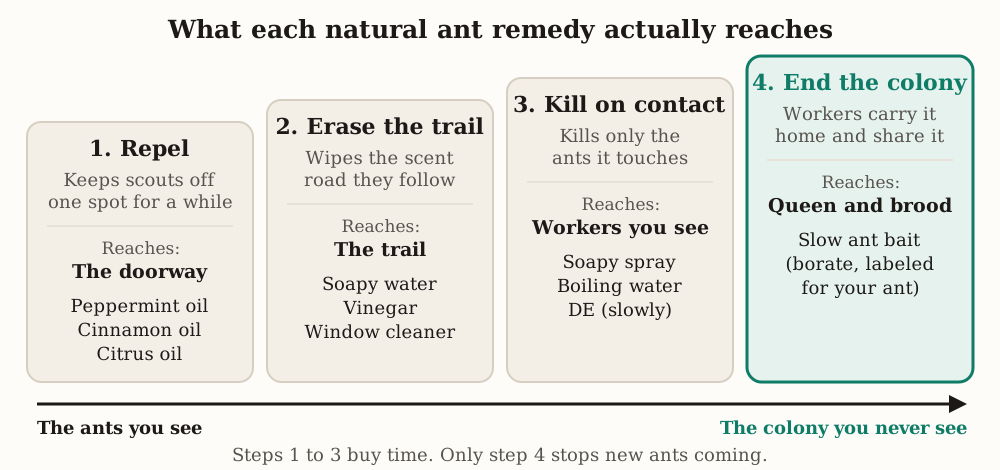
So the honest question is never “does it work?” but “which job does it do?” Once you know that, you can use a repellent for what it is good at. For example, a scent at a door you cannot seal is a fine backup. It just cannot be the whole plan. Our guide to clearing an ant colony with bait covers the part no repellent can do.
Every home remedy for ants, rated by what it does
Of 20 common home remedies, only one, a borax or boric acid bait, can end a colony. Six kill ants on contact or soon after, eight repel, erase or block a trail for hours to weeks, and five do nothing measurable. The table below rates each one by its job, the evidence, how long it lasts and its safety.
We rated each natural ant repellent and killer by the best study we could find. Where there is no test, we say so. Many of the tests were done on fire ants or on ants nesting in plant pots, not on a kitchen trail. That is a real gap, so read the evidence column as a guide, not a guarantee.
20 home remedies for ants, rated by what they actually do
Vinegar spray
- What it actually does
- Erases the scent trail; may kill ants it soaks
- Evidence
- No ant study found; UC IPM uses soapy water for the same job
- How long it lasts
- Until it dries and the smell fades
- Pets and children
- Safe on its own. Never mix with bleach
Lemon juice
- What it actually does
- Erases the trail like any wipe
- Evidence
- No test of juice; citrus peel oil (d-limonene) kept ants out of pots for about 4 weeks (Bernard 2020)
- How long it lasts
- Until it dries
- Pets and children
- Safe
Soapy water (dish soap)
- What it actually does
- Kills ants it wets and erases the trail
- Evidence
- UC IPM recommends it
- How long it lasts
- No residue once dry
- Pets and children
- Safe
Window cleaner, Lysol
- What it actually does
- Kills on contact
- Evidence
- UC IPM: kills on contact, no lasting effect
- How long it lasts
- None after drying
- Pets and children
- Use as the label says, with air flow
Peppermint oil
- What it actually does
- Repels
- Evidence
- 10% mint oil kept nesting ants out of treated pots for 15 weeks (Bernard 2020)
- How long it lasts
- Days to weeks; refresh it
- Pets and children
- Concentrated oils can poison pets (ASPCA)
Cinnamon oil
- What it actually does
- Repels; kills in closed lab dishes
- Evidence
- 82.5% of ants chose clean air over it (de Pedro 2022); lab kill (Cheng 2008)
- How long it lasts
- Until the smell fades
- Pets and children
- Same oil warning
Ground cinnamon
- What it actually does
- Little or nothing
- Evidence
- On a fire ant mound, more activity than untreated (Texas A&M)
- How long it lasts
- Until swept up or wet
- Pets and children
- Safe
Tea tree, eucalyptus, clove oils
- What it actually does
- Some repel, some do not
- Evidence
- Eucalyptol was no better than plain air (de Pedro 2022); oils kill on contact with little residue (UC IPM)
- How long it lasts
- Short
- Pets and children
- Tea tree oil can harm pets in small amounts (ASPCA)
Coffee grounds
- What it actually does
- Nothing proven
- Evidence
- 1 cup on a fire ant mound: no change (Texas A&M)
- How long it lasts
- None
- Pets and children
- Keep out of pet reach
Cayenne or black pepper
- What it actually does
- May repel briefly
- Evidence
- No good test found
- How long it lasts
- Until wet
- Pets and children
- Irritates eyes and noses
Chalk line
- What it actually does
- Nothing lasting
- Evidence
- No test; ants walk around it
- How long it lasts
- Hours
- Pets and children
- Plain chalk is safe. Insecticide "ant chalk" is illegal (EPA)
Salt
- What it actually does
- Nothing proven
- Evidence
- No test found
- How long it lasts
- None
- Pets and children
- Skip it
Baking soda and sugar
- What it actually does
- Kills some workers, slowly
- Evidence
- About half of Argentine ants died in 6 days on a 5% bait (Brinkman and Gardner 2004); no colony data
- How long it lasts
- Until eaten or wet
- Pets and children
- Low risk
Cornmeal, grits, cream of wheat
- What it actually does
- Nothing; may feed them
- Evidence
- Grits and Malt-O-Meal failed on fire ant mounds (Texas A&M)
- How long it lasts
- None
- Pets and children
- Safe
Aspartame (Equal), club soda
- What it actually does
- Nothing
- Evidence
- Both failed on fire ant mounds (Texas A&M)
- How long it lasts
- None
- Pets and children
- Safe
Boiling water
- What it actually does
- Kills the ants it reaches in a mound
- Evidence
- About 3 gallons cleared about 60% of fire ant mounds (Texas A&M)
- How long it lasts
- One use
- Pets and children
- Serious burn risk; kills plants
Diatomaceous earth
- What it actually does
- Kills slowly by drying ants out
- Evidence
- EPA, NPIC; does not remove colonies (Texas A&M)
- How long it lasts
- While dry and undisturbed
- Pets and children
- Dust irritates lungs and eyes; registered product only
Borax or boric acid bait
- What it actually does
- Ends the colony when workers share it
- Evidence
- The active ingredient in many registered baits (UC IPM)
- How long it lasts
- Several days to a week to show results
- Pets and children
- Keep in a closed station, out of reach
Sticky band, water moat
- What it actually does
- Blocks one route, such as a tree trunk or pet bowl
- Evidence
- UC IPM advises sticky bands on trunks
- How long it lasts
- Until clogged with debris
- Pets and children
- Safe
Bleach
- What it actually does
- Kills ants it soaks
- Evidence
- No advantage over soap
- How long it lasts
- None
- Pets and children
- Fumes; toxic gas if mixed with vinegar or ammonia
What smells do ants hate?
In lab tests, ants avoid cinnamon oil most strongly: 82.5% of workers chose clean air over it. Citronella and mint oils also repel. Eucalyptus is weaker than its reputation. A natural ant repellent made from these oils keeps ants off a treated spot for hours to weeks, but none of them kills the nest.
The best direct test we found is the 2022 study by Luis de Pedro and Juan Antonio Sanchez in Spain. They let single ants choose between two tubes of air, one plain and one scented. Cinnamon oil sent 82.5% of the ants to the plain side, citronella 70% and anisaldehyde, an anise scent, 62.5%. Eucalyptol, the main compound in eucalyptus oil, scored 52.5%, which is no better than a coin toss.
They then built the scents into buried irrigation tubing in an olive grove, where ants chew the drippers. After three months, about 59% of the plain drippers were damaged. With cinnamon oil or anisaldehyde in the plastic, only about 3% were. A third scent, a fragrance compound called ethyl anthranilate, stopped the damage completely.
That is strong evidence that some smells work. Still, it was one Mediterranean ant species, in a lab tube and in pipes underground. A smell on a windowsill fades faster than a scent built into plastic.
Peppermint oil for ants
Peppermint oil does repel ants, and it has the longest-lasting result of any natural ant repellent we found. In a University of Maine trial, plant pots dipped in 10% peppermint or spearmint oil stayed free of European red ant nests for the whole 15-week test. Meanwhile, untreated pots were colonized.
Keep two limits in mind. That was a 10% solution soaked into soil pots, far stronger than a few drops in a spray bottle. It also kept ants from nesting, which is not the same as stopping a trail. In a house, a cotton ball with peppermint oil at an entry point will turn some scouts away, and it needs refreshing every few days.
Essential oils for ants, and the pet warning
An essential oil is not a harmless natural ant repellent just because it comes from a plant. The ASPCA warns that concentrated oils can poison dogs and cats that walk through them or lick them off their fur. Signs include wobbling, low energy and, in severe cases, low body temperature. As few as seven or eight drops of concentrated tea tree oil can cause problems.
Keep oils on cotton balls in places pets cannot reach, and never put them on an animal. UC IPM adds another reason for caution: plant-oil sprays sold for ants kill well on contact but leave little lasting effect. Because they count as food-based products, they do not have to be registered as pesticides, so nobody checks their claims.
Does cinnamon keep ants away?
Cinnamon oil keeps ants away; ground cinnamon from the spice jar does very little. The oil was the strongest repellent in the 2022 Spanish test. A Taiwanese study also found that 2% cinnamon leaf oil killed half of a group of fire ants in about 18 minutes in a closed dish.
The powder is another matter. When a Texas A&M entomologist sprinkled a tablespoon of ground cinnamon on a fire ant mound, the mound ended up busier than an untreated one. A line of cinnamon across a doorway may turn a few ants for a while, but it will not kill them. The popular claim that ants breathe it in and suffocate has no study behind it.
Do coffee grounds repel ants?
There is no good evidence that coffee grounds repel or kill ants. Texas A&M tested a cup of used grounds on a fire ant mound over 30 days. Ant activity stayed the same as on mounds that got nothing. Grounds are good compost, but they are not an ant treatment.
Lemon, citrus and orange oil
Lemon juice wiped on a counter erases a trail, the same as any wipe. The stronger part of a lemon is the peel oil, d-limonene. Dipped plant pots treated with it kept ants away for about 4 weeks in the Maine trial. Some commercial fire ant mound drenches use d-limonene as their active ingredient, Texas A&M notes. If you buy one, check for an EPA registration number and a label that lists your ant and your site.
Plants that repel ants
Mint, lavender, tansy and wormwood often appear on lists of plants that repel ants. We found no trial showing that a living plant works as a natural ant repellent in a house or a garden bed. The oils from mint do repel, as the Maine work shows. However, a growing plant gives off far less scent than an oil-soaked pot.
Does vinegar kill ants?
Vinegar may kill an ant it soaks, but its real job is erasing the scent trail. Once it dries and the smell fades, usually within hours, ants can lay a new trail. Vinegar never reaches the nest, so it does not kill ants permanently. We found no study testing vinegar against ants, so every claim beyond that is guesswork.
Ants find food by following a chemical trail that scouts lay on the way home. Wiping a band of that trail with vinegar, or with plain soapy water, removes the scent. The next ants to arrive lose the road and wander. That is why wiping seems to work so well for a day.
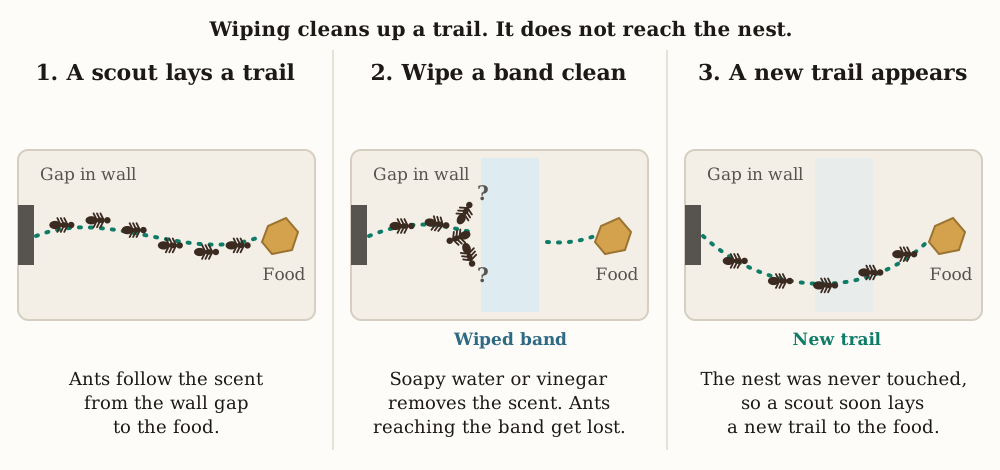
Does vinegar kill ants permanently?
No. The colony is somewhere else, behind a wall, under a slab or in the yard, and vinegar never reaches it. As long as the food and the gap are still there, a scout will find them again and lay a fresh trail. In fact, a vinegar wipe is a good first step only because it gives you a clean counter for the steps that matter.
How long will vinegar keep ants away?
About as long as the smell lasts, which is usually a few hours. As a natural ant repellent, a daily vinegar mop keeps trails broken, and some people find that enough. If the ants keep coming back after each wipe, though, the nest is close and still feeding. Then it is time for bait.
Does dish soap kill ants?
Yes. Soapy water kills ants on contact and wipes away their scent trail, which is why UC IPM recommends it over sprays indoors. Of every natural ant repellent and killer here, it is the cheapest, and it is safe around pets. Like vinegar, it leaves nothing behind once dry, so it clears today’s trail but not tomorrow’s.
UC IPM goes further. It says vacuuming trails or sponging them with soapy water can work as well as an insecticide spray for clearing the ants you see. That makes soapy water the first step in almost every plan on this page.
Will Dawn and vinegar kill ants?
A spray of Dawn and vinegar kills the ants it wets, mostly because of the soap. The vinegar adds a smell that masks the trail for a few hours. Together they clean up a trail well, but neither reaches the colony. Do not use the mix right next to a bait station, since you want ants to find the bait.
Does baking soda kill ants?
Baking soda can kill some ants, but slowly and only partly. In a 2004 lab study, about half of the Argentine ants fed a 5% baking soda and sugar bait died within 6 days, and stronger mixes did no better. No study shows that it reaches the queen or ends a colony.
Many popular pages explain it wrong. Western Exterminator says baking soda reacts with the acid in an ant’s stomach and kills it within minutes. Treehugger says it kills by mixing with stomach acid. The study by Mark Brinkman and Wayne Gardner, published in Florida Entomologist, found nothing that fast. Instead, the soda slowly raised the ants’ internal pH, which the authors think stopped their enzymes working.
The details matter. Nearly all ants kept on a thick layer of soda died within 6 days. Fire ants given the same amount of sodium as table salt died no faster than untreated ants, so the effect comes from the bicarbonate. However, the sugar mix killed only about half the workers, and more soda did not help.
Some popular guides say ants carry the mix home and it kills the queen. That part has never been tested. A slow bait can only reach the queen if it kills slowly and reliably enough for workers to share it, and baking soda has not shown that. If you want a bait that works, use one with a tested active ingredient.
Does diatomaceous earth kill ants?
Diatomaceous earth kills ants, but not on contact. The fine powder strips the waxy coat from an ant’s body, and the ant then slowly dries out and dies. It works only while the powder stays dry, it only reaches ants that walk through it, and Texas A&M says it usually does not wipe out a fire ant colony.
Several top pages get the speed wrong. Western Exterminator says it dehydrates ants “upon contact”, and many pages repeat that line. The EPA describes these drying powders as slow: once the coat is damaged, bed bugs “slowly dehydrate and die”, and ants are no different. In practice, an ant that crosses the powder walks on and dies later.
Water ends its effect. The National Pesticide Information Center says it stays effective only as long as it is kept dry and undisturbed. A humid bathroom, a mopped floor or a rainy porch makes it useless.
How to use diatomaceous earth safely
Use only a product registered with the EPA for ants, with an EPA registration number on the label. Puff a thin film into cracks and crevices with a hand duster. Do not pour lines or piles across floors, sills or the yard.
The EPA limits these powders to cracks and crevices because the dust is a breathing hazard. It also warns that food-grade and pool-grade products, which are sold for other uses, carry a higher inhalation risk. Texas A&M says the same: no other forms should be used as a pesticide. Breathing the dust irritates the nose and throat, and it can irritate eyes and skin, NPIC says. Keep children and pets out of the room while you apply it.
Does bleach kill ants? And other risky fixes
Bleach kills ants it soaks, but it is a bad choice. It does nothing soap cannot do, and it fills the room with fumes. Mixed with vinegar, it makes chlorine gas; mixed with ammonia or urine, it makes chloramine gas. Never use gasoline, kerosene or rubbing alcohol on ants either: they are fire hazards and are not registered pesticides.
The bleach risk is real in an ant fight, because people often reach for vinegar and bleach on the same afternoon. The Vanderbilt poison center explains that bleach plus an acid, such as vinegar or some bathroom cleaners, releases chlorine gas. Bleach plus ammonia, including pet urine, releases chloramine gas. Both burn the eyes, nose and throat.
Even well-known pages slip here. A gardening site that ranks for what kills ants, Planters Place, names gasoline and a match as the writer’s own fire ant remedy. On Reddit’s biggest thread on natural ant control, with nearly 600 comments, fire and gasoline get plenty of jokes. However, Texas A&M is clear that fuels are dangerous, kill the grass and can pollute groundwater.
Boiling water, salt, cornmeal and chalk
Of the old tricks, only boiling water kills many ants, and then only outdoors. About 3 gallons poured on a fire ant mound clears about 60% of mounds, Texas A&M reports. Cornmeal and grits failed in tests, salt is untested, and a chalk line only slows ants for a short while.
Does boiling water kill ants?
Yes, the ants it reaches. Boiling water works best on a cool, sunny morning or after rain, when the colony sits near the top of the mound. Even then, about 4 in 10 mounds survive, and a colony that survives may simply move. It also kills the grass and plants around the mound.
The bigger issue is safety. Carrying gallons of boiling water across a yard is an easy way to get a serious scald, so keep children and pets inside. Never use it indoors or on ants in a wall.
Does cornmeal kill ants?
No. The story is that ants eat cornmeal, grits or cream of wheat, which then swells and bursts them. However, adult worker ants cannot swallow solid food. They drink liquids and carry solids home for the larvae. Texas A&M tested grits and Malt-O-Meal on fire ant mounds, and neither controlled them. At best, cornmeal feeds the colony.
Does salt kill ants?
We found no test showing that salt kills or repels ants. In the 2004 baking soda study, fire ants exposed to sodium as table salt died at the same rate as untreated ants. Outdoors, salt also harms soil and plants, so it is one remedy to skip.
Does a chalk line keep ants away?
A line of plain chalk may break a trail for a short time, and the ants soon walk around it. Western Exterminator, a pest company, says chalk does not get rid of ants. Plain chalk is harmless, so it does no harm to try.
“Ant chalk” is a different product, and a dangerous one. Insecticide chalk sold online, often as “Miraculous Insecticide Chalk”, is not registered with the EPA. In 2019 the EPA warned that it has made children ill when they mistook it for ordinary chalk. Do not buy it.
What kills ants, and what only moves them
On contact, soapy water, window cleaner, boiling water and strong oils all kill ants. Those are the workers you can see, and UC IPM notes foragers are only a small part of the colony. To kill the ants you cannot see, you need a slow bait that workers carry home. Everything else only moves them.
This is why the question “what kills ants instantly?” leads people astray. A fast kill is the wrong goal. A bait that killed a worker in seconds would never reach the nest. UC IPM says bait products must be slow-acting so foragers can feed the rest of the colony before they die.
What kills ants, by where it works
On the counter, today
- Natural or home option
- Soapy water, window cleaner, vinegar wipe
- What it reaches
- The ants you wet, and the trail
At a doorway, for days
- Natural or home option
- Mint or cinnamon oil on a cotton ball
- What it reaches
- Scouts that would use that spot
In cracks, while dry
- Natural or home option
- EPA-registered diatomaceous earth
- What it reaches
- Ants that walk through it, slowly
In an outdoor mound
- Natural or home option
- About 3 gallons of hot water
- What it reaches
- About 60% of fire ant mounds, with a burn risk
In the nest
- Natural or home option
- A slow bait, such as a borate bait
- What it reaches
- The queen and the brood
Borax for ants, in brief
Borax is the one home remedy that can end a colony, because it kills slowly enough for workers to share it. Mixed into a sweet bait, it is carried home to the queen and the young. It is not harmless: it is a pesticide when you use it as one, and it must be kept away from children and pets.
Borax and boric acid are not the same thing. Some pages, Serious Eats among them, say borax is “also known as boric acid”. The National Pesticide Information Center lists borax as a sodium borate salt, a relative of boric acid. Both kill insects that eat them by upsetting the gut and nerves. Both can also kill plants, so do not spread borax on garden soil as some forum posts suggest.
We do not give a homemade recipe here. A homemade mix has no label, no tested strength and no child-resistant container. Too strong, and ants die before they get home; too weak, and nothing happens. A registered borate bait in a closed station solves all three. We plan a separate guide to borax for ants, with the common mistakes.
Infants are more sensitive to boric acid than adults, NPIC notes. If a child swallows bait or borax, call Poison Control at 1-800-222-1222 right away.
What actually ends an ant problem
Ending an ant problem takes three things no repellent provides: removing the food, sealing the entry point and killing the colony with a slow bait. UC IPM calls bait the only insecticide it recommends in most situations, and borate baits show results within days. A natural ant repellent then works as a backup at gaps you cannot seal.
This plan starts with what costs nothing. If you want to avoid pesticides entirely, steps 1 to 4 and step 7 still help, and sometimes they are enough. If exclusion and sanitation are successful, insecticide treatments are not required.
How to end an ant problem, low-toxic first
Check what you are dealing with
A swarm of small dark ants fighting on a sidewalk in spring is usually a pavement ant battle, and it ends on its own. Big black ants with sawdust point to carpenter ants. Stinging ants in a soil mound in the South point to fire ants. Each needs a different plan.
Take away the food and water
Put sugar, honey, fruit and pet food in sealed containers. Lift pet bowls at night, wipe sticky spots, empty the toaster tray and fix dripping pipes. Bait has to be the best meal in the room to work.
Wipe the trail with soapy water
Soapy water kills the ants it wets and removes the scent trail, as UC IPM advises. Do this before you set bait, and do not wipe right next to the bait once it is down.
Find where they come in
Watch a fresh trail without disturbing it. It leads back to a crack, a gap around a pipe, a window frame or a door sill. That entry point is where the bait goes and, later, what you seal.
Set a slow bait beside the trail
Use an EPA-registered ant bait whose label lists ants and indoor use. A closed station is safest around children and pets. If the ants ignore a sweet bait, try one with protein. The label is the law.
Leave it alone while they feed
More ants at the bait in the first days means it is working. Do not spray, wipe or put strong scents near it. UC IPM says borate baits can take several days to a week to show results.
Seal the gap once the traffic stops
Caulk the crack or the gap around the pipe. Only then use a scent, such as a cotton ball with peppermint oil out of pet reach, as a backup at entry points you cannot seal.
Not sure which ant you have? Our guide to the common house ants will help. Tiny ants at the sugar bowl are often what people call sugar ants, and they take sweet bait well.
Natural options outdoors and in the garden
Outdoors, most ants need no natural ant repellent or treatment at all. A spring swarm on the sidewalk is often two pavement ant colonies at war, and it ends by itself. For ants on a tree or plant, a sticky band on the trunk keeps them off. A fire ant mound needs bait, because home remedies fail on fire ants.
The sidewalk swarm that goes away on its own
UC IPM notes that neighboring pavement ant colonies fight in spring, making spectacular sidewalk “ant wars”. The best-known Reddit thread on natural ant control began with exactly that. A grandchild caring for a grandparent with dementia posted photos of a seething mass of ants by the steps and asked for a nontoxic fix.
One reply named it a Tetramorium war, the genus of the pavement ant. The poster took the advice to wait, and in an update said the ants were gone the next morning. So before you treat a dense swarm outside, wait a day.
Ants in a tree, shrub or potted plant
Ants on a tree or shrub are usually there for honeydew, the sugary waste of aphids and soft scales. UC IPM suggests a band of sticky material around the trunk, on a wrap to protect young bark. Then trim branches touching buildings so the trunk is the only way up. Check the band every week or two, since debris lets ants cross.
Dealing with the aphids also helps, since the ants lose their reason to climb. Our steps for clearing aphids cover the order that works. For ants nesting in a potted plant, UC IPM soaks the pot outdoors in a solution of insecticidal soap; follow the soap product’s label for the strength.
Fire ant mounds
Fire ants are the outdoor ant where home remedies fail most clearly. Texas A&M tested a long list of them, and only hot water did much. If you live in the South and see a mound with no single opening, read our fire ant guide before you treat it. Keep children away from the mound.
Ant control that is safe around pets and children
The safest ant control around pets and children is soapy water, sealed food, caulked gaps and bait in closed stations placed out of reach. The riskiest home options are concentrated essential oils near pets, boiling water, dusts that can be breathed in, and open dishes of borax.
- Bait. Choose a closed station and put it behind an appliance or inside a cabinet where small hands and paws cannot reach.
- Oils. Keep oil-soaked cotton balls up high, and never spray oils where pets walk or sleep.
- Dusts. Use registered diatomaceous earth only in cracks, never across floors or pet beds.
- Hot water. Keep children and pets indoors while you carry it outside.
Our main ant control guide covers how to place bait stations in a home with pets.
Home remedy myths, corrected
The most common myths about natural ant control come from top-ranking pages, not just forums. Below are 9 claims, the pages that make them, and what the evidence says. Each correction names its source, so you can check it yourself before you spend money or time.
Myth 1
Myth: “Baking soda and sugar poison ants through their digestion and kill the colony.”
Truth: In the only lab study we found (Brinkman and Gardner, 2004), it killed about half of Argentine ant workers in 6 days by raising their internal pH. Nobody has shown it reaches the queen or ends a colony.
Myth 2
Myth: “Baking soda kills ants within minutes by reacting with their stomach acid.”
Truth: Western Exterminator makes this claim. The lab study found deaths over days, not minutes, and no gas reaction.
Myth 3
Myth: “Food-grade diatomaceous earth kills ants on contact.”
Truth: It kills slowly by drying ants out, and only while dry (EPA, NPIC). The EPA warns that food-grade products carry a higher inhalation risk and limits registered dusts to cracks and crevices.
Myth 4
Myth: “Ants inhale cinnamon and suffocate.”
Truth: Treehugger and Western Exterminator both repeat this, with no study behind it. Ground cinnamon made a fire ant mound busier in a Texas A&M test.
Myth 5
Myth: “Cornmeal, grits or cream of wheat swell up inside ants and burst them.”
Truth: Adult ants cannot swallow solids. Grits and Malt-O-Meal failed to control fire ant mounds in Texas A&M tests.
Myth 6
Myth: “Equal (aspartame) is a neurotoxin to ants.”
Truth: A tip on Treehugger. Aspartame failed to control fire ant mounds when Texas A&M tested it.
Myth 7
Myth: “Borax is the same thing as boric acid.”
Truth: Serious Eats says so. NPIC lists borax as a sodium borate salt, a related but different compound.
Myth 8
Myth: “Essential oil ant sprays are safe for pets.”
Truth: Bug Out, a pest company, says so on its pet-friendly page. The ASPCA warns that concentrated oils can poison dogs and cats.
Myth 9
Myth: “Vinegar kills ants for good.”
Truth: It erases a trail for a few hours and never reaches the nest. No study we found shows a lasting effect.
When to stop trying home remedies
Stop experimenting and change plan when the ants are carpenter ants in wood, fire ants where people walk, or tiny pale ants spreading through an apartment building. Also change plan when two rounds of correct baiting have not worked. At that point you likely have several nests or an ant that needs a professional product.
When home remedies are the wrong tool
Big black ants, sawdust below wood
- What it usually means
- Carpenter ants nesting in damp wood
- What to do
- Find the moisture and the nest; see our carpenter ant removal guide
A mound with no single opening, painful stings
- What it usually means
- Fire ants
- What to do
- Bait the yard; keep children away; see our fire ant guide
Tiny pale ants in several rooms of a building
- What it usually means
- Possibly pharaoh ants, which split when sprayed
- What to do
- Bait only; tell the landlord or property manager
Ants still trailing after two rounds of bait
- What it usually means
- Several nests, or the wrong bait
- What to do
- Try a protein bait, or call a licensed pest professional
Winged insects shedding equal-length wings indoors
- What it usually means
- Possibly termites, not ants
- What to do
- Have a licensed inspector look before you treat
For big black ants, start with our carpenter ant removal plan, or confirm the ant first with our carpenter ant identification guide. Not sure what you have? Upload a photo to our free insect identifier.
Pest control disclaimer. Photo-based identification can help, but it is not always perfect. For dangerous spiders, large infestations, or anything you are unsure about, contact a licensed pest control professional.
Natural ant repellent FAQ
What is the best homemade ant repellent?
How do Amish get rid of ants?
How do I get rid of ants overnight?
Does Lysol or Windex kill ants?
Does neem oil kill ants?
Is apple cider vinegar better than white vinegar for ants?
Do natural remedies work on fire ants?
Should I leave ants alone outside?
Related guides
How to get rid of ants
Why bait beats spray, which household ant you have, and how to match the bait to it.
Sugar ants
The tiny ants at the sugar bowl: which ants they really are and how to clear them.
Types of ants
The common house ants side by side, so you know which one you are dealing with.
Fire ants
Mounds, stings and the bait method that works where home remedies fail.
How to get rid of carpenter ants
Finding the nest and the moisture behind big black ants in the house.
Get rid of aphids
The honeydew source that brings ants onto your plants, and how to clear it.
Sources
- de Pedro L, Sanchez JA. Natural Repellents as a Method of Preventing Ant Damage to Microirrigation Systems. Insects 13(4):395 (2022)
- Brinkman MA, Gardner WA. Mortality of Ant (Hymenoptera: Formicidae) Pest Species Exposed to Sodium Hydrogen Carbonate. Florida Entomologist 87(3):324 (2004)
- Bernard K, Groden E, Drummond FA. Evaluation of Four Plant Extract Repellents for Management of the European Red Ant Myrmica rubra. Journal of Economic Entomology 113(4):1609 (2020)
- Cheng SS et al. Terminating red imported fire ants using Cinnamomum osmophloeum leaf essential oil. Bioresource Technology 99(4):889 (2008)
- UC IPM, Pest Notes: Ants, Publication 7411
- UC IPM, Key to Identifying Common Household Ants: Pavement ant
- Texas A&M AgriLife Extension, Natural, Organic, and Alternative Methods for Imported Fire Ant Management, ENTO-009 (2014)
- Texas Imported Fire Ant Research and Management Project, Entomologist testing puts bite on many 'home' fire ant treatments (W. Brown)
- US EPA, Pesticides to Control Bed Bugs (desiccants: registered products, cracks and crevices only)
- National Pesticide Information Center, Diatomaceous Earth General Fact Sheet
- National Pesticide Information Center, Boric Acid General Fact Sheet
- US EPA, EPA orders online marketplace to stop selling illegal pesticides (Miraculous Insecticide Chalk), December 20, 2019
- ASPCA, Is the Latest Home Trend Harmful to Your Pets? (essential oils, ASPCA Animal Poison Control Center)
- Vanderbilt University Medical Center, Tennessee Poison Center: Why shouldn't I mix household chemicals with bleach?