How many types of ants are there?
Scientists have named more than 15,700 species and subspecies of ants, and a 2022 study in PNAS suggests there may be as many again still waiting for names. The US has somewhere between 700 and 1,000 kinds, depending on the source. Yet only about two dozen types of ants are common in American homes and yards.
The same PNAS team put the number of ants alive on Earth at about 20 quadrillion. That is roughly 2.5 million ants for every person. So when a trail appears in your kitchen, it is a tiny slice of a very big group.
The US count is a number sources disagree on. PestWorld and the Missouri Department of Conservation say “more than 700”, while Western Exterminator and DoMyOwn put it near 1,000. Some states have a lot on their own: Texas A&M counts about 300 in Texas, and UC IPM counts about 270 in California. On iNaturalist, naturalists have photographed 673 ant species in the US with an expert-confirmed name (read October 21, 2026).
Older numbers still circulate, too. UC IPM’s ant guide says “more than 12,400” worldwide, which is below today’s count, because new species are named every year. For pests the list is short: Penn State’s pest key covers just 21 species that matter around buildings in North America.
The 10 most common types of ants in US homes
These are the ants that the extension guides we checked name most often as house pests. Each one has a short entry further down this page.
- Odorous house ant, the small brown kitchen ant that smells of coconut when crushed.
- Pavement ant, which piles soil in sidewalk and slab cracks.
- Carpenter ant, the big black ant that nests in damp wood.
- Argentine ant, which forms huge trails, above all in California.
- Pharaoh ant, a tiny yellow ant of heated buildings.
- Little black ant, a tiny, shiny black ant of lawns and kitchens.
- Thief ant, also called the grease ant.
- Fire ant, the stinging mound ant of the South.
- Acrobat ant, which raises a heart-shaped abdomen when disturbed.
- Field ant, the medium red, black or red and black ant of lawn mounds.
How to identify an ant in five checks
To identify an ant, use five checks in order. First make sure it is an ant, then measure it, note its color in daylight, and count the one or two nodes in its waist. Finally, note where you found it and smell a crushed one. Those five clues name most US house ants without a microscope.
The top-ranking guides list ants one by one but rarely let you sort the ant in your hand. These checks are the features a phone can see, so they work at the kitchen counter.
Identify an ant, step by step
Make sure it is an ant
Look for a pinched waist and antennae with a bend in the middle, like an elbow. A termite has a thick waist and straight, beaded antennae. Pale “white ants” are termites.
Measure it
Set a few ants beside a ruler or a coin. Sort them into tiny (1/16 inch, 2 mm), small (1/8 inch, 3 mm), medium (3/16 to 1/4 inch, 4 to 7 mm) or large (1/4 inch, 6 mm, and up). Note whether the workers are all one size or mixed.
Note the color in daylight
Indoor light makes brown ants look black. Check the head, the middle and the abdomen separately, because many ants are two-toned.
Count the nodes in the waist
From the side, the waist has one bump or two. Zoom in with your phone or use a hand lens. One node or two cuts the list of suspects in half.
Note where you found it, then sniff
Write down the place: a kitchen trail, a lawn mound, wood, or bare soil. Then crush one ant on a paper towel and smell it. Coconut, lemon and vinegar smells each point to a different ant.
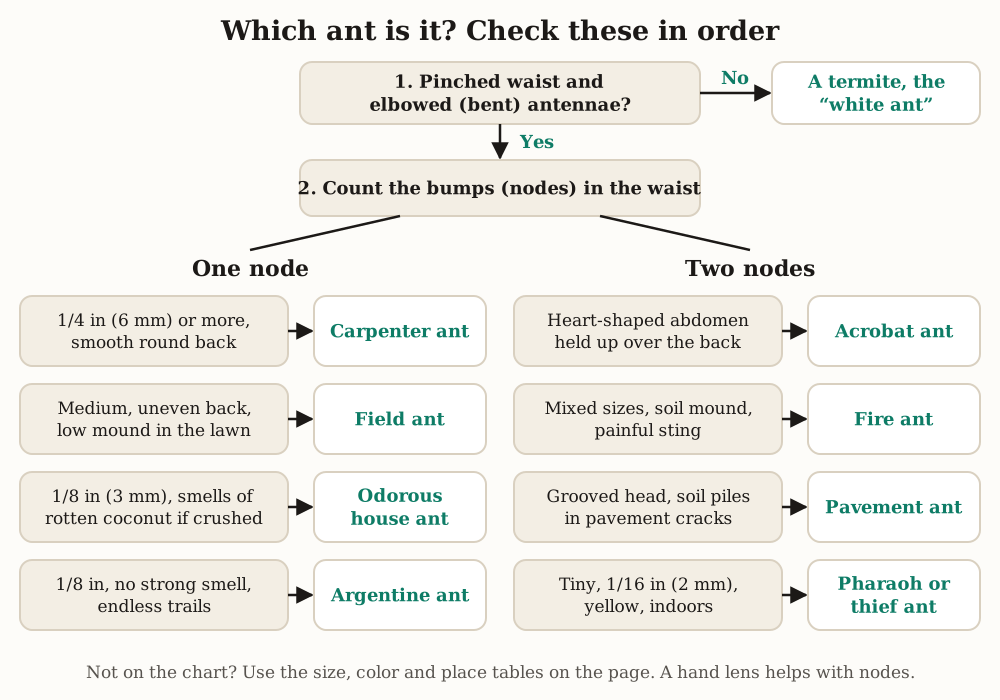
One node or two
The node is a small bump on the thin waist between the middle of the body and the abdomen. Some ants have one, and some have two in a row. Illinois Public Health calls the number and shape of the nodes “useful features for identifying ant species”. Seen from the side, even a zoomed phone photo often shows it.
One node points to odorous house, Argentine, carpenter, field, winter, crazy, ghost and citronella ants. Two nodes point to pavement, pharaoh, thief, fire, acrobat, harvester, big-headed and little black ants. However, on odorous house and ghost ants the single node hides under the abdomen, so look closely before you decide.
The crush-and-sniff test
Several ants give off a smell when crushed, and the smell is a fast, free clue. Crush one ant on a paper towel and sniff it. Then compare it with this table, which uses the descriptions in the extension guides.
What a crushed ant smells like
Rotten coconut or rancid butter
- Most likely ant
- Odorous house ant
- What else to check
- About 1/8 in (3 mm), brown to black, one hidden node
Coconut, on a tiny pale ant
- Most likely ant
- Ghost ant
- What else to check
- Under 1/16 in (1.5 mm), dark head, see-through abdomen
Lemon, citronella or soap
- Most likely ant
- Citronella ant (larger yellow ant)
- What else to check
- Yellow to orange, about 3/16 in (4 to 5 mm)
Sharp, like vinegar (formic acid)
- Most likely ant
- Field ant or cornfield ant
- What else to check
- One node, uneven back, mounds in the lawn
Strong and unpleasant
- Most likely ant
- Velvety tree ant (West) or acrobat ant
- What else to check
- Red thorax and black abdomen, or a heart-shaped abdomen
Faintly musty, or nothing
- Most likely ant
- Argentine ant
- What else to check
- Dull brown, about 1/8 in, endless trails
No smell noted in extension guides
- Most likely ant
- Pavement, pharaoh, thief or carpenter ant
- What else to check
- Use size and nodes instead
What a phone photo can and cannot show
A sharp photo shows size, color and often the node count. But it rarely shows antenna segments, spines or hairs, and those settle the close calls. Extension experts say so often. In one 2024 Ask Extension case, an Oregon expert needed “to see a specimen to look at identifying features under a dissecting scope”.
For the best photo, put a few ants on white paper beside a ruler and shoot from the side in daylight. Use workers, not winged ants. If you still need a name, take a few ants to your county Extension office. The ants do not need to be alive, the Oregon expert told the asker, but they do need to be whole: “no squishing please!” You can also try our free photo bug identifier first.
Ant identification key: sort by size
Size is the fastest way to sort the common types of ants. Tiny ants are about 1/16 inch (2 mm), small ants about 1/8 inch (3 mm), medium ants 3/16 to 1/4 inch (4 to 7 mm), and large ants 1/4 inch (6 mm) or more. Find your size band, then read the first column of its table.
Each table puts the feature that separates the ants first. Also note whether every worker in a trail is the same size. Fire ants, carpenter ants and leafcutter ants come in mixed sizes in one colony, while most small house ants do not.
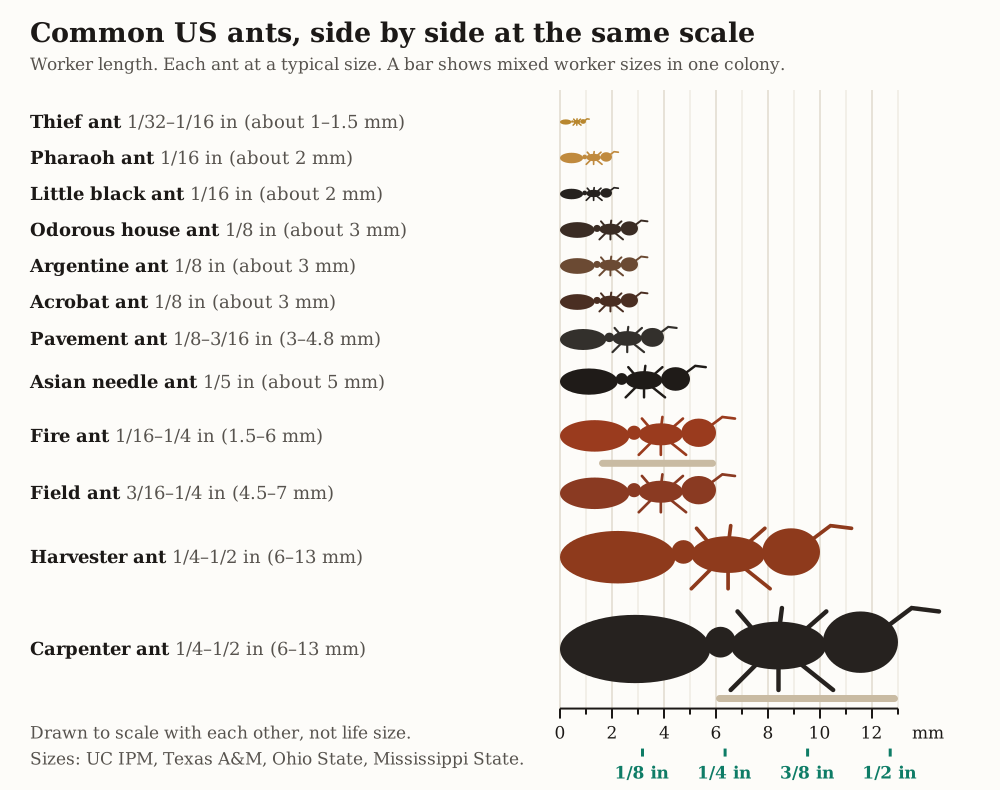
Tiny ants, 1/16 inch (2 mm) or less
Tiny ants, about 1/16 inch (2 mm) or less
Pale, see-through abdomen and legs, dark head
- Ant
- Ghost ant
- Size
- Under 1/16 in (1.3–1.5 mm)
- Nodes
- One, hidden
- Where you find it
- Kitchens, bathrooms, potted plants; Florida, Texas, Hawaii
Yellow to reddish brown, darker tail tip, indoors all year
- Ant
- Pharaoh ant
- Size
- 1/16 in (about 2 mm)
- Nodes
- Two
- Where you find it
- Kitchens, bathrooms, apartments, hospitals
Yellow to light brown, smallest of all, goes for grease
- Ant
- Thief ant (grease ant)
- Size
- 1/32–1/16 in (about 1–1.5 mm)
- Nodes
- Two
- Where you find it
- Cupboards; soil, often beside other ants
Shiny jet black, tiny craters of fine soil
- Ant
- Little black ant
- Size
- 1/16 in (about 2 mm)
- Nodes
- Two
- Where you find it
- Lawns, woodwork, kitchens; East, North, southern California
Dark brown to pale blond, humped back, no bite or sting
- Ant
- Rover ant
- Size
- About 1/16 in (2 mm)
- Nodes
- One, hidden
- Where you find it
- Damp spots, potted plants, wall voids; Texas and the South
Golden, slow, stings, drops from trees
- Ant
- Little fire ant (electric ant)
- Size
- 1/16 in (1.5 mm)
- Nodes
- Two
- Where you find it
- Hawaii and Florida
Small ants, about 1/8 inch (3 mm)
Small ants, about 1/8 inch (3 mm)
Rotten coconut smell when crushed
- Ant
- Odorous house ant
- Size
- 1/16–1/8 in (2–3 mm)
- Nodes
- One, hidden
- Color
- Brown to black
- Where you find it
- Kitchens, bathrooms, wall voids; the whole US
Wide, endless trails; little or no smell
- Ant
- Argentine ant
- Size
- 1/8 in (about 3 mm)
- Nodes
- One
- Color
- Dull light to dark brown
- Where you find it
- California above all; the Gulf Coast and Southeast
Fine grooves on the head and thorax; soil in pavement cracks
- Ant
- Pavement ant
- Size
- 1/8–3/16 in (3–4.8 mm)
- Nodes
- Two
- Color
- Dark brown to black, paler legs
- Where you find it
- Sidewalks, slabs, basements; most of the US
Heart-shaped abdomen raised over the back
- Ant
- Acrobat ant
- Size
- 1/8 in (about 3 mm)
- Nodes
- Two
- Color
- Light brown to black
- Where you find it
- Window frames, damp wood, trees
Out in cold weather, gone in summer heat
- Ant
- Winter ant (small honey ant)
- Size
- 1/8 in (2–4 mm)
- Nodes
- One
- Color
- Shiny dark brown to black
- Where you find it
- Kitchens in early spring and late fall
Runs fast in zigzags; very long legs and antennae
- Ant
- Longhorn crazy ant
- Size
- 1/8 in (about 3 mm)
- Nodes
- One
- Color
- Grayish black
- Where you find it
- The Southeast, Texas, Florida, Hawaii
Huge numbers outdoors; gets into electrical boxes
- Ant
- Tawny crazy ant
- Size
- 1/8 in (about 3 mm)
- Nodes
- One
- Color
- Reddish brown
- Where you find it
- Texas Gulf Coast and Florida
Two worker sizes; the big ones have huge heads
- Ant
- Big-headed ant
- Size
- 1/10–1/7 in (2.4–3.8 mm)
- Nodes
- Two
- Color
- Reddish brown
- Where you find it
- Soil and under objects; the South, Florida, Hawaii
Black body, pale yellowish feet
- Ant
- White-footed ant
- Size
- Just over 1/8 in (3 mm)
- Nodes
- One, hidden
- Color
- Black
- Where you find it
- South Florida, Hawaii, parts of California
A cone-shaped bump on the back; crater in bare soil
- Ant
- Pyramid ant
- Size
- 1/8 in (about 3 mm)
- Nodes
- One
- Color
- Red and black
- Where you find it
- Sunny bare ground, mostly in the South
Medium ants, 3/16 to 1/4 inch (4 to 7 mm)
Medium ants, 3/16 to 1/4 inch (4 to 7 mm)
Mixed sizes in one mound; no hole on top; stings
- Ant
- Fire ant
- Size
- 1/16–1/4 in (1.5–6 mm)
- Nodes
- Two
- Color
- Reddish brown, darker abdomen
- Where you find it
- Sunny lawns and fields; the South and parts of California
One tall, paddle-shaped node; orange-brown legs; stings
- Ant
- Asian needle ant
- Size
- About 1/5 in (5 mm)
- Nodes
- One
- Color
- Shiny black
- Where you find it
- Leaf litter, logs and mulch in shade; the Southeast and Mid-Atlantic
Uneven back; low mounds in the lawn; vinegar smell
- Ant
- Field ant
- Size
- 3/16–1/4 in (4.5–7 mm)
- Nodes
- One
- Color
- Red, black, or red and black
- Where you find it
- Lawns, flowerbeds, woods; the whole US
Lemon smell when crushed; swarms indoors in winter and spring
- Ant
- Citronella ant (larger yellow ant)
- Size
- 5/32–1/4 in (4–6 mm)
- Nodes
- One
- Color
- Yellow to orange brown
- Where you find it
- Soil by foundations and under slabs; the North and Midwest
Red thorax, velvety black abdomen, strong smell
- Ant
- Velvety tree ant
- Size
- 1/8–1/4 in (3–6 mm)
- Nodes
- One
- Color
- Red and black
- Where you find it
- Dead limbs and stumps; California and the West
Large ants, 1/4 inch (6 mm) and up
Large ants, 1/4 inch (6 mm) and up
Smooth, evenly curved back; workers of many sizes
- Ant
- Carpenter ant
- Size
- 1/4–1/2 in (6–13 mm)
- Nodes
- One
- Color
- Black, or red and black
- Where you find it
- Damp wood, trees, houses; the whole US
Bare circle around one nest hole; a beard of hairs under the head; stings
- Ant
- Harvester ant
- Size
- 1/4–1/2 in (6–13 mm)
- Nodes
- Two
- Color
- Red to dark brown
- Where you find it
- Open dry ground; Texas, the West, Florida
Carries pieces of leaves; spiny back; crater mounds
- Ant
- Texas leafcutter ant
- Size
- 1/6–1/2 in (4–13 mm)
- Nodes
- Two
- Color
- Rust brown
- Where you find it
- Central and East Texas, western Louisiana
Slender and wasp-like, big eyes; lives in twigs; stings
- Ant
- Twig ant
- Size
- 5/16–2/5 in (8–10 mm)
- Nodes
- Two
- Color
- Orange body, dark head and tail
- Where you find it
- Shrubs and twigs; Florida, Texas, the Gulf Coast
Sizes from UC IPM, Texas A&M, Ohio State, Illinois Public Health, Mississippi State and Ohio State BYGL. Where sources differ, the table gives the range they cover.
One size is worth a note. UC IPM, Ohio State and Texas A&M all give the thief ant as 1/32 inch, while DoMyOwn says 1/16 inch. Ohio State gives a range of 1/32 to 1/20 inch. That puts a thief ant at roughly 1 to 1.5 mm, and either way it is the smallest ant you are likely to find in a kitchen.
Common house ants: the kitchen and bathroom types
The types of ants that come into kitchens and bathrooms are about a dozen small species, most of them 1/16 to 1/8 inch (2 to 3 mm) long. They come in for sweets, grease and water. Odorous house, pavement, Argentine and pharaoh ants cause the most calls, and most of them nest outdoors and only forage inside.
Many people call any of these “sugar ants”, but that is a nickname, not a species. Our guide to what people mean by sugar ants sorts out which ant is usually behind the name. For bait choice and removal, our ant control guide matches each house ant to the bait it takes.
Odorous house ant
The odorous house ant (Tapinoma sessile) is a brown to black ant about 1/8 inch long. Crush one and it smells of rotten coconut, which settles the ID. It lives across the US, Texas A&M says, though it is rare in the southwestern deserts. DoMyOwn says it is not found in the Southeast, but iNaturalist has hundreds of confirmed records from North Carolina, Georgia and Alabama.
Argentine ant
The Argentine ant (Linepithema humile) is a dull brown ant about 1/8 inch long. It forms wide trails that run for yards, with many queens spread over many nests. UC IPM calls it the most common ant in and around California homes. On iNaturalist, California holds 10,646 of its 12,024 US records. PestWorld places it “mainly throughout the southeastern United States”, which misses where it is worst.
Pavement ant
The pavement ant is a dark brown to black ant, 1/8 to 3/16 inch long, with fine parallel grooves on its head and thorax. It pushes small piles of soil up through cracks in sidewalks, driveways and slabs. Illinois Public Health calls it “probably the most common ant in structures”. Its scientific name has changed to Tetramorium immigrans, so older guides call it T. caespitum.
Pharaoh ant
The pharaoh ant (Monomorium pharaonis) is a tiny yellow to reddish ant, about 1/16 inch long, with a darker tip on its abdomen. In most of the US it lives only in heated buildings. Never spray it. Texas A&M and Maryland Extension both warn that sprays and dusts make the colony split into new colonies, which is called budding. Baits are the method extension services recommend.
One Reddit user in r/pestcontrol reported a pest technician who insisted pharaoh ants “only live in hospitals”. That is wrong. They are well known in hospitals, but Texas A&M says they live in heated structures throughout the United States.
Little black ant
The little black ant (Monomorium minimum) is shiny jet black and about 1/16 inch long, with two nodes. Outdoors it leaves very small craters of fine soil in the lawn. It is native across the North and East and common in southern California, Texas A&M says. DoMyOwn limits it to southern California, Texas and Oklahoma, which leaves out most of its range.
Thief ant, also called the grease ant
The thief ant (Solenopsis molesta) is the smallest common house ant, yellow to light brown and about 1/32 to 1/16 inch long. Ohio State calls it the grease ant, because it feeds on grease, oils, cheese and meat rather than sweets. It gets its name from nesting near other ants and robbing their food and young. It belongs to the same genus as fire ants, Solenopsis, but it is far smaller.
Ghost ant
The ghost ant (Tapinoma melanocephalum) is under 1/16 inch long, with a dark head and thorax and a pale, almost clear abdomen and legs. The pale body is hard to see on a counter, which is where the name comes from. Outdoors it lives mainly in Florida and Hawaii. Farther north it turns up indoors, and Texas A&M lists finds in heated buildings as far away as Iowa and Oregon.
Crazy ants
Crazy ants are named for the way they run in fast, jerky zigzags instead of straight lines. The longhorn crazy ant is grayish black and about 1/8 inch, with very long legs and antennae. The tawny crazy ant, also about 1/8 inch but reddish brown, arrived near Houston in 2002. It now forms huge outdoor populations in Texas and Florida, and it does not sting, Texas A&M says.
Winter ant (small honey ant)
The winter ant (Prenolepis imparis), also called the small honey ant or false honey ant, is a shiny dark brown ant about 1/8 inch long. It handles cold better than other house ants. Illinois Public Health says it may be the first and the last ant seen each year, and it can vanish in summer heat. It is the third most photographed ant in the US on iNaturalist, with 21,553 confirmed records.
Big-headed ant
Big-headed ants (Pheidole) are reddish brown and 2.4 to 3.8 mm long, with two kinds of workers. The small workers look ordinary, but the large ones have a head far too big for the body. The native Pheidole dentata lives from Kansas to Virginia and south to Florida. An introduced species, the African big-headed ant, is one of the most reported ants in Hawaii.
White-footed ant
The white-footed ant is a black ant just over 1/8 inch long, with pale yellowish feet. It forms huge colonies with many egg-laying females, so it is hard to clear. Texas A&M lists it in South Florida, Hawaii and San Francisco. On iNaturalist, nearly all US records come from Florida.
Rover ant
Rover ants (Brachymyrmex) are about 1/16 inch long and range from black to pale blond. They neither bite nor sting, Texas A&M says, but they can turn up indoors in large numbers. Indoor problems usually go with moisture or rotting wood. Texas A&M also says rover ants are spreading in Texas.
Ants in wood and walls
Four types of ants nest in wood or wall voids: carpenter ants, acrobat ants, velvety tree ants and moisture ants such as the citronella ant. All of them prefer wood that is damp or already rotting. Finding one of them indoors usually points to a leak or a wet spot near the nest.
Carpenter ants
Carpenter ants (Camponotus) are the largest common house ants, 1/4 to 1/2 inch (6 to 13 mm) long, with one node and a smooth, evenly curved back. They are black, or red and black. They do not eat wood but dig nests in it. The eastern black carpenter ant is the most reported ant in the US on iNaturalist, with 36,276 confirmed records.
A colony has workers of many sizes, a clue Reddit users often point out. When one North Texas poster asked about ants “bigger than sugar ants”, with “some bigger than others”, the top answer was carpenter ants. Our carpenter ant guide covers the look-alikes and the damage, and our page on removing carpenter ants covers finding the nest.
Acrobat ants
Acrobat ants are about 1/8 inch long and lift a heart-shaped abdomen over their back when disturbed. They nest in damp wood and foam insulation, often around window frames. Our page on acrobat ants and the debris they leave explains how to tell them from carpenter ants by the waist.
Velvety tree ants
The velvety tree ant (Liometopum occidentale) is a western ant, 1/8 to 1/4 inch long, with a red thorax and a velvety black abdomen. It gives off a strong smell when crushed, UC IPM notes. It nests in dead limbs and stumps, and in California it sometimes moves into attics and walls where wood is damp.
Citronella and other moisture ants
The citronella ant, or larger yellow ant, is yellow to orange and up to 1/4 inch long. Crushed, it smells of lemon or citronella. Its winged swarmers often pour out of basement cracks in winter and spring, and people mistake them for termites. Illinois Public Health says baits do not work, because these ants feed only on honeydew from aphids on roots underground.
Pest companies call several yellow ants of this group “moisture ants”. They nest in soil and water-damaged wood, so a damp crawlspace or basement is the usual cause.
Ants in the lawn and yard
The yard ants people notice most are the mound builders: fire ants, harvester ants and field ants, plus pyramid ants and Texas leafcutter ants in the South. Mounds range from a tiny crater to Allegheny mound ant hills nearly 3 feet (1 m) high. Fire ants and harvester ants sting, so identify the mound first.
Fire ants
Fire ants are reddish brown, 1/16 to 1/4 inch long, with workers of mixed sizes in one colony. Their mound is loose soil with no single hole on top. In the US the main one is the red imported fire ant, found across the South and in parts of California. See our fire ant guide, with its state-by-state range, before you treat a mound.
Harvester ants
Harvester ants are large red to dark brown ants, 1/4 to 1/2 inch long, that clear a bare circle around one nest hole and collect seeds. They have a beard of long hairs under the head. Their sting is painful, so keep children and pets off the nest. Our harvester ant guide covers the kinds in Texas, the West and Florida.
Field ants and mound ants
Field ants (Formica) are medium ants, about 3/16 to 1/4 inch long, colored red, black, or red and black. They are often taken for carpenter ants, but their back is uneven, not smoothly curved. They have no sting. Instead, NC State Extension says, they pinch the skin and squirt formic acid into it, which can feel like a sting.
Most field ants build low mounds in lawns and flowerbeds. The Allegheny mound ant, with a rust-red head and thorax and a black abdomen, builds the big ones. Ohio State describes mounds “nearly three feet high by six feet in diameter”. These ants also inject formic acid into nearby plants, which kills the grass around the mound.
Pyramid ants
Pyramid ants (Dorymyrmex) are about 1/8 inch long, red and black, with a small cone-shaped bump on top of the thorax. They build a neat crater of soil in sunny, bare ground, often near other ants’ nests. In Florida, Buren’s pyramid ant is the fourth most reported ant on iNaturalist.
Texas leafcutter ants
The Texas leafcutter ant (Atta texana) is a rust brown, spiny ant whose workers range from 1/6 to 1/2 inch long. Workers carry cut pieces of leaves home, where they feed them to a fungus garden. Their nests can cover more than half an acre, with crater mounds. Texas A&M places them in central and eastern Texas and northwestern Louisiana, so yes, the US has leafcutter ants.
Twig ants
Twig ants (Pseudomyrmex gracilis) are slender, wasp-like ants about 5/16 to 2/5 inch (8 to 10 mm) long, with big eyes and an orange and dark body. They nest inside hollow twigs and stems and can sting. Terminix says they are “not commonly found” in the US. Yet iNaturalist has 7,089 confirmed US records, mostly from Florida and Texas.
Which types of ants sting?
In the US, five types of ants give a sting that matters: fire ants, harvester ants, the Asian needle ant, the little fire ant and twig ants. Most other house ants only bite, and some, such as rover ants, do neither. A sting can cause a severe allergic reaction in a sensitive person, so know which ants live near you.
Ants that sting in the US
Mixed sizes swarming out of a loose soil mound
- Ant
- Fire ant
- Where
- The South and parts of California
- What the sting is like
- Burning pain, then a white pus bump
Large red ant at a bare circle around one hole
- Ant
- Harvester ant
- Where
- Texas, the West, Florida
- What the sting is like
- Strong pain that can last 8 hours or more
Shiny black, orange legs, under leaves or logs
- Ant
- Asian needle ant
- Where
- The Southeast and Mid-Atlantic
- What the sting is like
- Painful, often felt in waves; rarely a severe allergic reaction
Tiny, golden, falls from trees
- Ant
- Little fire ant
- Where
- Hawaii and Florida
- What the sting is like
- Painful welts that can last for weeks
Slender, wasp-like, on shrubs
- Ant
- Twig ant
- Where
- Florida, Texas, the Gulf Coast
- What the sting is like
- Painful, usually when disturbed in thick shrubs
The Asian needle ant
The Asian needle ant (Brachyponera chinensis) is a shiny black ant about 1/5 inch (5 mm) long, with orange-brown legs and one tall node. It lives under leaf litter, pine straw and rotting logs in shady yards. It does not trail like house ants. Mississippi State Extension says the sting can “potentially induce a life-threatening allergic reaction” in sensitive people, although this is rare.
It is spreading. iNaturalist has 3,568 confirmed US records from 24 states and Washington, DC, led by North Carolina, Georgia and Virginia. In the Mid-Atlantic and Upper South it now makes up 3.9% of all confirmed ant records, more than the pavement ant. Wear gloves when you move logs or mulch in those states.
Ants that bite but do not sting
Carpenter ants can give a hard pinch with their jaws but have no sting. Field ants pinch and then spray formic acid into the bite. Acrobat ants bite when the nest is opened, and Ohio State says they “bite fiercely”. Tawny crazy ants bite, but Texas A&M says the pain fades quickly. Odorous house, ghost and rover ants are not a bite risk.
One look-alike is worth knowing. A fuzzy red and black “ant” walking alone on bare ground is probably a velvet ant, which is a wingless wasp with a strong sting. Our page on the cow killer and other velvet ants shows how to tell.
Types of ants by color
Color narrows the list but rarely settles it, because about a dozen common types of ants are some shade of brown or black. Use it with size and place. Big black ants over 1/4 inch are usually carpenter ants, and tiny red ants in a southern lawn are usually fire ants. White “ants” are termites.
What the color of an ant usually means
Big and black, 1/4 in (6 mm) or more
- Most likely ant
- Carpenter ant
- Check this to be sure
- One node and a smooth, curved back
Tiny and black
- Most likely ant
- Little black, odorous house or pavement ant
- Check this to be sure
- Coconut smell means odorous house ant; grooves on the head mean pavement ant
Brown, about 1/8 in (3 mm)
- Most likely ant
- Odorous house, Argentine or winter ant
- Check this to be sure
- The smell, and whether the trail ever ends
Tiny, light brown or yellow, indoors
- Most likely ant
- Pharaoh or thief ant
- Check this to be sure
- Both have two nodes. Do not spray pharaoh ants
Tiny red ants in a lawn mound
- Most likely ant
- Fire ant
- Check this to be sure
- Mixed sizes and a mound with no hole on top
Tiny red ants indoors
- Most likely ant
- Pharaoh, thief or young fire ant
- Check this to be sure
- Where the trail goes: a heated room or a door to the lawn
Big red ant on bare ground
- Most likely ant
- Harvester ant
- Check this to be sure
- A bare circle around one hole
Red and black
- Most likely ant
- Field, carpenter, velvety tree or pyramid ant
- Check this to be sure
- Uneven back means field ant; smooth curved back means carpenter ant
Red and black, fuzzy, alone
- Most likely ant
- Velvet ant, a wasp
- Check this to be sure
- Thick hair, about 3/4 in (19 mm), no trail
Yellow or orange
- Most likely ant
- Citronella ant; pharaoh or thief ant if tiny
- Check this to be sure
- A lemon smell means citronella ant
Pale, see-through abdomen
- Most likely ant
- Ghost ant
- Check this to be sure
- Under 1/16 in, dark head
Black with pale feet
- Most likely ant
- White-footed ant
- Check this to be sure
- Florida, Hawaii or coastal California
White
- Most likely ant
- Termite workers, or ant larvae and pupae
- Check this to be sure
- Straight antennae and a thick waist mean termite
Are white ants real?
No. There is no white ant in the US. “White ants” is an old name for termites, as Illinois Public Health notes, and termites are not ants at all. A termite worker is soft and creamy white, with a thick waist and straight antennae. When a northern New Jersey Reddit user found “little white ant things” under rocks by a shed, the top answer was short: “They are indeed termites.”
The other white things in an ant nest are the young. The white “ant eggs” that workers carry when a nest is opened are mostly pupae, Illinois Public Health explains, since real ant eggs are almost too small to see. If you found white insects in wood, read our termite guide. If the problem is winged insects, see our guide to telling a flying ant from a termite.
What are the big red ants called?
It depends on where you live. In Texas and the West, a big red ant at a bare circle is a harvester ant. In the North, big red ants in a lawn mound are usually field ants. Red imported fire ants are small, not big, so a big red ant is rarely a fire ant. A big, fuzzy red and black “ant” is a velvet ant.
Red and black ants
Red and black ants are usually field ants or carpenter ants, and the back tells them apart. A field ant has a bumpy, uneven back. A carpenter ant has a smooth, evenly curved one. In the West, the velvety tree ant is also red and black, and pyramid ants are smaller red and black ants of bare ground.
Which ants live in my state?
The types of ants you meet depend on your region. Carpenter ants and the winter ant lead in the North and East, fire ants in Texas and the Deep South, and the Argentine ant in California, at 24% of confirmed records. We read the 792,099 US ant sightings on iNaturalist and built the table below from the expert-confirmed ones.
The first column lists the ants naturalists photograph most in each region. Next to it are the house ants that extension guides name for that area, and the last column flags the stinging ants to know there.
Ants by US region (iNaturalist confirmed records, read October 21, 2026, plus extension guides)
Northeast (New England, NY, NJ, PA)
- Most reported ants
- Eastern black carpenter ant (22%), winter ant (12%), pavement ant, odorous house ant
- House ants to expect
- Odorous house, pavement, carpenter, winter, citronella and thief ants
- Stinging ants to know
- None common; European fire ant on the coast of Maine
Mid-Atlantic and Upper South (MD, VA, WV, KY, TN, NC)
- Most reported ants
- Chestnut and eastern black carpenter ants, winter ant, odorous house ant, Asian needle ant
- House ants to expect
- Odorous house, pavement, carpenter, little black and acrobat ants
- Stinging ants to know
- Asian needle ant; fire ants in parts of TN, NC and VA
Deep South (AL, GA, SC, MS, LA, AR)
- Most reported ants
- Eastern black carpenter ant (16%), red imported fire ant (16%), Asian needle ant, twig ant
- House ants to expect
- Argentine, odorous house, rover, crazy and big-headed ants
- Stinging ants to know
- Fire ants, Asian needle ant, Florida harvester ant
Florida
- Most reported ants
- Florida carpenter ant (16%), Florida harvester ant (10%), fire ant, pyramid ant, twig ant
- House ants to expect
- Ghost, white-footed, big-headed, crazy and pharaoh ants
- Stinging ants to know
- Fire ants, little fire ant, twig ant, harvester ant
Midwest and Plains
- Most reported ants
- Eastern black carpenter ant (24%), winter ant (11%), pavement ant, odorous house ant
- House ants to expect
- Odorous house, pavement, carpenter, citronella, thief and field ants
- Stinging ants to know
- None common; harvester ants in Kansas
Texas and Oklahoma
- Most reported ants
- Red imported fire ant (20%), red harvester ant (11%), Texas leafcutter ant (11%), acrobat ant
- House ants to expect
- Rover, tawny crazy, Argentine, odorous house and acrobat ants
- Stinging ants to know
- Fire ants, harvester ants, twig ant
Desert Southwest and Rockies (AZ, NM, NV, UT, CO)
- Most reported ants
- Rough, red and western harvester ants, pavement ant, southern fire ant
- House ants to expect
- Pavement, Argentine and odorous house ants (rare in the low desert)
- Stinging ants to know
- Harvester ants, southern fire ant
California
- Most reported ants
- Argentine ant (24%), winter ant (about 10%), harvester ants, velvety tree ant
- House ants to expect
- Argentine, odorous house, little black and velvety tree ants
- Stinging ants to know
- Southern fire ant; red imported fire ant in southern counties; harvester ants
Pacific Northwest and the North (OR, WA, ID, MT, WY, AK)
- Most reported ants
- Western black carpenter ant (19%), western thatching ant (16%), pavement ant (15%)
- House ants to expect
- Carpenter, odorous house, pavement and Argentine ants
- Stinging ants to know
- None common
Hawaii
- Most reported ants
- Yellow crazy ant (22%), Hawaiian carpenter ant, big-headed ant, twig ant
- House ants to expect
- Big-headed, ghost, white-footed and crazy ants
- Stinging ants to know
- Little fire ant, tropical fire ant
Percentages are each ant’s share of research-grade iNaturalist ant records in that region. They show what naturalists photograph, mostly outdoors, not how often each ant gets into homes. House ants from UC IPM, Texas A&M, Ohio State, Illinois Public Health and Maryland Extension.
Three findings stand out. First, the eastern black carpenter ant is the most reported ant in the country, with 36,276 confirmed records. Second, the red imported fire ant (22,008) and the winter ant (21,553) come next. Third, the Asian needle ant now outnumbers the pavement ant in records from the Mid-Atlantic and Upper South, a sign of how fast it has spread.
Season matters, too. Across the US, April holds 16.8% of ant sightings and May 15.3%, while December holds only 1.9%. So a trail in your kitchen in spring is normal timing. Ants indoors in midwinter usually mean a nest inside the heated house.
What are the three types of ants in a colony?
Every ant colony has three types of ants, called castes: workers, queens and males. Workers are wingless, sterile females that do all the work. Queens lay the eggs. Males have wings, mate once, and die soon after. Some species split the workers again into small and large sizes.
The ants you see on a trail are always workers. Queens and males only show up when they leave the nest in a mating flight, so a swarm of winged ants is the reproductive castes, not a new type of ant. Our guide to winged ants and what a swarm means covers that moment. After mating, a new queen sheds her wings and starts a colony. Our page on the queen ant and what finding one means explains how to spot her.
Worker sizes are the next clue. Carpenter ants, fire ants and leafcutter ants have workers of many sizes in one colony. Big-headed ants have just two: small workers and large ones with oversized heads, sometimes called soldiers. Honeypot ants go further. Some of their workers, called repletes, swell up with stored food and hang from the nest ceiling like living jars.
Other names for ants, and bugs called ants that are not ants
Many ants have two or three common names, and at least four “ants” are not ants at all. Grease ants are thief ants, electric ants are little fire ants, and sugar ants are a nickname for several house ants. White ants are termites, and velvet ants and blue ants are wasps.
Ant names that confuse people
Sugar ant
- What it usually means
- In the US, a nickname for small sweet-eating ants such as odorous house and Argentine ants. The real banded sugar ant lives in Australia
- Is it an ant?
- Yes
White ant
- What it usually means
- A termite
- Is it an ant?
- No
Grease ant
- What it usually means
- The thief ant
- Is it an ant?
- Yes
Electric ant
- What it usually means
- The little fire ant
- Is it an ant?
- Yes
Piss ant (pissant)
- What it usually means
- An old name from European wood ants, whose formic acid smells sharp. In the US, any small house ant
- Is it an ant?
- Yes
Winter ant, false honey ant
- What it usually means
- The small honey ant, Prenolepis imparis
- Is it an ant?
- Yes
Moisture ant, yellow ant, orange ant
- What it usually means
- Citronella ants and their relatives
- Is it an ant?
- Yes
Door head ant
- What it usually means
- Ants whose large workers block the nest hole with a flat head, such as turtle ants
- Is it an ant?
- Yes
Velvet ant, cow killer
- What it usually means
- A wingless female wasp covered in hair
- Is it an ant?
- No
Blue ant
- What it usually means
- An Australian flower wasp with a wingless, metallic blue female
- Is it an ant?
- No
Ant lion, doodlebug
- What it usually means
- The larva of an antlion, a lacewing relative that digs pits in sand
- Is it an ant?
- No
The sugar ant name causes the most confusion. Google’s results mix the Australian banded sugar ant, which is large with an orange band, with tiny American kitchen ants. Our page on sugar ants in US kitchens sorts out which ant you probably have. The pissant name has a similar story. It started with European wood ants that squirt formic acid, and in the US it now means any small ant in the house.
Famous types of ants from around the world
Beyond the US house ants, a dozen kinds of ants are famous for one trait. The bullet ant has one of the most painful stings known. The Saharan silver ant is the fastest, at 855 mm (about 34 inches) per second. Army ants live on the move, and three of these famous groups live in the US.
Famous ants, and whether they live in the US
One of the most painful insect stings; up to 1 in (25 mm) long
- Ant
- Bullet ant
- Where it lives
- Rainforests of Central and South America
- In the US?
- No
No fixed nest; colonies march and raid other insects
- Ant
- Army ants
- Where it lives
- The tropics; Neivamyrmex species across the southern half of the US
- In the US?
- Yes, native species
Farms fungus on cut leaves
- Ant
- Leafcutter ants
- Where it lives
- The Americas, north to Texas and Louisiana
- In the US?
- Yes
Stores liquid food in swollen living workers
- Ant
- Honeypot ants
- Where it lives
- Deserts worldwide, including the US Southwest
- In the US?
- Yes
Fastest ant, 855 mm (34 in) per second
- Ant
- Saharan silver ant
- Where it lives
- The Sahara Desert
- In the US?
- No
Sews leaves into nests with silk from its larvae
- Ant
- Weaver ants
- Where it lives
- Tropical Asia
- In the US?
- No
Long jaws, sharp eyes and a strong sting
- Ant
- Bull ants (bulldog ants)
- Where it lives
- Australia
- In the US?
- No
Workers burst open to coat enemies in a toxic liquid
- Ant
- Exploding ants
- Where it lives
- Southeast Asia
- In the US?
- No
Largest queens of any ant, up to 52 mm (2 in)
- Ant
- Driver ants
- Where it lives
- Africa
- In the US?
- No
Soldiers plug the nest entrance with a flat head
- Ant
- Turtle ants
- Where it lives
- The American tropics
- In the US?
- Mostly tropical
Two of these come up in US searches often. Are there army ants in the US? Yes. Neivamyrmex nigrescens is the most widespread army ant in the country, and iNaturalist has confirmed records of it from more than a dozen states. Are there bullet ants in the US? No, though a large Texas ant is sometimes called the “Texas bullet ant”. Our bullet ant page explains the sting and the Texas look-alike.
What to do once you know your ant
Once you know which of the types of ants you have, the plan follows from it. Most sweet-eating house ants clear with cleaning, sealing and a bait on the trail within a few weeks. Pharaoh ants must never be sprayed. Carpenter ants mean damp wood, and outdoor field and pyramid ants can usually be left alone.
First steps by type of ant
Odorous house, Argentine, winter or crazy ants
- Start with
- Clean up sweets, seal gaps, and set a sugar bait on the trail
- Avoid
- Spraying near the bait, which kills the carriers
Pharaoh ants
- Start with
- Bait stations placed widely along the trails
- Avoid
- Any spray or dust indoors, which splits the colony
Thief or pavement ants
- Start with
- Seal slab cracks; try a protein or grease bait if they ignore sugar
- Avoid
- Leaving pet food out overnight
Carpenter or acrobat ants
- Start with
- Find the damp wood and the nest
- Avoid
- Spraying the trail before you find the nest
Citronella ants
- Start with
- Seal basement cracks and fix damp spots
- Avoid
- Baits, which they ignore
Fire or harvester ants
- Start with
- Keep people and pets away; use a bait labeled for that ant
- Avoid
- Gasoline, kerosene or digging up the mound
Field or pyramid ants in the lawn
- Start with
- Leave them unless they bother you
- Avoid
- Spreading pesticide over the whole lawn
White “ants” in wood
- Start with
- A licensed termite inspection
- Avoid
- Treating them as ants
Start with what costs nothing: wipe up food, fix leaks, and seal the gaps the trail uses. If exclusion and sanitation are successful, insecticide treatments are not required. If you do use a bait or spray, choose an EPA-registered product whose label lists your ant and the place you will use it. The label is the law. Illinois Public Health puts it plainly: following the label is the applicator’s “legal responsibility”.
For a full plan, our guide to matching the bait to the ant covers sugar, protein and grease baits and where to put them. If you would rather start without pesticides, our page on natural ant repellents rates the home remedies honestly. Still not sure what you have? Our six checks for naming any bug help when it may not be an ant at all.
Pest control disclaimer. Photo-based identification can help, but it is not always perfect. For dangerous spiders, large infestations, or anything you are unsure about, contact a licensed pest control professional.
Types of ants FAQ
What is the most dangerous ant?
Can two types of ants live in one house?
Why do I see a different ant each season?
Do different types of ants fight each other?
Are there ants in Antarctica?
Related guides
How to get rid of ants
Why bait beats spray for every small house ant, and how to match the bait to the ant.
Carpenter ants
The big black ants that dig into damp wood, and how to tell them from other large ants.
Fire ants
The stinging mound ants of the South, and which states have them.
Sugar ants
What Americans mean by sugar ants, and which ant is usually behind the name.
Ant bites
Which ants bite or sting, what is normal, and the warning signs that need care.
Flying ants vs termites
Three features that separate a winged ant from a termite swarmer.
Acrobat ants
The tiny ants with a heart-shaped abdomen that nest in damp window frames.
Harvester ants
The big red seed-collecting ants of Texas and the West, and their sting.
Sources
- Schultheiss P, Nooten SS, Wang R, et al. The abundance, biomass, and distribution of ants on Earth. PNAS 119(40), 2022
- UC IPM Pest Notes: Ants, Publication 7411, M. Rust and D. Choe
- Ohio State University Extension, Ants In and Around the Home, HYG-2064
- Illinois Department of Public Health, Ants
- Texas A&M AgriLife Extension, Urban Entomology, Ants (species pages)
- University of Maryland Extension, Ants: Indoor Insects (updated October 2024)
- Penn State Extension, Common Pest Species of Ants, T. Carroll and G. Bennett
- Mississippi State University Extension, Asian Needle Ant, Publication 4142 (2025)
- NC State Extension, Henderson County Center, Pest Alert: Formica Ants
- Ohio State University, Buckeye Yard & Garden onLine, Allegheny mound ants, Formica exsectoides
- Cleveland Clinic, Ant Bites
- MedlinePlus Medical Encyclopedia, Insect bites and stings
- Myrmecological News Blog, Different types of ants (2022)
- Australian Museum, Blue Ant
- iNaturalist, ant (Formicidae) observations in the United States (read October 21, 2026)