What is a bullet ant?
A bullet ant is Paraponera clavata, a large ant of the lowland rainforests of Central and South America. Workers are 0.7 to 1.2 inches (18 to 30 mm) long, reddish black, and built like a wingless wasp, with a long sting at the tip of the abdomen. That sting is rated the most painful of any insect.
It is the only living species in its genus, and even in its own subfamily. Its one known relative is an extinct ant found in amber from the Dominican Republic. In other words, it has no close cousins anywhere, and certainly none in the US.
Local names say a lot about it. In Venezuela it is the hormiga veinticuatro, the “24 ant”, for the day of pain after a sting. Costa Ricans call it bala, which means bullet. In Brazil it is the tocandira or tucandeira, from a Tupi word. English speakers also call it the conga ant.
How to recognize a bullet ant
Check each clue below to narrow down what you saw.
Very large: 0.7 to 1.2 inches (18 to 30 mm)
Bigger than any ant you will meet in the US.
Reddish black to dark brown
The thorax, the middle section, is hairy.
Big jaws in front and a sting at the tip of the abdomen
From a distance it looks like a wasp with no wings.
A single large bump (node) in the waist
AntWiki calls the shape of this waist segment unique among ants.
On a tree trunk in a lowland rainforest, often at dusk or at night
The nest is in the soil at the base of a tree.
It squeaks when it is held or disturbed
The sound comes from rubbing body parts together, called stridulation.
Why is it called a bullet ant?
People say the sting feels like being shot. That comparison gave the ant its English name and its Costa Rican one. Still, the people who have actually been stung describe it in other ways. Schmidt compared it to walking on hot coals with a long nail in your heel. Entomologist Alex Wild, stung on purpose in Costa Rica, likened it to the ache that follows a hard blow to the arm.
How big is a bullet ant?
A worker is 0.7 to 1.2 inches (18 to 30 mm) long. Most are close to 1 inch (25 mm), about the width of a US quarter. Sources disagree on the top end: Wikipedia and Orkin give 30 mm, while Britannica stops at 1 inch. The queen is only a little bigger than her workers.
Bullet ant size, by source
Wikipedia
- Size given
- 18–30 mm (0.7–1.2 in)
- Note
- Workers
Orkin
- Size given
- 18–30 mm, up to 1.2 in
- Note
- Calls it one of the largest ants in the world
Britannica
- Size given
- 1.8–2.5 cm (0.7–1 in)
- Note
- Queens only slightly larger
Discover Wildlife
- Size given
- About 2.5 cm, 80–120 mg
- Note
- Sting up to 3.5 mm long
AntWiki
- Size given
- More than 2 cm
- Note
- Workers
Robinson and others, Nature Communications (2023)
- Size given
- About 20 mm
- Note
- One worker in a study photo
Mongabay report (2019)
- Size given
- Up to 2.5 cm (1 in)
- Note
- Ants collected for a Sateré-Mawé glove
Our reading: most workers are near 1 inch. An ant well under 3/4 inch (18 mm) is probably something else.
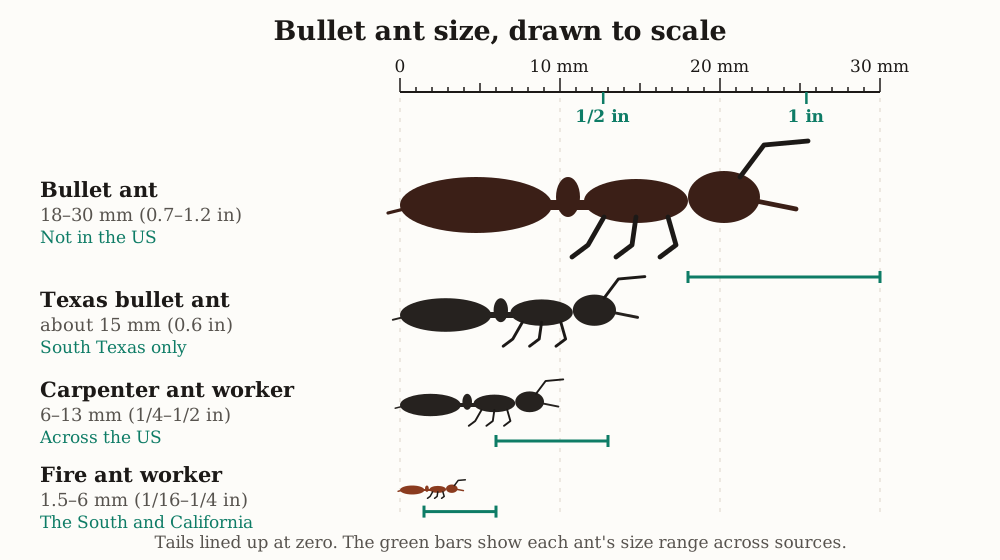
What does a bullet ant look like?
It looks like a heavy, reddish-black wasp with no wings. It has a large head, strong jaws, one big bump at the waist, and a thick abdomen that ends in a sting. The thorax is hairy. Workers vary a little in size, but there are no distinct small and large worker types like those in a fire ant mound.
The bullet ant queen and new colonies
A queen ant of this species looks much like a worker and is only slightly larger. She has wings until she mates, then sheds them. Winged queens and males come to lights at the start of the rainy season in Panama, according to a 1991 study AntWiki cites. So yes, bullet ants can fly, but only for a short time and only the young queens and males.
A new queen founds her colony alone. Unusually, she has to leave the nest to hunt until her first workers grow up. In lab colonies, the ant biologist Christian Peeters found that those first workers lay special eggs just to feed the queen’s larvae.
Where do bullet ants live?
The species lives in humid lowland rainforest from Honduras and Nicaragua south to Peru, Bolivia and Brazil. Most colonies sit below 2,460 feet (750 m), though one specimen came from about 4,900 feet (1,500 m) in Costa Rica. No source we checked lists Mexico, the Caribbean islands or the US.
Within that band they are found in Honduras, Nicaragua, Costa Rica, Panama, Colombia, Venezuela, Ecuador, Peru, Bolivia, Brazil and the Guianas. Sources differ at the edges. Wikipedia and Britannica add El Salvador, and AntWiki adds Paraguay and Argentina. A 2007 mapping study by Murphy and Breed placed the northern limit in Nicaragua, so records farther north are few.
The nest is a hole in the soil at the base of a tree. Workers climb that tree to forage in the canopy, and they seldom search the forest floor. Studies in Costa Rica and on Barro Colorado Island in Panama counted about 4 nests per hectare, or about 1.6 per acre.
Are there bullet ants in the US?
No. Paraponera clavata has no wild population in the US. Its range ends in Honduras, more than 1,000 miles (1,600 km) south of Texas. iNaturalist holds 11 US records under its name, and none is a verified wild sighting: 6 are marked captive, and the other 5 never reached a confirmed ID.
So what are Americans seeing when they report one? Usually it is one of three things. It may be the Texas bullet ant, a big native ant such as a carpenter or harvester ant, or a velvet ant, which is really a wasp.
The Texas bullet ant is a different ant
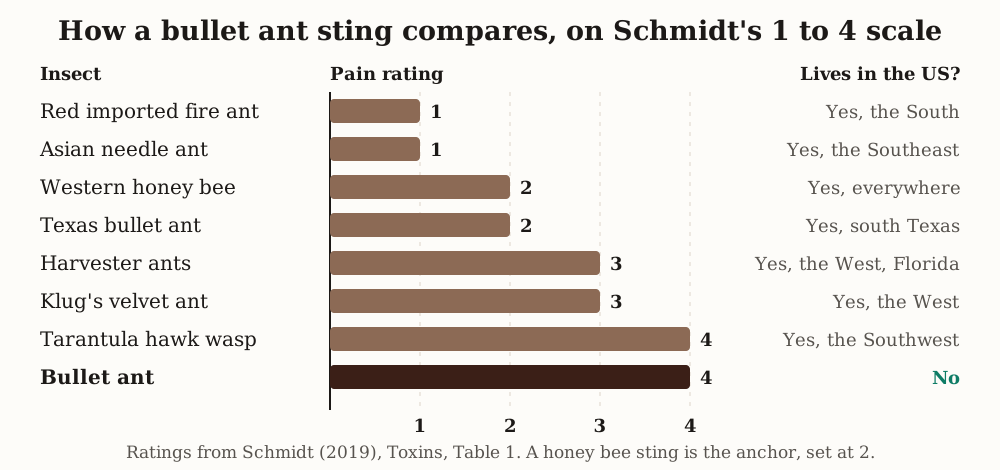
The “Texas bullet ant” is Neoponera villosa, a black hunting ant with golden hairs, about 5/8 inch (15 mm) long. Zoos and pest companies use the name, but it belongs to a different subfamily. Its sting rates 2 on Schmidt’s scale, the same as a honey bee, against 4 for Paraponera.
It goes by other names too: hairy panther ant, greater Texas bullet ant and giant hunting ant. Older papers call it Pachycondyla villosa. It is one of the most widespread hunting ants in the Americas, from south Texas to Argentina. It nests in dead wood, tree hollows and air plants, hunts insects, and drinks nectar, including from mistletoe in south Texas.
We read every US record of it on iNaturalist on October 21, 2026. All 945 verifiable records come from Texas. About 64% are from the Lower Rio Grande Valley, south of latitude 26.5°N, and 86% are from south of 28°N. The northernmost sit near Brackettville in Kinney County and near Kingsbury, east of San Antonio. October and November alone hold 30% of the sightings.
One correction is worth making. Cincinnati Zoo’s page lists its range as only southern Texas and Mexico. In fact it runs on through Central and South America, as Mackay and Mackay’s 2010 revision describes.
Bullet ant vs Texas bullet ant
Sting pain (Schmidt)
- Bullet ant
- 4, the top of the scale
- Texas bullet ant
- 2, like a honey bee
In the US?
- Bullet ant
- No
- Texas bullet ant
- Yes, south Texas only
Size
- Bullet ant
- 18–30 mm (0.7–1.2 in)
- Texas bullet ant
- About 15 mm (0.6 in)
Color
- Bullet ant
- Reddish black to dark brown
- Texas bullet ant
- Black with golden hairs
Range
- Bullet ant
- Honduras to Bolivia and Brazil
- Texas bullet ant
- South Texas to Argentina
Nest
- Bullet ant
- Soil at the base of a tree
- Texas bullet ant
- Dead wood, tree hollows, air plants
Scientific name
- Bullet ant
- Paraponera clavata
- Texas bullet ant
- Neoponera villosa (once Pachycondyla villosa)
US ants that people mistake for a bullet ant
In the US, a “bullet ant” is usually a large carpenter ant, a harvester ant, a velvet ant or, in south Texas, the Texas bullet ant. None of them reaches Paraponera’s size. Only the harvester ant and the velvet ant come close on pain, at 3 out of 4.
Big US ants mistaken for a bullet ant, and how to tell them apart
Black with golden hairs, hunts alone on trees
- What it is
- Texas bullet ant
- Size
- About 5/8 in (15 mm)
- Sting pain (Schmidt)
- 2
- Where in the US
- South Texas
Black or red and black, one smooth node, near damp wood; bites, no sting
- What it is
- Carpenter ant
- Size
- 1/4–1/2 in (6–13 mm); queens to 1 in
- Sting pain (Schmidt)
- None, it bites
- Where in the US
- Nationwide
Red to dark brown, square head, bare circle around one nest hole
- What it is
- Harvester ant
- Size
- 1/4–1/2 in (6–13 mm)
- Sting pain (Schmidt)
- 3
- Where in the US
- The West, Great Plains and Florida
Fuzzy red and black, antennae with no elbow, runs alone over bare ground
- What it is
- Velvet ant, a wingless wasp
- Size
- About 3/4 in (19 mm)
- Sting pain (Schmidt)
- 3 (Klug's velvet ant)
- Where in the US
- Every state but Alaska and Hawaii
Small, shiny black, under logs and mulch
- What it is
- Asian needle ant
- Size
- About 1/8 in (3.5 mm)
- Sting pain (Schmidt)
- 1
- Where in the US
- The Southeast
Reddish brown, mixed sizes, soil mound with no hole
- What it is
- Fire ant
- Size
- 1/16–1/4 in (1.5–6 mm)
- Sting pain (Schmidt)
- 1
- Where in the US
- The South and California
Big black ants near wood are covered in our carpenter ant identification guide. Large red ants that clear a bare circle are explained on the harvester ant page. A fuzzy “ant” with a fierce sting is most likely a cow killer velvet ant. For everything else, start with our guide to the common types of ants.
The Asian needle ant deserves a word, because it is a hunting ant like Paraponera. It is small and its sting rates only 1, but the allergy risk is real. Clemson Extension notes two cases of anaphylaxis in South Carolina and one in North Carolina in 2006.
Other ants called bullet ants
The name gets borrowed a lot. In Asia, Diacamma ants are sold and posted as “Asian bullet ants”. In South America, giant Dinoponera ants are often mistaken for the real thing. Some people use the name for trap-jaw ants, too. On Reddit’s r/ants, keepers complain that some sellers call anything with a strong sting a bullet ant.
None of them matches Paraponera on pain. Schmidt rated Dinoponera gigantea at 1.5, Diacamma rugosum at 2 and a common trap-jaw ant at 2.5.
How bullet ants live
A colony holds a few hundred workers, and sometimes more than 2,000, in a nest at the base of a tree. Workers climb into the canopy, mostly at dusk and at night, to collect nectar and hunt small insects. They are calm away from the nest, but they defend it fiercely.
Colony counts vary by source. Wikipedia says several hundred, Discover Wildlife 700 to 1,000, and AntWiki more than 2,000. Britannica says some colonies reach several thousand.
Nectar is what foragers carry home most often. They hold it as a droplet between their jaws. They also bring back small insects and other invertebrates, alive or dead, and bits of plants.
Neighboring colonies fight, and injured ants are common. Those wounded ants draw a tiny parasitic fly that arrives within 2 to 3 minutes of an injury and lays its eggs in the ant. Meanwhile, a nest under attack squeaks, and its workers rush out to sting.
How painful is a bullet ant sting?
A bullet ant sting is the most painful insect sting on record. Justin Schmidt rated it 4, the top of his 1 to 4 scale, where a honey bee sting is 2. A few wasps tie with it. What sets it apart is time: the pain can last 12 to 24 hours, while a tarantula hawk sting fades in minutes.
Schmidt, the entomologist who rated about 100 stinging insects, called it “pure, intense, brilliant pain”, according to the Natural History Museum in London. Many pages give it “4+”, including Wikipedia, Orkin, Britannica and Discover Wildlife. However, Schmidt’s own 2019 table and the museum both list a plain 4.
Does a bullet ant bite or sting?
It does both, but the sting is what hurts. The ant grips the skin with its jaws, and Orkin notes that the grip alone is painful. Then it drives in the sting at the tip of its abdomen. So when people talk about a “bullet ant bite”, they almost always mean the sting.
What a bullet ant sting feels like
The first jolt is sharp, but the depth is what people remember. Alex Wild, writing on AntWiki, called his forearm sting bearable. Even so, he described a deep, throbbing ache that built for hours. It still hurt at bedtime, 8 hours later, and was gone by morning.
Sam Robinson, who led the 2023 venom study at the University of Queensland, described a deep, drilling pain felt in the bones, with sweating and goosebumps. The sting site itself shows little: some redness and swelling. A bite mark cannot tell you which insect stung, so identify the ant itself if you can.
How long does the pain last?
Plan on hours, and possibly most of a day. Sources give anywhere from about 8 to 24 hours, and the spread probably reflects real differences in dose, body part and person.
How long bullet ant sting pain lasts, by source
Schmidt, quoted by Wikipedia, Orkin and Britannica
- How long
- Up to 24 hours
- Context
- Pain in waves
Haddad and others (2005), medical review
- How long
- Up to 24 hours
- Context
- Covers bullet ants and their giant cousins
Mongabay report (2019)
- How long
- 18 hours
- Context
- Sateré-Mawé village, many stings
Robinson, University of Queensland (2023)
- How long
- Up to 12 hours
- Context
- Against about 10 minutes for a bee
Alex Wild, AntWiki
- How long
- Still aching at 8 hours, gone by morning
- Context
- One sting on the forearm
Orkin
- How long
- Up to 24 hours, and elsewhere 12 hours or longer
- Context
- The same page gives both
Why stories about the pain differ
Where you are stung matters. Wild wrote that he would take a dozen of these stings on the arm over one honey bee sting on the tip of the nose. The number of stings matters too, and so does the person. That is why online videos disagree so much. On r/ants, for example, readers argued over whether one creator overplayed his reaction while another barely flinched. Neither video can settle what your own sting would feel like.
Is a bullet ant sting the worst pain there is?
Among insect stings, it ties for the top. Schmidt gave a 4 to the bullet ant, the tarantula hawk wasp and the warrior wasp. Paraponera wins on duration, because the others fade far sooner. No scale we know of compares it with human pains such as a broken bone. Schmidt’s scale only compares stings with each other. For calmer comparisons, see how a honey bee sting rates.
What is in bullet ant venom?
The pain comes mainly from poneratoxin, a small protein of 25 amino acids that makes up nearly all of the venom. A 2023 University of Queensland study found that it props open the sodium channels in pain nerves, so the nerves keep firing. That is why the pain lasts hours instead of minutes.
In that study, published in Nature Communications, Robinson and colleagues made poneratoxin in the lab. They found it makes the channels open more easily and stops them from closing. Injected into mice, it caused immediate, long-lasting pain. The toxin seems aimed at animals with backbones, which fits its job as a defense rather than a hunting tool.
The same team found similar toxins in other ants, including an Australian ant and an African one. Researchers hope these toxins will help explain how pain signals work, and perhaps lead to new painkillers one day.
Gram for gram, the venom is strong. In Schmidt’s mouse tests it scored a lethal dose of 1.4 mg per kg, stronger than honey bee venom at 2.8. A single ant, however, delivers only a tiny amount.
Can a bullet ant kill you?
Almost certainly not, unless you are allergic. We found no documented human death from its sting in the medical sources we searched. Technology Networks, reporting on the 2023 study, says there are no confirmed reports. The real risk is anaphylaxis, a severe allergic reaction that any sting can set off.
Two claims online go further than the evidence. Wikipedia says “24-hour ant” may refer to the time it takes to kill a person. We found nothing to support that. Britannica says many stings can be lethal but cites no case. In theory that is possible, given how strong the venom is, but we could not find one.
What happens if a bullet ant stings you?
Expect intense pain at once that lasts for hours. A 2005 review by Brazilian doctors also lists fever, trembling, cold sweat, nausea, vomiting, swollen lymph nodes and an irregular heartbeat. Britannica adds that the stung arm or leg can be briefly paralyzed. Any of these beyond the sting site is a reason to see a doctor.
Wikipedia goes further and lists blood in the stool as common after one sting. Its source, that same 2005 review, describes this in a single patient stung by a different giant ant, Dinoponera gigantea. Discover Wildlife mentions hallucinations, which we found in no medical source.
Care after a sting, for reference
For a sting with no warning signs, MedlinePlus’s general advice is to wash the site with soap and water. Then use ice wrapped in a cloth, 10 minutes on and 10 minutes off. Expect it to keep hurting anyway. In the giant ant case Haddad’s team reported, neither hot water nor ice helped, and the worst pain eased after about 8 hours.
A doctor can treat the pain and watch the heart rate and breathing. Do not take any medicine that a doctor or pharmacist has not cleared for you. See someone promptly if the pain is severe, a child was stung, or symptoms spread beyond the sting site.
What is the deadliest ant in the world?
By human deaths, the deadliest ants are fire ants and Australia’s jack jumper ant, not bullet ants. They kill through allergic reactions, not strong venom. A 1989 survey of US doctors confirmed 32 deaths from fire ant stings, and Australia recorded 6 ant sting deaths between 1980 and 1999.
The US survey, run by the Fire Ant Subcommittee of the American Academy of Allergy and Immunology, asked 29,300 doctors. It received 83 reports of fatal reactions. After removing duplicates, it confirmed 32 deaths across Alabama, Florida, Georgia, Louisiana and Texas. Our fire ant sting guide covers the warning signs.
In Australia, McGain and Winkel traced 6 deaths, 5 of them in Tasmania. All were men aged 40 to 80. Most knew they were allergic to jack jumper or bull ants, none carried adrenaline, and most died within 20 minutes of a single sting. That corrects a common claim, made on Orkin’s page, that bulldog ant venom is strong enough to kill a grown man. The deaths came from allergy.
Venom strength tells a different story. In Schmidt’s data, North American harvester ants have some of the strongest venom gram for gram, far stronger than Paraponera’s. Our harvester ant sting section explains it. To compare the ants you are likely to meet in the US, see our ant identification chart.
Where you might meet a bullet ant, and how to avoid a sting
You are most likely to meet a bullet ant on a rainforest trail in Costa Rica, Panama, or the Amazon basin of Peru, Ecuador, Bolivia and Brazil. Most colonies sit below 2,460 feet (750 m). Workers climb trunks from nests at the base of trees, so a hand on a trunk, a vine or a rail is the usual risk.
Reddit’s ID requests show where travelers spot them: Puntarenas, Guanacaste and La Fortuna in Costa Rica, the Chagres area in Panama, the Peruvian Amazon and Brazil’s Atlantic coast. Near Iguazu Falls, readers ask whether their big ant is a bullet ant or a giant Dinoponera.
How to avoid a bullet ant sting
Look before you touch a tree
These ants travel up and down tree trunks. Check before you lean on a tree, grab a vine or hold a wooden trail rail.
Stay clear of the base of big trees
Nests sit in the soil at the foot of a tree. Do not sit there, set a bag down, or poke into holes between the roots.
Take extra care at dusk and at night
Workers forage mostly in the evening and at night. Use a headlamp on night walks and watch where your hands go.
Cover up and shake out your gear
Wear closed shoes and long pants on trails. Shake out boots, gloves and clothes that were left outside before you put them on.
Do not handle one, even for a photo
An ant that is picked up or pinned will sting. Photograph it where it is, from a short distance.
Flick it off with something other than your hand
If one climbs onto you, brush it off with a hat, a stick or a sleeve, then step away from the tree it came from.
Plan for an allergy before you travel
Know the local emergency number and the nearest clinic. If you have ever had a whole-body reaction to a sting, see a doctor before the trip and carry any emergency kit you have been prescribed.
If a sting happens, move away from the tree and sit down somewhere safe. Then watch for the warning signs in the red box above. A guide or lodge staff will know the nearest clinic.
The Sateré-Mawé bullet ant initiation
The Sateré-Mawé, an Indigenous people of the Brazilian Amazon, use stinging ants in a rite of passage for boys and young men. The ants are woven into a glove, and the young man wears it while the community sings and dances. Men repeat the rite many times, often 20 or more, as a proof of endurance.
Their home is the Andirá-Marau Indigenous Land, about 788,500 hectares (3,000 square miles) between the states of Amazonas and Pará. Communities also live in towns such as Maués and Parintins and in Manaus. Guaraná is central to their culture, and in 2023 their language became an official language of Amazonas state.
The glove
The best scholarly account we found is a 2011 study by Botelho and Weigel, based on fieldwork with a Sateré-Mawé community near Manaus. On the eve of the rite, the ants go into a container with cashew leaves, which stuns them. The next day they are fixed into a woven straw glove, stings pointing in.
The young man, his arms painted with black genipap dye, then puts his hand in the glove. He keeps it there for several minutes while the singing and dancing go on. A 2019 Mongabay report from Fortaleza village on the Andirá River adds detail. Villagers collected the ants from a nest at the foot of a tree and stunned in water with chopped cashew leaves. The gloves were decorated with macaw and hawk eagle feathers.
What the rite means
The rite marks the move from childhood to adulthood. In the myth Botelho and Weigel record, wearing the glove protects the young man against illness and prepares him for adult roles. Participants told Mongabay the stings work like a vaccine, making them better warriors and hunters. The songs also recall the 1830s Cabanagem revolt and colonial violence.
The rite has changed, too. Some evangelical Sateré-Mawé now treat it as tradition rather than a sacred act, and near Manaus it is also performed for paying visitors. In the villages, leaders link it to defending their land against illegal loggers. It is a community ceremony with its own songs and rules, not a pain challenge.
How long and how often
The Sateré-Mawé glove rite, by source
Botelho and Weigel (2011), peer-reviewed
- Time in the glove
- Several minutes
- How many times
- At least 20 times in adult life
Haddad and others (2005), medical review
- Time in the glove
- About 30 minutes, from about age 12
- How many times
- 25 times
Mongabay report (2019)
- Time in the glove
- Not given
- How many times
- At least 20 times in a lifetime
Wikipedia and Britannica
- Time in the glove
- 5 to 10 minutes
- How many times
- 20 times (Wikipedia)
Which ant goes in the glove is less settled than most pages suggest. Mongabay and Haddad’s review nameParaponera clavata. Botelho and Weigel, however, name a giant Dinoponera ant for the community they studied. In Portuguese, tucandeira can mean either one, so the ant may differ from place to place.
Can you keep a bullet ant as a pet?
Not legally without a federal permit. USDA regulates the import and interstate movement of every ant species, so bringing live bullet ants into the US, or moving them between states, needs a PPQ 526 permit. That puts them out of reach for most home keepers. It is also a big, defensive ant with the worst sting on record.
USDA’s page for ant keepers is blunt. Buying ants is legal only if the seller holds a permit for that species and for shipment to your state. If you order from abroad, you are the importer and the permit is your job. Breaking these rules can bring civil or criminal penalties. USDA also says never to release any ant, and it suggests catching local ants instead.
The rule covers the Texas bullet ant, too. Shipping one out of Texas is interstate movement. One Reddit user posted about bringing a Paraponera queen home from Peru to sell. Replies pointed out that it needed permits from both Peru and the US.
Bullet ant myths
Most bullet ant myths either inflate the danger or mix the ant up with others. Several come from well-known sites, including Wikipedia, Britannica, Orkin and Discover Wildlife. Here are 8 common claims, and what the sources we checked actually say about each one.
Myth 1
Myth: “Bullet ants live in Texas.”
Truth: Neoponera villosa, sold under the name Texas bullet ant, is a different and much milder ant. No wild population of Paraponera lives in the US.
Myth 2
Myth: “The "24-hour ant" kills you in 24 hours.”
Truth: That name refers to how long the pain lasts. We found no documented death from this ant's sting.
Myth 3
Myth: “The sting rates 4+ on the Schmidt index.”
Truth: Schmidt's own 2019 table and the Natural History Museum list a plain 4, shared with the tarantula hawk and the warrior wasp.
Myth 4
Myth: “Bullet ants are aggressive.”
Truth: They are calm away from the nest. They defend the nest fiercely, and they sting when handled.
Myth 5
Myth: “Bullet ants hunt frogs.”
Truth: Britannica and Orkin say so. The field studies we read describe nectar and small invertebrates, and none shows them killing frogs.
Myth 6
Myth: “A sting often causes blood in the stool.”
Truth: That comes from one patient stung by a different giant ant, Dinoponera gigantea, in a 2005 case report.
Myth 7
Myth: “They nest under African oil bean trees.”
Truth: Discover Wildlife names that West African tree. Paraponera lives only in the Americas, where they gather nectar from its relative, Pentaclethra macroloba.
Myth 8
Myth: “Bulldog ant venom is strong enough to kill a grown man.”
Truth: Australia's ant sting deaths were allergic reactions, mostly in people who already knew they were allergic.
When to get help
Call 911 or the local emergency number for any sign of anaphylaxis. Get emergency care for many stings, a stung child, or chest pain. See a doctor for pain that keeps building after a day, spreading redness or pus. For a big ant at home in the US, a photo usually settles what it is.
Who to call about a bullet ant sting or sighting
911 or the local emergency number
- When
- Trouble breathing, swelling of the face or throat, fainting, hives all over
- Why
- Signs of anaphylaxis, which can move fast
Emergency care
- When
- Many stings, a small child stung, chest pain or a racing heart
- Why
- The whole body is reacting, not just the sting site
A doctor or clinic
- When
- Pain still building after a day, spreading redness, pus or fever
- Why
- A bigger reaction or an infection
An allergist, before travel
- When
- You have ever had a whole-body reaction to a sting
- Why
- MedlinePlus says to get tested and carry an emergency kit
Poison Control, 1-800-222-1222
- When
- Questions about any sting in the US that is not an emergency
- Why
- Free advice, day or night
USDA, about a PPQ 526 permit
- When
- Before buying, importing or shipping any live ant
- Why
- Every ant species is regulated
Not sure what that big ant in your yard is? Upload a photo to our free bug identifier for an answer in seconds. If you were stung by an ant at home, our ant bite guide helps you work out which ant it was.
Medical disclaimer. This page is for general information only. It is not a medical diagnosis. If you have severe symptoms, trouble breathing, swelling of the face or throat, fast spreading redness, fever, severe pain, pus, or signs of infection, contact a doctor or your local emergency number.
Bullet ant FAQ
How long do bullet ants live?
What eats bullet ants?
Are there bullet ants in Florida, Hawaii or Puerto Rico?
I found a huge ant in my yard in Texas. Should I worry?
Related guides
Tarantula hawk
The US wasp that ties the bullet ant at 4 on Schmidt's scale, though its pain fades in minutes.
Harvester ants
The big red ants of the West with a sting rated 3 and venom stronger than a bullet ant's.
Cow killer (red velvet ant)
A fuzzy wingless wasp often called an ant, with a sting rated 3.
Fire ant bites
What fire ant stings look like, how they heal, and the allergy signs that need 911.
Types of ants
How to tell the common US ants apart, from tiny sugar ants to carpenter ants.
How to get rid of ants
Why bait beats spray for the ants that actually come into US homes.
Sources
- Schmidt JO. Pain and lethality induced by insect stings: an exploratory and correlational study. Toxins 11(7): 427 (2019)
- Robinson SD, Deuis JR, Touchard A and others. Ant venoms contain vertebrate-selective pain-causing sodium channel toxins. Nature Communications 14: 2977 (2023)
- Natural History Museum, London. The Schmidt sting pain index
- Murphy CM, Breed MD. A predictive distribution map for the giant tropical ant, Paraponera clavata. Journal of Insect Science 7: 8 (2007)
- AntWiki, Paraponera clavata (biology, sting notes by Alex Wild, flight period)
- AntWiki, Neoponera villosa (Mackay and Mackay 2010 description and range)
- iNaturalist, Neoponera villosa observations in the United States (read October 21, 2026)
- Haddad Junior V, Cardoso JLC, Moraes RHP. Description of an injury in a human caused by a false tocandira (Dinoponera gigantea) with a revision on the giant ants of the genera Paraponera and Dinoponera. Revista do Instituto de Medicina Tropical de São Paulo 47(4): 235–238 (2005)
- Botelho JB, Weigel VACM. The Sateré-Mawé community of Y'Apyrehyt: ritual and health on the urban outskirts of Manaus. História, Ciências, Saúde-Manguinhos 18(3) (2011)
- Borges T, Branford S. Stinging ants: Amazon Indigenous group girds itself to hold ancestral lands. Mongabay, via the Pulitzer Center Rainforest Journalism Fund (2019)
- Rhoades RB, Stafford CT, James FK. Survey of fatal anaphylactic reactions to imported fire ant stings. Journal of Allergy and Clinical Immunology 84: 159–162 (1989)
- McGain F, Winkel KD. Ant sting mortality in Australia. Toxicon 40: 1095–1100 (2002)
- MedlinePlus, Insect bites and stings (first aid and when to call 911)
- USDA APHIS, Invertebrate pets: a message to ant keepers, importers and sellers
- Clemson Cooperative Extension, HGIC 2470, Asian Needle Ant