What is a queen ant?
A queen ant is the female that lays the eggs in an ant colony. She is usually the mother of every ant in it. Queens are bigger than workers, with a bulky thorax built for flight. Most common US house ants have 1 queen per colony, but odorous house, Argentine and pharaoh ants keep dozens to hundreds.
A young queen starts life with wings. She flies once, mates, and then breaks off her wings to start a nest. After that she stays underground and lays eggs for years. The workers are her daughters. They are females too, but they never mate and never grow wings.
Do all ants have a queen? Nearly all do. A few species are odd ones out. In some, workers can take over egg laying when the queen dies, and in the little fire ant, daughter queens are clones of their mother. For the ants in a US home, though, every colony has at least one queen.
Is the queen in charge?
No. Despite the name, she gives no orders. The workers decide where to forage and when to move, and each one follows simple cues from the others. The queen’s job is to lay eggs. Her scent tells the workers she is alive and well, but that is as close as she gets to ruling.
How to tell a queen ant from a worker and a male
To tell a queen ant from a worker, look at the thorax, the middle body section, from the side. A queen’s thorax is tall and humped, with 2 pairs of small wing scars or stubs on top. A worker’s thorax is low and smooth. Males keep their wings and have small heads with big eyes.
The thorax is the best clue because it holds the flight muscles. Workers never fly, so theirs stays small. A queen keeps her big thorax for life, even after her wings are gone.
Is it a queen? Check these
Check each clue below to narrow down what you saw.
A tall, humped thorax, much bulkier than the workers'
This is the best single clue, and it works even on a dead ant.
Small wing scars or stubs on top of the thorax
A queen breaks off her wings after mating. The stubs look like tiny bumps or flaps.
Bigger than the workers around her, often 2 to 3 times as long
In odorous house ants the queen is only a little bigger, so size alone can mislead.
A large, long abdomen
A queen laying eggs has the fullest abdomen in the nest.
Elbowed antennae and a pinched waist
If the antennae are straight and the waist is thick, it is a termite.
Workers crowding around her
Workers lick and feed their queen, so they cluster on her.
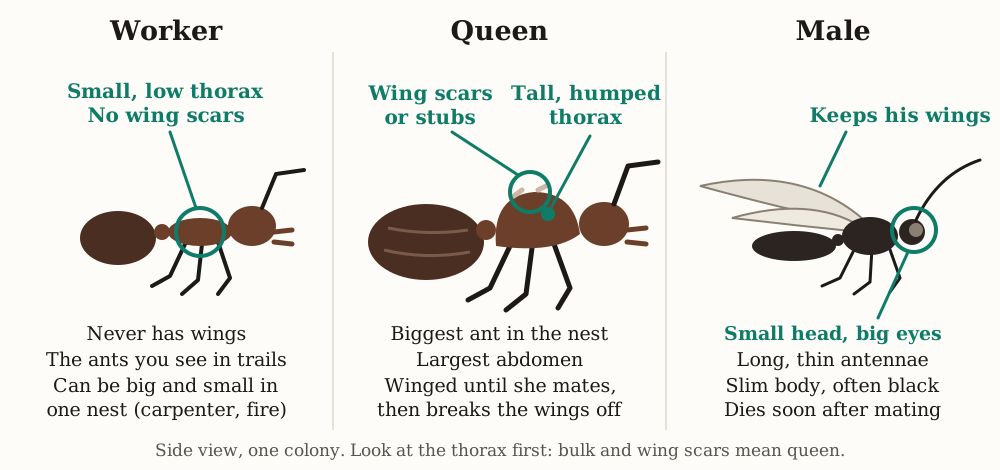
Queen, worker or male: how to tell them apart
Thorax from the side
- Queen
- Tall and humped, wing scars on top
- Worker
- Low and smooth
- Male
- Humped, with wings attached
Wings
- Queen
- Until she mates, then broken off
- Worker
- Never
- Male
- Keeps them until he dies
Size
- Queen
- The biggest ant in the colony
- Worker
- Smallest; some species have big and small workers
- Male
- Smaller than the queen
Head and eyes
- Queen
- Normal head, often 3 tiny simple eyes on top
- Worker
- Normal head
- Male
- Small head, large eyes
Abdomen
- Queen
- Largest, long and full
- Worker
- Small
- Male
- Slim
Where you see it
- Queen
- Mating flights, or a nest that was opened or disturbed
- Worker
- Trails, food, everywhere
- Male
- Mating flights, dead on sills the next day
What does a queen ant look like?
A queen ant looks like an oversized worker with a heavy, humped middle. Seen from above, her thorax is wider than her head. Before mating she has 4 wings. After mating she has none, only small scars where they were. Her color matches the workers of her species, though some queens are a little darker.
Queen or just a big worker?
This is the most common mix-up. Carpenter ants and fire ants have workers of many sizes, and a large carpenter ant worker can be 1/2 inch (13 mm) long. Ohio State Extension notes that carpenter ant workers have large heads and a small thorax, while the winged forms have a smaller head and a large thorax. So a big head means a big worker. A big thorax with scars means a queen.
What a phone photo can show
A sharp side view shows the thorax and the wing scars, and that is enough to call a queen. It cannot always name the species. For that, experts want a few workers, because most ant keys are built on workers. Put the ant in a clear bag on white paper beside a ruler, and take the photo from the side in daylight.
Do queen ants have wings?
Yes, a queen ant has 4 wings until she mates. She uses them for one mating flight, then breaks them off and never flies again. That is why most queens found indoors have no wings. Workers never have wings. Males keep theirs, and most die within days of the flight.
So a winged ant can be a young queen or a male. The queen is the bigger of the two. The University of Florida describes how a mated queen rakes her legs forward to snap her wings off at the base. Wing scars are what is left.
Can queen ants fly? Most can, once. A few cannot. Argentine ant queens skip the flight and mate inside the nest, UF/IFAS notes. New colonies of these ants form when queens walk off with a group of workers instead.
Winged queen ant or termite swarmer?
A winged queen ant has elbowed antennae, a pinched waist, and front wings longer than the back ones. A termite swarmer has straight antennae, a thick waist and 4 wings of the same length. Both swarm in spring, and both drop their wings, so a pile of wings on a sill does not settle it on its own.
Winged queen ant or termite swarmer?
Antennae
- Winged queen ant
- Elbowed, bent at a joint
- Termite swarmer
- Straight, like a string of beads
Waist
- Winged queen ant
- Pinched, narrow
- Termite swarmer
- Thick, no waist
Wings
- Winged queen ant
- Front pair longer than the back pair
- Termite swarmer
- All 4 the same length, longer than the body
Color
- Winged queen ant
- Black, brown or reddish, by species
- Termite swarmer
- Eastern subterranean swarmers are dark brown to almost black
After the flight
- Winged queen ant
- The male dies; the queen nests alone
- Termite swarmer
- A king and queen pair up and nest together
One common claim is wrong. Many pages say termite swarmers are pale. In fact, the swarmers of the eastern subterranean termite are dark brown, almost black to the naked eye, a 2024 UF/IFAS fact sheet says. The pale, creamy termites are the workers, which you rarely see. Our guide to telling flying ants from termites goes through every feature, and the flying ant guide explains which ants swarm in which month.
How big is a queen ant?
A queen ant is usually 2 to 3 times a worker’s length. Black carpenter ant queens are about 5/8 to 3/4 inch (16 to 19 mm). Fire ant queens are about 1/3 to 3/8 inch (8 to 10 mm). The queens of small house ants are only about 1/8 to 3/16 inch (4 to 5 mm).
So the size of a queen tells you more about the species than about the caste. A carpenter ant worker is bigger than the queen of any small kitchen ant. Compare the ant with the workers around it, not with a number.
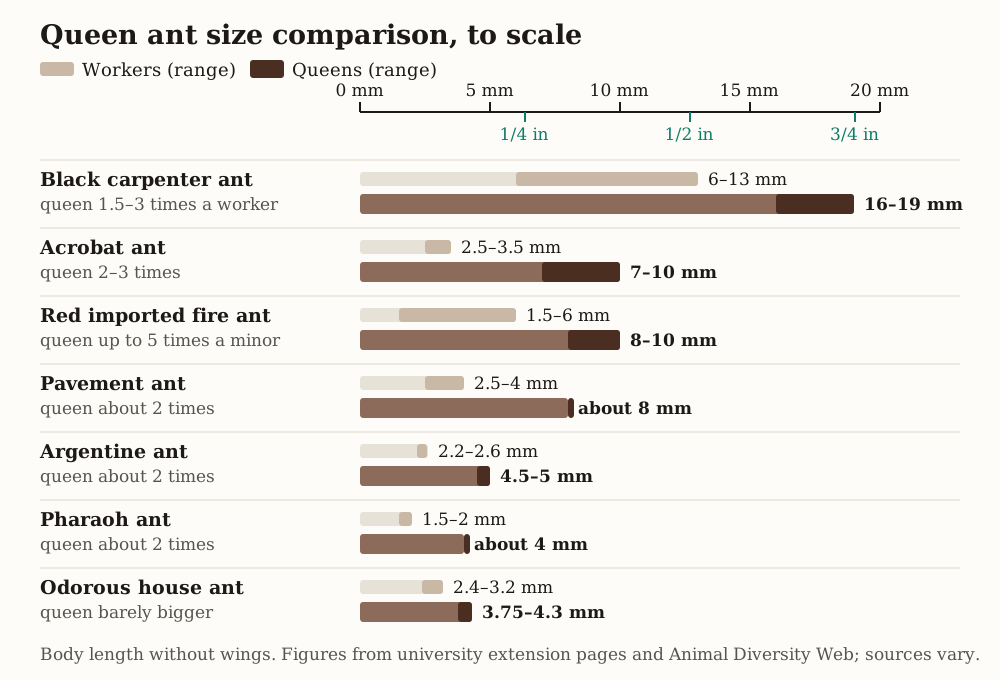
Queen ant size comparison: common US ants
Black carpenter ant
- Queen
- 5/8–3/4 in (16–19 mm)
- Worker
- 1/4–1/2 in (6–13 mm)
- Queen compared with worker
- 1.5 to 3 times; easy to spot
Acrobat ant
- Queen
- 1/4–3/8 in (7–10 mm)
- Worker
- About 1/8 in (3 mm)
- Queen compared with worker
- 2 to 3 times
Red imported fire ant
- Queen
- 1/3–3/8 in (8–10 mm)
- Worker
- 1/16–1/4 in (1.5–6 mm)
- Queen compared with worker
- Up to 5 times the smallest workers
Pavement ant
- Queen
- About 5/16 in (8 mm)
- Worker
- 1/8–3/16 in (2.5–4 mm)
- Queen compared with worker
- About 2 times
Argentine ant
- Queen
- About 3/16 in (4.5–5 mm)
- Worker
- About 1/10 in (2.2–2.6 mm)
- Queen compared with worker
- About 2 times
Pharaoh ant
- Queen
- About 1/8 in (4 mm)
- Worker
- About 1/16 in (1.5–2 mm)
- Queen compared with worker
- About 2 times, and darker
Odorous house ant
- Queen
- Just under 3/16 in (3.75–4.3 mm)
- Worker
- 1/16–1/8 in (2.4–3.2 mm)
- Queen compared with worker
- Only a little bigger; check the thorax
From Penn State, Ohio State, NC State, Utah State and UF/IFAS Extension, with Animal Diversity Web for the pavement, Argentine and odorous house ant queens. Lengths are without wings, and sources vary.
Carpenter ant queen
A carpenter ant queen is the big black ant people find alone in spring. Ohio State gives wingless queens at 5/8 inch and winged queens at 3/4 inch, and Terminix says some reach an inch. She is shiny black in the black carpenter ant, the most common species in the East. Penn State says a colony has one wingless queen.
That queen lives in the parent nest, often outdoors in a stump or damp wood. The ants inside your walls are often in a satellite nest of workers and older young, with no queen at all. So a queen on your floor in spring is usually a new queen from outside, not proof of a nest. Our carpenter ant identification guide covers the signs that do prove one, and the carpenter ant removal plan covers finding the parent nest.
Fire ant queen
A fire ant queen is about 1/3 to 3/8 inch (8 to 10 mm) long, with a long abdomen. She lives deep in the mound and lays up to 1,500 or more eggs a day, UF/IFAS says. Some colonies have one queen. Others have many, and those yards can hold more than 200 mounds per acre. Our fire ant guide covers the mounds and the swarms.
What is the biggest queen ant?
The biggest queen ant belongs to the African driver ants. Guinness World Records lists the queen of Dorylus fulvus at up to 5 cm (2 inches) long, the largest ant known. Driver ant queens can lay 3 to 4 million eggs every 25 days, according to the University of Florida Book of Insect Records. No US ant comes close.
Found a queen ant in your house? Here is what it means
A single queen ant in your house in spring or early summer is usually a newly mated queen looking for a nest site. She wandered in and is not proof of a colony. But 2 or more queens, winged ants indoors in winter, or a trail of workers near her point to a nest in or next to the house.
Extension experts say the same. “Seeing just one of these ants is not a reason to panic,” an Oregon State expert told one homeowner. A Maryland expert explained that an established queen does not leave the nest unless the whole colony moves. Use the season and the place to read what you found.
Found a queen ant: what it means by season and place
Winged or freshly wingless queens outdoors, spring to fall, often the day after rain
- What it usually means
- A mating flight. New queens are looking for a place to dig in
- What to do
- Nothing. Most will die before they start a nest
One wingless queen indoors, spring or early summer, no trail
- What it usually means
- A mated queen that wandered in through a door or gap
- What to do
- Remove her. Watch for two weeks
Winged ants or queens indoors in late winter, often at a window
- What it usually means
- A nest inside the house. It is too cold for outdoor ants to fly
- What to do
- Find the nest. For big black ants, look for wet wood
A queen walking out near your bait, or the day after a spray, with workers around her
- What it usually means
- The colony is disturbed and may be moving. The nest is close
- What to do
- Keep the bait out. Do not spray. Follow the workers
Several tiny queens mixed into a kitchen trail
- What it usually means
- A many-queen ant such as pharaoh, odorous house or Argentine ants
- What to do
- Bait the trail. Never spray, which can split the colony
Ants and a queen coming indoors after heavy rain
- What it usually means
- A flooded nest moving to dry ground
- What to do
- Seal the gap. Bait if they stay after the ground dries
A queen and workers coming out of a houseplant pot
- What it usually means
- A nest in the pot soil
- What to do
- Move the plant outside and repot it
Winged ants in the same room day after day
- What it usually means
- A nest in the wall, floor or furniture near there
- What to do
- Watch where they come out. Call a pro for a wall nest
A pile of loose wings on a sill, no bodies
- What it usually means
- A flight ended indoors, but termites drop wings too
- What to do
- Find one whole insect and check the antennae and waist
Built from Ask Extension answers (Oregon State, University of Maryland, University of Minnesota) and dozens of homeowner reports on Reddit’s r/pestcontrol and r/whatsthisbug, 2021 to 2026.
Is it rare to see a queen ant?
It depends on which queen. An established queen rarely leaves the nest, so seeing her is unusual. New queens are common, though. Each mature colony sends out many of them on mating flights, mostly from spring to fall, and most die soon after. So in season, a lone queen on a patio or a floor is an ordinary sight.
Why is a queen out in the open?
There are three usual reasons, and each means something different:
- She is new. She has just mated and is looking for a place to dig in. This is the most common reason in spring and summer.
- Her colony is moving. Bait, a spray, a flood or a remodel can make a whole colony move, queen included. Homeowners often report a queen near a bait station a day after setting it out.
- Her species keeps many queens. Pharaoh, odorous house and Argentine ant queens travel with their workers, so they turn up on trails.
What to do if you find a queen ant
Make sure it is an ant
Look for elbowed antennae and a pinched waist. Straight antennae and a thick waist mean a termite swarmer, which needs a termite inspection instead.
Check the thorax
Look at the middle section from the side. A tall, humped thorax with small wing stubs or scars means a queen. A low, smooth thorax means a big worker.
Note the season and the place
Write down the date, the room and whether she had wings. Then use the table above to see what that usually means.
Remove her without spraying
Catch her in a cup or a jar, or vacuum her up. You do not need a spray for one ant, and a spray near any bait you have out stops the bait working.
Keep one for identification
Put her in a sealed bag or jar, or take a sharp photo from the side beside a ruler. A photo of the workers helps even more, because experts identify ants from workers.
Watch for two weeks
One queen and nothing else usually means a stray. More queens, winged ants indoors or a trail of workers means a nest nearby. Follow the trail to find where they go in.
Treat the ant, not the queen
If a trail appears, bait it with a slow-acting ant bait labeled for that ant, and do not spray nearby. For big black ants, look for wet wood. Call a professional for a nest inside a wall.
Does killing the queen ant get rid of the ants?
Killing the queen ant ends a colony only in species with 1 queen, and even then the workers live on for weeks to months. In many-queen species, such as odorous house, Argentine and pharaoh ants, killing one changes nothing. The other queens keep laying. Baits work better, because the workers feed the poison to every queen.
There is a second catch. The queen you find on the floor is usually not the queen of the ants in your kitchen. A new queen has no workers yet. The queen that matters sits deep in a nest you cannot see. One homeowner on r/pestcontrol killed a pharaoh ant queen on a bedroom wall. A licensed technician replied that it “really doesn’t mean anything” for that species.
How many queen ants are in a colony?
Most colonies of carpenter, pavement and acrobat ants have 1 queen. Fire ants come in both forms, with up to 80 queens in a many-queen nest, Utah State says. Odorous house ants keep many queens, and Argentine and pharaoh ant colonies can hold hundreds. The number changes how you get rid of them.
Single-queen and many-queen ants, and why it changes control
Carpenter ant
- Queens per colony
- Usually 1 (up to 40 in one western species)
- How new nests start
- Mating flights; satellite nests have no queen
- What killing one queen does
- Ends the colony slowly, if she is the parent-nest queen
- What works
- Find the parent nest; bait; fix wet wood
Pavement ant
- Queens per colony
- Usually 1
- How new nests start
- Mating flights
- What killing one queen does
- Ends the colony slowly
- What works
- Bait at cracks in the slab
Acrobat ant
- Queens per colony
- Usually 1
- How new nests start
- Mating flights
- What killing one queen does
- Ends the colony slowly
- What works
- Bait; fix damp wood
Fire ant
- Queens per colony
- 1, or many (up to 80 per nest)
- How new nests start
- Mating flights; many-queen colonies also split
- What killing one queen does
- Single-queen: ends it slowly. Many-queen: nothing
- What works
- Bait the whole yard, then treat mounds
Odorous house ant
- Queens per colony
- Many
- How new nests start
- Budding: a queen walks off with workers
- What killing one queen does
- Nothing
- What works
- Sweet bait; no repellent sprays
Argentine ant
- Queens per colony
- Hundreds; nests join into supercolonies
- How new nests start
- Budding; queens do not fly
- What killing one queen does
- Nothing
- What works
- Sweet bait over weeks; no sprays
Pharaoh ant
- Queens per colony
- Up to several hundred
- How new nests start
- Budding; sprays make it worse
- What killing one queen does
- Nothing; workers can raise a new queen
- What works
- Non-repellent bait only; never spray
Little black ant and ghost ant
- Queens per colony
- Many
- How new nests start
- Budding
- What killing one queen does
- Nothing
- What works
- Bait
From Penn State, UC IPM, Utah State, Mississippi State, NC State and UF/IFAS Extension, and the Mississippi Entomological Museum.
Many of the ants people call sugar ants are in the many-queen group. Our guide to sugar ants in the kitchen covers which one you likely have.
What happens when the queen ant dies?
In a single-queen colony, no new workers hatch once she dies. The colony shrinks as the old workers die off, over weeks to months. Before the end, some workers may lay eggs of their own. These eggs are unfertilized, so they hatch only into males. In harvester ants, a field study found the queen is never replaced, and the colony withers away.
Many-queen colonies carry on. Pharaoh ant workers can even raise a new queen from the brood they carry, UF/IFAS says. That is why one dead queen on the floor rarely changes what you see in the kitchen.
How baits reach the queen
Baits reach the queen because ants share food mouth to mouth. Workers carry bait back to the nest, where it is “transferred mouth to mouth to other workers, larvae, and queens to kill the entire colony,” UC IPM explains. For that to work, the bait must be slow. A fast poison kills the worker before she gets home.
Some fire ant baits hold an insect growth regulator, which stops queens from producing workers. Texas A&M says these baits usually take 2 to 6 months. Sprays work against all of this. They kill the few workers out foraging and leave the queens alone. Worse, in pharaoh ants a spray can make the colony split into several new nests. Our guide on how to get rid of ants with bait explains how to match the bait to your ant.
Do queen ants bite or sting?
A queen ant can bite if handled, like any ant, but she is not aggressive. Carpenter ant queens have no sting at all. Fire ant queens carry a sting and a venom gland, but extension entomologists say queens do not use them the way workers do. Among fire ants, the 100,000 or more workers do the stinging.
The fire ant team at eXtension, the national extension network, says queens and winged females have a poison gland. However, they “do not use their ovipositors as stingers, as do worker ants.” Texas A&M agrees that the workers are the ants that sting. Alabama Extension is less sure: it says winged fire ants “can also bite or sting”, though it is highly unlikely while they fly or hunt for a nest site. So use a cup or a tool to move any fire ant, not your fingers. A winged queen is often near a mound full of workers that do sting.
Carpenter ants cannot sting, UC IPM says, but they can bite with strong jaws and spray formic acid into the bite, which burns. A bite cannot tell you which ant bit you, so identify the ant itself. Our guides to ant bites and stings and to fire ant stings and their blisters cover what to expect.
How long does a queen ant live?
A queen ant lives for years. A carpenter ant queen can live up to 15 years, NC State Extension says. Fire ant queens live about 2 to 7 years, depending on the source. The record is a European black garden ant queen that lived 28 3/4 years in captivity. Pharaoh ant queens live only 4 to 12 months.
Here is how the main figures compare, with the sources that disagree named side by side:
How long queen ants live, by species and source
Black garden ant (Lasius niger, Europe)
- Queen lifespan
- 28 3/4 years in captivity, the record for any insect
- Source
- University of Florida Book of Insect Records, from Kutter and Stumper (1969)
Black garden ant
- Queen lifespan
- Up to 29 years
- Source
- Lucas, Privman and Keller, Aging (2016)
Red harvester ant (Pogonomyrmex barbatus)
- Queen lifespan
- 25 to 30 years, the life of the colony
- Source
- Ingram and others, Gordon lab (2013)
Western harvester ant (P. owyheei)
- Queen lifespan
- Colonies live 14 to 30 years
- Source
- Porter and Jorgensen (1988)
Carpenter ant
- Queen lifespan
- Up to 15 years
- Source
- NC State and University of Nevada Extension
Red imported fire ant
- Queen lifespan
- 2 to 6 years
- Source
- UF/IFAS EDIS (2001)
Red imported fire ant
- Queen lifespan
- Up to 7 years
- Source
- UF/IFAS EDIS (2006); Texas A&M says 7 or more
Pharaoh ant
- Queen lifespan
- 4 to 12 months
- Source
- UF/IFAS EDIS
Why do the numbers differ? Queens in the wild are hard to follow. Researchers often estimate a queen’s age from how long her colony lasts, and a colony can sometimes replace its queen. Captive records are exact but rare. The 28 3/4-year queen is often rounded to 29, which is why both figures appear.
The record holder is European. Its American cousin, the cornfield ant (Lasius neoniger), is the small brown ant behind the late-summer lawn swarms. Our harvester ant guide covers the long-lived US harvester colonies.
Why queens live so long
Queens are safe. They live underground, guarded and fed, so they rarely die from accidents or predators. A 1997 study in Nature found that social insect queens live about 100 times longer than solitary insects. Their bodies also seem built to last. In 2022 a University of Florida team found that queens of one ant species make a substance that blocks part of the insulin signal and slows aging.
How long workers and males live
Workers live weeks to a few years. Fire ant workers last about 30 to 180 days, with the biggest ones living longest. Black garden ant workers live 1 or 2 years, even in the lab. Males live the shortest lives of all. Most die within days of the mating flight, and pharaoh ant males die 3 to 5 weeks after mating.
How a queen ant starts a colony
A queen ant starts a colony alone. After her mating flight she breaks off her wings, digs or finds a small cell, and seals herself in. She lays about 10 to 20 eggs and raises the first workers on her own body fat and her broken-down wing muscles. Those first tiny workers appear in about 3 to 8 weeks.
- The flight. Young queens and males leave their nests on a warm, still day, often after rain. She mates with one or a few males in the air or on the ground. The males die soon after.
- The sperm store. She keeps the sperm in a small sac inside her body. She never mates again, and that store fertilizes her eggs for years.
- The cell. She sheds her wings and seals herself into a chamber in soil or wood. Virginia Tech says a carpenter ant queen does not leave the nest or feed herself during this time.
- The first eggs. A fire ant queen lays 10 to 15 eggs within a day of mating, UF/IFAS says. A carpenter ant queen starts with 15 to 20.
- Living off her wings. Her flight muscles are no longer needed, so her body breaks them down to feed the young larvae.
- The first workers. They are small, and they take over the digging and the feeding. Fire ants get there in about a month. In one Virginia Tech study, black carpenter ant queens took about 46 days.
- Years of growth. A carpenter ant colony may need 3 to 6 years or longer before it sends out its own winged queens, Virginia Tech says.
Very few queens make it. Birds, spiders, lizards and other ants kill most of them soon after the flight. That is part of why a lone new queen indoors is rarely a threat.
How does an ant become a queen?
An ant becomes a queen mostly through food and size. Every female starts as a fertilized egg. Larvae that are fed more grow bigger, and the biggest develop into queens with wings and full ovaries. The others become workers. Unfertilized eggs become males.
Genes play a part too. A 2025 study from Rockefeller University, in the clonal raider ant, found that body size almost perfectly predicted whether a larva became queen-like. However, the genes set the size at which that switch happens. How much each factor matters varies from species to species.
Myths about queen ants
Most myths about queen ants come from one idea: that every colony has a single queen who rules it. Here are 7 beliefs from homeowner questions and the sources that correct them. Several of them lead people to spray, which makes many-queen ants harder to get rid of.
Myth 1
Myth: “Kill the queen and the ants are gone.”
Truth: Only in single-queen colonies, and only slowly. In odorous house, Argentine and pharaoh ants, the other queens keep laying.
Myth 2
Myth: “Every colony has one queen.”
Truth: Many common house ants keep dozens or hundreds. Even some carpenter ants in the West keep up to 40 in one nest, UC IPM says.
Myth 3
Myth: “A queen in the house means a nest in the house.”
Truth: One queen in spring is usually a new queen from outside. Winter sightings and repeated winged ants indoors are the real signs.
Myth 4
Myth: “The queen controls the colony.”
Truth: She lays eggs. The workers decide where to forage, when to move and when to raise new queens.
Myth 5
Myth: “The ants will come after you if you kill her.”
Truth: Ants do not look for a lost queen or seek revenge. The trail carries on as before.
Myth 6
Myth: “A spray on the trail reaches the queen.”
Truth: Sprays kill the workers they touch. Only a slow bait, shared mouth to mouth, reaches the queens.
Myth 7
Myth: “Any big winged insect at the window is a queen ant.”
Truth: Termite swarmers look similar. Check for elbowed antennae and a pinched waist before you call it an ant.
When to call someone
Most people who find a queen ant need to do nothing more than remove her and watch for 2 weeks. Call for help when winged ants or queens keep appearing indoors, or when big black ants nest in wet wood. Also call when a trail survives a month of bait, or when the “queen” turns out to be a termite.
Who to call about a queen ant
Licensed pest professional
- When
- Winged ants or queens indoors again and again, or in winter; a nest in a wall
- Why
- They can find and treat a hidden nest
Termite inspector
- When
- Straight antennae, a thick waist or 4 equal wings
- Why
- A termite swarm indoors needs a termite inspection
Roofer, carpenter or plumber
- When
- Carpenter ants plus soft or wet wood
- Why
- The ants return until the wood is dry and sound
Landlord
- When
- You rent and see a trail or winged ants inside
- Why
- Pest control and leaks are usually the owner's job
911 or a doctor
- When
- A sting followed by trouble breathing, face or throat swelling, or spreading redness
- Why
- Allergic reactions to fire ant stings can be serious
Vet or ASPCA, (888) 426-4435
- When
- A pet ate ant bait or insecticide
- Why
- The poison, not the ant, is the risk
Not sure what you found? Upload a photo to our free insect identifier, or use our six checks for naming any bug.
Pest control disclaimer. Photo-based identification can help, but it is not always perfect. For dangerous spiders, large infestations, or anything you are unsure about, contact a licensed pest control professional.
Queen ant FAQ
Do sugar ants have a queen?
Will the ants come looking for the queen if I kill her?
How long do the workers last after the queen dies?
Can a colony make a new queen?
Is a queen ant a sign of termites?
Can you buy a queen ant?
Related guides
How to get rid of ants
Why bait beats spray, and how to pick a bait your ant will carry home to the queens.
Carpenter ants
The big black ants whose queens people find alone in spring, and what a sighting means by season.
Flying ants
Which ants swarm in which month, and why a swarm indoors matters more than one outside.
Flying ants vs termites
Antennae, waist and wings: the three checks that tell a winged ant from a termite.
Fire ants
Single-queen and many-queen mounds, swarms after rain, and how to stay clear of the stings.
Sugar ants
The tiny kitchen ants behind the name, and why most of them keep many queens.
Sources
- UC IPM Pest Notes: Ants, Publication 7411, M. Rust and D. Choe
- UC IPM Pest Notes: Carpenter Ants, Publication 7416
- Penn State Extension, Carpenter Ants
- NC State Extension, Biology and Control of Carpenter Ants, M. Crawley and M. Hayes (revised 2023)
- Virginia Cooperative Extension, Carpenter Ants, 3104-1573, T. Dellinger and E. Day (revised 2021)
- UF/IFAS EDIS EENY-195, Red Imported Fire Ant, Solenopsis invicta
- UF/IFAS EDIS EENY-290, Pharaoh Ant, Monomorium pharaonis
- Utah State University Extension, Imported Fire Ants, ENT-214-20
- eXtension Fire Ant Community of Practice, Fire Ant Stings (archived copy; the live site is offline)
- Alabama Cooperative Extension System, Swarming Fire Ants, X. P. Hu (June 15, 2021)
- UF/IFAS EDIS EENY-212, Native Subterranean Termites: Reticulitermes flavipes, R. virginicus, R. hageni, T. Chouvenc, N.-Y. Su and R. Scheffrahn (2024)
- University of Florida Book of Insect Records, Chapter 34: Longest Adult Life
- Lucas ER, Privman E, Keller L. Higher expression of somatic repair genes in long-lived ant queens than workers. Aging 8(9) (2016)
- Rockefeller University, How ant queens are made (July 22, 2025)
- MedlinePlus, Insect bites and stings
- Cleveland Clinic, Fire Ant Bites