First, make sure it is a carpenter ant
Before you work out how to get rid of carpenter ants, check the ant. A carpenter ant worker is 1/4 to 1/2 inch (6 to 13 mm) long, black or red and black, with one node at the waist and a smooth, rounded back. If one check fails, you may be treating the wrong pest.
This matters because the plans really differ. Small kitchen ants take a sweet bait and little else. Termites need a termite company. However, carpenter ants need you to find a nest and fix damp wood. If you want to know how to get rid of big black ants, start here, because most of them in a house are carpenter ants.
Big black ants and their look-alikes: what changes in the plan
1/4 to 1/2 in, one node, smooth rounded back, coarse sawdust nearby
- What it is
- Carpenter ant
- What that means for treatment
- This page: find the nest, fix the damp, bait slowly
Big black ant, one node, but a bumpy, uneven back
- What it is
- Another large ant, such as a field ant
- What that means for treatment
- Usually nests in soil, not wood. Seal gaps and leave it
About 1/8 in, heart-shaped abdomen raised over the back
- What it is
- Acrobat ant
- What that means for treatment
- Smaller job: a sugar bait and a moisture fix
Tiny ants in a line to the sugar
- What it is
- Small house ants
- What that means for treatment
- Sweet bait on the trail, covered in our ant hub
Thick waist, straight antennae, four equal wings
- What it is
- Termite swarmer
- What that means for treatment
- Call a termite professional
Round 1/2 in holes in bare wood, big black bee
- What it is
- Carpenter bee
- What that means for treatment
- A different pest with a different fix
Our carpenter ant identification guide has the side-view checks, the size table and what a sighting means by season. Small ants with a heart-shaped abdomen are acrobat ants, the ant most often mistaken for carpenter ants. Winged ones at a window may be termites, so check our termite guide before you buy anything. For tiny trailing ants, the plan in our guide to small house ants is the right one.
How to get rid of carpenter ants, step by step
Here is how to get rid of carpenter ants in 8 steps, and the first 4 cost little or nothing. Confirm the ant, find the nests at night, fix the moisture and cut off their routes. Then remove or treat the nest, or bait the trail if it stays hidden. Allow several weeks.
The carpenter ant plan in 8 steps
Confirm it is a carpenter ant
Check for a worker 1/4 to 1/2 inch (6 to 13 mm) long, with one node at the waist and a smooth, rounded back. Tiny kitchen ants, acrobat ants and termites all need a different plan.
Find the nests after dark
Watch between sunset and midnight with a red-filtered flashlight. Set out tuna packed in water in spring, or honey later in the year, and follow the ants that carry food away. Check outdoors for the parent nest too.
Fix the moisture
Repair roof, plumbing and gutter leaks, stop condensation, and replace wood that has gone soft. This costs nothing beyond a repair you need anyway, and it takes away what the nest depends on.
Cut off their bridges
Trim branches back from the roof and walls. Move firewood off the ground and away from the house, and pull out old stumps. Keep mulch to 2 to 3 inches (5 to 8 cm), and seal gaps where pipes and wires enter.
Remove or treat any nest you find
Take out nest wood outdoors. Treat a nest you can see with a product labeled for carpenter ants. A nest inside a wall is best left to a licensed professional, who drills small holes and puffs in a dust.
Bait the trail if the nest stays hidden
Use a slow-acting bait labeled for carpenter ants, right on the trail. Check it within 24 hours, replace any bait they ignore, add more when they eat it, and never spray near it.
Give it weeks, not days
Expect more ants at the bait in the first few days. Activity should then fall over one to two weeks, and full control can take several weeks. Keep fresh bait out while they still feed.
Call a professional if it stalls
Call a licensed pest professional for a nest in a wall, ceiling or floor, for ants indoors in winter, or for ants still trailing after two rounds of careful baiting.
Why carpenter ants are so hard to kill
Carpenter ants are hard to kill because you only see a small part of the colony. Only 10 to 15% of the workers are outside the nest at any time, Illinois DPH says. The queen stays hidden in a parent nest, often outdoors, while the ants in your kitchen may live in a separate satellite nest.
So spraying the ants on the counter kills a few foragers and nothing else. The queen keeps laying eggs, and new workers take their place. That is why so many people say they sprayed last year and the ants were back in spring.
A large colony also spreads out. The parent nest holds the queen, the eggs and the young larvae. It needs damp, decaying wood, so it is usually outdoors in a stump, a dead tree or old timbers. Satellite nests hold workers, older larvae and pupae. Because they have no eggs to keep moist, they can sit in drier places such as insulation, hollow doors and wall voids.
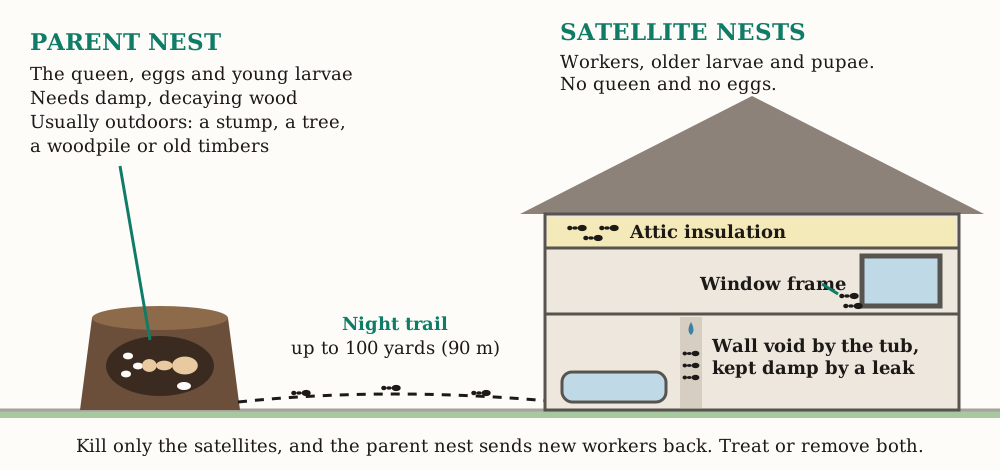
The two kinds of nest can be far apart. The trail between them may run up to 100 yards (90 m), and the workers move back and forth along it. As a result, wiping out one satellite nest in a wall can still leave the parent nest free to send more ants next year.
Their diet is the last problem. Carpenter ants eat insects, honeydew from aphids, and household sweets and meats. Their tastes change through the year, so a bait they love in May may sit untouched in August. That is also why the advice below keeps saying to watch the bait and swap it.
Step 1 in practice: find the nests at night
The best time to find a carpenter ant nest is between sunset and midnight in spring and summer. Workers leave the nest about 15 minutes after sundown. Put out a lure, wait, then follow the ants that carry food away. Two or three evenings of watching usually show you the trail.
- Use red light. Tape red film or red cellophane over a flashlight. The University of Minnesota says the ants cannot see red light, so they keep working while you watch.
- Pick the lure by season. In spring the ants want protein, so use a small piece of tuna packed in water (not in oil). Later in the year, honey or sugar water works better.
- Follow the food. An ant carrying food is heading home. Mark where it disappears with painter’s tape. The nest may still be a few feet inside the wall from that point.
- Listen. Tap gently on the suspect wood and put your ear to it. A disturbed colony makes a dry rustle, like crinkling cellophane.
Our carpenter ant guide has the full seven-step method for tracking a nest, with the sawdust and damp-wood checks. Here, the point is to look for both kinds of nest, because removing only one is why treatments fail.
Where the parent nest hides outdoors
Walk the yard in daylight and check every piece of old, damp wood near the house. Look in stumps, tree roots, dead branches and hollow trees, firewood stacks, landscape timbers, old fence posts and boards lying on the ground. A cone of coarse sawdust at the base of a tree or a stump is a strong clue.
Where satellite nests hide indoors
Indoors, start where water collects. Check under sinks, behind the toilet, around tubs and showers, below windows and skylights, around the dishwasher and near the chimney. Then check the dry spots satellite nests also use: attic insulation, hollow doors and wall voids. Fresh sawdust that comes back after you sweep it means the ants are still working above it.
If you find one nest, keep looking. The University of Minnesota warns that a building may hold more than one.
Fix the moisture first: the step that costs nothing
Fixing moisture is the cheapest part of how to get rid of carpenter ants for good. The ants dig their nests in wood that has been wet. Penn State notes they will not infest sound wood with a moisture content under 15%. Dry the wood out and replace what has gone soft, and an indoor nest loses its home.
- Find the leak. Check the roof, flashing, chimney, skylights, window seals and every pipe near the ants.
- Clear the gutters and make sure downspouts carry water away from the walls.
- Stop condensation. Insulate pipes that sweat, and vent attics, crawl spaces and bathrooms.
- Test the wood. Press a screwdriver into suspect trim and framing. Wood that gives easily needs replacing.
- Lift wood off the ground. Remove places where siding, decks or porches touch soil.
If exclusion and sanitation are successful, insecticide treatments are not required. This is also the honest answer for anyone searching for how to get rid of carpenter ants naturally. Drying the house, removing the nest wood and sealing the gaps use no pesticide at all. For scents and kitchen remedies, see our natural ant repellent guide, though no scent will move a nest out of wet wood.
Carpenter ant bait: how to make it work
Carpenter ant bait works when the workers carry it home and share it with the queen and the young. That takes time, so baits are slow by design. The University of Minnesota says baiting can take weeks or months. Use bait when you cannot find the nest, choose one whose label lists carpenter ants, and check it within 24 hours.
Why slow is the point
A bait is food mixed with a slow-acting poison. Workers eat it, walk home and pass it mouth to mouth to other workers, the larvae and the queen. If the poison acted fast, the foragers would die on the trail and the nest would never get a dose. UC IPM stresses this because only about 10% of the ants forage at once.
That is also why you should never spray near a bait. A spray kills the carriers before they get home, and it can wipe out the scent trail the others follow.
Sweet or protein? Match the bait to the season
Carpenter ants change what they want to eat. In spring, colonies need protein to raise their young. Purdue University researchers found that the ants crave protein in spring and switch to sugar in the fall. The University of Wisconsin adds that baits work best in spring and early summer.
So in practice, offer a choice. Put a protein or combination gel bait and a sweet liquid bait side by side, as UC IPM suggests for ants in general. Keep whichever one the ants feed on, and drop the other.
Where to put the bait, and how to check it
- Only where you see ants. Put small dabs or a station right on the trail, near where they come out.
- Check within 24 hours. If they ignore it, clean it up and try a different bait.
- Add more when they eat it. An empty bait cannot keep working.
- Leave the crowd alone. A mass of ants at the bait means it is working.
- Keep it out of reach of children and pets, inside a sealed station where you can.
Do carpenter ant baits really work?
Sometimes. This is the one point where extension services disagree, and you should know it before you spend money. Some see baits as a useful tool. Others say carpenter ants are too picky for baits to be reliable.
What extension services say about baits for carpenter ants
University of Minnesota
- Verdict on baits
- Can work, slowly
- In their words
- Baits "can take weeks or months"; placement and monitoring are the keys
Oregon State University
- Verdict on baits
- Can work, success varies
- In their words
- "It takes several weeks for the bait to kill the entire colony"
NC State Extension
- Verdict on baits
- Can work
- In their words
- Activity may take 7 to 10 days to drop; full control one to two weeks
University of Nebraska
- Verdict on baits
- Usually fails
- In their words
- "Baits usually are not successful" because the diet is so varied
Michigan State University
- Verdict on baits
- Weak
- In their words
- Shop bait stations are "relatively ineffective"
Iowa State University
- Verdict on baits
- Weak
- In their words
- General ant baits are "rarely effective" on large black carpenter ants
Our reading: bait is the fallback when the nest stays hidden, not the first move. It works best with a product made for carpenter ants, placed in spring, checked daily and swapped when ignored. Finding and treating the nest is faster and more certain.
How long does it take to get rid of carpenter ants?
Plan on several weeks. A nest you find and treat directly can go quiet within days. Bait is slower: NC State says activity may take 7 to 10 days to drop, and the University of Minnesota allows weeks or months. Any plan that promises the whole colony in 2 or 3 days is promising too much.
Week by week: what to expect when you get rid of carpenter ants
Nights 1 to 3
- What you do
- Inspect from sunset to midnight with a lure and red light
- What you should see
- The trail, where they get in, maybe a sawdust pile
Week 1
- What you do
- Fix leaks, cut back branches, move firewood; treat any nest you found; set bait if you did not
- What you should see
- Fewer ants if a nest was treated directly
Bait, days 1 to 5
- What you do
- Keep the bait topped up; no spraying anywhere near it
- What you should see
- Often more ants at the bait, not fewer. That means they are taking it
Bait, days 7 to 14
- What you do
- Keep going; swap the bait if they stop feeding
- What you should see
- Activity should start to drop
Weeks 3 to 6
- What you do
- Keep fresh bait out while any ants feed
- What you should see
- Few or no ants; stragglers can come from a second nest
Still trailing after two rounds of bait
- What you do
- Stop baiting blind
- What you should see
- Time to call a licensed professional
After a professional treatment
- What you do
- Watch and report back
- What you should see
- A short burst of activity, then quiet
Next spring
- What you do
- Check damp spots and walk the trails at night
- What you should see
- New ants mean another satellite nest or the parent nest outside
Built from the University of Minnesota, NC State, UC IPM and the University of Wisconsin, plus what readers report on forums. Your timing will vary with the size of the colony and the season.
Treating a carpenter ant nest you have found
A nest you have found is the best target you will get. Take out nest wood outdoors. For a nest you can see, use a ready-to-use product labeled for carpenter ants on that site. For a nest inside a wall, a professional drills holes about 1/8 inch (3 mm) wide and puffs in an insecticidal dust.
An exposed nest is the easy case. You may open one while replacing rotten trim or a window frame. Treat it then, because the University of Minnesota notes that the exposed part of the colony will try to move. After that, replace the damaged wood.
A nest inside a wall needs care. The University of Minnesota says to leave the drilling to a professional. The University of Nebraska adds that liquid insecticide should never go into a wall void, where water can harm the insulation, the drywall or the wiring. Dusts are used instead, in small, light amounts.
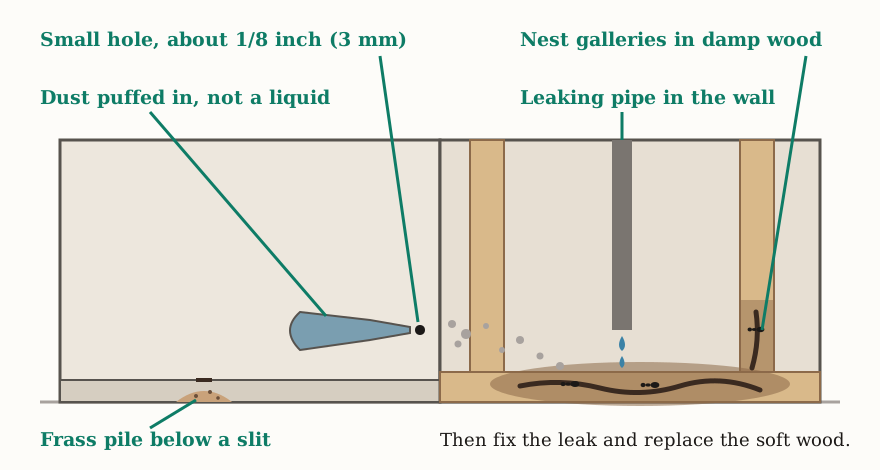
The dusts used for this include boric acid, diatomaceous earth and silica gel. UC IPM says drying dusts stay effective as long as they stay dry, and that you should avoid breathing them in. Our carpenter ant guide’s sawdust and galleries photos show what a nest looks like once the wood is open.
Does diatomaceous earth kill carpenter ants?
It can, slowly, when a registered diatomaceous earth dust is puffed into a nest or a void and stays dry. The University of Nebraska lists several registered dusts of this kind for carpenter ants. It does not work as a ring around the house, and it stops working when it gets wet. Use only a product sold as an insecticide, into cracks and voids, never spread across floors or lawns.
What kills carpenter ants? Products compared
The carpenter ant killers that work are the ones that reach the nest: slow baits the workers carry home, and dusts placed in the nest itself. Contact sprays reach only the 10 to 15% of workers out foraging. The most effective products, such as fipronil sprays, are for licensed applicators only, UC IPM and the University of Kentucky note.
Carpenter ant killers compared, from most to least useful at home
Slow-acting gel or liquid bait
- How it works
- Workers carry it home and share it
- When it helps
- On the trail when the nest is hidden
- Watch out for
- Label must list carpenter ants; no spray nearby; swap if ignored
Sealed bait stations
- How it works
- Same, inside a closed case
- When it helps
- Homes with children and pets
- Watch out for
- Some stations rarely tempt carpenter ants
Insecticidal dust (boric acid, diatomaceous earth)
- How it works
- Coats ants moving through the nest
- When it helps
- A nest opening or a void
- Watch out for
- Light puffs only; keep it dry; drilling is a pro job
Ready-to-use spray or aerosol
- How it works
- Kills on contact
- When it helps
- An exposed nest you can see
- Watch out for
- Useless on trails; repels and scatters foragers
Non-repellent perimeter spray (fipronil)
- How it works
- Ants cross it and carry it home
- When it helps
- Outside the house, by a professional
- Watch out for
- Licensed applicators only
Store perimeter sprays and granules
- How it works
- A barrier around the foundation
- When it helps
- Rarely
- Watch out for
- Little or no control (Illinois DPH); pyrethroids pollute waterways (UC IPM)
Foggers (bug bombs)
- How it works
- Fill a room with spray
- When it helps
- Never for carpenter ants
- Watch out for
- Do not reach the nest inside walls
Common bait ingredients include avermectin, borax and boric acid, fipronil and spinosad. A carpenter ant spray sold in shops is usually a pyrethroid such as deltamethrin. It earns its place only on a nest you can see. Oregon State is blunt: the most effective insecticides for carpenter ants are not sold in retail stores.
Getting rid of carpenter ants outside: the parent nest
Outdoors, the goal is the parent nest, because it holds the queen. Remove the stump, log, woodpile or rotten timber it lives in, or have it treated. Remove stumps and waste wood within 100 yards (90 m) of the house where you can, Penn State advises. A colony left outside can send workers back in.
A nest in a living tree is often best left alone. The University of Minnesota says the ants use wood that is already decayed and do not harm the tree itself. Instead, trim the branches that touch the roof and wires, so the colony has no bridge into the house. Ask an arborist about a tree with large dead or hollow sections.
A perimeter treatment is a professional’s call. A non-repellent spray applied outside lets foragers carry the product home, and Penn State notes that usually one treatment is needed. On the other hand, injecting insecticide into the soil around the house, as for termites, is unnecessary for carpenter ants, the University of Nebraska says.
Homemade borax bait: what is true and what is risky
No extension service we found publishes a homemade borax bait for carpenter ants. The popular forum mix, 1/2 cup sugar, 1 1/2 tablespoons borax and 1 1/2 cups water on cotton balls, has helped many people. But it is stronger than the 0.5 to 1% borate that UC IPM gives for liquid ant baits, and it carries no label.
Strength matters. A strong bait can kill the foragers before they reach the nest, or taste too bitter to eat. A dry version, a third borax and two thirds sugar sprinkled along the trail, is stronger still. Worse, it leaves open powder on floors where children and pets walk.
Borax and boric acid are not the same thing either, as Iowa State points out, though readers often mix them up. Laundry borax is sold as a cleaner, not as an insecticide. So there are no label directions for using it around a family.
Is it safe? Not as safe as forum posts claim. The National Pesticide Information Center says people who swallow boric acid can get nausea, vomiting and diarrhea. In pets, signs of poisoning can start within 2 hours. It also reports seizures and deaths more often in infants with long-term exposure than in adults.
Our advice: a sealed, labeled bait station gives you the same idea with tested strength and a case small hands cannot open. If you still mix your own, keep it in a closed container the ants can enter, well out of reach, and remove it when you are done. For other home remedies and how well they work, see our natural ant repellent guide.
What does not work against carpenter ants
The 3 most common mistakes are spraying the trail, setting off a fogger and using kitchen remedies. Each one goes after the ants you can see and leaves the nest, the queen and the damp wood alone. Here is what the extension sources say about the methods people try first.
Myth 1
Myth: “Spraying the trail will get rid of them.”
Truth: The University of Minnesota says spraying foragers is not effective and may only reduce the ants you see for a while. Most of the colony stays home.
Myth 2
Myth: “A perimeter spray around the foundation keeps them out.”
Truth: Illinois DPH says spraying the foundation or an open attic usually gives little or no control, and it exposes people and pets for nothing. NC State adds that sprays mostly repel the ants elsewhere.
Myth 3
Myth: “A bug bomb will clear the house.”
Truth: The University of Wisconsin says foggers do not work well on carpenter ants because they do not get into walls. EPA also warns to keep foggers away from flames and pilot lights.
Myth 4
Myth: “Vinegar, peppermint or cinnamon will drive them out.”
Truth: Plant oils kill ants on contact but last very little time, UC IPM says, and soapy water only wipes a scent trail. None of them reaches a nest in wet wood.
Myth 5
Myth: “Borax bait kills the colony in 2 to 3 days.”
Truth: Extension sources give weeks: 7 to 10 days before activity drops at best, and weeks or months for full control.
Myth 6
Myth: “A ring of diatomaceous earth around the house will stop them.”
Truth: It stops working when it gets wet, and the nest is not touched. Registered dusts work only inside the nest or a void.
Myth 7
Myth: “Once the ants are gone, the job is done.”
Truth: Killing a satellite nest leaves the parent nest outside, and Illinois DPH says it can reinfest later. Fix the moisture, or a new colony can move in.
Myth 8
Myth: “Carpenter ants need monthly spraying all year.”
Truth: The University of Nebraska says regularly scheduled sprays are not needed. Treat the colony, then watch to see if it worked.
When to call a pro, and what treatment involves
Call a licensed pest professional when the nest is inside a wall, ceiling or floor, when you see carpenter ants indoors in winter, or when ants still trail after 2 rounds of bait. Most of the time, a good treatment is a careful inspection, then nest treatment with a dust or a bait, not monthly spraying.
Knowing how to get rid of carpenter ants yourself does not mean every nest is a DIY job. Professionals have tools you do not. The University of Minnesota lists experience finding nests, moisture meters and listening devices, and professional insecticides such as fipronil. A typical visit includes:
- An inspection inside and out, looking for trails, sawdust, damp wood and the parent nest.
- Drilling and dusting any nest in a wall, door or frame.
- Baits placed where ants trail, if the nest cannot be reached.
- A non-repellent perimeter spray outside, in some cases.
- Advice on the leak and the wood to replace. Some firms also seal gaps.
Tell the technician when, where and how many ants you have seen. Your night trail notes make their inspection faster.
How much does carpenter ant treatment cost?
It varies with your region, the size of the house and how hard the nest is to reach. No university or government source publishes prices. One consumer cost guide, This Old House, puts carpenter ant removal at $250 to $500, with follow-up visits at $40 to $70. Treat any quote outside that range as a reason to ask questions.
Get two or three quotes, and compare the treatment, the guarantee and the price, as the University of Wisconsin advises. Wisconsin also notes that a correct treatment of the nest should usually end it in one visit. UC IPM suggests asking for baits and spot treatments rather than monthly sprays.
Do you need a year-round pest contract?
For carpenter ants alone, usually not. A plan that sprays inside and out every month does not find the nest, and the University of Nebraska says regularly scheduled sprays are not needed. It is fair to ask a company what each visit will treat, and why. A follow-up visit to check the nest is a different thing, and a sensible one.
Carpenter ants when you rent
If you rent, carpenter ants are usually your landlord’s job, because they point to a leak or rotten wood, and that is a repair. Rules vary by state. Minnesota law (section 504B.161), for example, makes the landlord keep the unit in reasonable repair, and the state Attorney General lists exterminating insects among the landlord’s duties.
- Report it in writing, with dates, photos and where you see the ants, and keep a copy.
- Point out any leak, stain or soft wood near the ants. That is the part the owner must fix.
- Do not set off a fogger. It will not reach the nest, and it can drift into other units.
- Sealed bait stations labeled for ants are a reasonable stopgap in your own unit, out of reach of children and pets.
- In a condo or HOA, ask who is responsible for the walls and exterior. Nests often sit in shared structure.
How to keep carpenter ants from coming back
To keep carpenter ants away, keep wood dry and keep their bridges cut. Trim branches at least 12 inches (30 cm) from the house, keep mulch to 2 to 3 inches (5 to 8 cm) deep, and store firewood off the ground and away from the walls. Then walk the house each spring, when colonies wake up.
- Firewood: bring in only what you will burn soon, and never stack it against the house, on the porch or in the garage.
- Stumps and old timbers: remove them near the house, since they are favorite parent nest sites.
- Gaps: seal where pipes, cables and wires enter, and around doors and windows.
- Hoses and cables: coil garden hoses off the ground, and keep cables away from branches.
- A spring check: look for soft wood, stains and sawdust around windows, skylights, the chimney and the bathroom.
Winged ants at a window in spring need their own check, because some are termites. Our flying ants guide shows the difference. Round holes in bare wood belong to the carpenter bee, which needs its own fix.
Pest control disclaimer. Photo-based identification can help, but it is not always perfect. For dangerous spiders, large infestations, or anything you are unsure about, contact a licensed pest control professional.
Carpenter ant removal FAQ
Will carpenter ants ever go away on their own?
Why do I suddenly have carpenter ants in my house?
What is the fastest way to get rid of carpenter ants?
Can I get rid of carpenter ants without killing them?
Is it safe to sleep with carpenter ants in the house?
How do I get rid of winged carpenter ants inside?
Related guides
Carpenter ants
How to identify them, what a sighting means by season, the damage they do, and the seven-step method for finding a nest.
How to get rid of ants
Small kitchen ants: why bait beats spray, and how to match the bait to the ant.
Acrobat ants
The small ant with a heart-shaped abdomen that also nests in damp wood, and is often mistaken for carpenter ants.
Flying ants
Winged ants at the window: what a swarm means, month by month, and how to rule out termites.
Termites
If the damage has mud in it, or the winged insects have straight antennae, start here instead.
Natural ant repellent
Vinegar, peppermint, borax and the other home remedies, and which ones actually work.
Sources
- University of Minnesota Extension, Carpenter ants, J. Hahn and S. Kells (reviewed 2024)
- UC Statewide IPM Program, Pest Notes: Carpenter Ants, Publication 7416
- UC Statewide IPM Program, Pest Notes: Ants, Publication 7411, M. Rust and D. Choe
- NC State Extension, Biology and Control of Carpenter Ants (revised 2023)
- University of Nebraska-Lincoln Extension, NebGuide G1738, Carpenter Ant Management (revised 2019)
- Penn State Extension, Carpenter Ants, S. Jacobs
- Oregon State University, Solve Pest Problems: Carpenter Ants (updated April 2026)
- Illinois Department of Public Health, Carpenter Ants
- University of Wisconsin Extension, A3641, Controlling carpenter ants, P. Pellitteri
- Purdue University News, Carpenter ant research, G. Bennett (April 2000)
- National Pesticide Information Center, Boric Acid General Fact Sheet
- US EPA, Introduction to Pesticide Labels
- Minnesota Attorney General, Landlords and Tenants: Rights and Responsibilities, Chapter 2
- This Old House, Ant Exterminator Cost (a commercial estimate, updated March 2026)