What are acrobat ants?
Acrobat ants are small ants in the genus Crematogaster, named for the way they lift their abdomen up and over their body when disturbed. Workers are about 1/8 inch (3 mm) long, shiny, and brown to black. The abdomen is heart-shaped from above, flat on top and rounded underneath.
They belong to the same large ant family as fire ants and pavement ants. BugGuide counts 28 species north of Mexico and close to 500 worldwide, while Wikipedia lists more than 520. Most live outdoors in trees, stumps and logs. A few kinds come indoors, usually to nest in wood that has stayed wet.
You will often find them before you know what they are. A trail of tiny ants on a window frame, or a pile of dark grit on the sill, is the usual first sign. If you are not sure you have an ant at all, our six checks for naming any bug are a good place to start.
Is it an acrobat ant? Check these
Check each clue below to narrow down what you saw.
Small, about 1/8 inch (3 mm), and all the workers in a trail are the same size
Big and small workers mixed in one trail point to fire ants or carpenter ants.
Shiny body, light brown, reddish brown or black
The abdomen is often darker than the rest of the body.
A heart-shaped abdomen seen from above, coming to a point at the tip
No other common house ant has that outline.
The abdomen is lifted over the back when the ant is disturbed
Blow gently on a trail or nudge one with a twig to see it.
Two small bumps (nodes) in the waist, joined to the top of the abdomen
You need a sharp side view or a hand lens. See the diagram below.
Trails along wires, pipes, window frames or tree limbs that touch the house
They follow the same scent trail day after day.
Piles of dark debris near a window, door frame or skylight
Dead ants, insect parts and foam crumbs, often mistaken for rust or dirt.
Why are they called acrobat ants?
They get the name because a disturbed worker swings its abdomen up over its back, like an acrobat doing a handstand. The flexible waist makes this possible. It joins the top of the abdomen rather than the front, so the abdomen can tilt in almost any direction.
The scientific name points to the same trick. Crematogaster blends Greek words for “hanging” and “stomach”, BugGuide explains, for that unusual waist. Other common names come from the shape. Some people call them Valentine ants, for the heart-shaped abdomen, and others call them cocktail ants.
Which ant has a heart-shaped abdomen?
In the US, an ant with a heart-shaped abdomen is almost always an acrobat ant. Seen from above, the abdomen is wide at the front and narrows to a point at the tip, like a heart or a guitar pick. No other common house ant has that outline.
How big are acrobat ants?
Acrobat ant workers are about 1/8 inch (3 mm) long. Most sources give 2.5 to 3.5 mm, and every worker in a colony is about the same size. The queen is two to three times longer, about 1/4 to 3/8 inch (7 to 10 mm). A trail of mixed sizes is probably another ant.
A few sources give bigger numbers for workers, probably because they have mixed in the queen. Here is how the main sources compare:
Acrobat ant size, by source
UF/IFAS Extension
- Size given
- 2.6–3.2 mm (about 1/8 in)
- What it measures
- Workers, Ashmead's acrobat ant
BugGuide
- Size given
- 2.5–3.5 mm; queens about twice as long
- What it measures
- Workers and males, the whole genus
Animal Diversity Web
- Size given
- 2.6–4.0 mm; queens 7–8 mm
- What it measures
- Cherry acrobat ant
Virginia Tech Extension
- Size given
- 2–3 mm (about 0.1 in)
- What it measures
- Workers
PestWorld
- Size given
- Workers average 1/8 in (3.2 mm); queens up to 3/8 in (10 mm)
- What it measures
- Workers and queens
University of Minnesota Extension
- Size given
- 1/4 in
- What it measures
- An outlier, about twice the size others give
Terminix
- Size given
- 1/8–3/8 in
- What it measures
- Does not say workers or queens; 3/8 in matches queen size
What does an acrobat ant queen look like?
An acrobat ant queen looks like a large worker with a bigger thorax, about 1/4 to 3/8 inch (7 to 10 mm) long. Before mating she has wings. After her mating flight she drops them, and you can see small stubs where they joined. She has the same heart-shaped abdomen and two-node waist as the workers.
You rarely see one. Queens stay deep in the nest, so a queen on the floor usually means a nest has been opened up or a swarm is under way.
Do acrobat ants have wings?
Workers never have wings. Young queens and males do, for a short time. They leave the nest together in a swarm to mate, and the queens then drop their wings to start new colonies. A swarm of these winged ants inside the house means a nest is in or close to the house, Virginia Tech Extension says.
The winged ants themselves are harmless, Iowa State Extension notes. They are often the first sign of a nest you had not found. Our guide to winged ants and what a swarm means explains how to rule out termites, which swarm in spring.
How to identify acrobat ants up close
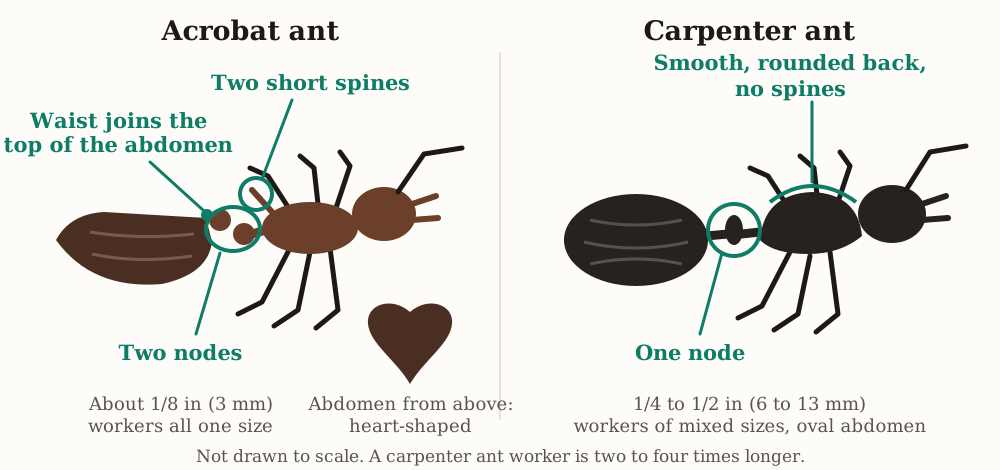
To identify acrobat ants for sure, look at the waist from the side. They have two small bumps, or nodes, and the second joins the top of the abdomen, not the front. They also have two short spines on the back of the middle body section. No other genus in the Americas has a waist built this way.
The waist explains the whole act. Because the abdomen hangs from its top edge, the ant can flip it up over its head. Most other ants cannot.
Three more features help:
- Antennae. Workers have 11 segments in each antenna. One Texas A&M page says 12, but other entomology sources give 11.
- Spines. The two spines point back from the middle section, just in front of the waist. Iowa State says you need magnification to see them.
- Same size. All the workers in a trail are about the same size. Fire ants and carpenter ants come in a mix of small and large workers.
What a phone photo can and cannot show
A clear photo from above can show the heart-shaped abdomen, and a photo of an ant with its abdomen raised is close to proof. However, the waist and the spines need a sharp side view, and counting antenna segments needs a hand lens. The University of Minnesota says it is “often challenging to recognize ants from a picture.”
For the best photo, put a few ants in a clear bag or jar, set it on white paper beside a ruler, and shoot from the side in daylight. A worker gives a better answer than a winged ant. Texas A&M’s ant identification workshop puts it in capitals: “YOU NEED WORKER ANTS TO IDENTIFY ANTS”.
Acrobat ant or something else?
The ants most often mistaken for acrobat ants are carpenter ants, odorous house ants, pavement ants and fire ants. Acrobat ants are the only ones with a heart-shaped abdomen that tilts up over the back. Carpenter ants are two to four times longer, at 1/4 to 1/2 inch, with one node and a smooth, rounded back.
Check the waist and the size first. Then check where you found them and what they were doing.
Acrobat ants and the ants most often mistaken for them
Abdomen from above
- Acrobat ant
- Heart-shaped, pointed tip, raised when disturbed
- Carpenter ant
- Oval
- Odorous house ant
- Oval
- Pavement ant
- Oval
- Fire ant
- Oval
Waist
- Acrobat ant
- Two nodes, joined to the top of the abdomen
- Carpenter ant
- One node
- Odorous house ant
- One flat node
- Pavement ant
- Two nodes
- Fire ant
- Two nodes
Size of workers
- Acrobat ant
- About 1/8 in, all one size
- Carpenter ant
- 1/4–1/2 in, mixed sizes
- Odorous house ant
- About 1/8 in, all one size
- Pavement ant
- About 3/16 in
- Fire ant
- 1/16–1/4 in, mixed sizes
Other clue
- Acrobat ant
- Two short spines; trails on wires and frames
- Carpenter ant
- Smooth, evenly curved back
- Odorous house ant
- Rotten coconut smell when crushed
- Pavement ant
- Fine grooves on the head and thorax
- Fire ant
- Soil mounds outdoors; painful sting
Damage
- Acrobat ant
- Debris piles; nests in damp wood and foam
- Carpenter ant
- Smooth tunnels in wood, coarse sawdust
- Odorous house ant
- None
- Pavement ant
- None
- Fire ant
- Stings
Are acrobat ants the same as carpenter ants?
No. They are different ants that both nest in wood. A carpenter ant worker is 1/4 to 1/2 inch long, with one node in the waist and a smooth, curved back. An acrobat ant is about 1/8 inch, has two nodes and a heart-shaped abdomen, and does far less damage.
Carpenter ants dig clean, smooth tunnels into damp wood and can weaken it over time. The smaller acrobat ant mostly moves into wood that is already rotting, or into old carpenter ant and termite tunnels. People mix them up all the time, and so do some pest companies. In one Ask Extension case from Maryland, a pest company called them carpenter ants, though the extension expert said the photo did not look like carpenter ants. If yours are big and black, read our carpenter ant identification guide.
Acrobat ants vs odorous house ants
Odorous house ants are the same size and color, so they are the hardest to tell apart by eye. Crush one and sniff: an odorous house ant smells like rotten coconut, Texas A&M’s ant identification workshop says. Its waist has one flat node, and its abdomen is oval, not heart-shaped. Our guide to small house ants covers them.
Acrobat ants vs pavement ants
Pavement ants also have two nodes and a pair of spines, so they can fool a close look. The difference is on the head and thorax: pavement ants have fine, parallel grooves running along them. Their abdomen is oval. They usually come in from cracks in the slab or the sidewalk, not from window frames.
Acrobat ants vs fire ants
Fire ants live in soil mounds outdoors, and their workers range from tiny to large in the same colony. Acrobat ant colonies nest in wood, and the workers are all one size. A fire ant’s antenna has 10 segments with a 2-segment club, while an acrobat ant’s has 11. Fire ants also give a burning sting that leaves pus bumps. See our fire ant identification guide if you live in the South and found a mound.
Acrobat ants vs termites
Termites have a thick waist, straight antennae and, when winged, four wings of equal length. Ants, including acrobat ants, have a pinched waist, elbowed antennae and hind wings smaller than the front ones, UC IPM notes. Their debris piles can look like termite damage, so check the insect, not just the mess.
Do acrobat ants bite or sting?
Acrobat ants bite, usually when you disturb their nest, and the bite is a small pinch. They do have a sting at the tip of the abdomen, but they do not use it on people. Instead, they use it to dab defensive chemicals onto other insects. For most people, an acrobat ant bite is minor and short-lived.
Sources disagree on how eager they are to bite. Michigan State University Extension says the workers “bite aggressively” when alarmed, while Terminix calls them “not aggressive”. Both can be true. A worker walking on a counter rarely bites, but a nest you have just pulled open will defend itself. In northern states such as Michigan, where fire ants do not live, this is one of the small ants that bite.
The sting question confuses many readers. The University of Texas at El Paso’s ant guide says that “they cannot sting” but can inflict a painful bite. Instead, the same guide says, they wave their abdomens over their bodies, “ready to dab noxious chemicals” on an attacker. That defense is aimed at other ants and small predators, not at people.
Wash the bite with soap and water, then hold a cold pack on it to ease any swelling, as Cleveland Clinic advises. Our bug bite identification guide covers what to watch for, but a bite alone cannot tell you what bit you. Identify the ant from the ant itself.
Are acrobat ants dangerous?
No. Acrobat ants are not dangerous to people. They are not venomous to humans in any way that matters, and they spread no disease. The UF/IFAS Extension sheet calls them “usually of minimal nuisance to people” compared with other pest ants. The risk is to the house, not to you, and even that risk is small.
We found no US extension source that reports a medical problem from these ants. As with any insect, though, a person with a severe allergy to bites or stings should treat any unusual reaction seriously.
Are acrobat ants safe around pets and children?
The ants themselves are a minor nuisance to pets and children. The bigger risk is what you use to kill them. Place bait stations where children and pets cannot reach them, as Michigan State and UC IPM both advise. If a pet eats ant bait or insecticide, call your vet or the ASPCA Animal Poison Control Center at (888) 426-4435. A fee may apply.
Why do acrobat ants smell?
Some species give off a sharp, unpleasant smell when they are crushed or alarmed. Michigan State calls it “a repulsive odor”. It is not the rotten coconut smell of odorous house ants, which is a different ant.
Do acrobat ants damage your house?
Acrobat ants do little damage to a sound house. They do not tunnel through solid, dry wood the way carpenter ants and termites do. Instead, they move into wood that is already damp or rotting, into old insect tunnels, and into foam insulation. A nest in your walls is a sign of a moisture problem.
The real cost is usually the leak that drew them in. Wood that stays wet long enough for these ants to nest in it is wood that needs fixing anyway.
Do acrobat ants eat wood?
No. They do not eat wood. UF/IFAS says they “do not nest in sound wood” and do “minimal damage to wood”. They may push out bits of soft, rotten wood while they clear a nest space. The University of Maine says they can tunnel through rotten wood much as carpenter ants do, and Iowa State notes that they dig out galleries in moist wood. Neither suggests they harm sound timber.
The “sawdust” you see is mostly debris. Virginia Tech lists dead ants, bits of insect prey, a sawdust-like powder and small pieces of building material in the piles they leave.
Acrobat ants in foam insulation
Foam insulation is one of their favorite nest sites. The ants nest in damp foam board, in rigid insulation inside walls, and in the foam panels behind vinyl siding. They chew the foam into small crumbs and push them out. Pale foam crumbs below siding or on a window sill are a strong clue that a nest is inside.
Do acrobat ants chew electrical wires?
Possibly, but the evidence is thin. PestWorld and a 2004 Clemson Extension fact sheet both say the ants can strip the insulation from electrical or telephone wires and cause short circuits. Neither gives data or a study. Virginia Tech, UF/IFAS, Texas A&M, Iowa State and Michigan State do not mention wire damage at all.
What is clear is that the ants travel along wires and pipes, and Reddit users report them in smoke detectors and electrical equipment. If you see ants coming out of an outlet, a switch or a smoke detector, do not spray or dust into it yourself. Turn off the power to that circuit if you can do it safely, and call a licensed electrician or a pest professional.
Why are acrobat ants in my house?
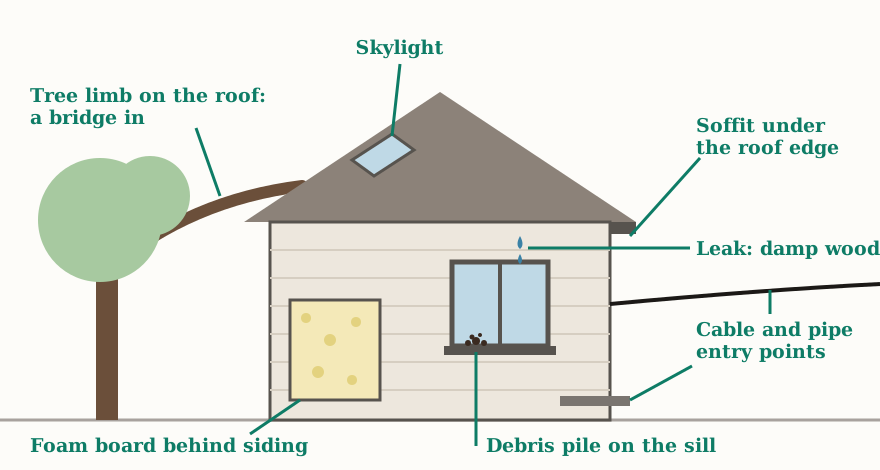
Acrobat ants come inside for two reasons: a place to nest and food. Indoors they nest in damp or rotting wood, wall voids and foam insulation, often around windows, door frames and skylights. Their presence often means a leaking roof, a dripping pipe in a wall, or wood that stays wet.
Many colonies also live outdoors and only send workers in for food. Virginia Tech puts it plainly: their presence “may indicate that there are leaks in the roof or a leaky water pipe in the walls”. So the ants are a clue. Find the water, and you have usually found the nest.
What attracts acrobat ants?
Damp wood, sweets and protein attract them. Outdoors their main food is honeydew, the sugary waste of aphids and scale insects. Indoors they go for sugary spills and for meat or other protein foods. A tree full of aphids with branches resting on your roof gives them both food and a bridge into the house.
How do acrobat ants get in?
Acrobat ants get in through small cracks around window frames, door frames and roof vents. They also walk in along tree branches that touch the roof or siding, and along wires and pipes where they enter the walls. Workers follow scent trails, so once a few find a way in, many more use the same path.
Signs of acrobat ants in the house
The most common sign is a small pile of dark debris on a window sill, under a door frame or below a skylight. It may hold dead ants, insect parts, foam crumbs and fine grit. Many people first think it is rust or dirt. Other signs are trails of tiny ants on wires, pipes and frames, and winged ants indoors.
In Ask Extension cases from Maryland, Oklahoma and Texas, homeowners found the debris long before they saw a nest. One wrote, “I thought it was just rust but when I brushed it away I saw that there were small bugs in the piles.”
What it means when you see acrobat ants
What it means when you see acrobat ants
A few workers on a tree, fence or deck outside
- What it usually means
- A normal outdoor colony
- What to do
- Nothing. Trim branches that touch the house
A trail along a wire, pipe or tree limb into the house
- What it usually means
- Workers foraging from an outdoor nest
- What to do
- Follow the trail, cut back the branch, seal the gap, bait the trail
A debris pile on a sill or below a skylight
- What it usually means
- A nest in the frame or wall right there
- What to do
- Look for a leak or soft wood above it; bait; call a pro if it keeps coming back
Foam crumbs below siding or around windows
- What it usually means
- A nest in foam insulation
- What to do
- Check for water getting behind the siding; bait or call a pro
Winged ants inside the house
- What it usually means
- A nest in or close to the house; in winter, almost certainly inside
- What to do
- Find the nest; a pro can treat wall voids
Ants coming out of an outlet, switch or smoke detector
- What it usually means
- Ants nesting in the wiring box or device
- What to do
- Do not spray into it. Call an electrician or a pest professional
Where do acrobat ants live?
Acrobat ants live across the United States, from forests and yards to city trees. Outdoors they nest in tree cavities, dead branches, stumps, logs, firewood and under stones. They are more common in the Southeast than the Northeast, the University of Maine notes. A tree near the house, especially one with aphids, is often where an indoor problem starts.
Some kinds live high in pine trees. In north Florida, for example, Ashmead’s acrobat ant is the most common ant in the canopy of coastal pine forests, UF/IFAS says. It is also a main food of the endangered red-cockaded woodpecker.
Which acrobat ant lives in your area?
Common acrobat ants in the US
Small-lined acrobat ant (Crematogaster lineolata)
- Where it lives
- The mid-latitude East and Southeast; farther north it is mostly replaced by the cherry acrobat ant
- What to know
- The one most often found in US homes, Texas A&M says
Cherry acrobat ant (C. cerasi)
- Where it lives
- The north-central and northeastern US and Quebec; uncommon in the South
- What to know
- A common home invader in the Northeast
Ashmead's acrobat ant (C. ashmeadi)
- Where it lives
- Florida and the Southeast
- What to know
- Lives high in pine trees; occasional pest indoors
Pine tree acrobat ant (C. pinicola)
- Where it lives
- Alabama, South Carolina and Florida pine flatwoods
- What to know
- Looks like Ashmead's, but strongly red and black
Shiny acrobat ant (C. laeviuscula)
- Where it lives
- Across the southern US, including Texas
- What to know
- Nests in rotting wood and hollow stems; the most photographed acrobat ant in the US on iNaturalist
Ranges from BugGuide, UF/IFAS and Texas A&M. iNaturalist lists 29 acrobat ant species with US records.
You cannot tell these species apart without a microscope, and you do not need to. They all look and behave much the same around a house, so the treatment is the same. In Texas, Ask Extension cases from Austin and Fort Worth, and Reddit threads from Austin, describe nests in soffits, kitchen cabinets and water-damaged wood.
What do acrobat ants eat?
Acrobat ants eat mainly honeydew, the sweet liquid that aphids and scale insects give off as they feed on plants. They also hunt small insects, scavenge dead ones and eat seeds and flower nectar. Indoors they forage for sweets and for meat or other protein foods. The honeydew habit is why they so often trail up trees.
Many colonies guard their aphids and scale insects closely. On dogwoods in Ohio, Ohio State found them building shelters of chewed plant material over the aphids they tend. So when a plant near your house is covered in aphids or sticky honeydew, an acrobat ant colony may be farming it. Our aphid identification guide shows what to look for on the leaves.
Acrobat ant colonies and life cycle
An acrobat ant colony usually has one queen. Texas A&M says most colonies are small, but some reach thousands of workers. One study of Ashmead’s acrobat ant in Florida estimated up to about 80,000 workers in a mature colony. A colony may spread over several nest sites.
Like all ants, they go through four stages: egg, larva, pupa and adult. The queen lays the eggs, and workers raise the young. In Ashmead’s acrobat ant, a single queen can lay up to 450 eggs a day, that Florida study found. New colonies start when winged queens and males leave the nest to mate.
When do acrobat ants swarm?
Acrobat ants swarm in summer and fall, but the month depends on the species and the region. In Florida, Ashmead’s acrobat ant probably swarms in June and July. Farther north, the cherry acrobat ant swarms from about July to early September. Michigan State and Iowa State say winged ants usually show up in the fall.
When acrobat ants swarm, by source
Tschinkel, Journal of Insect Science (2002)
- Acrobat ant
- Ashmead's, Florida
- Swarm time
- June to late July
Ohio State University BYGL (2024)
- Acrobat ant
- Cherry, Ohio
- Swarm time
- July and August
Animal Diversity Web
- Acrobat ant
- Cherry
- Swarm time
- Late July to early September
PestWorld
- Acrobat ant
- Not given
- Swarm time
- Mid-June to late September
Iowa State, Michigan State
- Acrobat ant
- Not given
- Swarm time
- Usually in the fall
Inside the house, any swarm matters. Winged swarmers indoors, at any time of year, mean a nest is in or close to the house, Virginia Tech says. Michigan State goes further and calls them a good sign of a nest inside the home. In winter, when it is too cold for an outdoor nest to swarm, the nest is almost certainly inside.
When are acrobat ants most active?
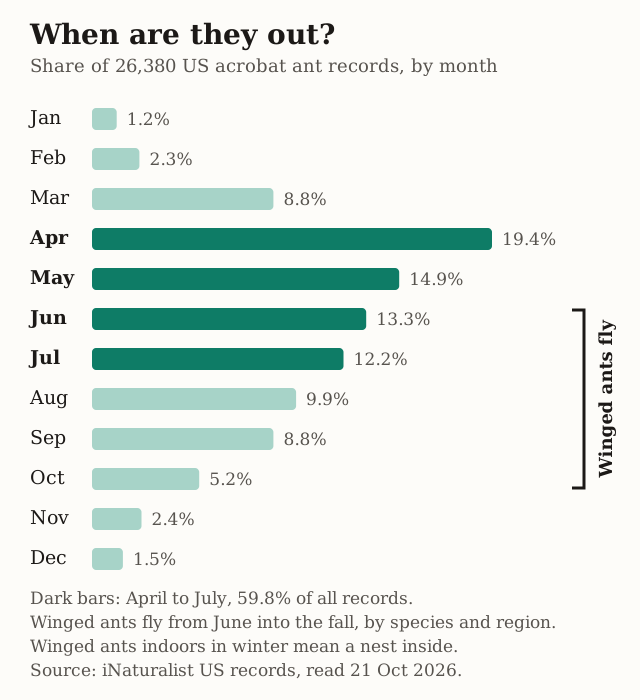
Acrobat ants are most active from April to July. Of 26,380 US sightings of the genus on iNaturalist, 59.8% fall in those four months, and April alone has 19.4%. Sightings fall away through the fall, and December to February together have only 5%. An acrobat ant seen indoors in midwinter is probably living inside.
These counts come from naturalists, mostly outdoors, so they show when the ants are out and about. They do not show how often each species gets into homes. Still, they match what homeowners report: many questions about these ants in the house arrive in spring.
How to find an acrobat ant nest
To find an acrobat ant nest, follow a trail of workers back to where they go into a crack or hole. Then look for the signs around it: a debris pile, foam crumbs, soft or stained wood, or a leak. Indoors, nests are most often in window frames, door frames, skylights, soffits and wall voids near damp wood.
Work through these places in order:
- Follow the trail. Watch where the ants walk when nobody disturbs them. Texas A&M says strong trails “should be followed to suspected nest site”. Mark where they enter a crack.
- Check the windows and doors. Look at sills, frames and trim for debris piles, gaps and soft wood. Press the wood with a screwdriver. Wood that gives easily is wet or rotting.
- Look up. Check skylights, roof vents, gutters and the soffits under the roof edge. Water often gets in at these points.
- Check the wires and pipes. Look where cables, the phone line and pipes enter the walls, inside and out.
- Walk the outside. Look for foam crumbs below vinyl siding, and for tree limbs and shrubs that touch the house. Check stumps, logs and firewood near the walls.
- Find the water. Look for a dripping pipe, a stained ceiling or a blocked gutter near the trail. Fixing it is part of getting rid of the ants.
How to get rid of acrobat ants
To get rid of acrobat ants, confirm the ant, find the trail and the nest, then fix the moisture and cut back branches touching the house. Next, set out a sugar-based ant bait along the trail for several weeks, with no spray nearby. Spray only a nest you can reach, and call a professional for nests in walls.
Start with what costs nothing. Most homes need only the first five steps, plus bait.
How to get rid of acrobat ants, step by step
Confirm it is an acrobat ant
Check the heart-shaped abdomen and the size. Carpenter ants, odorous house ants and fire ants need different treatment.
Find the trail and the nest
Use the steps above. Clemson Extension says control depends on a thorough inspection and correct identification.
Fix the moisture
Repair leaks in the roof, flashing, gutters and plumbing. Replace rotten wood around windows, doors and skylights. Without damp wood, an indoor nest has nowhere to live.
Cut the bridges
Trim tree limbs, shrubs and vines so they do not touch the roof, siding or foundation. If a tree near the house is full of aphids, deal with those too.
Move the firewood
Store firewood at least 20 feet (6 m) from the house and about 5 inches (13 cm) off the ground, as PestWorld advises. Remove old stumps and logs near the walls.
Bait the trail
Set out an ant bait labeled for sugar-feeding ants, right on or beside the trail. Virginia Tech says several rounds may be needed. Keep fresh bait out until you no longer see ants. Do not spray anywhere near it, since a spray kills the workers before they carry the bait home.
Treat a nest you can reach
If you have opened up the nest, for example by pulling off rotten trim, Virginia Tech says you can treat it directly with an insecticide labeled for ants. Nests inside walls may need a dust applied into the void, which is a job for a licensed professional.
Seal the gaps
Once the trail has stopped, caulk gaps around windows, doors, and the places where wires and pipes enter the house. Replace damaged foam and siding.
What kills acrobat ants?
A slow-acting bait works best, because workers carry it back to the queen and the young in the nest. Use a bait labeled for sugar-feeding ants, as Virginia Tech advises. Baits can work less well in summer, when their favorite foods are plentiful outdoors, Michigan State notes. If the ants ignore a sweet bait, try one with protein, since Michigan State says they also like meat and other protein foods indoors.
Common bait ingredients include boric acid or borate, fipronil, avermectin and hydramethylnon, UC IPM says. Choose an EPA-registered product, and check that its label lists ants and the place you want to use it, indoors or out. The label is the law. One Reddit user in r/pestcontrol bought “everything possible” online, then found the labels did not list their ant.
Should you spray acrobat ants?
Usually not. If moisture repairs and baiting work, insecticide sprays are not needed. Spraying a trail kills the few workers you see but not the queen or the young. UC IPM says sprays “only provide temporary control”. Clemson’s advice is short: “Do not spray areas where baits are used.”
A spray has one good use: a nest you have opened up and can see. Even then, use only a product labeled for ants at that site, and follow the label exactly. Avoid spraying pyrethroids outdoors on hard surfaces such as driveways and sidewalks, or around the foundation. UC IPM says these products pollute waterways.
How to get rid of acrobat ants outside
Outside, you usually do not need to get rid of them at all. Outdoor colonies are part of the yard, and they hunt other small insects. Act only where they reach the house. Trim the branches they use, move firewood and logs away from the walls, and bait the trail where it meets the house.
If the colony lives in a dead or rotting tree right next to the house, an arborist can tell you whether the tree should come down. Removing the rotten wood removes the nest.
What does not work, and common myths
Most of what fails against acrobat ants goes after the ants you can see and leaves the nest and the damp wood alone. Here are 8 common beliefs, several of them from Reddit and Ask Extension questions, and what the sources say about each.
Myth 1
Myth: “Acrobat ants are baby carpenter ants.”
Truth: They are a different ant. Carpenter ant workers are at least 1/4 inch long and have one node. Acrobat ant workers are 1/8 inch, have two nodes and a heart-shaped abdomen.
Myth 2
Myth: “They are eating the wood in your house.”
Truth: They do not eat wood, and they rarely nest in sound wood. They move into wood that is already wet or rotting.
Myth 3
Myth: “The pile on the sill is termite damage.”
Truth: Acrobat ant debris often holds dead ants, insect parts and foam crumbs. Look for the ants themselves before you assume termites.
Myth 4
Myth: “Spraying the trail fixes it.”
Truth: It kills the workers you see and leaves the nest. Spray near a bait also stops the bait from working.
Myth 5
Myth: “A bug bomb will clear a wall nest.”
Truth: Foggers settle on open surfaces. They do not reach a nest inside a wall void.
Myth 6
Myth: “Any ant killer will do.”
Truth: Check the label lists ants and your site. Some products are for outdoor use only, and some cannot be sold in every state.
Myth 7
Myth: “A homemade mix is as safe as a store bait.”
Truth: Some extension services, Michigan State among them, do give a jelly and boric acid recipe. Still, a sealed, labeled bait station is safer around children and pets than an open lid of homemade bait.
Myth 8
Myth: “The ants are the problem.”
Truth: In a house, they are usually a clue. The leak or the wet wood is the problem, and they will return until it is fixed.
When to call someone
Most acrobat ant problems end with a moisture repair, trimmed branches and a few weeks of bait. Call for help when the nest is inside a wall or ceiling, when ants come from outlets or smoke detectors, when you find soft or rotting wood you cannot fix, or when ants are still trailing after a month of baiting.
Who to call about acrobat ants
Licensed pest professional
- When
- A nest in a wall, ceiling or soffit, or ants still trailing after a month of bait
- Why
- They can dust wall voids with tools and products homeowners do not usually have
Roofer, carpenter or plumber
- When
- Soft wood, a leaking roof or skylight, or a dripping pipe near the nest
- Why
- The ants will return until the wet wood is fixed
Licensed electrician
- When
- Ants coming out of outlets, switches or electrical panels
- Why
- Spraying or dusting into live wiring is a shock and fire risk
Landlord
- When
- You rent and find ants, a leak or rotting wood
- Why
- Leaks and rotten wood are usually the owner's repair
Doctor, or 911
- When
- A bite with trouble breathing, swelling of the face or throat, fever or spreading redness
- Why
- Acrobat ant bites are minor, so a strong reaction needs checking
Vet or ASPCA, (888) 426-4435
- When
- A pet ate ant bait or insecticide
- Why
- The pesticide, not the ant, is the risk
If a pest company proposes heavy treatment, it is fine to ask what each product is for. In one Ask Extension case from Maryland, a company planned “four different high-power toxins”, including a fogger, for ants in one wall. The extension expert’s advice was simple: there is “no harm in getting a second opinion”.
Not sure it is an acrobat ant at all? Upload a photo to our free bug identifier for an answer in seconds.
Pest control disclaimer. Photo-based identification can help, but it is not always perfect. For dangerous spiders, large infestations, or anything you are unsure about, contact a licensed pest control professional.
Acrobat ant FAQ
Are acrobat ants hard to get rid of?
Will acrobat ants go away on their own?
How long does it take to get rid of acrobat ants?
Should I kill acrobat ants I see outside?
Do acrobat ants come back every year?
Are acrobat ants found in the UK or Europe?
Related guides
Carpenter ants
The big black ants that really do tunnel into wood, and the ant most often confused with acrobat ants.
How to get rid of ants
Why bait beats spray for every small house ant, and how to match the bait to the ant.
Flying ants
What a swarm of winged ants means, month by month, and how to rule out termites.
Fire ants
The red ants that sting in numbers and build soil mounds in the South.
Bug bite identification
What different bites look like, and the warning signs that need a doctor.
What bug is this?
Six checks for naming any bug you find in the house.
Sources
- Virginia Cooperative Extension, Acrobat Ant, ENTO-405NP, P. Wooden, T. Dellinger and E. Day (revised July 2026)
- Michigan State University Extension, Plant & Pest Diagnostics, Acrobat Ants, H. Russell, reviewed by S. Hughson (May 2025)
- UF/IFAS Extension, Acrobat Ant, Crematogaster ashmeadi, EENY-333 / IN610, E. Saarinen
- Texas A&M AgriLife Extension, Urban Entomology, Acrobat Ant, Crematogaster sp.
- Clemson Cooperative Extension, HGIC 2400, Acrobat Ants (2004)
- Iowa State University Extension, Yard and Garden, Acrobat Ant (originally published 2016)
- University of Maine Cooperative Extension, Home and Garden IPM, Acrobat Ants
- UC IPM Pest Notes: Ants, Publication 7411, M. Rust and D. Choe
- BugGuide, Genus Crematogaster, Acrobat Ants
- W. Mackay, University of Texas at El Paso, Ants of North America: Crematogaster
- Tschinkel WR. The natural history of the arboreal ant, Crematogaster ashmeadi, Journal of Insect Science 2:12 (2002)
- Animal Diversity Web, University of Michigan, Crematogaster cerasi
- Ohio State University, Buckeye Yard & Garden onLine, Acrobat ant, Crematogaster cerasi (2024)
- Cleveland Clinic, Bug Bites
- American Academy of Dermatology, Bug bites and stings: When to see a dermatologist
- iNaturalist, acrobat ant (Crematogaster) observations in the United States (read October 21, 2026)