Do ants bite or sting?
All ants can bite, but only some sting. Poison Control says every kind of ant can bite people, though most bites go unnoticed. In most of the US, the ants with a sting that really hurts are fire ants, harvester ants and the Asian needle ant. A few others, such as carpenter ants, bite and then squirt acid.
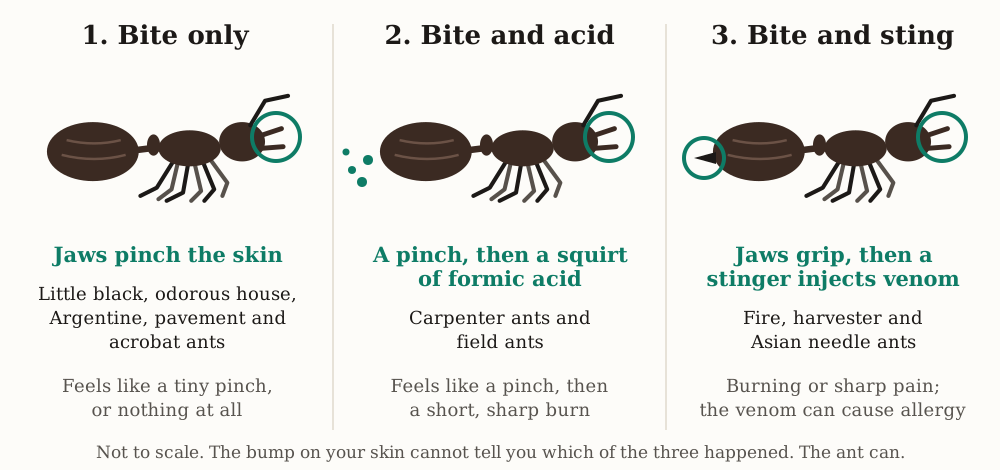
So there are three ways an ant can hurt you. The first is a plain bite. The ant pinches your skin with its jaws, called mandibles. Most house ants are only 1/16 to 1/8 inch (1.5 to 3 mm) long, and DermNet says most ants are too small to bite people effectively. You may feel a prick, or nothing at all.
The second is a bite with acid. Carpenter ants and field ants pinch first, then spray formic acid from the tip of the abdomen into the wound. Clemson Extension says this gives “the feeling of being stung,” even though field ants have no stinger.
The third is a true sting. A fire ant grips your skin with its jaws, then drives a stinger at the back end into the skin and injects venom. Because the sting has no barb, the same ant can sting again and again. Poison Control puts the average at 7 to 8 stings per ant, in a circle around the bite.
People say “ant bite” for all three, and that is fine. The difference matters for one reason: the venom in a sting is what causes most of the pain, the blisters and the allergic reactions.
Do all ants have stingers?
No. Odorous house ants and Argentine ants have no sting at all, Mississippi State Extension says, and PestWorld says the same for ghost ants. Little black ants and pavement ants do carry a small sting. However, PestWorld calls the little black ant’s sting “too small and weak to be effective,” and Washington State says pavement ants are rarely aggressive toward people.
DermNet notes that only female ants have a stinger. Workers and queens are female, so they can sting if their kind has one. Winged males have no sting, so a male flying ant can do you no harm.
Which ant bit you? Start with the ant you saw
To work out which ant bit you, look at the ant, not the bite. Its size, color, nest and where you were tell you far more than the bump does. Most bites in a US home come from small house ants 1/16 to 1/8 inch long, and they barely hurt. A burning sting outdoors in the South usually means fire ants.
Use the table below with what you saw. If you did not see the ant, skip to what else the bite could be.
Which ant bit you: match the ant you saw
Tiny black or brown ants, 1/16–1/8 in (1.5–3 mm), trailing to food indoors
- Likely ant
- Little black, odorous house, Argentine or ghost ant (often called sugar ants)
- Bite or sting
- Bite at most; no working sting
- What it feels like
- A faint prick, or nothing
- How long it lasts
- Minutes to a day
- Risk
- Very low
Dark ants about 3/16 in (2.5–4 mm) from cracks in the pavement or slab
- Likely ant
- Pavement ant
- Bite or sting
- Bite; a small sting it rarely uses on people
- What it feels like
- A small pinch
- How long it lasts
- Minutes to a day
- Risk
- Very low
Small shiny ants that lift a heart-shaped abdomen, on window frames or trees
- Likely ant
- Acrobat ant
- Bite or sting
- Bite
- What it feels like
- A small pinch
- How long it lasts
- Short-lived
- Risk
- Very low
Big black, or red and black, ants 1/4–1/2 in (6–13 mm) near wood
- Likely ant
- Carpenter ant
- Bite or sting
- Bite, may squirt formic acid
- What it feels like
- A sharp pinch, then a brief burn
- How long it lasts
- The burn fades on its own
- Risk
- Low
Ants of mixed sizes, 1/8–3/8 in (3–10 mm), from a big mound of soil and thatch in a lawn or field
- Likely ant
- Field ant (Formica)
- Bite or sting
- Bite, then squirts formic acid; no sting
- What it feels like
- Like a sting, Clemson says
- How long it lasts
- Short-lived
- Risk
- Low
Reddish-brown ants of mixed sizes pouring out of a loose dirt mound with no hole on top, mostly in the South
- Likely ant
- Fire ant
- Bite or sting
- Grips, then stings again and again
- What it feels like
- Burning, then a white pustule within a day
- How long it lasts
- About a week, up to 10 days
- Risk
- Moderate; allergy risk
Red to dark ants 1/4–1/2 in around a bare, cleared patch with one hole, mostly in the West and Florida
- Likely ant
- Harvester ant
- Bite or sting
- Sting
- What it feels like
- One of the most painful stings in North America
- How long it lasts
- Pain for hours, a welt for days
- Risk
- Moderate; allergy risk
Shiny black ants about 1/5 in (5 mm) with orange-brown legs, under mulch, leaves or logs, mostly in the Southeast
- Likely ant
- Asian needle ant
- Bite or sting
- Sting
- What it feels like
- Painful, often in waves
- How long it lasts
- Varies
- Risk
- Allergy risk, sometimes severe
Small red ants, 3/16 in, under logs and stones in damp yards in coastal Maine
- Likely ant
- European fire ant
- Bite or sting
- Sting
- What it feels like
- Stings readily
- How long it lasts
- Varies
- Risk
- Moderate
A fuzzy red and black “ant” running alone on bare ground
- Likely ant
- Velvet ant, a wingless wasp
- Bite or sting
- Sting
- What it feels like
- A hard sting
- How long it lasts
- Varies
- Risk
- Moderate
Winged ants in a swarm
- Likely ant
- Flying ants (any kind)
- Bite or sting
- Hardly ever bite; winged fire ants can sting
- What it feels like
- Usually nothing
- How long it lasts
- Rarely an issue
- Risk
- Very low, except fire ants
Sizes from UC IPM, Clemson, Penn State, Mississippi State and our species guides. Feelings and times are typical, not promises. A strong reaction can follow any sting.
For pictures of each ant and how to tell them apart, see our guide to the common types of ants. The rest of this section answers the ant questions people search for most.
Do black ants bite?
Most small black ants can bite but rarely break the skin. Little black ants and odorous house ants are only about 1/16 to 1/8 inch long, so their nip is faint at most. Big black ants, 1/4 inch or more, are usually carpenter ants. Their bite is a real pinch, and the acid they add burns for a moment.
One black ant does deserve care. The Asian needle ant is shiny black with orange-brown legs, about 1/5 inch (5 mm) long, and it stings. Mississippi State Extension says the sting can, rarely, cause a life-threatening allergic reaction in sensitive people. It hides under mulch, leaf litter and rotting logs, so wear gloves when you garden in the Southeast. For the big black ones, see our carpenter ant identification guide.
Do sugar ants and house ants bite?
Hardly. In the US, “sugar ant” is a nickname, not a species. It covers the tiny ants that trail to sweets in the kitchen, such as odorous house, Argentine, pavement and little black ants. None of them has a sting that works on people, and their bites are faint. Mississippi State says the odorous house ant’s bite is “not very painful because the ants are so small.”
Cleveland Clinic’s ant bite page, which ranks first on Google, describes the sugar ant as Camponotus consobrinus. That is the banded sugar ant of Australia, not the ant in an American kitchen. Our guide to what people mean by sugar ants sorts out the real species.
Do carpenter ants and acrobat ants bite?
Yes, both bite, but neither stings. Carpenter ants are big, 1/4 to 1/2 inch, so the bite is a sharp pinch, and they may squirt formic acid into it. They bite mostly when you pick one up or open a nest. Small acrobat ants also nip when you disturb their nest, but the bite is minor.
Do flying ants bite?
Hardly ever. A winged ant leaves the nest to mate, and it has no nest to defend. Winged males cannot sting at all. The exception is fire ants, since a winged fire ant queen carries the same sting as a worker. Our page on what a swarm of winged ants means covers the rest.
Which ant bites hurt the most?
In the US, harvester ants give the worst sting. The entomologist Justin Schmidt rated it 3 on his 4-point pain scale, and the pain can last more than eight hours. Fire ants come next for most people, because they sting in numbers. Our harvester ant guide covers that sting in detail. The famous bullet ant, the top of the scale, lives in Central and South America.
What does an ant bite look like?
A bite from a small ant usually looks like a small red bump, much like a mosquito or flea bite. Cleveland Clinic describes the mark as raised and red to purple, like a pimple. A fire ant sting is different. It turns into a red welt within about an hour and a white, pus-filled bump within a day.
Ant bites usually land on the feet, ankles, legs and hands, Cleveland Clinic notes, because those touch the ground and the nest. A bite from a carpenter ant may also show a tiny pinch mark. Stings from fire ants come in clusters, often in a ring or half circle where one ant stung several times.
Here is the honest part. Apart from the fire ant pustule, ant bites look like many other bug bites. Cleveland Clinic calls ant bites “unique” among insect bites. Yet a small ant’s bite is just a red bump, and a mosquito, a flea or a spider can leave the same mark. Even the fire ant pustule is “almost diagnostic,” in the words of the Schmitt pediatric guidelines, not certain.
Why this page shows no pictures of ant bites
Many sites post pictures of ant bites. We do not, on purpose. A photo of someone else’s skin invites a wrong match, and nobody can name the bug from a bump. MedlinePlus advises bringing the insect itself when you see a doctor, so it can be identified.
So photograph the ant instead. Trap one under a clear cup on white paper, set a ruler beside it, and shoot from above in daylight. Then try our bug identifier by picture with that photo.
Fire ant stings: the ant bite that blisters
If many ants stung you at once, outdoors in the South, near a loose dirt mound, they were almost certainly fire ants. Each ant grips with its jaws and stings several times. The sting burns at once, and within about 24 hours each spot becomes a white pustule. The pustule is sterile, so leave it alone.
Mississippi State Extension explains that the pustule looks infected but is not. Scratching it open is what lets infection in, and it can leave a scar. The stings itch for days and usually heal in about a week. HealthyWA says they can take up to 10 days.
Fire ant stings have their own page, because the care differs. Our full guide to fire ant stings covers the stages day by day, what helps the itch, and when many stings need a doctor. To check the mound itself, see how to recognize fire ants and their mounds.
How long do ant bites last?
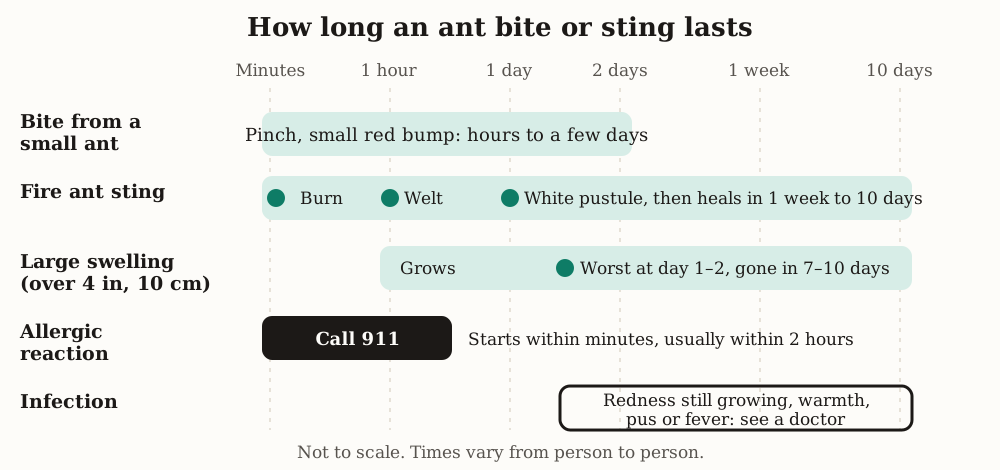
Most ant bites last a few hours to a few days. DermNet says an ordinary local reaction fades within 24 hours, and Cleveland Clinic says bites usually go away after a few days. Fire ant stings last longer: Cleveland Clinic gives 3 to 7 days, and HealthyWA up to 10 days.
Some people swell much more. DermNet calls swelling of more than 10 cm (about 4 inches) a large local reaction. It peaks after 1 to 2 days and takes 7 to 10 days to settle. That looks alarming, but it stays at the bite, and DermNet says the risk of a severe allergy after one is extremely low.
Swelling that grows on the second day is often normal, too. The Schmitt pediatric guidelines say swelling from the venom can increase for 24 hours. However, see a doctor if a bite is no better after a week to 10 days, as Cleveland Clinic advises.
Why do ant bites itch so much?
The itch is your body’s reaction to what the ant left behind. A plain bite or a squirt of formic acid irritates the skin for a short time. Venom does more. Poison Control explains that fire ant venom kills cells at the sting, and the pustule forms as your immune system clears them away. The itch can then last a week.
Can you get rid of ant bites overnight?
No. A bite heals at its own pace, and WebMD says you cannot speed up the process or draw the venom out. What you can do is make it more comfortable tonight. Cool it, use an anti-itch cream, and keep from scratching, so a small bite does not turn into an infected one.
How to treat an ant bite
To treat an ant bite, get away from the ants, wash the bite with soap and water, and cool it with ice wrapped in a cloth for 10 minutes at a time. For itching, a hydrocortisone cream or an oral antihistamine helps. Then leave any blister alone. Most ant bites need nothing more than that.
What to do after an ant bite, step by step
Get away from the ants
Step off the trail or mound first, then get the ants off your skin fast. Brush or pick them off, and take off shoes and socks they have climbed into. Do not hose them off: HealthyWA says ants sprayed with water may latch on with their jaws.
Check for emergency signs
Trouble breathing, swelling of the face, lips or throat, hives away from the bite, dizziness or vomiting can mean a severe allergic reaction. Call 911 now. Everything below is for a reaction that stays at the bite.
Wash the bite
Wash the skin with soap and water, as Cleveland Clinic and MedlinePlus advise. That clears away dirt and lowers the risk of infection.
Cool it
MedlinePlus suggests ice wrapped in a washcloth, 10 minutes on and 10 minutes off. Raise an arm or leg if it swells. Do not put ice straight on the skin.
Ease the itch
The American Academy of Dermatology says most bites can be treated at home with hydrocortisone cream or an oral antihistamine. Follow the package directions. Ask a pharmacist first for a child, during pregnancy, or if you take other medicines.
Leave blisters alone
Do not pop or scratch a blister or a white pustule. If one breaks, wash it and cover it with a bandage, as Cleveland Clinic advises.
Note the ant
If you can, trap the ant or take a clear photo of it. Cleveland Clinic says knowing the ant helps your doctor give the right treatment. A photo of the bump cannot do that.
Watch it for two days
Redness in the first day is the normal reaction. Redness that keeps spreading after that, warmth, pus or a fever needs a doctor.
What to put on ant bites
A cold pack comes first, because it eases both pain and swelling. For itching, the American Academy of Dermatology lists hydrocortisone cream and an oral antihistamine. Poison Control adds that a nonprescription pain reliever can help. Use each one as its package directs.
We do not list medicine names or doses on this page. The right product and amount depend on age, weight, pregnancy and other medicines. So for a child, ask your pediatrician or pharmacist which one to use and how much. Home remedies such as a baking soda paste or aloe may soothe the skin, but they do not pull venom out.
Should you pop ant bites?
No. Do not pop an ant bite, a blister or a white pustule. Cleveland Clinic says popping it could lead to an infection. The fire ant pustule is sterile on its own, Mississippi State says, so breaking it only opens a door for germs. It can also leave a scar.
If a blister breaks anyway, wash it with soap and water and cover it with a clean bandage. Then watch it for the infection signs below.
Infected ant bite: the signs to watch for
An infected ant bite gets worse after the first day or two instead of better. Watch for redness that keeps spreading, warmth, swelling and pain that grow, cloudy pus, a yellow crust or a fever. A white fire ant pustule on its own is not an infection. Infection usually follows scratching or a broken blister.
Timing helps you tell them apart. The Schmitt pediatric guidelines say that redness in the first 24 hours is a reaction to the bite. Redness that starts after 24 hours, or keeps growing after 48 hours, needs a doctor. Cleveland Clinic lists fever, chills, growing swelling, cloudy fluid and a yellow crust as signs of infection.
A skin infection from a bite is often cellulitis. MedlinePlus lists insect bites as a cause, and says the red, warm area grows as the infection spreads. A red streak running up an arm or leg from a bite is a warning sign, because the infection may be moving along the lymph vessels. See a doctor the same day for a streak, or go to the ER if you also have a high fever or feel very sick.
One Reddit thread about red streaks after a bite drew 180 comments, and one reply said the same thing happened to them: “Turned out to be cellulitis.” Antibiotics treat it, but only a doctor can prescribe them.
Allergic reaction to ant bites
A serious allergic reaction to an ant almost always follows a sting, not a bite. Signs start within minutes: hives away from the bite, swelling of the face, lips or throat, wheezing, dizziness or vomiting. That is anaphylaxis, and it needs 911. DermNet puts whole-body reactions at under 1% of ant bites and stings.
Large swelling or allergy? How to tell
DermNet sorts ant bite reactions into four kinds. The first two stay at the bite and can be handled at home. The last two involve the whole body, and those are the ones that need help fast.
Kinds of reaction to an ant bite or sting
At the bite, under about 2 in (5 cm), gone within a day
- What it is
- Local reaction, the usual kind
- What to do
- Wash, cool, anti-itch cream
At the bite but over 4 in (10 cm), worst at day 1–2, gone in 7–10 days
- What it is
- Large local reaction
- What to do
- Home care; a doctor if it crosses a joint or keeps growing
Hives, flushing or itching away from the bite, or mild nausea
- What it is
- Mild whole-body reaction
- What to do
- Emergency care now, as DermNet advises; 911 if breathing changes
Breathing trouble, throat or face swelling, dizziness, fainting
- What it is
- Severe reaction (anaphylaxis)
- What to do
- Epinephrine if prescribed, and call 911
Categories and sizes from DermNet (revised 2020).
If you have reacted badly before
See a board-certified allergist. The American College of Allergy, Asthma and Immunology says about 50 people die each year from allergic reactions to insect stings, fire ant stings included. After one severe reaction, the chance of another with the next sting is about 50 to 60%.
There is a fix. For fire ants, ACAAI says allergy shots, called venom immunotherapy, can cut that chance to 2 to 3%. An allergist can also decide whether you should carry epinephrine. Our bee sting guide explains how a normal swelling differs from an allergic one, and the same signs apply to ants.
Sources disagree on who is most at risk. Poison Control says serious reactions are more common in children. DermNet says the risk of a severe whole-body reaction is greater in adults, especially over 45. Either way, treat any spreading reaction seriously at any age.
Can you become immune to ant bites?
Not by letting ants bite you. A Reddit post in r/ants asked exactly that, and the answer runs the other way. Poison Control says allergic reactions can get worse with each new sting. Only an allergist’s venom shots, given in a clinic, lower the risk safely.
Ant bites on kids and babies
Most ant bites on kids heal the same way as an adult’s: wash, cool, and keep small fingers from scratching. Call 911 for any breathing trouble or face swelling. The Schmitt pediatric guidelines also say to get care now for a baby under 1 year old with 20 or more fire ant stings, or for a sting inside the mouth or on the eye.
The same guidelines set a rough limit for older children. Get care now for more than 5 stings for every 10 pounds (5 kg) of body weight, and for more than 50 stings in a teen. A newborn with more than 5 stings needs care too. Children’s Health in Dallas adds that a child with dozens of fire ant stings may need to see a doctor.
Do not guess at medicine for a child. Ask your pediatrician or pharmacist which product to use and how much, since it depends on age and weight. For a toddler, cover a blister with a bandage so it stays clean. Small children put their hands in their mouths, and a broken blister can get infected.
Prevention works best with kids. Children’s Health suggests shoes for outdoor play, and teaching children what an ant mound looks like so they keep away. HealthyWA notes that young children get more fire ant stings because they are less aware of nests.
Ant bites on dogs and cats
Dogs usually get bitten or stung on the nose, face and paws, because they lead with them. Watch for licking or chewing at a paw, limping, hives, swelling and whining. Swelling of the face can block the airway. Vomiting, weakness, pale gums, trouble breathing or collapse mean an emergency vet visit now, PetMD says.
First, move your pet away from the ants. Then put on gloves and brush or comb the ants out, checking between the toes and around the ears and eyes. Do not hose your pet down: the National Fire Ant Eradication Program says water can make fire ants more aggressive. A cool bath afterward can ease the pain.
Do not give your pet a human allergy pill or pain reliever on your own. PetMD says to ask your vet whether an antihistamine is right and how much to give. We found no separate guidance for cats, so treat a cat the same way and call the vet. If a pet eats ant bait or insecticide, call your vet or the ASPCA Animal Poison Control Center at (888) 426-4435. A fee may apply.
Ant bites in bed at night
Ants rarely bite a sleeping person. They come to a bed for crumbs, spilled drinks or water, and UC IPM says most ant species rarely bite at all. If you wake with new itchy bumps night after night, bed bugs, fleas or mosquitoes are more likely. Check the sheets and mattress seams before you blame ants.
A few clues point away from ants. Bites in a line or cluster on skin that touched the bed, with tiny dark spots on the sheets, suggest bed bugs. Small itchy bumps on the lower legs in a home with a pet suggest fleas. Our guide to what bed bug bites look like covers the night-time suspects.
If you do see ants in the bed, they are usually after food, and the nest is in a nearby wall or under the floor. Stop eating in the bedroom, and wash the bedding. Then bait the trail, as our guide to getting ants out of the house explains.
What can be mistaken for ant bites?
Bites from mosquitoes, fleas, bed bugs, chiggers and spiders can all look like ant bites, and so can hives or a pimple. The bump alone rarely settles it. What does is whether you saw ants, where you were, and the pattern. Ant bites usually come with ants in view, on the feet, legs or hands.
Ant bite or something else? Clues that help
You felt a pinch and saw ants on your skin
- Most likely
- Ant bite
- What else to know
- Usually on feet, ankles, legs or hands
Burning stings in clusters near a dirt mound, white bumps the next day
- Most likely
- Fire ant stings
- What else to know
- Leave the pustules alone
Bites in a line or cluster on skin that touched the bed, found in the morning
- Most likely
- Bed bugs
- What else to know
- Look for small dark spots on sheets and in mattress seams
Small itchy bumps on the ankles and lower legs, a pet in the house
- Most likely
- Fleas
- What else to know
- Check the pet and its bedding
Very itchy bumps along the sock line or waistband after time in grass
- Most likely
- Chiggers
- What else to know
- The itch peaks a day or two later
Single itchy bumps on bare skin after time outside at dusk
- Most likely
- Mosquitoes
- What else to know
- No pinch felt; the itch starts quickly
One sore bump found later, which grows, darkens or forms a blister
- Most likely
- Possibly a spider, or an infection
- What else to know
- See a doctor if it spreads or turns dark
Raised welts that move around the body and fade within hours
- Most likely
- Hives
- What else to know
- An allergic reaction; watch for breathing signs
A pattern is a clue, not proof. To compare many kinds of bites at once, use our bug bite identification chart.
Ant bite vs spider bite
You cannot tell them apart by the bump. Instead, think about what happened. An ant bite comes with ants you saw or felt at the time, often several bites at once. A spider bite is usually a single bump you find later. Most spider bites are harmless, MedlinePlus says. However, a bite that turns dark, spreads or forms an open sore needs a doctor, whatever caused it.
Ant bites vs bed bug bites
Cleveland Clinic points out that ants usually leave single bites on the feet, hands and legs. Bed bugs leave several small bumps, often in a line, on skin that touched the bed. Bed bug bites also show up in the morning, while ant bites come with a pinch you feel at the time.
Ant bite vs mosquito bite
A mosquito bite rarely hurts when it happens, and it itches within minutes. An ant bite starts with a pinch or a burn, and the ant is usually still there. Both leave a red bump, so the moment of the bite is the better clue.
Why do ants bite?
Ants bite to defend their nest, their food or themselves. Most bites happen when someone steps on, sits on or reaches into a nest, or when an ant gets trapped in a sock or a sleeve. To the ants, that is an attack. Fire ants answer together, which is why one wrong step means many stings.
Mississippi State Extension says fire ants do not normally seek people out. Instead, almost every stinging comes from someone who steps in, lies on or disturbs a mound without knowing it. A Reddit user in r/ants asked why ants bit “for no reason at all” while cleaning a chicken coop. The top reply was blunt: the coop was their territory, and they were defending it.
How to avoid ant bites
Most ant bites can be avoided with three free habits. Look before you sit, kneel or stand still on the ground. Wear shoes and socks outdoors. Then wear gloves when you garden, move logs or pull up mulch. Insect repellent is not a reliable shield against ants.
Sources disagree on that last point. Cleveland Clinic suggests insect repellent to prevent ant bites. Yet the Schmitt pediatric guidelines say repellents, including those with DEET, do not help prevent fire ant stings. The same guidelines add that fire ants cannot bite through socks. So socks and shoes do more than spray.
Indoors, take away what draws ants in. Wipe up crumbs and sweet spills, keep food sealed, and fix leaks. Then use a slow-acting bait on the trail rather than a spray, because UC IPM says sprays give only temporary control. Our guide to clearing ants for good matches the bait to the ant.
Ant bite myths
At least 8 common beliefs about ant bites are wrong. Some come from health sites that rank on Google, and some from Reddit threads. Here is what each one gets wrong.
Myth 1
Myth: “You can tell which ant bit you from the bump.”
Truth: Only the fire ant pustule comes close, and the Schmitt guidelines call even that “almost diagnostic.” A small ant’s bite looks like a mosquito or flea bite. Identify the ant, not the bump.
Myth 2
Myth: “Insect repellent stops ant bites.”
Truth: The Schmitt pediatric guidelines say repellents, DEET included, do not help prevent fire ant stings. Shoes and socks work better.
Myth 3
Myth: “A white bump on an ant bite means it is infected, so pop it.”
Truth: A fire ant pustule is sterile, Mississippi State says. Popping it is what invites infection.
Myth 4
Myth: “Sugar ants are a biting species.”
Truth: In the US, “sugar ant” is a nickname for several tiny kitchen ants. Their bites are faint, and none has a working sting.
Myth 5
Myth: “Only fire ants can hurt you.”
Truth: Harvester ants, Asian needle ants and European fire ants also sting. Carpenter and field ants pinch and add acid.
Myth 6
Myth: “A home remedy can draw the venom out.”
Truth: WebMD says you cannot remove fire ant venom. Wash, cool and protect the bite instead.
Myth 7
Myth: “If you were fine last time, you cannot react now.”
Truth: Poison Control says allergic reactions can get worse with later stings. A first severe reaction can come at any time.
Myth 8
Myth: “Letting ants bite you builds immunity.”
Truth: It can do the opposite. Only an allergist’s venom shots lower the risk safely.
When to see a doctor for an ant bite
Most ant bites need no doctor. Call 911 for breathing trouble, face or throat swelling, or fainting. See a doctor the same day for many stings on a child or an older adult, a sting in the mouth or eye, or a red streak. See one within a day or two for spreading redness, pus or a fever.
Who to call about an ant bite or sting
911
- When
- Trouble breathing, swelling of the face, lips or throat, fainting, or hives with vomiting
- Why
- Possible anaphylaxis, a life-threatening allergic reaction
Emergency room, before symptoms
- When
- You know you have a severe sting allergy and you were stung
- Why
- Poison Control advises not waiting for symptoms
Doctor, the same day
- When
- A baby or young child with many stings, a sting inside the mouth or on the eye, or a red streak from the bite
- Why
- These need a check even without allergy
Doctor, within a day or two
- When
- Redness that spreads after the first day, warmth, pus or a fever
- Why
- Possible infection, which may need antibiotics
Doctor, routine visit
- When
- A bite no better after a week to 10 days
- Why
- Cleveland Clinic’s rule of thumb
Allergist
- When
- After any whole-body reaction to a sting
- Why
- Testing and venom shots can prevent the next one
Poison Control, 1-800-222-1222
- When
- Questions about a bite or sting, or someone swallowed ant bait or medicine
- Why
- Free, confidential, 24 hours a day
Vet, or ASPCA at (888) 426-4435
- When
- A pet with face swelling, vomiting, weakness or breathing trouble, or a pet that ate ant bait
- Why
- Pets can have severe reactions too
Still not sure what bit you? If you can find the ant, a clear photo through our free bug identifier will name it. That answer is worth more than any picture of the bite.
Medical disclaimer. This page is for general information only. It is not a medical diagnosis. If you have severe symptoms, trouble breathing, swelling of the face or throat, fast spreading redness, fever, severe pain, pus, or signs of infection, contact a doctor or your local emergency number.
Pest control disclaimer. Photo-based identification can help, but it is not always perfect. For dangerous spiders, large infestations, or anything you are unsure about, contact a licensed pest control professional.
Ant bite FAQ
Do queen ants bite?
What if an ant bites my lip or near my eye?
Do ant bites leave scars?
Can ant bites make you sick?
Are there bull ants in the US?
Related guides
Fire ant bites
The stings that blister: the stages day by day, care, and when many stings need a doctor.
Types of ants
Pictures and size of the common US ants, so you can name the one that bit you.
Fire ants
How to recognize fire ants and their mounds, and keep children and pets away.
Carpenter ants
The big black ants that pinch hard, and what they mean for your house.
Bug bite identification
A chart of 20 bites by look, place and timing, plus the warning signs.
Bed bug bites
The usual cause of itchy bumps found in the morning.
How to get rid of ants
Why bait beats spray, and how to match the bait to your ant.
Sources
- Cleveland Clinic, Ant Bites: Symptoms, Treatment and Prevention (last updated May 6, 2022)
- MedlinePlus Medical Encyclopedia, Insect bites and stings (reviewed October 14, 2025)
- MedlinePlus Medical Encyclopedia, Anaphylaxis (reviewed January 20, 2026)
- MedlinePlus Medical Encyclopedia, Cellulitis
- American College of Allergy, Asthma and Immunology, Insect allergies: answers to common questions
- American Academy of Dermatology, Bug bites and stings: When to see a dermatologist
- DermNet, Ant bites and stings, M. A. Krisna and A. Oakley (revised September 2020)
- Poison Control (National Capital Poison Center), Stung by an ant? P. Soto
- Mississippi State University Extension, The Fire Ant Sting
- Schmitt Pediatric Guidelines, Fire Ant Sting, as published by West Side Pediatrics, Cincinnati
- PetMD, How to Identify and Treat Ant Bites and Stings in Dogs
- UC IPM Pest Notes: Ants, Publication 7411
- Clemson Cooperative Extension, Field Ants
- Mississippi State University Extension, Pest Snapshot: Asian Needle Ant, Publication 4142 (2025)
- Mississippi State University Extension, Control of Argentine Ants and Odorous House Ants in the Home, Publication 2407