What are sugar ants?
Sugar ants are any small ants that trail to sweets in a house. The name is a nickname, not a species. In the US it usually means the odorous house ant, Tapinoma sessile, a brown to black ant about 1/8 inch (3 mm) long. It also covers Argentine, pavement, pharaoh, ghost and little black ants.
Each region has its own favorite. Wikipedia’s page for the name lists five different ants, and Texas A&M gives “sugar ant” as another name for the pharaoh ant. Still, when people complain about sugar ants, they most often mean odorous house ants, an Oregon extension expert wrote on Ask Extension. So the name tells you what the ant eats, not which ant it is.
That gap matters, because the right fix depends on the ant. Most of the ants called sugar ants respond to the same bait plan. A few do not, and one of them gets worse if you spray it. The sort table below takes about a minute.
The real sugar ant lives in Australia
The ant whose proper common name is sugar ant is the banded sugar ant, Camponotus consobrinus. It lives in Australia, not the US. This large, mostly night-active ant is about 0.2 to 0.6 inch (5 to 15 mm) long, with an orange-brown band around its abdomen. It belongs to the same genus as the carpenter ants.
Some US sources mix the two up. Cleveland Clinic’s ant bite page names the sugar ant as Camponotus consobrinus and calls it “very small”. In the same way, one Ask Extension answer to a Texas homeowner described that Australian ant. Neither is the ant in an American kitchen. The tiny trail on your counter is one of the ants in the next section.
Which sugar ant lives where you do?
Where you live narrows the list fast. Odorous house ants live in every state. Argentine ants rule much of California and the Southeast, ghost ants are a Florida sugar ant now found in Texas too, and pharaoh ants turn up in heated apartment buildings anywhere.
The sugar ant you most likely have, by region
The North, Midwest and Northeast
- Most likely sugar ant
- Odorous house ant
- Also common
- Pavement ant along slabs and sidewalks; little black ant
The Pacific Northwest
- Most likely sugar ant
- Odorous house ant
- Also common
- Pavement ant; moisture ants in rotting wood
California
- Most likely sugar ant
- Argentine ant, the most common house ant there
- Also common
- Odorous house ant; pharaoh ant indoors
The Southeast and Gulf Coast
- Most likely sugar ant
- Argentine ant or odorous house ant
- Also common
- Crazy ants; ghost ants in warm buildings
Florida
- Most likely sugar ant
- Ghost ant
- Also common
- Pharaoh ant, which can nest outdoors there; Argentine ant
Texas
- Most likely sugar ant
- Odorous house ant or Argentine ant
- Also common
- Ghost ant, found in Texas since the mid-1990s; pharaoh ant outdoors in south Texas; crazy ants
Apartments, offices and hospitals anywhere
- Most likely sugar ant
- Pharaoh ant
- Also common
- Odorous house ant
Ranges from UC IPM, Texas A&M and UF/IFAS. Ant ranges overlap, so use this to narrow the list, not to settle it.
Which sugar ant do you have?
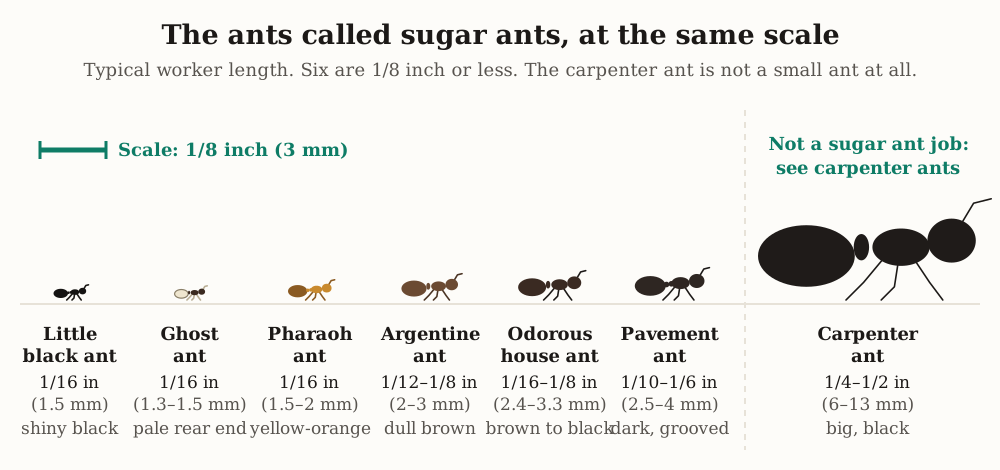
You can name most sugar ants with three free checks: size, color and smell. Crush one and sniff. A rotten coconut smell means an odorous house ant, or a ghost ant if its rear half is pale. Yellow ants about 1/16 inch (1.5 mm) long are pharaoh ants. Black ants over 1/4 inch (6 mm) are carpenter ants.
Start with the first column. Find the line that matches what you see:
Which sugar ant do you have?
Brown to black; rotten coconut smell when crushed
- It is probably
- Odorous house ant
- Worker size
- 1/16–1/8 in (2.4–3.3 mm)
- Waist
- One flat node, hidden
- Where you find it
- Kitchen trails, wall voids near pipes, after rain
Dull brown; long busy trails; musty smell when crushed
- It is probably
- Argentine ant
- Worker size
- 1/12–1/8 in (2–3 mm)
- Waist
- One upright node
- Where you find it
- California and the Southeast, coming in from outside
Dark, with fine grooves on the head; little sand piles by slab cracks
- It is probably
- Pavement ant
- Worker size
- 1/10–1/6 in (2.5–4 mm)
- Waist
- Two nodes
- Where you find it
- Basements, garages, slab cracks, sidewalks
Yellow to orange, darker rear end; in a heated building
- It is probably
- Pharaoh ant
- Worker size
- 1/16 in (1.5–2 mm)
- Waist
- Two nodes
- Where you find it
- Apartments, bathrooms, kitchens, hospitals
Dark front half; pale, see-through rear and legs
- It is probably
- Ghost ant
- Worker size
- 1/16 in (1.3–1.5 mm)
- Waist
- One node, hidden
- Where you find it
- Florida and parts of Texas; sinks and potted plants
Shiny jet black and very tiny
- It is probably
- Little black ant
- Worker size
- 1/16 in (1.5 mm)
- Waist
- Two nodes
- Where you find it
- Lawns, under stones, kitchen cabinets
Lifts a heart-shaped rear end over its back
- It is probably
- Acrobat ant
- Worker size
- About 1/8 in (3 mm)
- Waist
- Two nodes
- Where you find it
- Window frames and damp wood
Big, black or red and black; sawdust nearby
- It is probably
- Carpenter ant
- Worker size
- 1/4–1/2 in (6–13 mm)
- Waist
- One node
- Where you find it
- Damp wood; a different job
Sizes from Penn State, Mississippi State, Texas A&M, UF/IFAS and UC IPM extension pages.
Three free checks that name most sugar ants
Check each clue below to narrow down what you saw.
The crush test: squash one ant on a paper towel and sniff
Rotten coconut or blue cheese means odorous house ant, or ghost ant in Florida. A stale, musty smell points to Argentine ants.
The size test: lay a ruler next to the trail
About 1/16 inch is pharaoh, ghost or little black ant. About 1/8 inch is odorous house, Argentine, pavement or acrobat ant. 1/4 inch or more is a carpenter ant.
The color test: look in daylight, not under a kitchen light
Yellow to orange is pharaoh. A pale rear end is ghost. Shiny jet black is little black ant. Dull brown is Argentine.
Bonus check: the waist, from the side
One bump or two? A zoomed phone photo can show it, and it splits the list in half.
Tiny sugar ants: the 1/16-inch group
The tiniest sugar ants, about 1/16 inch (1.5 mm) long, are pharaoh ants, ghost ants or little black ants. Color settles it. Pharaoh ants are yellow to orange with a darker rear, ghost ants have a dark front and a pale rear, and little black ants are shiny jet black. Of the three, only the pharaoh ant needs special care, because spraying it makes it spread.
Even smaller, yellowish ants about 1/32 inch (under 1 mm) that go for grease rather than sugar are thief ants, often called grease ants. Those are covered below.
Sugar ants with wings
Winged sugar ants are young queens and males leaving the nest to mate. Odorous house ants produce them from May to July, Penn State says. Pavement ants usually swarm in spring, but in heated buildings they can appear in late fall and even February. Pharaoh ants and Argentine ants mate inside the nest, so you rarely see them with wings.
Winged ants indoors in winter mean the nest is inside the building. Winged ants in spring could also be termites, so check the waist and the wings. Our guide to telling flying ants from termites shows the three features that settle it, and the flying ants guide explains what a swarm means.
What a phone photo can and cannot show
A sharp photo shows color, size against a ruler and, zoomed in, the waist. It cannot show smell, and smell is the fastest test for the most common sugar ant. For the best picture, put a few ants in a clear bag on white paper beside a ruler and shoot in daylight. Then our free photo bug identifier can name the ant from the picture.
Why it matters which sugar ant you have
Most sugar ants respond to the same plan: a sweet bait on the trail and no spray. Three do not. Pharaoh ants split into new nests when sprayed, carpenter ants need their damp nest found and fixed, and tiny red ants that sting in the South are fire ants. Getting the name wrong can cost weeks.
How the plan changes with the ant
Odorous house ant
- Do this
- Liquid sugar bait on the trail; bait again after heavy rain
- Avoid this
- Repellent sprays, which can make the colony split
Argentine ant
- Do this
- Several liquid sugar bait stations, kept full
- Avoid this
- Fire ant baits, which rarely work on them; sprays near the bait
Pavement ant
- Do this
- A sweet bait and a greasy bait side by side at the slab crack
- Avoid this
- Spraying the crack, which only kills foragers
Pharaoh ant
- Do this
- Bait stations everywhere they trail, protein and sweet; whole-building treatment in apartments
- Avoid this
- Any spray, dust or fogger: these make the colony bud into new nests
Ghost ant
- Do this
- Sweet bait on every trail; check potted plants
- Avoid this
- Spraying one nest, since a colony has many
Carpenter ant
- Do this
- Find and fix the damp-wood nest
- Avoid this
- Treating it like a kitchen ant
Fire ant (tiny red ants that sting)
- Do this
- Treat the outdoor mound with a fire ant bait
- Avoid this
- Handling them or disturbing the mound
Pharaoh ants are the one to take most seriously. Texas A&M warns that repellent sprays and dusts used indoors “typically cause colony budding”. A group of workers leaves with a queen and starts a new nest, so one trail becomes several. A baiting program for them can take several months to a year.
Carpenter ants are the other big exception. They like sweets too, so people call them sugar ants, but they nest in damp wood. Start with our carpenter ant identification guide, then follow the carpenter ant removal plan. If your tiny red ants sting and build mounds in the yard, read about fire ants instead.
Sugar ants vs other small ants
Six comparisons come up most often. Ghost ants and pharaoh ants are sugar ants themselves, both about 1/16 inch (1.5 mm). Moisture ants point to rotting wood, grease ants want fat, and crazy ants have very long legs. Carpenter ants, at 1/4 to 1/2 inch, are a different ant with a different fix.
Ghost ants vs sugar ants
A ghost ant is a sugar ant. In Florida, it is often the ant people mean by the name. Ghost ants are about 1/16 inch (1.3 to 1.5 mm), with a dark brown head and thorax and a milky, see-through abdomen and legs. On a light counter they seem to vanish, which is how they got the name. Crushed, they smell like rotten coconut, like their relative the odorous house ant.
UF/IFAS counts the ghost ant among the most important household ant pests in Florida. North of Florida it mostly survives in heated buildings and greenhouses. Colonies have many queens and many small nests, often in potted plants and wall gaps, so bait every trail rather than spraying one nest.
Pharaoh ants vs sugar ants
Pharaoh ants are on the sugar ant list too, and they are the one where the name matters most. Workers are about 1/16 inch (1.5 to 2 mm), yellow to reddish brown with a darker rear end, and have two nodes in the waist. They nest in warm wall voids, behind baseboards and in cabinets, mostly in apartments, offices and hospitals.
Unlike odorous house ants, pharaoh ants also like fat and protein, so offer both kinds of bait. Never spray, dust or fog them. In an apartment building, UF/IFAS says the whole building has to be treated, so tell your landlord.
Moisture ants vs sugar ants
Moisture ants (Lasius species) are yellow to dark brown ants, all one size, that nest in rotting wood, often in a crawl space. The Pacific Northwest Pest Management Handbook calls them a sign of wood decay in or under the building. Sugar ants trail to your food. Moisture ants point to wet wood, and removing that wood and fixing the water ends most cases.
Grease ants vs sugar ants
“Grease ant” is another nickname, usually for the thief ant. It is a yellowish to light brown ant only about 1/32 inch (under 1 mm) long. If your tiny ants ignore a sugar bait but crowd peanut butter or bacon fat, switch to a protein or grease bait. UC IPM notes that thief ants and pharaoh ants both prefer protein or greasy baits.
Crazy ants vs sugar ants
Longhorn crazy ants are about 1/8 inch (3 mm), grayish black, with coarse hairs and very long legs and antennae. They live across the Southeast, from South Carolina to Texas, and like humid, wet spots. If your “sugar ants” have antennae nearly as long as the body, think crazy ant. Fixing leaks and drainage helps, but Texas A&M’s control advice leans on professional perimeter and crack treatments rather than baits, so a stubborn crazy ant problem is worth a professional’s look.
Carpenter ants vs sugar ants
A carpenter ant is two to four times longer than any sugar ant, 1/4 to 1/2 inch (6 to 13 mm), with one node and a smooth, rounded back. One Minnesota homeowner on Ask Extension found ants 1/3 to 1/2 inch long on a glob of caramel by the sink, and the expert’s best guess was carpenter ants. Ants that size are worth a closer look. Small ants that lift a heart-shaped rear end are acrobat ants, which usually mean damp wood near a window.
Do sugar ants bite?
Sugar ants can bite, but they rarely do. Odorous house ants and Argentine ants, both 1/8 inch (3 mm) or less, have no stinger, and their bite is not very painful, Mississippi State Extension says. Pharaoh ants have a stinger but do not sting people. A burning sting that leaves a pus bump is a fire ant.
Ghost ants have no stinger either, UF/IFAS notes. Pavement ants carry a small stinger, according to Penn State. If something on your counter really hurt, the ant was likely something else: an acrobat ant guarding a nest, a carpenter ant, or a fire ant. Our fire ant bite guide shows what those stings look like.
For a sugar ant bite, wash the spot with soap and water and hold ice on it for any swelling, as Cleveland Clinic advises. Try not to scratch, because broken skin can get infected. A bite alone cannot tell you which ant bit you, so identify the ant itself. Our guide to ant bites covers each kind.
Are sugar ants harmful?
In a home, sugar ants are a nuisance, not a health risk. Still, they walk through trash and drains and then over food, so throw out anything a trail has covered. Pharaoh ants in hospitals are the exception. UF/IFAS reports that they can carry more than a dozen kinds of germs, including Salmonella and Staphylococcus, which puts burn patients and newborns at risk.
Sugar ants around children, pets and pregnancy
The ants are not the risk around children and pets. The products are. Use closed bait stations, and put them where small hands and paws cannot reach, such as behind the fridge or inside a cabinet. If someone in the house is pregnant, start with the steps that use no pesticide, and ask a doctor before using any product.
If a pet eats ant bait, call your vet or the ASPCA Animal Poison Control Center at (888) 426-4435. A fee may apply. If a child swallows bait, call Poison Control at 1-800-222-1222.
Why do I suddenly have sugar ants?
Sugar ants usually appear suddenly after rain, a heat wave or the first warm days of spring. Rain washes honeydew off outdoor plants, so odorous house ants come inside for sweets, UC IPM explains. Hot, dry weather sends ants in for water. In US sightings, 54% of odorous house ants are logged from April to June.
The weather link is easy to see at home. An Oregon extension diagnostician wrote on Ask Extension that at her place they “often reappear with most heat waves” and a day or so after heavy rain. That is why the same trail can come back several times a year, even in a spotless kitchen.
What time of year do sugar ants come out?
Sugar ants come out in spring. Outdoors, odorous house ants rest through winter and start foraging again around March, UC IPM says. Sightings on iNaturalist show the rest of the year. Of 16,957 US records of odorous house ants, 54% fall from April to June. Pavement ants are even more bunched, with 57% of 18,790 records in those three months.
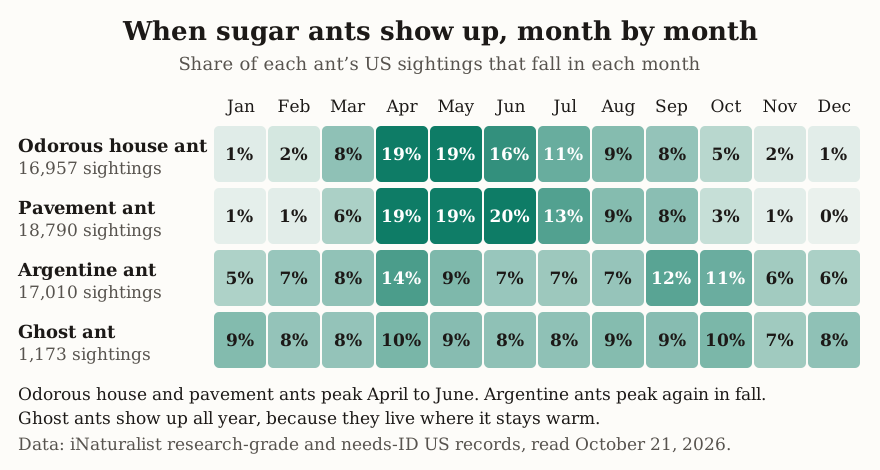
Argentine ants have a second peak in September and October, as colonies gather for winter. Ghost ants barely change through the year, because they live where it stays warm. These counts come from naturalists, mostly outdoors, so they show when the ants are out. They do not show how often each gets into houses.
A trail indoors in December or January is a different signal. It usually means a nest inside the house, in a wall void, near hot water pipes or in a potted plant, and baiting it works at any time of year.
Where do sugar ants come from?
Most sugar ants come from a nest outside. Odorous house ants nest under stones, logs, boards and mulch, and then follow the edges of siding, deck boards and door frames inside. Indoors they can nest in wall voids near hot water pipes and heaters, and sometimes in potted plants. Pharaoh ants are the exception, since they live indoors in warm voids.
The nests also connect. A Purdue study by Grzegorz Buczkowski found odorous house ants living about 50 to a colony with one queen in forests. In cities, however, their supercolonies held more than 6 million workers and 50,000 queens. So when you kill one nest, a neighbor’s nest can send the next trail.
How do you find where sugar ants are coming from?
Let the ants show you. Put a drop of honey or jelly on an index card where you saw them, wait half an hour, and follow the ants that leave full. They walk home along the same scent line.
Then check these spots, in this order:
- Under the sink, where pipes come through the wall or floor.
- Along baseboards and the edge of the countertop, where gaps hide.
- Window and door frames, and the edges of siding outside.
- Outlets and switch plates. In one Maryland case, ants poured out of the outlet that held the garbage disposal switch.
- Cracks in a slab or basement floor, with small piles of sand beside them (pavement ants).
- Potted plants, especially ones that spent the summer outdoors.
Do not spray or pour anything into an outlet. Put bait near it instead, and call an electrician if ants keep coming from inside the box.
What attracts sugar ants?
Sweets attract them first: sugar, syrup, honey, fruit, juice, soda and pastry. Most also take grease, meat and pet food, and all of them need water. A drip under the sink or a wet sponge can be enough. Outdoors, their main food is honeydew, the sugary waste of aphids and scale insects on nearby plants.
How to get rid of sugar ants
To get rid of sugar ants, name the ant, take away its food and water, then put a liquid sugar bait on the trail and leave it alone for two weeks or longer. Do not spray near the bait. Seal the gap once traffic stops, and bait again when scouts return after rain. Pharaoh ants take months, not weeks.
This is the plan for the sweet-loving house ants. The full reasons bait beats spray are in our main guide to ant control. Start with the steps that cost nothing.
How to get rid of sugar ants, step by step
Name the ant first
Crush one and sniff, check the size against a ruler, and look at the color in daylight. Tiny yellow ants are pharaoh ants and need bait only, never spray. Ants 1/4 inch (6 mm) or longer are carpenter ants, which need a different plan.
Watch the trail and find the way in
Do not wipe the trail yet. Watch where it goes for ten minutes, or put a drop of honey on a card and follow the ants that leave with it. Mark the crack, outlet or gap they use.
Take away the free food and water
Seal sugar, honey, cereal and pet food in closed containers. Rinse cans and bottles, lift pet bowls at night, empty the toaster tray and fix any drip under the sink. This costs nothing, and it makes the bait the best meal in the room.
Put liquid sugar bait right on the trail
Set a liquid sugar bait station on the trail, as close to the entry point as you can. Use several stations for a big trail. For pharaoh ants, or ants that ignore sugar, put a protein or grease bait beside it.
Leave the ants alone and keep the bait fresh
More ants at the bait in the first days means it is working. Do not spray, wipe or mop near it. Refill the station before it runs dry, and keep it out for two weeks or longer.
Clean the trail once the traffic stops
When no ants come to the bait for a few days, wipe the old trail with soapy water. That removes the scent line that would guide the next scouts in.
Seal the gap and fix the damp
Caulk the crack or gap they used, and seal around pipes and wires. Pull mulch back from the foundation, trim branches that touch the house, and fix leaks.
Bait again at the first scouts
Odorous house ants often return after heavy rain or a heat wave. Put bait out as soon as the first few scouts appear, while the trail is still small.
What is the best sugar ant killer?
For most sugar ants, the best killer is a slow-acting liquid sugar bait, not a spray. Odorous house ants take sweet liquid baits readily. Common active ingredients include boric acid and other borates, fipronil and abamectin. For a large Argentine ant infestation, UC IPM says liquid borate baits at 0.5 to 1% work better on the colony than the 5.4% borate in many prepackaged stations, which kill foragers before they get home.
Check two things on the label. First, it should list ants and the place you want to use it, indoors or out. Second, it should be made for your kind of ant. Mississippi State says baits designed for fire ants usually do not work well against Argentine ants or odorous house ants. Use only EPA-registered products, exactly as the label says. The label is the law.
Do sugar ant traps work?
A sugar ant trap is really a bait station, and it works when the ants carry the bait home. More ants at the station for the first few days is a good sign. However, small sealed stations can dry out or run empty in a big infestation, so UC IPM prefers refillable stations for tough cases. Sticky traps only catch the few ants that walk onto them.
On Reddit, people argue about sealed boxes versus liquid drops on a card. Both work if the bait stays wet and the ants keep feeding. Either way, the bait has to sit on the trail, not just near it.
Should you spray sugar ants?
Not while you are baiting. A spray kills the foragers you can see but not the queens. Wisconsin Extension warns that spraying insecticide near the bait can reduce its effectiveness. A barrier spray around the foundation does not kill the colony either, UC IPM says, and it can trap ants indoors. With pharaoh ants, a spray can split one nest into several.
Should I squish sugar ants?
Squishing a few does no harm, and squishing one is the quickest way to identify it by smell. It will not fix the problem, though, because the ants you see are a small share of the colony. When you are baiting, let the ants at the bait go. Every one that walks home full is doing your work for you.
How does Dawn dish soap get rid of sugar ants?
Soapy water wipes away the ants’ scent trail, UC IPM says, and soap products can kill ants on contact. Dish soap leaves nothing behind that reaches the nest, though, so the colony simply sends more. Use a soapy cloth to clean a trail you are not baiting, or to wipe up once the bait has done its job.
What smell do sugar ants hate?
Strong smells such as peppermint, orange, clove and vinegar disrupt a scent trail for a few hours. UC IPM says plant-oil products kill ants on contact but last only a short time. None of them reaches the nest. Our natural ant repellent guide rates the home remedies one by one.
Sugar ants in the kitchen or bathroom
In the kitchen, the trail usually leads to sugar, pet food or a drip under the sink. Fix those first, then bait beside the trail rather than on the counter you just cleaned. In a bathroom there is little food, so the ants are after water. Tiny pale ants there are often pharaoh ants, which need bait only, while a dark trail is more likely odorous house ants nesting near the hot pipes.
Sugar ants in your car
Ants in a car have usually found food inside or climbed up from a nest where you park. Vacuum the seats and floor, remove wrappers and drink cups, and park somewhere else for a few days. If a trail runs up a tire, bait the nest at the parking spot rather than putting bait in the car.
What does not work against sugar ants
Most failed fixes kill the ants you can see and leave the queens alone. Foragers are only a small share of the colony, UC IPM notes, so those fixes look good for a day and then fail. Here are 8 common beliefs, several taken from Reddit threads and Ask Extension questions, and what the evidence says about each one.
Myth 1
Myth: “Sugar ants are one kind of ant.”
Truth: The name covers six or seven different ants. Pharaoh ants and carpenter ants need a different plan from the rest, so name yours first.
Myth 2
Myth: “A bug bomb will clear them out.”
Truth: A fogger kills only the ants it lands on, which an Oregon extension expert put at several percent of the colony. It does not reach nests inside walls.
Myth 3
Myth: “Spray the trail and the baseboards.”
Truth: Sprays kill foragers and keep other ants away from the bait. On pharaoh ants, repellent sprays make the colony split into new nests.
Myth 4
Myth: “Baking soda and sugar kills them.”
Truth: There is no good evidence that baking soda kills ants. The ants eat the sugar and leave the soda.
Myth 5
Myth: “A line of cinnamon or chalk keeps them out.”
Truth: Strong smells and powders are a short detour at best. The colony finds another route within hours or days.
Myth 6
Myth: “Diatomaceous earth kills them on contact.”
Truth: It works slowly and only while it stays completely dry. If you use it, choose an EPA-registered product and puff a light layer into cracks, never broadcast it across floors or counters.
Myth 7
Myth: “Wipe the trail with bleach or rubbing alcohol.”
Truth: Soapy water removes the trail just as well. Rubbing alcohol is flammable and is not a pest control product, so leave it out.
Myth 8
Myth: “Sugar ants mean a dirty house.”
Truth: Odorous house ants come in after rain and heat waves even in spotless kitchens. Clean counters make bait work better, but they do not keep scouts out.
When to call someone about sugar ants
Most sugar ant trails end within a few weeks with bait and a few free fixes. Call a licensed pest professional when ants are still trailing after a month of correct baiting, when you have pharaoh ants in an apartment building, or when ants keep coming out of outlets. Renters should tell the landlord first.
Who to call about sugar ants
Licensed pest professional
- When
- Ants still trailing after a month of correct baiting, or several nests you cannot find
- Why
- They have baits and tools homeowners do not usually have
Landlord or building manager
- When
- You rent, or you have pharaoh ants in an apartment
- Why
- Pharaoh ants need the whole building treated
Licensed electrician
- When
- Ants coming out of outlets, switches or panels
- Why
- Spraying into live wiring is a shock and fire risk
Plumber or roofer
- When
- A leak or damp wall near the trail
- Why
- Water keeps drawing the ants back
Doctor, or 911
- When
- A bite or sting with trouble breathing, face or throat swelling, or spreading redness
- Why
- Sugar ant bites are minor, so a strong reaction needs checking
Vet or ASPCA, (888) 426-4435
- When
- A pet ate ant bait or insecticide
- Why
- The product, not the ant, is the risk
Expect some patience, even from a professional. An Oregon extension expert called odorous house ants the “Number One call-back problem” for pest companies across the country. Her advice was to keep up the bait and the cleaning, and to bait again every time they come back.
Want to see how these ants fit with the rest? Our guide to the types of ants covers every common US ant, from the smallest to the biggest.
Pest control disclaimer. Photo-based identification can help, but it is not always perfect. For dangerous spiders, large infestations, or anything you are unsure about, contact a licensed pest control professional.
Sugar ant FAQ
Do sugar ants have a queen?
What are baby sugar ants?
How long do sugar ants live?
Are sugar ants nocturnal?
Will sugar ants go away on their own?
How long does it take to get rid of sugar ants?
Can sugar ants hurt my dog or cat?
Related guides
How to get rid of ants
Why bait beats spray for every small house ant, and how to match the bait to the ant.
Types of ants
Every common US ant side by side, with the feature that tells each one apart.
Ant bites
Which ant bit you, what each bite looks like, and the warning signs that need a doctor.
Natural ant repellent
Vinegar, peppermint, borax and other home remedies, honestly rated.
Carpenter ants
The big black ants that also love sweets, and what their sawdust means.
Acrobat ants
Small ants that raise a heart-shaped abdomen and nest in damp window frames.
Fire ants
Tiny red ants that sting in numbers and build mounds in the South.
Flying ants
What a swarm of winged ants means, and how to rule out termites.
Sources
- UC IPM Pest Notes: Ants, Publication 7411, M. Rust and D. Choe
- UC IPM Ant Key, Odorous house ant: colony propagation
- Penn State Extension, Odorous House Ant, S. Jacobs
- Mississippi State University Extension, Control of Argentine Ants and Odorous House Ants in the Home, Publication 2407
- Utah State University Extension, Odorous House Ant
- University of Wisconsin-Madison Extension, Odorous House Ants
- Texas A&M AgriLife, Urban and Structural Entomology, Pharaoh Ant, Monomorium pharaonis
- UF/IFAS Extension, Ghost Ant, Tapinoma melanocephalum, EENY-310, J. Nickerson, C. Bloomcamp and R. Pereira
- UF/IFAS Extension, Pharaoh Ant, Monomorium pharaonis, EENY-290, J. Nickerson, D. Harris and T. Fasulo
- Pacific Northwest Pest Management Handbooks, Wood-infesting pests: Ant (moisture ants)
- Purdue University via ScienceDaily, Common house ants form supercolonies, prosper in urban settings (2010)
- Ask Extension, eradicating sugar ants, answered by J. Natter, Oregon (2016)
- Cleveland Clinic, Ant Bites
- MedlinePlus Medical Encyclopedia, Insect bites and stings
- US EPA, Introduction to Pesticide Labels
- iNaturalist, odorous house ant (Tapinoma sessile) observations in the United States (read October 21, 2026)