Flying ants vs termites: the four checks
A flying ant and a termite swarmer differ in four ways you can see with a phone camera. Ants have elbowed antennae, a pinched waist and two sizes of wing. Termites have straight antennae, a thick waist, and four matching wings longer than the body, with many fine veins. Check at least two of the four.
Both insects are alates, the winged males and females a mature colony sends out to mate and start new colonies. That is why they turn up in the same places, at windows and lights, often on the same warm afternoons. However, they are not related, and a swarm of each means something very different for your house.
Flying ant compared with a termite swarmer, feature by feature
1. Antennae
- Flying ant
- Elbowed: bent at a sharp angle
- Termite swarmer
- Straight, like a string of beads; may droop, never elbowed
2. Waist
- Flying ant
- Pinched and narrow between body sections
- Termite swarmer
- Thick; the body has straight sides and no waist
3. Wing sizes
- Flying ant
- Front pair clearly bigger than the hind pair
- Termite swarmer
- All four about the same size and shape
4. Wing length and veins
- Flying ant
- Shorter, with only a few veins
- Termite swarmer
- Longer than the body, with many fine veins
After landing
- Flying ant
- Queens chew their wings off and leave no stub; males die with wings on
- Termite swarmer
- Both sexes snap their wings off and keep small stubs
Color (does not separate them)
- Flying ant
- Black, brown, reddish or yellow
- Termite swarmer
- Dark brown to black in most US kinds; orange-amber in Formosan termites
Size with wings (does not separate them)
- Flying ant
- Varies; carpenter ant swarmers reach 3/4 in (19 mm)
- Termite swarmer
- About 3/8–1/2 in (10–13 mm); Formosan 1/2–5/8 in (12–15 mm)
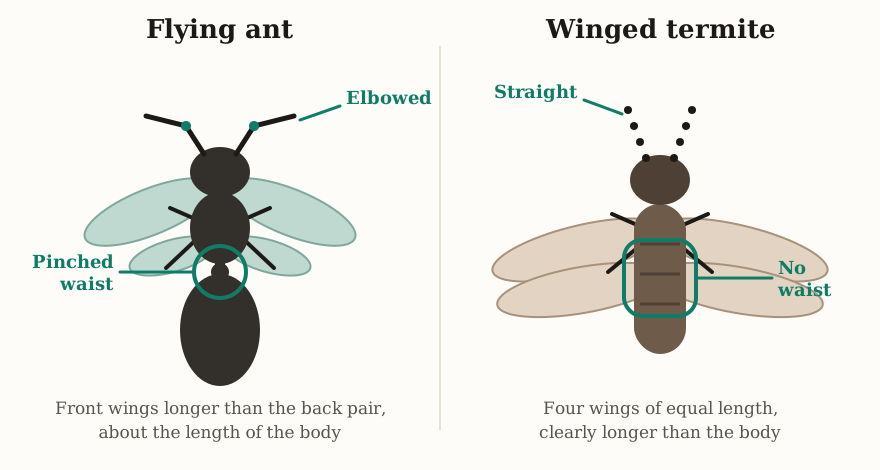
1. Antennae: elbowed or straight
An ant’s antenna has a long first segment, then a sharp bend, like an arm bent at the elbow. A termite’s antenna is a straight row of tiny beads. It can droop or curve a little on a dead swarmer, but it never has that sharp joint. This is the most reliable check when the wings are folded or gone.
2. Waist: pinched or thick
Ants are built in three clear sections, and the back two meet at a narrow, pinched waist. A termite has no waist at all. Its body runs straight from the middle section to the tip, like a thick grain of rice. You can often see an ant’s waist through its wings, even in a blurry photo.
3. Wings: two sizes or four the same
Both insects have four wings. On an ant, the front pair is clearly bigger than the hind pair. On a termite, all four are about the same size and shape, and they lie flat over the back like a closed pair of scissors. NC State Extension makes the same point about loose wings: termite wings are all the same length and size, unlike ant wings.
4. Wing length and veins
A termite’s wings reach well past the tip of its body. An ant’s wings are shorter for its size. Hold a wing up to the light, too. Termite wings carry many fine veins, while ant wings have only a few, Texas A&M AgriLife notes. That makes the veins useful when all you have is a loose wing.
Why color does not tell them apart
A common claim in flying ants vs termites guides is that termites are pale or cream while flying ants are dark. It was repeated in Google’s AI answer for this search in October 2026. But it describes termite workers, which never fly. The swarmers of the most common US termite are dark. UF/IFAS describes the eastern subterranean termite swarmer as dark brown, “almost black to the naked eye”. UC IPM gives dark brown to brownish-black, and K-State, one of the sources that AI answer cited, says the swarmers have dark bodies.
Ants cover the same range. Carpenter ant swarmers are black, field ant swarmers are often yellowish-brown, and citronella ant swarmers are light yellow to light brown. Meanwhile, Formosan termite swarmers are orange to light amber. So a dark insect can be either one, and so can a pale one. Use the antennae, the waist and the wings instead.
Size will not settle it either
Size overlaps just as much. An eastern subterranean termite swarmer is about 3/8 inch (10 mm) long with its wings, and Formosan swarmers reach 5/8 inch (15 mm). Carpenter ant swarmers can be 3/4 inch (19 mm), while many other ant swarmers are smaller than any termite. Also, one ant swarm has two sizes in it: big queens and much smaller males.
What a phone photo can and cannot show
A sharp photo from above usually shows the waist and the wing sizes. The antennae are harder, because they move and blur. So take one picture from above and one from the side, on white paper, next to a ruler. Then zoom in on the base of the antenna. If you see an elbow, it is an ant.
Photo apps get flying ants vs termites wrong often. One Reddit user in r/termites wrote that Google Lens kept saying ants while they feared termites. A termite company owner in the thread confirmed ants, because the waist showed through the wings. If a photo leaves you unsure, a jar of real specimens settles it.
Are flying ants termites?
No. Flying ants are ants, and termites are not ants at all. Ants belong to the same insect order as bees and wasps. Termites are social cockroaches, in the order Blattodea. The two look alike only because both live in colonies and both send out winged swarmers. Not one of the four checks above is shared.
They also grow up differently. Ants go through four stages: egg, larva, pupa and adult, like a bee. Young termites skip the grub and pupa. Instead, they hatch as small, pale versions of the adults and molt as they grow.
Do termites look like ants?
From across a room, a winged termite does look like a winged ant. Up close, they look quite different: the termite is straight-sided with beaded antennae, and the ant is built in three clear sections. Wingless termites look even less like ants, since the workers are soft, pale and almost see-through.
Baby termites vs ants
The “baby termites” people find in broken wood are usually workers: cream-colored, soft, wingless and about 1/8 inch (3 to 4 mm) long. They walk. Baby ants are white, legless grubs that cannot walk and are carried by the workers. So a small, pale insect that walks on six legs in damp wood is a termite, not a young ant.
Worker termites and worker ants differ in other ways too, from what they eat to the damage they leave. That comparison is about the insects without wings. This page sticks to the swarmers. Our termite identification guide covers the workers and soldiers.
Shed wings on the sill: termite or ant?
Loose wings on a sill are often the only flying ants vs termites clue left after a swarm. Termite wings are all the same size, longer than the body and full of fine veins. Ant wings come in two sizes, have few veins, and are often still attached to dead ants. Both insects shed their wings.
Termites drop their wings on purpose. Each wing snaps off near its base, so a termite that has landed keeps short stubs, called scales, on its back. Both the males and the females do it, because they start the new colony as a pair. As a result, a termite swarm leaves a pile of loose, matching wings and a few wingless swarmers.
Ants are different. A mated queen chews her wings off and leaves no stub, but the males die soon after mating with their wings still on, Texas A&M AgriLife explains. So an ant swarm tends to leave dead winged ants on the floor, plus a few loose wings of two sizes.
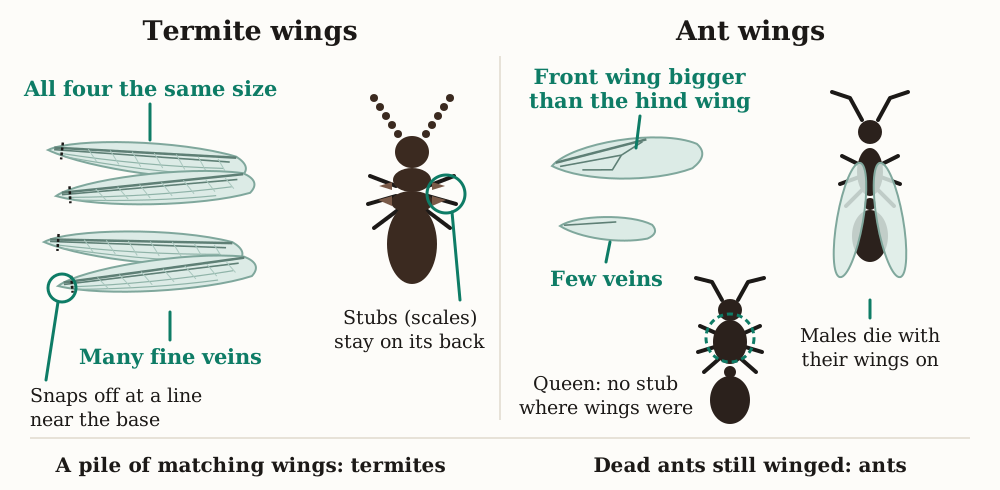
The shed wings test
Sweep a few wings onto white paper and look at them in daylight, with a magnifier if you have one.
Are the wings all the same size and shape?
Yes points to termites. Two clear sizes, big and small, point to ants.
Is each wing much longer than the insects lying nearby?
Termite wings reach well past the tip of the body.
Do you see many fine veins, or only a few?
Many fine veins: termite. A few dark veins that make one or two cells: ant.
Are there dead insects still wearing their wings?
Dead ants with wings attached are usually male ants. Termites rarely keep theirs.
Do the wingless bodies have small stubs on the back?
Stubs (scales) mean termites. A smooth back with no stubs means an ant queen.
Were the wings inside a closed room, in a pile, more than once?
Repeated piles indoors mean the swarm came from inside the house.
The test has limits. A few loose ant wings do turn up, since every ant queen sheds hers. And wings blow around, so one or two by an open window prove little. A pile of matching wings in a closed room is the finding that counts.
When do flying ants and termites swarm?
In the US, most subterranean termites swarm from March to May, and Formosan termites from April to June. Ant swarms run from April to October outdoors, starting with carpenter ants in spring and ending with field ants in the fall. Drywood termites fly in late summer and fall. So in almost every month, a swarm can be either one.
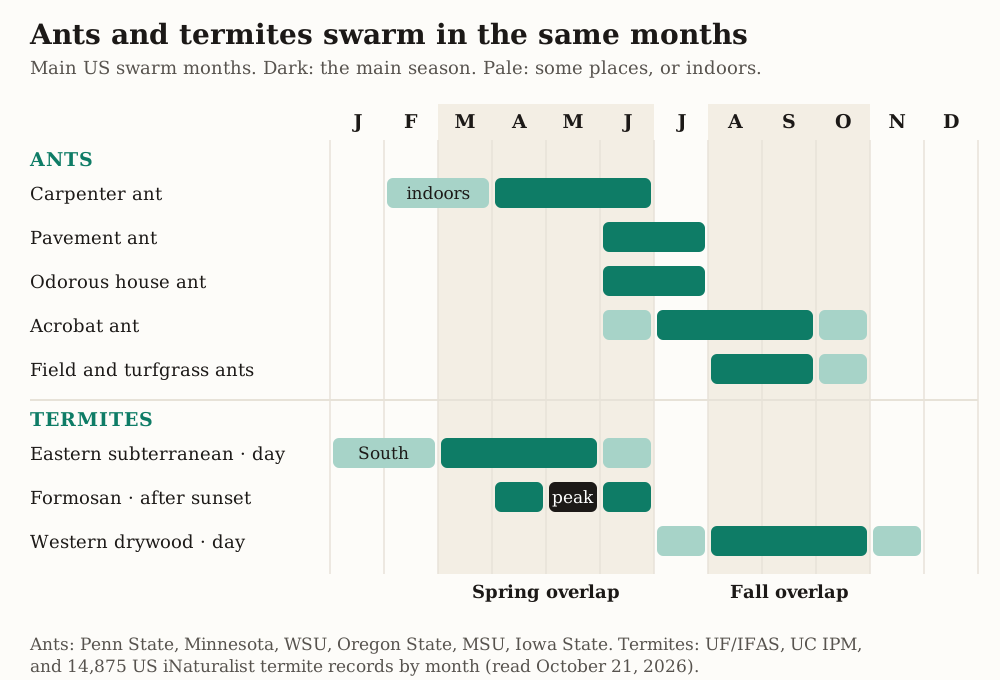
When the common US swarmers fly, and at what time of day
Eastern subterranean termite
- Main months
- March to May; January to April in Florida
- Time of day and place
- Warm, still afternoons after rain
- Clue
- The most common termite swarm in the US
Formosan termite
- Main months
- April to June, peak in May
- Time of day and place
- Just after sunset, toward lights; Southeast, Hawaii, southern California
- Clue
- A swarm at a porch light on a May evening
Western drywood termite
- Main months
- August to October
- Time of day and place
- Daytime, in the West
- Clue
- Six-sided pellets below tiny holes nearby
Carpenter ant
- Main months
- April to June; late winter indoors
- Time of day and place
- Often late afternoon, after rain
- Clue
- Large black ants, up to 3/4 in (19 mm)
Pavement ant
- Main months
- June and July
- Time of day and place
- Out of cracks in sidewalks and slabs
- Clue
- Small dark ants; any month in heated buildings
Odorous house ant
- Main months
- June or July
- Time of day and place
- Around homes and gardens
- Clue
- Workers smell like rotten coconut when crushed
Acrobat ant
- Main months
- Summer into fall
- Time of day and place
- At windows and skylights indoors
- Clue
- Heart-shaped abdomen on the workers
Field and turfgrass ants
- Main months
- Late August to fall
- Time of day and place
- Out of lawns and bare ground
- Clue
- Clouds of small ants over grass
Citronella ant
- Main months
- Mid to late summer
- Time of day and place
- Up through slab cracks and around doors
- Clue
- Yellow; smells of lemon when crushed
The termite months above are backed by records as well as fact sheets. Of 11,564 US iNaturalist records of the eastern subterranean termite, 59.5% fall in March, April and May. For Formosan termites, 59.7% of 1,309 records fall in May alone. For the western drywood termite, 77.1% of 2,002 records fall from August to October. Most of these photos show swarmers, the only termites people usually see.
Why the season does not settle it
Many flying ants vs termites pages imply that a spring swarm means termites. It does not. Carpenter ants fly in spring and early summer, right when subterranean termites do, and both often take off on a warm day after rain. Later, drywood termites share the fall with field, citronella and acrobat ants. K-State’s diagnostic lab gets both kinds of sample all through spring and summer.
The month is still useful once you know which insect you have. It narrows down the kind of ant or the kind of termite. Our guide to ant swarms month by month goes further on the ant side.
Time of day: the one timing clue that helps
Time of day helps in one case. Formosan termites fly just after sunset and crowd around lights, while the native subterranean kind flies in the early afternoon. So a swarm at a porch light on a warm May evening in the Gulf states points to Formosan termites, a major structural pest. Even then, check one insect before you call.
Does a flying ant swarm mean you have termites?
No. A flying ant swarm means an ant colony, not termites. Termite swarmers coming out indoors mean a colony at least five years old in or under the house. Many winged carpenter ants indoors mean a nest in the building. Most other ant swarms are harmless and end the same day.
Where and when you saw them, what it means, and what to do
Termite swarmers coming out of a wall, baseboard, floor or window frame
- What it usually means
- A colony feeding in or under the house
- What to do
- Book a termite inspection this week. Do not spray
Piles of matching loose wings on sills, more than once
- What it usually means
- Termites swarmed inside the house
- What to do
- Same: an inspection, with the wings kept as evidence
One or two termite swarmers near an open door, window or light
- What it usually means
- They may have flown in from outside
- What to do
- Keep one in a jar. Watch for more, and check for mud tubes
A termite swarm in the yard, a stump or a woodpile
- What it usually means
- A colony nearby, not proof of one in the house
- What to do
- Walk the foundation for mud tubes. Consider an inspection
Termites at a porch light after dark, April to June, in the Southeast
- What it usually means
- Probably Formosan termites
- What to do
- An inspection soon, and sooner if any came out indoors
Many large black winged ants inside, late winter or early spring
- What it usually means
- A carpenter ant nest in the building
- What to do
- Find the damp wood and the nest
One or a few winged ant queens indoors
- What it usually means
- Mated queens that wandered in
- What to do
- Vacuum them. No other action
Yellow winged ants coming up through slab cracks in summer
- What it usually means
- Citronella ants, a nuisance only
- What to do
- Vacuum. If it repeats, look for the colony outside
Small winged ants pouring out of a lawn or pavement
- What it usually means
- Pavement, field or turfgrass ants
- What to do
- Nothing. It is over the same day
Termite swarmers indoors: why it means an inspection
Swarmers themselves do no damage. The workers in the colony do. But a colony only sends out swarmers once it is mature, which takes five to ten years for the eastern subterranean termite, UF/IFAS says. So swarmers coming out inside mean an established colony is already feeding in or under the house, as NC State Extension puts it.
That is a reason to act, not to panic. Termites eat wood slowly, so you have time to get two or three inspections and compare written quotes. Our guide to termite types and treatment explains what each kind needs and what a fair contract looks like.
Carpenter ant swarmers indoors
Large black winged ants inside in late winter or early spring mean the ants are coming from a nest in the building, the University of Minnesota says. Finding just one or a few winged queens does not, because those are usually mated queens that wandered in. A carpenter ant nest indoors almost always sits in wood that has been wet: a leaking window, roof, or pipe.
How much harm they do is where sources differ. Penn State Extension says expansion into a building’s timbers rarely causes structural damage. UC IPM says a nest can spread into sound wood and weaken it. Either way, the leak comes first. See our carpenter ant guide for how to find the nest.
Are flying ants bad for your house?
Most are not. Pavement, field, turfgrass and citronella ant swarmers do no damage, and the swarm ends the same day. Carpenter ants are the exception worth checking, because they nest in damp wood. Acrobat ants at a window in summer can also point to damp wood nearby; our acrobat ant guide shows what their debris looks like.
What to do when winged ants or termites swarm
When winged insects come out indoors, do not spray them. First, catch three or four in a jar and photograph one next to a ruler. Then note exactly where they came out and vacuum the rest. Finally, check for piles of wings and mud tubes, and call a termite inspector only if the four checks say termite.
What to do when they swarm inside, step by step
Do not spray them
A can of bug spray kills the insects you can see and nothing else. It also ruins the specimens you need for an ID, and with termites it can make an inspector's job harder.
Catch a few
Put three or four in a jar, a pill bottle or a zip bag, or press them onto clear tape on an index card. Dead ones are fine. Keep a few loose wings too.
Take sharp photos
Photograph one from above and one from the side on white paper, next to a ruler, in daylight. Try to show the antennae, the waist and the wings spread out.
Note where and when they came out
Write down the room, the spot (a baseboard, a window frame, a light, a crack in the slab) and the time of day. Where they came out matters more than where they ended up.
Vacuum the rest
Once you have your samples, vacuum the others and empty the vacuum outside. The swarm itself is over within hours.
Look for other signs
Check sills for piles of matching wings. Walk the outside of the foundation for mud tubes about the width of a pencil. Look for coarse, sawdust-like debris near damp wood, which points to carpenter ants.
Make the right call
Termites inside: book an inspection with a licensed termite company, and get two or three written quotes. Carpenter ants inside: find the damp wood. Renting: tell your landlord in writing, with your photos, and do not treat it yourself.
If the swarm is outdoors
An outdoor ant swarm needs nothing done. The males die within days, and the queens scatter. An outdoor termite swarm is not an emergency either, since the colony may be in a stump or a neighbor’s yard. However, it does mean termites are close, so walk the foundation for mud tubes and keep wood and mulch off the siding.
How to get rid of flying ants or termites
Whatever the flying ants vs termites answer, you do not need to kill the swarmers. Instead, deal with the colony. For ants, that means fixing damp wood and baiting the workers. For termites, it means a professional soil treatment or bait system for subterranean kinds, or a whole-wood treatment such as fumigation for drywood termites.
Start with what costs nothing: identify the insect, find where it came out, and fix leaks and wood that touches the soil. Pesticides come last. If exclusion and sanitation work, you may not need any. When you do use one, choose an EPA-registered product labeled for that pest and that place, and follow the label exactly. The label is the law.
How each one is handled
An ant swarm outdoors
- Free first steps
- Nothing; close the windows and wait
- If that is not enough
- Not needed
- Who to call
- No one
Small house ants indoors after a swarm
- Free first steps
- Clean up food and water; find the trail
- If that is not enough
- Ant bait on the trail, with no spray nearby
- Who to call
- A pest professional if it keeps coming back
Carpenter ants indoors
- Free first steps
- Find and fix the leak; replace wet wood
- If that is not enough
- Bait the trails; treat a nest you can reach
- Who to call
- A pest professional for nests inside walls
Subterranean or Formosan termites
- Free first steps
- Keep the evidence; fix leaks; pull mulch and wood off the foundation
- If that is not enough
- Liquid soil treatment or a bait system
- Who to call
- A licensed termite company; two or three quotes
Drywood termites
- Free first steps
- Keep the pellets and wings as evidence
- If that is not enough
- Fumigation, heat or treating the infested wood
- Who to call
- A licensed termite or fumigation company
For the ant side, our guides to bait that clears a colony and clearing a carpenter ant nest go step by step. For termites, EPA is blunt: products that only claim to kill termites have not shown they can protect a building. So a spray, a dust or a store-bought foam on the swarmers will not fix a termite problem.
Bugs that look like flying termites
Almost every bug mistaken for a flying termite is a winged ant. The usual ones are carpenter ant swarmers, yellow citronella ants coming up through a basement slab, and small pavement or field ant swarmers. A wingless ant queen also gets mistaken for a termite that has dropped its wings. The four checks settle each one.
Insects most often mistaken for flying termites
Elbowed antennae, pinched waist, black, up to 3/4 in (19 mm)
- What it is
- Carpenter ant swarmer
- Where and when
- Spring; indoors in late winter if nesting inside
- Risk to the house
- A nest in damp wood
Elbowed antennae, pinched waist, yellow, lemon smell
- What it is
- Citronella ant swarmer
- Where and when
- Mid to late summer, up through slab cracks
- Risk to the house
- None; it does not attack structures
Elbowed antennae, pinched waist, small and dark
- What it is
- Pavement or field ant swarmer
- Where and when
- Summer to fall, from lawns and pavement
- Risk to the house
- None
No wings, no stubs, big middle section, pinched waist
- What it is
- Ant queen that dropped her wings
- Where and when
- Any season, alone
- Risk to the house
- None by itself
No wings, small stubs on the back, thick waist, straight antennae
- What it is
- Termite that dropped its wings
- Where and when
- After a swarm, often in pairs
- Risk to the house
- A colony nearby
Elbowed antennae, pinched waist, reddish, mounds with no hole on top
- What it is
- Fire ant swarmer
- Where and when
- After warm rain in the South
- Risk to the house
- None to wood, but they sting
Penn State Extension notes that citronella ants are often confused with termites when they swarm into living areas. They come up through cracks in the slab, which makes the mistake easy. Fire ants are the one look-alike that stings, so keep your distance from swarms near mounds; our fire ant guide shows how to confirm them.
Common mistakes, corrected
Most mistakes about flying ants vs termites come from a single shortcut: color, the month, or the loose wings alone. Each one fails in a way that costs money or worry. Here are seven, several of them from the pages that rank for this search, and what the extension sources say instead.
Myth 1
Myth: “Termites are pale or cream, and flying ants are dark.”
Truth: That describes termite workers, which never fly. Eastern subterranean swarmers are dark brown to almost black (UF/IFAS, UC IPM, K-State).
Myth 2
Myth: “A swarm in spring means termites.”
Truth: Carpenter ants swarm in the same spring weeks. Only the antennae, the waist and the wings tell them apart.
Myth 3
Myth: “Shed wings on the sill always mean termites.”
Truth: Ant queens shed their wings too. Matching wings of one size point to termites; two sizes point to ants.
Myth 4
Myth: “Flying ants never harm a house.”
Truth: Most do not, but carpenter ants nest in damp wood, and UC IPM says a nest can spread into sound wood.
Myth 5
Myth: “Killing the swarmers stops the termites.”
Truth: NC State Extension says it does not. Swarmers are a sign of a colony, and the workers keep feeding.
Myth 6
Myth: “Spraying or dusting where the swarmers land protects the house.”
Truth: It kills what it touches. EPA says kill-only products have not shown they protect a building from termites.
Myth 7
Myth: “Termites are a kind of ant, the “white ant”.”
Truth: Termites are social cockroaches. The nickname comes from the pale workers, not from any link to ants.
Still not sure what you caught? Upload a photo to our free bug identifier for an answer in seconds, then check the antennae yourself.
Pest control disclaimer. Photo-based identification can help, but it is not always perfect. For dangerous spiders, large infestations, or anything you are unsure about, contact a licensed pest control professional.
Flying ants vs termites FAQ
Why do flying ants suddenly appear?
Do termite swarmers bite or sting?
How long do termite swarmers live indoors?
Can flying ants and termites swarm on the same day?
Will a termite swarm come back next year?
Do ants eat termites?
Are white ants termites?
Related guides
Flying ants
Which ant swarms in which month, and why an indoor swarm is the one that matters.
Termites
The four US termites, the signs of each, and how treatment, quotes and warranties work.
Carpenter ants
Big black ants that nest in damp wood: what a sighting means by season, and how to find the nest.
How to get rid of carpenter ants
Fix the moisture, find the nest and bait the trails, step by step.
How to get rid of ants
Why bait beats spray for every small house ant, and how to match the bait to the ant.
Acrobat ants
Small winged ants at a window in summer or fall may be acrobat ants nesting in damp wood.
Fire ants
The one flying ant that stings. How to confirm them and keep clear of the mounds.
Sources
- UF/IFAS Extension, EDIS IN369, Native subterranean termites, Reticulitermes spp.
- UF/IFAS Extension, EDIS IN278, Formosan subterranean termite, Coptotermes formosanus
- UC IPM Pest Notes 7415, Subterranean and other termites
- UC IPM Pest Notes 7440, Drywood termites
- UC IPM Pest Notes 7411, Ants
- UC IPM Pest Notes 7416, Carpenter ants
- K-State Entomology, Insect Diagnostician, Winged ants vs termites (H. Davis, updated 2025)
- NC State Extension, Termite swarmers: what do they mean for you?
- Texas A&M AgriLife Extension, Travis County, Ants and termite swarmers ID (W. Brown, 2022)
- Penn State Extension, Carpenter ants
- Penn State Extension, Citronella ants (S. Jacobs)
- University of Minnesota Extension, Carpenter ants
- Oregon State University Extension, PNW 761, Integrated pest management for ants in schools
- EPA, Termites: How to identify and control them
- iNaturalist, eastern subterranean termite observations in the United States, by month (read October 21, 2026)