What blood type do mosquitoes like? The short answer
What blood type do mosquitoes like? No type has been proven to draw them. The type O idea rests mainly on a 2004 study of one species, the Asian tiger mosquito. It landed more often on type O people than on type A people. The other gaps could have been chance. Other studies found type AB or B preferred, or no preference at all.
Still, some people really do get far more bites than others. We know much more about why. It comes down to the carbon dioxide you breathe out, your body heat, and the mix of acids on your skin. That mix depends partly on your genes and partly on the bacteria that live on you.
Only female mosquitoes bite. They need protein from blood to make eggs, and both sexes drink plant nectar for energy. A female finds you by smell, sight and heat, and she never touches your blood until she has already bitten. Our guide to mosquitoes covers the life cycle and the common US species.
Type O is also the most common blood type in the US. The American Red Cross puts it at about 45% of white Americans, 51% of Black Americans and 57% of Hispanic Americans. So if type O were a strong lure, about half the people at any cookout would be mosquito magnets.
Does O positive attract mosquitoes more?
No study we found has tested it. The blood type studies looked only at A, B, AB and O. None checked the Rh factor, the part that makes a type positive or negative. Our Blood Institute’s article says mosquitoes land on “O positive or O negative” people far more often, citing the 2004 study. That study never checked Rh at all.
Which blood type do mosquitoes hate?
None. Even in the studies that found a favorite, mosquitoes still landed on and fed from every type. In a 2014 study of the Asian malaria mosquito, type O came last, which is the opposite of the popular claim.
What the blood type studies actually found
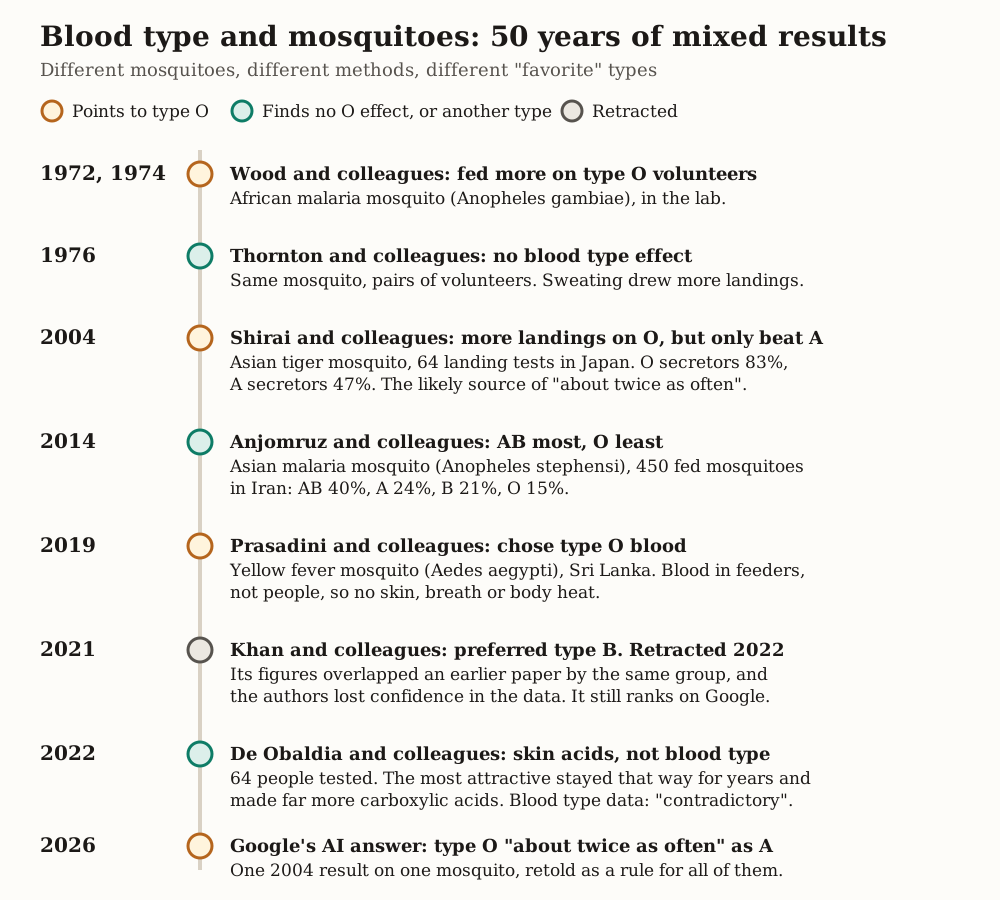
So what blood type do mosquitoes like, according to the research? We found seven studies since 1972, and they disagree. Three point to type O, one to AB, two to B, and one found no effect. They used four mosquito species and very different methods, from live arms to blood in a dish. So you cannot just add them up.
Every blood type study, side by side
Type O
- Study
- Wood and others, 1972 and 1974
- Mosquito and method
- African malaria mosquito; feeding on volunteers in the lab
- What it found
- Fed more often on type O people
- How strong
- Weak: a 1976 retest of the same mosquito found no effect
No type
- Study
- Thornton and others, 1976
- Mosquito and method
- African malaria mosquito; landings and feeds on pairs of volunteers’ forearms
- What it found
- No blood type effect. A sweating volunteer drew far more landings
- How strong
- Moderate: a direct retest
Type O over A only
- Study
- Shirai and others, 2004
- Mosquito and method
- Asian tiger mosquito; 64 landing tests on people
- What it found
- O beat A; O against B and AB was not significant. O secretors 83.3%, A secretors 46.5%
- How strong
- Weak to moderate: one species, one lab, landing only
Type AB
- Study
- Anjomruz and others, 2014
- Mosquito and method
- Asian malaria mosquito; feeders and volunteers’ arms, 450 fed mosquitoes typed
- What it found
- AB 40%, A 24%, B 21%, O 15%
- How strong
- Moderate: ranks type O last
Type O
- Study
- Prasadini and others, 2019
- Mosquito and method
- Yellow fever mosquito; four blood types in membrane feeders
- What it found
- Chose type O blood; egg counts did not differ. This is the 2019 study Pfizer cites
- How strong
- Weak: blood in a feeder has no breath, skin or heat
Type B
- Study
- Khan and others, 2021
- Mosquito and method
- Asian malaria mosquito; feeders and a wind tunnel
- What it found
- Strong preference for type B
- How strong
- None: retracted in June 2022
Type B
- Study
- Khan and others, 2022
- Mosquito and method
- Yellow fever mosquito; feeders and a wind tunnel
- What it found
- Strong preference for type B
- How strong
- Weak: its figures reappear in the retracted paper
Skin, not blood
- Study
- De Obaldia and others, 2022
- Mosquito and method
- Yellow fever mosquito; skin odor of 64 people
- What it found
- Skin acids separated the most and least attractive people
- How strong
- Strong, but it did not test blood type
Where the type O idea started
The claim dates to 1972. That year, Wood and colleagues reported in Nature that the African malaria mosquito fed more on volunteers with type O blood. Wood followed up in 1974. In 1976, Thornton and colleagues retested the same mosquito on pairs of volunteers, using landings and blood meals on the forearm. They found no effect of blood group at all.
What did matter in the 1976 test was sweat. When the team made a volunteer sweat with heat, mosquitoes landed and fed on that person far more often. The blood-group substances some people release in sweat made no difference.
The 2004 study behind “twice as often”
Most of today’s type O claims trace to Shirai and colleagues, in the Journal of Medical Entomology in 2004. They counted landings of the Asian tiger mosquito (Aedes albopictus) on people in 64 tests. Type O drew the most landings, but the gap was significant only against type A. Against types B and AB, the difference could have been chance.
The famous ratio comes from a smaller slice. Some people release blood-group markers into saliva and sweat, and scientists call them secretors. Mosquitoes landed on type O secretors 83.3% of the time on average, against 46.5% for type A secretors. That is about 1.8 times as often, for one species, in one lab.
The team also smeared the blood-group markers straight onto volunteers’ forearms. The type O marker drew more landings than the type A one. Even so, the authors concluded that the markers did not, in general, decide which blood group the mosquitoes chose.
Studies that picked AB or B instead
In 2014, a team in Iran fed the Asian malaria mosquito (Anopheles stephensi) on all four blood groups. They used both feeders and volunteers’ arms, then typed the blood in 450 fed mosquitoes. AB came first at 40%, then A at 24% and B at 21%. Type O came last, at 15%.
In 2019, a team in Sri Lanka offered the yellow fever mosquito (Aedes aegypti) all four types at once in feeders. Type O blood came out on top. A feeder holds blood behind a thin film, with no breath, skin or body heat. So it tests the blood itself, not the person a mosquito would have to find first. Egg counts were about the same whichever type the mosquitoes drank.
This is the 2019 study Pfizer’s article means when it says the dengue mosquito “preferred people with type O blood”. It is not the retracted paper, and it has not been retracted. But no people took part. The mosquitoes chose between four feeders of human blood, so the study cannot tell you whom they would pick in a backyard.
Then a group based in Pakistan reported the opposite for the same mosquito. In feeders and in a wind tunnel, it found a strong pull toward type B. That paper appeared in Pest Management Science in 2022, and its figures matter for the next part of the story.
The retracted study that still ranks on Google
The PMC article ranked fourth on Google for this question carries a large RETRACTED banner. It is a paper by Khan and colleagues on the Asian malaria mosquito, from Scientific Reports in December 2021. It never supported type O. Instead, it reported a strong preference for type B.
The journal’s retraction note, dated June 17, 2022, gives the reason. Five of its figures overlap figures in the same group’s paper on the yellow fever mosquito, a different species. A review found errors the authors could not resolve. In the end, they said they had lost confidence in the data.
What Google’s AI answer gets wrong
Ask Google what blood type do mosquitoes like, and its AI Overview says mosquitoes show “a strong preference for type O blood over other blood types”. That is not what the studies show. The 2004 landing study found type O ahead of type A only, in one species. The 1976 retest found no effect, and the 2014 study ranked type O last. Nothing in that record is a strong preference.
The AI answer goes on to say that mosquitoes disfavor type A. Yet in the 2014 study, type A came second and type O came last. Another version of the same answer said type O gets bitten “about twice as often” as type A. That fits only the 2004 secretor comparison: one species, landings rather than bites, and type O against type A alone.
Health sites repeat the short version too. Harvard Health says type O blood “appears to attract the pests”, and Healthline concludes that mosquitoes may prefer type O. By contrast, the 2022 “mosquito magnet” study in Cell calls the blood type evidence contradictory. A Cleveland Clinic doctor says the question is still open, and we agree. Blood type may nudge some species a little, but no one has shown it reliably.
How mosquitoes find you, from 35 meters away to your skin
Mosquitoes find people in stages. Carbon dioxide from your breath draws a female from up to about 35 meters (115 feet), the American Mosquito Control Association says. At 5 to 15 meters (16 to 50 feet) she can see you. Within about 70 cm (2 feet) she senses your body heat, and then skin odor decides where she lands.
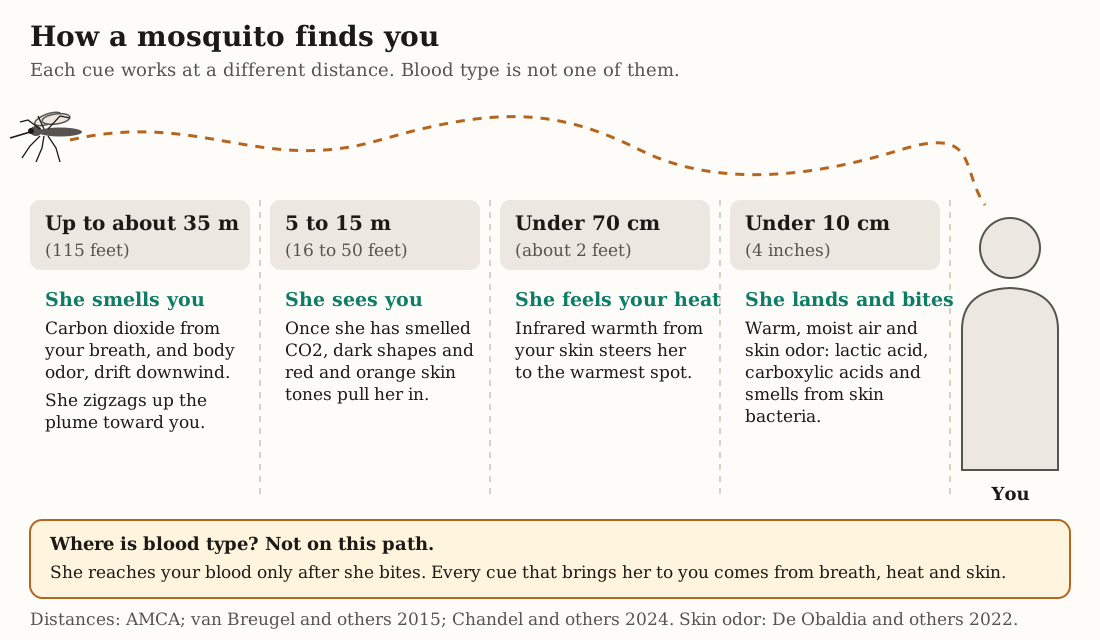
The far distance is the least certain. A 2015 Caltech study points out that no one has measured exactly how far a mosquito can smell one person’s breath. In 1970 field tests in the Gambia, malaria mosquitoes reacted to a single person or calf from about 15 to 20 yards (14 to 18 meters). Published figures vary for that reason: Google’s AI answer gives 50 to 100 feet, and a 2026 BBC report uses about 10 meters (33 feet).
Once she smells carbon dioxide, her eyes take over. In that Caltech wind tunnel, yellow fever mosquitoes ignored dark objects in clean air. After a puff of CO2, they flew over to explore them. That is one reason a person in dark clothes is easy to find at dusk.
Heat works at short range. In a 2024 study in Nature, yellow fever mosquitoes sensed the infrared warmth of skin from up to 70 cm (about 2.3 feet). Warm air rising off your body only reaches them within about 10 cm (4 inches).
Last comes skin odor. Scientists found lactic acid on human skin to be a mosquito lure in 1968. Mosquitoes bred without the receptor for it are less drawn to people. No cue works well alone, though. In lab tests, heat and lactic acid pull hard only when carbon dioxide is present too.
Some skin lotions contain lactic acid too. Cleveland Clinic suggests skipping them before you head outside. That makes sense, although we found no study that tested a lotion on mosquitoes directly.
Why do mosquitoes bite some people more than others?
Mostly because of skin odor. So a better question than what blood type do mosquitoes like is what your skin smells like to them. In a 2022 Rockefeller University study, the most attractive of 64 volunteers drew mosquitoes over 100 times more than the least attractive. These “mosquito magnets” made far more carboxylic acids on their skin, and they stayed attractive for years. Your genes and skin bacteria shape that odor.
What draws mosquitoes, ranked by the evidence
Carbon dioxide in your breath
- What the research found
- The long-range cue; draws females from up to about 35 m (115 ft), AMCA says
- How strong
- Strong
Skin odor acids
- What the research found
- Carboxylic acids separated the most and least attractive of 64 people (De Obaldia 2022)
- How strong
- Strong
Body heat
- What the research found
- Infrared warmth sensed from up to 70 cm, about 2 ft (Chandel 2024)
- How strong
- Strong
Your genes
- What the research found
- Identical twins smelled alike to mosquitoes; heritability 0.62 (Fernández-Grandon 2015)
- How strong
- Moderate
Skin bacteria
- What the research found
- More bacteria but fewer kinds on the most attractive of 48 men (Verhulst 2011)
- How strong
- Moderate
Sweat and lactic acid
- What the research found
- A sweating volunteer drew far more landings (Thornton 1976)
- How strong
- Moderate
Pregnancy
- What the research found
- Twice as many malaria mosquitoes on pregnant women (Lindsay 2000)
- How strong
- Moderate
A beer
- What the research found
- More landings after one beer (Shirai 2002; Lefèvre 2010)
- How strong
- Moderate
Body size
- What the research found
- Share of bites matched share of body surface or weight (Port 1980)
- How strong
- Moderate
Dark, red and orange colors
- What the research found
- Drew mosquitoes after they smelled CO2 (Alonso San Alberto 2022)
- How strong
- Moderate, lab only
Blood type
- What the research found
- Seven studies, three different favorites, one retracted
- How strong
- Weak and contradictory
Porch lights
- What the research found
- Most species ignore black lights (University of Delaware)
- How strong
- Weak
The “mosquito magnet” study
Leslie Vosshall’s lab at Rockefeller had volunteers wear nylon sleeves on their forearms for 6 hours. Then yellow fever mosquitoes chose between pairs of sleeves. One volunteer, known as Subject 33, beat everyone in almost every trial. That person scored 4 times higher than the next volunteer and over 100 times higher than the two least attractive.
The ranking held. The team retested four volunteers over three years, and the order stayed the same. Lab tests then showed that the attractive group carried far more carboxylic acids. These acids are part of the natural oils on skin.
There was no easy way around it either. Mosquitoes bred without key smell receptors still told high and low scorers apart. In other words, they read human odor in several ways at once, so no single chemical explains it.
Your skin bacteria
The bacteria on your skin turn sweat and oil into many of the smells mosquitoes follow. A 2011 Dutch study tested 48 men. Those most attractive to malaria mosquitoes had more bacteria on their skin, but fewer kinds. Staphylococcus bacteria were 2.6 times more common on the attractive men. Pseudomonas were 3.1 times more common on the least attractive.
Your genes
A 2015 British study tested 18 pairs of identical twins and 19 pairs of non-identical twins. Odor from identical twins’ hands drew mosquitoes in much more similar numbers. The authors put the heritability of attraction at 0.62, a level they compare to traits like height and IQ.
Pfizer’s article says DNA may explain “nearly 67%” of mosquito attraction. In the paper, though, 0.67 was the figure for how many mosquitoes took flight. It also came with a wide margin of error. The figure for attraction itself was 0.62.
Why do mosquitoes bite me and not my husband?
Two things are probably going on. First, your skin odor may simply attract more mosquitoes than his, for the reasons above. Second, your bodies may react differently. CDC notes that people react differently to bites. So a partner with a mild reaction may get bites and never notice.
Bite size runs in families as well. A 2017 genetic study of more than 84,000 people linked large, itchy bite reactions to immune system genes. It also found that people with bigger reactions tended to rate themselves as more attractive to mosquitoes. In part, then, “they always bite me” can mean “my bites always show”.
The same goes if mosquitoes never seem to bite you. You may be in the low-odor group, or you may just not react much. Our guide to mosquito bites and how long they last explains why reactions differ. If your bites swell into large, hot patches, read about skeeter syndrome.
Sweat, beer, pregnancy, size and color: what else matters
Several everyday things make you a bigger target, mostly by raising your breath, heat or odor. Studies found more landings after one beer and about twice as many mosquitoes on pregnant women. Bigger bodies get more bites, and dark and red-orange colors pull mosquitoes in. None is as strong as your own skin odor.
Does sweat attract mosquitoes?
Yes. In the 1976 study, mosquitoes landed and fed much more on a volunteer made to sweat with heat. Sweat carries lactic acid and other compounds mosquitoes track, and exercise adds heat and heavy breathing. Rinsing off after a workout makes sense, though no study has tested it directly.
Does drinking beer attract mosquitoes?
It seems to. In a 2002 Japanese study, 13 volunteers drank 350 ml (about 12 ounces) of beer, and mosquito landings on them rose. Neither the alcohol in their sweat nor their skin temperature explained it. Then in 2010, in Burkina Faso, 25 volunteers drank a liter of local beer. Fifteen minutes later they drew more malaria mosquitoes, while water made no change.
Are pregnant women more attractive to mosquitoes?
Yes. In a 2000 study in the Gambia, pregnant women drew about twice as many malaria mosquitoes as other women: 6.3 against 3.1 a night. A 2004 study in Sudan found much the same. Women late in pregnancy breathe out about 21% more air and run warmer, Texas A&M AgriLife notes.
The good news is that repellent still works. CDC says EPA-registered repellents, used as directed, are safe and effective for pregnant and breastfeeding women.
Do mosquitoes prefer fat or skinny people?
They prefer bigger people, not fat ones as such. In Gambian villages, researchers traced 2,339 blood meals to the people sleeping under each net. Each person’s share of bites matched their share of the group’s body surface or weight. In a related study, women got over 7 times as many bites a night as the children near them.
A bigger body breathes out more carbon dioxide and gives off more heat. We found no study showing that body fat itself draws mosquitoes.
What colors attract mosquitoes?
Dark colors, red and orange. In a 2022 University of Washington study, yellow fever mosquitoes first smelled carbon dioxide. Then they flew toward red, orange, black and cyan. Green, blue and violet drew no more interest than a plain white object. All human skin tones reflect red and orange light, so skin itself is a visual target.
No color repels mosquitoes. Some sites say green, blue or white clothes deter them, but in that study those colors simply drew no more interest than the control. So think of light clothing as a small help, not protection. It works best with long sleeves and repellent.
Are mosquitoes attracted to light?
Not the way moths are. Most mosquito species do not respond to the black lights in bug zappers, a University of Delaware entomologist explains. In 1994 tests at six suburban sites, only 31 of nearly 14,000 insects killed by zappers were biting flies. Mosquitoes find you by breath, heat and odor, so a porch light changes little.
Light does affect some species. In 2020 lab tests at UC Irvine, day-biting yellow fever mosquitoes, especially females, moved toward light during the day. A night-biting malaria mosquito avoided UV and blue light in the daytime instead. Both responses changed with the time of day.
That is why Google’s AI answer, which says most mosquitoes tend to avoid bright light, is only half right. Night biters such as malaria mosquitoes shy away from it. Day biters such as the yellow fever mosquito can move toward it, so the answer depends on the species and the hour.
Does keeping a light on keep mosquitoes away? No. For most species, light neither pulls them in nor keeps them out. A mosquito that has smelled your breath will find you in a bright room or on a dark porch. To lower the numbers around your home, see our guide to getting rid of mosquitoes in the yard and house.
Sweet blood, vitamin B1, garlic and bananas: myths checked
Nothing you eat or take makes you mosquito-proof. Careful tests found no effect from vitamin B pills or eating garlic, and the CDC Yellow Book calls both ineffective. “Sweet blood” is not something a mosquito can detect. Bananas and soap are open questions, with single small studies.
Myth 1
Myth: “Mosquitoes strongly prefer type O, about twice as often.”
Truth: The ratio comes from one 2004 landing study on the Asian tiger mosquito, and only for type O against type A. Other studies found AB or B preferred, or no effect (Thornton 1976; Anjomruz 2014).
Myth 2
Myth: “Mosquitoes can smell your blood type.”
Truth: No test has shown it. Blood-group markers smeared on skin did not, in general, change where mosquitoes landed (Shirai 2004). The markers in sweat made no difference either (Thornton 1976).
Myth 3
Myth: “Some people have sweet blood.”
Truth: A mosquito does not taste your blood before she bites. She chooses by breath, heat and skin odor. The odor differences come from skin acids and bacteria (De Obaldia 2022; Verhulst 2011).
Myth 4
Myth: “Taking vitamin B1 keeps mosquitoes away.”
Truth: A University of Wisconsin trial found no effect from vitamin B pills (Ives 2005). A vitamin B1 patch did nothing in a 2015 New Mexico State test. CDC lists vitamin B as ineffective.
Myth 5
Myth: “Eating garlic repels mosquitoes.”
Truth: In a double-blind University of Connecticut trial, eating garlic did not cut bites (Rajan 2005). CDC lists garlic as ineffective.
Myth 6
Myth: “Eating bananas attracts mosquitoes.”
Truth: Unsettled. A 2018 University of Wisconsin test found more mosquito contacts 1 to 3 hours after people ate bananas, though not for everyone. The AMCA says bananas did not attract mosquitoes.
Myth 7
Myth: “Your soap makes you a target.”
Truth: Sometimes, a little. In a 2023 Virginia Tech study, four common soaps raised attraction for some people and lowered it for others (VanderGiessen 2023).
For which natural products do work on skin, see our guide to natural mosquito repellents that are EPA-registered.
How to get bitten less, whatever your blood type
Repellent works no matter your blood type. The CDC recommends an EPA-registered repellent with DEET, picaridin, IR3535, oil of lemon eucalyptus, PMD or 2-undecanone. Add loose, light clothes, permethrin on fabric and a fan where you sit. If you are a mosquito magnet, reapply sooner, because EPA says attractiveness affects how long protection lasts.
How to get fewer mosquito bites
Use an EPA-registered repellent
Pick a product with DEET, picaridin, IR3535, oil of lemon eucalyptus, PMD or 2-undecanone, the six active ingredients CDC lists. Follow the label for how much to use and how long it lasts.
Reapply sooner if you are a magnet
Sweat, water, heat and how attractive you are all shorten protection, EPA notes. Reapply when bites start, as often as the label allows.
Cover up in light, loose clothes
Long sleeves and long pants leave less skin to bite. Light colors are harder for a mosquito to pick out than black, red or orange.
Treat clothes, not skin, with permethrin
Permethrin-treated clothing keeps working through many washes. Never put permethrin on your skin.
Run a fan where you sit
Moving air breaks up the plume of breath and odor that mosquitoes follow, and they fly poorly in a breeze. Aim it low, at your feet and ankles.
Skip the beer and rinse off sweat
One beer raised mosquito landings in two separate studies, and sweat drew more landings in a third. Save the drinks for indoors on a bad mosquito night.
Empty standing water every week
Once a week, tip out, scrub or cover anything that holds water, such as buckets, toys, birdbaths and flowerpot saucers. Fewer mosquitoes nearby means fewer bites for everyone.
Not sure which ingredient to pick? Our comparison of picaridin and DEET covers strength, feel and safety. Plants on the patio help far less than people hope, as our guide to plants that repel mosquitoes explains.
Pest control disclaimer. Photo-based identification can help, but it is not always perfect. For dangerous spiders, large infestations, or anything you are unsure about, contact a licensed pest control professional.
Mosquitoes and blood type: FAQ
What does it mean if mosquitoes bite you a lot?
Is blood type O+ rare?
Why do mosquitoes bite my ankles?
Does perfume attract mosquitoes?
Related guides
Mosquitoes
What a mosquito is, the US species, the life cycle and mosquito season.
Natural mosquito repellent
Which natural options are EPA-registered, and which home remedies fail.
Picaridin vs DEET
The two most proven repellents compared on strength, feel and safety.
Mosquito bites
Why bites itch, how long they last, and when one needs a doctor.
Getting rid of mosquitoes
Standing water, screens, fans and yard control that work.
Skeeter syndrome
Very large bite reactions, who gets them, and what helps.
Plants that repel mosquitoes
What the evidence says about citronella and other patio plants.
Sources
- CDC, Preventing mosquito bites
- EPA, Using insect repellents safely and effectively
- Thornton and others (1976), Effects of human blood group, sweating and other factors on individual host selection by species A of the Anopheles gambiae complex, Bulletin of Entomological Research
- Anjomruz and others (2014), Preferential feeding success of laboratory reared Anopheles stephensi mosquitoes according to ABO blood group status, Acta Tropica
- Prasadini and others (2019), Blood feeding preference of female Aedes aegypti mosquitoes for human blood group types and its impact on their fecundity, American Journal of Entomology
- De Obaldia and others (2022), Differential mosquito attraction to humans is associated with skin-derived carboxylic acid levels, Cell
- Fernández-Grandon and others (2015), Heritability of attractiveness to mosquitoes, PLOS One