Bed bug vs mosquito bites: the clues side by side
To tell bed bug vs mosquito bites apart, look past the bump. Both leave a red, itchy, slightly swollen mark, and CDC says bed bug bites look like mosquito or flea bites. The clues that do separate them are where you were, how fast the itch came, and what you find nearby. The table puts the most useful clue first.
Bed bug bites compared with mosquito bites, most useful clue first
What else you find
- Bed bug bites
- Dark spots of droppings, rusty smears, pale shed skins, eggs or live bugs in mattress seams
- Mosquito bites
- A whine at night, a mosquito on the wall, standing water or a torn screen
- How much it tells you
- The only clue that confirms it
Where you were
- Bed bug bites
- In bed, asleep. You find the bites on waking
- Mosquito bites
- Outdoors, on a porch, or in a room with an open window
- How much it tells you
- Strong, but mosquitoes also bite indoors at night
When the itch started
- Bed bug bites
- Often a day or more later; first bites can take up to 14 days. Some people never react
- Mosquito bites
- A puffy bump within minutes, then a harder itchy bump about a day later
- How much it tells you
- Strong when the itch came within minutes
How long it lasts
- Bed bug bites
- About 1 to 2 weeks
- Mosquito bites
- Itch for 3 or 4 days; swelling can last up to a week
- How much it tells you
- Some help, but reactions vary
Season
- Bed bug bites
- All year, indoors
- Mosquito bites
- Mostly the warm months, late spring to fall
- How much it tells you
- Some help in cold states, where a midwinter bite is rarely a mosquito
Who else is bitten
- Bed bug bites
- Often only one person in the bed reacts, though others are bitten too
- Mosquito bites
- Anyone who was outdoors or in the room
- How much it tells you
- Weak
Pattern
- Bed bug bites
- Scattered, in clumps, or sometimes in a line
- Mosquito bites
- Usually scattered single bumps
- How much it tells you
- Weak. Lines and clusters happen with both
Where on the body
- Bed bug bites
- Skin left uncovered in bed: face, neck, arms, hands, legs
- Mosquito bites
- Any bare skin, and through thin clothing
- How much it tells you
- Weak. Both bite exposed skin
Disease
- Bed bug bites
- Not known to spread disease
- Mosquito bites
- Can spread germs such as West Nile virus
- How much it tells you
- Tells you the risk, not the bug
Read the table from the top. What you find and where you were carry the most weight. The pattern and the place on your body carry the least, because both bugs feed on bare skin and both can leave several bites close together.
Does a line of three bites mean bed bugs?
Not on its own. Bed bug bites are famous for coming in a row of three, nicknamed breakfast, lunch and dinner. Google’s AI Overview for this search still sets the pattern up as the way to tell the two apart. It gives clusters, rows or zigzags for bed bugs and random bumps for mosquitoes. That is not a reliable test. Cornell University’s IPM program calls the three-bite rule a myth, and its bed bug experts say bites come singly, in clumps or in a line. CDC likewise says the marks may be random or in a straight line.
So a line is a reason to check the bed, not proof. Bed bug bites can be scattered, in clumps or sometimes in a line, and several mosquitoes feeding at once can leave bumps close together too. On r/Bedbugs, people post lines of bites from hotels and scattered bites from home. The regulars give the same reply each time: “You cannot tell by bites alone.”
Do bed bug bites look like mosquito bites?
Yes, very often. Both marks are your skin reacting to the insect’s saliva, so the bump shows how you react, not which insect bit you. UC IPM says telling bed bug bites from mosquito, flea and spider bites is difficult to impossible. EPA adds that bites on the skin are a poor sign of bed bugs.
Skin color changes the look of both. On brown or Black skin, either bite may look skin-colored, purple or darker brown rather than red, and you may feel the bump more easily than you see it. Both can also leave a flat dark mark for weeks or even months after the itch is gone. Dermatologists call it post-inflammatory hyperpigmentation, and it tells you about your skin, not about the bug.
That is also why a picture of the bite cannot settle bed bug vs mosquito bites. A photo of your arm shows your reaction. In contrast, a photo of the bug, a shed skin or a stained seam shows the insect. If you swatted a mosquito or caught a bug, set it on white paper and try our bug identifier by picture.
When the itch starts: minutes for mosquitoes, days for bed bugs
Without the bug in hand, timing is the best clue to bed bug vs mosquito bites. A mosquito bite makes a puffy bump within a few minutes, CDC says, and a harder itchy bump a day or so later. Bed bug bites, by contrast, usually show up one to several days after the bite. In some people they take as long as 14 days.
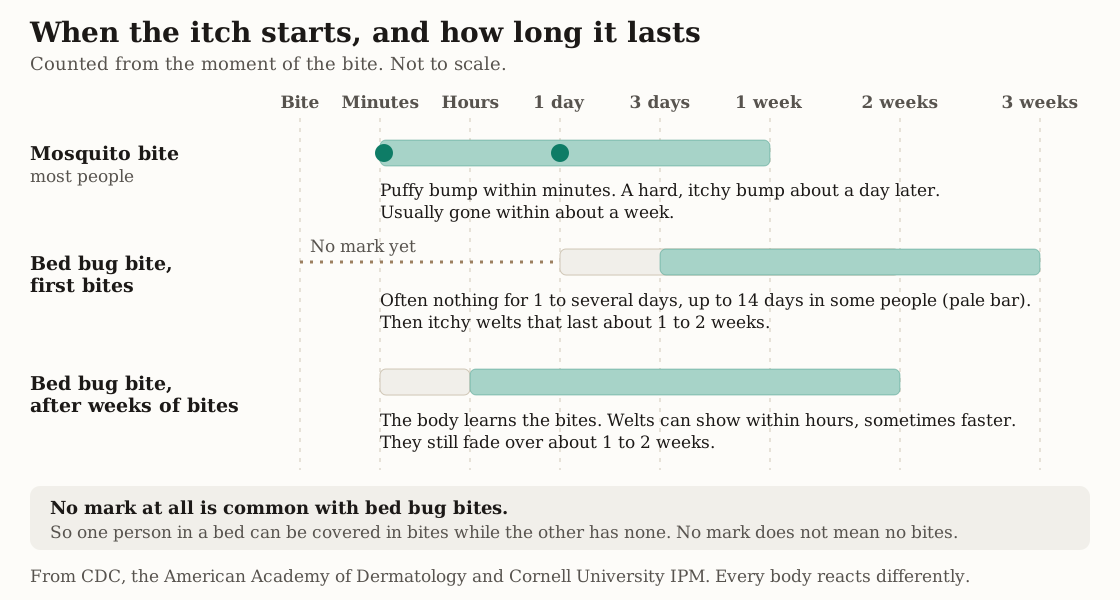
The reason is the way each insect feeds. A mosquito pierces the skin, and your body reacts to her saliva almost at once. A bed bug, on the other hand, injects a numbing agent and a blood thinner while it feeds for a few minutes. As a result, you sleep through it, and the reaction comes later, often after you have forgotten the night.
Repeated bites change the timing. The American Academy of Dermatology notes that people tend to become more sensitive to bed bug bites. After many bites, itchy welts can appear within seconds. So a fast itch does not rule out bed bugs in a home that has had them for weeks.
How long the bites last differs a little too, and mosquito bites last longer than Google’s AI Overview suggests. It says they fade within 1 to 3 days. In fact, most mosquito bites itch for 3 or 4 days, and the swelling may last up to 7 days, according to the Seattle Children’s pediatric guidelines. Bed bug bites usually heal within a week or two, the dermatology academy says. Either way, a bite that lasts longer than usual is not proof of one bug or the other.
Why does only one person in the bed have bites?
Because many people, roughly 30 to 60% by most estimates, never react to bed bug bites at all. CDC lists no physical signs as one way a bed bug bite can show up. Cornell makes the same point: you could get an itchy rash while the person beside you does not. So the partner with no bites is probably being bitten too.
One r/Bedbugs reader had seven raised bites after a hotel stay, while the friend who shared the bed had none. With bed bugs, that is a normal picture, not proof against them. Mosquitoes also pick some people over others, and our guide to why mosquitoes bite some people more sorts the real reasons from the myths.
How to confirm a bed bug bite: find the bug, not the bite
The only way to confirm bed bug bites is to find bed bugs or their signs. UC IPM says you can confirm an infestation only by finding the bugs themselves, or their fecal spots, blood spots, egg cases and shed skins. About 85% of bed bugs are in or near the bed, so start with the mattress, box spring, frame and headboard.
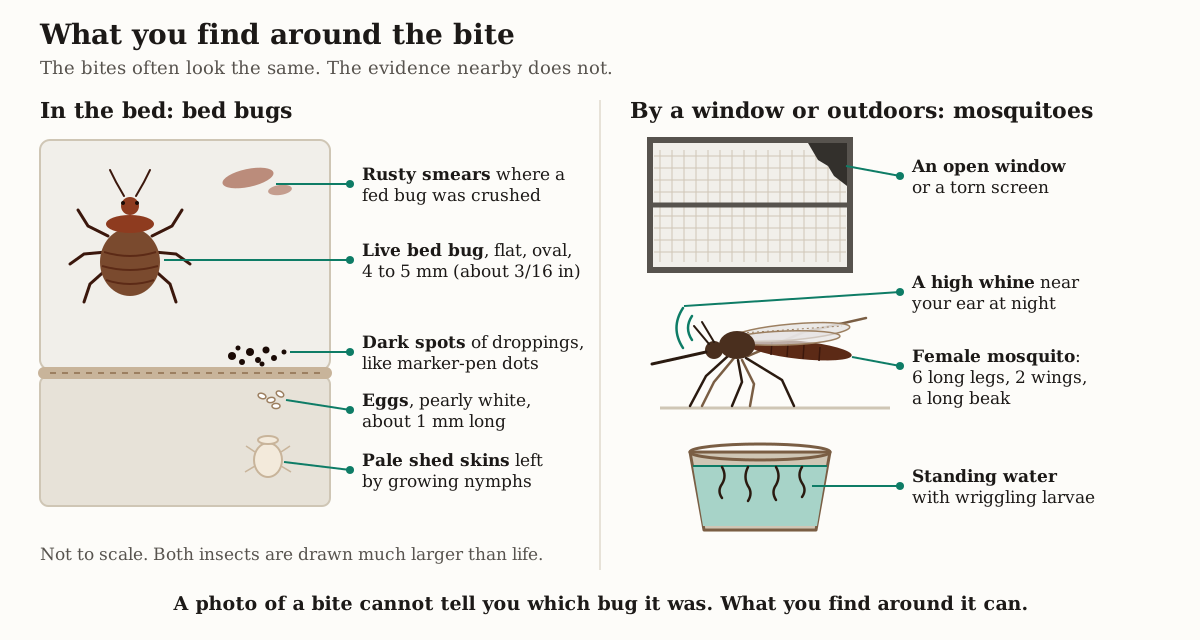
Here is what each sign looks like. Dark spots of droppings are about the size of a period, like dots from a marker pen. Wiped with a damp white cloth, they smear rusty brown. Rusty smears on the sheet, meanwhile, come from fed bugs that were crushed. Shed skins are pale and hollow, and eggs are pearly white and about 1 mm long. Finally, a live adult is flat, oval and 4 to 5 mm long, about the size of an apple seed.
How to check whether bites came from bed bugs or mosquitoes
Write down every new bite
Note the date, where the bite is on your body, and where you slept and spent the evening. A few days of notes show whether bites follow nights in bed or evenings outdoors.
Look at the sheets in the morning
Before you make the bed, check the sheet and pillowcase for small rusty smears and dark dots.
Run a flashlight along the mattress seams
Follow every seam, tag and the piping, then the box spring corners, the bed frame joints and the headboard. A credit card helps you lift a seam.
Test any dark spot
Wipe it with a damp white cloth. Bed bug droppings smear rusty brown. Mold, ink and lint do not.
Catch any bug whole
Press clear tape over it or seal it in a zip bag. A squashed bug is much harder to identify.
Set interceptors if you find nothing
Put interceptor cups under the bed legs, 8 or more per room, and check them for two weeks. One empty search does not clear you.
Check for mosquitoes as well
At night, look for one resting on the walls or ceiling. Check the window screens, and empty any standing water outside.
Our guide to checking a bed for bed bugs covers the full inspection, room by room. To be sure of what you caught, our guide to what bed bugs look like at every stage shows the eggs, nymphs and adults at true size.
What are three signs you might have bed bugs?
The three most useful signs are dark spots of droppings along the mattress seam, pale shed skins, and live bugs in seams or cracks near the bed. Rusty smears on the sheets and tiny pearly eggs come close behind. Bites alone are the weakest sign, because some people do not react at all. Our guide to the early signs of bed bugs puts them in the order they usually appear.
A mosquito in the bedroom: bites at night that are not bed bugs
Waking up with bites does not always mean bed bugs. CDC says mosquitoes bite day and night and live indoors as well as outdoors. Culex mosquitoes, the common house mosquitoes, are most active from dusk to dawn. So one that slips in through a window can feed on you all night.
The signs differ from bed bugs. You may hear a high whine near your ear, find a mosquito resting on a wall or the ceiling, or see a small blood smear after you swat one. The bites land on skin outside the covers and itch within minutes. They also stop once that mosquito is gone.
One reader on r/Bedbugs described exactly this. For weeks his wife woke with one or two itchy bites most mornings. Then he saw a mosquito in the room and killed it, and her bites stopped. When bites started on him a week later, the same question came back, which is why the bed check is still worth doing.
In late summer and fall there is one more reason. Some house mosquitoes spend the winter as adult females and shelter in garages and attics, and some find their way inside. To find the one in your room and keep more out, see our guide on how to get rid of mosquitoes in the house.
What is biting me at night that looks like mosquito bites?
Besides bed bugs and mosquitoes, three other biters leave itchy bumps that people mistake for mosquito bites: fleas, chiggers and scabies mites. Each has one giveaway, usually where the bites are or who else has them. A tick is different, because you can usually find it still attached.
Other bites that look like mosquito bites
Groups of small bites below the knees, with a cat or dog at home
- What it likely is
- Fleas
- Where on the body
- Ankles and lower legs
Intense itch that starts 3 or more hours later, after time in tall grass
- What it likely is
- Chiggers (larval mites)
- Where on the body
- Sock line, waistband, cuffs and collar
Intense itch that is worst at night, often in several people at home
- What it likely is
- Scabies mites
- Where on the body
- Wrists, elbows, waist and other skin folds
A small bug still fixed in the skin
- What it likely is
- A tick
- Where on the body
- Scalp, waistband, armpits and behind the knees
From the NHS and UC IPM (fleas), Clemson Cooperative Extension (chiggers) and CDC (scabies).
A flea bite has a small red center with a red halo, and fleas jump, while bed bugs only crawl. Scabies is slower than any bite: a first case can take 4 to 8 weeks to start itching, CDC says. If you found a bug in the bed rather than a bite, our guide to telling a tick from a bed bug counts the legs for you. To compare 20 kinds of bites at once, use our bug bite identification chart.
If the bumps keep coming and you find no insect at all, see a doctor. Scabies, hives and some rashes need a diagnosis, not a pest treatment.
Which is worse? Disease risk from bed bugs and mosquitoes
For your health, mosquito bites carry more risk. Bed bugs are not known to spread diseases to people, CDC says. Mosquitoes, however, can spread germs such as West Nile, dengue and Zika viruses. Even so, most people infected with West Nile virus have no symptoms at all.
According to CDC, about 8 in 10 people infected with West Nile virus never feel ill. About 1 in 5 get a fever and flu-like illness, and less than 1% develop a severe illness of the brain or spinal cord. Symptoms usually start 2 to 6 days after the bite, but can start up to 14 days later.
Bed bugs cost you in other ways. The bites itch, scratching can lead to a skin infection, and the lost sleep and worry are real. Rarely, a person has a serious allergic reaction to either kind of bite. Our guide to mosquito bites covers the diseases and the warning signs in more detail.
What to do for either bite
The care is the same for both bites. Wash the bite with soap and water, then hold an ice pack wrapped in a cloth on it for 10 minutes, as CDC advises for mosquito bites. An anti-itch or antihistamine cream can also help, as long as you follow the label. Above all, try not to scratch.
Scratching is what turns a bite into a problem, because broken skin lets bacteria in. Keep nails short, and cover a bite you keep picking at. For full care steps, see our guides to mosquito bite relief and bed bug bite treatment. A bite that swells to the size of a palm has its own guide, on skeeter syndrome.
Treating the skin will not stop bed bug bites, though. New bites keep coming until the bugs are gone, so the bed check matters more than any cream.
Bed bugs or mosquitoes? What to do next
To settle bed bug vs mosquito bites for good, start with what costs nothing: a bite log, a flashlight and a careful look at the bed. Then match what you found to the table below. Do not spray the bed or set off a bug bomb before you know which insect you have, because the fix for each is different.
What you found, what it likely is, and what to do
Dark spots, shed skins or live bugs in the mattress seams
- What it likely is
- Bed bugs
- What to do
- Seal a bug in a bag, check the rest of the bed, and call a licensed pest professional. If you rent, tell your landlord in writing
A mosquito in the room, or a whine at night
- What it likely is
- A mosquito
- What to do
- Find and swat it, fix the window screens, and run a fan over the bed
Bites after an evening outdoors, near standing water
- What it likely is
- Mosquitoes
- What to do
- Empty standing water every week and use an EPA-registered repellent outdoors
Bites a few days after a hotel stay or a trip
- What it likely is
- Possibly bed bugs from the luggage
- What to do
- Dry travel clothes on high heat for at least 30 minutes, check the suitcase seams, and watch the bed
Bites below the knees, with pets at home
- What it likely is
- Possibly fleas
- What to do
- Check the pets and their bedding with a flea comb
Bites but nothing found
- What it likely is
- Cannot tell yet
- What to do
- Set 8 or more interceptors, keep the bite log, and check again in two weeks
If it is bed bugs, most homes need a licensed professional and a follow-up visit. Heat is the do-it-yourself tool that works on fabric, and EPA lists a clothes dryer on high heat as one way to kill them. Our guide to what kills bed bugs compares heat, steam and sprays.
If it is mosquitoes, the fix is water and screens. Dump standing water every week and repair torn screens. Outdoors, use an EPA-registered repellent such as DEET, picaridin, IR3535 or oil of lemon eucalyptus, and follow the label. For everything else, from how to spot a mosquito to when they bite, start at our complete guide to mosquitoes.
Medical disclaimer. This page is for general information only. It is not a medical diagnosis. If you have severe symptoms, trouble breathing, swelling of the face or throat, fast spreading redness, fever, severe pain, pus, or signs of infection, contact a doctor or your local emergency number.
Bed bug vs mosquito bites FAQ
Can bed bugs or mosquitoes bite through clothes?
Do bed bug bites itch more than mosquito bites?
Can I bring bed bugs home from a hotel?
Is it bed bugs if the bites are only on my legs?
Should I throw out my mattress if I find bed bugs?
Related guides
Mosquitoes
The hub: what mosquitoes are, how to spot one, and every mosquito guide on the site.
Bed bug bites
The forms a bed bug bite takes, why the itch comes late, and how to treat it.
Mosquito bites
What a normal bite looks like, how long it lasts, and the signs that need a doctor.
How to check for bed bugs
Where to look on a mattress, which tools help, and how many interceptors you need.
What bed bugs look like
Eggs, nymphs and adults at true size, and the bugs people confuse with them.
Early signs of bed bugs
The seven early signs in the order they appear, starting with the mattress seam.
How to get rid of mosquitoes
Standing water, screens and the one in your bedroom, step by step.
Skeeter syndrome
When a mosquito bite swells to the size of a palm, and what helps.
Tick vs bed bug
A small flat bug in the bed: count the legs and look for antennae.
Bug bite identification
A chart of 20 bites by look, place and timing.
Sources
- CDC, About bed bugs
- CDC, About mosquito bites
- CDC, Symptoms of West Nile virus disease
- US EPA, Do-it-yourself bed bug control
- American Academy of Dermatology, Bedbugs: signs and symptoms
- Seattle Children's, Mosquito Bite (Schmitt Pediatric Guidelines)
- Cornell University NYS IPM, Bed bug FAQs
- UC IPM Pest Notes 7454, Bed bugs