Most people meet weevils in a bag of flour or rice, often a large one they have just paid for. The second biggest group finds the same long-nosed insect walking up a bathroom sink in July, with no food anywhere near it. Those two situations look identical and need completely different answers, so this page starts by separating them.
Part 1 of 4
Start here
Which of the three weevils do you have?
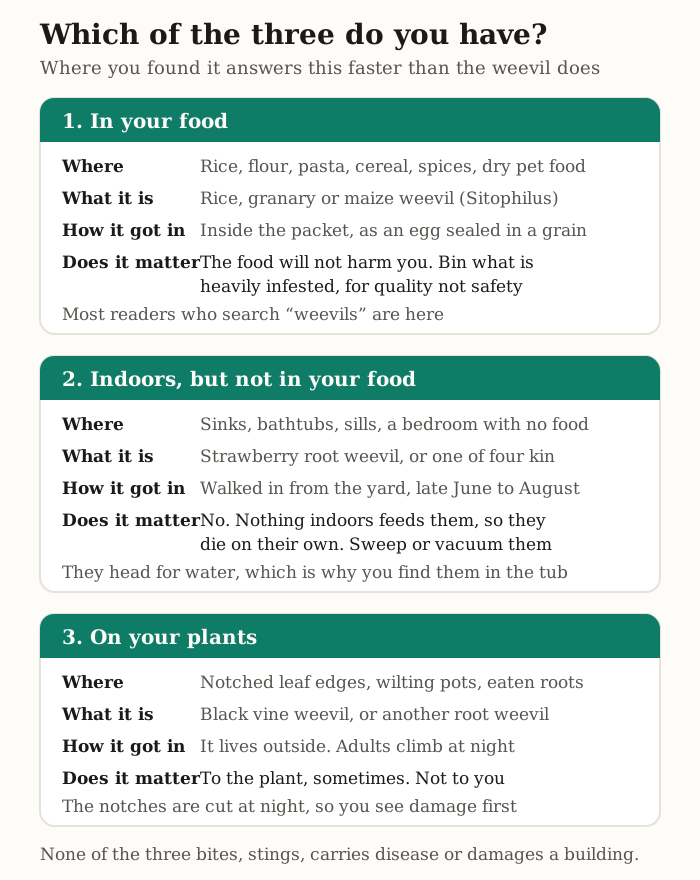
Weevils turn up in exactly three places in a US home: in stored food, indoors with no food near them, or on garden plants. The answer changes everything that follows, and where you found it settles it faster than studying the insect does. So start with the place, then come back to the weevil.
The three weevil situations
Place yours in one of these three before you buy anything. Only the first and the third need you to act.
In your food
Rice, flour, pasta, cereal, spices or dry pet food. It arrived inside the packet, so the shelf is not where it started. The food will not harm you.
Indoors, but not in your food
A sink, a bathtub, a window sill, or a bedroom with nothing to eat in it. It walked in from the yard, and it will die indoors on its own.
On your plants
Notched leaf edges, a wilting pot, or chewed roots. This one matters to the plant, and never to you.
Google splits the topic the same way, and it has to ask which one you are in, because no single page it ranks answers all three. That gap is the reason this page exists.
Is it even a weevil?
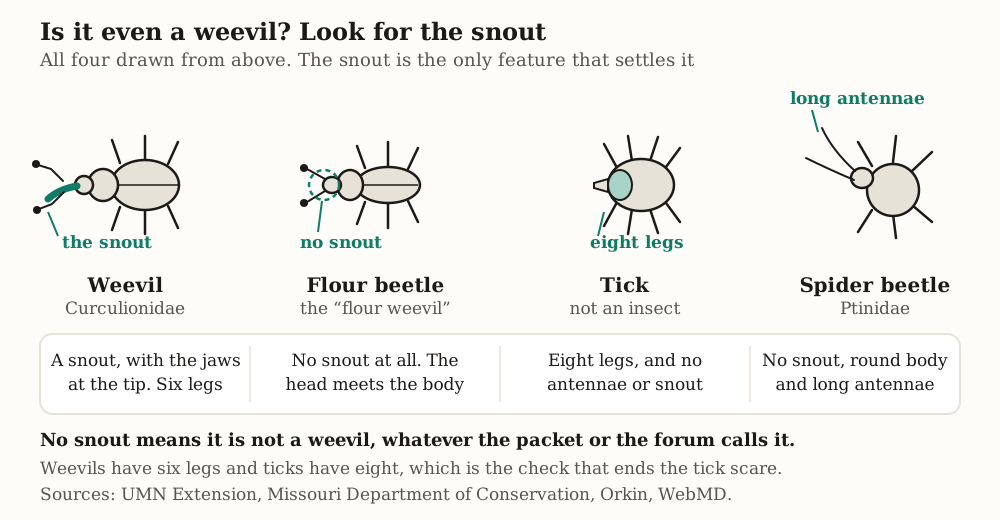
A weevil has a long snout with its jaws at the tip, elbowed antennae that end in a small club, and six legs. Most are 1/8 to 1/2 inch long (3 to 13 mm), and many are under 1/4 inch. If there is no snout, it is not a weevil, whatever the packet or the forum thread calls it.
What the snout tells you
The snout is called a rostrum, and the mouthparts sit at the end of it rather than on the head. That is not decoration. A female uses it to drill into a grain or a plant stem, then lays an egg inside. That is how weevils get into food that looks sealed. In some species the snout is as long as the rest of the body.
Look at the antennae next. They come off the sides of the snout, bend sharply partway along like an elbow, and finish in a club. On many weevils the first segment folds back into a groove along the snout. Then check the legs: six means an insect, and the count matters more than it sounds.
What colour and size tell you
Colour alone will not name a weevil, but it narrows things quickly, and it is what most people search for. Dark brown and black cover nearly every weevil found indoors. Bright green or iridescent usually means a garden species that wandered in.
Sorting weevils by colour and size
Tiny, dark brown to near black
- Size
- About 1/8 in (3 mm)
- Most likely weevil
- Rice or granary weevil
- Where it was
- In rice, flour, pasta or cereal
Black to dark brown, rows of pits down the back
- Size
- About 1/4 in (6 mm)
- Most likely weevil
- Strawberry root weevil
- Where it was
- Sink, bathtub, sill, in summer
Black, flecked with gold
- Size
- About 3/8 in (9 mm)
- Most likely weevil
- Black vine weevil
- Where it was
- On plants, or indoors near them
Lime green or iridescent scales
- Size
- About 1/4 in (6 mm)
- Most likely weevil
- Polydrusus weevil
- Where it was
- Outdoors, or at a window
Shiny reddish-brown
- Size
- 1/8 to 3/16 in (3 to 5 mm)
- Most likely weevil
- Barypeithes pellucidus
- Where it was
- Indoors, June and July
Grey-brown, mottled scales
- Size
- 3/16 in (5 mm)
- Most likely weevil
- Imported longhorned weevil
- Where it was
- Indoors, July and August
No snout at all, under 1/8 in
- Size
- Under 1/8 in (3 mm)
- Most likely weevil
- A flour beetle, not a weevil
- Where it was
- In flour or meal
The four bugs weevils get confused with
Each one separates on a single feature, and none of them needs a microscope. Work down the first column until something matches.
Weevil look-alikes, and the one feature that separates each
A long snout with jaws at the tip
- If it has it
- A weevil
- If it does not
- A flour beetle, which is what a flour weevil usually is
Six legs
- If it has it
- A weevil or another insect
- If it does not
- Eight legs means a tick, which does bite
Very long antennae and a round body
- If it has it
- A spider beetle
- If it does not
- A weevil has short elbowed antennae
Grooved wing covers and no snout
- If it has it
- A biscuit beetle
- If it does not
- A weevil in a spice jar still has its snout
Webbing in the packet
- If it has it
- A pantry moth caterpillar
- If it does not
- Weevils leave no webbing at all
Too small to see any detail
- If it has it
- A grain mite, which is not an insect
- If it does not
- A weevil is visible as a shape
Is it a tick?
This is the fear behind a surprising share of weevil searches, and it is settled in one glance. Minnesota Extension puts it plainly: weevils have six legs and ticks have eight. A tick also has no snout and no antennae. We cover the tiny bugs that look like ticks in full, with the check that rules each one in or out.
Can you still eat the food?
Yes. Rutgers Cooperative Extension states it directly: eating them will not harm you. Weevils carry no disease, they do not poison what they feed on, and swallowing one by accident does nothing. So throwing out a sack of flour is a decision about how you feel, not a health precaution.
That answer matters because it is the question people actually ask. Forum threads about whether weevil-infested rice is safe run to hundreds of replies. Meanwhile the pages that rank for weevils mostly tell readers to discard the food and move on. Rutgers also addresses the part nobody says out loud: pantry pests are not uncommon, and they are not a reflection of anyone’s housekeeping skills.
When to keep it
- A few insects in a large, expensive bag. Sieve them out, then freeze or heat the rest as described below.
- Whole grains, rice, dried beans or pasta. These sieve and rinse well, and weevils do not get into the inside of a dried bean.
- Anything you will cook thoroughly. Heat kills every stage.
When to bin it
- Heavy infestations, where the food is more insect than food. That is a quality call, and a fair one.
- Anything that smells sour or musty. A long-running infestation can bring mould with it, and mould is a genuine reason to discard food.
- Flour and meal you cannot sieve clean. Fine powder hides larvae and droppings you will never separate.
- Anything you simply will not eat now. There is no prize for forcing it down.
Part 2 of 4
Where you found it
Weevils in rice, flour and the pantry
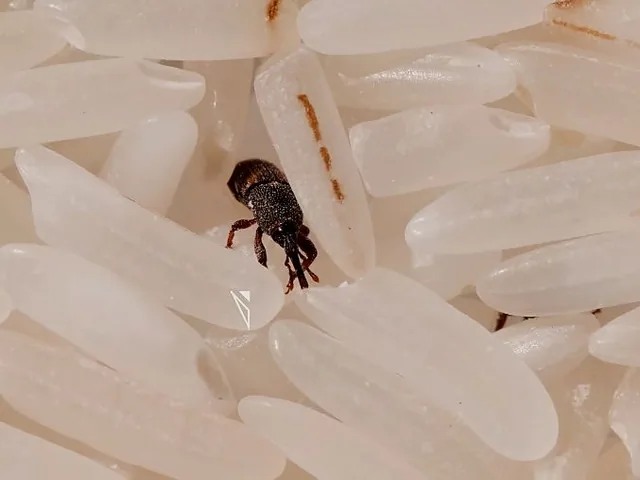
Pantry weevils are the rice weevil and the granary weevil, both about 1/8 inch (3 mm) and dark brown. They eat whole grains, so they turn up in rice, wheat, pasta, birdseed and dry pet food. They almost never arrive by walking in, which is the single most useful fact about them.
Rice weevil or granary weevil?
Two species cover almost every case, and one check separates them. If it flew to your window or your lamp, it is a rice weevil. If it cannot fly and ignores light, it is a granary weevil, which is also sold under the names grain weevil and wheat weevil. Either way the treatment is identical.
Our rice weevil guide has the full comparison, the maize weevil that gets confused with both, and the freezer timing that most pages get wrong.
How they got into a sealed bag
This is the part that surprises everyone. The female drills into a single grain with her snout, lays one egg inside, and seals the hole with a plug. From the outside that grain looks untouched. Her larva grows hidden inside it, eating as it goes. Weeks later it chews its way out as an adult.
So the insects were already in the packet when you brought it home, as eggs inside grains nobody could see. The weevils you are looking at now hatched on your shelf. Minnesota Extension notes that dry goods can pick up pantry pests anywhere from the processing plant to the grocery store. Food of any age can be affected, so a fresh bag is no guarantee.
Will they go away on their own?
Only once the food they are breeding in is gone. There is no season to wait out, because a heated house suits them all year. Minnesota Extension gives a useful rule for pantry insects generally. You may still see a few for up to three weeks after the source goes out. After that, a weevil still appearing means an infested packet you have not found yet.
One more thing about flour, since it causes the most confusion. The insects in a bag of flour are usually not weevils at all, but flour beetles, which have no snout and cannot open whole grain. Check for the snout before you blame a weevil. Our guide to weevils in flour covers the three insects that get the name, and whether the bag is worth keeping.
Weevils indoors that are not in your food
This is the reader nobody serves, and it is a large group. You are finding the same dark 1/4 inch weevil every morning, in the bath, the sink or along a sill, and there is no food anywhere near. These are home-invading weevils, and they are not infesting anything.
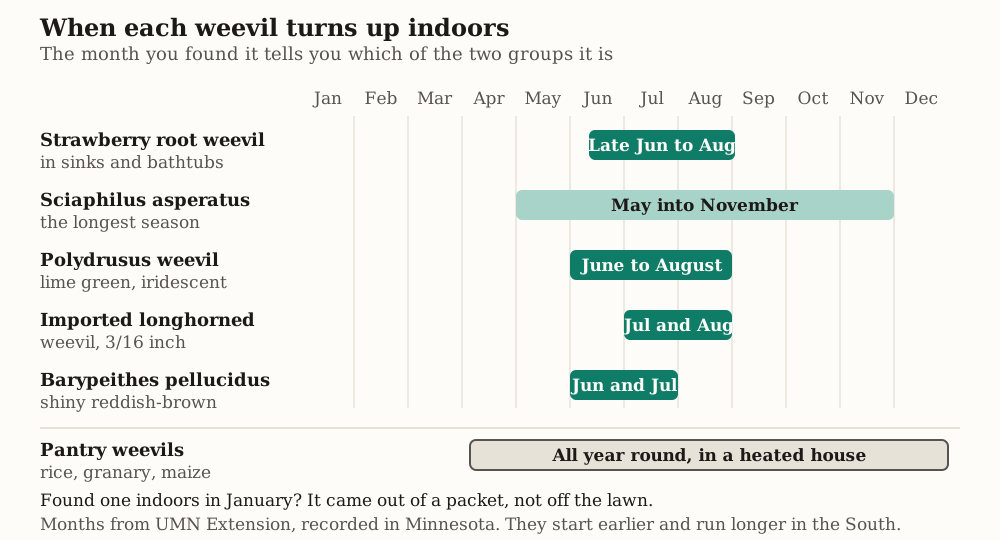
The usual one is the strawberry root weevil, about 1/4 inch (6 mm), black to dark brown, with rows of small pits running down its back. It cannot fly. Minnesota Extension records it coming indoors from the end of June through August. It calls the whole group a temporary nuisance. They do not harm people or pets, damage buildings, or infest food.
Why the bathroom and the kitchen sink
Because they are looking for water, not food. Strawberry root weevils are drawn to moisture, so sinks, bathtubs and water basins are exactly where they end up. The smooth sides then stop them climbing out again. That is why people find a fresh one in the tub every morning and assume a nest somewhere.
There is no nest. They walked in from the lawn or the flower bed through a gap, and your house holds nothing they can eat or breed in. A few other species do the same thing on slightly different schedules. The imported longhorned weevil comes in during July and August, while Sciaphilus asperatus can turn up from May into November. One more, the Asiatic oak weevil, comes to lights at night, which is how it finds a house in the first place.
What to do about them
Sweep or vacuum the ones you find, and seal the way in when you have time. Nothing else is needed, and Minnesota Extension is blunt that pesticides are neither effective nor necessary for weevils indoors. They die on their own within days. Not certain yours is a weevil? Our small black beetle sorting covers the other dark insects that walk in under a door.
Weevils in the garden
Garden weevils are the only group that does real damage, and almost all of it is done out of sight. The adults chew semicircular notches from the edges of leaves at night. Their larvae are pale, legless and curled into a C. Those larvae eat roots underground, and that is what kills a plant.
In most US gardens the black vine weevil is the one doing it, about 3/8 inch, black flecked with gold, and flightless. It works on rhododendrons, azaleas, yew, strawberries and container plants of all kinds. University of California IPM notes that most weevil species are harmless. So finding one on a leaf is not in itself a reason to act.
Checking without chemicals
Since the adults feed after dark, daylight inspections find nothing. Go out at night with a flashlight, or shake a branch over a white cloth and see what drops. University of California IPM also suggests wrapping a band of corrugated cardboard around a trunk overnight. Unwrap it in the morning and see what sheltered inside.
For the larvae, the useful option is biological. Entomopathogenic nematodes, usually Heterorhabditis bacteriophora, are watered into warm, moist soil from midsummer into fall. Because most of these weevils cannot fly, a six-inch band of sticky material over landscape fabric around a trunk stops the adults climbing at all.
Part 3 of 4
Is it a problem?
Do weevils bite, or damage the house?
No on both counts. Weevils do not bite or sting people or pets, and they carry no disease. They also do no damage to buildings, furniture, clothing or carpets. Their mouthparts are built for drilling into seeds and plant tissue, and they are no use on skin or wood framing.
One claim circulating in community groups says that some weevils eat the frame of a house. That is wrong. Minnesota Extension and WebMD both state that weevils do not damage buildings or property, and Google’s own summary of the topic says the same. If something is boring into structural wood, it is a wood-boring beetle or a termite instead, and that is a different problem with a different answer.
The real cost is food and plants. Pantry weevils contaminate more than they eat, which is why a packet looks ruined out of proportion to the number of insects in it.
Why you suddenly have a lot of them
There are only two real answers, and the month tells you which. A weevil found indoors between late June and August probably walked in from the yard. One found in January came out of a packet, because nothing is walking in during winter.
- A packet has been open too long. A forgotten bag of flour, birdseed or dry pet food can breed weevils for months before anyone notices, and warmth speeds the whole cycle up.
- The season arrived. Home invaders come in from late June through August, and a few species run from May into November.
- It is dry outside. Weevils that want moisture move indoors when the ground dries out, which is why a hot spell is often followed by weevils in the bath.
- A light is drawing them in. The Asiatic oak weevil in particular comes to lights at night, and others are drawn to the warmth of a wall.
- They never left. In a heated house a pantry population breeds all year, so numbers climb steadily rather than arriving in a wave.
Where you live changes the dates
The months above come from Minnesota Extension, and they are Minnesota dates. Further south the same weevils start earlier and carry on later. A Texas or Florida reader can expect home invaders outside the June to August window. The pattern holds even when the calendar shifts: the seasonal ones come from outdoors, and the pantry ones do not care what month it is.
Part 4 of 4
What to do
How to get rid of weevils, in order
Work down this list rather than across it. The first four steps cost nothing and settle almost every case. That last step is unnecessary far more often than the pest control pages suggest. Nothing here involves spraying a kitchen.
The weevil clear-out, step by step
Find the packet, not the weevil
Take everything out of the cupboard and check it with a flashlight. Look at rice, flour, pasta, cereal, spices, birdseed and dry pet food. Spices and forgotten pet food are the two that get skipped most often. Pour anything suspect onto a pale plate, because weevils show up against white and vanish against cardboard.
Decide what to keep and what to bin
Rutgers Cooperative Extension puts the safety question to rest: eating them will not harm you. So the decision is about quality, not health. Bin anything heavily infested, anything you would not enjoy eating, and anything with a sour or musty smell. Keep the rest and treat it in the next step.
Freeze it or heat it
Freezing at 0°F (-18°C) for at least four days kills every stage, including the eggs hidden inside grains. An oven at 130°F (54°C) for at least 30 minutes does the same. Sources differ slightly on the timing, so these are the longer figures from University of Minnesota Extension rather than the shortest ones. Sieve out the dead insects afterwards.
Vacuum the shelf, then empty it outside
Work along the cracks, the corners and the shelf-pin holes, because that is where spilled grain collects. Take the bag or the canister contents straight outside. Skip the bleach. Minnesota Extension says washing with detergent, bleach or ammonia will not keep pantry pests from returning. Those chemicals are also a hazard if they reach food.
Store what is left in glass or metal
Weevils chew through paper, cardboard and thin plastic bags, so the bag your flour came in is not a barrier. Glass jars that pressure seal with a rubber gasket are the best of the usual options. Buy dry goods in amounts you will finish within two to four months, and use the older packet before the newer one.
For the ones not in food, close the way in
Home-invading weevils need no treatment at all, because nothing indoors feeds them. Sweep or vacuum the ones you find. Then caulk the gaps around doors, windows and utility lines, and fix torn screens. A pan of shallow water will catch some. Minnesota Extension is honest about the limit: these pans do not capture enough weevils to reduce the number entering homes.
Skip the spray, and here is why
Insecticide cannot reach an insect sealed inside a grain or a packet, and it does not belong near food. Minnesota Extension states that pesticides are not recommended in stored-food cupboards, and that pesticides available to the public are not very effective against weevils anyway. If a perimeter treatment is used outdoors for repeat invasions, the label lists the pest and the place, and the label is the law.
When it is worth calling someone
Hardly ever, and that is the honest answer. Two situations are worth paying for. The first is a pantry problem that keeps returning after a thorough clear-out. That usually means a source you cannot see, such as a wall void with spilled grain or an old rodent bait. The second is a garden infestation that is killing established plants, where a professional can identify the species and time a treatment properly.
How to keep weevils out
Prevention here is storage and habit, not chemistry, and most of it is a one-off job that keeps working.
- Move dry goods into glass or metal. Jars that pressure seal with a rubber gasket are best. Weevils chew through bags, cardboard and thin plastic.
- Freeze new bags of flour, rice and pasta for four days before they go in the cupboard. This kills eggs that came home with the packet, and it is the one habit that prevents repeats.
- Buy what you will use in two to four months, and finish the older packet before opening the newer one.
- Check the packet before it goes in the trolley. Holes, tears and grit along the seams are worth a second look.
- Include the spices, the birdseed and the pet food in all of the above. These three are skipped more than anything else.
- Seal gaps around doors, windows and utility lines, and repair torn screens, which stops the ones that walk in.
- Keep mulch and dense planting back from the walls. That is where home-invading weevils spend the day before they find a gap.
What does not work
Some of the advice circulating about weevils is harmless but useless, and a little of it will cost you food.
Myth 1
Myth: “Bay leaves in the cupboard keep weevils out.”
Truth: University of Minnesota Extension states that there is no evidence that bay leaves or sticks of spearmint gum prevent or get rid of stored-food insects. The advice is everywhere, including in Google's own answer panel, and it still has nothing behind it.
Myth 2
Myth: “Sage, peppermint, cloves or cinnamon repel them.”
Truth: Same evidence problem, and these come up constantly in forum replies. Herbs and essential oils are sold as repellents, not as control, and none of them reaches an egg sealed inside a grain.
Myth 3
Myth: “White vinegar kills the eggs on contact.”
Truth: It does not. Vinegar is useful for wiping out a shelf, and that is the extent of it. The eggs are inside the grains, where nothing you wipe on can reach.
Myth 4
Myth: “Bleach the shelves and they will not come back.”
Truth: Minnesota Extension says washing with detergent, bleach, ammonia or disinfectant will not keep pantry pests away, and adds that those chemicals could be dangerous if they come into contact with food.
Myth 5
Myth: “Spray the pantry with a household insecticide.”
Truth: Household insecticides have no effect on insects inside food packages, and any food that contacts pesticide has to be thrown out. This is the one piece of common advice that actively costs you money.
Myth 6
Myth: “Some weevils eat the frame of your house.”
Truth: A top-voted community answer says this and it is false. Weevils do not damage buildings, furniture or clothing. Round exit holes and fine powder in timber mean a wood-boring beetle instead.
Myth 7
Myth: “Weevils mean your kitchen is dirty.”
Truth: Rutgers Cooperative Extension answers this directly: pantry pests are not uncommon and are not a reflection of anyone's housekeeping. They arrive sealed inside shop-bought packaging.
Myth 8
Myth: “A pan of water by the wall will clear them out.”
Truth: It catches some, and it is a reasonable way to see how many are coming in. Minnesota Extension is honest that these pans do not capture enough weevils to reduce the number entering a home.
How many kinds of weevil are there?
About 62,000 described species, and probably far more that nobody has named yet. That figure comes from Oberprieler, Marvaldi and Anderson, who counted them for the journal Zootaxa in 2007 and estimated the real total at around 220,000, meaning science has described roughly a quarter of them.
You will see about 97,000 quoted more often, including on Wikipedia, where it carries no citation, and in Google’s own summary. Treat it with care. The specialists who did the counting put the described figure lower and the likely total far higher. Either way, weevils are the largest family in the animal kingdom by some counts, which is why they turn up in so many different places.
Closer to home the numbers also disagree. Orkin puts it at over 1,000 species of Curculionidae in North America, while the Missouri Department of Conservation gives about 2,500 north of Mexico. A handful of those ever meet a householder.
The famous ones you have heard of
- The boll weevil destroyed cotton crops across the American South after 1892, and a long eradication programme has largely cleared it from the United States. It does not come indoors.
- The acorn weevil is the one in the nature videos, drilling into an acorn with a snout longer than its body to lay an egg inside.
- The giraffe weevil of Madagascar has a neck that folds like a hinge. It is a photography subject rather than anything a US home will meet.
- The biscuit weevil is not a weevil at all. It is the biscuit beetle, which has no snout and belongs to a different family.
Weevils are beetles, which surprises people, and they sit alongside the other common house beetles in a kitchen. If you would rather name yours by size and colour across the whole group, our guide to the different types of beetles covers every beetle a US household meets. For the pantry crowd specifically, the tiny black bugs in the pantry round-up sorts the ones that are not weevils. A “carpet weevil” is another misnomer: that insect is a carpet beetle, and what carpet beetles look like is a different problem entirely. One more confusion worth naming is the wheel bug, which is far larger, carries a cog-like crest, and unlike a weevil can give a painful bite.
Still not sure what you are holding? Take a sharp photo from directly above and run it through our bug identifier before you throw anything away.
Pest control disclaimer. Photo-based identification can help, but it is not always perfect. For dangerous spiders, large infestations, or anything you are unsure about, contact a licensed pest control professional.
Weevil FAQ
What is another name for a weevil?
How do you pronounce weevil?
Do weevils fly?
How long do weevils live?
What kills weevils instantly?
Are weevils harmful to dogs or cats?
Related guides
Types of beetles
Name any beetle by size, colour and shape, indoors or out, starting with whether it is a beetle at all.
House beetles
The other beetles that turn up indoors, sorted by the room you found them in.
Small black bugs
The tiny dark insects of the kitchen and bathroom, including the pantry crowd that are not weevils.
Bugs that look like ticks
Seventeen bugs mistaken for ticks, with the leg count and the one check that settles each.
Drugstore beetle
The biscuit beetle, often called a biscuit weevil, which breeds in spices and dry pet food.
Carpet beetles
The fabric pest behind most 'carpet weevil' searches, and how to find the source.
Black beetle
Dark beetles found indoors, sorted by size and shine, for when the snout is hard to see.
Clothes moths
Webbing in a packet means a moth, not a weevil. How to tell the fabric and pantry moths apart.
Sources
- University of Minnesota Extension, Home-invading weevils, J. Hahn and S. Kells (reviewed 2024)
- University of Minnesota Extension, Pantry pests: Insects found in stored food (reviewed 2024)
- Rutgers Cooperative Extension, I Found Bugs in My Cereal, Pasta or Cake Mix. What Do I Do?
- University of Maryland Extension, Rice and Granary Weevils (revised 2020, updated 2024)
- UC Statewide IPM Program, Pest Notes: Weevils
- Oberprieler, R.G., Marvaldi, A.E. & Anderson, R.S. (2007) Weevils, weevils, weevils everywhere. Zootaxa 1668: 491-520
- Missouri Department of Conservation, Weevils (Snout Beetles)