Usually it does not matter. Most house beetles are harmless, and a few adults indoors are not a sign of anything. The exceptions are worth catching early, though, so this page sorts them the way a professional does. If you want to name the beetle by its size, colour and shape instead, our guide to beetle identification covers every beetle a US household meets, indoors and out.
Part 1 of 4
Start here
First, is it doing any damage?
Start here, because the answer changes everything you do next. House beetles are doing one of four things, and only three of them cost you anything. Finding dead beetles on a windowsill means something very different from finding a live larva in a wool sweater, even when the beetle is the same species.
The University of California’s pest notes put the rule plainly for carpet beetles, and it holds for nearly every beetle in this guide: “A few adult beetles indoors should not be cause for alarm. Management only needs to occur if you find larvae developing in fabrics or other areas in your home.”
Four things house beetles can be doing
Place yours in one of these four before you buy anything. Only the first three need action.
Eating fabric
Wool, silk, fur, feathers or pet hair, usually in a dark closet or under furniture. The adult is not the problem, the larva is.
Eating stored food
Flour, cereal, spices, dry pet food. It arrived inside a package, so the shelf is not where it started.
Boring into wood
Small round holes with fine powder underneath. This is the one that can cost real money.
Lost, and eating nothing
It came in under a door, through a vent or on a cut flower. Nothing here feeds it, so it needs nothing from you.
If yours belongs in the fourth group, you are done. Sweep it outside and seal whatever it came through.
Where you found it narrows it fast
The room does most of the identification work, because each group of house beetles lives where its food is. A speckled beetle at a window and a brown beetle in the flour are rarely the same animal, and the fix for one does nothing for the other. So before studying the beetle, look at where it was.
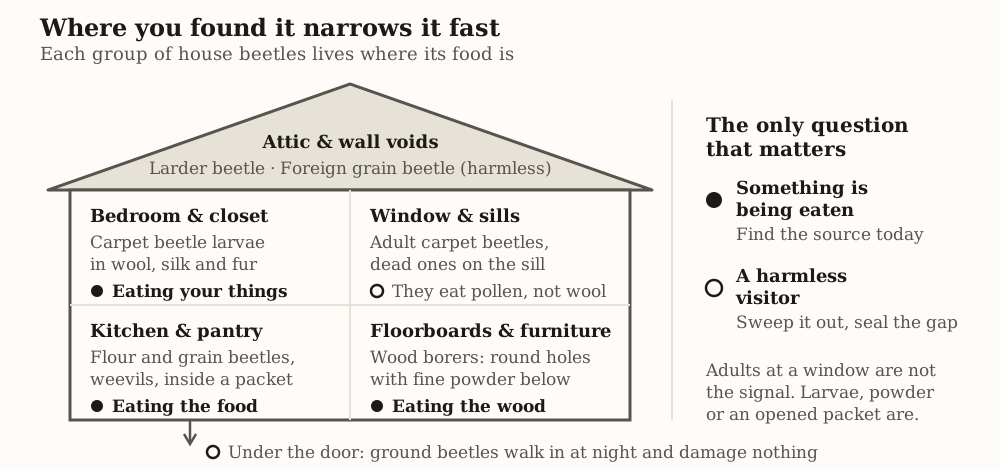
Where you found the house beetle, and what it probably is
Windowsill, curtains, light fittings
- Most likely beetle
- Carpet beetle adult
- Size
- 1/10 to 1/8 in
- Is it damaging anything?
- No. The adults eat pollen. Look for the larvae instead
Closet, under rugs, in stored wool
- Most likely beetle
- Carpet beetle larva
- Size
- Up to 5/16 in, bristly
- Is it damaging anything?
- Yes, and this is the one to act on
Pantry, flour, spices, dry pet food
- Most likely beetle
- Pantry beetle or weevil
- Size
- Under 1/8 in, brown
- Is it damaging anything?
- Yes, to the food. Harmless to you
Floorboards, furniture, beams
- Most likely beetle
- Wood-boring beetle
- Size
- 1/8 to 1/4 in, rarely seen
- Is it damaging anything?
- Possibly, and it is worth checking properly
Basement floor, under boxes, at night
- Most likely beetle
- Ground beetle
- Size
- 1/8 to 1/2 in, shiny black, fast
- Is it damaging anything?
- No. It wandered in
Wall sockets and baseboards in a new build
- Most likely beetle
- Foreign grain beetle
- Size
- About 1/12 in, reddish-brown
- Is it damaging anything?
- No. It is eating mould inside the wall
Sunny outside wall in autumn
- Most likely beetle
- Asian lady beetle
- Size
- 1/4 to 1/3 in, orange
- Is it damaging anything?
- No, though it can stain and it smells
One row of that table surprises people. Adult carpet beetles at a window are not eating anything there, because the adults live on pollen. They are drawn to light, so a windowsill is simply where they end up. Any damage is happening somewhere dark instead, which is why the sill is the wrong place to look.
Part 2 of 4
The ones that are eating something
Beetles at the window and in the closet
Carpet beetles are the house beetles behind nearly all fabric damage in US homes. Adults run about 1/10 to 1/8 inch, are round, and are mottled with black, white, brown and yellow scales. Older ones wear smooth and look plain black or brown. The adults are harmless: they feed on pollen and nectar outdoors, and they often arrive on cut flowers or through an open window. It is the larvae that eat, and they eat wool, silk, leather, fur, feathers and pet hair. They will not touch synthetics.
What to look for when you cannot find a beetle
Larvae stay in dark, undisturbed places, so you usually find the evidence before you find the insect. Look for brown, shell-like cast skins where the larvae moulted, and for droppings about the size of a grain of salt. There will be no webbing. That last detail matters, because webbing means clothes moth larvae instead, and the damage pattern differs too: carpet beetles chew one large patch, while moths leave scattered holes.
Our full guide to getting rid of carpet beetles covers finding the source, laundering, freezing and why spraying clothing is the wrong move.
Larder beetles, and the dead insect you never saw
A larder beetle is larger and easier to name. Adults run 1/4 to 1/3 inch, dark brown and oval, with a cream to yellow band across the top of the wing covers carrying six dark spots inside it. The larvae are about half an inch, hairy, and have a pair of spines on the tail that curve backwards.
Despite the name, Minnesota Extension notes that it is very uncommon for larder beetles to feed on stored food. They eat dead insects, birds and rodents trapped in wall voids and attics, plus dry pet food. That gives them a cause most people never connect: “Insects such as cluster flies and boxelder bugs get into homes in late summer and fall. You will notice a larder beetle problem in the next season, if large numbers of these insects die off.”
So a heavy boxelder bug infestation in autumn can hand you larder beetles the following spring. Finding and clearing the dead insects is the fix. Spraying is not, because the food source is still there.
Are those bites?
They are almost certainly not. Carpet beetle larvae have barbed hairs, and in sensitive people those hairs cause an itchy rash. A 2021 report in the CDC journal Emerging Infectious Diseases examined a household cluster of such marks and concluded that they “mimic bites but are allergic reactions to larvae hairs pegged in the skin”, and “should be distinguished from bites of bed bugs or fleas”.
The pattern helps as well. Hair reactions tend to be single and scattered on exposed skin. Bed bug and flea bites usually arrive in clusters instead.
Beetles in the kitchen and the pantry
The house beetles that get into food are small, brown and almost all under an eighth of an inch. They did not walk in off the counter. They arrived inside a package, usually one damaged at the store or opened and forgotten at the back of a cupboard. That single fact decides the whole job, because the beetles you can see are not where the problem lives.
Find the package, not the beetle
Work through every dry good with a flashlight: flour, cereal, rice, pasta, spices, birdseed, dry pet food and anything decorative made from seeds or pasta. You are looking for live insects, fine webbing, or packets that feel gritty. Dry pet food and forgotten spice jars are the two commonest sources, and both get skipped. If the flour is where you find them, flour bugs sorts the six things that turn up in a bag, several of which are not beetles at all.
Readers often say the same thing at this point, which is that they clean constantly and still cannot find it. That is normal. The source is a sealed container, not a dirty floor.
Which one is it, and does it matter?
Mostly it does not. Several pantry beetles are near twins, and the treatment is identical for all of them. If you want the name anyway, each pair separates on one feature.
Pantry beetle look-alikes, and the one feature that separates each pair
Antennae end in an abrupt three-segment club
- Beetle
- Red flour beetle
- Its twin
- Confused flour beetle widens gradually into four segments
Smaller eyes
- Beetle
- Sawtoothed grain beetle
- Its twin
- Merchant grain beetle has noticeably larger eyes
Grooved wing covers
- Beetle
- Drugstore beetle
- Its twin
- Cigarette beetle has smooth covers and saw-like antennae
A long snout with the jaws at the tip
- Beetle
- Weevils, which attack whole grain and rice
- Its twin
- Flour beetles cannot open sound whole grain
Looks like a tiny shiny spider
- Beetle
- Spider beetle
- Its twin
- Carpet beetle larvae are bristly, not glossy
Weevils are beetles, by the way, which surprises people. The snout is the only real difference, and a pantry weevil in rice is doing the same job as a flour beetle in flour. Our guide to weevils in rice covers the two species that open whole grain, and settles whether the food is still safe to eat. The drugstore or biscuit beetle guide covers the commonest of these in full, including why it shows up in spices and dry pet food more often than in flour, where flour weevils are usually flour beetles instead.
Why spraying is the wrong tool here
Insecticide cannot reach an insect inside a sealed package, and it does not belong near food surfaces. Throw out the infested package, vacuum the shelf and its corners, then wipe it down. For packets you want to keep, freezing at 0°F (-18°C) for four days or heating at 130°F (54°C) for half an hour will clear them. After that, store what survives in glass, metal or heavy plastic rather than in the bag it came in.
Beetles in wood, and how worried to be
These are the house beetles that can cost real money, so they get a different question. Instead of naming the species first, settle three things in order: is it still active, is it structural, and did it come from your house or from firewood.
Three groups bore into seasoned wood indoors. You rarely see the adult. What you see is a scatter of small round exit holes with fine powder below them, and that powder tells you more than the beetle would. The pen-and-dust test that separates the three groups is on our beetle identification guide, along with the table.
Is it still active?
Brush the holes clean, mark the spot with a pencil, and look again in two or three weeks. Fresh powder or new holes mean live house beetles still at work. Clean holes in an old piece of furniture are usually a finished story, and plenty of antique furniture carries holes from an infestation that ended decades ago.
Is it beetle dust or termite droppings?
People reach for termites first, and the two are easy to tell apart once you know. Beetle frass is a fine, loose powder, somewhere between talcum powder and gritty sand depending on the group. Termite pellets are bigger, granular and almost peppery, and UC IPM points out the detail that settles it: look closely and termite pellets have ridges on their sides. Our guide to drywood termite droppings has photographs if you want to compare.
Where it came from
If the wood is a floor, a beam, a window frame or a piece of furniture, the beetles can keep breeding there. If it is firewood, they cannot. Flatheaded and roundheaded borers and bark beetles emerge from stored logs, alarm everyone, and are unable to reinfest the dry, milled wood of a house. Bring in only what you will burn that day and the problem goes away by itself.
Also worth knowing: powderpost beetles are not a damp problem. UC IPM records them attacking wood as dry as 8% moisture, which is drier than a heated room. A dry house therefore does not rule them out.
What to do
Small wooden items can be treated without chemicals. An oven at 120 to 140°F (49 to 60°C) for six hours works, as long as the item holds no fabric, pelts or paint, and a deep freeze at 0°F (-18°C) for 72 hours does the same. Thicker than two inches, and both need longer.
For structural wood, this stops being a weekend job. Borate products penetrate bare wood only, cannot treat a finished surface, and must be applied by a licensed operator. Whole-building fumigation is a professional job too, and it is worth knowing that it does not prevent reinfestation, and that beetle eggs need a higher dose than adults and larvae.
The ones that are only passing through
This is the biggest group of house beetles and the least written about, which is a shame, because it is where most readers actually land. These beetles are not infesting anything. They came in by mistake, and your house holds nothing they can eat or breed in.
Ground beetles
A fast, shiny black beetle running across a basement floor at night is almost always a ground beetle. They run from an eighth to half an inch, with a few reaching an inch, and the head is noticeably narrower than the section behind it. They rarely fly. Minnesota Extension is blunt about the risk: they “do not damage buildings, food or clothing”, they “are not harmful to people”, and they “are short-lived indoors and do not reproduce there”. They can pinch if you pick one up.
They come in during mid and late summer, especially August, through gaps under doors and cracks in the foundation. Sweep or vacuum the ones you find, then close the gap. If yours is black and you want to be sure of the species, our guide to small and large black beetles sorts the indoor black beetles by size.
Foreign grain beetles in a new house
If your home is less than two years old and you are suddenly finding hundreds of tiny reddish-brown beetles around sockets and baseboards in late summer, this is almost certainly it. They are about a twelfth of an inch, and under magnification they carry two small peg-like projections behind the head.
They are living in the wall voids, eating the mould that grows on lumber and drywall that has not finished drying. Three numbers explain the whole situation. They need relative humidity above 65% to breed, they die below 60%, and they complete a generation in about 30 days. So they peak in August and September, fade by October, and stop for good after a year or two as the building dries out.
A dehumidifier and better ventilation genuinely shorten this. Insecticide does not, because the beetles are behind the wall. One more thing is worth saying, since it is the question everyone asks next: their presence does not mean the mould in the wall is harmful to people.
Asian lady beetles, and click beetles
Orange beetles landing by the hundreds on a sunny wall in October are Asian lady beetles looking for somewhere to spend the winter. A few work their way inside around window frames and turn up on ceilings in midwinter. They are not a native ladybug, and the difference is covered in our guide to ladybugs and Asian lady beetles. A slim brown or black beetle that clicks loudly and flips itself over is a click beetle. It wandered in, it damages nothing, and it will die indoors.
Part 3 of 4
Ruling things out
Is it a beetle, or a bed bug?
This is the fear underneath most house beetle searches, so it is worth settling directly. Scroll any beetle identification thread and the top reply is usually the same two sentences: it is a carpet beetle, and it is not a bed bug. The two are not hard to tell apart once they are side by side.
Carpet beetle or bed bug?
Shape from above
- Carpet beetle
- Round, like a tiny domed ladybug
- Bed bug
- Flat and oval, like a lentil
Wing covers
- Carpet beetle
- Hard, meeting in a straight seam down the back
- Bed bug
- None you can see
Colour
- Carpet beetle
- Mottled black, white, brown and yellow, or plain black
- Bed bug
- Uniform reddish-brown, darker after feeding
Where you find it
- Carpet beetle
- Windowsills, closets, under rugs
- Bed bug
- Mattress seams, headboards, bed frames
Does it bite?
- Carpet beetle
- No. The larval hairs can cause a rash
- Bed bug
- Yes, and usually in clusters
Larvae or young
- Carpet beetle
- Fuzzy and bristly, with cast skins nearby
- Bed bug
- Miniature versions of the adult, pale
If the insect was on your mattress rather than your windowsill, read up on bed bug identification before anything else. Our round-up of bed bug look-alikes covers the others that get mistaken for them.
Do house beetles bite?
No. No house beetle in the United States bites people, and none of them carries a disease you can catch. That is worth stating plainly, because house beetle bites are searched for thousands of times a month, and the honest answer is that the culprit is usually something else, or nothing at all.
Two edge cases are real, and neither is a bite in the ordinary sense. Carpet beetle larval hairs cause an itchy rash in sensitive people, as the CDC report above describes. A ground beetle can pinch with its jaws if you hold one, which Minnesota Extension notes is the only way it can hurt you at all.
A handful of beetles found outdoors can irritate skin if they are crushed against it, and our guide to beetle types covers those. None of them lives in a house. If you are waking up with marks and want to work through every indoor possibility, start with types of bug bites.
Why you suddenly have a lot of them
“Why do I suddenly have beetles?” is the question Google puts in four of its six related-question panels on this topic, and there are only a handful of real answers. Most house beetles are seasonal, which is why the month you are reading this in narrows the list on its own.
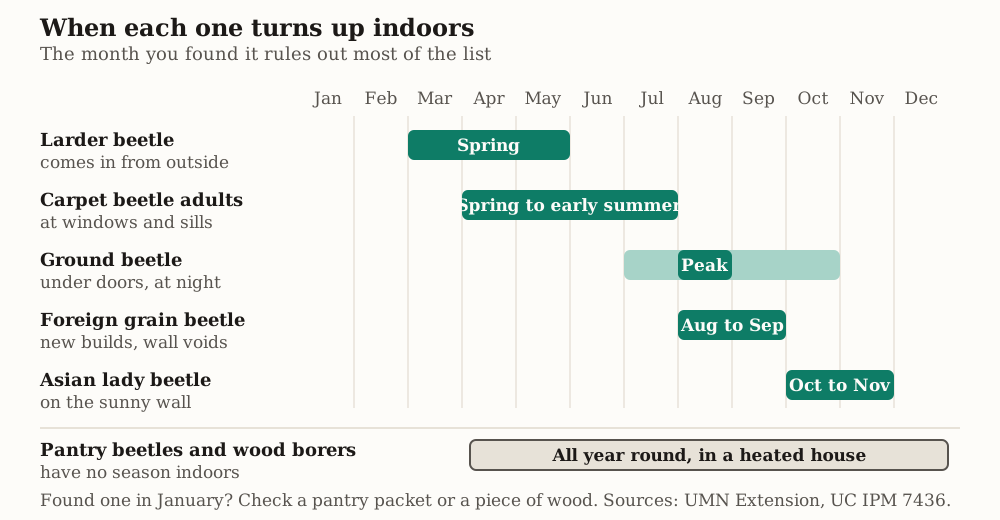
- A season arrived. Most house beetles have one. Carpet beetle adults appear at windows in spring and early summer. Larder beetles come in during spring. Ground beetles arrive in August, and foreign grain beetles in August and September. Asian lady beetles cluster in October and November.
- A light is pulling them in. Bright white LEDs and mercury vapour bulbs draw beetles from a long way off, and then they find a gap. Yellow bulbs do not have the same effect.
- A package has been sitting too long. A forgotten bag of flour or dry pet food can supply a kitchen for months before anyone notices.
- The house is new. Damp lumber and drywall grow the mould that foreign grain beetles eat, for the first year or two only.
- Something died last season. A wall void full of dead cluster flies or boxelder bugs feeds larder beetles the following spring.
- Something came in with you. Cut flowers, firewood, second-hand furniture and old rugs all carry beetles indoors.
One cause is not on that list, and its absence is deliberate. A clean house gets house beetles too. Carpet beetles fly in from flowers, pantry beetles arrive sealed inside a bag, and ground beetles do not care how the floor looks. Finding them says nothing about your housekeeping.
Part 4 of 4
What to do
How to get rid of house beetles, in order
Work down this list rather than across it. The first two steps cost nothing and settle most house beetle problems, and the last step is unnecessary far more often than the pest control pages suggest. The University of California states the principle directly: “If exclusion and sanitation are successful, insecticide treatments are not required.”
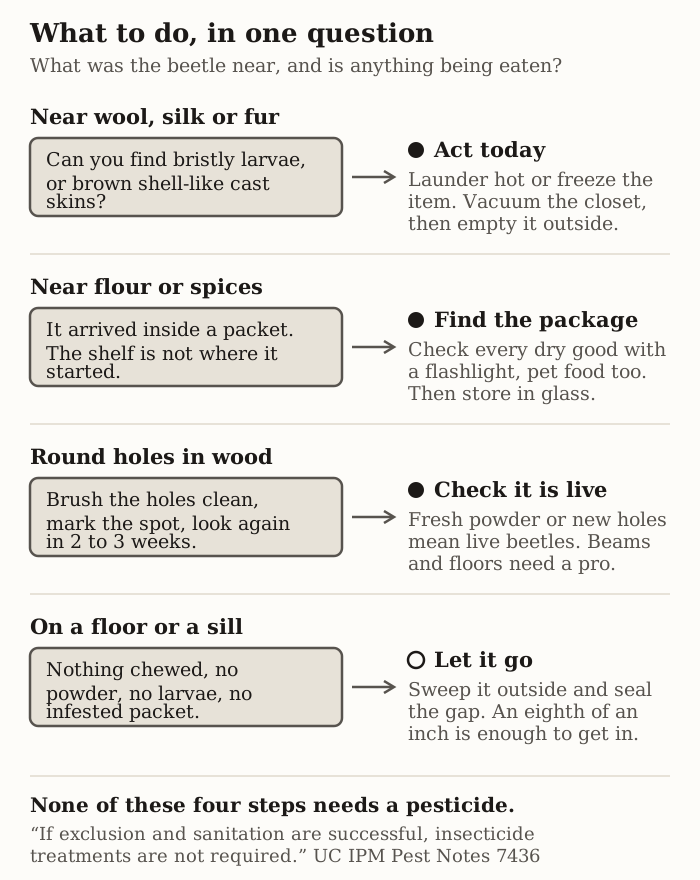
The house beetle clear-out, step by step
Vacuum, and empty it outside
Carpets, baseboards, closet floors, upholstery, cracks and the shelf the package sat on. This lifts eggs, larvae and the lint they feed on in one pass. Take the bag or canister contents straight outside, because they can still hatch.
Find and remove the source
With fabric, that is the item the larvae are in. With food, it is the package. Larder beetles mean dead insects in a wall void or an attic. Minnesota Extension puts it plainly: sprays and dusts indoors will not be effective if the food source is not removed.
Launder, freeze or heat what you are keeping
Washable fabric goes through a hot wash or dry cleaning, which kills every stage. Items that cannot be washed go into a freezer below 18°F (-8°C) for two weeks, or an oven at 120°F (49°C) for half an hour. Pantry packets need 0°F (-18°C) for four days, or 130°F (54°C) for thirty minutes.
Close the way in
Door sweeps, weather stripping, intact window screens, and hardware cloth over vents with openings under an eighth of an inch. A gap that small is enough for a ground beetle to walk through.
Change the lighting and the damp
Swap bright white exterior bulbs for yellow ones, move lights away from doors, and run a dehumidifier in a damp basement or a new build. Both are permanent fixes rather than treatments, and neither costs anything to maintain.
Only then consider a pesticide, and keep it narrow
Use a product whose label lists the beetle and the place you mean to use it, because the label is the law. Spot-treat carpet edges, closet floors and cracks. Never spray clothing, bedding, food or food surfaces. For large numbers arriving from outside, an exterior perimeter treatment is the usual approach.
How to keep house beetles out
Keeping house beetles out is mostly carpentry and habit, not chemistry. Nearly all of it is a one-off job that keeps working.
- Seal foundation cracks, gaps around utility lines and the space under doors. An eighth of an inch is enough for a beetle.
- Keep mulch about six inches clear of the siding, keep a gravel strip at the foundation, and stack firewood well away from the walls.
- Shake out and inspect cut flowers before bringing them in. That is how a great many carpet beetles arrive.
- Check second-hand furniture, rugs and boxes before they come through the door.
- Store dry goods in glass, metal or heavy plastic. Bags and cardboard are not barriers.
- Keep stored wool clean before it goes away, because food and perspiration stains attract carpet beetles. Air it once a year.
- Run a dehumidifier where the air stays damp. Below 60% relative humidity, foreign grain beetles cannot continue.
What does not work
Plenty of advice circulating about house beetles is harmless but useless, and a little of it is worse than that.
Myth 1
Myth: “Peppermint, cedarwood or citronella oil will repel them.”
Truth: Essential oils are sold as repellents, not as control. They do not reach larvae inside fabric, food or wood, which is where the problem is. Readers describe trying peppermint, cloves and dish soap in turn with no effect.
Myth 2
Myth: “A cedar chest protects wool.”
Truth: Cedar oil kills only very small larvae at best, and UC IPM notes that it dissipates over time. A tightly built, sealed container matters far more than the wood it is made of.
Myth 3
Myth: “Baking soda kills household pests.”
Truth: It does not. Videos promoting it collect tens of thousands of views and cost people weeks of effort.
Myth 4
Myth: “Spread diatomaceous earth around the room.”
Truth: Use only an EPA-registered product, applied into cracks and crevices, never broadcast across floors or furniture. The dust is an irritant to breathe, and a layer in the open does nothing useful.
Myth 5
Myth: “Set off a bug bomb.”
Truth: Foggers deposit on open surfaces. They do not get inside a wall void, a sealed package, a carpet pile or a piece of timber, which is where every one of these beetles lives.
Myth 6
Myth: “If you see a beetle in your home, leave immediately and call a doctor.”
Truth: This is circulating on social media and it is false. No house beetle in the US requires emergency care.
Myth 7
Myth: “Never kill a black beetle indoors or trouble will follow.”
Truth: An old superstition, still widely shared. It is folklore, not entomology.
Myth 8
Myth: “A brown beetle at the window must be a kudzu bug.”
Truth: A kudzu bug is not a beetle at all. It is a true bug, Megacopta cribraria, though at least one page ranking for common house beetles lists it as one.
When to call a professional
Most house beetle problems are a job for a vacuum and an afternoon. Four situations are not.
- Active wood borers in structural timber. Beams, joists, floors and frames need an inspection and, often, a borate or fumigation treatment that only a licensed applicator can carry out.
- A source you cannot reach. Dead animals in a wall void, an attic you cannot inspect, or a crawlspace are common causes of a larder beetle problem that keeps returning.
- Carpet beetles that survive a thorough clean. UC IPM describes them as among the most difficult indoor pests to control, because they disperse and feed in obscure places.
- Large numbers every year, from outside. A perimeter treatment at the right time of year is more effective than anything done indoors.
Ask whoever you call to show you the source they found. An inspection that produces a treatment plan but no source is one to question. Still not sure what you are holding? Take a sharp photo from above and run it through our bug identification tool before you buy anything.
Pest control disclaimer. Photo-based identification can help, but it is not always perfect. For dangerous spiders, large infestations, or anything you are unsure about, contact a licensed pest control professional.
Medical disclaimer. This page is for general information only. It is not a medical diagnosis. If you have severe symptoms, trouble breathing, swelling of the face or throat, fast spreading redness, fever, severe pain, pus, or signs of infection, contact a doctor or your local emergency number.
House beetle FAQ
Are house beetles harmless?
How long do house beetles live?
What do house beetles eat?
What is the hardest house bug to get rid of?
Why do I have beetles when my house is clean?
Should I be worried if I find one beetle in my house?
What attracts beetles into a house?
Related guides
Types of beetles
Name any beetle by size, colour and shape, indoors or out, starting with whether it is a beetle at all.
Carpet beetles
The commonest answer of all: the larvae, the damage, the rash, and how to find the source.
Black beetle
Twenty-two black beetles found indoors, sorted by size and shine.
June bug
The big brown beetle at the porch light in June, and why it keeps hitting the screen.
Drugstore beetle
The plain brown pantry beetle that breeds in spices and dry pet food, and flies to lamps.
Bugs that look like bed bugs
Fourteen insects mistaken for bed bugs, and the one feature that rules each in or out.
Ladybug vs Asian beetle
The orange beetles on your siding in autumn, and the mark behind the head that settles it.
Clothes moths
The other fabric pest. Webbing and scattered holes mean moths, not beetles.
Termite droppings
Ridged pellets mean termites, not beetle frass. What each one looks like up close.
Sources
- UC Statewide IPM Program, Pest Notes: Carpet Beetles, Publication 7436, D.H. Choe (updated 04/2020)
- UC Statewide IPM Program, Pest Notes: Wood-Boring Beetles in Homes, Publication 7418, V.R. Lewis and S.J. Seybold
- CDC, Emerging Infectious Diseases: Anthrenus sp. and an Uncommon Cluster of Dermatitis (2021)
- University of Minnesota Extension, Larder beetles, J. Hahn and S. Kells (reviewed 2024)
- University of Minnesota Extension, Ground beetles, J. Hahn and S. Kells (reviewed 2024)
- University of Minnesota Extension, Foreign grain beetle (reviewed 2024)