What do termite droppings look like?
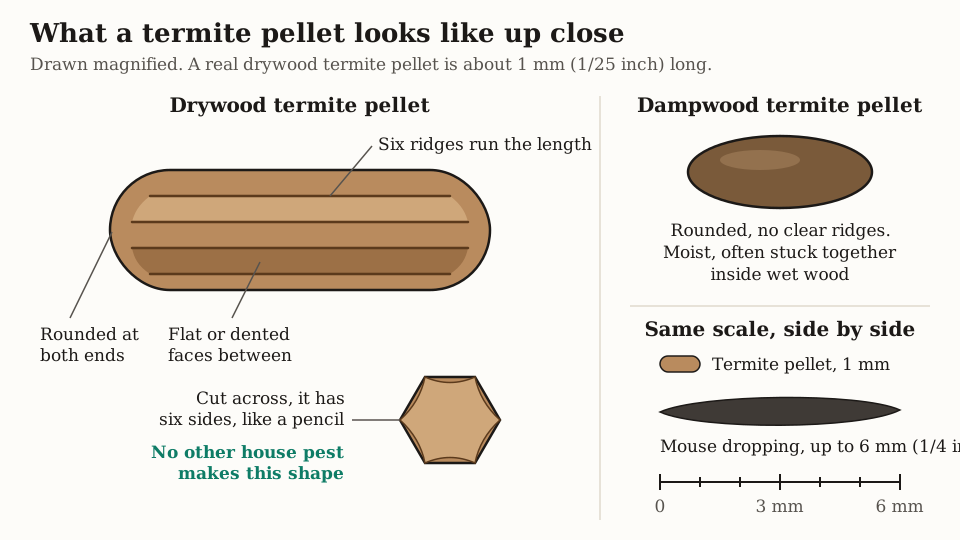
Termite droppings look like tiny, hard grains of sand or ground pepper. Each pellet is about 1 mm (1/25 inch) long, oval, with rounded ends and six flat or dented sides. They are all the same size and shape. In a pile they can be cream, tan, red, brown or black, often mixed together, and they feel gritty, not soft.
The six sides are the giveaway. Under a magnifier, ridges run along the length of each pellet, so a cut across it would look like a pencil. UC IPM calls these pellets diagnostic for drywood termites, because no other house pest makes them. You can see the shape with a phone camera zoomed all the way in.
Is it termite poop? Check these
Check each clue below to narrow down what you saw.
Hard grains that do not squash or smear when you press them
Soft or crumbly bits are not termite pellets.
Every grain the same size and shape, about 1 mm long
Mixed flakes, fibers and powder point to sawdust or other insects.
Six flat sides and rounded ends under a magnifier
This shape is unique to drywood termites.
A pile or a scattered circle with a small hole somewhere above it
Look straight up at the wood over the pile.
It comes back after you sweep it up
That means the termites are still feeding.
What color is termite poop?
Termite poop ranges from cream and tan to reddish brown and almost black, and one pile often holds several colors. Most pest control sites say the color matches the wood the termites ate, and so does Texas A&M. The termite researchers at the University of Florida disagree. Their 2020 fact sheet on the West Indian drywood termite says pellet color does not change with age or with the color of the wood. Nobody knows yet what sets it.
So do not read too much into the color. Dark pellets are not necessarily old, and pale ones are not necessarily fresh. The shape tells you it is termites. Only a new pile after you sweep tells you they are still active.
How big are termite droppings?
About 1 mm long, or 1/25 inch. That is roughly the size of a grain of coarse sand. Sources differ a little: Texas A&M gives about 1/32 inch (0.8 mm), the Extension Foundation about 1 mm, and Clemson’s Home and Garden Information Center about 1/16 inch (1.6 mm). Either way, a single pellet is hard to see without a magnifier, which is why people notice the pile first.
What is termite dust?
“Termite dust” is what many people call a pile of termite droppings, because from a few feet away it looks like dust or fine sawdust. Up close, it is not dust at all. It is a heap of separate, hard pellets you could count one by one. Real dust, as fine as flour, usually comes from powderpost beetles or from sanding, not termites.
What is termite frass?
Termite frass is just another name for termite droppings: the dry fecal pellets that drywood termites push out of the wood they live in. “Frass” is the entomologist’s word for insect waste, and pest companies use it, so you will see “termite frass”, “termite poop” and “termite pellets” for the same thing.
Drywood termites spend their whole lives inside one piece of wood, such as a window frame, a rafter or a chair. As they eat, their tunnels fill up with waste. To keep the tunnels clear, the workers chew small “kick-out holes” to the surface, 1 to 2 mm across, and push the pellets out. Then they often seal the hole again with a plug, which is why the hole can be hard to find even when the pile is obvious.
Which termites leave droppings?
Only drywood termites leave loose piles of droppings in a house. Dampwood termites make pellets too, but theirs stay stuck inside wet wood. Subterranean termites, the most common kind in most of the US, leave no pellets at all: they use their droppings, with soil and saliva, to build mud tubes. So a pellet pile almost always means drywood termites.
What each kind of termite leaves behind
Hard, six-sided pellets in piles below pinholes
- Termite
- Drywood
- Where in the US
- California, Arizona, the Gulf coast, Florida, Hawaii and other warm coastal areas
- What it means
- A colony living in the wood above the pile
Rounded pellets with no clear ridges, moist and clumped inside soaked wood
- Termite
- Dampwood
- Where in the US
- Mostly the Pacific coast; a few kinds in Florida
- What it means
- A leak or rotting wood, plus termites
No pellets. Mud tubes and mud-packed tunnels instead
- Termite
- Subterranean, including Formosan
- Where in the US
- Nearly every state
- What it means
- Termites coming up from the soil
Drywood termite droppings
Drywood termite droppings are the classic termite pellets: dry, hard, six-sided and piled under a hole. Common places are window sills, door frames, baseboards, attics, wooden furniture and the floor under a beam. A drywood colony is small, often under 1,000 termites by UC IPM’s count, but one house can hold several colonies, so you may find more than one pile.
Drywood termites are a regional problem. The western drywood termite lives in California and the Southwest, while the West Indian drywood termite and its relatives live in Florida, Hawaii and along the Gulf coast. They also travel inland in old furniture, so a pile in a dresser bought secondhand is worth checking even in Ohio.
Dampwood termite droppings
Dampwood termite droppings are rounded at both ends like a football, but they lack the sharp ridges of drywood pellets. Because the wood they live in is wet, the pellets stick together along the tunnel walls or turn into a muddy paste, according to UF/IFAS. You rarely see them unless you break open soaked wood near a leak, a stump or a log.
Subterranean termites: mud, not pellets
Subterranean termites do not leave piles of droppings. They live in the soil and build mud tubes, about the width of a pencil, from the ground up to the wood they eat. Their droppings go into the walls of those tubes and tunnels. So if your “termite dirt” is soft, moist soil or crumbly mud, look for tubes on the foundation and spots of mud on drywall, not for pellets. Our guide to the signs of termites shows what those look like.
Termite droppings vs look-alikes
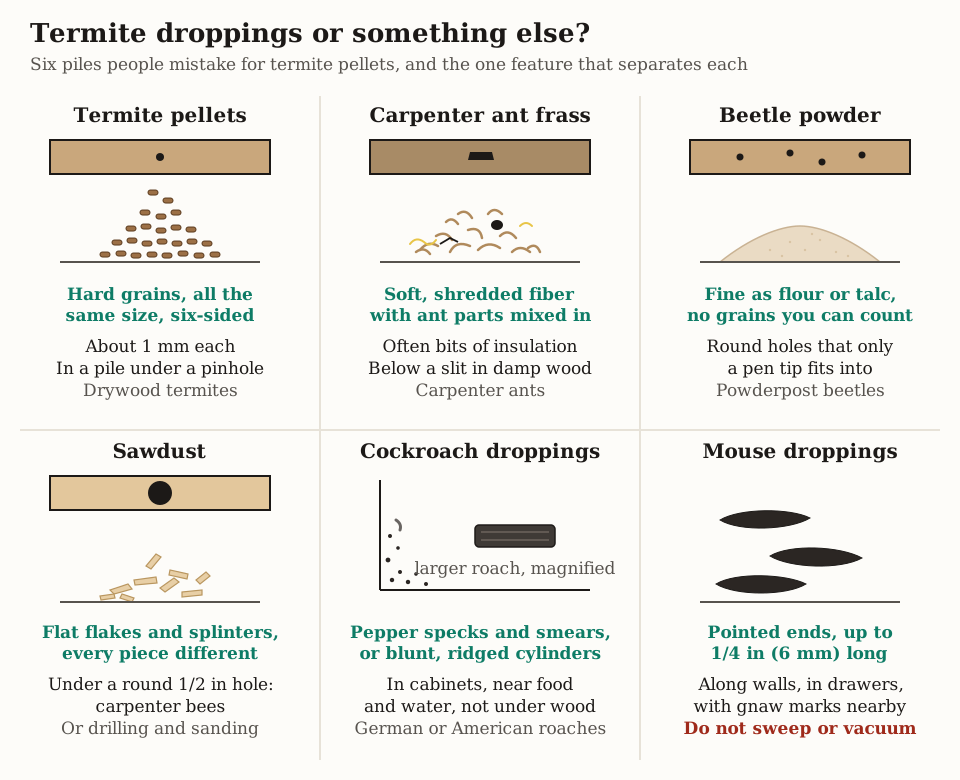
Plenty of things look like termite droppings from a few feet away: sawdust, drywall dust, carpenter ant frass, beetle powder, cockroach droppings, mouse droppings, sand and even coffee grounds. Only termite pellets are hard, all the same size, about 1 mm long, and six-sided. Check those four things, then look at where the pile is.
Termite droppings or something else? The separating feature first
Hard, same-size grains with six flat sides, below a pinhole
- What it is
- Drywood termite pellets
- Size
- About 1 mm (1/25 in)
- What it means
- Drywood termites in the wood above
Soft, shredded wood fibers with ant legs, wings or insulation mixed in
- What it is
- Carpenter ant frass
- Size
- Uneven, fluffy
- What it means
- Carpenter ants nesting in damp wood nearby
Fine as flour or talc, below round holes only a pen tip fits
- What it is
- Powderpost beetle frass
- Size
- Powder, no grains
- What it means
- Wood-boring beetles, often in hardwood floors or furniture
Flat flakes and splinters, every piece different, below a round 1/2 in hole
- What it is
- Carpenter bee sawdust
- Size
- Flakes of many sizes
- What it means
- A carpenter bee tunnel, usually outdoors in bare wood
Specks like black pepper, smears, or blunt cylinders with ridges
- What it is
- Cockroach droppings
- Size
- Specks under 1 mm; larger roach droppings several times a termite pellet
- What it means
- Cockroaches, near food and water
Dark, pointed at one or both ends, can smear when fresh
- What it is
- Mouse droppings
- Size
- Up to 1/4 in (6 mm)
- What it means
- Mice. Do not sweep or vacuum (see below)
Fine sand or soil, in a ring by a crack in the slab or floor
- What it is
- Pavement ant soil
- Size
- Grains of sand
- What it means
- Ants digging a nest under the slab
Soft, damp, smells of coffee, stains when wet
- What it is
- Coffee grounds
- Size
- Uneven
- What it means
- A spill, not insects
Pale, chalky dust by a door, window or trim that rubs or lets in grit
- What it is
- Drywall, paint or outdoor dust
- Size
- Fine and uneven
- What it means
- A sticking door or a leaky window seal, not insects
Smooth, shiny brown capsules, rounded at both ends, with faint rings
- What it is
- Fly pupae
- Size
- 1/8–1/3 in (3–8 mm)
- What it means
- Flies breeding in something nearby
Termite frass vs carpenter ant frass
Termite frass is droppings. Carpenter ant frass is not: it is the wood the ants chew out of their nest and throw away, because carpenter ants do not eat wood. So it looks like coarse, shredded sawdust, and UC IPM notes it can hold wood fragments, soil and insect parts. Termite pellets are hard and identical. If you see dead ants, ant legs or bits of insulation in the pile, think carpenter ants.
Where you find it helps too. Carpenter ant frass shows up below slits in damp wood, often near a leak, and carpenter ants walk about at night. Our carpenter ants guide shows their nests, and our termites vs ants comparison covers the insects themselves.
Termite droppings vs sawdust: do termites leave sawdust?
No, termites do not leave sawdust. They eat the wood they chew, so everything that comes out is digested pellets. Real sawdust is flat flakes and splinters of every size, and it is soft. A pile of true sawdust under a round hole about 1/2 inch (13 mm) wide is a carpenter bee tunnel, which our carpenter bee guide covers. Sawdust with no hole usually comes from drilling, sanding or a door rubbing its frame.
Termite droppings vs mouse droppings
Mouse droppings are much bigger, up to 1/4 inch (6 mm), about six times longer than a termite pellet. They are dark, shaped like a grain of rice, and pointed at one or both ends. You find them scattered along walls, in drawers and behind appliances, not in a neat pile under a hole. Treat them with care, as the box below explains.
Termite droppings vs cockroach droppings
Cockroach droppings come in two kinds. Small roaches, such as the German cockroach, leave specks like black pepper and dark smears in cabinet corners and hinges. Big roaches, such as the American cockroach, leave blunt-ended cylinders with ridges down the sides. Those ridges are why people mistake them for termite frass. However, roach droppings are several times bigger than a termite pellet and come in mixed sizes. Both kinds turn up near food, water and warmth, not under wood. Our guides to the German cockroach and the American cockroach show what to look for next.
Coffee grounds, sand or soil?
Termite pellets are often described as looking like coffee grounds. However, grounds are soft, uneven and damp, they smell of coffee, and they stain a wet paper towel brown. Termite pellets stay hard and dry. What about fine sand or soil that keeps appearing beside a crack in a concrete floor? That is usually pavement ants. Penn State Extension says they push it out as they dig nests under slabs.
Termite eggs or droppings?
If the grains are hard and lie in a pile on a surface, they are droppings. Termite eggs are soft, pale and see-through, and they stay hidden deep inside the colony, never out on a floor or sill. Small white or cream specks that are soft may be insect eggs of another kind. Our page on baby termites and termite eggs shows the difference.
Where termite droppings show up
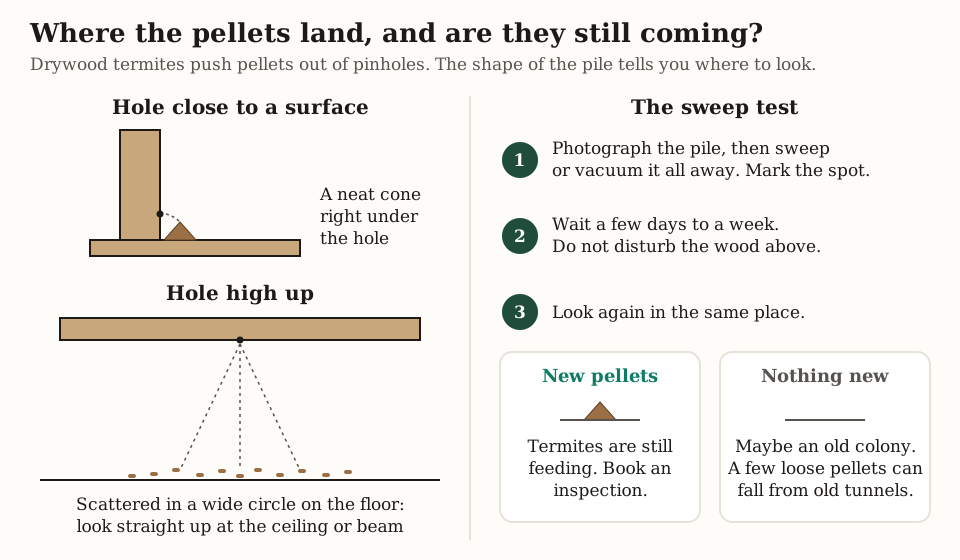
Termite droppings show up wherever drywood termites feed close to a surface. Look on window sills, along baseboards, under door frames, on attic floors, under wooden furniture and on the floor below beams. The pile sits right under the kick-out hole. If the hole is high, the pellets bounce and scatter in a wide circle instead of a neat cone.
Termite droppings from the ceiling
Pellets falling from the ceiling usually mean drywood termites in a ceiling joist, a rafter or the attic floor. They drop through gaps around light fixtures, ceiling fans, vents and crown molding. That is why people find them on counters, beds and even pillows. Check the attic above the spot with a flashlight, looking for pellet piles on the insulation and pinholes in the wood.
Termite droppings on a window sill or floor
A pile on a window sill usually comes from the window frame itself. Look at the frame just above the pile for a pinhole or a dark plug. On a floor, look at the baseboard, the door frame or the wood directly overhead. Outdoors, check deck railings, porch posts, fascia boards and wooden fences, since drywood termites infest those too.
Termite droppings in or under furniture
A small pile of termite droppings under a dresser, a bookcase or a wooden chair can mean the termites live in the furniture, not the house. This is common with antiques and secondhand pieces. Move the piece to a garage or another room, sweep the floor, and see whether the pellets follow the furniture. If they do, a pest professional can treat the piece on its own.
Termite droppings but no termites?
That is normal. Drywood termites never leave the wood, so you will almost never see them, even with an active colony. Old termite droppings can also keep falling from tunnels after the termites have died or been treated. UC IPM says pellets alone cannot tell you whether an infestation is active. The sweep test can: if a new pile appears within a few days to a week, they are still there.
Droppings but no termites: what it can mean
A new pile keeps coming back in the same spot
- Likely reason
- An active drywood colony in the wood above
- What to do
- Book an inspection
One old pile, nothing new after a week
- Likely reason
- An old or dead colony, or pellets shaken loose
- What to do
- Keep watching that spot for a month or two
A few pellets after doors slam or after repairs
- Likely reason
- Vibration knocking old pellets out of tunnels
- What to do
- Sweep and watch. A growing pile is different
Pellets in the weeks after fumigation or heat
- Likely reason
- Pellets falling from dead galleries
- What to do
- Sweep them up and watch; tell the company if piles keep growing
Pellets under one piece of furniture only
- Likely reason
- Termites in that piece, not the house
- What to do
- Move it and see if the pellets follow
Termite droppings after treatment
Some termite droppings after fumigation or heat treatment are expected. The termites are dead, but their old tunnels are still full of pellets, and movement shakes them out. UF/IFAS suggests clearing away every pellet and wing after a treatment. After that, new and growing piles, or new swarmers, usually mean the treatment missed a colony. Tell the company that did the work, since most treatments come with a warranty period.
Are termite droppings harmful?
No. Termite droppings are digested wood, and no extension or health source we checked links them to disease. The Extension Foundation calls them not dangerous or harmful. Like any fine dust, a crushed pile can irritate your nose or eyes if you stir it up. So vacuum rather than sweep, and wash your hands after cleaning. The real harm is to the wood the termites are eating.
Pellets that land on a bed or a pillow are a nuisance, not a health risk. Wash the bedding and look up for the source. A pet that licks up a few pellets is very unlikely to be harmed. If your pet seems unwell, call your vet. The bigger worry with any small dark droppings is mice, so rule them out first.
What to do if you find termite droppings
Do not panic, and do not spray. Look at the pellets closely, photograph them, keep a sample, and find the hole above. Then sweep the pile away and check the spot again in a few days. If new pellets appear, or you cannot tell, get a licensed termite inspection. Drywood termites work slowly, so you have time to get two or three opinions.
What to do when you find termite droppings
Look closely before you clean
Use a magnifier or zoom in with your phone camera. Hard grains that are all the same size and shape, with six flat sides, are termite pellets.
Photograph the pile and keep a sample
Take photos with a coin for size, then put a spoonful of pellets in a zip bag. An inspector can confirm them, and you keep proof after you clean.
Find the hole above the pile
Look straight up. Kick-out holes are 1 to 2 mm across, and termites often seal them with a dark plug, so a hole can be hard to spot.
Do the sweep test
Vacuum or sweep the pile away and note the exact spot. A sheet of dark paper or a strip of tape below it makes new pellets easy to see. Look again in a few days to a week. A new pile means the termites are still feeding.
Check for other signs nearby
Look for shed wings on sills, tiny holes, and wood that blisters, sounds hollow, or gives way to a screwdriver.
Do not spray or drill
Bug spray and foggers kill only the termites they touch. Drilling into the wood can spread the colony and makes the inspector's job harder.
Get an inspection
Ask a licensed termite company to inspect. Many do it for free. Renters should tell the landlord in writing, with the photos.
How to clean up termite droppings
Take your photos and sample first. Then vacuum the termite droppings, or sweep them onto a sheet of paper, and throw them away in a sealed bag. Wipe the surface with a damp cloth. Cleaning up does nothing to the termites, so the next step is the sweep test. If you are not sure the droppings are from termites, treat them as if they could be from mice and follow the CDC steps above instead.
Can you get rid of drywood termites yourself?
Not reliably. UC IPM says the products that control drywood termites are not sold for homeowner use, and that inspecting for them takes experience. Professionals choose between a whole-house treatment, such as fumigation (tenting) by a licensed fumigator, and a spot treatment of the infested boards. If you use any pesticide, use one registered by the EPA for that exact use and follow the label. The label is the law.
Our guide to termite treatment options explains each method, and the termite treatment cost guide shows what they usually cost. If the pellets came with damage, such as blistered paint or wood that crumbles, what termite damage looks like helps you judge how far it has gone.
Not sure the pellets came from termites at all, or found winged insects too? Start at our termite identification hub, which covers the insects, the four US types and how a swarm differs from an infestation.
Pest control disclaimer. Photo-based identification can help, but it is not always perfect. For dangerous spiders, large infestations, or anything you are unsure about, contact a licensed pest control professional.
Termite droppings FAQ
Do termite droppings smell?
Can termite droppings come from a neighbor's house?
Will an inspector find termite droppings?
Do termites poop?
What is the biggest enemy of termites?
Related guides
Termites
What termites look like, which of the four US kinds you have, and what to do next.
Signs of termites
Every sign at a glance: mud tubes, wings, pellets, damage and sounds, and what each one means.
Termite damage
What termite damage looks like in walls, floors and frames, and how it differs from rot.
Termite inspection
What an inspector checks, how long it takes, and how to read the report.
Carpenter ants
The ants behind most sawdust piles: coarse frass, damp wood and no pellets.
Termite treatment
Fumigation, heat, spot treatment, soil treatment and baits, and which fits your termites.
Fly pupae
Small brown capsules on the floor that get mistaken for droppings.
German cockroach
The roach whose pepper-like droppings get mistaken for termite frass.
Sources
- UC IPM Pest Notes 7440, Drywood termites
- UC IPM Pest Notes 7415, Subterranean and other termites
- UF/IFAS EDIS EENY-79, West Indian drywood termite (2020)
- UF/IFAS ENY-211, Drywood and dampwood termites (archived)
- Texas A&M AgriLife, Urban entomology: drywood termites
- Clemson Home and Garden Information Center, Drywood termites
- Extension Foundation, How to get rid of drywood termites
- UC IPM Ant key, Carpenter ant and termite frass
- UC IPM Pest Notes 7418, Wood-boring beetles in homes
- Cornell NYS IPM, Identifying your pest with poop
- Penn State Extension, Pavement ant
- CDC, How to clean up after rodents
- EPA, Termites: how to identify and control them