How much does termite treatment cost?
Most homeowners pay $1,000 to $3,000 to treat a house for subterranean termites, plus $200 to $500 a year to renew the warranty. Drywood termites cost more when the whole house needs tenting, at about $2,000 to $8,000. A small spot treatment can be a few hundred dollars. The exact price depends on the termite, the method and the size of the foundation.
These ranges come from three kinds of source, and none of them is perfect. Mississippi State Extension is the only university source we found that gives prices. In its homeowner questions, it calls $1,000 to $2,000 for the first treatment and about $200 to $300 a year to renew “a very rough estimate” for most single-family homes. In a 2022 news story, its entomologist put a 2,000 square foot house at $1,200 to $2,000.
The rest of our termite treatment cost figures come from cost websites, which collect what their users paid, and from quotes homeowners have posted online. We show both below and say which is which. Prices also rise over time, so treat any figure older than a year or two as a floor.
Termite treatment cost by method: typical first-year price and what it is priced on
Subterranean termites (mud tubes)
- Usual treatment
- Liquid soil treatment around the whole house
- Typical price
- $1,000–$3,000
- Priced on
- Linear feet of foundation, plus drilled concrete
- Every year after
- Optional renewal, about $200–$500
Subterranean termites (mud tubes)
- Usual treatment
- Bait stations around the house
- Typical price
- $1,000–$2,500 to install
- Priced on
- Linear feet, or the number of stations
- Every year after
- Service fee, about $200–$400. Needed to stay protected
Drywood termites spread through the house (pellets)
- Usual treatment
- Tenting (fumigation) or whole-house heat
- Typical price
- $2,000–$8,000
- Priced on
- Size of the building, often $1–$4 a sq ft
- Every year after
- None. No lasting protection
Drywood termites in one board or room
- Usual treatment
- Local injection, foam or orange oil
- Typical price
- About $350–$1,500
- Priced on
- The area treated
- Every year after
- Sometimes a short warranty
A small subterranean spot
- Usual treatment
- Spot treatment inside or outside
- Typical price
- About $350–$1,000
- Priced on
- The spot
- Every year after
- Usually little or no warranty
Ranges are rounded from Mississippi State Extension, HomeGuide and This Old House (cost websites built from what their users and partner companies charge), and the reader quotes below. Your local price can sit outside them.
Why the prices online disagree so much
You will see an “average termite treatment cost” of about $600 on some sites and $2,000 or more on others. Both can be true. The low averages count every job, including a $300 spot treatment or a single visit. The higher figures are whole-house treatments. So a national average tells you very little about a quote for your whole house.
Cost websites also differ in where their numbers come from. Some survey their own customers, and some ask the companies that advertise with them. None of them is a random survey of termite companies. That is why we lean on real quotes and the per-foot price below.
What homeowners were actually quoted
Real quotes posted by homeowners from 2019 to 2025 mostly fall between $1,500 and $3,000 for a subterranean treatment, with renewals of about $180 to $480 a year. Tenting quotes ran from about $1,600 to $4,500. The highest quotes came with longer guarantees or bigger houses, which is why the scope matters more than the total.
We read the price threads on Reddit, where a thread titled “How much does termite treatment cost? Did I overpay?” sits above every cost website on Google. We kept only the posts that gave a price and the job it covered. These are strangers’ reports, not checked invoices, so read them as a sense check.
Termite quotes that homeowners posted on Reddit, newest first
Arizona (Scottsdale)
- House
- 2,300 sq ft
- What was quoted
- Subterranean: liquid, bait or both, plus one inside wall, 5-year guarantee
- Price
- $2,500 to $4,300 (three options), then $250 a year
- Year
- 2025
California (Los Angeles area)
- House
- Not given
- What was quoted
- Drywood: three bids, one local treatment and two tentings
- Price
- Local $2,630; tenting $2,360, or $1,700 to $2,500 by warranty length
- Year
- 2025
Southern California
- House
- Not given
- What was quoted
- Subterranean: trench and drill the perimeter, foam in the drywall
- Price
- $1,800
- Year
- 2025
Not given
- House
- 2,000 sq ft
- What was quoted
- Subterranean: drill the concrete, trench the soil, checks every 90 days for 5 years
- Price
- $1,944
- Year
- 2025
Not given
- House
- Older house
- What was quoted
- Drywood: tenting
- Price
- $1,600
- Year
- 2025
Texas (Houston)
- House
- 2,900 sq ft, two stories
- What was quoted
- Drywood: whole-house tenting, prep included
- Price
- About $4,500
- Year
- 2024
Florida (Central)
- House
- 90-year-old house
- What was quoted
- Subterranean: re-treatment-only bond
- Price
- $1,500 the first year, then $480 a year
- Year
- 2024
Not given
- House
- Has a basement
- What was quoted
- Subterranean: bait stations
- Price
- $1,500 a year
- Year
- 2024
Not given
- House
- Not given
- What was quoted
- National company plan that also pays for repairs
- Price
- $113 a month the first year, then $33 a month
- Year
- 2024
Not given
- House
- Not given
- What was quoted
- Formosan: five quotes for bait, trenching, or opening the wall
- Price
- $800 to $2,600
- Year
- 2021
Not given
- House
- 2,400 sq ft, 1,800 on the ground floor
- What was quoted
- Subterranean infestation
- Price
- $4,200
- Year
- 2021
North Carolina (Chapel Hill)
- House
- Not given
- What was quoted
- Yearly plans: bait service, or inspect-and-treat with a repair bond
- Price
- $350 a year (bait) or $180 a year (bond)
- Year
- 2021
Texas
- House
- 4,000 sq ft
- What was quoted
- Subterranean: small spot, then a full trench
- Price
- $200 spot; $500 trench
- Year
- 2021
California (Northern)
- House
- About 100 years old
- What was quoted
- Local treatment under the house
- Price
- $1,700
- Year
- 2021
Not given
- House
- Not given
- What was quoted
- Bait system
- Price
- $2,000 to install, then $300 a year
- Year
- 2020
Not given
- House
- Not given
- What was quoted
- Drywood tenting, plus a subterranean treatment
- Price
- $2,000 tenting; $1,600 subterranean
- Year
- 2020
Not given
- House
- Not given
- What was quoted
- Subterranean: soil plus drilled slabs, 4-year warranty
- Price
- $2,800, then $280 a year
- Year
- 2020
Not given
- House
- Not given
- What was quoted
- Subterranean: front of the house only
- Price
- $900
- Year
- 2020
Not given
- House
- About 2,000 sq ft
- What was quoted
- Subterranean treatment
- Price
- $1,700
- Year
- 2020
Midwest
- House
- 2,700 sq ft plus garage; basement, slab and crawl space
- What was quoted
- Subterranean treatment
- Price
- $1,700
- Year
- 2019
From r/Termites and r/pestcontrol, read through the Arctic Shift Reddit archive in October 2026. “Not given” means the post did not say.
Did I overpay? How to check a termite quote
Divide the price by the linear feet it covers. Two commenters who said they worked for a national company put their branch prices at $8 and $10 a foot for a trench treatment. Mississippi State’s figure for a one-story 2,000 square foot house works out to about $6 to $11 a foot. So a $1,800 quote on 200 feet ($9 a foot) is in line. Some markets run lower: a Texas commenter in 2019 put local prices at $2.50 to $4.50 a foot.
A quote well above that band is not always too high, though. Look at what it adds. The Arizona quote of up to $4,300 bundled liquid, bait and five years of re-treatment. The Florida bond charged $480 a year. Ask the high bidder what the extra money buys, then ask the low bidder whether it covers the same feet.
Readers who asked “is this fair?” got the same answers again and again: get at least three quotes, watch whether the inspector checks the hard-to-reach spots, and be wary of a price far below the others. A company that cuts the price to win the job may not come back when the warranty is needed.
Termite treatment cost by method
The termite decides the method, and the method sets the termite treatment cost. Liquid treatment and bait stations for subterranean termites usually cost $1,000 to $3,000. Tenting for drywood termites costs $2,000 to $8,000. Local treatments for one board or one spot cost a few hundred dollars. How each method works is on our termite treatment guide.
Liquid soil treatment
A liquid treatment usually costs $1,000 to $3,000 for a house. The technician digs a narrow trench along the foundation, floods it with termiticide, and drills through any concrete that touches the house. Companies price it by the foot because the product and the labor both follow the foundation.
Cost websites quote anywhere from $3 to $20 a foot, which is too wide to use. The quotes above suggest $6 to $11 a foot is more typical. A much lower price can mean fewer feet or a lower product rate, so ask. Texas A&M found the highest rate on the label usually lasts longest, even if it costs a little more.
How much do termite bait stations cost?
A bait system usually costs about $1,000 to $2,500 to install, then $200 to $400 a year to service, by HomeGuide’s figures. The yearly fee is not optional in the same way as a liquid renewal. Mississippi State is clear that bait gives no lasting protection once the stations stop being serviced.
So compare bait over ten years, not one. A low install price with a high yearly fee can cost more in the end. One reader got a quote of $1,500 a year for bait, which is high, and was right to get two more quotes.
Termite tenting and fumigation cost
Tenting a house for drywood termites usually costs $2,000 to $8,000, or about $1 to $4 per square foot of the building, by HomeGuide’s figures. This Old House gives $1,500 to $5,000. A reader in Houston paid about $4,500 for a 2,900 square foot two-story house in 2024. The size of the building, not the foundation, sets the price.
Budget for the extras, too. UC IPM notes that people, pets and plants must leave for several days, someone must put out gas pilot lights, and the tarps can damage roofs. So add hotel nights, boarding for pets, and any roof repair. Tenting also leaves no lasting protection, so new drywood swarmers can move in later.
Fumigation is a job for a licensed fumigator only. The gas, sulfuryl fluoride, is applied under a sealed tent, and the house must be cleared before anyone goes back in. HomeGuide puts whole-house heat at about $1 to $3 a square foot, and UC IPM notes you are out for hours rather than days. Like tenting, it leaves no residue.
Spot treatment and no-tent options
A spot treatment usually costs $350 to $1,000, according to This Old House. For drywood termites in one board, local injection, foam or orange oil can be a fair choice. One Reddit commenter put California tenting at $1,800 to $2,200 and local treatment at $800 to $3,000. UC IPM warns local methods work only where the termites actually are, so a missed pocket survives.
For subterranean termites, a spot treatment is a gamble. The University of Kentucky says colonies forage in many directions, and most reputable firms will not warrant a spot job. Texas A&M adds that spot treatments often come with limited warranties, so a full treatment can be the better value.
Termite treatment cost by house size: per linear foot, not per square foot
Liquid and bait treatments are priced per linear foot of foundation, not per square foot of floor. A 2,000 square foot one-story house has about 180 to 210 feet of foundation, which at $6 to $11 a foot is about $1,100 to $2,300. The same floor area on two stories has only about 130 feet, so it often costs less to treat.
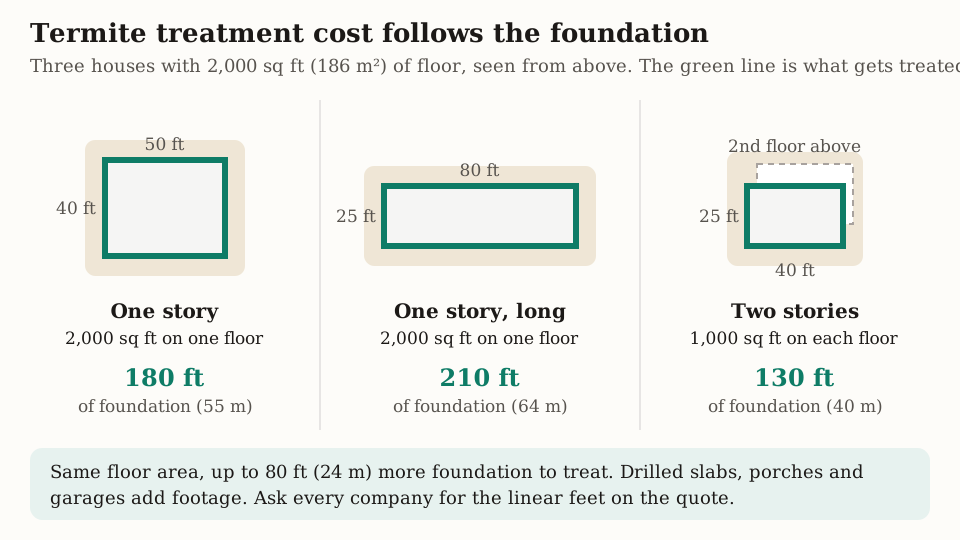
Feet of foundation by floor area, and a rough liquid treatment price at $6 to $11 a foot
1,000 sq ft (93 m²)
- Foundation, one story
- About 126 ft (38 m)
- Foundation, two stories
- About 89 ft (27 m)
- Rough price, one story
- $760–$1,390
1,500 sq ft (139 m²)
- Foundation, one story
- About 155 ft (47 m)
- Foundation, two stories
- About 110 ft (34 m)
- Rough price, one story
- $930–$1,710
2,000 sq ft (186 m²)
- Foundation, one story
- About 179 ft (55 m)
- Foundation, two stories
- About 126 ft (38 m)
- Rough price, one story
- $1,070–$1,970
2,500 sq ft (232 m²)
- Foundation, one story
- About 200 ft (61 m)
- Foundation, two stories
- About 141 ft (43 m)
- Rough price, one story
- $1,200–$2,200
3,000 sq ft (279 m²)
- Foundation, one story
- About 219 ft (67 m)
- Foundation, two stories
- About 155 ft (47 m)
- Rough price, one story
- $1,310–$2,410
Our arithmetic for a square footprint. Real houses have corners, wings, porches and garages, so the true foundation is usually longer. Drilled concrete adds more.
How much is termite treatment for a 2,000 sq ft house?
Plan on about $1,200 to $2,000 for a liquid or bait treatment, which is Mississippi State’s figure, and up to about $3,000 with a lot of concrete to drill or a long warranty, as several reader quotes show. Two readers with 2,000 square foot houses got quotes of $1,700 and $1,944. Tenting the same house for drywood termites would be about $2,000 to $8,000.
Estimate your own price
There is no reliable termite treatment cost calculator, because no one publishes local prices. Still, you can get close enough to judge a quote in about ten minutes with a tape measure.
How to estimate termite treatment cost for your house
Find out which termite you have
Mud tubes mean subterranean termites, which are priced by the foot of foundation. Six-sided pellets mean drywood termites, which are priced by the size of the building or the area treated.
Measure the outside of the foundation
Walk around the house with a tape or a measuring wheel, or add up the sides from your house plan. A 50 by 40 foot house has 180 feet. Count an attached garage and porch.
Add the concrete that needs drilling
Note patios, walks, driveways and garage slabs that touch the house, and any slab cracks or bath traps inside. Drilling usually costs more than trenching soil.
Multiply by a per-foot range
Two people who said they work for a national company put their branch prices at $8 and $10 a foot. Mississippi State's figure for a one-story 2,000 square foot house works out to about $6 to $11 a foot. Use that as a rough band.
Add the yearly renewal
Plan on about $200 to $500 a year if you keep the warranty. Texas A&M says the renewal should not be more than 20% of the first treatment.
Check it against real quotes
Your number is a sense check, not a price. Get two or three written quotes, then divide each price by the feet it covers to compare them.
What changes the price of termite treatment
Six things move the termite treatment cost most: the type of termite, the method, the length of the foundation, how much concrete and crawl space there is, where you live, and the warranty you buy. Two quotes on the same house can differ by $1,000 or more for these reasons alone. Five quotes for one Formosan termite job ranged from $800 to $2,600.
What raises or lowers a termite quote
Type of termite
- What raises the price
- Drywood spread through the house (tenting); Formosan colonies
- What keeps it lower
- Native subterranean termites in one area
Method
- What raises the price
- Tenting, heat, or liquid and bait together
- What keeps it lower
- Liquid only, or a local treatment where it fits
Foundation length
- What raises the price
- Long one-story houses, wings, attached garages
- What keeps it lower
- Compact or two-story houses
Construction and access
- What raises the price
- Slabs, patios and driveways to drill; crawl spaces; finished basements; spray foam
- What keeps it lower
- Bare soil around the house, open crawl space
Where you live
- What raises the price
- Heavy termite areas: the Southeast, Gulf coast, Hawaii, California
- What keeps it lower
- Areas with fewer termites
Warranty
- What raises the price
- Repair coverage, long terms, Formosan coverage
- What keeps it lower
- Re-treatment only, one year
Why a crawl space or slab costs more
A slab house needs holes drilled through any concrete that touches the foundation, and sometimes inside, at bath traps and cracks. A crawl space means work in a tight, dirty space along every pier and wall. Both take longer than trenching soil. A Reddit commenter added that porches, decks and thick landscaping cost more to work around.
Some houses do not allow a treatment to the usual standard at all. The University of Kentucky notes that wells, drains, heating ducts under the slab, or a crawl space nobody can reach can mean no warranty is offered. Spray foam insulation is another one: Mississippi State and UF/IFAS both note that some companies will not warrant those houses.
Annual renewals, warranties and termite bond cost
A yearly termite renewal usually costs about $200 to $500, and over ten years it can be the larger part of the termite treatment cost. Mississippi State gives $200 to $300 as a rough figure, and reader quotes ran from $250 to $480. Texas A&M says a renewal should not cost more than 20% of the first treatment. On a $1,500 job, that is $300 a year at most.
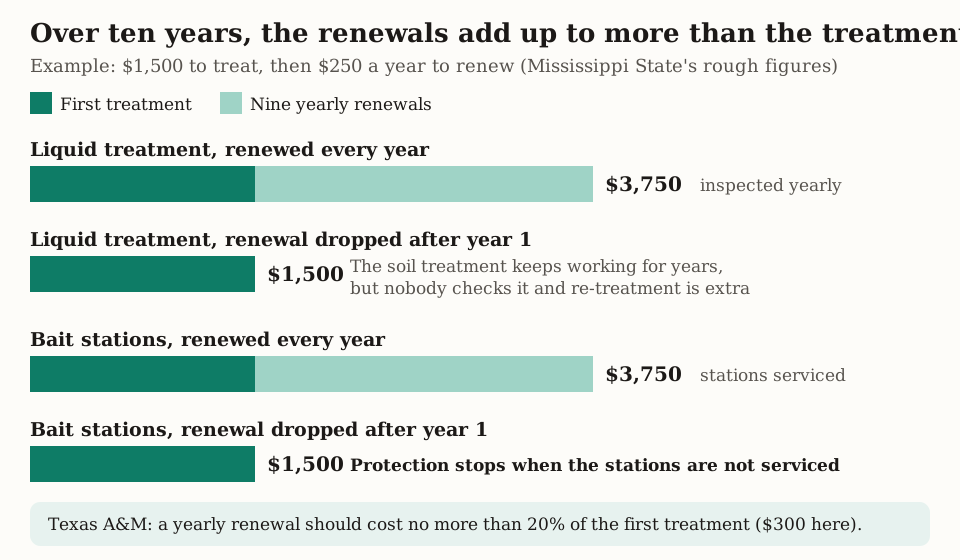
The renewal buys a yearly inspection and free re-treatment if termites come back. What happens when you stop paying depends on the method. Mississippi State explains that a liquid treatment keeps working in the soil for years after the contract lapses. Bait does not, because the stations need servicing.
Termite bond cost: re-treatment or repair?
A termite bond is the yearly contract that keeps the warranty in force, and it is common in the South. With a re-treatment bond, the company only treats again. A repair bond also pays to fix new damage, up to a limit, and costs more. One Florida reader got a quote of $1,500 for the first year of a re-treatment bond, then $480 a year.
Read the terms before you compare prices. That reader found “more loopholes for the company to avoid re-treatment than there is actual coverage.” Look for what voids it: wood mulch against the house, a leak left unfixed, a remodel, or skipped inspections. UF/IFAS notes that moisture and plants against the house can void some warranties.
Ask, too, whether the renewal fee can rise and by how much. Some contracts let it change each year. A bond that moves to the next owner when you sell is worth more, since buyers in termite country look for one.
Is a termite bond worth it?
In heavy termite areas, usually yes for the first few years. Texas A&M suggests keeping an extended warranty for at least one to two years after treatment, or for a year after termites were last seen. Mississippi State goes further for the Southeast: keep the house treated and the contract in force. Where termites are rare, a yearly inspection may be enough.
How to read a termite quote and compare two
A good quote names six things: the termite found and where, the method and product, the linear feet and concrete treated, the price, the warranty and renewal fee, and what is excluded. Without those you cannot compare two quotes. With them, you can divide each price by its feet and see which one is really cheaper.
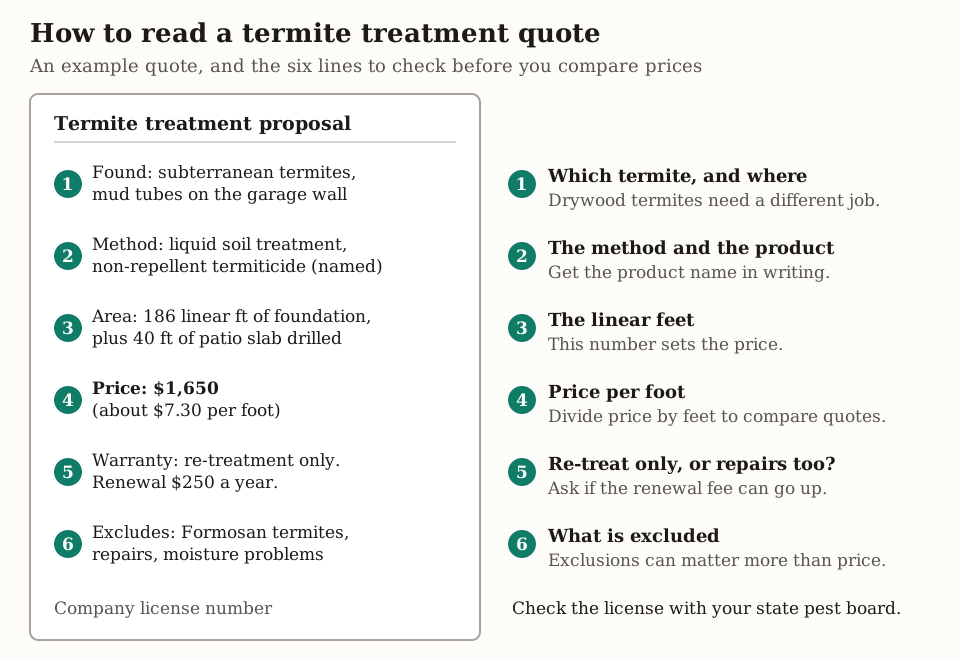
How to compare two termite quotes
Get two or three inspections
Ask each company to show you what it found. If one finds termites and another does not, that matters more than the price.
Make each quote list the same things
The termite found, the method and product, the linear feet and slab treated, the price, the warranty, the renewal fee and the exclusions.
Work out the price per foot
Divide each price by the feet it covers. A cheap quote that treats half the house is not cheaper.
Compare the warranties
Re-treatment only or repairs too? For how long? Can the renewal fee go up, and is there a cap?
Add ten years of renewals
Multiply the yearly fee by nine and add the first-year price. That is the real cost of each offer.
Check the license
Termite work needs a state license. Look the company up with your state's pest control board or department of agriculture before you sign.
Ask before you sign
Get the answers in writing. A good company will not mind.
Which termite did you find, and can you show me where?
No live termites found? Ask why treatment is needed now.
How many linear feet will you treat, and which slabs will you drill?
This is the number to compare across quotes.
What product, and at what label rate?
The label is the law. Ask for a copy if you want one.
Is the warranty re-treatment only, or repairs too, and for how long?
Get the exclusions in writing.
What is the renewal fee, and can it go up?
Texas A&M: no more than 20% of the first treatment.
Are the company and the technician licensed in this state?
Termite work needs its own license.
Does the inspection cost extra?
Usually not. Texas A&M notes that termite inspections are often free, unless you need a formal report for a home sale. Our guide to termite inspections covers what the inspector checks, the real estate form, and what that report costs.
Who pays: buyers, sellers and renters
When a home sale turns up termites, the treatment and repairs are usually negotiated between buyer and seller. Readers on r/RealEstate report repair estimates of $4,000 to $19,000, and one buyer’s second opinion came in at “a fraction” of the first. If you rent, tell your landlord in writing and do not treat it yourself. Treating the building is the owner’s job.
Can you save money by treating termites yourself?
A store that sells do-it-yourself products puts them at $150 to $400 for a 2,000 square foot house, against $1,000 or more for a professional. But Texas A&M says tests there could not show do-it-yourself baits controlling termites. It also says the cardboard in many of them should be replaced every 3 to 4 months, which can make them cost as much as a professional system.
A full liquid treatment needs trenching, drilling and a lot of mixed termiticide, which is why both Texas A&M and Mississippi State call it a job for professionals. Texas A&M suggests limiting do-it-yourself work to sheds, fence posts, decks and woodpiles. If a do-it-yourself job fails, nothing pays for the damage.
If you do use a product, use only an EPA-registered termiticide labeled for that use, and follow the label exactly. The label is the law. Never pour gasoline, kerosene or other fuels into the soil or the walls: they are fire hazards and poison the soil without stopping a colony. Our guide to treating termites covers what works and what does not.
Is termite treatment worth the cost?
Yes, when an inspection confirms termites in the house. A termite treatment cost of $1,000 to $3,000 is small next to repairs, which Mississippi State says can run from a few thousand dollars to hundreds of thousands. Home buyers on r/RealEstate posted repair estimates of $12,000, $13,000 and $19,000. Standard homeowners insurance excludes insect damage, so you pay for both.
Is it expensive to get rid of termites? It is a real bill, but a one-time one, plus a yearly fee if you keep the warranty. The expensive part is waiting until the damage shows. Our guide to termite damage shows what that looks like and how much is too much.
How to keep the cost down without skipping treatment
Start with the steps that cost nothing. They lower the risk of termites coming back, and many warranties require them. Then shop the treatment itself. None of this replaces treatment once termites are in the house.
- Fix leaks, clean gutters and point downspouts away from the house. Moisture draws subterranean termites.
- Pull mulch, soil and firewood back so no wood touches the soil, and leave a strip of bare foundation where tubes would show.
- Get three quotes, and ask each one for its price per foot on the same scope.
- Ask whether liquid or bait is cheaper over ten years for your house, not just in year one.
- Ask a big company for its minimum price on the same scope, with a lower written quote in hand.
- Check whether a past owner’s warranty can be transferred to you before paying for a new one.
Not sure the insects are termites at all? Check first: our termite guide shows the three features that separate them from flying ants, and the signs of termites page shows what an active infestation leaves behind.
Pest control disclaimer. Photo-based identification can help, but it is not always perfect. For dangerous spiders, large infestations, or anything you are unsure about, contact a licensed pest control professional.
Termite treatment cost FAQ
How much does Terminix or Orkin charge for termite treatment?
Is termite treatment covered by homeowners insurance?
Can I negotiate a termite treatment price?
Do I have to pay the yearly renewal?
Can I get a termite inspection for free?
How long does a termite treatment last for the money?
Related guides
Termites
What termites look like, which of the four US kinds you have, and what to do first.
Termite treatment
How liquid, bait, tenting and spot treatments work, and which one your termite needs.
Termite inspection
What an inspector looks for, the real estate report, and what an inspection costs.
Signs of termites
Mud tubes, wings, droppings and hollow wood: the signs that mean treatment.
Termite damage
What damage looks like in floors, walls and ceilings, and how much is too much.
Termite or flying ant?
Check the insect before you pay for anything: three features settle it.
Sources
- Mississippi State University Extension, Common questions about termites and termite control
- Mississippi State University Extension, Costly termites are best prevented, not treated (2022, updated 2025)
- Texas A&M AgriLife Extension, ENT-2002, Frequently asked questions about subterranean termite control
- University of Kentucky Entomology, ENTFACT-604, Termite control: answers for homeowners
- UC IPM Pest Notes 7440, Drywood termites
- UF/IFAS EDIS IN1277, Termite prevention and control
- EPA, Termites: How to Identify and Control Them
- Insurance Information Institute, sample homeowners policy HO 00 03
- HomeGuide, Termite treatment cost (a cost website, updated November 2025)
- This Old House, Termite treatment cost (a cost website, updated June 2026)