What is a termite inspection?
A termite inspection is a careful look through a house, inside and out, for live termites, signs of termites, termite damage, and conditions that invite them. The inspector works from the crawl space or basement up to the attic, with a flashlight and a probe, and writes down what they find. A typical house takes 30 to 60 minutes.
Most people book one for one of two reasons. Either they found something, such as wings on a sill or a mud tube on the foundation, or they are buying or selling a house and the lender or the contract asks for a report. The termite inspection is the same visual check in both cases. The difference is the paperwork.
A report for a home sale goes by several names. The WDI report covers wood destroying insects. A WDO report covers wood destroying organisms, which adds wood-decaying fungi in some states, such as Florida. In parts of the South, people call the same paper a termite letter or a clearance letter.
Termite inspection or home inspection?
They are separate jobs. A general home inspector looks at the roof, wiring, plumbing and structure, and may note damage or insects in passing. A termite inspection is done by a licensed pest control inspector who looks only for wood destroying insects and signs of them. Some home inspectors also hold a pest license and can do both in one visit. Ask before you book, because a lender wants the WDI report on the proper form.
What does a termite inspector look for?
A termite inspector looks for three things: termites themselves, evidence of termites, and conditions that make an attack likely. Evidence means mud tubes, shed wings, droppings called frass, small exit holes and damaged wood. Conditions mean wood touching soil, wet soil or wood, mulch against the siding, and firewood stacked by the walls.
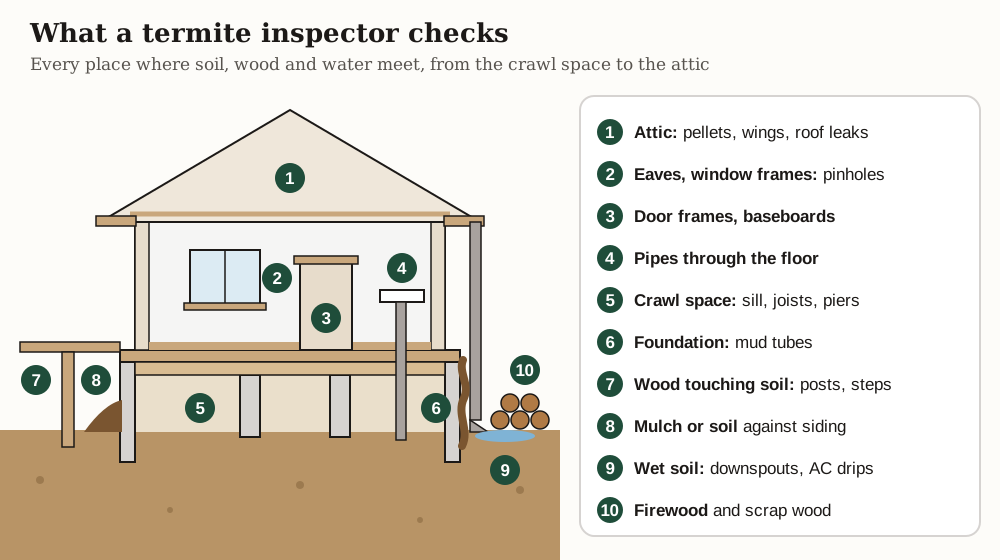
Where a termite inspection focuses depends on the kind of termite common in your area. For subterranean termites, which live in the soil, the inspector focuses low: the outside of the foundation, the crawl space or basement, the sill plate, the garage slab, and anywhere pipes come up through the floor. In areas with drywood termites, which live inside dry wood, they also check the attic, eaves, window frames, wood floors and sometimes wooden furniture.
What a termite inspector writes down, and what each finding means
Live termites in wood or a broken mud tube
- What it is
- Live insects
- What it usually means
- An active colony. Treatment is normally recommended
Mud tubes on a foundation, pier or wall
- What it is
- Evidence
- What it usually means
- Subterranean termites now or in the past. A tube with fresh, damp mud means now
Small piles of hard, six-sided pellets
- What it is
- Evidence
- What it usually means
- Drywood termites in the wood above
Piles of shed wings near windows
- What it is
- Evidence
- What it usually means
- A swarm, inside or close by
Wood that is hollow, layered or packed with mud
- What it is
- Damage
- What it usually means
- Feeding in that spot, old or current
Wood touching soil, wet soil, mulch on the siding
- What it is
- Conducive condition
- What it usually means
- No termites seen, but a fix is advised
Drill holes in the slab or a treatment sticker
- What it is
- Previous treatment
- What it usually means
- Someone treated the house before. Ask for the records
The inspector is reading the same clues you can see yourself, only with more practice and a better light. Our guide to the signs that termites are in a house shows each one in detail, and what termite droppings look like separates drywood pellets from the look-alikes.
What happens during a termite inspection?
A termite inspection usually starts outside, with the inspector walking the foundation for mud tubes and wood touching soil. Then they check the garage, the ground floor rooms, any crawl space or basement, and the attic where it matters. They tap and probe wood, check damp spots, and mark what they find on a report. Expect 30 to 60 minutes for an average house.
Probing is the main test. The inspector presses a screwdriver or probe into wood, or taps it and listens. Sound wood is hard and rings solid. Wood that termites have hollowed out sounds papery and gives way. Some inspectors also carry a moisture meter, because wet wood draws termites and a damp spot behind a wall can point to them.
At the end, a good inspector walks you through the findings and shows you anything they marked. For a routine visit, you may get a short written summary. For a home sale, you get the formal report, either on the spot or within a few days.
How long does a termite inspection take?
Most take 30 minutes to an hour. A large house, a deep crawl space, a lot of stored boxes, or signs of termites that need a closer look all add time. In California, where the report includes a sketch of the foundation and every finding, the state gives the company up to 10 business days to deliver the written report.
How to prepare for a termite inspection
A termite inspection only covers what the inspector can reach, so clear the way. Anything blocked goes on the report as “inaccessible”, and that is where problems hide.
Before the inspector arrives
Do these the day before.
Pull stored items about 2 feet (60 cm) away from garage and basement walls
Inspectors check the joints where the slab meets the walls.
Clear the crawl space door and the attic hatch
The NPMA-33 form lets an inspector call a crawl space inaccessible if there is less than 24 inches (61 cm) of clearance under the joists.
Empty the cabinets under the kitchen and bathroom sinks
Pipes coming up through the floor are a common entry point.
Trim shrubs and pull mulch back from the foundation
The inspector needs to see the bottom of the outside walls.
Have your old reports, treatment records and bond paperwork ready
They show what was found and treated before.
Tell the inspector what you saw and where, and show your photos
Swept-up wings or pellets cannot be inspected.
How much does a termite inspection cost?
A routine termite inspection from a pest control company is often free, because the company hopes to sell treatment or a yearly contract. A formal report for a home sale usually costs about $75 to $325, and about $100 to $130 on average. Bundled with a general home inspection, the two together run about $250 to $430.
Termite inspection cost, by type of inspection and by source
Routine check by a pest company
- Typical price
- Often free
- Where the figure comes from
- Texas A&M AgriLife; national companies advertise a free first inspection
Routine check by a company that charges
- Typical price
- Up to about $200
- Where the figure comes from
- LawnStarter price survey: $0 to $208
WDI or WDO report for a home sale
- Typical price
- $75 to $325, about $100 on average
- Where the figure comes from
- HomeAdvisor figures, as quoted by U.S. News
WDI or WDO report for a home sale
- Typical price
- $62 to $277
- Where the figure comes from
- LawnStarter price survey
WDO inspection by a home inspection firm
- Typical price
- $125 to $225 or more
- Where the figure comes from
- WIN Home Inspection
Termite check bundled with a home inspection
- Typical price
- $250 to $433 for both
- Where the figure comes from
- LawnStarter price survey
Yearly inspection under a termite contract
- Typical price
- Included in the renewal, often $200 to $300 a year
- Where the figure comes from
- Mississippi State Extension, a very rough estimate
The figures disagree because they measure different things, so read them as a range. What moves the price of a termite inspection: the size of the house, a crawl space versus a slab, how far the inspector drives, and, above all, whether you need a signed report for a lender. A report for a home sale costs more because the company takes on legal liability for what it signs. Florida, for example, requires companies that write these reports to carry insurance or a bond of at least $250,000 per claim, or to show a net worth of $500,000.
Do not mix this number up with the cost of treatment, which is a separate and much larger bill. Our termite treatment cost guide covers what liquid treatments, baits and tenting run.
Are free termite inspections really free?
Yes, the visit itself costs nothing, and Texas A&M notes that termite inspections are often free unless you need a formal report for a home sale. The catch is that the person inspecting also sells the treatment. Most are honest, but readers on Reddit describe free inspections that ended in a large quote for termites nobody could show them.
Protect yourself the simple way. Be there, ask the inspector to show you each finding, and get photos with the location written down. If a free inspection finds termites, get a second inspection from another company before you sign anything. Termites damage wood slowly, so a week of checking costs you nothing.
Who pays for a termite inspection when you buy a house?
It depends on your contract and local custom. In many places the buyer pays, as part of their inspections. In others the seller orders the report. On VA loans, the Department of Veterans Affairs has allowed veterans to pay for the termite report since 2022, and it encourages them to negotiate that cost and any repairs with the seller.
WDO and WDI inspections for a home sale
A WDO or WDI inspection is a termite inspection written up on an official form for a lender or a buyer. VA loans require one in 29 states and the District of Columbia, plus listed counties in eight more. FHA loans ask for one when there are signs of termites, or when the state, local custom or the lender calls for it. Most states use the NPMA-33 form, and some, such as Florida and California, have their own.
Which termite report a home sale needs
VA loan in a listed state or county
- Is a report needed?
- Yes, the VA makes it a condition of the loan
- Which form
- NPMA-33, or the state's own form
- Worth knowing
- The veteran may pay the fee. High-rise condo units are exempt
VA loan elsewhere
- Is a report needed?
- Only if the appraiser sees signs of termites or damage
- Which form
- Same
- Worth knowing
- The appraisal can trigger it anywhere
FHA loan
- Is a report needed?
- If there are signs of termites, or the state, local custom or lender requires it
- Which form
- NPMA-33, or the state's own form
- Worth knowing
- HUD's older guidance listed 14 states with their own form
Conventional or cash purchase
- Is a report needed?
- Only if your lender or your purchase contract asks for it
- Which form
- Usually NPMA-33
- Worth knowing
- Strongly worth it anyway in termite country
Florida home sale
- Is a report needed?
- When an inspection is done for a sale, the report must be on the state form
- Which form
- FDACS-13645
- Worth knowing
- Covers wood-decaying fungi too. A notice is posted near the attic or crawl space
California home sale
- Is a report needed?
- Usually asked for by the lender or the purchase contract
- Which form
- Structural Pest Control Board report
- Worth knowing
- Splits findings into Section 1 and Section 2
For a mortgage, the NPMA-33 report must be used within 90 days of the inspection. If closing slips past that, you need a fresh inspection. The form is not a warranty and is not a structural report, and it says so in plain words. If the inspector finds damage, a contractor or a structural engineer judges how serious it is. Our guide to termite damage covers what to ask for before you buy a house with damage on the report.
VA termite inspection: which states need one
The VA’s local requirements page (last updated July 11, 2025) requires wood destroying insect information for every property in Alabama, Arizona, Arkansas, California, Connecticut, Delaware, the District of Columbia, Florida, Georgia, Hawaii, Illinois, Indiana, Kansas, Kentucky, Louisiana, Maryland, Massachusetts, Mississippi, Missouri, New Jersey, New Mexico, North Carolina, Ohio, Oklahoma, Rhode Island, South Carolina, Tennessee, Texas, Virginia and West Virginia, and in Puerto Rico, the US Virgin Islands, Guam, American Samoa and the Northern Mariana Islands.
Colorado, Iowa, Nebraska, Nevada, New York, Pennsylvania, Utah and Wisconsin need it only in listed counties. In any other state, a VA loan needs a termite report only if the appraiser notes signs of insects, rot or damage. The rule comes from the VA Lender’s Handbook, which ties it to the areas where termite attack is rated “very heavy” or “moderate to heavy”. Ask your lender to confirm for your county.
FHA loans and termite inspections
FHA is looser than VA. HUD’s guidance has long said a termite inspection is needed only when there is evidence of an active infestation, when the state or local area requires it, when it is customary in the area, or when the lender wants one. That guidance comes from HUD’s archived reference pages, so ask your lender how it applies today. The NPMA-33 form states that it is approved for both FHA and VA loans.
The Florida WDO inspection
In Florida, the word is WDO, and the form is set by law. Under Florida Statute 482.226, when a licensed company inspects for wood destroying organisms for a real estate sale and charges a fee or writes a report, it must use the state form, FDACS-13645. The form covers termites, wood boring beetles and wood-decaying fungi. It lists live organisms, evidence, damage, areas that could not be reached, and any signs of past treatment.
Florida also requires the company to post a notice of the inspection, at least 3 by 5 inches (8 by 13 cm) and made to last 3 years, next to the attic access, the crawl space or another easy-to-reach spot. Treatments get a notice too. So when you tour a house, look by the attic hatch and the crawl space door: old stickers tell you who inspected or treated it, and when.
The California termite report: Section 1 and Section 2
California calls it a structural pest control report, or simply the termite report. It is written by a licensed Branch 3 inspector, includes a sketch of the house showing where each problem is, and must be delivered within 10 business days. The company also reports the address to the state Structural Pest Control Board.
The report sorts findings into two groups. Section 1 items show active infestation or infection, such as live termites or active fungus. Section 2 items are conditions likely to lead to problems, such as wood touching soil or a slow leak, with no infestation yet. Lenders and sellers usually focus on clearing Section 1. A third group, further inspection, lists areas the inspector could not reach.
Buyers in California have one more tool. The Structural Pest Control Board will send copies of inspection and completion reports filed for an address in the last two years. It is a simple way to see what an earlier buyer’s inspector found.
How to read a termite inspection report
The standard NPMA-33 report has five sections. Section II is the one that matters most: box A means no visible evidence was found, and box B means live insects, evidence or damage was seen. Then read Section IV, the list of areas the inspector could not reach. A clear report with a long Section IV tells you less than it seems.
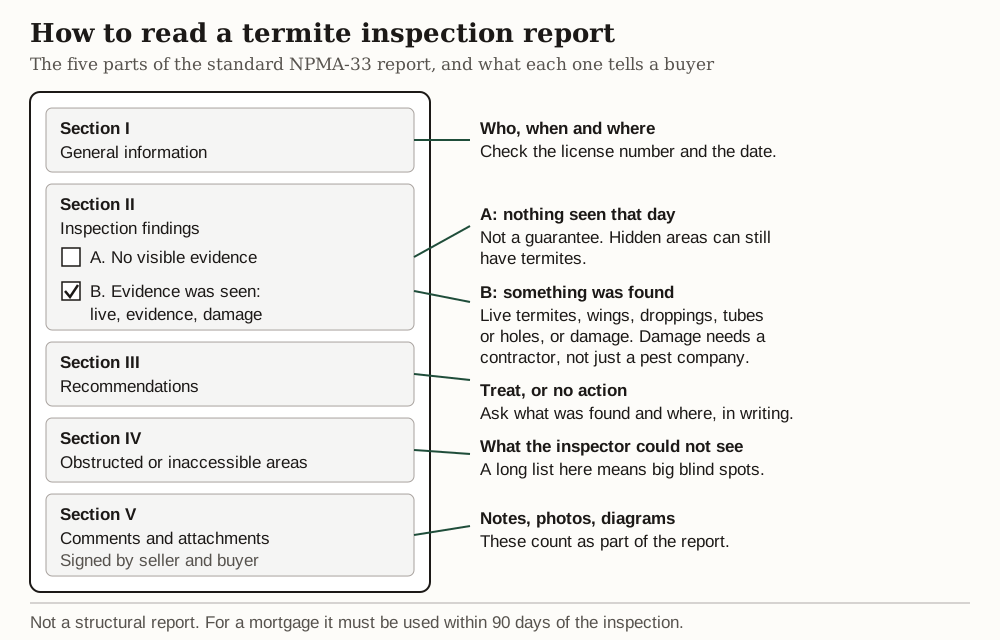
Read the words inside box B, not just the tick. “Evidence” can mean an old, empty mud tube from years ago. “Live insects” means an active colony. “Damage” tells you termites fed there, but not how badly the wood is weakened. If the report mentions a previous treatment, ask the seller which company did it, and whether a warranty or termite bond can be transferred to you.
What a clear report does not mean
A clear report means a trained inspector found no visible evidence on that day. It does not mean the house has no termites. Inspectors cannot see inside walls, under floor coverings, behind insulation or under a slab. Mississippi State Extension answers a buyer who found termites a year after a clear report: the report should not be viewed as a guarantee that the building is free of termites.
Some modern building methods make it harder. University of Florida entomologists warn that spray foam insulation can hide termite activity and block both inspection and treatment. If your report lists foam, finished basement walls or a crawl space too tight to enter, treat the clear result with caution. Pest professionals on Reddit say the same about sealed, foamed crawl spaces, and some companies void or downgrade a termite contract once they can no longer see the foundation.
What happens if the inspector finds termites?
The report will recommend treatment. The guidelines printed on the NPMA-33 say treatment should be recommended whenever live termites are found, and also when there is evidence of termites and no record of an earlier treatment. If the house was treated before and is still under a warranty, the report may leave it to the warranty company.
That rule explains a common complaint from sellers on Reddit: old mud stains or damage with no treatment record can mean no clear letter until the house is treated. Ask the seller for past treatment records first. Small drill holes in a concrete step, patio or garage slab are a sign of an earlier soil treatment.
You do not have to use the company that found them. Get one or two more inspections and written quotes, ask which termite was found and where, and compare the plans. Our guide to how termite treatment works explains which method fits which termite. If you are mid-purchase, the report becomes a negotiating point: buyers often ask the seller to treat, repair, or lower the price.
Can you do a termite inspection yourself?
Yes, a DIY termite inspection works well as a regular check between professional visits. A homeowner with a flashlight and a flat screwdriver can walk the house in about an hour and find most outside mud tubes, soft wood and moisture problems. You cannot write a report a lender will accept, and you should leave tight crawl spaces and attics to a professional.
The reason to leave those spaces alone is safety as much as skill. UC IPM points out that the telltale signs often sit in dark, hazardous places, such as attics and tight crawl spaces with nails, dust or standing water.
DIY termite inspection checklist
Get a flashlight, a flat screwdriver and your phone
Pick a dry, bright day. Wear old clothes and gloves. Bring a few zip bags for any insects or droppings you find.
Walk the outside of the foundation
Go slowly, all the way round. Look for mud tubes about the width of a pencil on concrete, block, brick, piers, pipes and steps, and look behind shrubs.
Probe the wood that touches soil
Press the screwdriver into deck posts, wooden steps, fence posts against the house and door frames at ground level. Sound wood resists. Wood with termite tunnels gives way or sounds hollow.
Find the water
Check that downspouts drain away from the house, that the air conditioner drip line is not soaking the soil, and that no outside tap leaks. Termites need moisture.
Check the gap above the soil
Look for at least 6 inches (15 cm) of bare foundation between the soil or mulch and the siding. Pull mulch back where it touches the wall.
Check the ground floor rooms
Look along baseboards, door frames and window sills for blistered paint, pinholes and small piles of wings or pellets. Open the cabinets under sinks where pipes come up through the floor.
Check the garage
Move boxes a couple of feet away from the walls. Look along cracks and joints in the slab and the bottom of the walls for mud.
Look under the house, only if it is safe
In a basement or crawl space, follow the sill plate, joists and piers with the light. Skip a tight, wet or dark crawl space: leave it for a professional.
In drywood country, look up too
In California, the Southwest, Florida, the Gulf coast and Hawaii, check the attic, eaves and window frames for tiny holes with hard, sand-like pellets below.
Photograph and leave everything in place
Take photos with a coin for size and note where you found each thing. Do not break tubes or sweep up pellets. If you found anything, book a professional inspection.
How often should you get a termite inspection?
A yearly termite inspection is the usual advice in the South and East. UF/IFAS, NC State and the University of Arizona all recommend a yearly professional inspection. UC IPM suggests every 3 to 5 years in California, and more often for a house that has had termites before. In states where the VA does not ask for a termite report, such as the Dakotas and Montana, less often is reasonable.
A yearly check is not just a sales pitch. Subterranean termite damage builds slowly and out of sight, so the gap between inspections is the time a colony has to feed unnoticed. If you have a termite contract or bond, the yearly inspection is usually part of the renewal fee. With bait stations, the yearly visits are what keep the protection working. A proper yearly visit still includes the crawl space. If the technician only walks the outside, ask why, or ask for a different technician.
Book an extra termite inspection, whatever the schedule, when any of these happen:
- Swarmers or piles of wings turn up inside the house.
- You find a mud tube, soft wood or small piles of pellets.
- A buyer asks for one, or you are buying a house.
- A remodel opens a wall and turns up mud or tunnels.
- Your neighbor has just had termites treated.
Choosing a termite inspector
Choose a licensed pest control company with a named, licensed inspector, and check the license with your state’s pest control regulator. For a home sale, the inspector should have no stake in the deal: Florida’s form and the NPMA-33 both include a statement that the inspector has no interest in the property.
California law prints a useful idea on every termite report: reports from different companies should list the same findings, but their recommendations to fix them may vary, and you have a right to a second opinion. That is good advice in any state. The findings are facts. The treatment plan is a sales choice.
Ask every termite inspector
Ask these before you sign anything, and get the answers in writing.
Are you licensed for termite work in this state? What is your license number?
Some states, such as Florida and California, license termite inspectors separately.
Which termite did you find, and exactly where? Can you show me?
Mud points to subterranean termites, pellets to drywood.
Is it active now, or old evidence?
Fresh, damp mud or live insects mean active.
Which areas could you not reach, and why?
These go in the inaccessible section of the report.
Can I have the findings in writing, with photos?
Use them to get a second opinion.
Do you also sell the treatment you are recommending?
Fine, but get a second quote before you sign.
For the bigger picture, our termite guide covers the four US termites, how to tell which one you have, and what a swarm means for your house.
Pest control disclaimer. Photo-based identification can help, but it is not always perfect. For dangerous spiders, large infestations, or anything you are unsure about, contact a licensed pest control professional.
Termite inspection FAQ
Is a termite inspection worth it?
Should I be home during a termite inspection?
Do termite inspectors drill holes?
Can I get a termite inspection on a condo?
Does a termite inspection check for other pests?
What time of year is best for a termite inspection?
Related guides
Termites
The four US termites, how to tell which one you have, and what to do first.
Signs of termites
Every sign an inspector looks for, and how sure each one is.
Termite treatment cost
What liquid treatments, baits and tenting cost, and how to read a quote.
Treatment options
Which treatment fits which termite, and what you can do yourself.
Termite damage
What damage looks like, how to tell it from rot, and buying a house with it.
Droppings and frass
Drywood pellets, and the look-alikes that fool people.
Termite swarmers
What a swarm in the house or yard means, and what to do.
Sources
- National Pest Management Association, Form NPMA-33, Wood Destroying Insect Inspection Report (HUD copy)
- U.S. Department of Veterans Affairs, Local requirements: wood-destroying insect information
- U.S. Department of Veterans Affairs, Circular 26-22-11, Pest inspection fees and repair costs (2022)
- HUD archives, HOC Reference Guide, Pest control (appraisal and property requirements)
- Florida Statutes, section 482.226, Wood-destroying organism inspection report
- Florida Department of Agriculture and Consumer Services, Form FDACS-13645, Wood-Destroying Organisms Inspection Report
- California Structural Pest Control Board, Structural Pest Control Act (Business and Professions Code 8516)
- California Structural Pest Control Board, Form 43M-19, Request for copy of inspection or completion reports
- Mississippi State University Extension, Common questions about termites and termite control
- UF/IFAS EDIS IN1277, Termite prevention and control
- UC IPM Pest Notes 7415, Subterranean and other termites
- Texas A&M AgriLife, ENT-2002, Frequently asked questions about subterranean termite control