What are termite swarmers?
Termite swarmers are the winged young kings and queens of a termite colony. A colony makes them only once it is mature, after about 3 to 10 years, and then sends hundreds to thousands out at once to mate and start new colonies. Scientists call them alates, which simply means winged. They do not eat wood, bite or sting.
A swarm is a mating flight. The same warm, wet weather sets off every mature colony in an area, so swarmers from different colonies meet in the air. Georgia Extension notes that colonies in the same area commonly swarm on the same day. That is why a whole street can see termites on one afternoon, and why pest companies get a wave of calls the same week.
The common eastern subterranean swarmer is dark brown to black and about 3/8 inch (10 mm) long including its wings. Formosan swarmers are tan to amber and about 1/2 inch (12 to 15 mm). All termite swarmers have straight antennae, a thick waist and four wings of equal length. Our guide to flying termites and what each kind looks like covers identification in detail, and the four checks that separate them from flying ants settle the usual doubt.
Why do termites swarm?
To spread. A colony cannot move house, so it sends out winged males and females instead. After a short flight, they land, break off their wings, and pair up. Then the female leads, the male follows close behind, and the pair looks for damp soil or wood to start a nest. In fact, almost all of them fail. The University of Arizona puts the survivors at usually less than 1%.
Does a termite swarm mean you have termites?
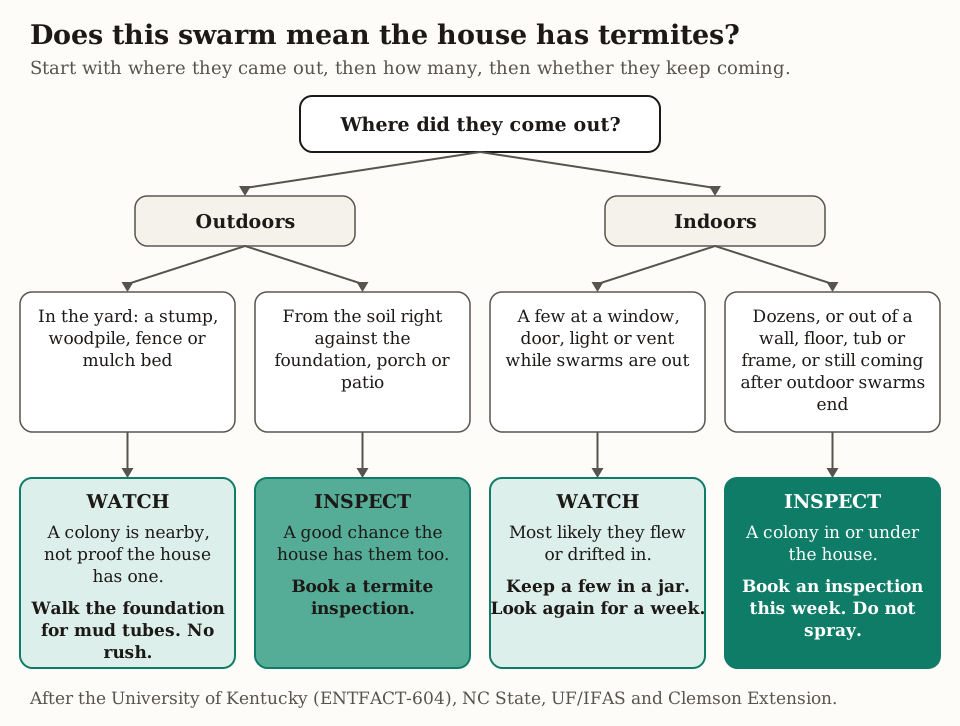
It depends on where the swarmers came out. A swarm from a stump or woodpile in the yard means a mature colony is nearby, not that the house is infested. Swarmers coming out inside, or out of the soil right against the foundation, usually mean a colony in or under the house. A few by a window during swarm season often flew in.
A termite swarm in the house
Termite swarmers that come out indoors are the clearest sign. NC State Extension says that if you find swarmers inside your home, you are probably dealing with an infestation in or under it. After an indoor swarm, native swarmers turn up dead near windows and in sinks and bathtubs, often with their wings still on. Bathrooms get many of them, because swarmers from under a slab can come up through gaps around pipes and drains.
Extension services do not agree on how much a few indoor swarmers prove, and the difference matters to you. Penn State Extension calls swarming termites or their wings indoors a sure sign that termites are working in the building. Clemson’s Home and Garden Information Center says a few termites found in a house do not mean a structural infestation, while large numbers of swarmers or wings indoors often do. In practice, the count and the exit point decide it.
A termite swarm outside
An outdoor swarm is not an emergency. The University of Kentucky says swarms from stumps, woodpiles and the like do not automatically mean the house is infested. However, it adds that swarmers coming out next to the foundation, or from a porch or patio against the house, give a good chance the house has them too. So look at exactly where the swarm rose from.
Either way, an outdoor swarm tells you termites are within a few hundred feet. UC IPM says swarmers generally fly less than 100 meters (about 330 feet) from their colony. Use the swarm as a reminder to walk the foundation for mud tubes and to pull mulch and firewood back from the siding.
How many termite swarmers is too many?
No source gives a magic number, but the pattern is consistent. One to a few termite swarmers indoors during the local swarm season usually flew in. Dozens in one room, or more coming out day after day, usually came out inside.UF/IFAS says that when hundreds to thousands of Asian subterranean swarmers turn up indoors, it usually means a structural infestation.
What the number and the timing of indoor swarmers suggest
One to a few, at a window, door, light or vent, on a day swarms are flying outside
- What it usually means
- They flew or drifted in
- What to do
- Keep one or two. Look again over the next week
Any number crawling out of a crack, baseboard, outlet, tub drain or window frame
- What it usually means
- They came out inside the house
- What to do
- Book an inspection. Leave the spot as it is
A dozen or more in one room, or piles of wings on sills
- What it usually means
- Most likely a swarm from inside
- What to do
- Book an inspection and keep a sample
Hundreds to thousands
- What it usually means
- A colony feeding in or under the house
- What to do
- Book an inspection this week
Still appearing days after the swarms outside have stopped
- What it usually means
- Their source is the house, not the neighborhood
- What to do
- Book an inspection
A few in a house treated in the last few months
- What it usually means
- Often termites that were already inside, dying off
- What to do
- Call the company that treated it
Termite inspectors on Reddit’s r/Termites give similar rules of thumb. One says two swarmers inside during the season are no big deal, but 50 or more with wings is the time to worry. Another says a Formosan infestation shows hundreds, not a few dozen. Treat these as experienced advice, not measured thresholds. If you are unsure, the inspection settles it.
When do termites swarm?
Most termites in the US swarm in spring, from January in South Florida and South Texas to May and June in the North. Formosan termites swarm on warm evenings in late April to June, peaking in May along the Gulf coast. In the West, drywood and dampwood termites swarm in late summer and fall. A warm, still day after rain sets off most swarms.
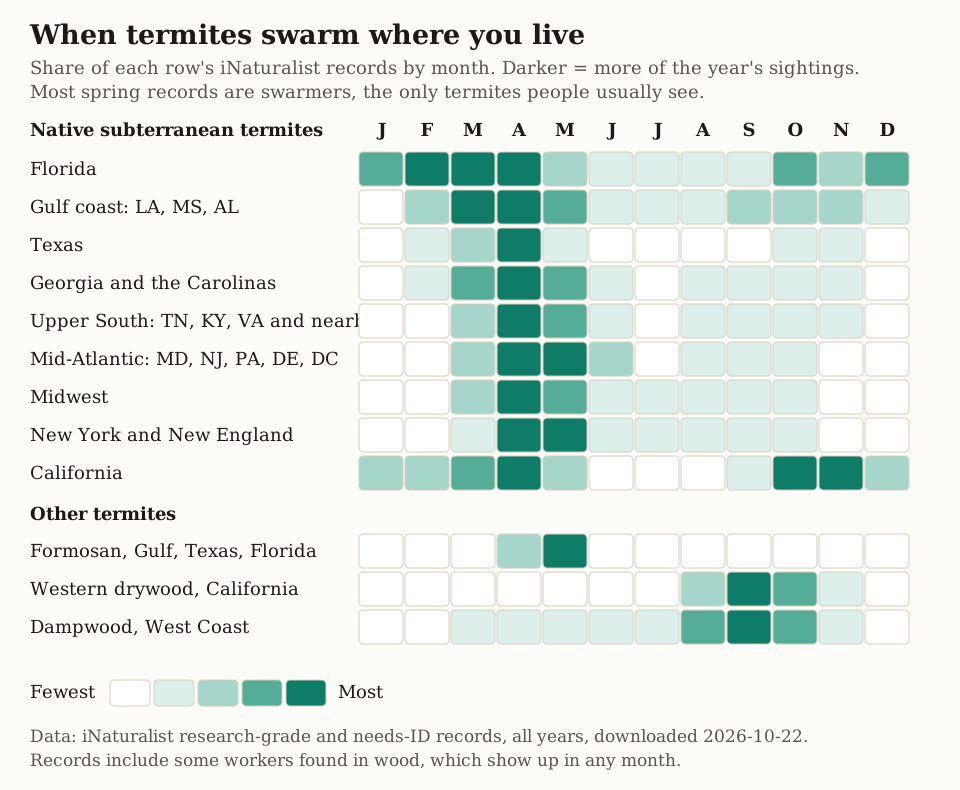
To see how the season moves across the country, we counted about 29,600 termite records on iNaturalist, where people post photos with a date and place. Most spring photos show swarmers, since workers stay hidden. The spring peak moves north by about a month. On the Gulf coast, 27% of native termite records fall in February and March. In New York and New England, only 8% do, and 57% fall in April and May.
Other termites stand out even more. For example, 61% of Formosan records from the Gulf states, Texas and Florida fall in May alone. Western drywood termites in California peak in September, when 41% of their records fall. California’s native subterranean termites have two seasons, spring and again in fall after the first rains.
Termite swarm season by region
Extension services publish the swarm months for their own states, and they agree well with the records. Here is the season by region, with the main native swarm first and other termites that swarm there after it.
Termite swarm season by US region
Florida
- Native subterranean swarms
- January to April for the eastern subterranean termite; one native kind flies December to February (UF/IFAS)
- Peak in our record count
- Spread from January to April
- Other termites that swarm there
- Formosan April to June at dusk, peak May; Asian subterranean February to April at dusk in South Florida; drywood termites April to November
Gulf coast: Louisiana, Mississippi, Alabama
- Native subterranean swarms
- From late January on the coast, peak late February to early April; April to June in northern Mississippi (Mississippi State)
- Peak in our record count
- March and April
- Other termites that swarm there
- Formosan late April to June at dusk, peaking near Mother's Day (LSU AgCenter)
Texas
- Native subterranean swarms
- January and February in South Texas; April and May in the Panhandle (Texas A&M)
- Peak in our record count
- April
- Other termites that swarm there
- Formosan in May in the east; drywood termites in late August and September
Georgia and the Carolinas
- Native subterranean swarms
- From February, peak March to May in Georgia (UGA); late winter and spring in North Carolina
- Peak in our record count
- April
- Other termites that swarm there
- Formosan mid-May to July at dusk; a light-colored native kind from late July to early October (UGA)
Tennessee, Kentucky, Virginia and nearby
- Native subterranean swarms
- Spring (University of Kentucky)
- Peak in our record count
- April
- Other termites that swarm there
- Few others
Mid-Atlantic and Pennsylvania
- Native subterranean swarms
- February to June in Pennsylvania, mostly spring (Penn State)
- Peak in our record count
- April and May
- Other termites that swarm there
- None common
Midwest
- Native subterranean swarms
- Spring, usually on a warm, sunny day after rain (University of Missouri); rare in Minnesota outside the south
- Peak in our record count
- April
- Other termites that swarm there
- None common
New York and New England
- Native subterranean swarms
- Spring; we found no state month figures
- Peak in our record count
- April and May
- Other termites that swarm there
- None common
California
- Native subterranean swarms
- Spring or fall, on clear afternoons after a soaking rain (UC IPM)
- Peak in our record count
- March and April, then October and November
- Other termites that swarm there
- Western drywood late September to November by day in southern California; dampwood summer and fall at dusk
Arizona
- Native subterranean swarms
- Desert subterranean after monsoon rains, July to September; another kind January to March below 4,000 feet (University of Arizona)
- Peak in our record count
- Too few records
- Other termites that swarm there
- Western drywood on sunny days, June to August
Washington and Oregon
- Native subterranean swarms
- Any time of year, by state extension accounts
- Peak in our record count
- Too few records
- Other termites that swarm there
- Pacific dampwood in late summer and fall, often after rain
Hawaii
- Native subterranean swarms
- None; Hawaii's subterranean termites are introduced
- Peak in our record count
- Too few records
- Other termites that swarm there
- Formosan in May and June on warm, humid, still nights; small swarms any time (University of Hawaii)
Termite season in Louisiana, Texas and Florida
These three states search for it most, and each has a twist. In Louisiana, the famous swarm is the Formosan termite. LSU AgCenter puts its season from as early as April through June, with a peak in early to mid May, at dusk on warm, humid, windless evenings. Many locals simply say it starts around Mother’s Day. The native termites there swarm earlier, by day.
Texas is big enough to have two seasons. Texas A&M says native swarms begin in January and February in South Texas but not until April or May in the Panhandle. Florida’s season is the longest. Native termites fly from December to May depending on the kind, Formosan termites fly from April to June, and drywood termites can fly in almost any month.
What time of day do termites swarm?
Native subterranean termites swarm in daylight, mostly from late morning to mid-afternoon. Formosan termites swarm after dark and fly to lights. In our count, 80% of 1,196 eastern native records in swarm season were taken between 8 a.m. and 5 p.m., while 72% of 1,114 Formosan records were taken after 8 p.m.
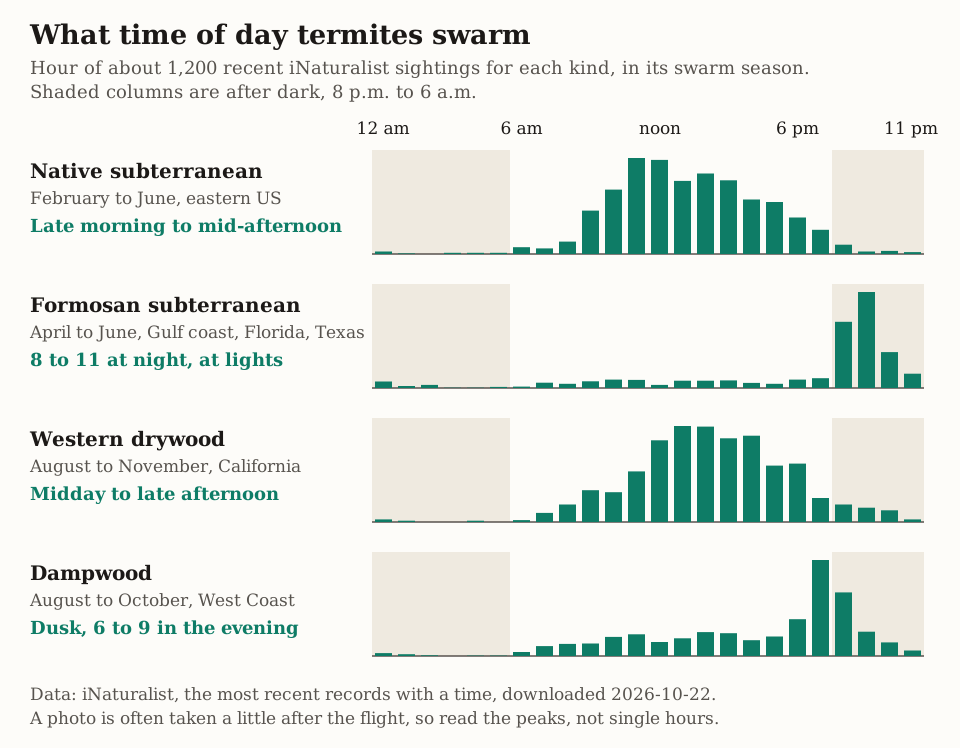
The two western kinds differ too. Western drywood termites in California swarm by day, with 74% of their records between 8 a.m. and 5 p.m. Dampwood termites peak at dusk, between 6 and 9 in the evening. Sources differ slightly on the native kind: Mississippi State says swarming usually happens in the morning, while UF/IFAS and Clemson say early afternoon. Our records peak between 11 a.m. and 1 p.m., which fits both.
So the clock is a useful clue. A swarm at a porch light at 9 p.m. in May on the Gulf coast is almost always Formosan. A swarm out of a slab crack at noon in March is almost always the native kind.
What weather sets off a termite swarm?
Warmth, rain and still air. The University of Georgia says swarms follow several warm days of 60 to 70F (16 to 21C) punctuated by rain. UF/IFAS describes native swarms on warm, sunny, windless early afternoons, usually after rain.
Wind matters more than most people think. The University of Hawaii found that Formosan termites will not swarm if the wind tops 2 mph (about 3 km/h), and a swarm already under way stops when it picks up. Western drywood termites are the exception to the rain rule. They fly on bright, sunny days of about 80 to 100F (27 to 38C).
When does termite season end?
Swarm season ends by early summer in most of the East: May in the South, June in the North, and late June or July for Formosan termites. In the West, it runs into November. But “termite season” only describes the swarmers. The workers keep eating all year, more slowly in cold weather, so the damage season never really ends.
How long does a termite swarm last?
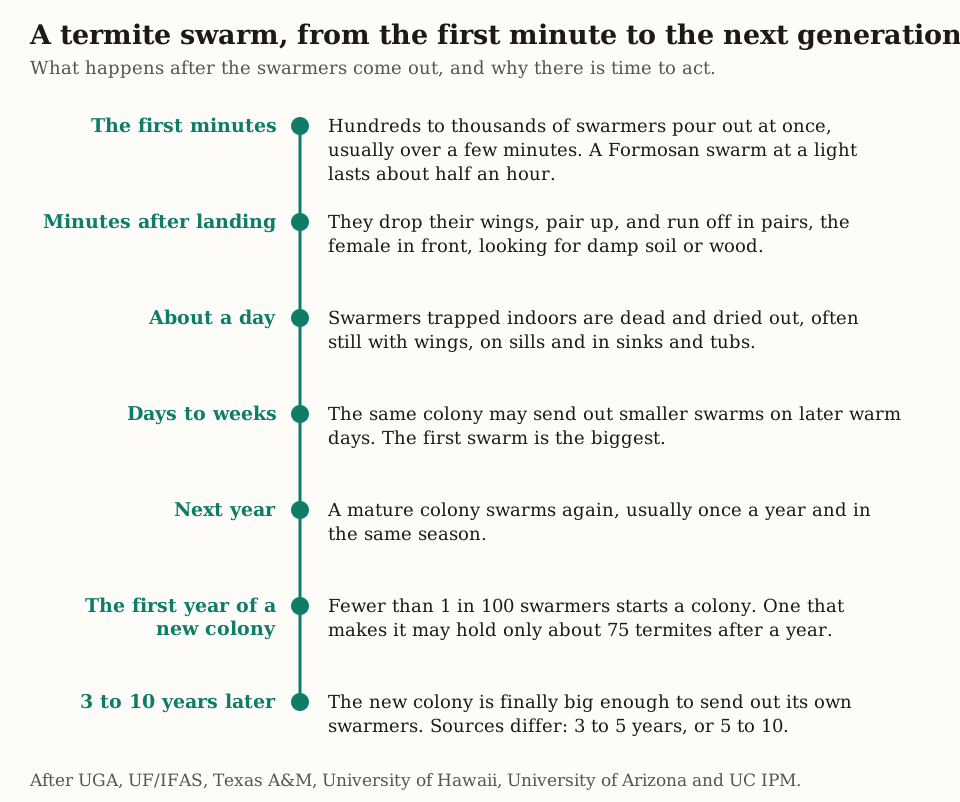
A single termite swarm usually lasts from a few minutes to half an hour. Georgia Extension says the swarmers emerge within minutes, and the University of Hawaii times Formosan swarms at about 30 minutes. Stragglers can keep appearing for a few hours, and the same colony may swarm again over the next days or weeks.
How long do termite swarmers live?
Indoors, termite swarmers live about a day. The University of Kentucky says swarmers that come out inside a house only live for about a day, and you can remove them with a broom or vacuum. They dry out, because a house is cooler and drier than they need. Outdoors, birds, lizards, toads and ants eat most of them. The few that find damp soil shed their wings and become the king and queen of a new colony.
Will they come back tomorrow, or next year?
Tomorrow, possibly. Georgia Extension notes that a mature colony may swarm several times over days or months, but the later swarms are usually smaller than the first. So a second, smaller swarm on the next warm day is normal. Next year, yes. A mature colony swarms about once a year, often in the same weeks, until it is treated.
That is also why there is no need to panic. The colony behind a swarm has been growing for years, and it eats wood slowly. A few weeks to book an inspection makes little difference to the damage.
What to do during a termite swarm
Stay calm and do not spray. Turn off the lights, close the door to the room, and collect 10 to 20 swarmers in rubbing alcohol. Then mark where they came out and vacuum the rest. Swarmers do not bite or sting, and they die within a day, so the swarm itself does no harm to you, your children or your pets.
What to do while termites are swarming
Do not spray
Bug spray kills only the swarmers it touches, and they die within a day anyway. It does nothing to the colony, and it spoils the sample an inspector needs.
Turn off the lights and close the room
Swarmers fly toward light. Switch off the lights in that room, close the door, and at night turn off the porch light too. They will settle on windows and floors.
Collect 10 to 20 for identification
Drop them into a small jar or pill bottle of rubbing alcohol, or a zip bag. Add a few loose wings. Dead ones are fine.
Mark where they came out
Find the spot with the most swarmers: a crack in the floor, a baseboard, an outlet, a window frame, a tub drain. Put a strip of tape beside it and take a photo.
Write down the date, time and weather
Note the time of day, whether it had rained, and whether neighbors saw a swarm the same day. Night swarms at lights point to Formosan termites.
Vacuum the rest
Vacuum the swarmers and wings, then empty the vacuum outside. Leave the crack or hole as it is: do not open the wall or seal it before the inspection.
Check outside the same wall
Walk the outside of the house opposite the spot where they came out. Look for mud tubes on the foundation and for small slits in the soil where swarmers left.
Should you kill termite swarmers?
There is no need. Killing termite swarmers does not protect the house. Under the heading “Will Killing the Swarmers Prevent a Termite Infestation?”, NC State Extension answers no: it ends the nuisance but gives no protection from termites already feeding. The workers in the colony do the damage, not the swarmers.
A vacuum is the right tool. Georgia Extension notes that the trip through a vacuum usually kills them. Bug spray, foggers and home remedies only kill the ones they touch, and they put pesticide where your family breathes it for no gain. If you later use a termite product, choose one registered by EPA for that use and follow the label exactly. The label is the law.
How to collect a termite sample
Put 10 to 20 termite swarmers in a small jar, vial or pill bottle filled with rubbing alcohol, and close it tight. Texas A&M advises 70% alcohol, which keeps them from drying out and keeps the wings on. Add a few loose wings, which help with identification too. A zip bag works if you have no alcohol, and dead swarmers are fine.
Label the jar with the date, the time and the room. Give it to the inspector, or take it to your county extension office, which can often identify termites for little or no cost. A sample settles the questions a photo cannot: whether it is a termite at all, which kind, and so which treatment fits.
If the swarm is outdoors
Leave it alone. There is nothing to spray, and the swarm will be over within the hour. Note where it rose from: a stump or woodpile, or the soil against the house. If it is after dark, turn off the outdoor lights and close the blinds. Afterward, walk the foundation for mud tubes, and move wood, mulch and firewood away from the siding.
What to do after a termite swarm
Book a termite inspection if swarmers came out indoors or from the soil beside the house, and bring your sample. You do not need to rush. Termites eat wood slowly, and the University of Kentucky says an extra day, week or month to choose a company makes little difference. Get two or three written quotes.
Already have a termite contract or bond? Call that company first, because a re-treatment is usually covered. If not, our guide to what a termite inspector checks explains the visit, and the options for treating termites show what each kind needs. Swarmers that turn out to be subterranean termites mean a soil treatment or baits. Drywood swarmers mean treating the wood.
Tell the inspector
Check each clue below to narrow down what you saw.
The date and time of the swarm, and the weather that day
Night swarms at lights point to Formosan termites.
The exact room and spot where they came out
Show the tape mark and the photo.
Roughly how many you saw, and on how many days
A few once is different from dozens every day.
Whether neighbors saw a swarm the same day
A neighborhood swarm makes a few strays indoors more likely.
Any mud tubes, pellets, wings or soft wood you have found
These confirm termites are feeding.
Swarmers after termite treatment
Termite swarmers soon after treatment do not mean it failed. Georgia Extension says it is not uncommon for swarms to come out inside a house after a liquid termiticide treatment. Those swarmers were already inside when the soil was treated. Baits take longer still, often months, to kill a colony. No treatment stops swarmers from a neighbor’s colony flying in during the season, either.
A swarm the next year is different. The University of Kentucky says that when termites swarm and keep infesting a house the year after treatment, they have usually found an untreated gap, not outlasted the product. For drywood termites, UF/IFAS says new swarmers after a treatment typically mean it did not work. In both cases, call the company under the warranty.
Renting, buying or selling in swarm season
If you rent, tell your landlord in writing, with photos and the sample, and do not treat the building yourself. If you are buying, ask whether the seller has seen swarms and ask for the termite report and treatment records. Swarm season is when hidden colonies show themselves, so a spring inspection is the most telling one. Our guide to the other signs of termites shows what else to look for.
How to see fewer swarmers next season
To keep termite swarmers away where Formosan termites live, turn off outdoor lights and close the blinds at dusk in May and June, as LSU AgCenter advises. Screen attic and soffit vents, and keep windows shut or screened on swarm evenings. Then deal with what draws colonies to the house: fix leaks, keep mulch and wood away from the foundation, and book a yearly inspection in late winter, before swarm season. Our termite guide covers prevention step by step.
Pest control disclaimer. Photo-based identification can help, but it is not always perfect. For dangerous spiders, large infestations, or anything you are unsure about, contact a licensed pest control professional.
Termite swarmers FAQ
Can termites swarm in winter?
Can termite swarmers start a colony inside my house?
My neighbor had a termite swarm. Will I get termites?
Does turning off the lights stop a termite swarm?
Do termites stop eating after swarm season?
Related guides
Termites
The termite hub: the four US kinds, the signs, treatment, quotes and prevention.
Termites with wings
What flying termites look like by type, why they appear, and dead ones in a light fixture.
Signs of termites
Every sign ranked by how sure it is, from swarmers in a wall to sticking doors.
Termite inspection
What the inspector checks, how long it takes, and how to read the report.
Treatment options
Soil treatment, baits, fumigation and heat: which one each kind of termite needs.
Termite or flying ant?
The four checks that tell a termite swarmer from a winged ant.
Sources
- NC State Extension, Termite swarmers: what do they mean for you? (2023)
- University of Kentucky Entomology, ENTFACT-604, Termite control: answers for homeowners
- University of Georgia Extension, Bulletin 1241, Termite control services
- UF/IFAS EDIS IN369, Native subterranean termites
- UF/IFAS EDIS IN278, Formosan subterranean termite
- UF/IFAS EDIS IN285, Asian subterranean termite
- LSU AgCenter, Preparing for the termite swarms (2026)
- Mississippi State University Extension, Species of termites in Mississippi
- Texas A&M AgriLife, E-368, Subterranean termites
- Clemson HGIC, Termites
- Penn State Extension, Eastern subterranean termites
- UC IPM Pest Notes 7415, Subterranean and other termites
- University of Arizona, AZ1356, Termite management for homeowners
- University of Hawaii CTAHR, HSP-2, The Formosan subterranean termite in Hawaii
- iNaturalist, termite observations in the US (Reticulitermes)