What are termites with wings?
Termites with wings are the reproductive caste of a termite colony, called alates or swarmers. They are the only termites with wings. Once a year, a mature colony sends out hundreds to thousands of them at once. They fly a short way, pair up, drop their wings and try to start a new colony. Most die within a day.
So do termites fly? Yes, but only for one short flight in their whole life. The termites that eat your house are the workers, and workers never have wings. They are pale, blind and stay hidden inside wood, soil and mud tubes. That is why swarmers are often the first termites a homeowner ever sees.
A colony has to be several years old before it makes swarmers. Sources give different ages, and the gap is wide. UF/IFAS says five to 10 years for native subterranean termites, five to eight for Formosan termites, and about five for the West Indian drywood termite. Pest company pages put it at three to six years. Either way, swarmers mean a colony that has been feeding for years, not days.
Do all termites have wings?
No. A colony has three main kinds of termite. Workers and soldiers never grow wings at any point in their lives. Only the young that develop into reproductives grow wings, and they keep them only until the flight. Even a queen started life as a termite with wings: after her flight she snapped them off, and only tiny stubs are left.
Are there baby termites with wings?
No. Young termites hatch without wings and look like small, pale workers. The ones that will become swarmers grow wing pads as they molt, but they only get working wings as adults. So a very small winged insect is either a small kind of termite swarmer or a different insect. Pale, wingless “babies” are covered in our guide to baby termites and termite eggs.
What do flying termites look like?
Flying termites are 1/4 to 5/8 inch (6 to 15 mm) long, wings included, for the kinds most Americans see. They have straight, beaded antennae, a thick body with no pinched waist, and four wings of the same size that reach well past the tip of the body. Most are dark brown to black. Formosan swarmers are amber, and Pacific dampwood swarmers are the largest, up to 1 inch (25 mm).
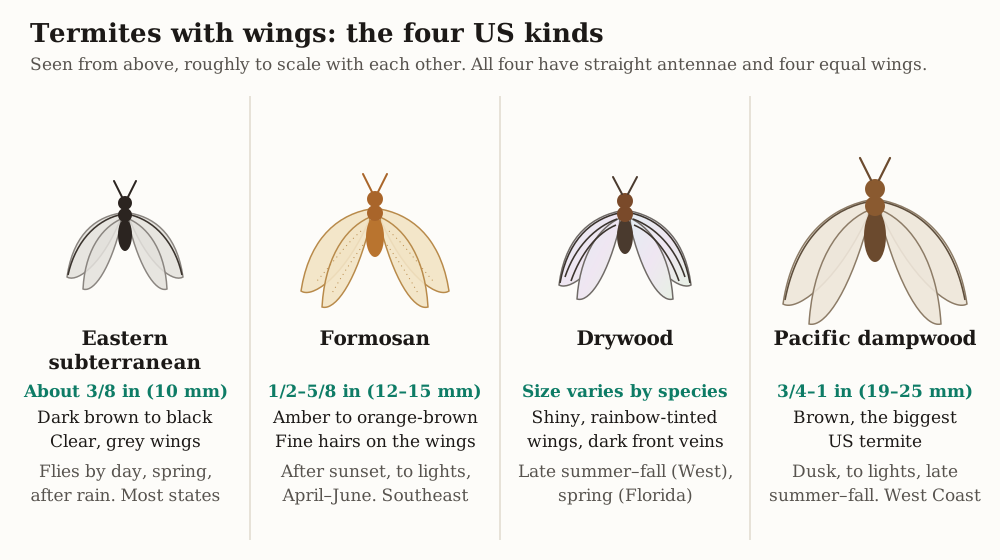
The four US kinds of termite with wings
Small, dark brown to almost black, clear grey wings
- Kind
- Eastern subterranean (and other native subterranean termites)
- Size with wings
- About 3/8 in (10 mm)
- When and where it flies
- By day, warm still afternoons after rain, late winter to spring. Nearly every state
Amber to orange-brown body, fine hairs on the wings, many at once at a light
- Kind
- Formosan subterranean
- Size with wings
- 1/2–5/8 in (12–15 mm)
- When and where it flies
- Just after sunset, toward lights, April to June, peak in May. Southeast, Hawaii, parts of California
Shiny, rainbow-tinted wings with several dark veins along the front edge
- Kind
- Drywood
- Size with wings
- Varies by species
- When and where it flies
- Daytime in late summer and fall in the West; April to June in Florida; some fly to lights at night
Very large, brown, at a light after dark
- Kind
- Pacific dampwood
- Size with wings
- 3/4–1 in (19–25 mm)
- When and where it flies
- Dusk, late summer and fall, often after rain. West Coast
Sizes and colors are from UF/IFAS, UC IPM and Texas A&M, and vary by species. A small yellowish-brown native species in the Southeast, about 0.3 inch long, flies in the evening instead of by day.
Is it a termite with wings? Check these
Check each clue below to narrow down what you saw.
Straight antennae, like a short string of beads
Antennae bent like an elbow mean an ant.
A thick body with no narrow waist
A pinched waist between the middle and the back means an ant or a wasp.
Four wings, all the same size and shape
An ant's front wings are clearly bigger than its back wings.
Wings much longer than the body, lying flat over the back
A mayfly holds its wings up like a sail, and a caddisfly folds them like a roof.
Wings that snap off at a touch and pile up
Loose wings in little piles are the classic termite sign.
The insect most often mistaken for a termite with wings is a flying ant. Our side-by-side guide to flying ants and termite swarmers covers the wing veins, the shed wings test and the ant swarm calendar. Mayflies, caddisflies, stoneflies and drain flies also get mistaken for them, and our round-up of bugs that look like termites gives the one feature that rules out each.
Black flying termites
A black flying termite in spring is almost always the eastern subterranean termite, the most common termite in the US. Its swarmers are dark brown, almost black to the naked eye, says UF/IFAS. Texas A&M describes them as dark-brown to blackish insects about 3/8 inch long. Many websites call termites “white”, which is true only of the workers, so a black swarmer surprises people.
Black termites without wings
Dark termites with no wings, crawling near a window or a door, are swarmers that have already dropped their wings. Each wing snaps off along a seam near its base, so look closely for four short stubs on the back. Pale, cream termites with no wings are something else: workers, from inside wood or a broken mud tube. Our guide to what termites look like shows workers and soldiers.
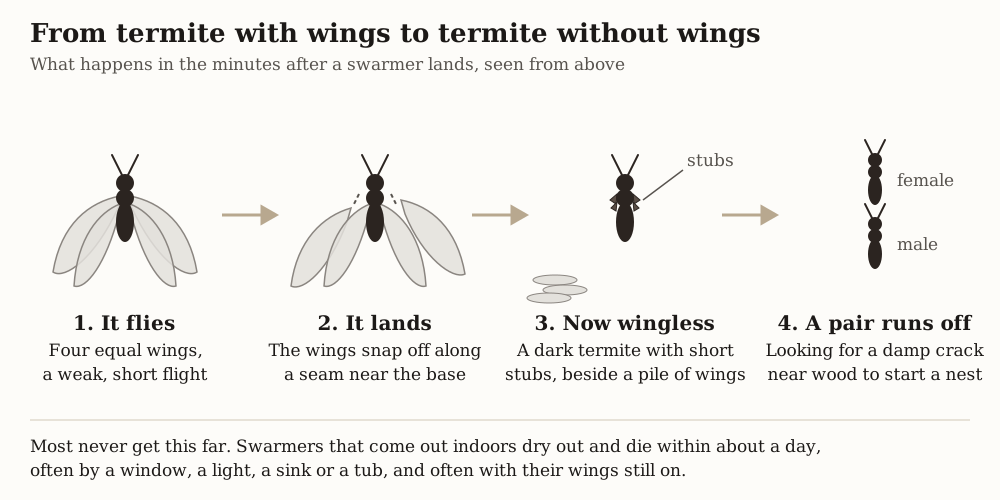
What do termite wings look like?
Termite wings are thin, see-through and all the same size, about twice the length of the body. Subterranean termite wings are pale grey with two dark veins running along the front edge. Drywood wings have three or four dark veins there and a rainbow shine. Formosan wings have fine hairs you can see with a magnifier. In a pile on a sill, they look like tiny fish scales.
Flying termites in Florida, Texas and California
Region changes which kind you are looking at. In Florida, black native swarmers fly by day from January to May, and amber Formosan swarmers crowd the lights after sunset from April to June. Texas A&M says most Texas swarms come from February to May. In California, a daytime swarm in late summer or fall points to drywood termites, and huge swarmers at a light after dark point to dampwood.
Why do flying termites suddenly appear?
Termites with wings appear suddenly because a whole colony releases its swarmers at once, on the first day the weather is right. That is usually a warm, still day after rain. The swarmers have been growing inside the nest for weeks. So one day there are none, and the next there are hundreds at the windows. By the next morning, most are dead.
The same weather sets off every mature colony in the area, so neighbors often see swarms on the same afternoon. Subterranean termites even build special exit tubes for the flight, UC IPM notes. Swarmers then leave from the soil, a stump, a crack in a slab, or the wall of a house. When and where each kind swarms through the year is covered on our termite swarmers page, with what to do while a swarm is happening.
Why do flying termites come out after rain?
Rain softens the soil and keeps the air damp, and a new pair needs damp soil or wood to survive. Warmth, high humidity and still air add to it. Rain alone does not trigger a swarm: the colony also has to be mature, and the season has to be right. NC State notes that swarms usually happen in daytime in spring, often after a rainstorm.
Are termites attracted to light?
Yes. Termites with wings fly toward light, which is why you find them at windows, glass doors, porch lights and light fixtures. Daytime swarmers that come out indoors head for the brightest window. Formosan, some drywood and dampwood termites fly after dark, so they gather around porch lights, street lights and lit windows. Turning lights off during a swarm is the simplest way to stop more coming in.
Why do flying termites suddenly die?
Because they dry out. Termites with wings have soft bodies that lose water fast, and indoors there is no damp soil to dig into. The University of Kentucky says swarmers that come out inside a house live for only about a day. Outdoors, birds, ants, lizards and frogs eat most of them. A pile of dead swarmers the next morning is normal and does not mean the problem is over.
Should I worry about termites with wings?
Worry about where they came from, not the swarmers themselves. One or two near an open door, or a crowd at a porch light, usually flew in from outside. Swarmers coming out of a wall, floor, baseboard or window frame, or piles of wings indoors, mean a colony is feeding in or under the house. That needs a professional inspection soon, not in an hour.
The University of Kentucky puts it plainly: winged termites coming out indoors almost always mean an infestation that needs treatment. A swarm from a stump or a woodpile out in the yard does not, by itself, mean the house is infested. But a swarm coming out of the soil right next to the foundation, a porch or a patio gives a good chance the house has them too.
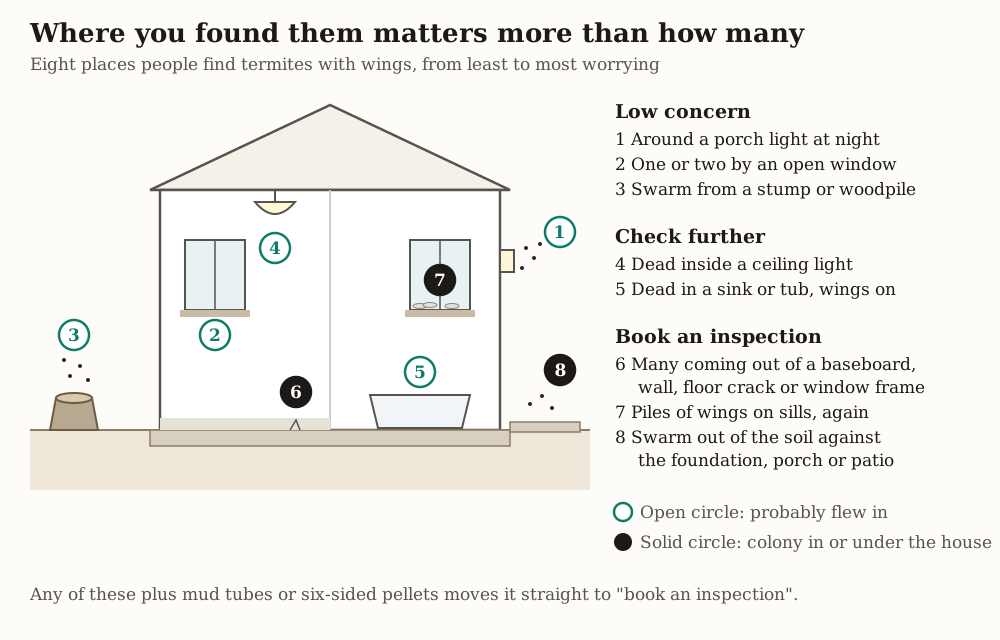
Where you found termites with wings, what it means, and what to do
A crowd around a porch light after dark
- What it most likely means
- Swarmers from colonies nearby, drawn to the light
- What to do
- Lights off during swarm season. Check the foundation for mud tubes
One or two by an open window or door
- What it most likely means
- Flew in from outside
- What to do
- Keep one in a jar. Watch for more over the next days
A swarm from a stump, woodpile or fence post in the yard
- What it most likely means
- A colony in the yard, not proof of one in the house
- What to do
- Remove the wood if you can. Walk the foundation for tubes
Dead ones inside a ceiling light fixture
- What it most likely means
- They flew to the light. Either they swarmed inside or got in through a gap
- What to do
- Look for wings and swarmers elsewhere in the house. Check the attic and ceiling
Dead ones in a sink or tub, wings still on
- What it most likely means
- Often a swarm from under a slab, through gaps around pipes
- What to do
- Book an inspection, especially with no termite contract
Many coming out of a baseboard, wall, floor crack or window frame
- What it most likely means
- A colony feeding in or under the house
- What to do
- Book an inspection this week. Do not spray
Piles of matching wings on sills, again and again
- What it most likely means
- Swarms are happening indoors
- What to do
- Same: an inspection, with the wings kept
A swarm out of the soil against the foundation, porch or patio
- What it most likely means
- A colony at, and likely in, the house
- What to do
- Book an inspection
Reddit’s r/Termites gets this question so often that a thread titled “Termites are flying! You do not need to worry.” ranks near the top of Google for it. Its core advice is sound: one lost swarmer in the house is nothing, and a crowd of dozens in one part of a room is the real warning. Two of its other claims are wrong, though. Swarmers do not travel very far: UC IPM says they generally fly less than 100 meters (about 330 feet) from the colony. And subterranean termites do not need rotten wood. UF/IFAS notes that any wood in a house is a potential food source for them, including sound framing, as long as their tunnels reach damp soil.
Even when the news is bad, you have time. Termites damage wood slowly, and the University of Kentucky says that taking an extra day, week or month to choose a company makes little difference. Do not sign on the spot because a swarm scared you.
One flying termite in the house
One swarmer, alive or dead, usually means very little. It probably flew in through an open door or window, or rode in on a breeze during a swarm outside. Keep it in a jar or a bag, then look at the windows and sills over the next few days. If you find more swarmers, piles of wings, mud tubes or pellets, that changes the picture. If you find nothing else, simply stay alert next swarm season.
Dead termites inside a ceiling light fixture
Dead termites in a ceiling light fixture are swarmers that flew to the light and could not get out of the cover. The question is how they got into the room. In spring, a few dead ones may have come in through a window and been trapped. A dozen or more, or dead ones in light fixtures in several rooms, usually mean a swarm came out inside the house.
Fixtures on the top floor or under an attic deserve a closer look. Drywood termites often live in attics, eaves and soffits, and their swarmers can drop through gaps around a ceiling box. Check the attic for small piles of six-sided pellets, and screen attic vents. Then keep a few of the dead termites from the fixture for the inspector.
Check one insect before you worry. On Reddit’s r/Termites, some “termites in my light” photos turn out to be ants, so look for straight antennae and four equal wings. In one upstairs apartment on Florida’s Gulf coast, the shiny, rainbow-tinted wings in the fixture pointed the answering expert to drywood termites.
Dead termites on a window sill or in a sink
After an indoor swarm, most native subterranean swarmers turn up dead and dried near windows or in sinks and bathtubs, often with their wings still attached, UF/IFAS notes. That pattern is a sign they came out inside. Swarmers from under a concrete slab can find their way up through gaps around bathtub drains and pipes, which is why bathrooms get them so often. Termite wings on window sills, with no bodies at all, mean the swarmers landed, shed their wings and crawled off.
Termites with wings outside the house
A swarm of termites with wings in the yard is not an emergency. It means a mature colony is living within a few hundred feet, often in a stump, buried wood or a neighbor’s yard. Use it as a reminder. Walk the foundation for mud tubes, pull mulch and firewood back from the siding, and fix anything that keeps the soil by the house wet.
Are flying termites dangerous?
Not to people or pets. Swarmers do not bite, sting or carry disease, and they cannot chew into your house. UMD Extension notes that alates are not a danger to structures, and most die of dehydration if they fly inside. The danger is the colony behind them, which can weaken framing and floors slowly over years if nobody finds it.
Flying termites in the house: what to do
When flying termites are in the house, do not spray them. Turn off the lights, keep a few in a jar, vacuum the rest and find where they came out. Then check for mud tubes and pellets and book a termite inspection. Killing swarmers does nothing to the colony, and NC State says it gives no protection from termites already feeding.
What to do when termites with wings are inside
Do not spray
Bug spray and foggers kill only the swarmers you can see, which die within a day anyway. They do nothing to the colony, and they ruin the specimens you need.
Turn off the lights and close the room
Swarmers fly to light. Switch off the lights in that room and outside, close the door, and they will settle on windows and floors where you can pick them up.
Keep a few
Put three or four in a jar, a pill bottle or a zip bag, or stick them to clear tape. Dead ones are fine. Keep a few loose wings too.
Find where they came out
Look for the spot with the most swarmers or wings: a baseboard, a crack in the floor or slab, a window or door frame, a wall outlet, a light fixture, a tub. Take a photo and write down the room.
Vacuum the rest
Once you have your samples, vacuum the swarmers and wings and empty the vacuum outside.
Look for the other signs
Walk the foundation for mud tubes about the width of a pencil, and look under windows and in the attic for small piles of six-sided pellets. Either one confirms termites are feeding.
Call the right person
Swarmers came out inside, or you found tubes or pellets? Book a termite inspection and get two or three written quotes. Already have a termite contract? Call that company first. Renting? Tell your landlord in writing.
How to get rid of flying termites
Termites with wings take care of themselves: they are dead within a day, and a vacuum removes them. Getting rid of flying termites for good means dealing with the colony they came from. For subterranean and Formosan termites, that is a soil treatment or a bait system. For drywood termites, it is fumigation, heat or treating the infested wood. Our guide to how termite treatment works explains each one.
Start with what costs nothing: identify the insect, find where it came out, fix leaks, and keep wood and mulch off the foundation. Pesticides come last. EPA warns that products that only claim to kill termites have not shown they can protect a building. So a can of bug spray or a store foam on the swarmers will not fix a termite problem. If you ever use a termite product, choose one registered by EPA for that use and follow the label exactly. The label is the law.
How to keep flying termites out
You can cut down how many get in, though not to zero. Turn off outdoor lights on warm spring evenings, and keep windows shut or screened. Screen attic and soffit vents, and seal gaps around windows, doors and pipes. UF/IFAS notes that a mesh with holes under about 1 mm (1/25 inch) keeps out drywood swarmers, but also that sealing a house completely is almost impossible.
Renting, buying or under contract
If you rent, tell your landlord in writing, with photos and the jar of swarmers, and do not treat it yourself. Treating the building is the owner’s job. If you already have a termite contract, call that company first, because a re-treatment may be covered. If you are buying, a swarm is a good reason to ask for the termite report and treatment records. Our guide to termite inspections explains what an inspector looks for.
Want the bigger picture? Our termite guide covers the four US kinds, the signs of a colony in a house, and how treatment, quotes and prevention work. If swarmers are not the only thing you found, our list of signs of termites covers mud tubes, pellets and damaged wood.
Pest control disclaimer. Photo-based identification can help, but it is not always perfect. For dangerous spiders, large infestations, or anything you are unsure about, contact a licensed pest control professional.
Termites with wings FAQ
How long do flying termites live?
Do flying termites bite?
Do flying termites eat wood?
How far do flying termites travel?
Will flying termites come back next year?
Is a termite queen a termite with wings?
Related guides
Termites
The termite hub: the four US kinds, the signs, treatment, quotes and prevention.
Termite swarmers
When each kind swarms, how long it lasts, and what to do during and after a swarm.
Flying ants vs termites
Four checks, a shed wings test and a swarm calendar for winged ants and termites.
Bugs that look like termites
Winged and wingless look-alikes, with the one feature that rules out each.
Signs of termites
Mud tubes, wings, pellets and damaged wood, and what each one means.
What do termites look like?
Workers, soldiers, swarmers and queens, with sizes and colors.
Termite inspection
What an inspector checks, how long it takes, and what the report means.
Flying ants
If the antennae are bent: which ants swarm in which month.
Sources
- University of Kentucky Entomology, ENTFACT-604, Termite control: answers for homeowners
- UF/IFAS EDIS IN369, Native subterranean termites
- UF/IFAS EDIS IN278, Formosan subterranean termite
- UF/IFAS EDIS IN236, West Indian drywood termite
- UC IPM Pest Notes 7415, Subterranean and other termites
- UC IPM Pest Notes 7440, Drywood termites
- NC State Extension, Termite swarmers: what do they mean for you?
- Texas A&M AgriLife, ENT-2002, Frequently asked questions about subterranean termite control
- University of Maryland Extension, Termites
- EPA, Termites: How to Identify and Control Them