What do baby termites look like?
Baby termites look like tiny, pale versions of worker termites. They are cream-white to almost clear, soft, and about 1/16 to 1/4 inch (1.5 to 6 mm) long, depending on age. Each has six legs, short straight antennae like a string of beads, and a thick body with no narrow waist. They have no wings and, at first, no eyes.
That shape surprises people who expect baby termites to look like grubs. Termites grow in small steps. A young termite hatches already shaped like the adults and simply molts, sheds its skin, as it gets bigger. So there is no worm stage and no resting pupa. Texas A&M puts all the young stages, larvae, young workers and nymphs, at 1/16 to 1/4 inch, and says even experts do not use them to tell termite species apart.
Here is the catch. The pale termites people actually find are rarely babies. They are workers, the adults that do the eating and building. Workers stay pale and wingless, so they look like babies their whole lives. The true baby termites stay in the safest chambers of the colony, where workers feed them.
Baby termite, worker, soldier or nymph?
Nearly see-through, very soft, no eyes, jaws still pale
- What it is
- Larva, the true baby termite
- Size
- About 1/25–1/16 in (1–1.5 mm) when it hatches
- Where you see it
- Only inside the nest, with workers around it
Cream-white body, slightly darker jaws, no wings
- What it is
- Worker, an adult
- Size
- About 1/8–3/8 in (3–10 mm), by species and source
- Where you see it
- In broken wood, a broken mud tube, soil under wood
Same pale body with a big brown or orange head and jaws
- What it is
- Soldier, an adult
- Size
- A little longer than a worker
- Where you see it
- Guarding a break in a tube or in wood
Pale body with short wing pads along the back
- What it is
- Nymph, a future swarmer
- Size
- Up to about 1/4 in (6 mm)
- Where you see it
- Only in mature colonies, before swarm season
Dark body with long wings, or dark with wing stubs
- What it is
- Swarmer, a winged adult
- Size
- About 3/8 in (10 mm) with wings
- Where you see it
- Near windows and lights in swarm season
Sources disagree on worker size. UF/IFAS gives about 1/8 inch for workers of native subterranean termites, while Texas A&M and Oklahoma State give 1/4 to 3/8 inch. Species differ, and so does who measured.
How big are baby termites?
Baby termites are tiny. A newly hatched eastern subterranean termite is about 1.1 mm long, roughly 1/25 inch, in a classic 1919 study of termite development by Caroline Thompson. That is about the size of a grain of sand. As they molt, the young grow to about 1/4 inch (6 mm). So a “tiny baby termite” you can see clearly with your bare eyes, walking around, is almost certainly a worker.
Are baby termites white or black?
Baby termites are white to cream, and often a little see-through, so you can make out dark food in the gut. They are never black. Small black “termites” without wings are usually swarmers that have just snapped their wings off, which leaves a dark body with short wing stubs. Small, shiny black bugs with a pinched waist are ants.
Do baby termites have wings?
No. Only adult swarmers have working wings. Nymphs, the young termites on their way to becoming swarmers, carry short wing pads on their backs, but they cannot fly. If you found small termites with long wings near a window, see our guide to winged termites and why they show up.
Termite larvae, nymphs and workers: what the names mean
Termites go through incomplete metamorphosis: egg, then young, then adult, with no pupa. Entomologists call the newest hatchlings larvae and the ones growing wing pads nymphs. Many pest company pages call every young termite a nymph, and others call them all larvae. Both mean small, pale termites, not grubs or maggots.
The narrow use is the one in extension guides. The Ohio State University plant clinic describes termite larvae as very pale, with no wing buds, no eyes and jaws that have not darkened yet. It adds that they are not true larvae, since termites do not go through a full change like a fly or a beetle. Larvae molt into workers. In a mature colony, some young termites become nymphs, which have wing buds and are slightly darker than workers.
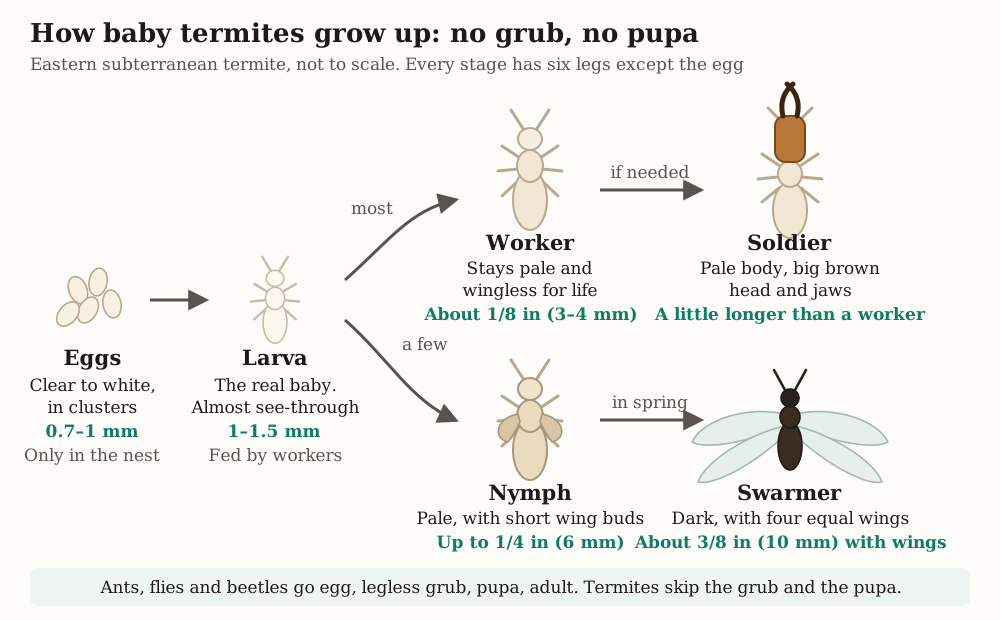
The exact path differs by species, and the experts admit it is messy. Texas A&M says larvae of native subterranean termites molt three or four times before they work as adults. UF/IFAS says Formosan termite larvae go through two larval stages before becoming workers or soldiers. A 2003 review by Lainé and Wright found the published counts of young stages in Reticulitermes, the common native genus, disagree, and called for one standard set of terms. For a homeowner, the names matter less than the shape: six legs, straight antennae, no waist.
The termite life cycle, from egg to swarmer
A colony starts when a pair of swarmers lands, drops its wings and digs a small chamber near wood. The new queen lays her first eggs, and the king and queen raise the first larvae themselves. After that, workers take over the care. Most young become workers. A few become soldiers. In a mature colony, some become nymphs and then swarmers, which fly off to start new colonies.
The colony grows slowly. Texas A&M says a native subterranean colony takes about 3 to 5 years to mature, when it usually has about 250,000 workers and starts to swarm. Large colonies also raise extra egg-layers, called secondary reproductives. These are pale to light brown, with short wing pads or none, and they help the queen keep the colony growing.
What do termite eggs look like?
Termite eggs are tiny, oval and white to see-through, and they sit in clusters inside the nest. An egg of the eastern subterranean termite measures about 0.7 mm, under 1/32 inch, in Thompson’s 1919 study. Drywood and dampwood termite eggs are larger, at 1.2 to 1.7 mm. Workers tend them constantly, so you almost never see termite eggs outside an opened colony.
Where the eggs are depends on the termite. Subterranean termites keep them in chambers in the soil, or in a satellite nest in damp wood. Drywood termites keep them inside the piece of wood the colony lives in, which can be a beam, a window frame or a piece of furniture. The eggs hatch in a few weeks or less; Oklahoma State gives about two weeks, while other sources range from several days to about a month.
How many eggs does a termite queen lay?
Far fewer than you may have read, at least for the termites in American houses. Texas A&M says a young native subterranean queen lays only a few hundred eggs in her first year, and Oklahoma State says a mature queen lays thousands each year. Large native colonies grow faster because extra queens lay eggs too.
Some pest company pages give much bigger numbers. Terminix says a US queen may produce up to 3,000 eggs a day, and a California company page says 30,000 a day. Daily counts that high come from species whose queens swell to a huge size, such as tropical mound builders. They do not fit the native subterranean termite, the one under most American houses.
What are the “termite eggs” I found?
If you can see them easily, they are probably not termite eggs. Real ones are smaller than a grain of sand and stay hidden in the colony. The most common finds are ant larvae and pupae, slug eggs, slow-release fertilizer beads in potting soil, and drywood termite pellets, which are droppings, not eggs. Check the size first, then the texture and the place.
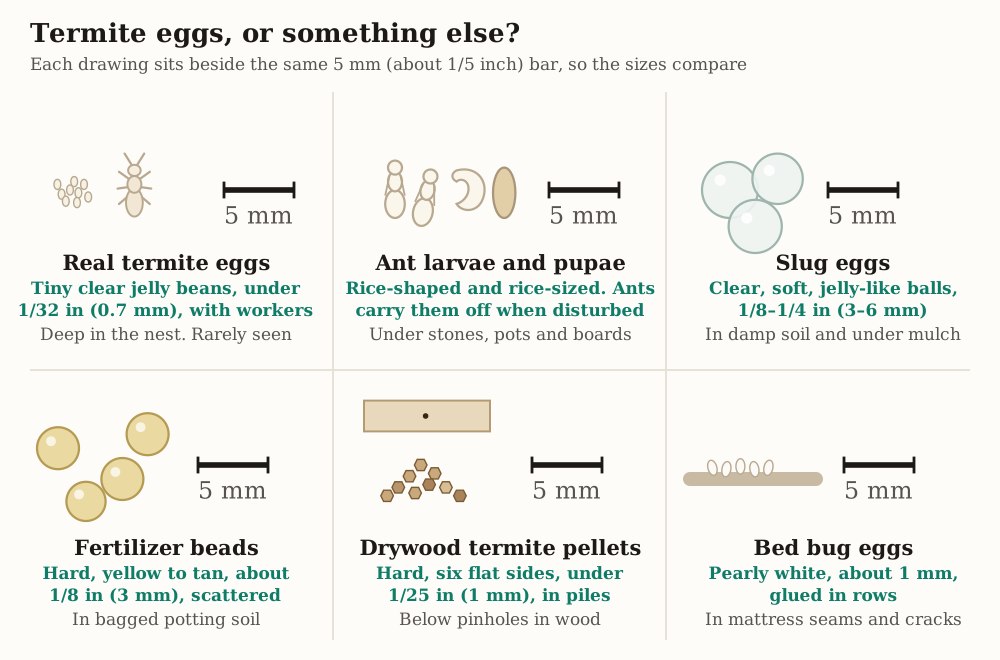
Termite eggs or something else?
Clear to white, oval, barely visible, with pale termites around them
- What it is
- Termite eggs
- Size
- About 0.7 mm in native subterranean termites; 1.2–1.7 mm in drywood and dampwood
- Where you find it
- Only inside an opened nest or infested wood
White, rice-shaped, and ants grab them and run when you lift the cover
- What it is
- Ant larvae and pupae (often called ant eggs)
- Size
- Rice-sized; varies by species
- Where you find it
- Under stones, pots, boards and in wall voids
Clear, soft, jelly-like round balls in a clump
- What it is
- Slug or snail eggs
- Size
- 1/8–1/4 in (3–6 mm)
- Where you find it
- Damp soil, under mulch, boards and pots
Hard, round, pale yellow to tan, spread through the soil, not clumped
- What it is
- Slow-release fertilizer beads
- Size
- About 1/8 in (3 mm)
- Where you find it
- Bagged potting soil and houseplant pots
Hard, six flat sides, all the same size, in piles below tiny holes
- What it is
- Drywood termite pellets (droppings)
- Size
- Under 1/25 in (1 mm)
- Where you find it
- Window sills, floors and furniture under infested wood
Pearly white, glued in place, in seams and cracks
- What it is
- Bed bug eggs
- Size
- About 1 mm
- Where you find it
- Mattress seams, headboards, bed frames
The fertilizer mix-up is so common that Purdue University’s plant diagnostic lab wrote about the calls it gets from people who think something laid eggs in their houseplant soil. Hard, see-through yellow beads about 1/8 inch across are fertilizer. Tiny, hard, six-sided grains under a pinhole are different. They are a real termite sign, and our guide to termite droppings and frass shows how to confirm them.
Is it a baby termite? Tiny white bugs that get mistaken for them
Most tiny white bugs found in a house are not baby termites. Springtails, booklice, ant larvae and pupae, fly larvae and mealybugs are far more common indoors. Check three things: a real termite has six legs, straight beaded antennae, and a thick body with no pinched waist. It walks slowly and does not jump. Then check the place, because termites stay in wood, soil and mud.
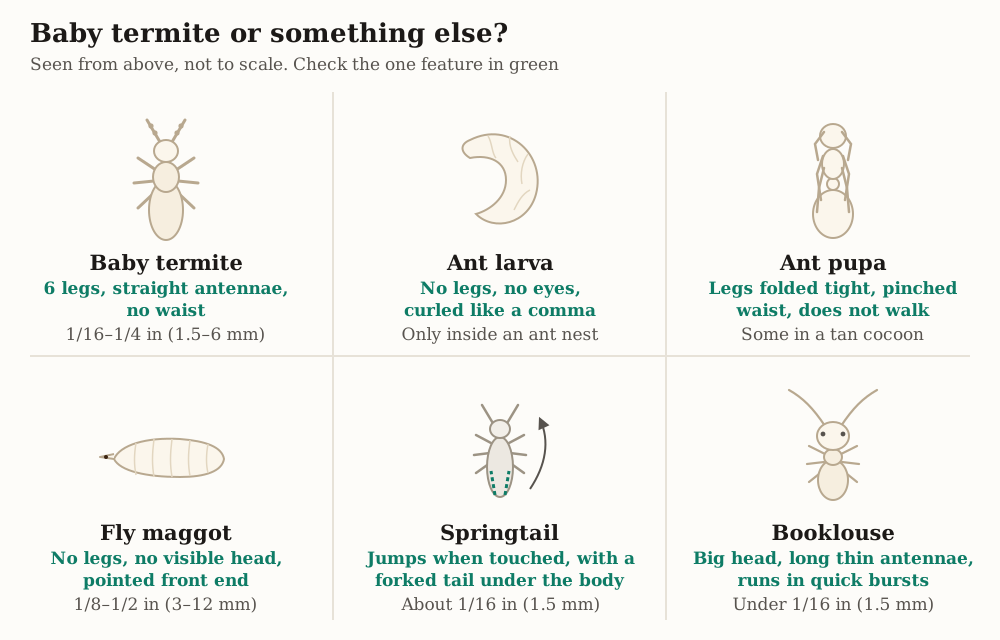
Baby termites and their look-alikes
Six legs, straight beaded antennae, no waist, walks slowly
- What it is
- Baby termite or worker
- Size
- 1/16–3/8 in (1.5–10 mm)
- Where you find it
- Inside wood, mud tubes, soil under wood, mulch
Jumps when touched, using a forked tail folded under the body
- What it is
- Springtail
- Size
- About 1/16 in (1.5 mm)
- Where you find it
- Sinks, tubs, damp basements, potted plants
Big head, long thin antennae, runs in quick bursts
- What it is
- Booklouse (psocid)
- Size
- Under 1/16 in (1.5 mm)
- Where you find it
- Damp paper, books, walls, stored food
No legs and no eyes, curled like a comma, cannot walk
- What it is
- Ant larva
- Size
- Varies by species
- Where you find it
- Only inside an ant nest
Legs folded tight, pinched waist, does not walk; sometimes in a tan cocoon
- What it is
- Ant pupa
- Size
- Rice-sized; varies by species
- Where you find it
- Ant nests under pots, stones and boards
Pinched waist and elbowed antennae, but pale
- What it is
- A newly emerged ant
- Size
- Same as the adult ant
- Where you find it
- Beside darker ants of the same kind
Dark head, pale see-through rear end, pinched waist, runs fast
- What it is
- Ghost ant
- Size
- Under 1/16 in (1.5 mm)
- Where you find it
- Kitchens, bathrooms, gaps in floor tiles
No legs, no visible head, tapers to a point at the front
- What it is
- Fly larva (maggot)
- Size
- 1/8–1/2 in (3–12 mm)
- Where you find it
- Garbage, drains, rotting food, pet food
See-through body with a shiny black head
- What it is
- Fungus gnat larva
- Size
- Up to 1/4 in (6 mm)
- Where you find it
- Wet potting soil
White, waxy, cottony, barely moves
- What it is
- Mealybug
- Size
- 2–4 mm
- Where you find it
- Stems, leaf joints and roots of houseplants
Springtails are a common false alarm. In one Ask Extension question, a homeowner found small bugs crawling on wood in a garage and asked if they were termites. The expert’s answer: no need to worry, they were springtails. UC IPM describes them as about 1/16 inch long and quick to jump, and they live where things are damp. For the full line-up of pale indoor bugs, see our guide to tiny white bugs.
We also read the 12 most-discussed “baby termite?” posts on Reddit’s r/Termites from 2024 to October 2026. Eleven got answers. The replies named ants in 5 of them, springtails in 3, and booklice or another small pest in 2. Only one turned out to be termites, and those were adult swarmers, not babies. These are reader reports, not lab checks, but the pattern is clear: a tiny pale bug on a floor, a sink or a porch is rarely a baby termite.
Termite larvae vs maggots
A maggot has no legs and no visible head, and its body tapers to a point at the front. A termite larva has six legs, a round head and two antennae, and it walks. Maggots also live somewhere else: in garbage, drains, compost and rotting food. If pale, legless worms are crawling across your floor, they are often fly larvae leaving their food to turn into brown fly pupae. In a houseplant pot, see-through worms with a black head are fungus gnat larvae.
Baby termites vs baby ants
Baby ants look nothing like baby termites. Ants go through a full change, egg, larva, pupa, adult, so their larvae are legless white grubs that cannot walk, and their pupae lie still with their legs folded. A pale ant that walks is a young adult, and it still has the pinched waist and bent antennae of every ant. So does the ghost ant, a tiny ant with a see-through rear end that turns up in Reddit posts asking about baby termites. Our page on termites vs ants compares the adults feature by feature.
Is it a baby termite? Check these
Check each clue below to narrow down what you saw.
Six legs you can count with a magnifier
No legs means a maggot or an ant larva.
Short, straight antennae like a string of beads
Long, thin, waving antennae point to a booklouse. Bent antennae mean an ant.
A thick body with no pinched waist
A narrow waist means an ant, even a pale one.
It walks slowly and does not jump
A bug that pops into the air is a springtail.
You found it in wood, a mud tube or soil touching wood
On a sink, a book or a houseplant, a look-alike is far more likely.
Where are baby termites found?
Baby termites live only inside the colony: in soil, damp wood, mud tubes or the galleries of infested wood. They dry out fast in open air, so you will not see them wandering across a floor, a counter or a bed. People find pale termites when they break open a mud tube, pull apart rotten wood or a stump, or dig into soil or mulch next to wood.
Bagged soil and mulch can hold them too. In an Ask Extension question from 2022, a gardener poured three bags of organic soil into grow bags and found thousands of small, white, wriggling insects. A University of Maryland Extension expert said they appeared to be termites, the soil was safe to use, and the termites would scatter. Termites in a bag of soil or a pile of mulch outdoors are not a threat to the house on their own.
The same goes for a rotting log or stump in the yard. A colony there is normal, and termites are a natural part of breaking down dead wood. It matters only if that wood touches the house, or if you stack it against a wall.
What does it mean if you find baby termites in the house?
Baby termites or pale workers inside the house mean a colony is feeding nearby, usually in the wood you found them in or in the soil under it. Workers do not leave their tunnels for open air, so they came out of something close by. Look for the source: a mud tube on the foundation, a soft baseboard or door frame, or wood touching soil. Then get an inspection. Our guide to what a termite inspection covers explains what the inspector will check.
Termites work slowly. Damage builds over months and years, not days. So you have time to collect a sample, get two or three quotes and choose calmly, without paying for an emergency visit.
What to do if you find baby termites
First, make sure they are termites: count six legs, check for straight antennae and no waist, and note where they were. Then do not spray. Bug spray only kills the termites you can see, not the eggs, larvae and queen in the colony. Keep a few in a jar, take photos with a coin for size, and book an inspection.
Six steps when you find tiny pale bugs
Stop and look closely
Use your phone camera zoomed in, or a magnifying glass. Count the legs, look at the antennae, and look for a pinched waist. Watch whether it walks, jumps or wriggles.
Note exactly where they were
Inside wood, a mud tube or soil means termites are likely. On a sink, a damp wall, a book or a houseplant means a look-alike is far more likely.
Collect a few
Pick up a few with a damp paper towel or clear tape, and put them in a small jar or zip bag. Dead ones are fine.
Take a photo with a coin for size
Photograph them beside a coin or a ruler, and photograph the spot. A clear photo of the legs and the antennae settles most cases.
Do not spray and do not dig
Bug spray kills only the ones you see. Breaking open more wood or knocking down tubes makes the colony harder for an inspector to judge.
If they are termites, book an inspection
Get two or three inspections and written quotes. If you rent, tell your landlord in writing, with the photos, and do not treat it yourself.
How do you get rid of baby termites?
You treat the colony, not the baby termites. Larvae cannot feed themselves, so they die when the workers that feed them die. UF/IFAS explains that this is how termite baits work: once the workers are gone, the larvae, soldiers and queen starve. For subterranean termites, a professional uses baits or a liquid treatment in the soil. For drywood termites, the wood itself is treated, or the building is fumigated by a licensed fumigator.
If you use any termite product yourself, use only one registered by the EPA for that use, and follow the label exactly. The label is the law. A spray that only kills on contact is not a termite treatment. Our guide to how termite treatment works compares the options.
Can baby termites hurt you or your pets?
No. Baby termites have soft jaws that have not even hardened yet, and workers have small jaws made for chewing wood. Soldiers can give a tiny nip if you handle infested wood, and Texas A&M says even that is harmless. Termites do not live on skin or infest beds, and no extension guide links them to disease. If a pale bug is biting you, it is not a termite.
Still not sure what you found? Our round-up of bugs that look like termites covers the winged look-alikes too, and our termite guide covers the four US kinds and the signs of an infestation.
Pest control disclaimer. Photo-based identification can help, but it is not always perfect. For dangerous spiders, large infestations, or anything you are unsure about, contact a licensed pest control professional.
Baby termites FAQ
Can you see termite eggs with the naked eye?
Can termites lay eggs inside my house?
How long does it take a baby termite to grow up?
Do baby termites eat wood?
What kills termite eggs?
What month are termites most active?
Which smell do termites hate?
Related guides
Termites
The four US termites, what a swarm means, the signs in a house, and what to do next.
What do termites look like?
Workers, soldiers, swarmers and queens, with sizes and colors for each.
Bugs that look like termites
The winged and wingless look-alikes, and the one feature that separates each.
Termites vs ants
Antennae, waist and color: telling wingless termites from ants.
Termite droppings
Six-sided pellets under a pinhole: drywood frass and its look-alikes.
Tiny white bugs
Springtails, booklice, mites and mealybugs: the pale bugs that are not termites.
Fungus gnats
See-through larvae with black heads in houseplant soil.
Fly pupae
Brown capsules left behind when maggots wander off to change.
Sources
- Ohio State University BYGL, Eastern subterranean termite, Reticulitermes flavipes (2024)
- Texas A&M AgriLife, E-368, Subterranean termites
- UF/IFAS EDIS IN278, Formosan subterranean termite
- UF/IFAS EDIS IN369, Native subterranean termites
- Oklahoma State University, Subterranean termite (Digital Diagnostics)
- Thompson, The development of the castes of nine genera and thirteen species of termites, Biological Bulletin (1919)
- Lainé and Wright, The life cycle of Reticulitermes spp.: what do we know?, Bulletin of Entomological Research (2003)
- UC IPM Pest Notes, Springtails
- UF/IFAS EDIS IG094, Psocids (booklice)
- Arizona State University, Ask A Biologist, Ant life cycle
- Purdue University Plant and Pest Diagnostic Lab, Fertilizer “eggs” (2022)
- Ohio State University Extension, HYG-2010, Slugs
- Ask Extension, Are these termites? (2022)
- EPA, Termites: How to Identify and Control Them