Part 1 of 5
Start here
What bugs look like termites?
Eighteen insects are mistaken for termites often enough to matter. Flying ants top the list. Mayflies, stoneflies, caddisflies, lacewings, drain flies, fungus gnats, webspinners and wood cockroaches fool people because they have wings. Booklice, springtails, earwigs, bed bugs and cockroach nymphs fool them without wings. Finally, carpenter bees and powderpost beetles fool them with damage.
Each look-alike has one feature that settles it, so the table below puts that feature first. You rarely need a microscope. A clear phone photo of the antennae, the waist and the wings answers most cases in under a minute.
The 18 bugs that look like termites, and the one feature that separates each
Elbowed antennae, pinched waist, front wings longer than the back pair
- Look-alike
- Flying ant
- Where and when you see it
- Warm days from spring to fall, at windows and lights
- Harm to the house
- None for most kinds
Elbowed antennae, pinched waist; black or red and black; swarmers up to 3/4 in (19 mm)
- Look-alike
- Carpenter ant
- Where and when you see it
- Spring swarms; indoors in late winter if nesting inside
- Harm to the house
- Nests in damp wood
Heart-shaped abdomen held up over the back; about 1/8 in (3 mm)
- Look-alike
- Acrobat ant
- Where and when you see it
- Around windows, damp wood and foam insulation
- Harm to the house
- Minor; moves into wood already damaged
Wings held upright like a sail, tiny back wings, 2 or 3 long tails
- Look-alike
- Mayfly
- Where and when you see it
- Near lakes and rivers, at lights, May to September
- Harm to the house
- None
Wings flat over the back like a termite, but long antennae and 2 tails
- Look-alike
- Stonefly
- Where and when you see it
- Near streams, at lights
- Harm to the house
- None
Hairy wings held like a roof; antennae as long as the body or longer
- Look-alike
- Caddisfly
- Where and when you see it
- Near water, around outdoor lights
- Harm to the house
- None
Lacy, net-veined wings held like a roof; golden eyes
- Look-alike
- Lacewing
- Where and when you see it
- Garden plants and porch lights in summer
- Harm to the house
- None; it eats aphids
Fuzzy and moth-like, 1/16 to 1/5 in (2 to 5 mm), sits still on walls
- Look-alike
- Drain fly
- Where and when you see it
- Bathrooms and kitchens, near drains
- Harm to the house
- None; points to a dirty drain
Only 2 wings, long legs, mosquito-like, 1/16 to 1/8 in
- Look-alike
- Fungus gnat
- Where and when you see it
- Houseplants and wet potting soil
- Harm to the house
- None
Slim body, swollen front feet that spin silk
- Look-alike
- Webspinner
- Where and when you see it
- Southern states; males fly to lights
- Harm to the house
- None
Flat body, wings covering the back, head hidden under a shield; up to 1 in (25 mm)
- Look-alike
- Wood cockroach
- Where and when you see it
- Porch lights at night, near woods
- Harm to the house
- None; it does not breed indoors
Under 1/16 in (1.5 mm), pale, wingless, on damp paper or food
- Look-alike
- Booklouse
- Where and when you see it
- Humid rooms, books, stored food
- Harm to the house
- None; a damp problem
Jumps when touched; most are 1 to 2 mm
- Look-alike
- Springtail
- Where and when you see it
- Damp soil, sinks, basements
- Harm to the house
- None
Pincers at the tail end; about 5/8 in (16 mm)
- Look-alike
- Earwig
- Where and when you see it
- Under mulch and debris, damp corners
- Harm to the house
- None
Flat, oval, reddish brown, about 5 mm; no wings
- Look-alike
- Bed bug
- Where and when you see it
- Mattress seams and bed frames
- Harm to the house
- None to wood, but it bites
Flat and fast, long antennae, head hidden under a shield
- Look-alike
- Cockroach nymph
- Where and when you see it
- Kitchens and bathrooms
- Harm to the house
- None to wood
One round hole about 1/2 in (13 mm), coarse sawdust and a yellow stain
- Look-alike
- Carpenter bee
- Where and when you see it
- Bare softwood: decks, eaves, fascia, in spring
- Harm to the house
- Tunnels in exposed wood
Pinhead holes with powder like flour or fine grit
- Look-alike
- Powderpost beetle
- Where and when you see it
- Hardwood floors, furniture, damp crawl space beams
- Harm to the house
- Slow damage to wood
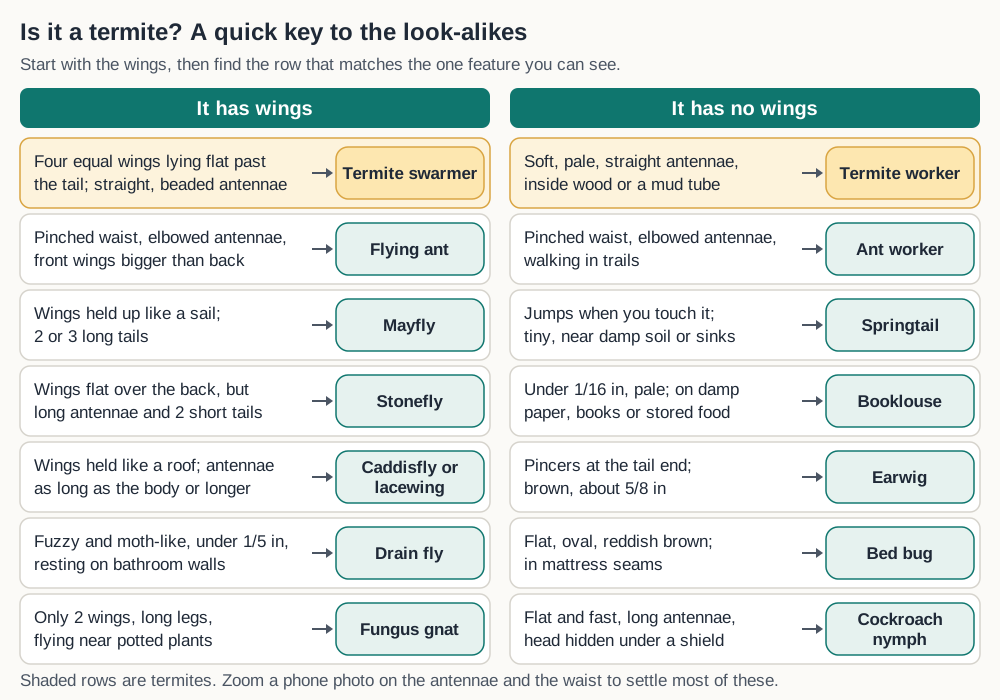
How do I know if a bug is a termite?
Check three things. A termite has straight antennae that look like a string of tiny beads and a thick body with no pinched waist. When it has wings, it has four of the same length that reach well past its tail. If even one of the three is missing, you are looking at one of the bugs that look like termites, not a termite.
A termite has all of these
Check each clue below to narrow down what you saw.
Short, straight antennae like a string of beads
Elbowed antennae mean an ant. Long, thread-like ones mean a fly, a lacewing or a stonefly.
A thick, straight-sided body with no narrow waist
A pinched waist means an ant or a wasp.
If winged: four wings of equal size, lying flat over the back
Wings held up like a sail or like a roof rule out a termite.
Wings about twice as long as the body, and easy to snap off
Piles of matching wings on a sill are a termite sign.
No tails, no pincers, no hard shell
Tails mean a mayfly or stonefly, pincers an earwig, a hard shell a beetle.
Size helps less than people expect. Most termite swarmers in the US are 1/4 to 5/8 inch (6 to 15 mm) long with their wings, although Pacific dampwood swarmers reach 1 inch. Workers are about 1/8 inch (3 mm). Many look-alikes fall in the same range. Our guide to what termites look like shows workers, soldiers and swarmers of each kind in detail.
Part 2 of 5
Look-alikes with wings
Bugs that look like flying termites
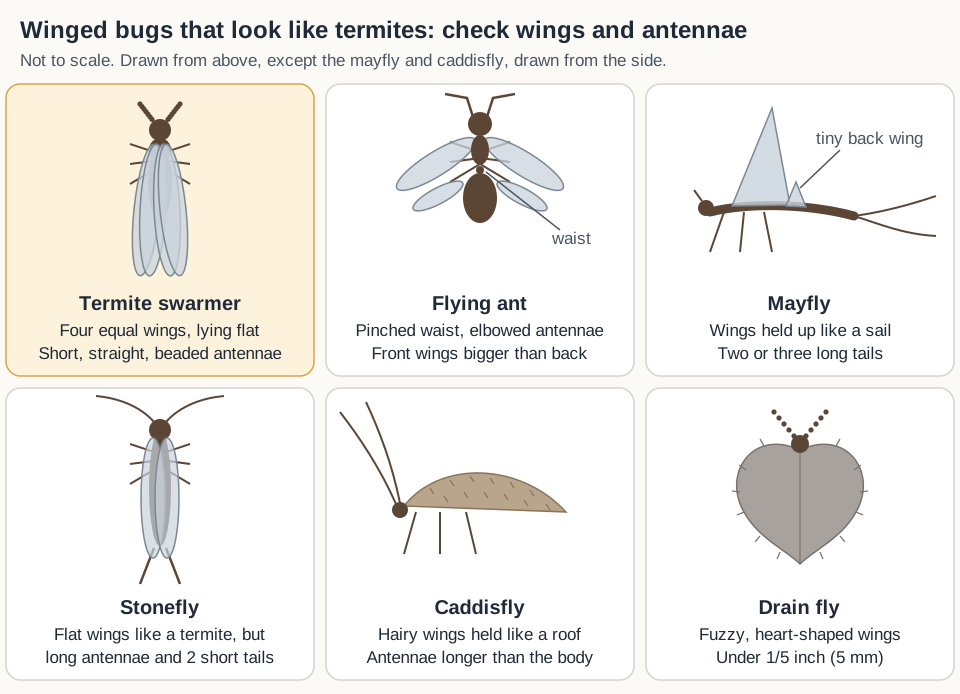
Winged ants cause most of the mix-ups, and nine other flying insects cause the rest. The quickest check is how the wings sit. A termite lays four equal wings flat over its back. Mayflies hold them up like a sail, while caddisflies, lacewings and drain flies fold them like a roof. Stoneflies lay theirs flat too, but carry long antennae and two tails.
Flying ants and carpenter ant swarmers
Flying ants are the look-alike in nearly every “is this a termite?” photo. Both swarm on warm days after rain, and both can be dark brown to black. However, an ant has elbowed antennae, a narrow pinched waist, and front wings clearly longer than its back wings. Carpenter ant swarmers are the big ones, up to 3/4 inch (19 mm), and they are the ants that nest in damp wood. One catch: male ant swarmers can have only slightly bent antennae, so always check the waist as well.
A wingless ant queen can fool you as well, because she sheds her wings after mating just as a termite does. She still has the pinched waist and a bulky middle section. For the side-by-side detail, see our pages on telling flying ants from termite swarmers and on termites vs ants without wings. Small ants with a heart-shaped abdomen that nest around damp window frames are acrobat ants.
Mayflies
Mayflies are 1/4 to 1 1/4 inches (6 to 32 mm) long, with a slim body and two or three long tails. They hold their wings straight up over the back like a sail. The back wings are tiny next to the front pair, so the four wings are never equal. They emerge from lakes and rivers in huge numbers from May into September and pile up under lights. Adults cannot bite and live only a day or two.
Stoneflies
Stoneflies are the closest match in shape. Like termites, they fold four wings flat over the back. But their antennae are long and thread-like, and two short tails stick out past the wing tips. Most are 1/2 to 2 inches (13 to 50 mm) long and dull brown. They stay close to clean streams, and many are drawn to lights at night. They do not eat wood and do no harm.
Caddisflies
A caddisfly looks like a small brown moth. Its wings are covered in fine hairs and held like a tent over the body, and its antennae are as long as the body or longer. Most are 1/4 to 1 inch (6 to 25 mm) long. They hatch from rivers and lakes and swarm to porch lights for a few weeks at a time.
Lacewings
Green lacewings are 3/8 to 1/2 inch (10 to 13 mm) long, pale green, with large, lacy wings held like a roof over the body. Look for the golden eyes and the long, thin antennae. Brown lacewings are smaller and darker, and they are the ones people post online as “flying termite or lacewing?” Both are garden helpers, since their larvae eat aphids.
Drain flies in the bathroom
Small dark bugs with wings in a bathroom are usually drain flies. They are 1/16 to 1/5 inch (2 to 5 mm) long, fuzzy all over, and hold their wings like a roof, so they look like tiny moths. They sit still on a tile or a mirror and flutter a short way when disturbed.
Still, termite swarmers do come out in bathrooms, because subterranean termites follow plumbing up through the slab. Dead swarmers near sinks and tubs are a known sign. So if the bugs are smooth rather than fuzzy, with long, flat wings that snap off, treat it as a termite question and check for wings on the floor.
Fungus gnats
Fungus gnats are tiny, dark, mosquito-like flies, 1/16 to 1/8 inch (1.5 to 3 mm) long. Like all true flies, they have only one pair of wings, and their legs are long and thin. They hover around houseplants with wet soil. A termite never has two wings, so counting them settles it.
Webspinners
Webspinners are slim, brown insects, 1/6 to 1/4 inch (4 to 7 mm) long in the US. They live in silk tunnels on bark, rocks and walls, and they are common in Florida and other warm southern areas. Females never have wings, but the males of some species fly to lights at night. Look at the front legs: a webspinner’s first foot segment is swollen, because that is where it spins silk. No termite has that.
Wood cockroaches
Male wood cockroaches fly to porch lights on warm nights, and people who see one land find a flat brown insect with long wings over its back. But it is a cockroach. The head hides under a shield-like plate, the antennae are long, and adult males reach 1 inch (25 mm). Indoors they do not feed or breed, and they dry out and die within a few days.
Part 3 of 5
Look-alikes without wings
Bugs that look like termites without wings
Without wings, a termite is a worker: soft, cream-colored and about 1/8 inch (3 mm) long, almost always inside wood, soil or a mud tube. Pale bugs out in the open are usually booklice, springtails or ants. A worker almost never walks across a counter, a bed or a windowsill, so where you found the bug is half the answer.
Booklice and mites
Booklice are tiny, soft, pale insects, usually under 1/16 inch (1.5 mm) long, which is less than half the size of a termite worker. Most indoor kinds have no wings. They feed on mold, so they turn up on damp books, papers, window sills and stored food in humid rooms. Bringing indoor humidity below 50% starves them of the mold they eat.
Tiny white mites on damp lumber or firewood are smaller still and have eight legs. Neither booklice nor mites eat wood. Our guide to tiny white bugs sorts out every pale speck you might find indoors.
Springtails
Springtails are 1 to 2 mm long and can be white, gray or dark. The giveaway is that they jump. A forked tail folded under the body snaps down and flings them an inch or more. They gather in damp spots such as sinks, tubs, basements and potted plants, and they do not bite or damage anything.
Ant workers
Pale or yellow ants trailing along a counter can look like termite workers at a glance. The pinched waist and elbowed antennae still give them away, and ants walk in the open while termite workers avoid light. Our comparison of termites and ants covers this pair in full. If what you found is tiny, white and grub-like, see what baby termites look like.
Cockroach nymphs
Young cockroaches have no wings and can be pale right after they molt, so a fresh nymph can look like a termite. Yet a cockroach is flat, fast and shy of light, with long antennae and the head tucked under a plate. Small, dark nymphs with a pale stripe in a kitchen point to the German cockroach.
Earwig vs termite
An earwig is about 5/8 inch (16 mm) long, flat and reddish brown, with a pair of pincers at the tail. Its wings are short flaps, so it looks wingless. Those pincers end the question, since no termite has anything at its tail. Earwigs hide under mulch and debris in damp spots and are harmless to people and houses.
Bed bugs
Bed bugs get confused with termites mostly in photos, as both can be small and brown. An adult bed bug is about 5 mm long, flat, oval and reddish brown, with no wings at all and no visible waist. It lives in mattress seams and bed frames, not wood framing. If you found it on a bed, read what bed bugs look like before anything else.
Part 4 of 5
Look-alikes that damage wood
Bugs that damage wood like termites
Three bugs that look like termites earn the name through damage, not looks: carpenter ants, carpenter bees and powderpost beetles. The holes and the dust tell them apart. Carpenter bees drill one round hole about 1/2 inch (13 mm) wide. Powderpost beetles leave pinholes with powder like flour. Termites leave six-sided pellets or mud, never sawdust.
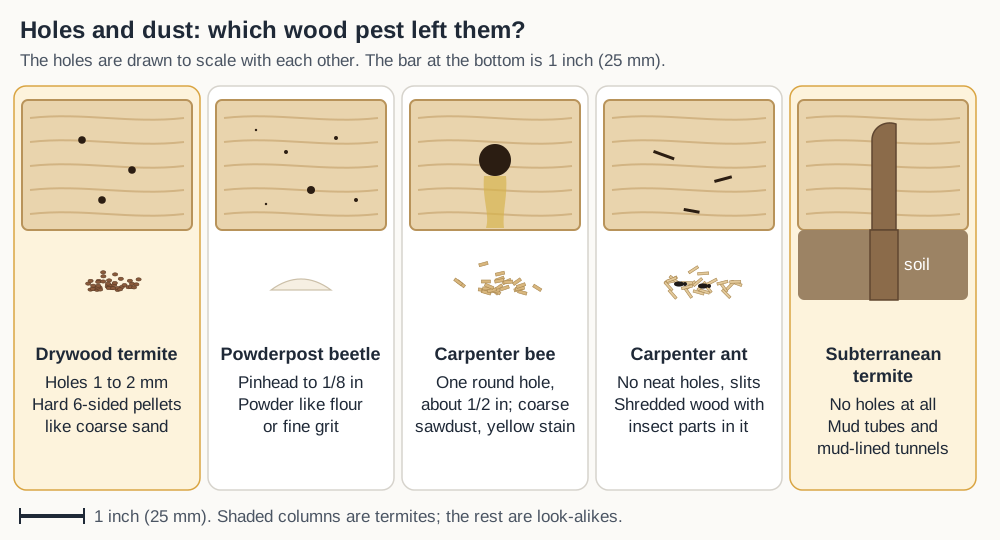
Wood damage from termites and the bugs that look like them
Hard, six-sided pellets like coarse sand below tiny holes
- Who made it
- Drywood termites
- Size of the holes
- 1 to 2 mm
- What to do
- Inspection; fumigation, heat or wood treatment
Mud tubes on the foundation; mud-lined tunnels along the grain
- Who made it
- Subterranean termites
- Size of the holes
- No holes
- What to do
- Inspection; soil treatment or baits
Powder like flour or fine grit sifting from round pinholes
- Who made it
- Powderpost beetles
- Size of the holes
- 1/32 to 1/8 in (about 1 to 3 mm); bigger kinds to 1/4 in
- What to do
- Check if active before you treat
One perfectly round hole, coarse sawdust and a yellow stain below
- Who made it
- Carpenter bee
- Size of the holes
- About 1/2 in (13 mm)
- What to do
- Paint or seal bare wood; plug old holes
Shredded wood with insect parts, smooth sanded galleries
- Who made it
- Carpenter ants
- Size of the holes
- No neat holes, slits and cracks
- What to do
- Fix the moisture, find the nest, bait
Carpenter ants
Carpenter ants dig nests in wood but do not eat it. They push the shavings out, so you find small piles of shredded wood mixed with dead ant parts below a slit or crack. Inside, their galleries are clean and smooth, as if sanded. Termite galleries are lined with mud or packed with pellets. Our carpenter ant guide shows how to find the nest.
Carpenter bees vs termites
A carpenter bee is a large, shiny black bee, and nobody mistakes the bee itself. The hole is the problem. It is perfectly round, about 1/2 inch (13 mm) across, in bare softwood such as deck rails, eaves and fascia, with coarse sawdust and a yellow stain below. Termites never make a hole that size.
Powderpost beetles
Powderpost beetles are small, reddish brown to black beetles, 1/16 to 3/4 inch long depending on the kind. Their grubs tunnel inside wood and leave round exit holes. The most common indoor kind, the lyctid beetle, makes holes about the size of a pinhead and powder that feels like flour or talc. Lyctids attack only bare hardwood, such as floors, paneling, molding and furniture.
The University of Kentucky calls powderpost beetles second only to termites at damaging dry, seasoned wood. Yet it also says many infestations die out on their own and that there is no need to rush. Its test is simple: sweep up the powder, mark the holes, and look again in spring or summer. Fresh holes with light-colored powder mean the beetles are still active.
Acrobat ants
Acrobat ants often move into wood that termites or carpenter ants have already hollowed out. So a termite job that seems to come back to life may be acrobat ants. They are about 1/8 inch (3 mm) long and raise a heart-shaped abdomen over their back when disturbed. Their debris piles hold dead insects and bits of insulation, not pellets.
For every kind of damage side by side, including wood rot, see our guide to what termite damage looks like. For the pellets themselves, see termite droppings.
Part 5 of 5
What it means for your house
When the look-alike is a termite after all
Sometimes the “look-alike” is just a different termite from the one you pictured. Eastern subterranean swarmers are dark brown to black, not pale, and fly by day in spring. Formosan swarmers are amber, 1/2 to 5/8 inch (12 to 15 mm), and fly at dusk toward lights from April to June. Drywood termites in the Southeast also swarm at night to lights.
So a dark swarmer at noon or an amber one under a porch light can still be a termite. Our page on termites with wings shows each kind, and what a termite swarm means explains whether one indoors means an infestation.
Which look-alikes matter, and which you can ignore
Fourteen of the 18 bugs that look like termites do no harm to wood at all, and three of those point to a damp spot you should fix. Only carpenter ants, carpenter bees and powderpost beetles damage wood, while acrobat ants mostly reuse wood that is already damaged. Sort your bug into one of these groups before you spend money on it.
What each look-alike means for you
Mayflies, stoneflies, caddisflies, lacewings, webspinners or wood cockroaches
- What it means
- Outdoor insects drawn in by lights
- What to do
- Nothing. Switch porch lights to yellow bulbs and close blinds at night
Flying ants other than carpenter ants, earwigs or springtails
- What it means
- A nuisance with no damage to wood
- What to do
- Vacuum them; seal gaps; fix damp spots for springtails
Drain flies, fungus gnats or booklice
- What it means
- A moisture source indoors
- What to do
- Clean the drain, let potting soil dry, lower the humidity
Carpenter ants, carpenter bees or powderpost beetles
- What it means
- Wood damage, usually slow
- What to do
- Find the source this season; a professional for carpenter ants inside walls
Bed bugs or cockroaches
- What it means
- A health and hygiene problem, not a wood problem
- What to do
- Follow a bed bug or cockroach plan, not a termite one
Straight antennae, thick waist, four equal wings
- What it means
- A termite
- What to do
- Keep a sample and book an inspection
What to do with a bug you think is a termite
Catch one, photograph it, and check the antennae, the waist and the wings before you buy anything. That takes about five minutes and costs nothing. Hold off on spraying, because a dead bug in a jar is worth more to an inspector than a sprayed floor. Then act only on what you confirm.
Seven steps, cheapest first
Catch one
Trap it under a glass, drop it into a jar or a zip bag, or press it onto clear tape. A dead one is fine, and so are a few loose wings.
Photograph it up close
Take one shot from above and one from the side, with a coin for size. Zoom in on the antennae, the waist and the wings.
Run the three checks
Straight antennae, a thick waist and four equal wings mean a termite. Any one of the three missing means a look-alike.
Note where and when
Write down the room, the time of day and whether the bug came out indoors or flew in. A swarm at a lit window at night and one in a bathroom at noon point to different insects.
Look for termite signs nearby
Check sills for piles of matching wings, the foundation for mud tubes, and wood for pinholes with six-sided pellets below.
Do not spray yet
Spraying kills the evidence and does nothing to a colony in the wall. Most look-alikes need no spray at all.
Get a second opinion if it is a termite
Send the photo to your county extension office or book a termite inspection. Renters should tell the landlord in writing.
If the checks point to termites, our guide to the signs of termites shows what else to look for, and what a termite inspection involves explains the next step. For the bigger picture, start at our termite hub.
Mistakes in other termite look-alike guides
Several of the pages that rank for this search repeat errors that send readers the wrong way. Here are four, each with the page it comes from and what the extension sources say instead. They matter, because each one can make a harmless bug look like termites or hide a real termite.
Mistake 1
Mistake: Mayflies shed equal wings like termites (Better Termite).
Reality: Penn State Extension describes mayflies with two large front wings and two small back wings, held straight up like a triangular sail. Unequal wings held upright rule out a termite.
Mistake 2
Mistake: Termites range from white to light brown (Terminix).
Reality: That fits workers, which never fly. UF/IFAS describes eastern subterranean swarmers, the ones people actually see, as dark brown to almost black.
Mistake 3
Mistake: A termite infestation comes with small piles of sawdust (Bob Vila).
Reality: Termites eat the wood and leave pellets or mud, not sawdust. Sawdust below a hole points to carpenter bees or carpenter ants.
Mistake 4
Mistake: White bugs that look like termites are most likely termites (Bob Vila).
Reality: Booklice, springtails and mites are pale too, and far more common out in the open. Termite workers stay hidden inside wood, soil and mud tubes.
Still not sure what you caught? Upload a photo to our free bug identifier, then check the antennae and the waist yourself.
Pest control disclaimer. Photo-based identification can help, but it is not always perfect. For dangerous spiders, large infestations, or anything you are unsure about, contact a licensed pest control professional.
Bugs that look like termites FAQ
What smell do termites hate?
What is the best spray for flying termites?
Should I be worried if I see termites?
What bugs look like termites in Florida and Texas?
Can a bug app tell a termite from a look-alike?
Related guides
Termites
The four US termites, what a swarm means, and how treatment, quotes and prevention work.
What do termites look like?
Workers, soldiers and swarmers of each kind, with sizes in inches and millimeters.
Termites with wings
Why winged termites appear, what they look like, and whether to worry.
Termites vs ants
Wingless workers and ants compared: antennae, waist, color and what each eats.
Flying ants vs termites
The four checks for winged ants and termite swarmers, and whose wings are on the sill.
Termite damage
What termite damage looks like next to carpenter ant, beetle and rot damage.
Tiny white bugs
Booklice, springtails, mites and the other pale specks people mistake for termites.
Carpenter bees
Round half-inch holes in decks and eaves, and how to stop the bees.
Sources
- University of Kentucky Entomology, ENTFACT-616, Powderpost beetles (M. F. Potter)
- Penn State Extension, Indicator insects: stoneflies and mayflies
- Penn State Extension, Wood cockroaches (M. J. Skvarla)
- University of Minnesota Extension, Mayflies
- University of Minnesota Extension, Caddisflies
- University of Minnesota Extension, Green lacewings
- Missouri Department of Conservation, Stoneflies
- UF/IFAS Extension, EDIS IG094, Booklice and silverfish
- Texas A&M AgriLife Extension, Springtails
- University of Minnesota Extension, Earwigs
- UF/IFAS Extension, Webspinners (Manatee County, 2026)
- UF/IFAS Extension, EDIS IN369, Native subterranean termites
- K-State Entomology, Winged ants vs termites
- EPA, Termites: How to identify and control them