Termites vs ants: the five checks
Termites vs ants comes down to five checks you can make with a phone camera. They are the waist, the antennae, the body, where the insect lives and what is in the wood. An ant has a pinched waist and elbowed antennae. A termite worker is 1/8 to 1/4 inch (3 to 6 mm) long, pale, soft and straight-sided, with beaded antennae.
Most people who ask this have not seen a swarm. They broke open a damp board, lifted a stone or pulled off a baseboard and found small insects. This page is about those wingless ones. The winged swarmers get their own section below.
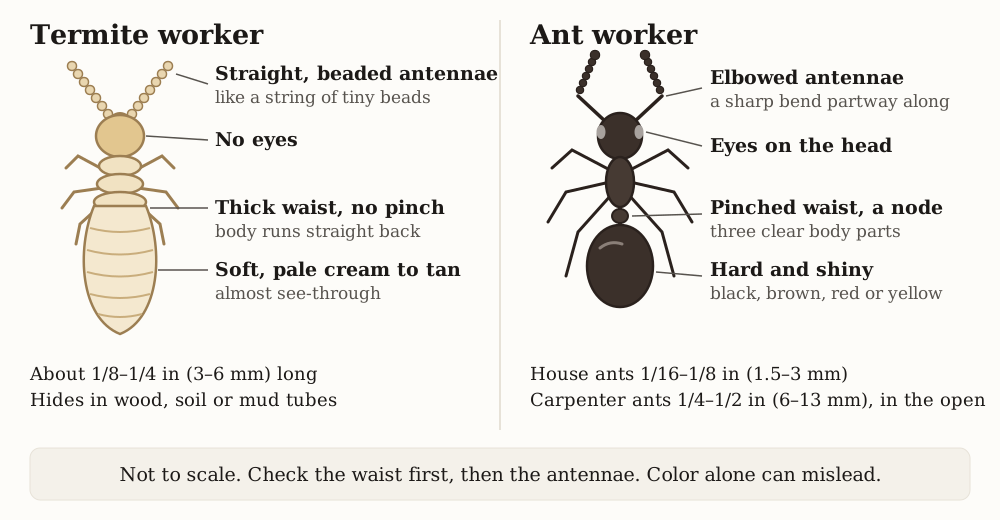
Termite worker compared with an ant worker
1. Waist
- Termite worker
- Thick; the body runs straight back with no pinch
- Ant worker
- Pinched and narrow, with one or two small bumps (nodes)
2. Antennae
- Termite worker
- Straight, like a string of beads
- Ant worker
- Elbowed: a long first part, then a sharp bend
3. Body
- Termite worker
- Soft, pale cream to light tan, almost see-through
- Ant worker
- Hard and shiny; black, brown, red or yellow
4. Where you see it
- Termite worker
- Inside wood, soil or mud tubes; it hides from light and air
- Ant worker
- Out in the open, often walking in a line
5. What is in the wood
- Termite worker
- Mud in the tunnels, or tiny hard pellets
- Ant worker
- Clean, smooth tunnels and coarse sawdust (carpenter ants only)
Eyes (hard to see)
- Termite worker
- None in workers and soldiers
- Ant worker
- Two eyes on the sides of the head
Size (does not separate them)
- Termite worker
- 1/8–1/4 in (3–6 mm)
- Ant worker
- 1/16 in (1.5 mm) for tiny house ants to 1/2 in (13 mm) for carpenter ants
1. The waist
This is the fastest check. An ant is built in three clear parts: head, middle and rear. The back two meet at a narrow waist with one or two small bumps called nodes. A termite has no waist at all. Its middle runs straight into its rear, so the whole insect looks like a grain of rice with legs.
2. The antennae
Next, zoom in on the head. An ant’s antenna has a long first segment and then bends sharply, like an arm at the elbow. A termite’s antenna is a straight row of tiny beads. It may droop or curve on a dead one, but it never has that sharp joint.
3. The body and its color
Termite workers are soft and pale, and you can almost see through them. Sources describe the shade a little differently: Penn State Extension calls the eastern subterranean worker creamy white, while UC IPM calls California’s workers light caramel. Ants, by contrast, wear a hard, shiny shell, and most house ants are black, brown or red.
Color is the weakest check, though. A newly emerged ant stays pale for a short time, ghost ants have a see-through rear, and the white “eggs” in an ant nest are really larvae and pupae. Any of them can pass for a termite at a glance. That is why the waist comes first.
4. Behavior: light, air and mud
Termite workers avoid light and open air, because they dry out fast. They travel inside wood, soil or mud tubes about the width of a pencil, and they have no eyes, so they find their way by touch and smell. You will almost never see one walking across a floor or a counter.
Ants forage in the open and often walk in a line to food. So a trail of small insects on a kitchen counter is ants. Big black ants out at night are often carpenter ants, which are most active after sunset.
5. What is in the wood
If you broke into damaged wood, the tunnels help as well. Subterranean termites leave mud and soil inside their tunnels. Carpenter ants leave smooth, clean galleries and push coarse sawdust out of the wood. The carpenter ant section below shows both, along with the pellets of drywood termites.
What a phone photo can and cannot show
A sharp photo from the side shows the waist, which settles most termites vs ants cases. The antennae are harder, because they move and blur. So photograph the insect on white paper next to a ruler, in daylight, then zoom in on the head. If you see an elbow, it is an ant. If you are still unsure, a jar with three or four real insects settles it, and our free bug identifier gives a quick first answer from a photo.
Do termites look like ants?
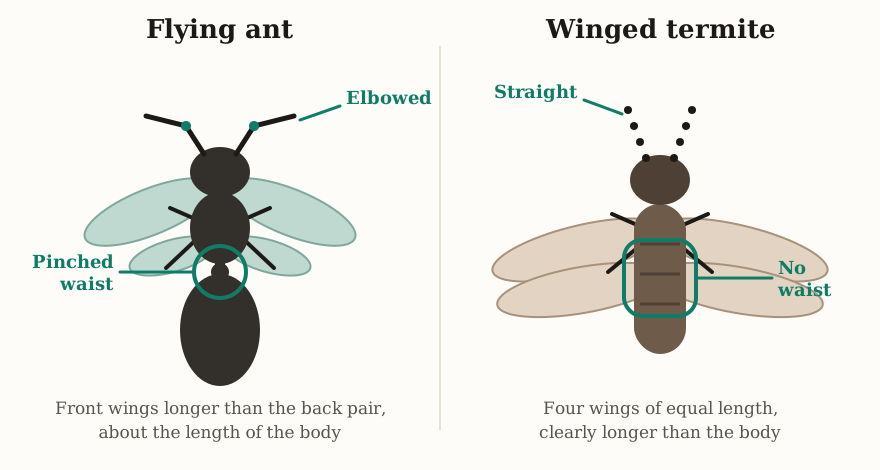
Wingless termites look little like ants up close: they are pale, soft and straight-sided. Winged termites are another story. Termite swarmers are dark brown to black and about 3/8 inch (10 mm) long with their wings, just like many winged ants, and both swarm on warm spring days. That is when most mix-ups happen.
With wings, the waist and antennae checks still work, and there is one more. A termite has four wings of equal size that reach well past its body, while an ant’s front wings are bigger than its back pair. Our guide to telling flying ants from termite swarmers covers the wing checks, shed wings on the sill and when each one swarms.
Are white ants termites?
Yes. “White ants” is an old nickname for termites, still common in Australia, India and Africa. It comes from the pale workers. There is no true white ant in the US, so a pale, soft, ant-sized insect inside wood is almost always a termite worker. Check the waist first, since termites have none.
In the termites vs ants question, the name misleads twice. Termites are not ants, and the termites most people actually see, the swarmers, are dark rather than white. Meanwhile, several pale bugs that are not termites get called white ants too.
Other small white bugs that look like termites or ants
Small pale insects found with or instead of termites
Soft cream body, thick waist, straight antennae; it walks
- What it is
- Termite workers
- Where you find it
- Inside damp wood, soil or a broken mud tube
White grubs with no legs, or still “grains of rice” that ants grab and carry off
- What it is
- Ant larvae and pupae (ant brood)
- Where you find it
- Under stones, pots and boards, and in rotten wood
Pale, with a pinched waist, beside darker ants of the same kind
- What it is
- A newly emerged ant
- Where you find it
- In an opened ant nest
Tiny, about 1/16 in (1.5 mm); dark front, see-through rear
- What it is
- Ghost ant
- Where you find it
- Kitchens, sinks and potted plants in Florida and Texas
Jumps when touched
- What it is
- Springtail
- Where you find it
- Damp spots: sinks, tubs, wet roofs, log piles
Fuzzy, carrot-shaped, with tufts of hair
- What it is
- Carpet beetle larva
- Where you find it
- Floors, closets and baseboards
Ant brood is the mix-up that comes up most on Reddit. In one r/pestcontrol thread, a homeowner found eggs and “creepy crawlies” in a rotted deck and feared termites. Several replies agreed it was ants with their young. “This is an ant nursery,” one wrote. In another thread, the “tiny white ants” in a wet roof turned out to be springtails.
Tiny white ants in the kitchen
Tiny pale “ants” walking in a line on a counter are ants, not termites, because termites do not forage in the open. In Florida and Texas they are often ghost ants, about 1/16 inch (1.5 mm) long, with a dark front and a pale, see-through rear. Our guide to sugar ants and ghost ants shows how to bait them.
Baby termites vs ants
Baby termites look like small, pale workers and walk on six legs from the day they hatch. Baby ants cannot walk at all. They are white, legless grubs (larvae) or still pupae about the size of a grain of rice, and the workers carry them away when you open the nest. So a pale insect that walks is a termite.
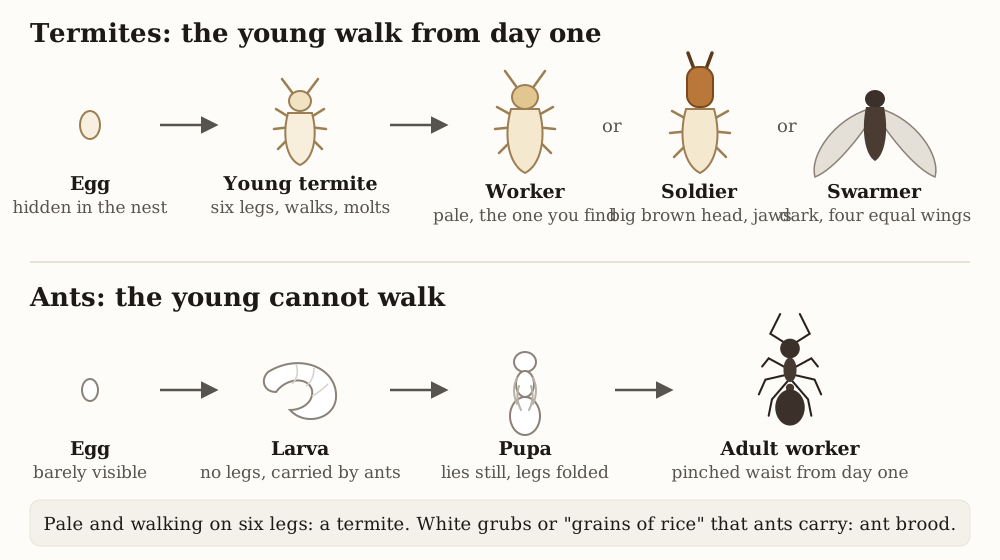
The difference comes from how each one grows up. Ants change completely, from egg to larva to pupa to adult, just like bees and wasps. Penn State Extension describes carpenter ant larvae as white and legless, with pupae in tan cocoons. Termites, on the other hand, skip the grub and the pupa. They hatch as tiny versions of the adults and molt as they grow, the way cockroaches do.
For pale young insects, walking is the best termites vs ants test. A small, pale insect that moves around on its own legs in damp wood is a young termite or a worker, and it means an active colony. Our guide to what baby termites look like covers termite eggs, larvae and the other tiny white bugs people mistake for them.
Are termites related to ants?
No. Termites are social cockroaches, in the insect order Blattodea, while ants belong to the order Hymenoptera with bees and wasps. The two groups took up colony life separately, millions of years apart. That is why they look alike from across a room and differ in nearly every detail up close.
The cockroach link was settled by DNA. A 2007 study in Biology Letters by Inward, Beccaloni and Eggleton compared termites with cockroaches and concluded that termites are “eusocial cockroaches”. UF/IFAS now lists termites in the cockroach order, so they are no longer a separate order of their own.
How termites and ants differ as animals
Insect order
- Termites
- Blattodea, with cockroaches
- Ants
- Hymenoptera, with bees and wasps
How the young grow
- Termites
- Egg, then young that look like small adults and molt
- Ants
- Egg, larva, pupa, adult
Who leads the colony
- Termites
- A queen and a king, who stays with her
- Ants
- One or more queens; males die soon after mating
Workers
- Termites
- Soft and pale; most have no eyes
- Ants
- Hard-bodied females with eyes
Main food
- Termites
- Cellulose: wood, paper, dead plants
- Ants
- Sweets, seeds, protein and other insects
Defense
- Termites
- Soldiers with big heads and jaws
- Ants
- Bites, and in some kinds a sting
Are termites a type of ant?
No. “White ants” and “termite ants” are only nicknames. Both insects live in colonies with a queen, workers and winged swarmers, which is where the confusion starts. However, their bodies, their life cycles and their food are all different.
Are termites cockroaches?
In a sense, yes. Termites sit inside the cockroach family tree, but they are not the roaches in your kitchen. They share an ancestor with them, and like roaches they grow up without a pupa stage. For what that means in a house, see our termite guide, which covers the four US kinds.
What do termites and ants eat?
Termites eat cellulose, the main fiber in wood, paper, cardboard and dead plants, and tiny microbes in their gut help them digest it. Ants eat almost everything else: sugary liquids, seeds, protein and other insects. Carpenter ants chew wood, but they do not eat it. Instead, they push it out as sawdust.
Do ants eat termites?
Yes, often. In 2020, Tuma, Eggleton and Fayle reviewed every published study on ants and termites. They found that ants hunting termites is the most important and most widespread link between the two. A few ants hunt termites as a specialty, and many more grab them whenever they get the chance. So the answer to “what is a termite’s worst enemy?” is usually ants.
Swarming is the riskiest time. UC IPM notes that most termite swarmers die during the flight, eaten by birds, lizards, ants and other insects. The workers stay safe by hiding in wood, soil and mud tubes.
Do not count on ants to protect your house, though. One Reddit user watched ants attack termites in an outdoor porch column, and a week later the termites were gone from that wood. That is real, and it is also the limit. Ants clear out termites they can reach, not a colony in the soil under a house.
Do termites eat ants?
No. Termites eat only plant material, and they never hunt. Their defense is the soldier caste: termites with large, hard heads and big jaws that guard the colony against ants and other predators.
Can ants and termites live in the same wood?
Sometimes, as neighbors in an old stump or a log pile outdoors. Inside a house, though, they rarely share one piece of wood for long. A pest professional on r/pestcontrol put it simply: ants and termites generally won’t coexist. So ants in termite-damaged wood can mean the ants moved in after the termites died out or were treated. Either way, have the wood checked.
Which is worse, termites or carpenter ants?
Termites, in most homes. They eat the wood itself, a colony can hold hundreds of thousands of workers, and they can feed out of sight for years. Carpenter ants only dig nests, usually in wood a leak has already softened, so their damage builds more slowly. Most other house ants do no damage to wood at all.
Experts agree on this part of termites vs ants. “Subterranean termites are the most serious wood destroying pest in the Southeast,” UF/IFAS entomologist Faith Oi told Southern Living, adding that ignored carpenter ant problems can cause real damage too.
Sources differ on how far carpenter ants go. Penn State Extension says they seldom tunnel into dry, sound wood. UC IPM says a nest can spread from damp wood into sound wood and weaken it. Either way, both need dealing with, and neither is an emergency tonight. Our guide to what termite damage looks like shows it room by room.
Carpenter ants vs termites
Carpenter ants are the ants most often confused with termites, because both turn up in damaged wood. Carpenter ant workers are 1/4 to 1/2 inch (6 to 13 mm) long, black or red and black, with a pinched waist. Termite workers are half that size or less, pale and soft. In termites vs ants cases inside wood, the tunnels tell them apart as well.
Carpenter ants compared with the two main house termites
The insect
- Carpenter ants
- Black or red and black, 1/4–1/2 in (6–13 mm), pinched waist
- Subterranean termites
- Cream workers, 1/8–1/4 in (3–6 mm), thick waist
- Drywood termites
- Cream workers, rarely seen outside the wood
Inside the wood
- Carpenter ants
- Smooth, clean galleries that can run across the grain
- Subterranean termites
- Tunnels along the grain, with mud and soil
- Drywood termites
- Hidden chambers; pellets pushed out
Debris outside
- Carpenter ants
- Coarse, shredded sawdust with ant parts, below slits
- Subterranean termites
- None; mud tubes instead
- Drywood termites
- Hard, six-sided pellets about 1 mm (1/25 in), below pinholes
Wood they pick
- Carpenter ants
- Wood a leak has softened, then sound wood nearby
- Subterranean termites
- Any wood with a path to moist soil
- Drywood termites
- Dry, sound wood, often in attics and furniture
Seen in the open?
- Carpenter ants
- Yes, foraging, mostly at night
- Subterranean termites
- Almost never
- Drywood termites
- Only the swarmers
Who fixes it
- Carpenter ants
- You, by fixing the leak and baiting; a pro for nests in walls
- Subterranean termites
- A licensed termite company
- Drywood termites
- A licensed termite company
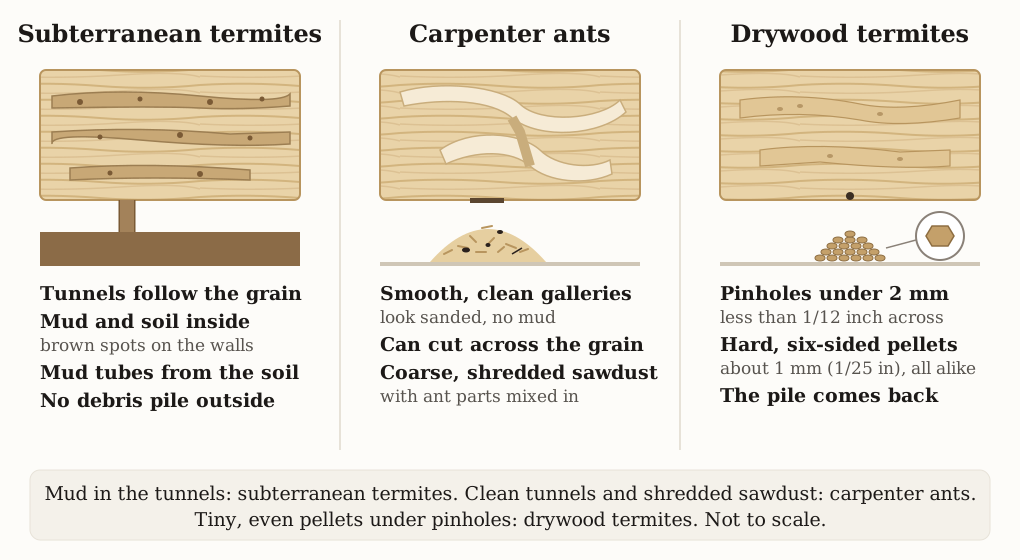
The tunnels are the strongest clue. Illinois Public Health notes that carpenter ant tunnels are smooth and clean and can run with or against the grain. Subterranean termite tunnels, by contrast, are lined with a mud-like material and follow the grain.
There is one catch. Dampwood termites on the Pacific coast live in very wet wood and dig large, open galleries with no mud. So in the Northwest, clean galleries in soaked wood are not proof of ants. In one r/pestcontrol thread from that region, two companies looked at the same wet wall and gave two different answers.
Termite frass vs ant frass
Termite frass is droppings: hard, six-sided pellets about 1 mm (1/25 inch) long, all the same size, left by drywood termites below tiny holes. Carpenter ant frass is not droppings. It is the wood they chewed out, coarse and shredded, mixed with dead ant parts and bits of insulation. Subterranean termites leave no pile at all.
A pile that comes back a few days after you sweep it means the insects are still active, whichever they are. Our guide to termite droppings and their look-alikes compares the pellets with sawdust, roach droppings and mouse droppings.
Other signs of carpenter ants vs termites
Carpenter ants give themselves away more often. You may see big black ants in the kitchen at night, or hear a faint rustling inside a wall. Penn State suggests listening with a stethoscope or a glass held to the wall. Termites stay quiet and hidden, so mud tubes on the foundation are usually the first sign. Small round holes with flour-like powder point to a third pest, powderpost beetles.
If they are carpenter ants, our guide to clearing a carpenter ant nest starts with the leak. For more on the ants themselves, see our carpenter ant identification guide.
Ant mound vs termite mound
In the US, a mound in your yard is an ant mound. The termites that attack American houses nest underground or inside wood and do not build mounds. The tall termite mounds you see in photos are built by tropical species in Africa, Australia and South America. Fire ant mounds, by comparison, reach about 18 inches high in pastures.
What US termites build instead are mud tubes: flat, dirt-colored tunnels about the width of a pencil that run up a foundation or a pier. In the yard, a soft dome of loose soil with no hole on top in the South is usually fire ants. A bare circle of ground around one hole, in Texas and the West, points to harvester ants. Neither one is a termite sign.
Termite or ant? What to do next
Start with what costs nothing. Catch three or four insects, photograph one next to a ruler and note exactly where you found them. Then match the find to the termites vs ants table below. Ants in the open usually need bait and a fixed leak. Termites in wood or mud need a licensed inspection and two or three written quotes.
When you cannot tell termites from ants, step by step
Do not spray yet
A spray kills the insects you can see and nothing else. It also ruins the samples you need for an ID. With termites, it does nothing to the colony in the soil or the wood.
Catch a few
Put three or four in a pill bottle, a jar or a zip bag, or press them onto clear tape. Dead ones are fine. A few hours in the freezer keeps them for an inspector.
Photograph one from the side
Use white paper, a ruler and daylight. The side view shows the waist best. Then zoom in on the head to see whether the antennae bend.
Note where they were
Inside wood, soil or a mud tube points to termites. A line of insects across a floor or counter points to ants. Write down the room and the exact spot.
Look for the other signs
Walk the foundation for mud tubes about the width of a pencil. Check below damaged wood for sawdust or tiny pellets, and check sills for piles of loose wings.
Leave the evidence in place
Do not knock down mud tubes or sweep away pellets until someone has seen them. An inspector reads them to tell which termite you have and whether it is still active.
Make the right call
Ants: clean up, fix the leak and use bait. Termites: book an inspection with a licensed termite company and get two or three written quotes. Renting: tell your landlord in writing, with your photos.
What you found, what it means, and what to do
Pale, soft insects in damp wood or a broken mud tube
- What it usually means
- Termite workers: an active colony
- What to do
- Book a termite inspection this week. Leave the wood as it is
Mud tubes on the foundation, no insects seen
- What it usually means
- Subterranean termites, now or in the past
- What to do
- Break off a small piece; live workers mean active. Book an inspection either way
Hard, even pellets below pinholes
- What it usually means
- Drywood termites
- What to do
- An inspection by a termite company
Dark ants with white grains in rotten wood or under a stone
- What it usually means
- An ant nest with its young
- What to do
- Nothing urgent; replace rotten wood near the house
Big black ants indoors at night, coarse sawdust
- What it usually means
- Carpenter ants nesting in damp wood
- What to do
- Find the leak and the nest, then bait
Small ants in a line to food
- What it usually means
- House ants
- What to do
- Clean up, then bait on the trail
Ants and termites in a stump or log pile outdoors
- What it usually means
- Normal life in dead wood
- What to do
- Move firewood and stumps away from the house; watch for mud tubes
Why ants and termites need different treatment
Most ant problems are a do-it-yourself job. Ant bait is sugar or protein mixed with a slow poison, and the workers carry it home to the colony. Our guide to bait that clears an ant colony explains how to match the bait to the ant.
Termites are a job for a licensed company. Termite baits are made of cellulose with a slow-acting insecticide, and they are installed and checked by professionals. EPA warns that products that only claim to kill termites have not shown they can protect a building. Our termite treatment guide compares the methods, and our termite inspection guide explains what the inspector checks.
Whichever you have, pesticides come last. If fixing leaks and cleaning up solves the problem, you may not need one. When you do, use an EPA-registered product labeled for that pest and that place, and follow the label exactly. The label is the law.
Termites vs ants: common mix-ups, corrected
Most mistakes about termites vs ants come from one shortcut: the color, the wood or the debris alone. Several of the six below appear on pages that rank for this search. Here is what the extension sources say instead.
Myth 1
Myth: “Termites are a kind of ant, the “white ant”.”
Truth: Termites are social cockroaches in the order Blattodea (UF/IFAS; Inward and others, 2007). The nickname comes from the pale workers.
Myth 2
Myth: “If it is white, it is a termite.”
Truth: Ant larvae and pupae, newly emerged ants, ghost ants and springtails are pale too. Check the waist, and whether it walks.
Myth 3
Myth: “Carpenter ants eat wood, just like termites.”
Truth: They dig nests and push the wood out as sawdust. They eat insects and sweets (UC IPM, Penn State).
Myth 4
Myth: “Termite droppings point to subterranean termites.”
Truth: Six-sided pellets are a drywood termite sign. Subterranean termites leave no pellet piles (UC IPM).
Myth 5
Myth: “Some worker ants are males.”
Truth: Ant workers are all female. Males appear only as winged swarmers and die soon after mating (Penn State).
Myth 6
Myth: “Dust diatomaceous earth around doors to stop ants and termites.”
Truth: Broadcasting it is not advised. A registered product goes only in cracks and gaps, and it will not stop termites in soil or wood.
Still not sure which one you found? Check the waist once more: if it is pinched, it is an ant. If it is neither a termite nor an ant, our guide to bugs that look like termites covers the other look-alikes.
Pest control disclaimer. Photo-based identification can help, but it is not always perfect. For dangerous spiders, large infestations, or anything you are unsure about, contact a licensed pest control professional.
Termites vs ants FAQ
What are termite ants?
Does seeing ants mean I have termites?
What kills termites instantly in a house?
Do termites bite or sting like ants?
Related guides
Termites
The four US termites, the signs of each, and how treatment, quotes and warranties work.
Flying ants vs termites
Four checks for the winged ones, a shed wings test and a swarm calendar.
Baby termites
Termite eggs and young, and the tiny white bugs people mistake for them.
Termite droppings
Drywood pellets compared with sawdust, ant frass, roach and mouse droppings.
Termite damage
What termite damage looks like, and how to tell it from rot, ants and beetles.
Bugs that look like termites
The look-alikes, winged and wingless, with the one feature that separates each.
Carpenter ants
Big black ants that nest in damp wood: what a sighting means and how to find the nest.
Types of ants
Name the ant by its waist, size, color and smell.
Sources
- UC IPM Pest Notes 7415, Subterranean and other termites
- UC IPM Pest Notes 7440, Drywood termites
- UC IPM Pest Notes 7411, Ants
- UC IPM Pest Notes 7416, Carpenter ants
- UF/IFAS Extension, EDIS IN369, Native subterranean termites, Reticulitermes spp.
- Penn State Extension, Carpenter ants
- Illinois Department of Public Health, Carpenter ants
- EPA, Termites: How to identify and control them
- Inward, Beccaloni and Eggleton (2007), Death of an order: termites are eusocial cockroaches, Biology Letters
- Tuma, Eggleton and Fayle (2020), Ant-termite interactions: an important but under-explored ecological linkage, Biological Reviews
- Southern Living, Termites vs. carpenter ants (with Faith Oi, UF/IFAS, and Eric Benson, Clemson), 2026