What does termite damage look like?
Termite damage looks like wood that termites have hollowed out from the inside. The outer skin often stays whole, so you only see it when you break, probe or remove the wood. Inside, subterranean termites leave long tunnels that follow the grain, packed with dried mud. Drywood termites leave clean chambers with pellets.
From the outside, termite damaged wood can look darker or blistered, and paint over it can bubble or ripple. Tap it and it sounds dull or hollow. Push a screwdriver in and it gives way, because the wood under the surface is often paper thin.
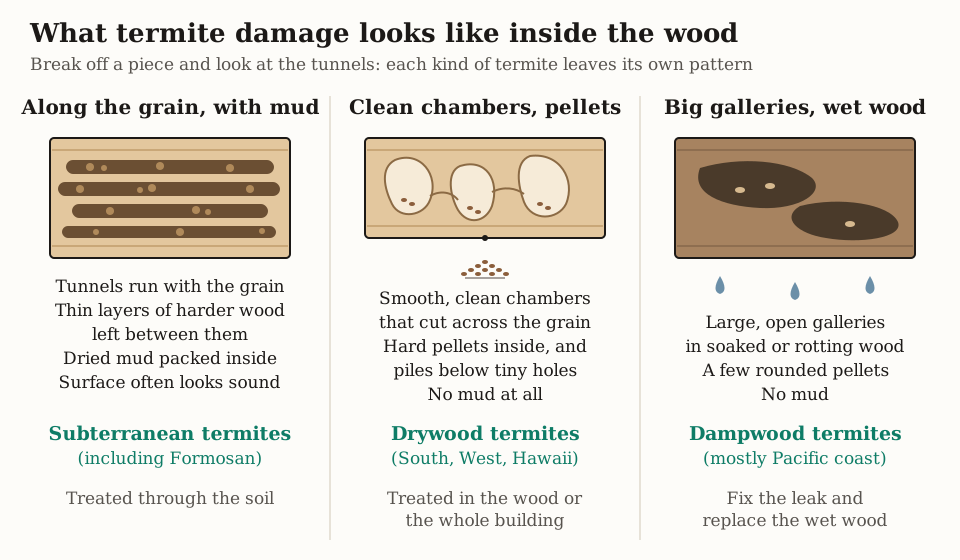
Termite damage by type of termite
Tunnels along the grain, thin layers of harder wood left between them, dried mud or soil inside
- Which termite
- Subterranean (eastern, western and others)
- Where in the US
- Almost every state
- What else you find
- Mud tubes on the foundation, piers or walls; mud dots on drywall
The same pattern, often with a lot of soil and a hard, papery “carton” filling voids in walls
- Which termite
- Formosan subterranean
- Where in the US
- Southeast, Gulf coast, Hawaii, parts of California
- What else you find
- Mud tubes high on walls and ceilings; damage in living trees
Smooth, clean chambers that cut across the grain, hard pellets inside, no mud
- Which termite
- Drywood
- Where in the US
- California, Arizona, Florida, the Gulf coast, Hawaii
- What else you find
- Tiny kick-out holes with piles of pellets below
Large, open galleries in soaked or rotting wood, a few rounded pellets
- Which termite
- Dampwood
- Where in the US
- Mostly the Pacific coast; a few kinds in coastal Florida
- What else you find
- A leak, a wet crawl space or wood touching soil
Subterranean and Formosan termite damage
Subterranean termites cause most of the termite damage in the US. They live in the soil and eat the softer springwood in each growth ring, leaving the harder summerwood behind. That is why badly damaged wood looks layered, like the pages of a closed book. UC IPM notes that this pattern alone can often separate subterranean termite damage from every other pest.
They also carry soil into their tunnels to keep the air moist, so the galleries hold dirt or dried mud. Formosan termites, the invasive kind in the Southeast, pack even more soil into walls and build a papery nest material called carton. Their colonies can number in the millions, so their damage spreads faster.
Drywood termite damage
Drywood termites live inside the wood they eat and never touch the soil. So their damage has no mud. Their chambers are smooth and clean, cut across the grain as well as along it, and hold small hard pellets. They push pellets out through kick-out holes 1 to 2 mm (about 1/25 to 1/12 inch) across, and the pellets pile up below like coarse sand.
Each pellet is about 1 mm (1/25 inch) long and has six flat sides with ridges, which no other house pest makes. Drywood colonies are small, often under 1,000 termites, but a house can hold many of them in attics, window frames, eaves and furniture. Our guide to drywood termite pellets and other droppings shows how to tell them from sawdust and roach or mouse droppings.
Dampwood termite damage
Dampwood termites only eat wood that is soaked or already rotting. They dig large, open galleries and leave a few rounded pellets. Finding them in a house nearly always means a leak, a wet crawl space or wood touching the soil. Fix the water and replace the wet wood, and the problem usually ends there.
Early termite damage: the first signs on the surface
Early termite damage is easy to miss. It shows up as small dots of dried mud on drywall or trim, faint sunken lines under paint, wood that sounds hollow when tapped, or paint that bubbles where nothing is wet. A door or window that suddenly sticks can be a sign too. The surest early signs are mud and live termites.
By the time any of these show, termites have usually been feeding for a while. Mississippi State Extension says a building is usually infested for some time before signs become obvious. So “early” means early enough to fix cheaply, not that the termites just arrived.
Early signs of termite damage
Each one is worth a closer look. Mud or live termites make it termites; the rest have other causes too.
BB-sized dots of dried mud on drywall, trim or wood
Termites plug holes they cut by accident. Scrape one: if it is patched again in a few days, they are active.
Narrow, winding sunken lines or dips in paint or wallpaper
Termites eating the paper face of the drywall just under the paint.
Wood that sounds dull or hollow when tapped, or gives under a screwdriver
Hollow behind a thin skin. Rot is soft all the way through, with no tunnels.
Blistered, bubbling or rippled paint on a dry wall
Possible termites close behind it. Water damage looks the same, so check for a leak too.
Doors or windows that suddenly stick, or a floor that feels soft
A late, weak sign. Humidity and settling cause it far more often.
Tiny piles of hard pellets on a sill, floor or counter
Drywood termites in the wood above. Sweep and check again in a few days.
Swarmers, shed wings and mud tubes on the foundation are signs of termites rather than damage. Our full list of termite signs covers each one and what it means.
How to check wood for termite damage
You need a flat screwdriver, a flashlight and a phone. Start where wood is close to soil or water: baseboards on outside walls, door frames, window sills, bathroom and kitchen floors, and the sill plate and joists in a crawl space or basement.
Tap the wood
Knock on baseboards, door frames, window sills and exposed joists with the handle of a screwdriver. Sound wood gives a solid knock. Damaged wood sounds dull, papery or hollow.
Probe anything that sounds wrong
Push a flat screwdriver or an awl into the spot. Sound wood resists. Damaged wood gives way, and you see tunnels behind a thin outer skin.
Look inside the hole
Mud or dirt in tunnels that follow the grain means subterranean termites. Smooth chambers with tiny hard pellets mean drywood termites. No tunnels at all usually means rot.
Scrape a mud spot
If you see a dot of dried mud on drywall or wood, scrape it off and mark the spot. If the termites patch it with fresh mud in a few days, they are active.
Sweep up any pellets
Clean up a pellet pile completely, then check again in a few days. New pellets in the same place mean drywood termites are still feeding above it.
Photograph and stop
Take photos with a coin for scale and note where you found the damage. Do not tear out more wood or spray anything. An inspector needs to see it as it is.
Termite damage in walls, ceilings, floors and furniture
Termite damage in a house looks different from room to room. Drywall shows pinholes plugged with mud and sunken lines. Ceilings show mud tubes, stains or sagging. Baseboards and door frames sound hollow and crumble. Floors may feel soft or buckle. In furniture, pellets point to drywood termites.
Drywall and walls
Termites do not eat the gypsum in drywall, but they eat its paper face. They tunnel just under the paint, which leaves narrow, winding, sunken lines or soft dips. When they cut through by mistake, they plug the hole with mud, so you see pinholes capped with dots of dried mud about the size of a BB. Mississippi State Extension calls these a sure sign of an active infestation.
The real worry is behind the drywall. If termites are eating the paper, they are almost certainly in the wood studs and plates nearby. That is why a wall with signs usually needs a section opened after treatment.
Ceilings
Early signs of termites in a ceiling include mud tubes hanging down or running along the corners, small mud dots, sagging or water-like stains, and pinholes in the drywall. Mud tubes high on walls and ceilings often point to Formosan termites, which can also nest above ground where a roof leak keeps wood wet. In the South and West, pellets falling from a ceiling usually mean drywood termites in the attic or the wood above.
A ceiling stain is still more likely to be a roof or plumbing leak. But a leak can invite termites, so check the attic side for mud and pellets before you patch it.
Baseboards and door frames
Baseboards and door frames are often the first trim termites reach, because they sit right above the floor and the wall plate. Signs of termites in baseboards include paint that cracks or bubbles along the top edge, wood that dents under a fingernail, mud in the gaps and seams, and a dull, hollow sound when tapped. Termites can hollow out a door frame at the bottom while the paint on it still looks whole.
Floors
Termite damage to floors shows as boards that feel soft or spongy, buckle, or creak more than they used to, and as a sagging or uneven floor. Under the floor, look at the subfloor, the joists and the sill plate from the crawl space or basement. Small, round holes with fine powder in a new hardwood floor are usually powderpost beetles, not termites, as the table further down explains.
Furniture
Drywood termites can live inside wooden furniture, picture frames and cabinets, and they travel in used furniture. Look for pinholes and small piles of pellets underneath. Subterranean termites only damage furniture, boxes or books sitting on a floor or against a wall where they are already feeding. Our termite treatment guide covers how to treat a piece of furniture.
Outside: siding, decks, fences and trees
Outside, termite damage turns up where wood touches soil: fence posts, deck posts and steps, landscape timbers and siding near the ground. Formosan termites also hollow out the dead center of living trees, which weakens the tree so it can fall in high winds, according to UF/IFAS. Termites in a stump or a fence post far from the house are normal recyclers, but they are a reason to check the house.
What do termite holes look like?
Most termite holes are tiny. Drywood termites make round kick-out holes 1 to 2 mm (about 1/25 to 1/12 inch) across, with pellets piled below. Subterranean termites make pinholes in drywall and wood and plug them with dried mud. Any clean, round hole you can see easily, especially one with sawdust or powder under it, probably came from something else.
Termite holes and the holes people mistake for them
Pinhole 1 to 2 mm (about 1/25 to 1/12 in)
- What made it
- Drywood termites
- What is below or around it
- A small pile of hard, six-sided pellets
Pinhole capped with a BB-sized dot of dried mud
- What made it
- Subterranean termites
- What is below or around it
- Nothing below it; sunken lines or hollow wood nearby
Small lumps or tubes of mud on a wall, ceiling or the ground in spring
- What made it
- Subterranean termites getting ready to swarm
- What is below or around it
- Swarmers and shed wings on swarm days
Many small round holes, about 1/16 in (1.5 mm), the size of a pencil lead
- What made it
- Powderpost beetles
- What is below or around it
- Fine powder like flour or talc
One perfectly round hole about 1/2 in (13 mm) wide on the underside of a board
- What made it
- Carpenter bees
- What is below or around it
- Coarse sawdust below; bees in spring
Slits or openings in wood with coarse, fibrous sawdust
- What made it
- Carpenter ants
- What is below or around it
- Shavings mixed with bits of dead ants
Holes in bare soil or lawn
- What made it
- Usually ants, ground bees or wasps
- What is below or around it
- Termites avoid open air and travel underground or inside mud tubes, so open holes are rarely theirs
Round half-inch holes in decks and eaves are a carpenter bee job, explained in our carpenter bee guide.
Termite damage vs wood rot
Look inside the damage. Termite damage has tunnels, and subterranean tunnels hold mud. Wood rot has no tunnels at all: brown rot cracks the wood into small, dark cubes, and white rot turns it pale, spongy and stringy. Rotted wood also stays damp, because the fungus cannot grow in dry wood. The two often turn up together.
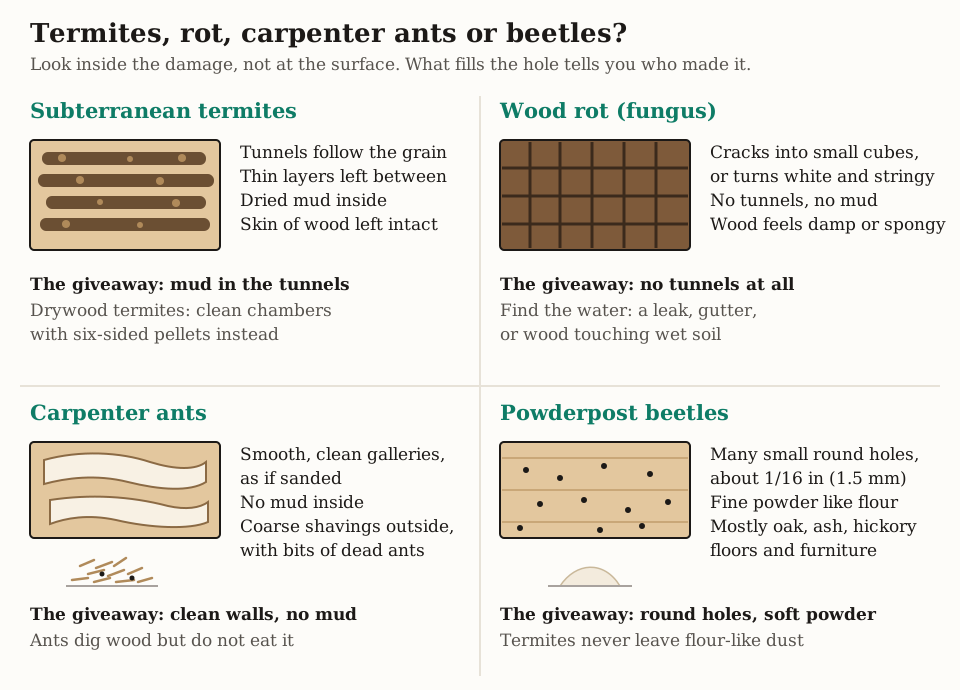
Termite damage or wood rot?
Inside the wood
- Termite damage
- Tunnels or chambers; subterranean tunnels along the grain with mud
- Wood rot
- No tunnels. Cube-shaped cracks (brown rot) or white, stringy fibers (white rot)
The surface
- Termite damage
- Often looks sound, with a thin skin over the hollow
- Wood rot
- Cracked, shrunken, darker or bleached, sometimes with fungus growth
How it breaks
- Termite damage
- Crushes into layers and dirt
- Wood rot
- Crumbles into powder or small cubes, or tears like wet cardboard
Moisture
- Termite damage
- Can be dry, especially with drywood termites
- Wood rot
- Always damp when active. No water, no rot
What else you see
- Termite damage
- Mud tubes, mud dots, pellets, swarmers
- Wood rot
- A leak, stains, a musty smell, wood touching wet soil
The fix
- Termite damage
- Termite treatment, then repair
- Wood rot
- Stop the water, then cut out and replace the wood
People often call brown rot “dry rot”, but that name is wrong. Washington State University notes that moisture is always needed for decay. Rot and termites also feed each other: subterranean termites prefer wood that fungi have already softened, and dampwood termites only live in it. So rot near a foundation is a reason to check for termites as well as for the leak.
Water damage or termite damage?
Water damage and termite damage both cause stains, bubbling paint, swollen trim and sagging. The difference is inside. Water alone leaves wet, soft or stained material with no tunnels and no mud. Termite damage has tunnels, and often mud dots or pinholes on the surface. If a wall is wet, find the leak first, then probe the wood behind it once it is open.
Termite, carpenter ant or powderpost beetle damage?
Three pests besides termites damage wood in houses. Carpenter ants dig smooth, clean galleries with no mud and push out coarse sawdust. Powderpost beetles leave small round holes and flour-like powder, mostly in hardwood. Carpenter bees drill one round half-inch hole. Only termites eat the wood and fill their tunnels with mud or six-sided pellets.
Who damaged the wood? Termites and the other wood pests
Mud in the tunnels, layered wood
- Pest
- Subterranean termites
- What the damage looks like
- Tunnels along the grain, thin layers left, outer skin intact
- Wood it attacks
- Any wood near soil or moisture, softwood framing first
Six-sided pellets, no mud
- Pest
- Drywood termites
- What the damage looks like
- Clean chambers across the grain, pinholes with pellet piles
- Wood it attacks
- Dry wood: attics, window frames, furniture
Smooth, sanded-looking galleries and coarse sawdust with ant parts
- Pest
- Carpenter ants
- What the damage looks like
- Galleries with clean walls, no mud and no pellets
- Wood it attacks
- Wet or already-decayed wood first, then sound wood nearby
Round holes about 1/16 in and flour-like powder
- Pest
- Powderpost beetles
- What the damage looks like
- Many exit holes on the surface, powder packed in tunnels
- Wood it attacks
- Hardwoods such as oak, ash, hickory and pecan, mostly under 10 years old
One round hole about 1/2 in wide
- Pest
- Carpenter bees
- What the damage looks like
- A short entrance, then a tunnel along the grain
- Wood it attacks
- Bare softwood: eaves, fascia, decks, railings
Carpenter ants do not eat wood. They dig nests in it, usually starting in wood a leak has softened. Their galleries look sanded smooth, and our carpenter ant guide shows their sawdust. Powderpost beetles are the usual cause of tiny holes in new hardwood floors, and Mississippi State Extension says a few dozen holes in the first years of a pecan or ash floor is common and often dwindles on its own.
Some “damage” is not from any pest. People often post photos of knots, pockets of bark left in a joist, old nail holes, hammer dents and even a dog’s chewing on a door frame as suspected termite damage. If the wood is hard all the way through and there are no tunnels, mud, pellets or powder, it is just wood.
Is the termite damage old or still active?
You only know termites are active when you see live termites, or fresh work: a mud dot that comes back after you scrape it, a broken tube that gets repaired, or new pellets after you sweep. Damage with dry, crumbly mud and no termites may be old. Many houses carry damage from an infestation treated years ago.
Old or active termite damage: what each finding means
Live, pale workers or soldiers in the wood or a broken tube
- What it suggests
- Active. This is the only sure proof
- What to do
- Leave it, photograph it, get an inspection this week
A mud dot or broken tube repaired within a few days
- What it suggests
- Active
- What to do
- Same as above
New pellets a few days after you swept the pile away
- What it suggests
- Active drywood termites
- What to do
- Inspection; treatment of the wood or the building
Dry, crumbly mud in galleries, no termites, an old treatment record
- What it suggests
- Probably old damage
- What to do
- Ask for the treatment history; a yearly inspection keeps it honest
An empty mud tube
- What it suggests
- Not proof either way. Termites often leave sections while they feed elsewhere
- What to do
- Break a 1 inch piece and check back in a few days
Pellets that never come back
- What it suggests
- Possibly old, or vibration shaking out old pellets
- What to do
- Watch it; an inspector can probe the wood
UF/IFAS puts it plainly: mud tubes and damage can point to subterranean termites, but live termites are needed to confirm an active infestation. Termites also leave an area quickly once it is disturbed, so a spot you have already torn open may look empty even when the colony is still in the wall.
How much termite damage is too much?
It is too much when it reaches wood that holds the house up: sill plates, rim and floor joists, beams, rafters and load-bearing studs. Damage to trim, baseboards, drywall paper or one stretch of siding is cosmetic and cheap to fix. A sagging floor, a bouncy stair or cracked drywall over a damaged wall means a structural check before repair.
Termite damage is not measured in a percentage. What matters is where it is and whether the wood can still carry its load. A contractor can often sister a new joist beside a damaged one, or replace a short section of sill plate, without rebuilding the floor. Termites destroy very few houses outright. When they are, it is usually after years of feeding in framing nobody looked at.
How fast does termite damage spread?
Slowly. PestWorld, the pest industry’s site, estimates that a colony of 60,000 subterranean termites eats about 1/5 ounce (5 g) of wood a day, roughly 2.3 feet of a 2x4 in a year. So serious damage usually means years of feeding. The University of Kentucky says termites damage wood slowly enough that taking an extra day, week or month to choose a company makes little difference. Formosan termites are the exception. Their colonies hold several million termites, so they eat far faster.
Can a house with termite damage be saved?
Almost always. A company treats the termites, then a carpenter reinforces or replaces the damaged wood. Houses with old, repaired termite damage are bought and sold every day, especially in the South. Our guide to termites explains how to tell which kind you have and how to treat each one.
Buying a house with termite damage
Termite damage on an inspection report is common, and old, treated damage is not a reason to walk away by itself. What matters is whether termites are still active, whether the house was treated and is under warranty, and whether the damage reaches the framing. Get the records, and get a contractor or engineer to look at any structural damage before you close.
The report itself will not judge the damage. The standard wood-destroying insect form used in home sales, the NPMA-33, says in its own words that it is “not a structural damage report”, that hidden damage may be present, and that buyers should ask a qualified structural professional about the extent and the repairs.
Buyers under contract post these report lines on Reddit all the time, asking whether to walk away. The honest answer is that nobody can be sure without opening the wall. One buyer whose report showed old mud tubes had the wall opened at the sill and found no damage at all. Another bought a house with disclosed, repaired damage and found more of it years later behind the bathroom walls. That is why the checks below matter more than the photo, and why disclosed damage can also lower the price you get when you sell.
Before you buy a house with termite damage, ask for
Ask the seller or their agent in writing. Missing paperwork is a negotiating point.
The treatment record: date, company, termite type, method and product
No record means you should assume the termites were never treated.
A current, transferable termite warranty or bond
Check whether it is re-treat only or also pays for repairs, and what the transfer costs.
Repair invoices for the damage on the report
Painted-over damage with no invoice is not a repair.
A fresh inspection of your own
The report you were handed may be months old, or ordered by the seller.
A contractor or structural engineer for any framing damage
Sill plates, joists and sagging floors are where the real repair costs are.
Many buyers use the report to ask for treatment, repairs or a price cut before closing. Disclosure rules for known termite damage vary by state, so ask your agent or a real estate lawyer if you think damage was hidden. Our termite inspection guide explains what the inspector checks and how to read the report.
How to repair termite damage
Treat the termites first, then repair. Cosmetic damage to trim, baseboards and drywall can be cut out and replaced like any other repair. Carpenters usually reinforce damaged framing by fastening new lumber beside it, called sistering, or replace the damaged section. A licensed contractor should do structural repairs, sometimes with an engineer’s plan.
What to do when you find termite damage
Leave the damage in place
Do not rip out the wood, knock down mud tubes or patch the hole yet. The inspector needs the evidence to judge the type and how far it goes.
Work out whether it is active
Look for live termites, fresh mud or new pellets. Old, dry damage with no termites may be from an infestation that was treated years ago.
Get a termite inspection
Ask for the termite type, where the activity is, and what the company will treat, in writing. Two or three opinions are normal.
Treat before you repair
Repairing first only gives the termites new wood to eat. Fix the termites, then the wood.
Get structural damage checked
If the damage is in a sill plate, floor joist, beam, rafter or load-bearing stud, or a floor sags, have a contractor or structural engineer look before anyone repairs it.
Fix the moisture
Repair leaks, gutters and drainage, and keep soil and mulch off the siding. Wet wood draws termites back and also rots.
Repair and keep the records
Keep the inspection report, the treatment record, the warranty and the repair invoices. You will need them when you sell the house.
You can replace damaged trim, baseboards or a fence board yourself. UC IPM notes that homeowners can replace termite damaged wood and fix the conditions that drew termites on their own. Killing the colony is different: a soil treatment needs licensed equipment and hundreds of gallons of product, and drywood products are not sold for home use.
How much does termite damage repair cost?
It depends entirely on what has to be replaced, and no extension service publishes an average. Pest companies do, and they disagree: Orkin puts the average repair at $3,000, while Terminix says over $8,000 for repairs and treatment together. Neither names a study. A patched baseboard costs little, and new joists cost thousands. Our termite treatment cost guide covers the price of the treatment itself.
Does homeowners insurance cover termite damage?
Usually not. The standard homeowners policy form most US insurers build on, ISO’s HO-3, excludes damage from “birds, vermin, rodents, or insects”. Insurers treat termites as a maintenance problem that develops slowly, not a sudden accident.
The same form has one narrow exception: a sudden collapse caused by insect damage that was hidden from view and that you did not know about. Policies differ, so read your own. In practice, a termite warranty that pays for repairs, plus a yearly inspection, protects you far better than insurance does.
Pest control disclaimer. Photo-based identification can help, but it is not always perfect. For dangerous spiders, large infestations, or anything you are unsure about, contact a licensed pest control professional.
Termite damage FAQ
Does termite damage smell?
Can termites eat through concrete or brick?
Can termite damage make a house collapse?
Can you paint or caulk over termite damage?
Do termites damage furniture and books?
Will a home inspector find termite damage?
Does termite damage keep getting worse after treatment?
Related guides
Termites
The hub: what termites look like, which of the four US kinds you have, and what to do next.
Signs of termites
Every sign at a glance, from swarmers and wings to mud tubes, and what each one means.
Termite droppings
Drywood pellets compared with sawdust, roach and mouse droppings and carpenter ant frass.
Termite inspection
What an inspector checks, the WDI report for a home sale, and how to read it.
Carpenter ants
Big black ants that dig clean galleries in damp wood. No mud, coarse sawdust.
Termite treatment
Soil treatments, baits, fumigation and heat, and which one fits your termite.
Termite treatment cost
What treatment costs by method and house size, and how to read a quote.
Carpenter bees
Round half-inch holes in decks and eaves, and why they are not termite damage.
Sources
- UC IPM Pest Notes 7415, Subterranean and other termites
- UC IPM Pest Notes 7440, Drywood termites
- UC IPM Pest Notes 7418, Wood-boring beetles in homes
- UC IPM Pest Notes 7416, Carpenter ants
- Mississippi State University Extension, Signs of termite infestation
- Mississippi State University Extension, Powderpost beetles in hardwood floors
- UF/IFAS EDIS IN278, Formosan subterranean termite
- UF/IFAS EDIS IN369, Native subterranean termites
- University of Kentucky Entomology, ENTFACT-604, Termite control: answers for homeowners
- Washington State University PestSense, Wood-rotting fungi
- Penn State Extension, Brown rot in wood
- NPMA-33 Wood Destroying Insect Inspection Report (Ohio Department of Agriculture copy)
- Insurance Information Institute, sample homeowners policy HO 00 03
- EPA, Termites: How to Identify and Control Them