The signs of termites, from proof to false alarm
The signs of termites are not equally useful. Three settle it: live termites, swarmers coming out of the house, and a mud spot that gets rebuilt. Three more are strong enough to book an inspection: mud tubes, piles of wings and six-sided pellets. Everything else is weak until you find one of those six beside it.
Most homeowners never see a termite. Workers stay inside soil, wood and mud tubes, so what you find is what they leave behind. That is why the signs matter, and why it pays to know which ones a pest company should take seriously.
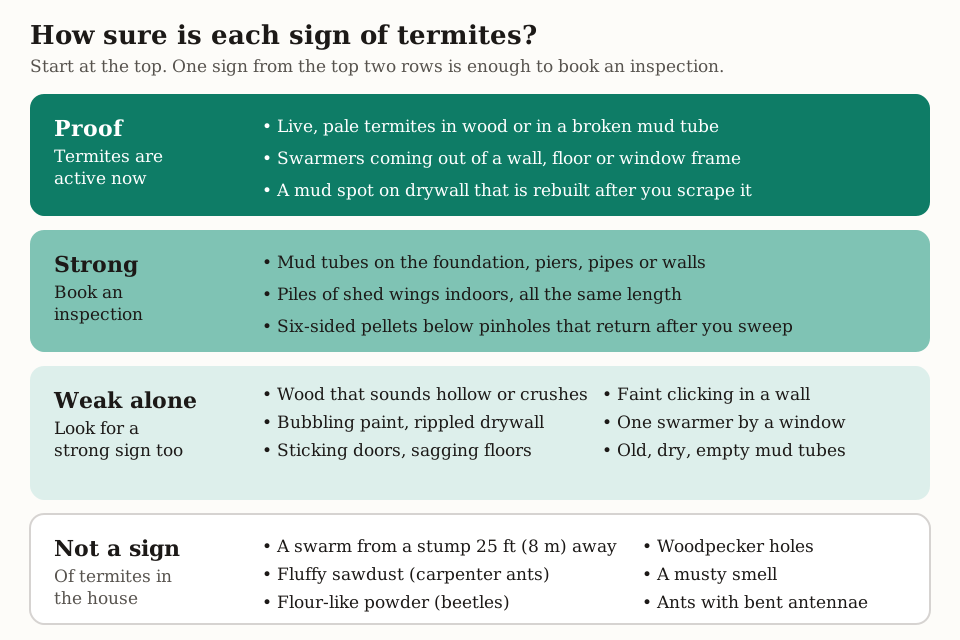
The signs of termites at a glance
Swarmers coming out of a wall, floor or frame
- What it looks like
- Dozens of dark, winged insects with straight antennae, often in spring
- Which termite
- Any swarming termite
- How sure
- Proof of a colony in or under the house
- Read more
- What a swarm means
Shed wings
- What it looks like
- Small piles of see-through wings, all the same length
- Which termite
- Any swarming termite
- How sure
- Strong, if indoors and in piles
- Read more
- Winged termites
Mud tubes
- What it looks like
- Dirt-colored tunnels about the width of a pencil, from soil up to wood
- Which termite
- Subterranean, including Formosan
- How sure
- Strong. Live workers inside are proof
- Read more
- Below, in full
Pellets (frass)
- What it looks like
- Hard, six-sided grains like coarse sand below tiny holes
- Which termite
- Drywood
- How sure
- Strong. New pellets after sweeping are proof
- Read more
- Termite droppings
Mud spots on drywall
- What it looks like
- BB-sized dots of dried mud plugging pinholes
- Which termite
- Subterranean
- How sure
- Proof, if rebuilt after scraping
- Read more
- Walls and ceilings
Hollow or crushed wood
- What it looks like
- Wood that sounds papery or gives way to a screwdriver
- Which termite
- Any
- How sure
- Weak alone. Mud or pellets inside make it strong
- Read more
- Termite damage
Rippled paint, sunken lines in drywall
- What it looks like
- Narrow, winding trails or blisters under paint or wallpaper
- Which termite
- Subterranean
- How sure
- Weak. Water does the same
- Read more
- Paint, doors, floors
Sticking doors, sagging or squeaky floors
- What it looks like
- Frames out of square, soft spots underfoot
- Which termite
- Late sign of any type
- How sure
- Weak. Moisture is more common
- Read more
- Paint, doors, floors
Clicking in a wall
- What it looks like
- Faint ticking or rustling in a quiet room
- Which termite
- Any
- How sure
- Weakest. Hard to hear, easy to mistake
- Read more
- Can you hear them?
Early warning signs of termites
The earliest sign most people get is a swarm in spring, or a mud tube on the foundation. Damage you can see comes much later. A subterranean colony needs about 3 to 5 years to grow big enough to send out swarmers, says NC State Extension. So a colony has usually been nearby for years by then.
That sounds alarming, but it also means termites are slow. Damage builds over months and years, not days. An early sign is a reason to look more closely and get an inspection, not a reason to sign a contract today.
Watch these places first. Look at window sills and light fixtures in spring for wings and dead swarmers. Next, walk the foundation, piers and steps for new mud tubes. Finally, check the bathroom and kitchen floors where pipes come up, because swarmers often come out there.
Can you have termites and see no signs?
Yes, often. Termites can feed for years behind walls, under floor coverings and inside slab cracks. The surface of the wood usually stays intact. Mississippi State Extension makes the point that a clean inspection does not prove a house is free of termites. An inspector can only check what is open and visible. So a house with no signs still needs a yearly look in termite country.
Swarmers and shed wings
Swarmers are the winged termites a mature colony sends out to start new ones. Eastern subterranean swarmers are dark brown to black and about 3/8 inch (10 mm) long, with four equal wings. Swarmers coming out of a wall, floor or window frame are proof of a colony in or under the house. A swarm in the yard is not.
After a short flight, swarmers drop their wings. Indoors, they cannot reach damp soil, so they die within about a day, usually on window sills and floors near the light. What you find later is the evidence: small piles of identical wings, and dead swarmers in light fixtures, sinks and tubs. Termite wings are all the same length, while a flying ant’s front wings are longer than its back ones. The four checks that separate termite swarmers from flying ants settle it when you are not sure.
Swarmers themselves do no damage. Killing them does not help either, because the colony that made them keeps feeding. Our guide to what a termite swarm means and what to do covers the season by region and what to do during a swarm. The page on termites with wings shows how to recognize one.
Does one termite mean an infestation?
Not by itself. Extension guides disagree a little here, and the difference is about numbers. Texas A&M calls swarmers indoors a reliable signal of infestation, but notes they occasionally fly in through open doors and windows. Mississippi State says more than a few native swarmers indoors should raise a flag. It also notes an exception for neighborhoods full of Formosan termites. There, a few dozen can drift in toward lights at night, while hundreds mean a definite problem.
So one swarmer near an open door or a porch light usually came from outside. Keep it in a jar and watch. Many swarmers, wings in piles, or swarmers coming out of the wall itself are a different matter: book an inspection. A wingless, pale worker indoors is also different. Workers never leave their tunnels, so finding one means wood or soil nearby is infested.
Mud tubes: the surest outdoor sign
Mud tubes are tunnels of soil, saliva and chewed wood that subterranean termites build to cross open ground. They are about the width of a pencil, roughly 1/4 inch (6 to 7 mm), sometimes wider. A tube running from the soil up a foundation, pier or pipe to wood is one of the clearest signs of termites in a house.
Termites dry out quickly in open air, so they never walk across concrete in the open. That is why the tubes exist. They show up on foundations, piers, plumbing and the inside of crawl space walls, and on the sill plate where a house sits on its foundation. Only subterranean termites build them, which includes the invasive Formosan kind. Drywood termites never do.
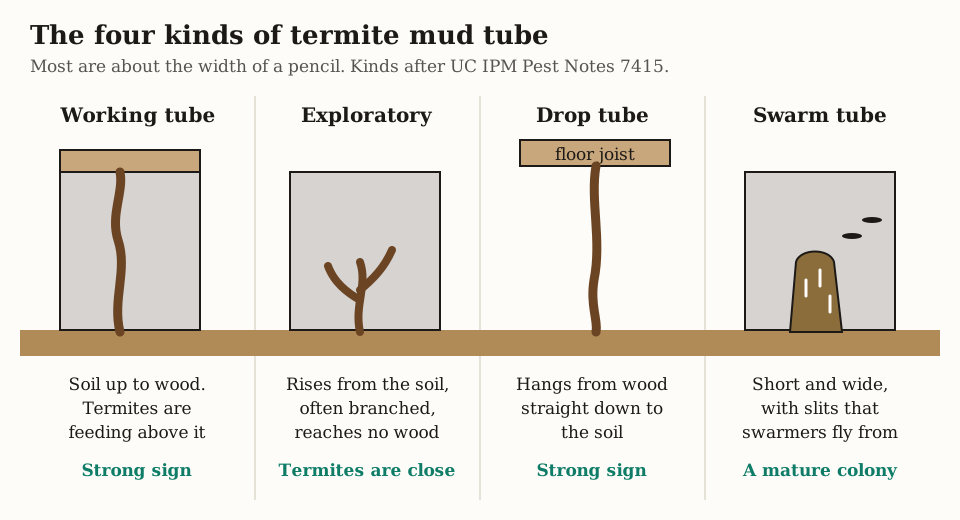
Not every tube means the same thing. UC IPM describes four kinds. Working tubes run from the soil to wood and carry termites to food. Exploratory tubes rise from the soil, often branched, and reach nothing. Drop tubes hang from wood straight back down to the soil. Swarm tubes are short and wide, with slits for swarmers to fly out of.
Do mud tubes mean you have termites?
A working or drop tube on your house usually does. To check if it is active, break open about 1 inch (2.5 cm) of the tube and look for small, cream-colored workers. Then look again over the next few days. If termites are there, or the gap gets patched with fresh mud, the infestation is active.
An empty tube does not prove the termites are gone. Colonies abandon sections of tube while feeding elsewhere. Old tubes are dry, pale and crumble at a touch. NC State notes they can leave a faint “etching” on concrete for years. Without the house’s inspection records, nobody can tell how old a tube is, so any tube is worth an inspection.
Should you knock down termite mud tubes?
Not all of it, and not yet. Break only the short piece you need to check, and leave the rest for the inspector, as Texas A&M advises. Knocking tubes down does not stop termites anyway. The colony is still in the soil, and it will rebuild or find another way in. After treatment, scrape old tubes off so they do not confuse the next inspection.
Mud tubes on a ceiling or high on a wall
Tubes that hang from a ceiling, run along upper walls or come out of the eaves mean something different. Mississippi State links them mostly to Formosan termites. NC State adds that they can mean an above-ground colony living inside the building, kept alive by a roof or plumbing leak. That kind is not stopped by a soil treatment, and many contracts exclude it, so fixing the leak comes first.
Termite droppings (frass)
Termite droppings look like a small pile of coarse sand or coffee grounds below a tiny hole. Drywood pellets are hard, about 1/25 inch (1 mm) long, and have six flat sides you can see with a magnifier. Subterranean termites leave no piles, because they build their droppings into their tubes.
Drywood termites push them out of kick-out holes 1 to 2 mm across. Pellets alone do not prove termites are still active, though. UC IPM’s test is simple: sweep the pile up, then look again a few days later. New pellets in the same spot mean termites are still there. Roach droppings, mouse droppings and carpenter ant sawdust all get mistaken for frass. Our guide to termite droppings and their look-alikes shows how to tell each one apart.
Damaged wood, hollow sounds and holes
Termites eat wood from the inside and leave the surface thin but whole. Wood that sounds hollow or papery when tapped, or that gives way to a screwdriver blade, is a possible sign. Inside, the tunnels tell you the type. Subterranean tunnels follow the grain and hold dried mud, while drywood tunnels cut across it and are smooth and clean.
A hollow sound is a weak sign on its own, because rot, old repairs and gaps behind trim sound hollow too. It becomes a strong sign when you find mud, live termites or pellets inside. NC State also mentions a thin, gritty, gray-brown film on the surface of damaged wood. Small round holes with fine powder below are usually beetles, not termites.
Damage is also how many people find termites by accident, when they pull up a floor, remove a baseboard or strip wallpaper. Our guide to what termite damage looks like goes room by room, from floors and baseboards to door frames. It also covers termite damage against wood rot, and how much is too much.
Signs of termites in walls and ceilings
In a finished wall, the clearest of the signs of termites is a tiny spot of dried mud plugging a pinhole in the drywall. It is about the size of a BB (3/16 inch, 4.5 mm). Rippled or sunken lines under the paint are a weaker sign.
Termites seal any hole they accidentally chew through. So a mud spot that comes back after you scrape it off is proof of an active colony. Termites do not eat the gypsum in drywall, though. Instead, they eat the paper on its face, often without breaking the thin coat of paint. That leaves narrow, winding, slightly sunken trails you notice when light hits the wall at an angle. Scrape a mud spot, mark it with a pencil, and look again over the next few days.
Mississippi State also describes odd lumps of dried mud sprouting from walls and ceilings in late spring. They are about 3 inches (7.5 cm) wide. These “swarm castles” are built by Formosan termites just before they swarm. Early signs in a ceiling, such as small holes, sagging drywall or tubes hanging down, are covered in our termite damage guide.
Paint, doors and floors: the weak signs
Bubbling paint, sticking doors and sagging or squeaky floors are on every list of signs of termites. But water causes all three far more often. Treat each one as a reason to look for a strong sign nearby, such as mud tubes, mud spots or pellets. On its own, none of them tells you termites are there.
Paint bubbles when moisture gets behind it. Termites can cause that, because they carry damp soil into the wall. So can a slow leak, condensation or a missing gutter. Doors and windows stick when frames swell or the house settles, which happens every humid summer. Floors sag or squeak when a subfloor or joist weakens, and termites are only one cause.
These signs matter more when they come together. Picture a soft, bubbled spot low on a bathroom wall, with a mud tube on the foundation outside. That is worth an inspection. A sticking door in August, with nothing else, is probably the weather.
Can you hear termites?
Sometimes, but rarely, and it is the least reliable sign. When disturbed, termites shake their bodies, and in some species the soldiers drum their heads against the tunnel to warn the colony. In a very quiet room, that might make a faint ticking or rustling inside a wall. Many people with termites never hear anything at all.
The drumming is real. In a 2013 study, Hager and Kirchner recorded soldiers of African mound-building termites drumming in pulses of 10 to 20 per second. It appeared in the Journal of Experimental Biology. A 2021 study in Scientific Reports recorded the vibrations made by body-shaking in the eastern subterranean termite, the common US species. In both cases the signals traveled through wood and soil, and the researchers needed sensors to pick them up.
That is also why sound makes a poor test. Pest companies have tried acoustic detectors, and UC IPM notes they are rarely used, because inspectors still rely on what they can see. Clicks in a wall can also come from pipes, wood expanding as it warms, or mice. If you hear something, look for a strong sign before you worry.
Which termite left the sign?
The sign tells you the type, and the type decides the treatment. Mud tubes and mud in the wood mean subterranean termites, including Formosan, which are treated through the soil. Six-sided pellets below pinholes mean drywood termites, which are treated in the wood or by tenting. Soaked, rotting wood with large pellets means dampwood termites and a leak.
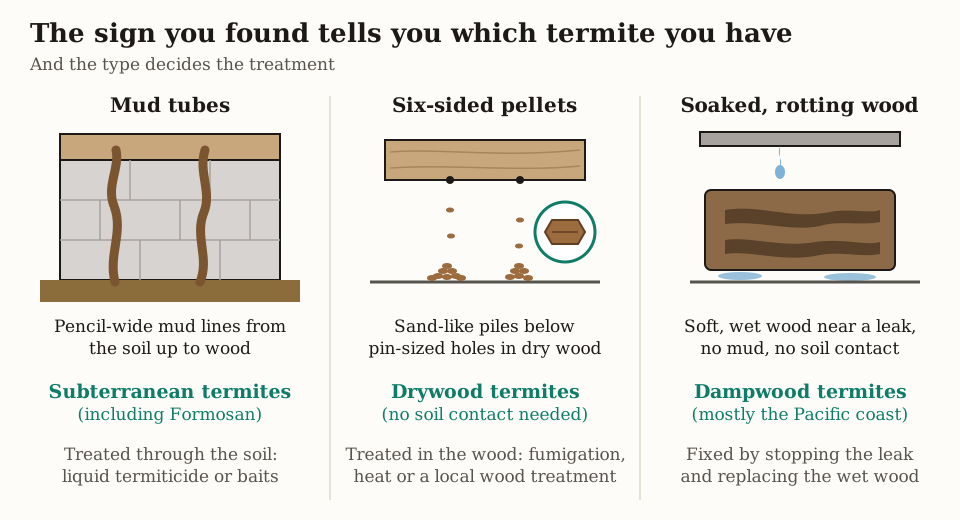
Where you live narrows it further. Subterranean termites live in nearly every state, so their signs are the ones most Americans find. Drywood signs turn up mostly in California, Arizona, Florida, the Gulf coast and Hawaii. Our termite guide covers all four US types and where each one lives. The page on how termites are treated explains what each type needs.
Signs of termites in the yard
Termites in the yard are normal, and most yard signs of termites do not mean the house has them. Mississippi State says a swarm from a stump, woodpile or fence post is rarely a concern if it is 25 feet (about 8 m) or more away.
Swarmers coming up next to the foundation, or from a porch or patio against the house, are a much stronger sign. Texas A&M puts it plainly: most yards have termites, especially in older neighborhoods. Finding them in a fence, woodpile or landscape timber does not mean the house needs treatment. Instead, it is a reminder. Check the foundation for mud tubes, keep wood and soil away from the siding, and find out when the house was last treated.
A few yard signs deserve more attention. Mud tubes on a deck post, steps or fence that touches the house are a bridge to it. So is mulch piled against the siding, and a stump right beside the foundation. Termites in a tree are rarely a threat to the house; they usually mean the tree has dead or damp wood inside.
What is not a sign of termites
Several common “signs” point to something else. Fluffy sawdust with insect parts means carpenter ants, fine flour-like powder means wood-boring beetles, and round half-inch holes mean carpenter bees. Mud dauber wasp nests get mistaken for mud tubes. Woodpecker holes, a musty smell and water stains are not termite signs by themselves. Check these first before you call a termite company.
Not a termite sign: what it is instead
Fluffy, fibrous sawdust with bits of insects
- What it usually is
- Carpenter ants
- How to tell
- Termites never push out sawdust. Large black ants nearby
Fine, flour-like powder below tiny round holes
- What it usually is
- Powderpost or other wood-boring beetles
- How to tell
- Holes are perfectly round; no mud and no six-sided pellets
Perfectly round holes about 1/2 inch (13 mm) across in a deck or eave
- What it usually is
- Carpenter bees
- How to tell
- Bees hovering nearby in spring; yellow stains below the hole
Short mud tubes or lumps stuck to an eave or garage wall, leading to neither soil nor wood
- What it usually is
- Mud dauber wasp nests
- How to tell
- Often side by side like organ pipes. Break one: spiders or a wasp larva, never termites
Holes and drumming on siding corners
- What it usually is
- Woodpeckers
- How to tell
- They drum to call and hunt bee larvae; not termite evidence alone
Black specks with ridges in a cabinet
- What it usually is
- Cockroach droppings
- How to tell
- No pinhole above; found where food is
Winged insects with bent antennae and a pinched waist
- What it usually is
- Flying ants
- How to tell
- Front wings longer than the back ones
A musty smell, water stains, soft wood that stays wet
- What it usually is
- Moisture or mold
- How to tell
- No mud in the wood; cubes or stringy rot instead of tunnels
If the insects turn out to be ants, our pages on carpenter ants and carpenter bees show the damage each one leaves. The round-up of bugs that look like termites covers the rest of the look-alikes.
How to check your house for termites
A homeowner check for signs of termites takes about an hour with a flashlight and a flat screwdriver. Start outside at the foundation, then the crawl space or basement, then the rooms on the ground floor, then the attic. Look where soil, wood and moisture meet. It will not find everything, but it finds most mud tubes, wings and pellets.
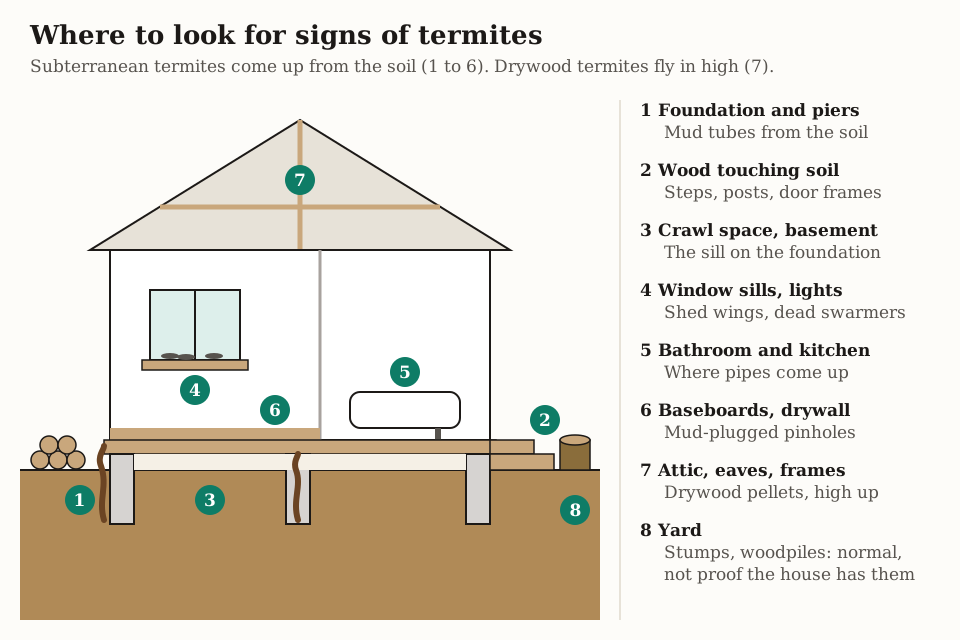
An 8-step termite check
Walk the foundation (1)
Go all the way round the outside with a flashlight. Look for mud tubes on concrete, brick, piers, pipes and steps, and behind shrubs, decks and stored items.
Probe wood that touches soil (2)
Push a flat screwdriver into deck posts, steps, door frames and siding near the ground. Sound wood resists. Wood that gives way, or holds mud, needs a closer look.
Check under the house (3)
In a crawl space or basement, look at the top of the foundation, the piers and the wood sill resting on them. Tap joists with the screwdriver handle and listen for a hollow sound.
Look at sills and light fixtures (4)
Look for shed wings and dead swarmers on window sills, in spider webs, and inside light fixtures, especially after warm spring days.
Check bathrooms and kitchens (5)
Look where pipes come up through the floor and around tubs and showers. Swarmers often come out here, because the soil under the slab stays damp.
Scan baseboards and drywall (6)
Look for small spots of dried mud, rippled or sunken paint, and baseboards that crush when pressed. Scrape a mud spot off and mark it.
Look up for drywood termites (7)
In the attic, the eaves, window frames and wooden furniture, look for pinholes with small piles of hard pellets below them.
Check the yard last (8)
Look at stumps, woodpiles, fence posts and landscape timbers. Termites there are normal. What matters is whether anything connects them to the house.
The best time is a dry day in late winter or spring, before swarm season, and again after any swarm. Some areas are risky or impossible to check, such as tight crawl spaces with nails and standing water, or wall voids. UC IPM recommends leaving those to a licensed inspector. A professional termite inspection also covers the paperwork a home sale needs.
How to tell if termites are active
Use one of three tests, and give each a few days. Break about 1 inch of a mud tube and see whether it gets rebuilt. Scrape a mud spot off drywall, mark it, and see whether it returns. Sweep up a pile of pellets and see whether new ones fall. A rebuilt tube, a new mud spot or fresh pellets mean termites are still feeding.
Live termites settle it straight away. But termites leave an area quickly once it is disturbed, so not seeing any right after you break into wood proves little. Old damage with dried mud and no termites could be from a colony treated years ago. That is why records of past treatment are worth keeping.
Is it a termite infestation?
A termite infestation means a colony is feeding on the house itself, not just living in the yard. Live termites in the structure, swarmers coming out indoors, active mud tubes on the foundation or new pellets all mean an infestation. A single swarmer, a yard swarm or old empty tubes do not, on their own.
What you found, what it means, what to do
One or two swarmers near an open door, window or light
- What it likely means
- They flew in from outside
- What to do
- Keep one in a jar. Check sills and the foundation over the next few weeks
A swarm from a stump, woodpile or fence well away from the house
- What it likely means
- A colony in the yard, which is normal
- What to do
- Check the foundation for tubes. No emergency
Swarmers next to the foundation or from a porch or patio
- What it likely means
- A good chance the house has them too
- What to do
- Inspection soon
Swarmers coming out of a wall, floor or frame, or piles of wings indoors
- What it likely means
- A colony in or under the house
- What to do
- Inspection this week. Keep a sample
A mud tube on the foundation, live or rebuilt after you break it
- What it likely means
- Subterranean termites feeding in the house
- What to do
- Inspection this week. Leave most of the tube
Six-sided pellets that come back after sweeping
- What it likely means
- Active drywood termites in the wood above
- What to do
- Inspection. Ask about whole-house and local treatment
Hollow wood, bubbling paint or a sticking door, and nothing else
- What it likely means
- Possibly termites, more often moisture
- What to do
- Look for a strong sign; fix any leak
Dry, empty, crumbling tubes and old damage with no termites
- What it likely means
- Possibly an old, treated infestation
- What to do
- Ask for past treatment records; inspection if none
An infestation is rarely an emergency. The University of Kentucky notes that termites damage wood slowly. An extra day, week or month to choose a company makes little difference. Use that time to get more than one opinion.
What to do if you find signs of termites
If you find signs of termites, do not spray, and do not tear the house apart. Keep a sample, take photos, leave most of the evidence in place for the inspector, and book two or three inspections. If you rent, tell your landlord in writing. Termites work slowly, so a few days spent comparing quotes costs nothing.
What to do if you find signs of termites
Keep a sample
Put a few swarmers or workers in a jar or zip bag, or stick them to clear tape. Dead ones are fine. Wings help too.
Take photos and notes
Photograph each sign with a coin for size, and write down where and when you found it.
Leave the evidence in place
Break only a short piece of a mud tube to check it, and leave the rest. Do not sweep up every pellet or tear into walls before the inspection.
Do not spray
Bug spray, foggers and home remedies kill only the termites they touch. The colony keeps feeding out of sight.
Book two or three inspections
Ask each company which termite it found, where, and what it would do about it, in writing. Termites work slowly, so you have time to compare.
Renting? Tell your landlord
Send photos and a short note in writing, and do not treat it yourself. Treating the building is the owner's job.
Many companies inspect for free unless you need a formal report for a home sale. Our guides to what a termite inspector checks, termite treatment options and what termite treatment costs cover the next steps.
Pest control disclaimer. Photo-based identification can help, but it is not always perfect. For dangerous spiders, large infestations, or anything you are unsure about, contact a licensed pest control professional.
Signs of termites FAQ
Do termites smell?
What time of year do signs of termites show up?
How long do termites take to show signs?
Are the signs of termites different in Florida, Texas or Arizona?
How do I know termites are gone after treatment?
Can termites be in furniture?
Related guides
Termites
The termite hub: what they look like, the four US types, swarms, treatment and prevention.
Termite droppings
Six-sided pellets, and how to tell them from roach and mouse droppings or sawdust.
Termite damage
What damage looks like in floors, walls, ceilings and frames, and termite damage vs wood rot.
Termites with wings
How to recognize a winged termite, and why they turn up by windows and lights.
Termite swarmers
What a swarm means, when termites swarm where you live, and what to do during one.
Termite inspection
What an inspector looks for, how long it takes, and what the report means.
Bugs that look like termites
The look-alikes, winged and wingless, and the one feature that separates each.
Termite or flying ant?
Four checks that separate a termite swarmer from a flying ant.
Sources
- Mississippi State University Extension, Signs of termite infestation
- Mississippi State University Extension, Common questions about termites and termite control
- NC State Extension, Monitoring and management of eastern subterranean termites
- NC State Extension, Termite swarmers: what do they mean for you?
- UC IPM Pest Notes 7415, Subterranean and other termites
- UC IPM Pest Notes 7440, Drywood termites
- University of Kentucky Entomology, ENTFACT-604, Termite control: answers for homeowners
- Texas A&M AgriLife, ENT-2002, Frequently asked questions about subterranean termite control
- EPA, Termites: How to Identify and Control Them
- Hager and Kirchner, Vibrational long-distance communication in the termites Macrotermes natalensis and Odontotermes sp., Journal of Experimental Biology (2013)
- Pailler and others, Vibratory behaviour produces different vibrations patterns in presence of reproductives in a subterranean termite species, Scientific Reports (2021)