What do termites look like?
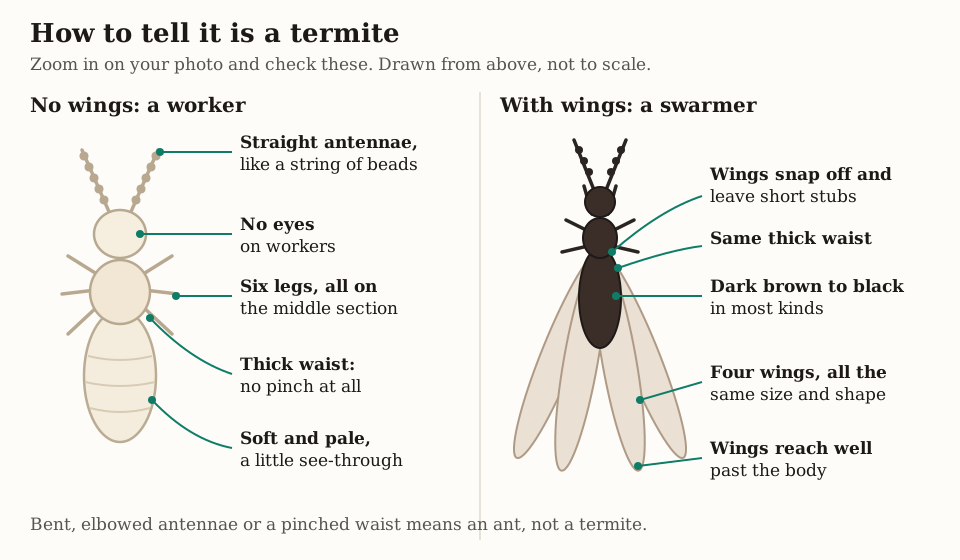
Termites are small, soft-bodied insects with straight antennae like a string of beads, a thick body with no pinched waist, and six short legs. Workers are cream or white and 1/8 to 1/4 inch (3 to 6 mm) long. Swarmers are dark brown to black, with four equal wings, and 1/4 to 5/8 inch (6 to 15 mm) long.
Termites are social insects in the order Blattodea, the same order as cockroaches. A colony has workers, soldiers and, once a year, winged swarmers, and each one looks different. So the termite you found tells you something. A pale worker came out of wood or soil close by, while a dark swarmer may have flown in from outside.
Most people never see a live worker, though. Workers avoid light and dry air, so they stay inside wood, soil and mud tubes. The termites people do find are swarmers on a sill, wings on the floor, or pale workers in a board that broke open.
How do you tell if it’s a termite?
Check the antennae first, then the waist, then the wings. Straight, beaded antennae and a thick waist mean a termite. Elbowed antennae and a pinched waist mean an ant. Color and size will not settle it, because many ants are also small and dark.
Is it a termite? Check these five things
Check each clue below to narrow down what you saw.
Straight antennae that look like a string of tiny beads
An elbow halfway along the antenna means an ant.
No narrow waist: the body is about as wide in the middle as at the back
A thin, pinched waist means an ant or a wasp.
Six legs and a soft, dull body
A hard, shiny body usually means an ant or a beetle.
If it has wings: four wings of the same size, reaching well past the tail
Front wings longer than the back pair mean an ant.
Wings that break off near the base and leave short stubs
Piles of identical wings on a sill point to a swarm nearby.
For a side-by-side look, our guide to how a wingless termite differs from an ant compares the workers, and winged ants and termite swarmers compared does the same for the ones with wings.
Workers, soldiers, swarmers, kings and queens
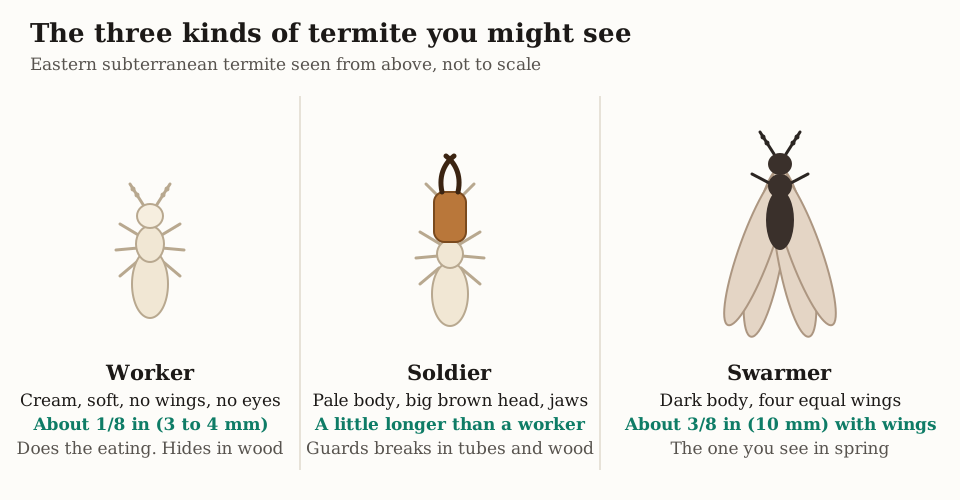
What do termites look like inside a colony? You might see five kinds of adult. Workers are pale and 1/8 to 1/4 inch (3 to 6 mm) long. Soldiers are pale with a big colored head. Swarmers are darker and have wings. Kings and queens are swarmers that lost their wings, and an old queen can swell to about 1/2 inch (13 mm).
Termite castes at a glance
Soft, pale body, no wings, no eyes
- Caste
- Worker
- Size
- 1/8–1/4 in (3–6 mm)
- Color
- Cream, white or light caramel
- Where you see it
- Inside broken wood, soil or a broken mud tube
Pale body with a large, hard head and jaws
- Caste
- Soldier
- Size
- About the size of a worker; larger in drywood and dampwood termites
- Color
- Head yellow-brown, orange, reddish-brown or black
- Where you see it
- Guarding a break in a tube or in wood
Four long wings, all the same size
- Caste
- Swarmer (alate)
- Size
- 1/4–5/8 in (6–15 mm) with wings; dampwood up to 1 in (25 mm)
- Color
- Dark brown to black in most kinds; amber, tan or yellow in some
- Where you see it
- By windows, lights, sinks and tubs in swarm season
Like a swarmer, but with short wing stubs instead of wings
- Caste
- Swarmer that dropped its wings, later a king or queen
- Size
- A little shorter than with wings
- Color
- Same as the swarmer
- Where you see it
- On floors and sills after a swarm
Long, swollen belly with pale stripes
- Caste
- Queen of an older colony
- Size
- Up to about 1/2 in (13 mm) in eastern subterranean termites
- Color
- Pale bands between darker plates
- Where you see it
- Only deep inside the nest
Sizes are from UF/IFAS, Texas A&M, Arkansas and Arizona extension publications. They vary by species, so treat them as typical.
Workers
Workers are the termites that eat the wood. They are soft, wingless and blind, and they look like a grain of rice with legs. Most are cream or white. In California, though, UC IPM describes western subterranean workers as light caramel.
Worker size depends on whom you ask. The University of Arkansas gives about 1/8 inch for eastern subterranean workers, the University of Maryland about 1/4 inch, and Texas A&M 1/4 to 3/8 inch. The reason is simple: workers grow each time they molt, so one colony holds every size.
Drywood and dampwood termites have no true workers. Their young do the work instead, and they look much the same: pale and soft. Very small, pale ones are young termites, and our guide to baby termites and termite eggs shows what those look like.
Soldiers
Soldiers have the same soft, pale body as workers, with a large, hard head and long jaws. The head is the giveaway. It is usually yellow-brown, orange or reddish-brown, which is why people describe “red and white termites” or “termites with red heads”. Most colonies have only a few soldiers in every hundred termites, but Formosan colonies have about one in ten.
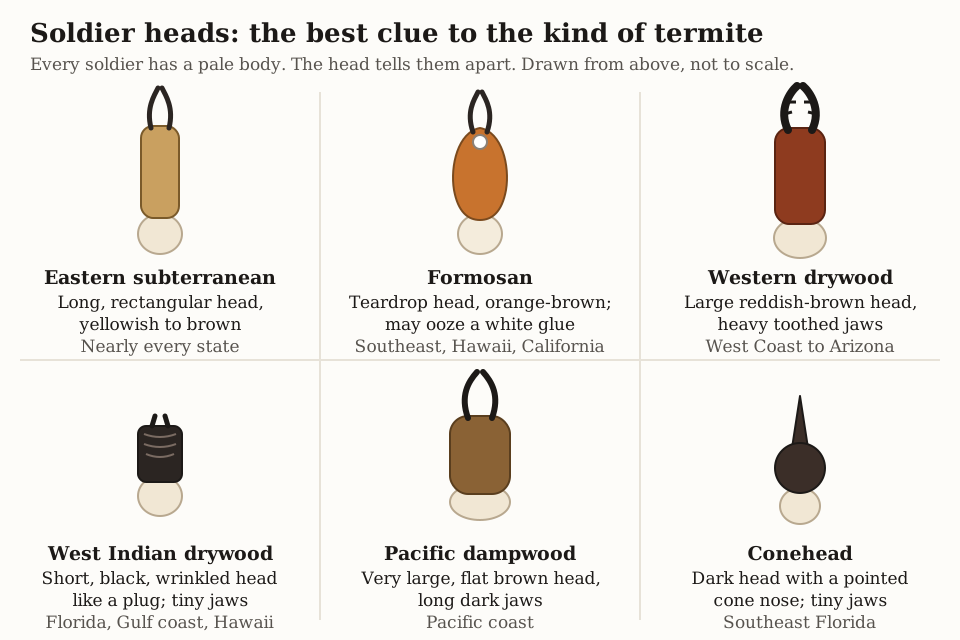
The head shape also points to the kind of termite. Formosan soldiers have an oval, teardrop-shaped orange head, and they can ooze a drop of white glue from a pore at the front of it. By contrast, eastern subterranean soldiers have a longer, rectangular head. The West Indian drywood soldier has a short, black, wrinkled head with a flat front. Conehead soldiers have a dark head drawn out into a pointed nozzle that squirts a sticky defense.
Swarmers
Swarmers, also called alates, are the winged adults that leave a mature colony to start new ones. They are the only termites with working eyes and darker, firmer bodies, and they are the ones most people find. Their four wings are the same size, usually pale and see-through, and about twice as long as the body. Each wing breaks off easily near the base.
For winged termites in detail, from shed wings in light fixtures to why they show up after rain, see our guide to termites with wings.
Kings and queens
A king and queen are swarmers that landed, dropped their wings and started a colony. The king hardly changes. He stays the size and color of a swarmer, with short wing stubs. The queen’s belly, on the other hand, keeps stretching as she lays more eggs. The University of Arkansas says the eastern subterranean queen reaches about 1/2 inch (13 mm), with pale bands between the plates of her belly that make her look striped.
You will almost never see either one, because they live deep in the nest. The huge, finger-sized queens in nature videos belong to tropical mound-building termites, not to any US species.
How big are termites?
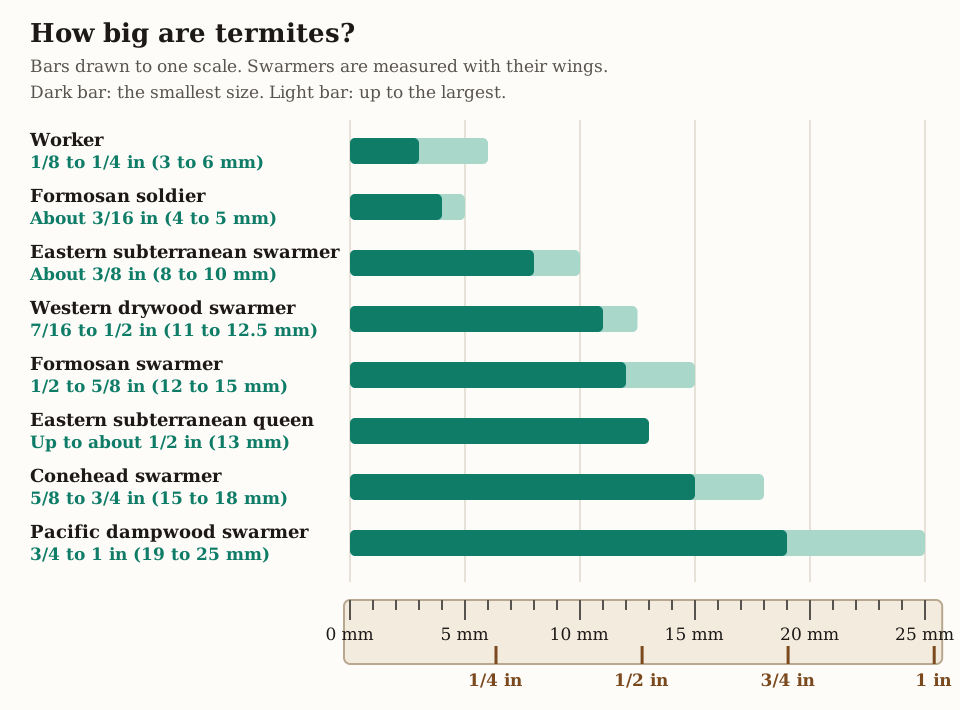
Most termites a US homeowner sees are 1/8 to 5/8 inch (3 to 15 mm) long. Workers are the smallest, at 1/8 to 1/4 inch (3 to 6 mm). Swarmers of the common eastern subterranean termite are about 3/8 inch (10 mm) with wings. The largest, Pacific dampwood swarmers, reach about 1 inch (25 mm).
Termite sizes by type, in inches and millimeters
Eastern subterranean
- Swarmer, with wings
- About 3/8 in (8–10 mm)
- Soldier
- About worker size, longer head
- Worker or young
- 1/8–1/4 in (3–6 mm); up to 3/8 in by some counts
- Where in the US
- Most of the US east of the Rockies
Western subterranean
- Swarmer, with wings
- About 3/8 in (10 mm)
- Soldier
- About worker size
- Worker or young
- About 1/4 in (6 mm)
- Where in the US
- West Coast and the West
Desert subterranean
- Swarmer, with wings
- About 1/2 in (13 mm); 3/8 in (10 mm) without wings
- Soldier
- No reliable figure
- Worker or young
- Pale
- Where in the US
- Arizona and the desert Southwest
Formosan subterranean
- Swarmer, with wings
- 1/2–5/8 in (12–15 mm)
- Soldier
- About 3/16 in (4–5 mm)
- Worker or young
- About 1/8 in (3–4 mm)
- Where in the US
- Southeast from Texas to Virginia, Hawaii, southern California
Western drywood
- Swarmer, with wings
- 7/16–1/2 in (11–12.5 mm)
- Soldier
- 5/16–1/2 in (8–12 mm)
- Worker or young
- Pale young, no true workers
- Where in the US
- California to central Arizona
West Indian drywood
- Swarmer, with wings
- About 7/16 in (11 mm)
- Soldier
- About 3/16 in (4–5 mm)
- Worker or young
- Pale young, no true workers
- Where in the US
- Florida, the Gulf coast, Hawaii
Southeastern drywood
- Swarmer, with wings
- About 7/16 in (11 mm)
- Soldier
- Large, rectangular head
- Worker or young
- Pale young, no true workers
- Where in the US
- Gulf coast and the Southeast
Pacific dampwood
- Swarmer, with wings
- 3/4–1 in (19–25 mm)
- Soldier
- Large, with long jaws
- Worker or young
- About 1/2 in (13 mm)
- Where in the US
- Pacific coast and mountains
Florida dampwood
- Swarmer, with wings
- 1/2–5/8 in (12–16 mm)
- Soldier
- 5/16–1/2 in (8.5–13.5 mm)
- Worker or young
- Pale young, no true workers
- Where in the US
- Coastal Florida
Conehead
- Swarmer, with wings
- 5/8–3/4 in (15–18 mm)
- Soldier
- About 3/16 in (5 mm)
- Worker or young
- Pale
- Where in the US
- Southeast Florida
From UF/IFAS, UC IPM, Texas A&M, the University of Arizona, Mississippi State, Washington State and the University of Arkansas. Where they differ, the table gives the range.
Can you see termites with the naked eye?
Yes. Even the smallest grown worker, at about 1/8 inch (3 mm), is about half the length of a grain of long rice. A swarmer with its wings is about 3/8 inch (10 mm), a little longer than a pencil is wide. So what do termites look like to the human eye? A tiny pale grain that moves, or a small dark bug with long, clear wings.
What you cannot see without help are the details: the beads on the antennae, the soldier’s jaws, and the six flat sides of a drywood pellet. A phone camera zoomed in, or a 10x hand lens, shows all of them. And if you rarely see termites, that is normal. Workers hide from light, so you only meet them when you break open a mud tube or damaged wood.
Why termite sizes online disagree
Size figures online disagree for three reasons. First, some count the wings and some do not, and the wings add a third to a half to a swarmer’s length. Second, workers grow as they molt, so a colony holds many sizes. Third, some numbers get copied from page to page without a check.
Drywood termites are the clearest case. Terminix, Dodson and Massey all list drywood termites at 3/8 to 1 inch long. However, UF/IFAS measures western drywood swarmers at 11 to 12.5 mm with wings, which is under 1/2 inch, and Texas A&M puts them at 9/16 inch. The termites that reach 1 inch are Pacific dampwood swarmers, a different kind. So a 1-inch termite in Florida or Texas is very unlikely to be drywood.
What color are termites?
Termite workers are cream to white. Soldiers are pale with a yellow, orange, reddish-brown or black head. Swarmers are mostly dark brown to black, but a few kinds are lighter. Formosan swarmers are amber to yellowish brown, and the southeastern drywood termite’s swarmers are light yellow. No US termite worker is black.
What a termite's color tells you
White or cream, soft, no wings
- What it most likely is
- A termite worker or young termite
- Check next
- Straight antennae and no waist? Then termites are feeding nearby
Pale body, yellow, orange or reddish-brown head
- What it most likely is
- A termite soldier
- Check next
- The head shape in the soldier diagram tells the kind
Pale body, short black wrinkled head
- What it most likely is
- West Indian drywood soldier
- Check next
- Look for six-sided pellets below tiny holes
Dark brown to black, with wings, by day in spring
- What it most likely is
- Eastern or western subterranean swarmer
- Check next
- Four equal wings and straight antennae?
Amber or yellowish brown, at lights after dark
- What it most likely is
- Formosan swarmer, or a drywood swarmer
- Check next
- Note where and when; Formosan swarms in late spring evenings
Reddish-brown head, dark brown body, smoky wings
- What it most likely is
- Western drywood swarmer
- Check next
- Usually late summer and fall in the West
Large, orange-brown to dark brown, up to 1 in
- What it most likely is
- Dampwood swarmer
- Check next
- Look for wet or rotting wood nearby
Shiny black and hard, with a pinched waist
- What it most likely is
- Not a termite: an ant
- Check next
- Check for elbowed antennae
Black termites
Black termites are almost always swarmers. Eastern subterranean swarmers are dark brown and look nearly black to the eye, and conehead swarmers are dark brown with dark wings. A black swarmer from a house is usually about 3/8 inch (10 mm) long with its wings, and about 1/4 inch (6 mm) once they drop.
Because no termite worker is black, a black, wingless insect that is shiny and hard is most likely an ant. The antennae and waist will confirm it.
White termites
White termites are workers and young termites. People also call them “white ants”, but they are not ants. A soft, white insect with straight, beaded antennae in damp wood or a broken mud tube is a termite worker.
On the other hand, tiny white bugs on damp paper, books or a windowsill are more often booklice, which are under 1/16 inch (1.5 mm). Pale springtails jump when touched. Ants that have just molted are pale for a day or two, but they still have a pinched waist. Our guide to small white bugs in the house sorts the rest.
Red and brown termites
There is no red termite species in the US. “Red termites” are soldiers: a pale body with an orange or reddish-brown head. Formosan soldiers have orange-brown heads, and western drywood soldiers have large reddish-brown heads. Some swarmers are reddish too, such as the western drywood swarmer, with its orange-brown head and dark body, and Florida’s dampwood swarmers.
A rule shared online says black termites are subterranean and red ones are drywood. It does not hold. Some drywood swarmers are dark, the southeastern drywood swarmer is light yellow, and soldiers of both kinds can have reddish heads. Instead, go by what the termites leave behind: mud tubes point to subterranean termites, while six-sided pellets point to drywood.
What each US termite looks like
What do termites look like where you live? That depends on the kind, and the US has five groups that matter to homes: subterranean, Formosan, drywood, dampwood and conehead. Native subterranean termites live in nearly every state. Formosan termites live in the Southeast, Hawaii and parts of California, and drywood termites in warm southern and western areas. Dampwood termites live mostly on the Pacific coast, and conehead termites only in southeast Florida.
US termites side by side
Mud tubes; black swarmers by day in spring
- Termite
- Eastern subterranean
- Swarmer
- Dark brown to black, about 3/8 in (10 mm), pale to smoky wings
- Soldier head
- Long, rectangular, yellowish to brown
- Where
- Most of the US east of the Rockies; the most common US termite
Mud tubes in the West
- Termite
- Western subterranean
- Swarmer
- Dark brown to brownish black, brownish-gray wings, about 3/8 in
- Soldier head
- Long, narrow, amber
- Where
- West Coast and the West
Amber swarmers at lights after dark; many soldiers
- Termite
- Formosan subterranean
- Swarmer
- Amber to orange-brown, hairy wings, 1/2–5/8 in (12–15 mm)
- Soldier head
- Teardrop, orange-brown; may ooze white glue
- Where
- Southeast, Hawaii, southern California
Six-sided pellets below pinholes, in the West
- Termite
- Western drywood
- Swarmer
- Reddish-brown head and thorax, dark brown body, smoky wings, 7/16–1/2 in
- Soldier head
- Large, reddish-brown, toothed jaws
- Where
- California to central Arizona
Pellets in furniture, attics and trim, in Florida
- Termite
- West Indian drywood
- Swarmer
- Medium brown, shiny wings, about 7/16 in (11 mm)
- Soldier head
- Short, black, wrinkled
- Where
- Florida, the Gulf coast, Hawaii
Pale yellow swarmers at lights
- Termite
- Southeastern drywood
- Swarmer
- Light yellow to light brown, clear wings, about 7/16 in
- Soldier head
- Rectangular, dark yellow-brown
- Where
- Gulf coast and the Southeast
Very large swarmers, wet or rotting wood
- Termite
- Pacific dampwood
- Swarmer
- Orange-brown to dark brown, 3/4–1 in (19–25 mm)
- Soldier head
- Very large, flat, brown; long jaws
- Where
- Pacific coast and mountains
Dark nests and covered trails on trees and walls
- Termite
- Conehead
- Swarmer
- Dark brown, dark wings, 5/8–3/4 in (15–18 mm)
- Soldier head
- Dark, with a pointed cone nose
- Where
- Southeast Florida
Subterranean termites
Subterranean termites are the ones most Americans have. The eastern subterranean termite, Reticulitermes flavipes, has black swarmers about 3/8 inch (10 mm) long with pale to smoky wings, cream workers, and soldiers with long, rectangular, yellowish-brown heads. The western subterranean termite in California and the West looks much the same, with brownish-gray wings.
In Arizona, there are two more. The desert subterranean termite has pale yellowish-brown swarmers about 1/2 inch (13 mm) long with wings. The arid-land subterranean termite has dark brown to black swarmers of the same size.
Formosan termites
Formosan subterranean termites, Coptotermes formosanus, are bigger and lighter in color. Their swarmers are amber to orange-brown, 1/2 to 5/8 inch (12 to 15 mm) long with wings, and covered in fine hairs. They fly after dark toward lights. Their soldiers are the easiest to recognize: a teardrop-shaped orange head on a white body, about 3/16 inch (4 to 5 mm) long.
According to UF/IFAS, a soldier defends itself by oozing a white, glue-like fluid from a pore on its head. A crowd of these soldiers at a break in a mud tube points to Formosan termites. In South Florida, a close relative, the Asian subterranean termite, has darker brown swarmers of about the same size and the same teardrop-headed soldiers.
Drywood termites
Drywood termites live inside dry wood with no contact with soil, so you rarely see them outside it. The western drywood termite has swarmers with a reddish-brown head and thorax, a dark brown body and smoky wings, and soldiers with large reddish-brown heads and heavy, toothed jaws.
In the Southeast, the southeastern drywood termite has light yellow swarmers with clear wings. The West Indian drywood termite, which UF/IFAS says is behind nearly all tent fumigation in Florida and Hawaii, has medium-brown swarmers with shiny wings and soldiers with short, black, wrinkled heads. All three are about 7/16 to 1/2 inch (11 to 12.5 mm) with wings. Their hard, six-sided pellets are often the first thing anyone sees, and our guide to drywood termite pellets shows them.
Dampwood termites
Dampwood termites are the giants. Pacific dampwood swarmers are 3/4 to 1 inch (19 to 25 mm) long with wings, orange-brown to dark brown, and their soldiers have big, flat brown heads with long dark jaws. The Nevada dampwood termite, a close relative, is a little smaller and darker, at about 3/4 inch.
Florida has its own dampwood termites, with reddish-brown to reddish-orange swarmers of 1/2 to 5/8 inch (12 to 16 mm). UF/IFAS calls them the largest termites in the eastern US. Dampwood termites need wet wood, so finding them indoors usually means a leak.
Conehead termites
The conehead termite, Nasutitermes corniger, is an invasive termite from the American tropics. It was first found established in the US in Dania Beach, Florida, in 2001, as UF/IFAS records. Its soldiers are about 3/16 inch (5 mm) long, with a dark head drawn out into a pointed cone. Its swarmers are dark brown with dark wings and fairly large, at 5/8 to 3/4 inch (15 to 18 mm).
Unlike most US termites, conehead workers and soldiers travel in the open at night and cover their trails with a mix of soil and droppings. They also build bulky nests in trees and on buildings, which makes them easier to spot than other termites.
Which kind you have changes how it is treated. Our main termite guide explains what each kind means for your house.
What do termites look like on wood and around the house?
On wood, live termites look like pale, soft grains of rice moving through tunnels, often with a few soldiers that have colored heads. Subterranean termites line their tunnels with mud. Around the house, though, you are more likely to find dead dark swarmers on sills, piles of see-through wings, or mud tubes than a live termite.
Termites that come out inside a house usually die within a day. That is why they turn up near windows, sinks, tubs and lights, where light drew them. If the damage or the little piles under the wood are what you found, our guides to what termite damage looks like and to every sign of termites in a house cover them.
What do dead termites look like?
A dead swarmer has often lost some or all of its wings, which lie nearby in a small pile. Its body shrinks a little as it dries, but the straight antennae and thick waist still show under a magnifier. Loose wings are a clue on their own: termite wings are all the same size, pale and see-through, and about twice the length of the body.
What bug can be mistaken for termites?
Ants are mistaken for termites more than any other insect, both with wings and without. After ants come booklice, tiny pale insects on damp paper; webspinners, slim insects that live in silk tunnels; and winged look-alikes such as brown lacewings and termite-eating rove beetles. The antennae and waist check rules out most of them in seconds.
Our round-up of bugs that look like termites gives the one feature that separates each of them, from carpenter ants to mayflies.
How to photograph a termite for an ID
A good termite photo shows the antennae, the waist and, on a swarmer, all four wings, next to a coin or ruler for size. Take it from straight above in daylight, then take a second one from the side. That is enough for an expert, or for you, to rule out an ant.
Catch it whole
Trap it under a glass, or pick it up with clear tape. Do not squash it: a crushed termite loses the waist and wings you need to see.
Chill it
Put it in a zip bag or a small jar in the freezer for an hour so it stops moving. A dead termite is fine for an ID.
Add a size scale
Set it on white paper next to a ruler or a coin. A US penny is 3/4 inch (19 mm) across.
Use daylight, not the flash
Shoot near a window. A flash can make a black swarmer look yellow or brown in the photo.
Shoot from above, then from the side
Fill the frame and tap to focus on the head. The top view shows the antennae and wings. The side view shows the waist.
Zoom in on three things
Check the antennae (straight or bent), the waist (thick or pinched) and, on a swarmer, the wings (equal or unequal).
Keep the sample
Keep it in the jar for an inspector, and write down where and when you found it.
Photo apps and AI chatbots often call a winged ant a termite, and the reverse. Readers on Reddit report this all the time, and some even had a pest company or a fence contractor call their ants termites. So use any identifier, including our photo bug identifier, as a first guess, and then confirm it with the three checks. If you are still unsure, an inspector or your county extension office can look at the sample.
You found a termite: what it means
What you found and where matters more than the termite’s size or color. One swarmer near a window often flew in from outside. Many swarmers indoors, piles of wings, or pale workers in wood mean a colony is in or under the house. That needs a professional inspection. Do not spray; keep a sample instead.
What your termite find likely means
One dark swarmer, alive or dead, near a window, door or light
- What it likely means
- It probably flew in from outside
- What to do
- Keep it in a jar. Look for more swarmers, wings and mud tubes
Many swarmers coming out of a wall, floor or window frame
- What it likely means
- A colony is feeding in the house
- What to do
- Book a professional inspection this week
Pale workers in broken wood or a mud tube
- What it likely means
- An active colony right there
- What to do
- Leave it in place for the inspector
A pale insect with an orange, brown or black head
- What it likely means
- A soldier, so a colony is close
- What to do
- Same as above, and note the head shape
A tiny white bug on paper, a sill or in a damp bathroom
- What it likely means
- Often a booklouse, not a termite
- What to do
- Check the antennae and the waist
A very large termite at a porch light in the West
- What it likely means
- Likely a dampwood swarmer
- What to do
- Check for wet or rotting wood
From here, our guide to what a termite inspection checks explains the next step if you think a colony is in the house.
Pest control disclaimer. Photo-based identification can help, but it is not always perfect. For dangerous spiders, large infestations, or anything you are unsure about, contact a licensed pest control professional.
Termite appearance FAQ
How many legs does a termite have?
Do termites have eyes?
Are termites soft or hard?
Do termites bite people?
Are white ants the same as termites?
Related guides
Termites
The full guide: which of the US termites you have, what a swarm means, and what to do next.
Termites with wings
Winged termites in detail: why they appear after rain, and dead ones in light fixtures.
Baby termites
Tiny pale nymphs and eggs, and the white bugs that get mistaken for them.
Termites vs ants
Wingless workers side by side: antennae, waist, color and what each one eats.
Flying ants vs termites
The four checks for winged ones, and whose wings are on your sill.
Bugs that look like termites
Every common look-alike, with the one feature that separates it.
Signs of termites
Mud tubes, wings, pellets and damage, and how sure each sign is.
Termite droppings
Six-sided drywood pellets and the piles that only look like them.
Sources
- UF/IFAS EDIS IN369, Native subterranean termites
- UF/IFAS EDIS IN278, Formosan subterranean termite
- UF/IFAS EDIS IN526, Western drywood termite
- UF/IFAS EDIS IN236, West Indian drywood termite
- UF/IFAS EDIS IN279, Florida dampwood termites
- UF/IFAS EDIS IN1275, Conehead termite
- UC IPM Pest Notes 7415, Subterranean and other termites
- Texas A&M AgriLife, E-368, Subterranean termites
- Texas A&M AgriLife, E-366, Drywood termites
- University of Arkansas, FSA7061, Biology of subterranean termites
- University of Arizona, AZ1356, Termite management for homeowners
- University of Maryland Extension, Termites
- Mississippi State Extension, Species of termites in Mississippi
- Washington State University, Pestsense: Termites