Two readers land here. One is holding a bag with something moving in it and wants a name. The other can see no insect at all, only flour that looks grey and smells wrong, which is a different answer entirely. Both are below.
Part 1 of 3
Name it
Start with what you can see
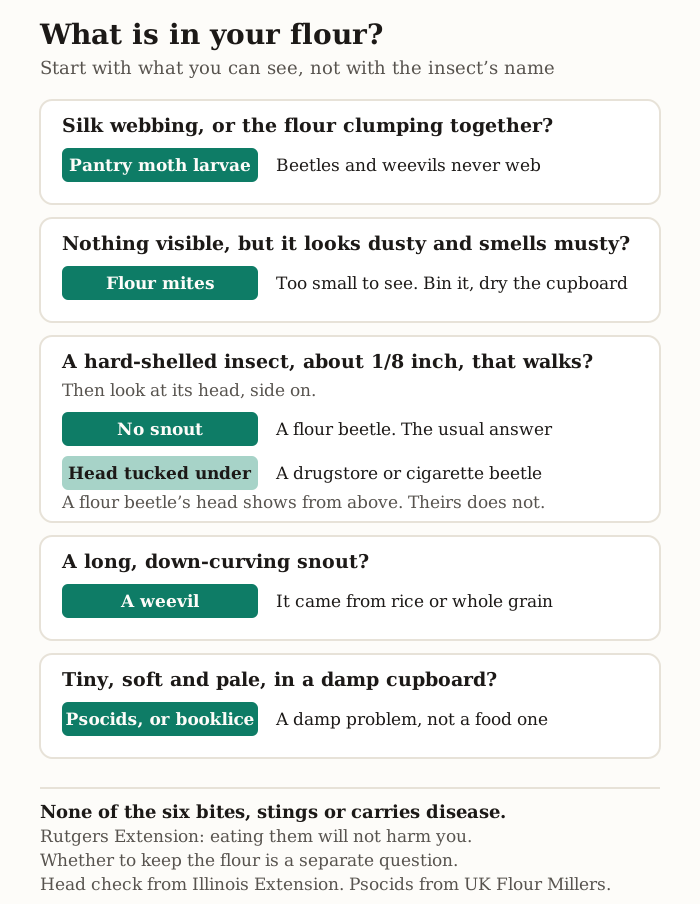
Do not start with the insect’s name. Start with webbing, dust and the snout, because each of those rules out most of the list in one look. The bugs in flour that people actually find come down to six candidates, and three checks separate nearly all of them.
Is the flour safe?
Yes. Rutgers Cooperative Extension states it plainly: eating them will not harm you. None of the bugs in flour bites, stings or carries a disease you can catch, and baking kills every stage. Rutgers adds the part people are quietly worried about. Pantry pests are not uncommon, and they are not a reflection of anyone’s housekeeping.
Safe is not the same as worth keeping, though, and that is a separate decision with its own rules. The keep-or-bin chart sits on our other flour page, which answers is it safe to use flour with weevils and names the two cases where the answer is bin it without hesitating.
The six things that turn up in flour
Each row separates on one feature. Work down the first column until something matches what is in front of you.
The bugs in flour, and the one feature that gives each away
Hard shell, 1/8 in, no snout, head visible from above
- What it is
- Flour beetle, red or confused
- What it means
- The usual answer. It cannot open whole grain
Hard shell, but the head is tucked out of sight
- What it is
- Drugstore or cigarette beetle
- What it means
- Check the spices and the dry pet food
A long, down-curving snout
- What it is
- A weevil
- What it means
- It came from rice or whole grain nearby
Silk webbing, clumping, small caterpillars
- What it is
- Pantry moth larvae
- What it means
- Beetles and weevils never leave webbing
No insect visible, flour dusty and musty
- What it is
- Flour mites
- What it means
- A damp problem. Discard rather than sift
Tiny, soft, pale, in a damp cupboard
- What it is
- Psocids, or booklice
- What it means
- They eat mould, not flour
The head check, which settles the beetles
Three brown beetles of about the same size turn up in dry goods, and Illinois Extension gives the one check that separates them. A flour beetle’s head is visible when you look down at it. On a drugstore or cigarette beetle the head is tucked under, so from above you see only the hood of the thorax. Our page on telling a cigarette beetle vs drugstore beetle apart covers the pair in full, down to the grooved wing covers.
Mites, and the smell that gives them away
Mites are not insects and they are too small to see individually. What you notice is the flour itself: dusty, slightly lumpy, and seeming to shift if you stare at it. The smell is the real tell, a musty or faintly minty note that clean flour never has. They need humidity, so they are a storage problem rather than bad luck.
Webbing means moths, and nothing else
Silk strands binding the flour together, or small caterpillars, mean pantry moth larvae. Beetles and weevils leave no webbing at all, which makes this the most reliable single sign on the page. Illinois Extension notes a detail that explains a lot of confused searches. Caterpillars leave the food to pupate, often ending up where a wall meets the ceiling.
Pantry moths and fabric moths are different animals. Moths in a wardrobe are the webbing clothes moth or a relative. Those eat wool, not flour.
If it has a snout, it is a weevil
A weevil carries its jaws on the tip of a long, down-curving snout, and no beetle in this list has one. Finding one in a flour bag is uncommon, because a weevil needs whole grain to breed in, so it has usually walked over from rice or wheat nearby. The rice weevil and the granary weevil are the two you are most likely to meet, and what are weevils covers the wider group.
Black, white or tiny: sorting by colour and size
Most people search by what the thing looks like rather than by what it is called, and the colour usually narrows it to one or two answers.
Sorting the bugs in flour by colour and size
Tiny black bugs
- Size
- About 1/8 in (3 mm)
- Almost always
- Flour beetles, which look black until you see them in good light
Tiny brown or reddish bugs
- Size
- About 1/8 in (3 mm)
- Almost always
- The same beetles. Reddish-brown is the true colour
White bugs, worm-like
- Size
- Up to 1/4 in
- Almost always
- Beetle larvae, creamy white with a darker head
White bugs, caterpillar-like, with silk
- Size
- Up to 1/2 in
- Almost always
- Pantry moth larvae
White or pale dust that seems to move
- Size
- Barely visible
- Almost always
- Flour mites. Not insects at all
Very small, pale, soft-bodied
- Size
- Under 1/16 in
- Almost always
- Psocids, in a damp cupboard
Anything with a long snout
- Size
- 1/8 in and up
- Almost always
- A weevil, whatever the colour
Part 2 of 3
Where they came from
How they got into a sealed bag
The bugs in flour were there before you bought it. Grain picks up insects anywhere between the field and the shelf, and milling does not remove every egg. Paper and thin plastic packaging is no barrier either. Flour beetles crawl into folds and seams, and Scotts notes that some will chew through plastic, paper and even foil.
Warmth and time do the rest. A bag at the back of a cupboard for a year is a different proposition from one used in a fortnight. So the shop almost certainly did not sell you something dirty, and the thing that would have prevented it is the freezer.
How long in the freezer? The sources disagree
This is where published advice falls apart. Five sources give five answers for killing bugs in flour. One of them is not really freezing at all.
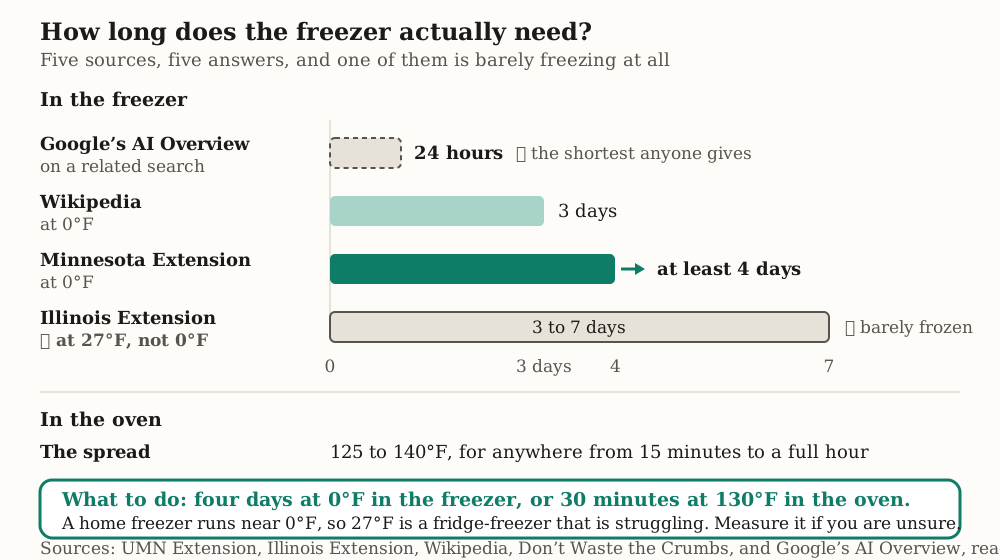
Minnesota Extension says at least four days at 0°F and Wikipedia says three, which is a normal amount of disagreement. Illinois Extension says three to seven days, but at 27°F. That is only just below freezing, and a long way from the figure everyone else uses. A home freezer runs near 0°F, so if yours is closer to 27°F it is struggling and worth a thermometer.
Use four days at 0°F, or 30 minutes at 130°F in the oven. Spread the flour no more than an inch deep. Both are the longer, safer end of what the sources give.
Part 3 of 3
What to do
Clearing the cupboard
The cupboard matters more than the packet. Bugs in flour come back from one bag left behind, and an adult flour beetle lives about a year. None of this needs a product.
The flour cupboard clear-out, step by step
Bag the infested packet and take it outside
Seal it before it leaves the cupboard. Adults walk out of an open kitchen bin and straight back onto the shelf. Illinois Extension advises exactly this: bag heavily infested items tightly, and dispose of them outdoors.
Check every other dry good, including the ones you forget
These insects move between packets, so one bag is rarely the whole story. Look at flour, cornmeal, cake and pancake mixes, cereal, pasta, spices, birdseed and dry pet food. Tip anything suspect onto a white plate and wait a minute: beetles start moving and show up against white.
Vacuum the shelves first
Work the corners, the shelf-pin holes and the gap at the back. Spilled flour collects there. Empty the vacuum outside. For psocids this matters twice over. The UK Flour Millers advise cleaning cupboards with a vacuum rather than liquids, because adding moisture is what they want.
Wash with soapy water, dry fully, and skip the bleach
Minnesota Extension says washing with detergent, bleach or ammonia will not keep pantry pests from returning, and warns those chemicals are a hazard if they reach food. Warm soapy water and a properly dry shelf does the same job without the risk.
Move what you keep into glass or metal
Paper, cardboard and thin plastic are not barriers. Rigid containers with gasket lids stop the spread between packets, which is how a single bag becomes a six-month problem. Label what you treated and when.
Fix the damp if there is any
Mites and psocids both need humidity, and both disappear when a cupboard dries out. Check for a leak under or behind the unit. Run the extractor when you cook, and leave a gap behind packed shelves. Neither pest can establish in a dry cupboard.
The other beetles that turn up around a kitchen, and the rooms they appear in, are sorted in our house beetles identification notes.
What does not work
No home remedy has been shown to stop bugs in flour. Even so, one widely read guide recommends four of them in a single list.
Myth 1
Myth: “Bay leaves in the container keep them out.”
Truth: Minnesota Extension states there is no evidence that bay leaves or spearmint gum prevent stored-food insects. It is the most repeated advice on this topic, and there is nothing behind it.
Myth 2
Myth: “Garlic, tea tree oil or dried chillies work as deterrents.”
Truth: All three appear together in one of the guides ranking for this search, which admits several were never tested. No extension source supports any of them.
Myth 3
Myth: “A day in the freezer is enough.”
Truth: Not reliably. The published figures run from 24 hours to seven days, and the eggs are the hardest stage to reach. Four days at 0°F is the figure that satisfies nearly all of them.
Myth 4
Myth: “Bleach the shelves and they will not come back.”
Truth: Minnesota Extension says detergent, bleach and ammonia will not keep pantry pests from returning. It warns they are dangerous if they reach food. Soapy water and a dry shelf is as effective, and safer.
Myth 5
Myth: “Spray the cupboard with a household insecticide.”
Truth: Illinois Extension says insecticides are not recommended for pantry pests. They cannot reach anything inside a packet, and control is temporary unless the source is removed. Any food that contacts pesticide must be thrown out.
Myth 6
Myth: “Sifting makes infested flour as good as new.”
Truth: Sifting removes adults and some larvae. It does not remove eggs, cast skins or droppings from a powder. That is why flour is a weaker candidate for saving than rice.
Myth 7
Myth: “Finding bugs in flour means your kitchen is dirty.”
Truth: Rutgers Cooperative Extension answers this directly. Pantry pests are not uncommon, and not a reflection of anyone's housekeeping. They arrive sealed inside shop-bought packaging.
Myth 8
Myth: “They can bite, or they are dangerous to pets.”
Truth: Nothing in this list bites people or pets, and none carries a disease you can catch. The only real health point is mite allergy in sensitive people.
Still not sure what you are looking at? Photograph it from directly above against something pale. Our free tool will identify a bug from the picture, before you decide what to throw away.
Pest control disclaimer. Photo-based identification can help, but it is not always perfect. For dangerous spiders, large infestations, or anything you are unsure about, contact a licensed pest control professional.
Bugs in flour FAQ
What are the tiny black bugs in flour called?
Can flour bugs fly?
Why are there bugs in flour I only just bought?
What are the white bugs in flour?
Do flour bugs bite?
Why do I find them in the bedroom when the pantry is clean?
Related guides
Weevils in flour
Whether to keep the bag or bin it, and why the insect is usually not a weevil at all.
Rice weevil
The weevil that can open a whole grain, and whether rice it has been in is still safe.
Weevils
The wider guide: pantry, home-invading and garden weevils, and which of the three you have.
House beetles
Beetles found indoors, sorted by room, including the ones that wander far from food.
Drugstore beetle
The brown pantry beetle whose head is tucked out of sight, found in spices and pet food.
Clothes moths
The fabric moths, and how they differ from the ones in your cupboard.
Small black bugs
Tiny dark insects around the house, sorted by the room you found them in.
Types of beetles
Name any beetle by size, colour and shape, starting with whether it is a beetle at all.
Sources
- Rutgers Cooperative Extension, I Found Bugs in My Cereal, Pasta or Cake Mix. What Do I Do?
- University of Illinois Extension, What are Those Bugs in My Flour? Pantry Pests (2019)
- University of Minnesota Extension, Pantry pests: Insects found in stored food (reviewed 2024)
- UK Flour Millers, Psocids: on cleaning cupboards with a vacuum rather than liquids
- Wikipedia, Flour beetle (Tribolium), for the species, size and flight