Most people meet this insect the same way: a bag bought in bulk, opened weeks or months later, with small dark specks moving through it. The panic is about waste more than about health. So this page answers the money question first, then shows you how to name what you are holding.
Part 1 of 3
Start here
Can you still eat the rice?
Yes. Rutgers Cooperative Extension states it directly: eating them will not harm you. A rice weevil carries no disease, it does not poison the grain, and swallowing one does nothing. The same source adds the part people are quietly worried about: pantry pests are not uncommon, and they are not a reflection of anyone’s housekeeping skills.
That answer is harder to find than it should be. Threads asking whether weevil-infested rice is safe run to 223 and 267 replies, and Google’s own summary of this topic falls back on reporting that “opinions on Reddit are mixed”. They are not mixed among food-safety authorities. The honest nuance is about quality instead, and that is a judgment you can make with two rules.
What to save
- A few insects in a large bag. Sieve, rinse, then freeze. This is the ordinary case, and the rice is fine.
- Whole grains, rice, pasta and dried beans. These sieve and rinse well, and hollowed grains float away in water.
- Anything you will boil. Cooking handles whatever a rinse missed.
What to bin
- Rice that smells sour, musty or fermented. That is mould, not weevils, and mould is a real reason to throw food away.
- Bags that have gone sticky or clumped, or that are more insect than grain.
- Anything with webbing in it. Weevils leave none, so webbing means moth larvae have been there too.
- Anything you simply will not eat now. Appetite counts, and there is no prize for forcing it.
Is it a rice weevil?
A rice weevil is about 1/8 inch long (2 to 4 mm), dull reddish-brown to almost black, with a long down-curving snout and a thorax covered in round or irregular pits. Look for four faint pale spots on the wing covers, arranged in a rough cross. It flies, and it comes to lights.
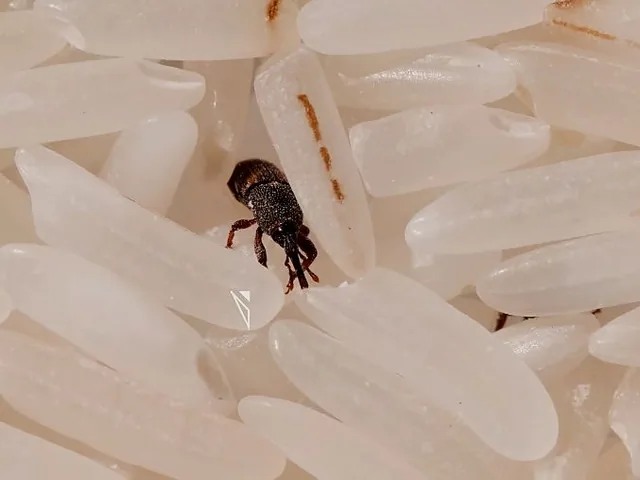
The snout settles whether it is a weevil at all. A weevil carries its jaws at the tip of that snout rather than on its head, and no pantry beetle without one is a weevil, whatever the packet calls it. Our guide to the types of weevils covers the ones that turn up elsewhere in a house, in the bathroom and on garden plants.
What you are looking at, in a bag of rice
Dark specks that move, four faint spots
- Size
- About 1/8 in (3 mm)
- What it probably is
- Rice weevil
- Does it have a snout?
- Yes, long and curved down
Same shape, plain, never flies
- Size
- 1/8 to 1/4 in
- What it probably is
- Granary weevil
- Does it have a snout?
- Yes
Reddish-brown, flat, no snout
- Size
- Under 1/8 in
- What it probably is
- A flour beetle, not a weevil
- Does it have a snout?
- No
Pale moving dust on the surface
- Size
- Barely visible
- What it probably is
- Grain mites, not insects
- Does it have a snout?
- No
Webbing, and small caterpillars
- Size
- Up to 1/2 in
- What it probably is
- Indianmeal moth larvae
- Does it have a snout?
- No
Tiny, pale, in damp stores
- Size
- Under 1/16 in
- What it probably is
- Psocids, also called booklice
- Does it have a snout?
- No
Rice weevil, granary weevil or maize weevil?
Three checks separate the rice weevil from its twin, and they agree with each other, so any one of them is enough. The flight test does most of the work in practice: if it flew to your window or your lamp, it is a rice weevil.
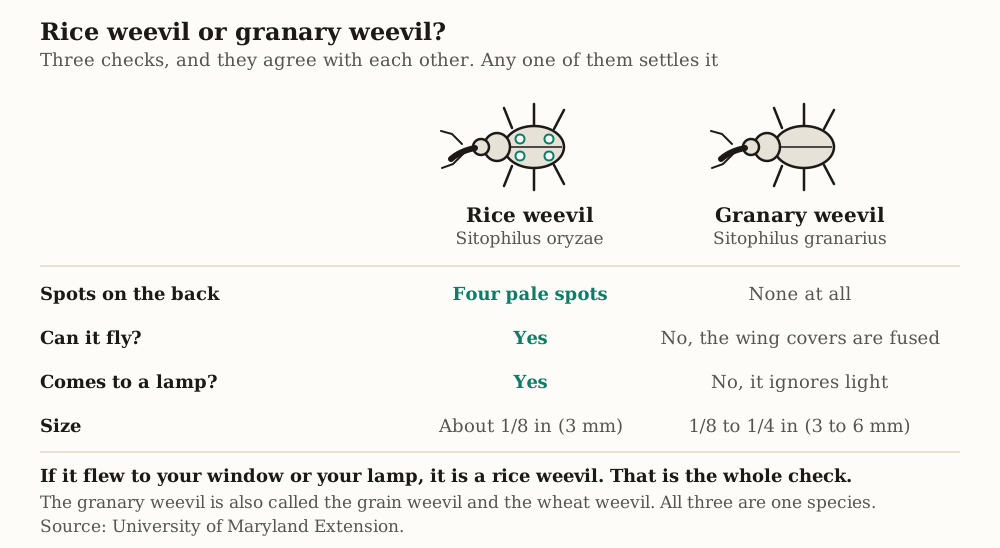
Rice weevil or granary weevil, on three checks that agree
Marks on the wing covers
- Rice weevil
- Four faint reddish to yellowish spots
- Granary weevil
- None at all
Can it fly?
- Rice weevil
- Yes
- Granary weevil
- No, the wing covers are fused
Does it come to a lamp?
- Rice weevil
- Yes
- Granary weevil
- No, it ignores light
Size
- Rice weevil
- About 1/8 in (3 mm)
- Granary weevil
- 1/8 to 1/4 in (3 to 6 mm)
Eggs per female
- Rice weevil
- 250 to 400
- Granary weevil
- 50 to 200
Scientific name
- Rice weevil
- Sitophilus oryzae
- Granary weevil
- Sitophilus granarius
Why grain, wheat and granary weevil are one insect
This is the part that confuses everyone, and no page we studied untangles it. The granary weevil, the grain weevil and the wheat weevil are three names for one species, Sitophilus granarius. Wikipedia files all three under a single entry. So if you have searched two of those names and found what looked like two different insects, they were the same animal.
There is a third species in the group. The maize weevil, Sitophilus zeamais, prefers corn and looks almost identical to the rice weevil. Sizes overlap, and specialists separate the two by dissection rather than by eye. For a kitchen it makes no difference at all, because the treatment is the same.
Part 2 of 3
Where they came from
How they got into a sealed bag
They were already inside. A female rice weevil chews a hole into a single grain with her snout, lays one egg inside it, and seals the hole with a plug. From the outside that grain looks untouched. The larva then grows hidden within it, eating the kernel out, and chews its way free as an adult weeks later.
So the bag did not have to be open, and the shop did not sell you something dirty. Grain can pick up weevils anywhere between the field and your shelf. Minnesota Extension notes that dry goods become infested anywhere from the processing plant to the grocery store, and that food of any age is vulnerable. The weevils you are looking at almost certainly hatched in your own cupboard.
Is it every bag of rice?
No, but nothing on the outside tells you which bag. Most rice gets eaten long before a hidden egg finishes its cycle, which is why this is an occasional surprise rather than a constant one. It is also the reason the single most effective habit is freezing a new bag for a few days before it goes in the cupboard.
The life cycle, and why numbers jump a month later
A rice weevil generation takes about 28 days in a warm kitchen. Oklahoma State University Extension gives the stages: roughly three days as an egg, about eighteen days as a larva inside the grain, about six days as a pupa, then three to four days while the new adult’s shell hardens before it leaves the seed.
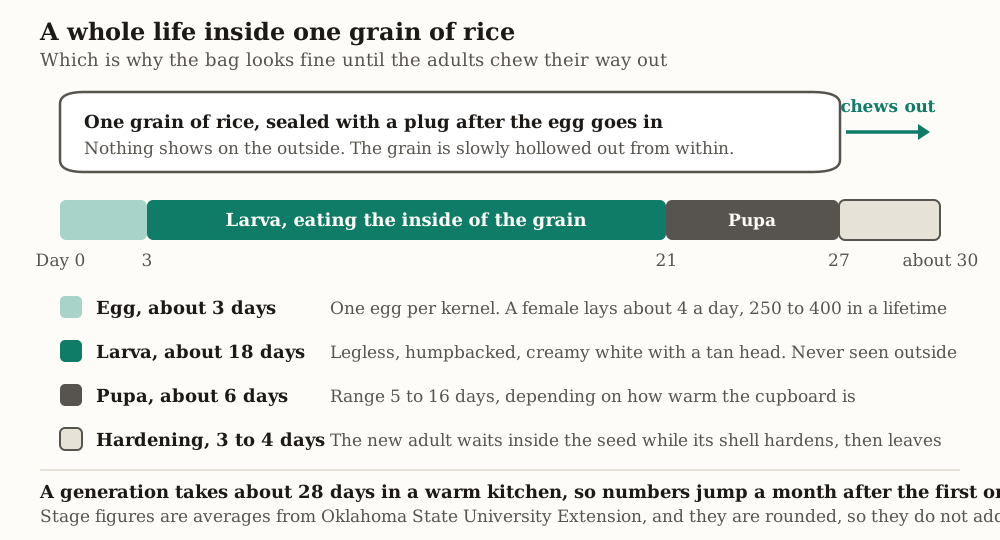
That timing explains something people find alarming. You see one rice weevil, clear up, and a month later there are twenty. The twenty were already there as eggs inside grains when you cleared up, and no amount of wiping shelves could have reached them. Heat speeds the whole thing along, so a warm cupboard runs faster than a cool one.
The larvae are worth knowing by sight, because they are what you find if you split grains open. They are legless, humpbacked and creamy white with a small tan head, and they never appear outside the kernel.
Do rice weevils bite or carry disease?
No on both counts. Oklahoma State University Extension states it directly: rice weevils do not bite, and they do not damage wood or furniture. They carry no disease that passes to people or pets, and a rice weevil has mouthparts built for drilling into seeds, which are no use on skin.
Pets are fine too. Dry pet food is one of the places these weevils turn up most often, and an animal that eats a few along with its kibble is at no risk. Treat the pet food bin the same way you treat your own rice.
Part 3 of 3
What to do
How to get rid of rice weevils
Work down this list. The first three steps save the food, the next three clear the cupboard, and the last one is the step to skip rather than take. None of it involves buying a product.
The rice weevil clear-out, step by step
Take the bag outside, then decide
Work over a bin or a sink, because adults scatter. Pour some onto a white plate: weevils show up against white and disappear against cardboard. Heavily infested rice, rice that smells sour or musty, and rice with sticky clumps or webbing goes in the outdoor bin. The rest is worth keeping.
Sieve and rinse what you are keeping
A fine sieve takes out the adults and most of the frass. Then rinse in a bowl of water: hollowed grains and dead insects float, and sound grains sink. This is what people on cooking forums actually do, and it works for whole grains, rice and dried beans. It does not reach eggs sealed inside kernels, which is what the next step is for.
Freeze it for four days, or heat it for half an hour
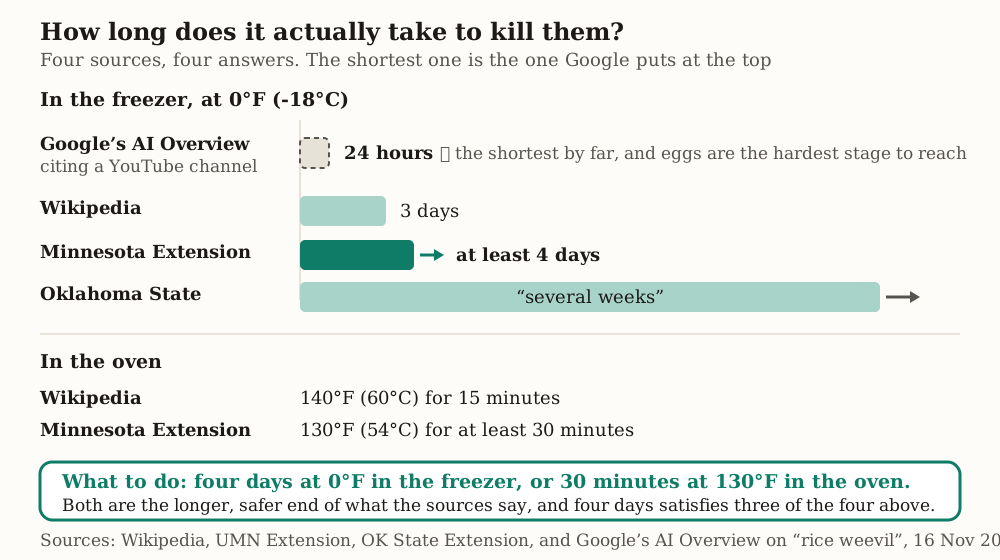
Freezing at 0°F (-18°C) for four days kills every stage, including the eggs. An oven at 130°F (54°C) for at least 30 minutes does the same. Spread the rice no more than an inch deep so the middle reaches temperature. Four days is the conservative figure, and the reason to use it rather than a shorter one is in the chart above.
Empty the cupboard and vacuum it
Take everything out. Vacuum the shelves, the corners, the shelf-pin holes and the gap at the back, because spilled grain collects there and a single kernel is enough to breed from. Empty the vacuum outside. Skip the bleach: Minnesota Extension says detergent, bleach and ammonia will not keep pantry pests away, and warns they are a hazard near food.
Check everything else dry, not just the rice
A rice weevil opens whole grains, so look at wheat, barley, oats, pasta, dried corn, beans, birdseed and dry pet food. Maryland Extension also flags spices, especially red pepper, paprika and chili powder, and dried flower arrangements. Pet food and forgotten spice jars are the two that get skipped.
Move what survives into glass or metal
They chew through paper, cardboard and thin plastic bags, so the bag it came in is not a barrier. Glass jars that pressure seal with a rubber gasket are the best of the usual options. Label what you treated and when, and use it within a few months.
Do not spray, and here is why
Maryland Extension puts it plainly: do not spray any food storage areas with insecticides. A spray cannot reach a larva sealed inside a grain, and any food that contacts pesticide has to be thrown out. The top answer on one of the threads ranking for this search recommends pesticides, vinegar and bay leaves. All three are wrong for a food cupboard.
When it is worth calling someone
Almost never, for a kitchen. Two cases are worth it. One is an infestation that keeps returning after a full clear-out, which usually means a source you cannot see, such as spilled grain under a built-in cupboard. The other is bulk storage rather than a pantry, where temperature management and fumigation are genuinely a professional job.
How to stop them coming back
- Freeze new bags for four days before they go in the cupboard. This one habit prevents almost every repeat, because it kills the rice weevil eggs that came home with the bag.
- Store everything dry in glass or metal. Gasket seals are best. Bags and cardboard get chewed through.
- Buy what you will use in two to four months, and finish the older bag before opening the newer one.
- Check the packet before it goes in the trolley. Holes, tears or grit along a seam are worth a second look.
- Include the spices, the birdseed and the pet food. Maryland Extension singles out red pepper, paprika and chili powder.
- Keep the cupboard cool and dry. They breed faster in warmth and higher humidity.
What does not work
This topic has an unusually active video layer, and most of the tricks in it have nothing behind them. One piece of popular advice is worse than useless, because it sounds like a treatment while leaving the eggs alive.
Myth 1
Myth: “Freeze the rice for 24 hours and it is dealt with.”
Truth: This is what Google's AI Overview currently recommends on this search, sourced to a YouTube channel, and it is the shortest figure anyone gives. Wikipedia says three days, Minnesota Extension says at least four, and Oklahoma State says several weeks. Eggs sealed inside grains are the hardest stage to reach, so use four days.
Myth 2
Myth: “Bay leaves in the container keep them out.”
Truth: Minnesota Extension states there is no evidence that bay leaves or spearmint gum prevent or get rid of stored-food insects. The advice is everywhere, including in the top answer on a forum thread that ranks for this search.
Myth 3
Myth: “Garlic cloves, sunlight or a hairdryer will clear the bag.”
Truth: These come from popular videos rather than from any source. Sunlight and a hairdryer do make adults run, so the bag looks better for a while, but neither reaches the larvae and eggs inside the grains.
Myth 4
Myth: “White vinegar kills the larvae.”
Truth: It does not. Vinegar is fine for wiping a shelf, and that is the whole of its usefulness here. The larvae are inside the kernels, where nothing you wipe on can reach them.
Myth 5
Myth: “Spray the pantry with a household insecticide.”
Truth: Maryland Extension says not to spray food storage areas at all. Sprays cannot reach inside a grain or a sealed packet, and any food they touch has to be thrown out.
Myth 6
Myth: “Weevils mean the shop sold you bad rice.”
Truth: Not usually. Grain can pick them up anywhere from the field to the warehouse, and the eggs are invisible inside intact kernels. A sealed bag is no guarantee, and a good shop is no guarantee either.
Myth 7
Myth: “Rice weevils bite, or they are dangerous to children and pets.”
Truth: A rice weevil does not bite and carries no disease. Oklahoma State Extension says so plainly. Dry pet food is one of their favourite places, and a pet eating a few is not at risk.
Tiny bugs in rice that are not weevils
If you have already ruled out a rice weevil, you are not stuck. A few other things live in stored grain, and each one separates on a single feature. The quickest check is the snout: no snout means it is not a weevil.
What else turns up in rice, and the one feature that gives it away
Pale dust that moves, too small to see a shape
- What it is
- Grain mites, which are not insects
- What to do
- Discard, and dry the cupboard out. They need damp
Webbing or silk through the grain
- What it is
- Indianmeal moth larvae
- What to do
- Discard that packet. Weevils never leave webbing
Flat reddish-brown beetle, no snout
- What it is
- A flour beetle
- What to do
- It cannot open whole grain, so check your flour instead
Very small, pale, soft, in a damp cupboard
- What it is
- Psocids, also called booklice
- What to do
- Dry the space out. They feed on mould, not grain
Round beetle with grooved wing covers, no snout
- What it is
- A drugstore or bread beetle
- What to do
- Check spices and dry pet food, its usual homes
A snout, and jaws at the tip of it
- What it is
- A rice weevil after all
- What to do
- Work through the steps above
Mites and booklice both point at damp rather than at the food, so a dehumidifier does more than a clean-out would. For the beetles, our guides to bread beetle infestations, the other pantry beetles, and the flour weevil that is really a flour beetle cover where each one actually breeds. Silk strands in a packet mean pantry moth webbing, which is a different job again. If the problem turns out to be in the flour rather than the rice, our sorter for tiny bugs in flour runs through all six candidates.
If it is small and dark but you are not sure it came from the rice at all, the small dark bugs by room round-up sorts them by where you found them, and our guide to beetle species covers the wider group. You can also photograph it from directly above and run it through our free bug identifier before you throw anything away.
Pest control disclaimer. Photo-based identification can help, but it is not always perfect. For dangerous spiders, large infestations, or anything you are unsure about, contact a licensed pest control professional.
Rice weevil FAQ
Are rice weevils in every bag of rice?
Can you see rice weevil eggs?
Why are there so many in one bag?
How long does a rice weevil live?
Is it vegan to eat rice that had weevils in it?
What else do rice weevils get into?
Related guides
Weevils
The wider guide: pantry, home-invading and garden weevils, and which of the three you have.
Small black bugs
Tiny dark insects of the kitchen and bathroom, sorted by the room you found them in.
House beetles
The other beetles that turn up indoors, and whether each one is eating anything.
Drugstore beetle
The brown pantry beetle that breeds in spices and dry pet food, often mistaken for a weevil.
Types of beetles
Name any beetle by size, colour and shape, starting with whether it is a beetle at all.
Clothes moths
Webbing in a packet means a moth. How the fabric and pantry moths differ.
Carpet beetles
The fabric pest whose larvae are often found near, but not in, stored food.
Bugs that look like ticks
Weevils are mistaken for ticks more than for anything else. The leg count settles it.
Sources
- Rutgers Cooperative Extension, I Found Bugs in My Cereal, Pasta or Cake Mix. What Do I Do?
- University of Maryland Extension, Rice and Granary Weevils (revised 2020, updated October 2024)
- Oklahoma State University Extension, Rice Weevil (Sitophilus oryzae)
- University of Minnesota Extension, Pantry pests: Insects found in stored food (reviewed 2024)
- Wikipedia, Rice weevil (Sitophilus oryzae), for the species biology and the maize weevil separation