Part 1 of 4
What it is
What pantry moths are
Pantry moths are small moths, about 3/8 inch (10 mm) long at rest, whose caterpillars live in stored dry food. In practice one species does nearly all of it in American kitchens: the Indian meal moth, Plodia interpunctella. You can name it from the wings alone, because the third nearest the head is pale grey and the outer two-thirds are coppery red-brown.
That two-tone wing is unusual, and it is the fastest check there is. The wingspan runs 16 to 20 mm, roughly 3/5 to 3/4 inch, so an adult is about the size of a cooked grain of rice. At rest it folds its wings back along the body and sits still. Pantry moths are usually spotted high on a wall or a ceiling, nowhere near the cupboard they came from.
How to recognise a pantry moth
Check each clue below to narrow down what you saw.
Two-tone wings: pale grey near the head, coppery red-brown beyond
This is the single most reliable feature. A plain one-colour moth in the kitchen is something else.
About 3/8 inch (10 mm) long at rest, wingspan 16 to 20 mm
Roughly the size of a cooked grain of rice. Cornell puts the length a little higher, at 3/8 to 1/2 inch.
Sits high: walls, ceilings, the tops of door frames
People usually notice them above head height, nowhere near the food the larvae are in.
Flies openly, and will come toward a lamp
Clothes moths do the opposite and stay in dark closets.
No tuft of hair on the head
A reddish tuft on top of the head means a clothes moth, not a pantry moth.
People name pantry moths by the room rather than the species. So kitchen moths, cupboard moths, food moths, flour moths and grain moths all mean one animal. Wikipedia lists weevil moth as another old name for it. That is confusing, because weevils are beetles and leave no silk at all.
Pantry moth or clothes moth?
Check the wings and check the room, and the answer takes about five seconds. Pantry moths have two-tone copper wings and live on your food. A clothes moth is one plain shade of gold, has a tuft of reddish hair on its head, and lives on wool. They need different traps, so getting this right saves money as well as effort.
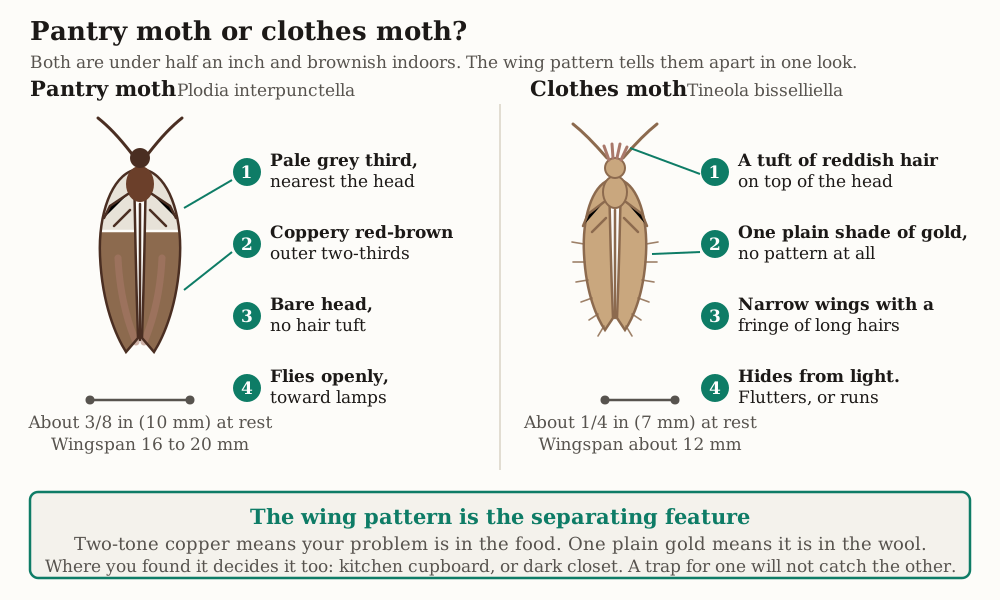
Which small indoor moth is it?
Wings
- Pantry moth
- Two-tone: pale grey third nearest the head, coppery red-brown beyond
- Clothes moth
- One plain shade of gold or buff, with a fringe of long hairs
- Moth from outdoors
- Usually patterned, often brown or grey
Size at rest
- Pantry moth
- About 3/8 in (10 mm)
- Clothes moth
- About 1/4 in (6 to 8 mm)
- Moth from outdoors
- Many sizes, often much larger
Head
- Pantry moth
- Bare
- Clothes moth
- A tuft of reddish hair on top
- Moth from outdoors
- Varies
Where you find it
- Pantry moth
- Kitchen, pantry, high on walls and ceilings
- Clothes moth
- Dark closets, near stored wool
- Moth from outdoors
- At windows and lights, near a door
What the larvae eat
- Pantry moth
- Flour, cereal, nuts, dried fruit, pet food, birdseed
- Clothes moth
- Wool, silk, fur, feathers
- Moth from outdoors
- Nothing indoors
Behaviour
- Pantry moth
- Flies openly, comes to lamps
- Clothes moth
- Flutters or runs, avoids light
- Moth from outdoors
- Flies to light, then dies at the window
The sign it leaves
- Pantry moth
- Silk webbing clumping dry food
- Clothes moth
- Irregular holes, silk under collars and cuffs
- Moth from outdoors
- None
If the damage is to clothing rather than food, you want the other guide, because the treatment is completely different. Our page on the moths that eat wool covers the washing, freezing and storage numbers for fabric. Something on the bathroom wall that sits flat in a tent shape and barely flies is not a moth. That one is a drain fly.
Pantry moth larvae, eggs and webbing
The larva is the one that matters. It is a cream caterpillar with a dark brown head. It grows to about 1/2 inch (12 to 14 mm), and only that stage eats anything of yours. The adults do no damage at all. So the webbing, the clumping and the small caterpillars in a packet are the real evidence, not the moths flying around.
What pantry moth larvae look like
Cream, off-white or pale yellow, soft, and segmented like any caterpillar. The head capsule is darker, a tan or brown, and that contrast is the giveaway. Their colour follows what they are eating, so they come out yellower in cornmeal and almost white in plain flour.
Larvae or maggots?
Look for a head and legs. A pantry moth larva is a caterpillar. It has a clear dark head capsule and three pairs of true legs near the front. Five pairs of stubby prolegs follow behind. A maggot is a fly larva, and it has neither: no legs, and no defined head. Dry food in a cupboard also makes a maggot very unlikely.
Pantry moth larva, maggot, or clothes moth larva?
Head
- Pantry moth larva
- Dark brown head capsule, easy to see
- Maggot
- No defined head
- Clothes moth larva
- Brown head capsule
Legs
- Pantry moth larva
- Three pairs of true legs plus prolegs
- Maggot
- None at all
- Clothes moth larva
- Three pairs plus prolegs
Shape
- Pantry moth larva
- Even width, caterpillar-like
- Maggot
- Tapered, fatter at one end
- Clothes moth larva
- Even width
Length
- Pantry moth larva
- Up to about 1/2 in (12 to 14 mm)
- Maggot
- Usually under 1/2 in
- Clothes moth larva
- Up to about 1/2 in
Where
- Pantry moth larva
- Dry food: flour, cereal, nuts, pet food
- Maggot
- Wet or rotting matter, bins, drains
- Clothes moth larva
- Wool, silk and fur in closets
Silk
- Pantry moth larva
- Yes, webbing through the food
- Maggot
- None
- Clothes moth larva
- Yes, tubes and patches on fabric
The webbing, and what it rules out
Webbing is the single most useful sign on this page. Pantry moths leave a silk thread wherever the larvae crawl. An infested packet ends up with fine threads through it, and the powder or grain stuck together in clumps. Beetles and weevils never do this, so silk means a moth and nothing else.
That one test sorts most kitchen problems quickly. Found small beetles and no silk at all? Read weevils in flour and rice instead. The animal and the advice are both different.
Eggs, cocoons and the part people call poop
Eggs are 0.3 to 0.5 mm across and laid in groups of up to thirty, so almost nobody sees them without a lens. Cocoons are easier: small flat silk cases, usually along a shelf edge or where the wall meets the ceiling. The gritty dark specks in the food are frass, which is droppings, and they stay behind even after the insects are gone.
Part 2 of 4
The food, and where it came from
Have you been eating them, and is the rest safe?
Almost certainly yes to the first, and yes to the second. Pantry moths carry no human disease. Insect fragments in milled food are ordinary. The US Food and Drug Administration even publishes a level at which it acts. For wheat flour that level is an average of 75 or more insect fragments per 50 grams, and the FDA classes the significance as aesthetic.
That figure is worth sitting with for a moment. It is not a safety limit, it is the point where the FDA steps in. The handbook says these levels are set on the premise that they pose no inherent hazard to health. Cornmeal is allowed an average of one or more whole insects per 50 grams. So the flour in your kitchen was never guaranteed to be insect-free, and that was true before the moths arrived.
FDA defect action levels, the point at which the FDA acts
Wheat flour
- The level
- Average of 75 or more insect fragments per 50 g
- Significance
- Aesthetic
Cornmeal
- The level
- Average of 1 or more whole insects per 50 g, or 25 or more fragments per 25 g
- Significance
- Aesthetic
Macaroni and noodles
- The level
- Average of 225 or more fragments per 225 g, in 6 or more subsamples
- Significance
- Aesthetic
None of that makes an infested packet pleasant, and most people bin it anyway. But if you are lying awake because the family ate the cereal for a fortnight, the honest answer is simple. Nothing in it was going to make anyone ill.
Where pantry moths came from, and why it is not your housekeeping
They came in with the shopping. Eggs or small larvae travel inside packaging from anywhere between the mill and the shop shelf. Pantry moths chew through thin plastic and cardboard, so an unopened box is not proof. Rutgers Extension answers the awkward part directly: pantry pests are common and are not a reflection of anyone’s housekeeping.
The sources people miss are the ones that sit untouched for months. So check these before you decide the cupboard is clear:
- Dry pet food and pet treats, especially a big sack bought on offer.
- Birdseed, which is a classic and is often stored in a garage or a utility room.
- Decorative dried corn, pot pourri and craft supplies, which nobody thinks of as food.
- Spices, nuts and dried fruit, bought in bulk bins and decanted at home.
- The packet at the back of the cupboard that has been there since last year.
Part 3 of 4
How it works
Why pantry moths are on the ceiling, and in rooms with no food
Because the larva leaves the food before it pupates. When it is fully grown it crawls away from the packet, sometimes a long way, and spins its cocoon somewhere sheltered. UC IPM says mature larvae are often found in parts of the house far from the original food source. So a cocoon in a bedroom does not mean there is food there.
This also explains the question people ask most: where is the nest? There is not one. Pantry moths build nothing. There is an infested packet, and there are pupation sites scattered away from it, and those are two different places.
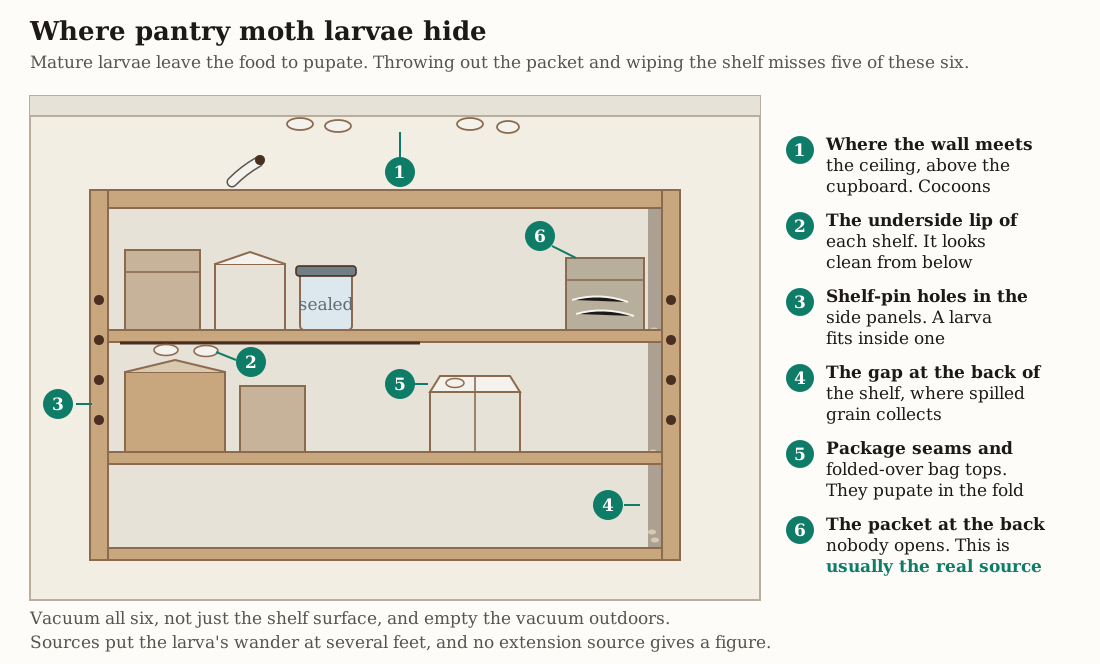
Honest caveat on distance: no extension source we read puts a number on how far a larva travels. Pest control sites say several feet, and they disagree with each other, so treat the whole cupboard and its surroundings rather than measuring. Want to know what the cocoon stage is doing? We have a guide to the pupal case and how long each insect spends in it.
The pantry moth life cycle, and how long this lasts
Pantry moths can finish a generation in as little as four weeks in a heated house. Six or more generations a year are normal indoors. That is why the problem seems to restart a month after you cleaned. Eggs hatch within about two weeks, and then the larva feeds for anything from 13 days to well over a year.
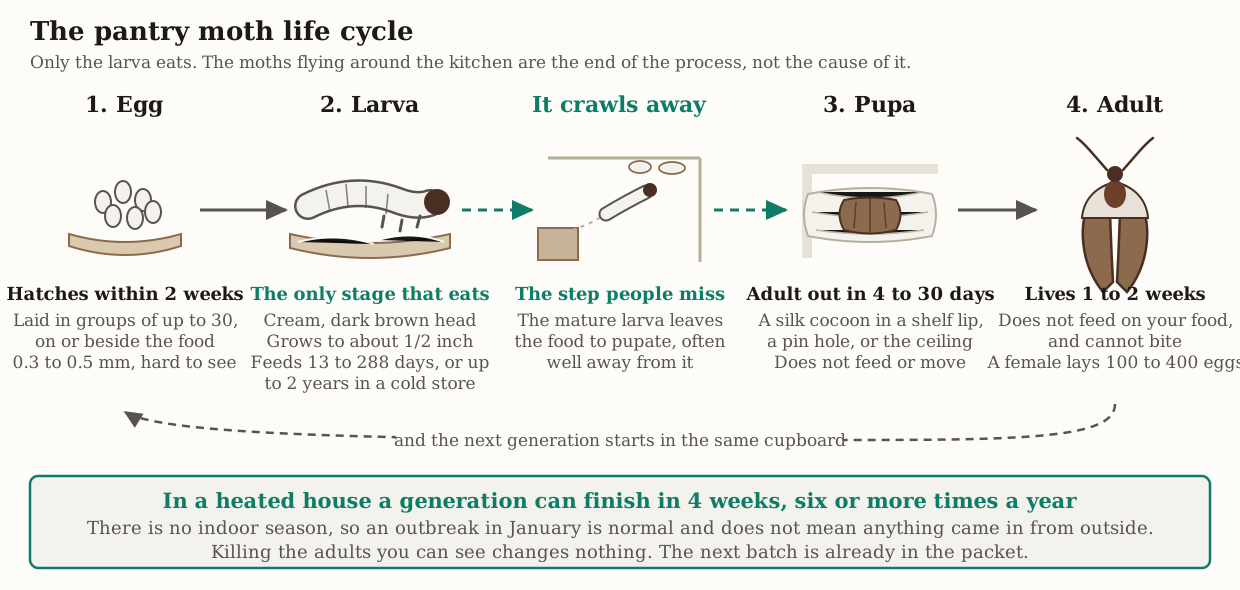
The published figures disagree, and the disagreement is the useful part rather than a flaw. Cornell puts larval feeding at 13 to 288 days. Utah State says it takes from two weeks to two years for larvae to reach full size. Wikipedia gives the whole cycle as 30 to 300 days, typically about 50. All three are right, for different temperatures and different foods, so nobody can tell you exactly when yours will end.
How long each stage takes, and what the sources say
Egg
- How long
- Hatches within about 2 weeks
- What it is doing
- 0.3 to 0.5 mm, laid in groups of up to 30
- Source
- Utah State Extension
Larva
- How long
- 13 to 288 days, or 2 weeks to 2 years
- What it is doing
- The only stage that eats. Leaves silk as it crawls
- Source
- Cornell IPM, Utah State
Wandering larva
- How long
- Not measured
- What it is doing
- Leaves the food to find a pupation site
- Source
- UC IPM
Pupa
- How long
- Adult emerges in 4 to 30 days
- What it is doing
- In a silk cocoon. Does not feed or move
- Source
- Utah State Extension
Adult
- How long
- About 1 to 2 weeks
- What it is doing
- Does not feed on your food. Lays 100 to 400 eggs
- Source
- Cornell IPM, Utah State
The practical point is simple. Because only the larva eats, killing adults achieves nothing, and the clock only stops when the food source goes. For the wider picture across every moth species, including the ones that never come indoors, see our guide to the moth life cycle.
Part 4 of 4
What to do
How to get rid of pantry moths
Start with the steps that cost nothing, and go after the food rather than the pantry moths. Killing the adults you can see is the most common mistake, and it is why people describe fighting the same infestation for months. Work through these in order, and most kitchens are clear in an afternoon.
Clearing pantry moths, in order
Empty the cupboard completely
Take out every box, bag, jar and tin, and put them on the counter. This costs nothing and it is the step that actually finds the source. A packet can look sealed and still be infested, because larvae chew through thin plastic and cardboard.
Check every single packet, not just the obvious one
Look for silk webbing, clumped powder, cream caterpillars or small holes in the packaging. Check flour, cereal, rice, pasta, nuts, dried fruit, spices, chocolate, birdseed and dry pet food. The packet at the back that nobody opens is the usual culprit.
Bin what is infested, into an outdoor bin
Seal infested food in a bag and take it straight outside, because a kitchen bin just moves the problem a few feet. If food is only suspect rather than clearly infested, you can freeze or heat it instead, and the next section gives the numbers.
Vacuum the cracks, the corners and the shelf-pin holes
Go along the shelf lip, into the corners, around the shelf-pin holes and into the gap at the back where spilled grain collects. Then empty the vacuum outdoors. Skipping this is the single most common reason an infestation restarts a month later.
Wash the shelves with warm soapy water, then dry them
Soap and water is enough, and the shelf must be properly dry before anything goes back. Minnesota Extension says detergent, bleach and ammonia will not keep pantry pests from returning, and warns that those chemicals are a hazard near food.
Move what is left into rigid sealed containers
Glass, metal or thick plastic with a tight gasket lid. Paper, cardboard, foil and thin plastic bags do not stop them, and a screw-top jar may not seal fully. This is the step that stops it happening again, so it is worth doing properly.
Put traps out to check your work, not to do it
Set two or three pheromone traps and check them weekly. An empty trap after three or four weeks means you found the source. A trap that keeps filling means you missed a packet, and the one filling fastest tells you roughly where to look.
What kills pantry moths: the temperatures and times
Cold and heat both work, and both kill every stage including eggs, but only if you hit the real number. Utah State Extension gives 0°F (-18°C) or lower for four to seven days in a freezer. For heat it gives 130 to 140°F (54 to 60°C) for half an hour to an hour in an oven. Guidance that just says a week in the freezer leaves out the temperature, which is the part that matters.
What actually kills every stage
Freezing
- The number
- 0°F (-18°C) or lower, 4 to 7 days
- What it kills
- Eggs, larvae, pupae and adults
- What to watch
- Many kitchen freezers run warmer than 0°F. Check yours before you trust it
Heating
- The number
- 130 to 140°F (54 to 60°C), 30 to 60 minutes
- What it kills
- Every stage, once the food is hot all through
- What to watch
- Never flour. See the warning below
Binning it
- The number
- Immediate
- What it kills
- Everything in the packet
- What to watch
- Seal the bag and take it to an outdoor bin, not the kitchen bin
Killing the adults
- The number
- Instant, and pointless
- What it kills
- Only the moths you hit
- What to watch
- The larvae in the packet are untouched, so it changes nothing
One thing neither method does is clean the food. Utah State notes that heat and cold both leave the silk, the cocoons, the shed skins, the dead insects and the droppings exactly where they were. Treating is for salvaging something expensive, and for most packets binning it is simpler.
Do pantry moth traps work?
They work as a monitor, not as a cure, and the difference matters. A pantry moth trap is baited with the female sex pheromone, so it catches adult males only. Every female, every egg and every larva in the packet is untouched. NPIC, Cornell and UC IPM all say this, and so do the trap manufacturers.
It is worth being blunt here, because a popular article ranking for this exact question says the opposite. One widely read blog tells readers that the traps kill the moths and prevent them from breeding. They do not. Safer Brand says it plainly, replying to its own reviewers. The trap attracts male pantry moths only, so it is not expected to eliminate an infestation alone.
What a pantry moth trap does, and does not do
What does it catch?
- The answer
- Adult males, drawn by the female pheromone
Will it clear an infestation?
- The answer
- No. The larvae in the food are unaffected
So what is it for?
- The answer
- Telling you whether a source is still active, and roughly where
How long does a lure last?
- The answer
- About three months, and UC IPM says check the traps weekly
Will it catch clothes moths?
- The answer
- No. Each lure matches one species, and the makers say so
Will it catch pantry beetles?
- The answer
- No. A moth lure does not attract beetles
There is a better use for a trap, and it comes from people who have dealt with pantry moths rather than from the articles. Put several traps out across the kitchen, leave them a few days, then see which one filled fastest. That points you at the cupboard holding the source. Used that way a trap earns its money, because finding the packet is the whole job.
What does not work
Three of the most-asked questions about pantry moths are about smells, and the honest answer to all three is the same. Nothing you can smell will clear an infestation. Here is what gets recommended, and what the evidence actually says.
Myth 1
Myth: “Bay leaves on the shelf keep pantry moths away.”
Truth: Widely repeated, including by an article ranking on the first page, but no extension source we read supports it as a control. A sealed container does the job that bay leaves are supposed to do.
Myth 2
Myth: “Vinegar will get rid of them.”
Truth: Vinegar and water is a cleaning solution, and wiping shelves is genuinely useful. It is not a treatment, and it does nothing to the larvae inside a packet.
Myth 3
Myth: “Cloves, lavender or peppermint oil will repel them.”
Truth: Same answer as bay leaves. If exclusion and cleaning are working, nothing else is needed, and if they are not working, a scent will not rescue it.
Myth 4
Myth: “Mothballs in the kitchen cupboard.”
Truth: No. NPIC says mothballs should not be used around food or food preparation areas, and the EPA label permits them only inside a sealed container. They are a pesticide, and the label is the law.
Myth 5
Myth: “Bleach the shelves and they will not come back.”
Truth: Minnesota Extension says detergent, bleach and ammonia will not keep pantry pests from returning, and warns those chemicals are a hazard if they reach food. Warm soapy water and thorough drying is safer and works as well.
Myth 6
Myth: “A bug zapper will clear them out.”
Truth: It only kills adults, which changes nothing. It is also the wrong light: research cited by Wikipedia found blue light at 400 to 475 nm pulls these moths more strongly than ultraviolet during twilight, and a zapper is ultraviolet.
Myth 7
Myth: “Just sieve the flour and carry on.”
Truth: Sieving removes the larvae and the clumps but leaves the silk, the shed skins and the droppings. It is a choice, not a fix, and a musty smell means bin it.
Mothballs come up often enough on this topic to be worth one more line. They are a registered pesticide with a narrow legal use. Our page about moth balls has the full picture, including why they do not repel mice or snakes.
How to stop pantry moths happening again
One habit keeps pantry moths out, and it does almost all of the work: keep dry food in rigid containers with a real seal. Utah State puts it plainly. Glass, metal or thick plastic with tight-fitting lids prevents nearly all stored product pest problems. Paper, cardboard, foil and cloth do not.
Which containers actually keep pantry moths out
Glass or metal with a gasket lid
- Does it work?
- Yes
- Why
- Nothing gets in or out, and you can see what is inside
Thick plastic with a clamp or gasket
- Does it work?
- Yes
- Why
- Same, as long as the seal is real rather than a push-on lid
Screw-top jar
- Does it work?
- Usually
- Why
- Fine for most, though some screw tops do not seal fully
Zip bag, even doubled
- Does it work?
- No
- Why
- Larvae chew through thin plastic, and people on forums report this constantly
Original cardboard box or paper bag
- Does it work?
- No
- Why
- They chew straight through, so an unopened packet is not safe either
Foil or cloth
- Does it work?
- No
- Why
- Neither is a barrier to a larva
- Rotate your stock and use older packets first. Utah State notes that severe infestations usually turn up in food stored a long time.
- Check new groceries for damaged packaging or webbing before they go on the shelf.
- Freeze flour and grain for a week when you bring it home, if you have the space. That kills anything already inside.
- Keep one trap out so you find out early rather than when moths are flying.
- Buy smaller packets of anything you use slowly, especially birdseed and dry pet food.
Are pantry moths harmful?
No. Pantry moths do not bite, they do not sting, and they are not known to transmit human pathogens. The adults cannot damage anything at all, and the larvae only eat stored food. The harm is to the contents of your cupboard, and that is the whole of it.
Two related questions come up a lot. They do not eat clothes, so holes in a sweater point to a different insect. Shed wing scales can cause mild respiratory irritation in sensitive people. That is rare, and it is not a reason to worry about an ordinary kitchen infestation.
Pest control disclaimer. Photo-based identification can help, but it is not always perfect. For dangerous spiders, large infestations, or anything you are unsure about, contact a licensed pest control professional.
Other moths and bugs in the same food
Most kitchen infestations are pantry moths, meaning the Indian meal moth, but not all of them. The quickest sort is the silk test: moths leave webbing, and beetles and weevils never do. After that, what the insect looks like and how damp the food was will tell you the rest.
Sorting the other stored food pests
Silk webbing, cream caterpillars, two-tone moth
- What it is
- Pantry moth, the Indian meal moth
- What to do
- This page. Find the packet
Webbing, but in damp food in a cellar
- What it is
- Meal moth, Pyralis farinalis
- What to do
- Check for mould first, then clear it the same way
Holes bored into whole grains of rice or wheat
- What it is
- Angoumois grain moth, Sitotroga cerealella
- What to do
- Same clear-out. It bores into whole grain, which the pantry moth does not
Small beetles, no silk anywhere
- What it is
- Flour or grain beetles
- What to do
- weevils in flour and rice
Beetles with a long snout, in rice
- What it is
- Rice or granary weevil
- What to do
- rice weevil life cycle
Tiny brown beetle in spices or medicine
- What it is
- Drugstore or biscuit beetle
- What to do
- biscuit beetle
Something small, dark and unidentified
- What it is
- Could be several things
- What to do
- tiny black bugs by room
Still not sure what you are looking at? Take a clear, well-lit photo and run it through our AI bug identifier by picture. Do that before you throw out a cupboard full of food.
Pantry moths FAQ
How long does a pantry moth infestation last?
Why am I getting pantry moths?
What smell keeps pantry moths away?
Are there baby pantry moths?
Can I sieve the flour and still use it?
Do pantry moth traps catch clothes moths?
Related guides
Moths
What moths are, what they eat, and why only a couple of species touch your things.
Clothes moths
The fabric moth: how to tell it from the pantry moth, and the numbers that kill it.
Types of moths
The 16 moths behind most US sightings, sorted by size and colour.
Weevils in flour
No webbing means a beetle, not a moth. Which one, and whether the flour is safe.
Rice weevil
The long-snouted beetle in rice, and how it got into a sealed bag.
Drugstore beetle
The small brown beetle in spices, medicine and dry goods.
Weevils
All three household weevils, in the kitchen and in the garden.
Small black bugs
Every tiny dark bug in the house, sorted by room and size.
Pupa
Cocoons on the ceiling or along a shelf: whose they are and what to do.
Carpet beetles
The other pantry and fabric pest, and the rash that is not a bite.
Insect identifier
Upload a photo and get an identification from the free AI tool.
Sources
- US Food and Drug Administration, Food Defect Levels Handbook
- UC Statewide IPM Program, Pest Notes: Pantry Pests
- Utah State University Extension, Flour Moths, Fact Sheet No. 1 (Karren and Roe, revised May 2000)
- National Pesticide Information Center, Pantry Moths (February 7, 2025)
- Cornell University IPM, Pantry Moths (What's Bugging You)
- University of Minnesota Extension, Pantry pests: Insects found in stored food (reviewed 2024)