Part 1 of 4
What they are
What moths are
Moths are insects of the order Lepidoptera, the group whose wings are covered in tiny scales. About 160,000 species have been described worldwide and roughly 11,000 live in the United States. North America alone holds more than 10,000 moth species against about 700 butterflies, which is the ratio most people have backwards.
Here is the part that surprises people: moths are not a scientific group at all.Butterflies form one tidy branch within Lepidoptera, and everything else in the order gets called a moth. Of the 133 described families, 126 are moth families and seven are butterflies. So “moth” is a word for the leftovers, which is why the variety inside it is so enormous.
That variety is the practical problem. If you want to put a name to one you found, size and color narrow it far faster than a family name does. Our guide to types of moths with pictures sorts the common US species that way.
What a moth looks like
Four features define them. Scales cover the wings and body, and those are modified hairs that come off as the powder on your fingers. The mouth is a proboscis, a coiled drinking tube, where it exists at all. Feathery antennae taper to a point and never end in a ball. And the body is thick and furry, which insulates it for flying on cool nights.
Size ranges further than in almost any other insect group. Pygmy moths, the smallest, span about 2.5 mm, less than a tenth of an inch. An average moth is close to an inch. North America’s largest native moth, the cecropia, reaches 5 to 7 inches across.
Three different records get muddled constantly, including by pages that rank for them. The atlas moth of Southeast Asia has the greatest wing area. The white witch of Central and South America has the greatest wing span, around 11 to 12 inches. Australia’s giant wood moth is the heaviest, at up to 30 grams. They are three different titles and three different moths.
The senses are tuned for finding a mate in the dark. A male’s feathery antennae can pick up a female’s pheromone from as far as a kilometre away. Moth compound eyes run from about 200 facets to 27,000.
Part 2 of 4
How they live
The life cycle, and the one stage that does damage
Moths pass through four stages: egg, larva, pupa and adult. Eggs hatch in about 4 to 10 days. The caterpillar feeds for roughly 2 to 8 weeks, stretching to as long as 10 months where it overwinters. The pupa takes 5 to 22 days inside a silk cocoon, and the adult lives from a few days to a few months.
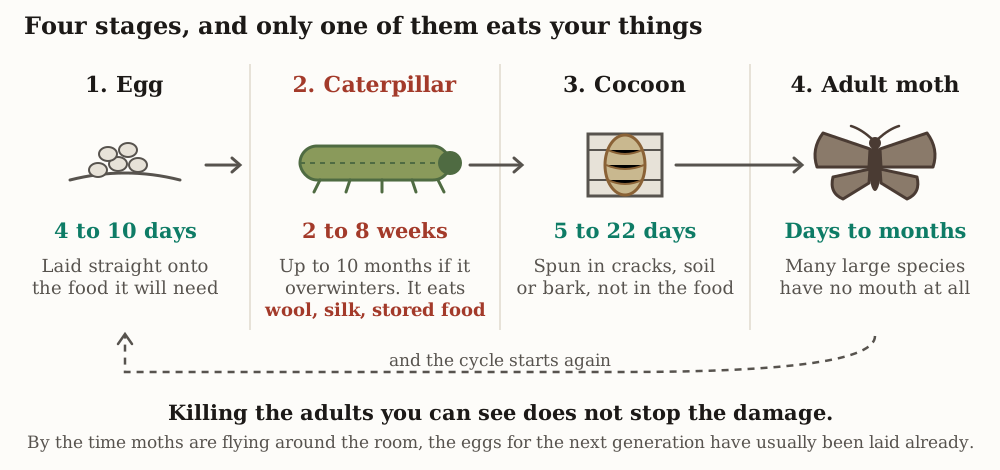
Only the larva feeds on your things. That single fact decides every control decision further down this page, and it is why killing the moths you can see changes nothing. A clothes moth lays around 40 eggs, an Indian meal moth 100 to 400, and a spongy moth up to 1,000. By the time adults are flying around a room, the next generation has usually been laid.
One widely repeated claim is simply wrong. Several large pest-control sites say moths pass the winter as eggs. They do not, or at least not as a rule: the overwintering stage is specific to the species. Luna and polyphemus moths overwinter as pupae, eastern tent caterpillars as eggs on a twig, and woolly bears as caterpillars under leaf litter.
What moths eat
Adults and caterpillars eat entirely different things, and the caterpillar is the one that matters. Adults drink: flower nectar, tree sap, rotting fruit and honeydew. Caterpillars chew, and the overwhelming majority chew leaves.
The strangest answer is that many of the biggest moths never eat anything at all. The luna moth, the rosy maple moth, the polyphemus, the imperial and the largest moth in North America, the cecropia, all emerge without working mouthparts. They run on fat stored as a caterpillar, which buys them roughly 5 to 14 days to find a mate, and then they die. The spectacular moth on your screen door has never eaten and never will.
Only a few species eat anything of ours, and only as larvae. Clothes moths take wool, silk, fur and feathers. Pantry moths take flour, cereal, nuts and dried fruit. In the garden a few caterpillars are serious pests, most famously the tobacco hornworm and its relatives on tomato plants.
Why moths come to your light
Nobody has settled this, and it is worth saying plainly, because most pages state one theory as established fact. The leading explanation is that moths navigate by holding a fixed angle to a distant light such as the moon. That works when the source is far away and its rays arrive parallel. A nearby bulb radiates instead, so the angle shifts constantly, and correcting for it curves the flight path inward.
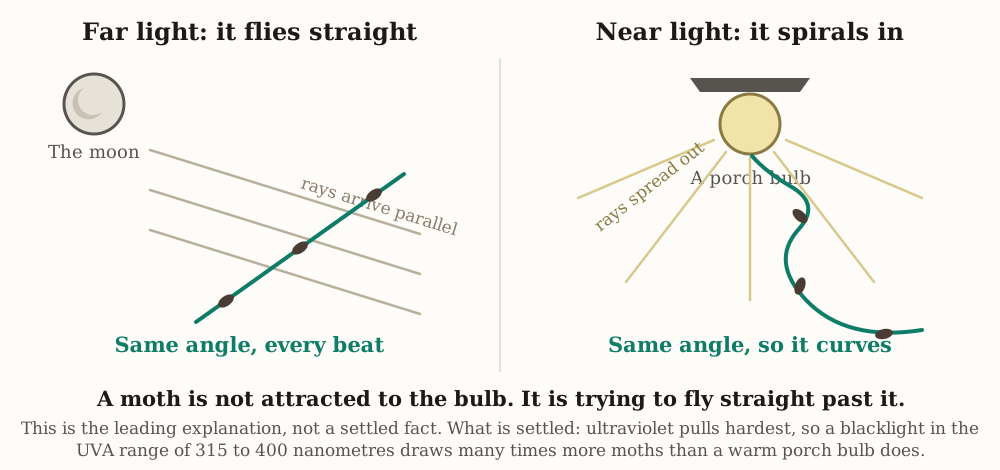
What is settled is which light pulls hardest. Ultraviolet does, which is why a blacklight in the UVA range of 315 to 400 nanometres draws many times what an ordinary porch bulb does. Warm-toned bulbs and shielded fittings that throw light downward attract noticeably fewer.
Not everything at the porch light is a moth, either. A caddisfly swarm near a river or lake produces the same roof-shaped silhouette in the same place, and those have hairy wings rather than scaled ones.
Why moths matter
Moths are among the most important night-shift pollinators, and the work is invisible because it happens after dark. A British study found moths carrying pollen from 47 plant species, seven of which bees largely ignore. Night-blooming and strongly scented flowers depend on them. A few work in daylight instead. The hummingbird moth feeds in full sun, and people report it as a tiny bird.
They are also a load-bearing part of the food web. Moths and their caterpillars feed bats, birds, amphibians, reptiles and predatory insects, and most songbird chicks are raised on caterpillars rather than seed. Populations are falling in many regions, with artificial light at night, habitat loss and pesticides the causes most often named.
It is worth holding both facts at once. A handful of species are genuine pests, and the rest are doing something useful. That is the honest reason not to treat every moth in the garden as a problem.
Part 3 of 4
Are they a problem?
Are moths dangerous?
No. No adult moth in the United States can bite or sting you. Most have a soft proboscis that cannot pierce skin, and the giant silk moths have no mouthparts at all. A moth landing on you leaves a few scales behind, and that is the whole of it.
There is one real exception worldwide and it is not in your house. A few tropical moths in the genus Calyptra, the vampire moths, have a barbed proboscis that can pierce skin, and it is the males that do it. They are not a US household insect, and nothing at your window is one.
So a moth in the bedroom is not a threat while you sleep. If you have woken with marks and a moth in the room, the moth is a coincidence and something that genuinely bites is the better explanation. Never try to identify an insect from a photograph of a bite, including with an app. Marks on skin do not carry enough information to say what caused them.
Two real effects are worth knowing. Moth scales and shed caterpillar hairs are airborne allergens, and a heavy indoor infestation can set off sneezing, itching or asthma. And a small number of caterpillars sting, which is a different matter entirely.
The moths that live indoors
Out of 11,000 US species, the ones that live in a house number about half a dozen, and every one of them is under an inch across and plainly colored. Where you see them is the strongest clue, because each is tied to what its larvae eat.
Household moths, and what each one is after
Closet, wardrobe
- What it is
- Webbing clothes moth
- What the larvae eat
- Wool, silk, fur, feathers
- The sign
- Irregular holes, silk webbing under collars and cuffs
Closet, with a small case
- What it is
- Casemaking clothes moth
- What the larvae eat
- The same fabrics
- The sign
- A tiny portable case the larva drags with it
Pantry, dry goods
- What it is
- Indian meal moth
- What the larvae eat
- Flour, cereal, nuts, dried fruit, pet food
- The sign
- Webbing and clumping inside a packet
Cupboards, dark corners
- What it is
- Brown house moth
- What the larvae eat
- Grain, wool, leather
- The sign
- Three or four black speckles on brown wings
Bathroom wall
- What it is
- Not a moth: a drain fly
- What the larvae eat
- Biofilm in the drain
- The sign
- Sits flat in a tent shape, barely flies
If the damage is to wool, check what is actually causing it before treating. Moths leave webbing and irregular holes; carpet beetles leave bare patches and shed bristly skins, and the signs of carpet beetles are easy to mistake for moth damage. On the fabric side, the casemaking clothes moth and its webbing cousin have their own guide with the full treatment.
Part 4 of 4
What to do
Do mothballs work?
Only in a sealed container, and that is not how most people use them. Mothballs are solid naphthalene or paradichlorobenzene that turn directly into a vapour, and it is the vapour that kills larvae. Reaching a lethal concentration needs an airtight space, so in an open closet, loft or crawlspace they scent the room and control nothing.
Cedar is the other common recommendation and it is weaker than its reputation. Cedar oil can kill very young larvae in a sealed chest, but the oil fades within a few years and it does nothing to larvae already established in a garment.
How to get rid of moths
Start with what costs nothing, and go after the source rather than the adults. Killing the moths you can see is the most common mistake, and it is why people describe fighting the same infestation for months.
Clearing moths, in order
Walk the outdoor ones back out
If moths arrived in ones and twos on a warm night, they flew in and nothing indoors feeds them. Kill the inside lights, open one exterior door and leave a porch light on. Fifteen minutes usually clears the room without a spray.
Decide whether something indoors is breeding
A steady supply over weeks is a different problem from a few visitors. Indoor breeding means a food source in the house, and only two groups qualify: fabric in a dark closet, or dry goods in a cupboard.
Use pheromone traps to monitor, not to fix
Traps catch males only, so they tell you whether the problem is still alive rather than ending it. A trap that keeps filling means the source is still in the room.
If something indoors is breeding, it is either in fabric or in food, and the two need different work. Wool, silk and fur mean clothes moths. Flour, cereal, nuts, dried fruit, birdseed and dry pet food mean pantry moths. That page has the full clear-out, the freezing times and what the traps really do.
When you see moths
Outdoors, the season depends on where you are. In the northern states adults are most active through the summer and on warm nights. In Florida and the lower-elevation Southwest the peak runs from roughly February to May, with a second peak in autumn.
Indoors there is barely a season at all. A heated house keeps clothes and pantry moths breeding year round, which is why a closet problem noticed in January is not unusual and does not mean anything came in from outside.
Pest control disclaimer. Photo-based identification can help, but it is not always perfect. For dangerous spiders, large infestations, or anything you are unsure about, contact a licensed pest control professional.
Frequently asked questions
How long do moths live?
Do moths have mouths?
Where do moths come from?
Why do I suddenly have moths in my house?
Are moths attracted to light or repelled by it?
Do moths eat clothes?
Related guides
Luna moth
The pale green moth with long tails that has no mouth and about a week to live.
Rosy maple moth
The small pink and yellow silk moth, and the six moths mistaken for it.
Hummingbird moth
The day-flying hawk moth people report as a baby hummingbird or a strange bee.
Pantry moths
The small two-tone moths whose larvae web up flour, cereal and pet food.
Cecropia moth
North America's largest native moth, and the cocoon fastened to a bare twig.
Polyphemus moth
The tan silk moth with one big eyespot on each hindwing, and how to read its cocoon.
Silk moth
Two insects share the name: the farmed Bombyx mori, which cannot fly, and the wild giants.
Comet moth
The Madagascan moon moth, with the longest tails of any silk moth.
Types of moths
16 common US moths sorted by size and color, with the feature that names each one.
Clothes moths
The small beige moth whose larvae eat wool, silk and fur, and how to kill every stage.
Carpet beetles
The other thing eating your wool, and the one most often blamed on moths.
Tomato hornworm
The big green caterpillar on your tomatoes, and the hawk moth it becomes.
Caddisfly
A moth-like insect from rivers and lakes that swarms at lights and cannot bite.
Drain flies
The fuzzy little moth-shaped fly on the bathroom wall, and the fix that works.
Sources
- EPA, mothballs and how to use them safely
- Poison Control, caterpillar stings and skin reactions
- University of Kentucky Entomology, stinging caterpillars
- University of Florida IFAS, Magnificent Moths (WEC462)
- Xerces Society, All About Moths
- Smithsonian, Moths
- Missouri Department of Conservation, Moths field guide