Most people meet this moth once, and they remember the size rather than the pattern. One post about it put the reaction well: imagine a moth so big it could cover your entire hand. So the questions that follow are usually the same three. Is it dangerous, is it really the biggest moth, and is it rare?
Two of those three have answers the web gets wrong, and this page corrects both with a named source.
Part 1 of 4
Name it
Is this a cecropia moth?
A cecropia moth is a giant silk moth 5 to 7 inches (13 to 18 cm) across, and it is the largest moth native to North America. Look for one reddish-rimmed whitish crescent at the centre of each of the four wings. Then check the body, which is red with a white collar and white bands across the abdomen.
The name is said se-KROH-pee-uh. Plenty of people who have seen one have never heard it spoken, because the moth turns up far more often than the word does.
Five things name it together, and the first two are usually enough:
- A crescent on every wing. One reddish-rimmed, whitish crescent sits at about the centre of each of the four wings, and the hindwing pair are the larger two.
- A red body with white bands. Stout, hairy, and banded in red and white along the abdomen.
- Dark brown or grey wings, with a reddish patch where each forewing meets the body.
- A pale line near the wing edge with red outside it. That line is the postmedial line, and the red beyond it matters later.
- Feathery antennae, broader on a male than on a female.
How big does a cecropia moth get?
Sources disagree, so treat it as a range. Wikipedia reports documented females at 5 to 7 inches (13 to 18 cm) or more, and Missouri Department of Conservation gives a lower 3.75 to 6 inches. Two extensions settle near 6 inches. One moth shipped accidentally to Newfoundland in 2012 emerged the next spring at about 20 cm (7.9 in).
For practical use, anything from four to six inches is ordinary and seven is exceptional. Below about three inches you are probably looking at something else, and the look-alike table deals with that.
Is a cecropia moth dangerous, and can you touch one?
No. A cecropia moth has no sting, no venom and no working mouthparts, so it has no way to hurt you at all. Iowa State University Extension puts it in one sentence: the caterpillars and the moths are harmless to people and pets. There is no first aid here, because there is nothing to treat.
Are cecropia moth caterpillars poisonous?
They are not, although a four-inch caterpillar studded with coloured knobs certainly looks like it should be. Every knob carries small black spikes, and those spikes do not sting. BugGuide’s species account says so directly: the imposing larvae do not sting. That separates this caterpillar from the few American caterpillars that genuinely do, such as the io, buck and flannel moths.
The reason the question keeps coming up is that the search results contradict themselves. One video ranking on the caterpillar query describes the spikes as venomous, while Google’s own summary on the same page says the opposite. The extensions are the ones to trust, and they agree with each other.
Is the cecropia moth really the largest moth?
It is North America’s largest native moth at 5 to 7 inches, and it is not the largest in the world. Four different moths hold four different records, and almost every post about any of them calls it the biggest moth. So here is which is which.
Four size records, four different moths
Largest native moth in North America
- The moth that holds it
- Cecropia moth
- The figure
- 5 to 7 in (13 to 18 cm)
- Where it lives
- The United States and Canada, east of the Rockies
Greatest wing area
- The moth that holds it
- Atlas moth
- The figure
- Broader wings, shorter span
- Where it lives
- Southeast Asia
Greatest wingspan
- The moth that holds it
- White witch
- The figure
- 27 to 30 cm
- Where it lives
- Central and South America
Heaviest body
- The moth that holds it
- Giant wood moth
- The figure
- Up to 30 g
- Where it lives
- Australia and New Guinea
Only the first row lives anywhere near a North American porch. So a reader who wants the world records, rather than this species, should read about the giant moth group instead. The word native is doing real work in that first row too, because it rules out anything imported or kept in a cage.
Are cecropia moths rare?
The species is secure and the moth is genuinely uncommon to meet, which are two different statements. BugGuide’s account calls it globally secure, with no conservation measures in place. Then it adds the other half: the moth is now uncommon or infrequently encountered across much of its former range. The National Wildlife Federation lists it as Not Listed and stable.
So why do so few people see one? NC State Extension gives the clearest reason. A female lays about a hundred eggs, yet the caterpillars are never abundant, perhaps because birds find them highly attractive as food. Tyler Arboretum, which rears them, reckons only 3 to 5% of wild caterpillars reach adulthood.
One caution before you collect anything. BugGuide notes that the moth may be protected in parts of its range, and that it is listed under articles of concern in a few states. So check locally first.
Part 2 of 4
How it lives
Why a cecropia moth has no mouth, and how long it lives
A cecropia moth lives about two weeks as an adult, and it cannot eat for any of them. The mouthparts are absent or useless, and so is the digestive system. Everything it needs was stored as fat while it was a caterpillar. Five sources agree on the fortnight, which is unusual on this topic.
That trade is the whole design. A giant silk moth spends almost a year building a body, then uses it for nothing but finding a mate. The same is true across the family. So how long do moths live has very different answers, depending on whether the adult can feed at all.
One cecropia moth year, stage by stage
Egg
- How long it lasts
- 10 to 14 days
- When
- Late spring, on both sides of a host leaf
Caterpillar
- How long it lasts
- Five instars, about a week each
- When
- June to September, feeding on leaves
Cocoon and pupa
- How long it lasts
- About ten months
- When
- Late summer right through to the following spring
Adult
- How long it lasts
- About two weeks
- When
- May and June, and it never eats
Moths that look like a cecropia moth
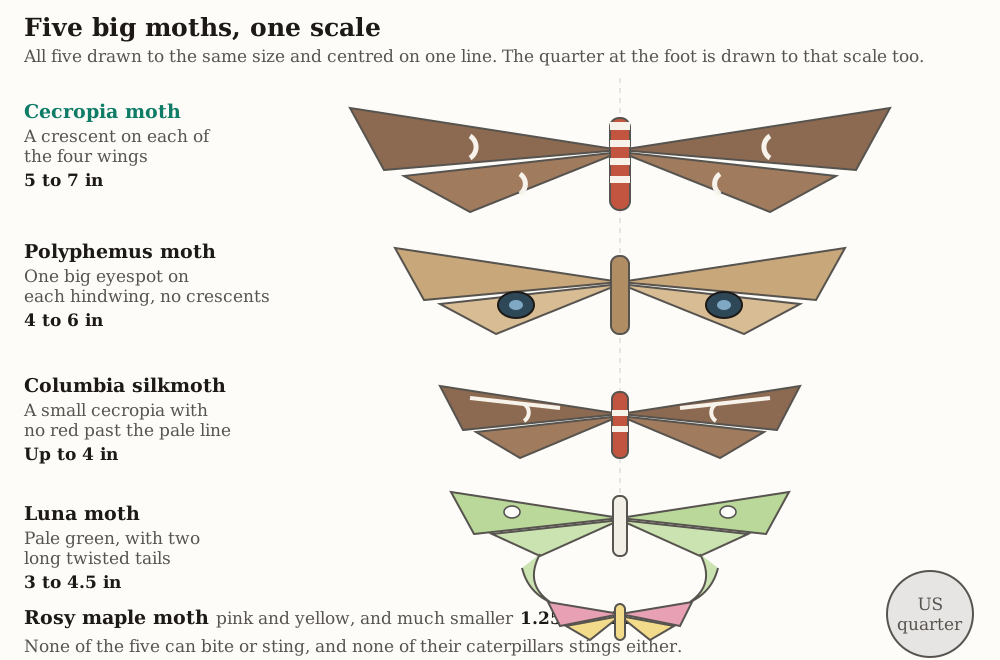
Four moths get mistaken for it, and each falls out on one feature. The nearest is the columbia silkmoth, a close relative that looks like a small cecropia. Then come the polyphemus, with eyespots instead of crescents, the luna, which is green with tails, and the rosy maple, which is tiny by comparison.
Big moths, and the feature that separates each from a cecropia moth
A crescent on each of the four wings, red beyond the pale line
- The moth
- Cecropia moth
- Wingspan
- 5 to 7 in
- Where you meet it
- Porch and street lights, near maple, cherry and birch
Looks like a small cecropia, but no red beyond the pale line
- The moth
- Columbia silkmoth
- Wingspan
- Up to 4 in
- Where you meet it
- The Great Lakes, eastern Canada and the Maritimes
One big blue and black eyespot on each hindwing, no crescents
- The moth
- Polyphemus moth
- Wingspan
- 4 to 6 in
- Where you meet it
- The same porch light. Tan to brown rather than red
Pale green, with two long twisted tails
- The moth
- Luna moth
- Wingspan
- 3 to 4.5 in
- Where you meet it
- The same porch light. Nothing else is green with tails
Pink and yellow, and far smaller
- The moth
- Rosy maple moth
- Wingspan
- 1.25 to 2 in
- Where you meet it
- Maple trees, often several at one light
Cecropia moth or columbia silkmoth?
This is the one pair that genuinely confuses people, and almost no page answers it. BugGuide gives the test: a cecropia moth has red shading beyond the pale postmedial line on all four wings, and the columbia silkmoth has none. The columbia is also smaller, topping out near 100 mm against the cecropia’s 110 to 150 mm.
Where the two overlap, around the Great Lakes and in eastern Canada, they interbreed. So some individuals sit between the two, and a photograph will not always settle it. That is worth saying plainly rather than pretending otherwise.
The cecropia moth caterpillar
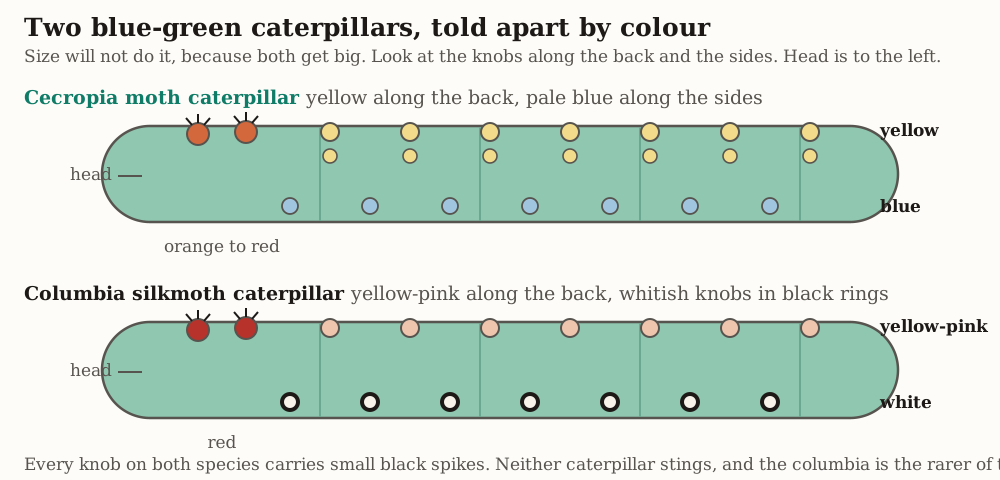
A full-grown cecropia moth caterpillar is about 4 inches long and 3/4 inch thick, pale blue-green with a faint sheen, and covered in coloured knobs. NC State Extension counts them exactly. There are four reddish knobs on the thorax and fifteen yellow ones in pairs along the back, apart from a single last one. Then two rows of blue knobs run along each side.
It does not start that way. The first instar is tiny, black and spiny, and the little caterpillars feed in a group. The second is dark yellow and still gregarious. From the third onward they feed alone and take on the blue-green colour, growing through five stages of roughly a week each.
Sizes differ between sources, as they do for the adult. NC State says four inches and the National Wildlife Federation says five, with most others landing on 4 to 4.5. It is, as Iowa State notes, the largest caterpillar in that state, and the same is true across much of the range. For the wider group, see our guide to the green caterpillar types people find most often.
Cecropia moth caterpillar, instar by instar
First
- What it looks like
- Tiny, black and spiny
- How it feeds
- In a group, on the leaf it hatched on
Second
- What it looks like
- Dark yellow to yellow
- How it feeds
- Still in a group
Third and fourth
- What it looks like
- Blue-green, knobs showing colour
- How it feeds
- Alone, and growing fast
Fifth
- What it looks like
- Up to 4.5 in, pale blue-green with red, yellow and blue knobs
- How it feeds
- Alone, then stops to wander and spin
Where you will find one
Not usually on a leaf, as it happens. Iowa State Extension records that full-grown larvae turn up wandering across lawns, sidewalks and driveways. A caterpillar ready to pupate goes looking for a place to spin. Late summer is the season, and our own sighting figures put the peak in August.
What cecropia moth caterpillars eat
Leaves, and from a very wide list. Extensions put it at more than 20 plant families, and the full published list runs to 22. In practice three trees do most of the work: maple, wild cherry and birch. Apple, willow, lilac, alder, dogwood, elm and plum all appear too.
There is a catch worth knowing if you are feeding one. BugGuide’s account warns that a plant eaten happily in one part of the range may be refused in another. Local populations are adapted to local trees. So the safest leaf to offer a found caterpillar is one from the plant it was sitting on.
Cecropia moth host plant choices, by region
Anywhere in the range
- Trees that work best
- Maple including box elder, wild cherry, birch
- Worth knowing
- The three every source names first
The Southeast
- Trees that work best
- Red maple, box elder, alder, birch, dogwood, sweet gum, elderberry
- Worth knowing
- Marked as favoured in BugGuide's own rearing notes
Florida
- Trees that work best
- Bald cypress, as well as the usual three
- Worth knowing
- Accepted by Florida stock only, with cocoons found on cypress in swamps
A garden anywhere
- Trees that work best
- Apple, crabapple, plum, willow, lilac
- Worth knowing
- Common yard trees that the caterpillars will use
Do they damage trees?
Effectively never, and five sources say so. NC State Extension records that they are rarely abundant enough to cause noticeable damage. Its advice to householders is one sentence: no control measures seem to be needed. Iowa State goes further, and suggests that encouraging them buys you the pleasure of seeing the moths in spring.
Part 3 of 4
The cocoon, and the calendar
The cecropia moth cocoon, and why it is the one you find
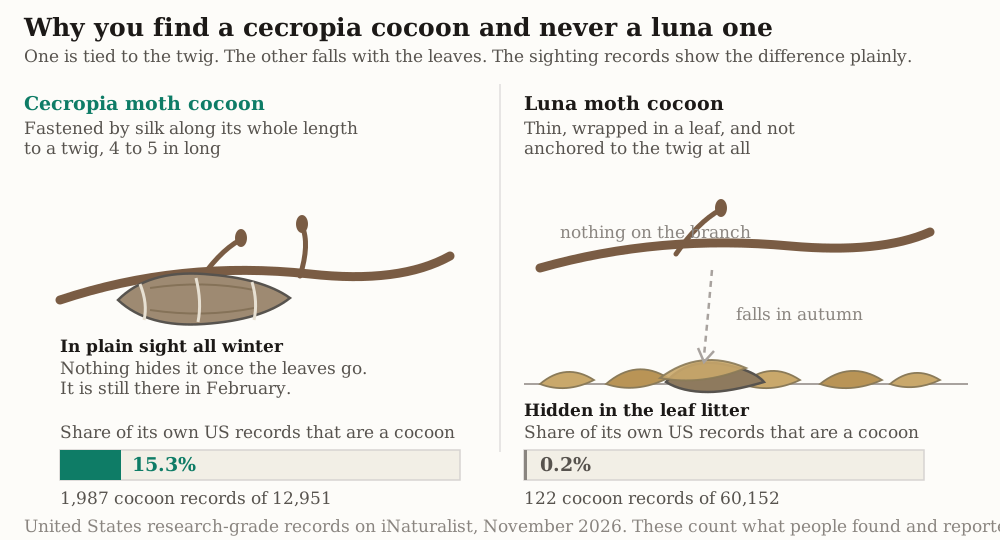
A cecropia moth cocoon is a tough grey-brown spindle 4 to 5 inches long and an inch or two wide. Iowa State Extension describes it as resembling a pod. The part that matters is how it is attached: fastened by silk along its whole length to a twig, in a sheltered spot. Five sources say the same thing.
That one detail explains something readers notice and nobody writes about. Fasten a cocoon to a branch and it stays in plain sight once the leaves fall. Our own count of public sighting records shows how large the effect is.
Cocoon records as a share of each moth's own sightings
Cecropia moth
- Cocoons as a share of its records
- 15.3% of 12,951 records
- Why
- The cocoon is tied lengthwise to a twig and stays there all winter
Polyphemus moth
- Cocoons as a share of its records
- 8.8% of 67,263 records
- Why
- Sometimes attached and sometimes not
Luna moth
- Cocoons as a share of its records
- 0.2% of 60,152 records
- Why
- The cocoon is not anchored, so it falls with the leaves
Read it carefully, because the comparison is the point. The luna has nearly five times as many sightings overall, yet it is reported as a cocoon one seventy-seventh as often once you allow for that. The published reason is the attachment. A luna moth cocoon is wrapped in a leaf and not tied to the twig, so autumn takes it to the ground.
These are records of what people found and chose to report, not a census. Observer effort changes with the season, and most sightings carry no life-stage note at all. Still, the pattern and the published mechanism agree, which is about as much as observation data can offer.
The two cocoon shapes
There are two, and this trips up people who find a second one. BugGuide records a slim tight spindle and a loose baggy form, both made by the same species. The shape does not tell you the moth’s sex, though a heavier pupa inside usually means a female.
The forms seem to suit different places. Baggy cocoons are common in the fire-maintained woods of the Southeast, while tight spindles hold moisture better through a cold dry winter. Either way, a cocoon is one of several types of pupa, and the insect inside is rebuilding itself rather than resting.
Where and when you will see a cecropia moth
The range runs from Nova Scotia and Maine south to central Florida, and west to the Rocky Mountains. Adults fly in May and June across most of that, starting as early as March in the south. There is one brood a year, and that single generation shapes everything about when you see one.
Two range claims are worth correcting. Google’s own summary puts the species in California, and no source supports that. The University of Florida gives the western limit as the Rockies, and BugGuide notes that even the reports from northern Mexico are probably other species.
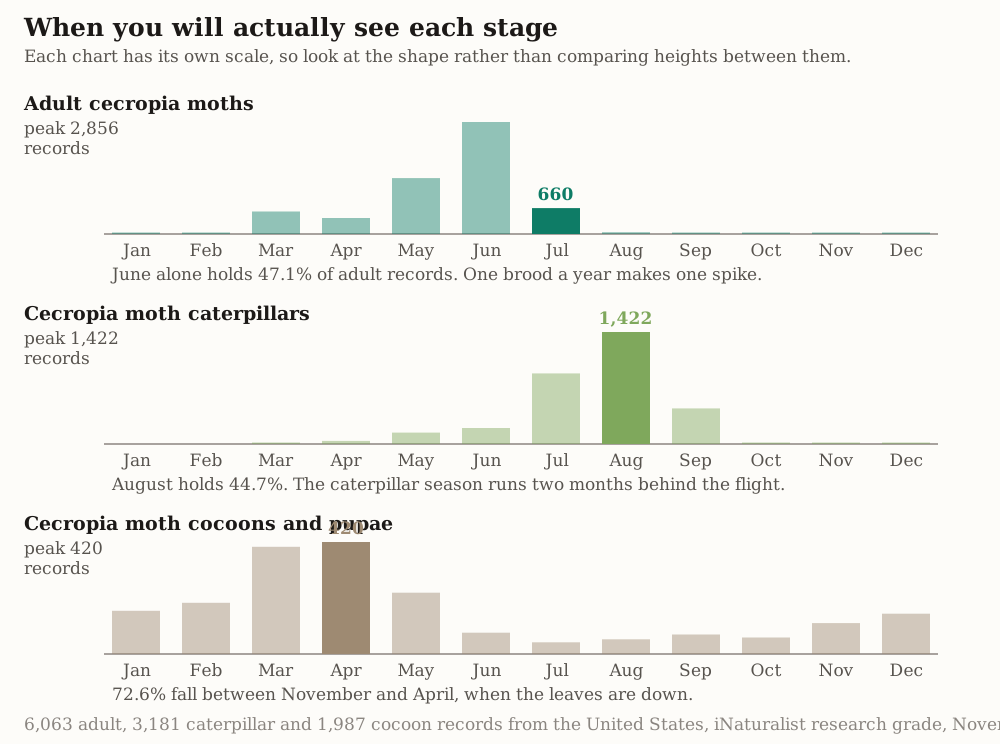
One brood a year leaves a mark you can see in the data. June alone holds 47.1% of adult sightings, and May and June together hold 70.6%. Compare the luna moth, which fits two or three generations into a southern summer: its best month takes only a fifth of its records. One generation makes one spike.
The other two stages run on their own clocks. Caterpillar sightings peak in August, two months after the adults, and 72.6% of cocoon records fall between November and April. So if you want to find each stage, look for the moth in June, the caterpillar in late summer and the cocoon once the leaves are down.
Male or female?
Look at the antennae first, because they do the job in one glance. A male cecropia moth has broad, feathery antennae that pick up a calling female from over a mile away. A female has narrower ones and a larger, rounder abdomen, because she is carrying about a hundred eggs.
Cecropia moth male vs female, in three checks
Antennae
- Male
- Broad and feathery, used to find a mate
- Female
- Narrower, and plainer
Abdomen
- Male
- Slimmer
- Female
- Larger and rounder, holding about 100 eggs
What it is doing
- Male
- Flying, often for miles
- Female
- Sitting still and calling, between about 3 and 4 am
Why a cecropia moth comes to your porch light
Because the light breaks the way it steers. The University of Florida explains the leading idea. A night-flying moth holds its course by moonlight, which arrives in parallel rays because the moon is so far away. A street lamp does not, so the moth circles trying to hold a straight line and ends up beside the bulb.
That is why the National Wildlife Federation says street and porch lights are where most people meet this species. The same pull explains why are moths attracted to light in general. Giant silk moths just make it obvious, because they are large enough to notice.
There is a timing detail here too, and it is a good one. Females call with their pheromone between about 3 and 4 am, and BugGuide, citing E. O. Wilson’s The Diversity of Life, notes that the narrow window helps keep the species from crossing with its relatives. The luna moth calls in the hours just after midnight. Two giant moths in one wood, kept apart by the clock.
Part 4 of 4
What to do
What to do with the cecropia moth or cocoon you found
Almost nothing, and that is the honest answer. A cecropia moth needs no rescue, no food and no professional. The one place people go wrong is the cocoon, because the advice circulating online is to bring it indoors for the winter. An extension says the opposite.
A cecropia moth, step by step
Leave the moth where it is
A cecropia moth on bark, a shrub or a shaded wall needs nothing. It flies at night, so sitting still all day is normal. Take your photograph, then walk away.
Move it only off hot or open ground
A sunny driveway or a doormat is worth moving it from. Slide a finger under the body and let the moth step on. Then set it on bark in the shade, away from the cat.
Do not try to feed it
There is nothing to feed. The adult has no working mouth, so sugar water and fruit both do nothing at all. A moth that will not drink simply cannot.
Let a caterpillar carry on walking
A big blue-green caterpillar crossing a path in late summer is looking for a place to spin. So lift it onto a shrub nearby if a car is coming. Otherwise leave it.
Put a found cocoon back outdoors
Iowa State Extension says to leave it in the winter environment until late April. A garage or an unheated porch also works. Never bring it into a warm house.
Record it, then turn the light off
Upload the photograph to iNaturalist so the sighting counts. Then switch the outdoor light off for the night. Both cost nothing, and the light is a pressure you control.
Can you overwinter a cocoon indoors?
Better not to. Iowa State Extension is specific. A cocoon found outside should stay in the winter environment until late April, or in a garage or an unheated porch. It should not be kept in the house, because a warm room triggers an early emergence into a season with no mates. The same page adds a sobering figure: fewer than half of cecropia cocoons produce a moth even when nothing goes wrong.
Still not sure what you have?
Photograph it from directly above, with the whole insect in frame and something familiar beside it for scale. Then run the picture through our free bug identifier. If yours turned out small and beige and indoors rather than huge and brown and outdoors, the answer is more likely a fabric moth in the wardrobe.
What is happening to cecropia moths, and what helps
The species is secure overall, and it is thinner on the ground than it was. BugGuide’s account lists habitat loss, pollution, pesticides, disease and parasitoids. One contributor notes that Florida populations have been declining since before the mid 1980s. Missouri Department of Conservation says much the same for parts of its range.
One named cause keeps recurring. Compsilura concinnata is a European fly brought to the United States to control the spongy moth, and it attacks native silk moths instead. Boettner, Elkinton and Boettner reported in 2000 that it may be behind the decline of giant silk moths in the northeast. Nothing can be undone there.
What a household can change is short and genuinely useful:
- Turn the outdoor light off, or fit one that does not spill upward. Lights pull moths away from breeding.
- Leave the twigs alone. Winter pruning of a maple or a cherry takes the cocoons with it.
- Skip the insecticide on a shade tree that does not need it, since the caterpillars do no real damage anyway.
One thing that sounds helpful is not. Eggs and pupae are sold commercially, and releasing bought stock can hurt a local population rather than boost it. BugGuide’s account explains why: nearby populations differ in which trees they accept and when they mate, and mixing them can undo that fit.
Cecropia moth facts worth knowing
Six that rarely make it onto a species page, and the first two matter well beyond this moth:
- Insect juvenile hormone was first described from this species. Carroll Williams did the work in 1956, and he could do it because a cecropia moth is big enough to yield a measurable amount from one specimen. That hormone is why a caterpillar keeps moulting into a bigger caterpillar until it stops.
- Cecropin is named after it. The protein family, central to how most insects fight infection, was first isolated from this moth. So was attacin, another antibacterial protein.
- Bolas spiders fake its scent. The National Wildlife Federation records that they mimic moth pheromones, so a male follows the smell of a female and finds a spider instead.
- The name is Greek, not botanical. Cecrops was a king in Greek mythology. The tropical cecropia trees simply share the word.
- It has a second real name. Extensions list it as the cecropia silkmoth and the robin moth, and almost nobody searches for either.
- Squirrels eat the pupae. Two sources name it as a real pressure, which follows from a cocoon sitting on a bare branch all winter.
Pest control disclaimer. Photo-based identification can help, but it is not always perfect. For dangerous spiders, large infestations, or anything you are unsure about, contact a licensed pest control professional.
Cecropia moth FAQ
How do you pronounce cecropia moth?
What does it mean when you see a cecropia moth?
Are cecropia moths rare?
Can you touch a cecropia moth caterpillar?
How long is a cecropia moth in its cocoon?
Do cecropia moths come back to the same place?
Related guides
Moths
What moths are, what they eat, why they come to your light, and which few damage a home.
Types of moths
Name the moth you found by size and colour, with the feature that confirms each one.
Luna moth
The pale green silk moth with long tails, and the cocoon that falls with the leaves.
Rosy maple moth
The small pink and yellow silk moth from the same family, and the moths mistaken for it.
Caterpillars
How to identify a caterpillar, which ones sting, and what to do with the one you found.
Pupa
What happens inside the stage this moth spends ten months in, fastened to a twig.
Hummingbird moth
The day-flying hawk moth people report as a baby hummingbird or a strange bee.
Bug identifier by picture
Upload the photograph you already took and get a name back.
Sources
- Iowa State University Extension and Outreach, Cecropia Moth, for the statement that the caterpillars and moths are harmless to people and pets, and for the overwintering guidance
- University of Florida IFAS Featured Creatures, Cecropia Moth, Hyalophora cecropia (EENY-478)
- NC State Extension, Cecropia Moth, for the caterpillar knob counts and the residential recommendation
- Missouri Department of Conservation, Field Guide, Cecropia Moth
- BugGuide, Hyalophora cecropia, for the columbia silkmoth comparison, the calling window and the two cocoon forms
- National Wildlife Federation, Cecropia Moth, for the conservation status and the bolas spider
- iNaturalist, Hyalophora cecropia, for the observation records quoted above