Most people meet this moth in one place: a porch light, a screen door or an outside wall. The time is early morning, and the phone is already out. The usual reaction is not fear. It is disbelief that something that looks like a sweet shop is a real insect that turned up in Ohio.
Part 1 of 3
Name it
What a rosy maple moth is
A rosy maple moth is a small North American silk moth, Dryocampa rubicunda. It has a woolly yellow body and pink forewings crossed by a triangular yellow band, and it spans 32 to 55 mm, or 1.25 to 2.17 inches. It is the smallest of the wild silk moths. Like the rest of that family, the adult has no working mouth.
That last point is the one people remember. A viral post about this moth has been shared for years on the strength of one line. The little pink and yellow moth on your porch screen has never eaten. It never will, and it is true. The caterpillar does all the eating, and the adult spends its short life running on what the caterpillar stored.
The name comes from the trees it breeds on. Females lay on maples, mainly red, sugar and silver maple, and the caterpillar is known separately as the greenstriped mapleworm. It belongs to the same family as the big silk moths of North America. So a moth barely an inch and a half across still counts as a giant.
How to identify a rosy maple moth
Four features name it together. The body is woolly and yellow. The forewings are pink with a yellow band running across the middle. Its legs and antennae are reddish pink. And the whole moth is 1.25 to 2.17 inches across, so it sits comfortably within the span of a credit card.
Check the body before the colour. A rosy maple moth is noticeably furry, and that fuzz is dense scales rather than hair. Many moths are drab and smooth, so a small moth that looks plush is already an unusual find.
Male or female?
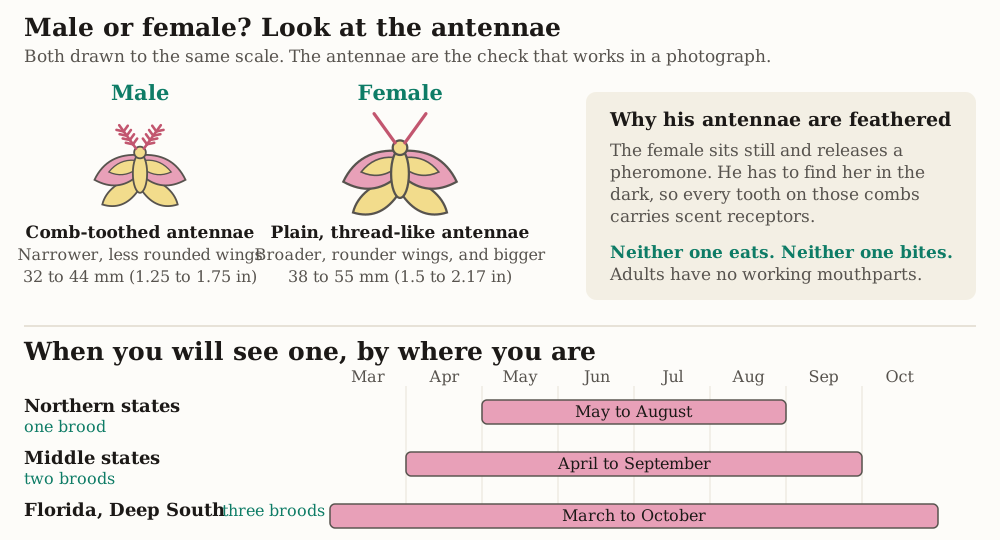
Look at the antennae, because they differ more than anything else. A male has bipectinate antennae, which means each one carries rows of fine teeth down both sides and looks like a tiny feather. A female has plain, thread-like antennae. Females are also larger, with broader and rounder wings.
The reason is scent. The female sits still and releases a pheromone, so the male has to find her in the dark using nothing but smell. Every tooth on those combs carries receptors, which is why his antennae look so overbuilt for an insect that cannot even feed.
Why your rosy maple moth is not pink
Because the colour varies far more than the photographs suggest. The Missouri Department of Conservation puts it bluntly. In most cases the moth is white, yellow or cream. The pink shows only at the outer and inner parts of the wings. The bright pink and yellow version is the one everybody photographs, not the one everybody finds.
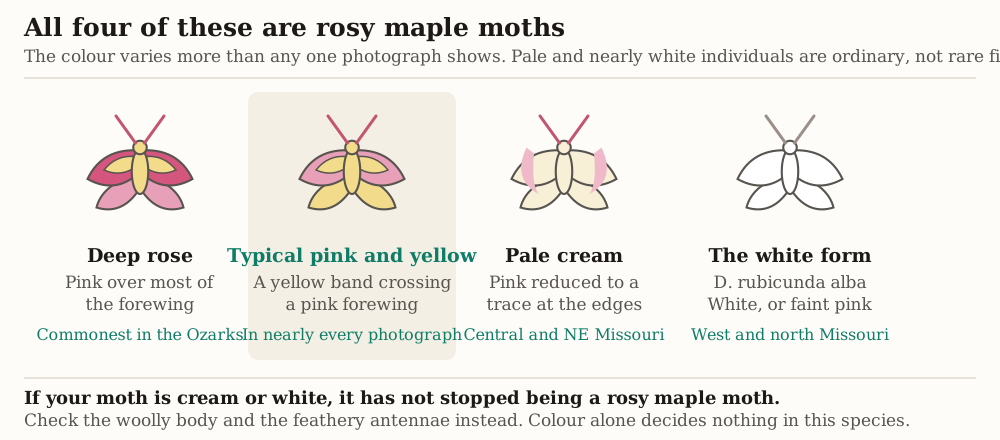
There is even a named white form, Dryocampa rubicunda alba, which is entirely white or white with faint pink markings. Missouri records it across the west and most of the north of the state, while the deepest pink individuals turn up in the Ozarks. So the same species produces a cotton-candy moth in one county and a plain white one two hundred miles away.
What this means in practice is simple. Do not identify this moth on colour alone. Use the woolly yellow body, the feathery antennae on a male and the size, then treat the pink as a bonus rather than a requirement.
Pink and yellow moths that are not rosy maple moths
Six other moths in the United States are pink and yellow enough to cause doubt. Each one separates on a single feature. Four of them are reasonably common: the chickweed geometer, the pink-striped oakworm moth, the southern pink moth and the primrose moth. The imperial moth is common too, but three to four times the size. The pink prominent is genuinely scarce. Size rules most of them out immediately.
This is the question nobody answers well. Two state wildlife agencies, Missouri and Maryland, both name the pink prominent as the species people confuse with this one. Missouri says it “has similar coloration but different wing patterns” and advises comparing photographs. Maryland says much the same. Neither one tells you what the difference actually is.
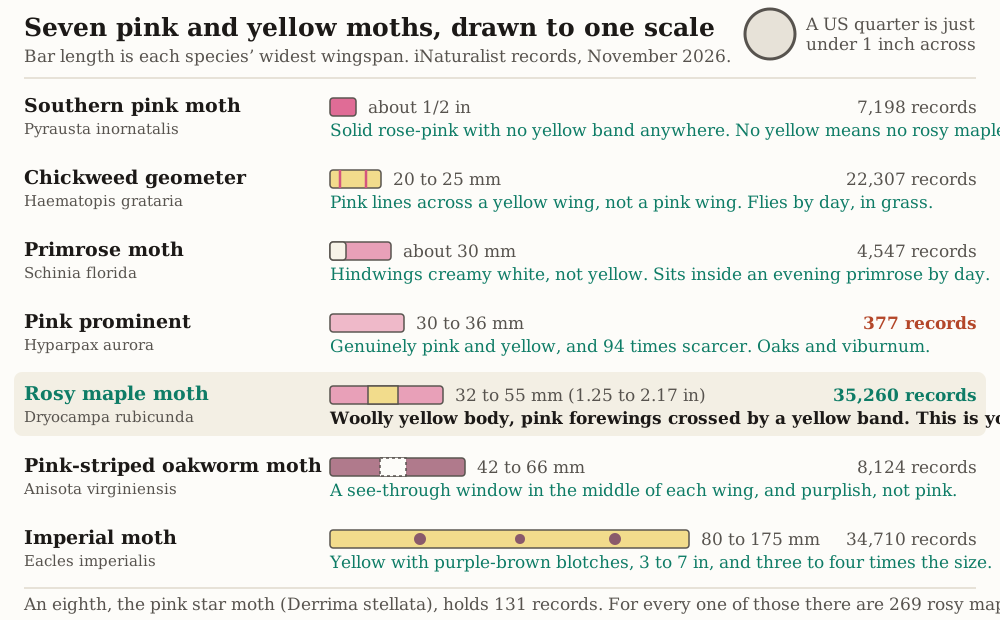
Pink and yellow moths, and the one feature that separates each from a rosy maple moth
Woolly yellow body, pink forewing crossed by a yellow band
- The moth
- Rosy maple moth
- Wingspan
- 1.25 to 2.17 in
- Where you meet it
- Porch lights and walls, at night, near maples
Pink lines across a yellow wing, and it flies in daylight
- The moth
- Chickweed geometer
- Wingspan
- 20 to 25 mm
- Where you meet it
- Lawns and rough grass, by day, all over the US
A see-through window in the middle of each wing
- The moth
- Pink-striped oakworm moth
- Wingspan
- 42 to 66 mm
- Where you meet it
- Oak woodland. Purplish rather than pink
Solid rose-pink with no yellow band at all
- The moth
- Southern pink moth
- Wingspan
- About 1/2 in
- Where you meet it
- Gardens, on sage and salvia
Creamy white hindwings, and it hides inside a flower
- The moth
- Primrose moth
- Wingspan
- About 30 mm
- Where you meet it
- Evening primrose flowers, in daylight
Three to four times the size, yellow with purple blotches
- The moth
- Imperial moth
- Wingspan
- 3 to 7 in
- Where you meet it
- The same porch light, impossible to mistake for small
Pink and yellow too, and genuinely scarce
- The moth
- Pink prominent
- Wingspan
- 30 to 36 mm
- Where you meet it
- Oaks and viburnum. See the record counts below
How likely is each one, actually
Nobody publishes this, so here it is. iNaturalist holds observation records for every species above, and the counts are public. In November 2026 a rosy maple moth was recorded 35,260 times by 17,668 separate observers. The pink prominent, the species both state guides warn you about, was recorded 377 times.
Public iNaturalist records, November 2026, for every pink and yellow moth above
Rosy maple moth
- Records
- 35,260
- Relative to a rosy maple moth
- The baseline
Imperial moth
- Records
- 34,710
- Relative to a rosy maple moth
- About even, but three to four times the size
Chickweed geometer
- Records
- 22,307
- Relative to a rosy maple moth
- 1 for every 1.6
Pink-striped oakworm moth
- Records
- 8,124
- Relative to a rosy maple moth
- 1 for every 4
Southern pink moth
- Records
- 7,198
- Relative to a rosy maple moth
- 1 for every 5
Primrose moth
- Records
- 4,547
- Relative to a rosy maple moth
- 1 for every 8
Pink prominent
- Records
- 377
- Relative to a rosy maple moth
- 1 for every 94
Pink star moth
- Records
- 131
- Relative to a rosy maple moth
- 1 for every 269
Read those numbers as odds rather than as biology. They count what people photographed and uploaded, not what exists. So a day-flying moth in a lawn gets noticed more than a scarce one in an oak canopy. Even allowing for that, the answer is clear. A woolly pink and yellow moth about an inch and a half across is a rosy maple moth. That holds anywhere in the eastern United States.
The one worth real attention is the chickweed geometer, and no field guide mentions it in this context. It is genuinely common, genuinely pink and yellow, and it is out in daylight where people notice it. But it is under an inch across, and its pink runs in two thin bands over a pale yellow wing rather than filling the forewing. Those two checks separate it every time.
Luna moth or rosy maple moth?
These two get confused surprisingly often, and colour settles it instantly. A luna moth is a big green moth with tails, spanning 4 to 4.5 inches, with long trailing hindwings. A rosy maple moth is pink and yellow, has no tails at all, and is less than half that size. Nothing about them overlaps.
The confusion is about reputation rather than appearance. Both are famous, both are silk moths, and both turn up at lights in the same states, so people reach for the more famous name first. On gardening forums the pattern repeats constantly: someone posts a photograph, guesses luna moth, and gets corrected in the first reply. Our guide to identifying moths by size and colour sorts both of them, along with fourteen more.
Part 2 of 3
The questions people actually ask
Are rosy maple moths rare?
No. This is one of the commonest silk moths in the eastern United States, and the 35,260 iNaturalist records above make that concrete. It is not threatened, not listed and not protected. Seeing one is lucky in the sense that any good-looking insect is lucky, not in the sense that it is unusual.
The myth has a clear source. One of the most-read posts about this species has hundreds of comments. It calls the moth “a rare species found mainly on the East Coast of North America”. Both halves of that sentence are wrong. The Missouri Department of Conservation records the moth statewide, and the range runs west to eastern Texas, Kansas, Nebraska and Minnesota.
Why does it feel rare? Because it flies at night, lives a week or two as an adult, and is only out for part of the year. You are not seeing a scarce animal. You are seeing a common animal during a short window.
What it means to see one
People search for this, so here is an honest answer. A rosy maple moth has no documented folklore of its own. The meanings attached to it online are modern and invented. Most run along the lines of hope or transformation. Nothing in entomology supports any of it. If it helps you to read something into the encounter, that is yours to decide, and we will not pretend it came from anywhere older.
Are rosy maple moths dangerous or poisonous?
No, on every count. The adult has no sting, no venom and no functional mouthparts, so there is physically nothing it could do to you. It is not poisonous to touch, and it is not poisonous to a cat or a dog that eats one. The caterpillar has two black horns and short spines, and neither carries venom.
There is a real risk, but it runs the other way. Handling a moth rubs the scales off its wings, and those scales matter for flight and warmth. So the answer to “can I touch it” is that you can, and that it is better for the moth if you do not. If it has to be moved, hold a leaf or a sheet of paper against the wall and let it walk on.
How long a rosy maple moth lives
The adult lives about a week, sometimes two. That is the number people want, and it is the one most pages bury. Figures of two to nine months also get quoted. Those describe the whole life cycle. Almost all of that time passes underground, as a pupa.
The short adult life follows directly from the missing mouth. There is no feeding, so there is no way to replace the energy the caterpillar banked. Everything the moth does in that week, finding a mate, laying between 150 and 200 eggs, runs on a fixed budget that cannot be topped up.
Be slightly careful with any single figure here, including ours. Sources disagree, they often mix adult life with total life, and we could not find a study that settles the adult figure precisely. A week to two weeks is the range the evidence supports.
The caterpillar: the greenstriped mapleworm
A rosy maple moth caterpillar is a greenstriped mapleworm. It changes appearance so much that one animal looks like three. It grows through five stages and reaches about 2 inches. Throughout, it carries two long black horns on the segment just behind the head, plus rows of short spines along the body.
The head is the giveaway, and it changes colour as the caterpillar grows. Early on it is large and black against a pale yellow-green body. Later the head shrinks relative to the body, turns yellow, then turns bright red in the final stage. The lengthwise stripes darken from faint green to reddish as this happens.
Behaviour changes too. Young caterpillars feed in groups on the underside of a leaf, which is where the female laid them, in clusters of 10 to 40 eggs. From about the third or fourth stage they separate and feed alone. When they are full grown they leave the tree entirely. They crawl down to the base and pupate underground, in a shallow chamber. There is no cocoon in a branch.
Part 3 of 3
Where it fits in your year
When and where you will see rosy maple moths
It depends on your latitude, and the difference is large. Northern states get one brood, flying May to August. The middle of the range gets two broods, April to September. Florida and the Deep South get three, March to October. Missouri records adults from late April into September.
The place is more predictable than the date. Adults emerge in the late afternoon, mate the same evening, then fly during the first third of the night. So they reach lights early and then stop. Mississippi State Extension describes the result exactly as readers do: the moth is often seen resting on buildings, where lights have drawn it in.
For range, the species covers the eastern half of the country. The northern edge is southern Canada and the southern edge is Dade County, Florida. Westward it reaches eastern Texas, Kansas, Nebraska and Minnesota. Look near maples, because that is where the next generation has to feed. A rosy maple moth in a yard with no maple nearby has simply flown in.
Caterpillars are stripping my maple
In almost every case, do nothing. Heavy feeding can strip a maple, and a single tree may carry hundreds of caterpillars, but the damage is cosmetic. Healthy trees push out new leaves and recover. Clemson’s Home and Garden Information Center is direct about this: control is usually not needed.
Two situations deserve a second look. A young sapling has less in reserve than a mature tree. A tree already weakened by drought or disease may not shrug off repeated defoliation. In either case the right call is an arborist or your county extension office, who can judge the tree rather than the insect.
If you want to act and it costs nothing, wipe the egg clusters off the undersides of the leaves you can reach. Clemson lists insecticides that work on the larvae and then says plainly that they are rarely advised or economically worthwhile. Any pesticide must be EPA registered and used exactly as its label directs. The label is the law. On a shade tree, there is usually no reason to reach for one at all.
Can you keep a rosy maple moth?
Not in any way worth doing. The adult cannot eat, so there is nothing to feed it and nothing you can do to extend its week. Keeping one in a jar changes only where it spends that week, and handling rubs away the scales it needs. A photograph lasts longer and costs the moth nothing.
Rearing is a different question. Some people raise the caterpillars on cut maple, which does work, because the larva is the stage that feeds. Even then the adult that emerges still has no mouth and still lives about a week. Buying one is a third question again, and we do not point readers at dealers for a species this common.
Still not sure what you have?
Photograph it from directly above, in daylight if you can, with the whole moth in frame. Then run it through our free bug identifier, or work through our guide to what moths are and what they eat for the wider picture. If yours turned out to be small, beige and indoors rather than pink and outdoors, the likely answer is a fabric moth instead.
Pest control disclaimer. Photo-based identification can help, but it is not always perfect. For dangerous spiders, large infestations, or anything you are unsure about, contact a licensed pest control professional.
Rosy maple moth FAQ
What is the difference between a primrose moth and a rosy maple moth?
How much is a rosy maple moth worth?
In what states can you find rosy maple moths?
Is the rosy maple moth venomous?
Why do rosy maple moths sit on screen doors?
Do rosy maple moths have a mouth?
Related guides
Moths
What moths are, what they eat, why they come to your light, and which few damage a home.
Types of moths
Name the moth you found by size and colour, with sixteen common US species and the feature that confirms each.
Clothes moths
The small beige moths whose larvae eat wool and silk, and how they differ from pantry moths.
Tomato hornworm
The other big caterpillar people find on a garden plant, and the sphinx moth it becomes.
Pupa
What happens inside the stage this moth spends the winter in, underground at the base of a maple.
Caddisfly
A moth-like insect from rivers and lakes that cannot bite or sting, often reported as a moth.
Types of beetles
If it had hard wing covers rather than scales, start here instead.
Bug identifier by picture
Upload the photograph you already took and get a name back.
Sources
- Clemson Cooperative Extension, Home & Garden Information Center, Rosy Maple Moth (HGIC 2022)
- Missouri Department of Conservation, Field Guide, Rosy Maple Moth
- Mississippi State University Extension Service, Bug's Eye View, Rosy Maple Moth, vol. 4 no. 10
- BioKIDS, University of Michigan Animal Diversity Web, Dryocampa rubicunda
- iNaturalist, Dryocampa rubicunda, for the observation records quoted above