Most people meet this moth once. The place is a porch light, a screen door or an office doorway, and the reaction is almost never fear. Read enough sighting reports and the same phrases keep coming back: never seen one before, my first, what a treat, I thought it was a white bat. One person in North Carolina measured theirs with a ruler and got 11 centimetres, tip to tip.
Part 1 of 4
Name it
What a luna moth is
A luna moth is a large North American silk moth, Actias luna, spanning 3 to 4.5 inches. The wings are pale lime green and the body is white and furry. Each of the four wings carries one eyespot, and the hindwings trail two long twisted tails. This is a giant silk moth, so like the rest of that family the adult has no working mouth.
It also goes by a second name, the American moon moth, and both names point at the same thing. Linnaeus renamed the species in 1758 after Luna, the Roman moon goddess. That is where our words lunar and lunatic come from as well. James Petiver had already described it in 1700 as Phalena plumata caudata, the brilliant feather tail. So this was the first North American silk moth to reach print.
You may also have met one without knowing. A luna moth was on a United States first-class stamp in 1987. An animated one was then the mascot of the Lunesta sleep-aid commercials from 2007. For a surprising number of Americans, that advert is where the wings and the tails were first seen.
How to identify a luna moth
Four features name it together, and two of them are enough. The wings are pale lime green. The hindwings carry long twisted tails. Each of the four wings has one transparent eyespot, oval on the forewings and round on the hindwings. The front edge of each forewing is a thick dark band, maroon to brown, tapering towards the tip.
Check the tails first, because they settle it faster than colour does. North Carolina State Parks puts the test plainly. No other large moth in that region is pale green with long hindwing tails. Add the size and you are done, since a luna moth is roughly as wide as a postcard is long.
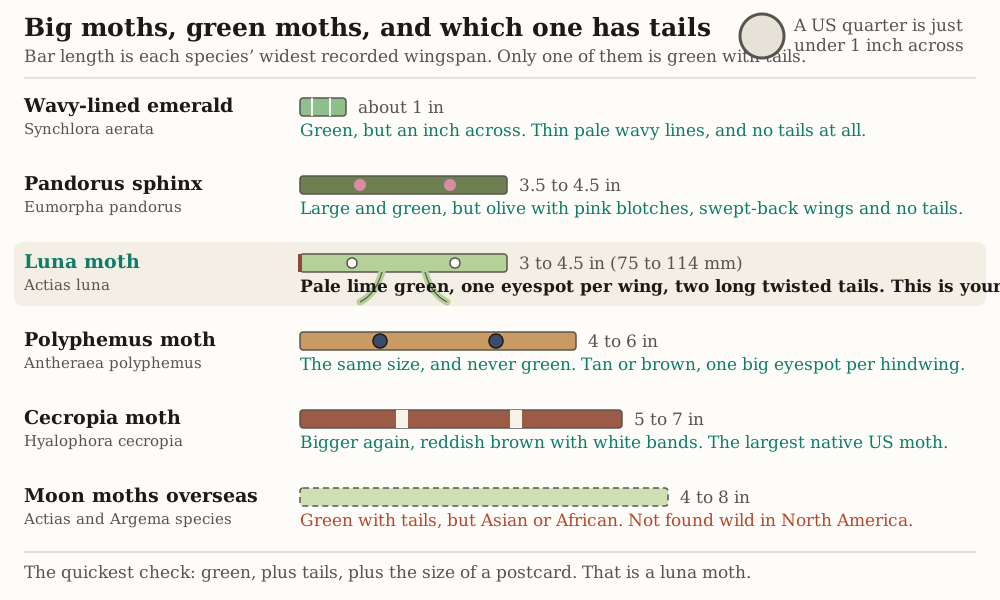
How big does a luna moth actually get?
Sources disagree, and the honest answer is a range. Clemson Cooperative Extension gives 3 to 4.5 inches. The University of Florida is tighter at 75 to 105 mm, or 3 to 4 1/8 inches, following Covell’s field guide. Wikipedia reports a typical span of 114 mm (4.5 in) with rare individuals above 178 mm (7 in). Southern populations run smaller than northern ones, which is part of why the figures differ.
For practical purposes, treat 3 to 4.5 inches as the normal range and anything near 7 inches as exceptional. If what you are holding is under 2 inches, it is almost certainly something else, and the next two sections deal with that.
Is a luna moth dangerous, and can you touch one?
No, and yes. A luna moth has no sting, no venom and no working mouthparts, so it has no mechanism to hurt you at all. Texas A&M Forest Service says the caterpillar is harmless to people too. It also says the species is not a pest. There is no first aid here, because there is no injury to treat.
The caterpillar question deserves its own answer, because a big green caterpillar covered in spines looks like it should sting. It does not. The spines on a luna moth caterpillar carry no chemical component. That is what separates it from the few American caterpillars that genuinely sting, such as the io, buck and flannel moths. Those are a real medical problem. This one is not.
The safe way to pick one up
Slide a finger or a piece of paper under the abdomen and let the moth walk on. Never pinch the wings. Scales will come away on your skin, and that worries people far more than it should. The scales rub off, the moth flies on, and the old belief that touching a moth kills it is simply wrong. A bent or torn wing is the real risk, and that comes from gripping rather than from contact.
Green moths that are not luna moths
Four moths cause most of the confusion, and size rules out two of them immediately. The polyphemus and cecropia moths are the same size but not green. The wavy-lined emerald is green but barely an inch across. Only the pandorus sphinx is both large and green, and even it has no tails.
Big or green moths, and the one feature that separates each from a luna moth
Pale green with two long twisted tails
- The moth
- Luna moth
- Wingspan
- 3 to 4.5 in
- Where you meet it
- Porch lights at night, near hardwood trees
Tan or brown, with a big eyespot on each hindwing
- The moth
- Polyphemus moth
- Wingspan
- 4 to 6 in
- Where you meet it
- The same porch light. Never green
Reddish brown with white bands, and bigger again
- The moth
- Cecropia moth
- Wingspan
- 5 to 7 in
- Where you meet it
- The same porch light. North America's largest native moth
Olive green with pink blotches, no tails, swept wings
- The moth
- Pandorus sphinx
- Wingspan
- 3.5 to 4.5 in
- Where you meet it
- Gardens and vineyards, near grape and Virginia creeper
Green but about an inch across, with thin wavy lines
- The moth
- Wavy-lined emerald
- Wingspan
- About 1 in
- Where you meet it
- Flowers and shrubs. Its caterpillar wears petals
Green with tails, but photographed overseas
- The moth
- Indian, Chinese and African moon moths
- Wingspan
- 4 to 8 in
- Where you meet it
- Asia and Africa, and all over social media
The last row catches more people than any of the others. A spectacular long-tailed green moth in a photograph is often an Indian or African moon moth rather than a luna moth. Those species travel much further on social media than they ever do in life. If the picture came from a friend abroad, it is probably a relative and not this species.
One more distinction is worth making for anyone searching by colour alone. A small green moth, roughly an inch across, is almost always an emerald rather than a luna moth. Our guide to the giant moths of the US sorts sixteen species by size and colour, each with the feature that confirms it.
Part 2 of 4
Its one week
Why a luna moth has no mouth, and how long it lives
A luna moth lives about a week as an adult, usually quoted as 7 to 10 days, and it spends that week unable to eat. The mouthparts are vestigial, which means present but reduced past usefulness, and there is no digestive system behind them. Every bit of energy comes from fat the caterpillar stored.
That trade is deliberate, in evolutionary terms. A moth that does not need to feed does not need to risk feeding, and the whole adult stage collapses into one job: find a mate, lay eggs, stop. Giant silk moths across the family are built the same way, which is why the question do moths have mouths has two different answers depending on the species.
The published lifespan figures vary a little, and it is worth knowing why. Wikipedia gives 7 to 10 days. The Chesapeake Bay Program says under 10 days. Clemson, Missouri’s Department of Conservation and Northern Woodlands all say about a week. Nobody is wrong, because the moth dies when the fat runs out, and how fast that happens depends on how much flying it has had to do.
How long each luna moth stage lasts, and what it does
Egg
- How long
- About a week, reported as 7 to 13 days
- What happens
- Laid in small groups under a leaf, 200 to 400 per female
Caterpillar
- How long
- 3 to 6 weeks, across five instars
- What happens
- Eats, and gains roughly a thousandfold in weight
Cocoon, summer
- How long
- 2 to 3 weeks
- What happens
- Pupates in leaf litter, then emerges the same year
Cocoon, winter
- How long
- About 9 months
- What happens
- Enters diapause and waits for spring
Adult
- How long
- About 7 to 10 days
- What happens
- Cannot feed. Mates, lays, dies
What the long tails are for
They are a decoy aimed at bats, and the effect has been measured. In 2015 a team led by Jesse Barber at Boise State University pitted bats against luna moths. Bats caught 81% of the moths whose tails had been clipped off. With the tails intact, they caught only 35%. The tails spin in flight, and a hunting bat strikes them instead of the body. Its Madagascan relative, the comet moth, goes further still, with tails twice as long again.
A follow-up in 2016 by Wu-Jung Lee and Cynthia Moss explained the mechanism further. The twist in each tail does not merely shift where the echo comes from. It scatters the returning sound in all directions, so the bat’s sonar picture smears out. The result is a nonessential appendage that gets bitten off while the moth flies away.
Its caterpillar has its own defences, and they are noisier. Threatened, it rears the front of its body into a sphinx pose. Then it clicks its mandibles loudly enough to hear, and regurgitates a foul-tasting fluid. Experiments on the closely related polyphemus moth showed that ants and mice both back off from the regurgitant. The click appears to be a warning that it is coming.
Are luna moths rare, or endangered?
Neither. NatureServe ranks the luna moth G5, meaning secure, and public iNaturalist records hold 48,409 adult sightings from the United States alone. The species is common across the eastern half of the country. What is rare is the encounter, not the moth.
Two things make it scarce to human eyes. The adult flies at night and lives about a week, so the window in which any individual can be seen is tiny. The cocoon spends winter lying in leaf litter, where it looks exactly like the dead leaves around it. People who have lived in the same house for twenty years still report their first sighting.
The endangered belief turns up constantly, and it is worth naming because people act on it. One sighting report on BugGuide says outright that the species is on the endangered list, and the writer was pleased not to have chased the moth away. The instinct was right and the fact was wrong. No federal protection covers a luna moth anywhere in the United States.
When and where you will see a luna moth
Adult sightings peak in June and run high from May through August, with 88.9% of all records falling between March and August. The range covers the eastern half of North America, from Maine to Florida and west to eastern Texas and the Great Plains, and north through Ontario to Nova Scotia and Saskatchewan.
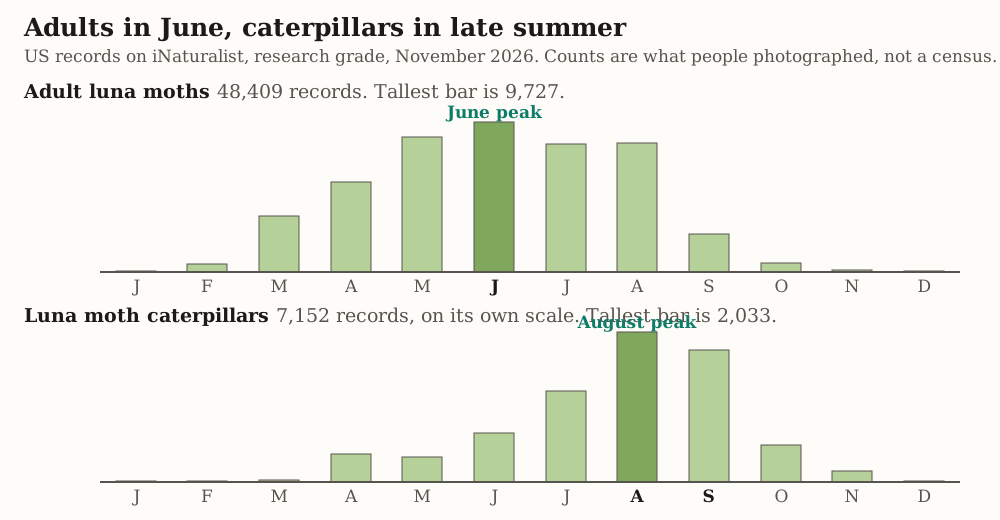
Those counts come from our own pull of public iNaturalist research-grade records for the United States, taken in November 2026. Read them as a record of what people photographed rather than as a census, because observer effort rises in summer too. Even so, the gap between the two stages is far too large to be an artefact, and it is the most useful thing on this page for anyone hunting the caterpillar.
One brood, or three?
It depends on your latitude. From Michigan northward there is one generation a year, flying May to July. Through the Ohio River Valley there are two. In the Deep South there are often three, from March to September, and Louisiana has recorded luna moths in every month of the year.
The place is more predictable than the date. Adults are strongly drawn to light, and particularly to ultraviolet wavelengths, so a porch light or a lit wall is where they turn up. In the woods they are almost invisible: the green wings read as leaves and the reddish-brown forewing edges read as twigs with buds, which is why people meet luna moths on buildings rather than in habitat.
Male or female luna moth?
Look at the antennae, because they differ more than anything else. Both sexes have quadripectinate antennae, comb-toothed on four sides, but the male’s are markedly larger and deeper. The female carries a visibly fatter abdomen, because it holds 200 to 400 eggs.
Telling a male luna moth from a female in a photograph
Antennae
- Male
- Broad and deeply feathered, like two small ferns
- Female
- Narrower combs, closer to a thread
Abdomen
- Male
- Slim
- Female
- Thick, holding 200 to 400 eggs
Wing tint
- Male
- More yellow-green
- Female
- More blue-green
Timing
- Male
- Emerges several days before the females
- Female
- Emerges later, then calls
A male's antennae are overbuilt for a reason. The female sits still and releases a pheromone, usually in the first couple of hours after midnight, and the male has to find her in the dark on scent alone. Every tooth on those combs carries receptors. He is a strong flier and may cover a long distance doing it.
Purple, pink and brown luna moths
Most of them are the ordinary spring brood, and the colour is in the wing edges rather than the wings. Where more than one generation flies each year, the spring brood is a deeper green with reddish-purple margins, while later broods are yellower with yellow margins. Both are the same species, and you can see both in one yard.
That single fact answers most of the searching. One sighting report asks why theirs lacked the dark red wing edges and wonders whether the moth was young. It was not young, it was a later brood. The same mechanism explains the opposite question, from people whose luna moth looks almost maroon along the front of the wing.
A second answer applies to the vivid purple and pink moths in online photographs. Breeders rear captive colour morphs, and those images circulate without any note that they are not wild. If you have found a wild luna moth in the United States, expect green with either red or yellow trim. Anything beyond that is either a different species or a photograph from a breeder’s cage.
Part 3 of 4
The caterpillar and the cocoon
The luna moth caterpillar
A full-grown luna moth caterpillar is a bright green grub 2 to 3 inches long, as thick as an adult finger, with a pale yellow line low along each side and three rows of small reddish tubercles. It passes through five instars in 3 to 6 weeks, and it turns reddish just before it spins.
Caterpillar sightings peak much later than adult ones. In our iNaturalist pull, August and September hold 53.5% of all caterpillar records, against an adult peak in June. Caterpillars also turn up about one seventh as often as adults, which is the honest answer to whether seeing one is rare: rarer than seeing the moth, and far from impossible in late summer.
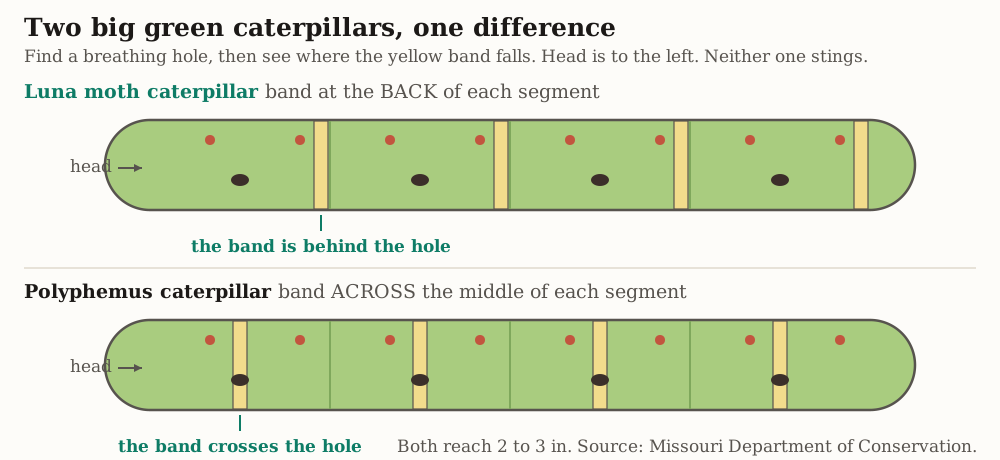
Luna moth caterpillar or polyphemus caterpillar?
Find a breathing hole along the side, then look at the yellow band next to it. On a luna moth caterpillar the band sits at the hind edge of the segment, behind the hole. On a polyphemus caterpillar it runs across the hole, at about the centre of the segment. Missouri’s Department of Conservation is the only source that publishes this, and it is the whole difference.
Size is no help at all here, since both are big green caterpillars on the same kinds of tree in the same months. Neither stings. So if the band position is unclear in your photograph, the practical answer is that it does not matter: whichever of the two it is, the handling advice and the host trees are the same.
Each stage, by size
The five luna moth caterpillar instars, after Packard's measurements
First
- Length
- 6 to 8 mm (about 1/4 in)
- What changes
- Hatches, starts feeding on the leaf it was laid on
Second
- Length
- 9 to 10 mm (about 3/8 in)
- What changes
- Green throughout, faint markings
Third
- Length
- 13 to 15 mm (about 1/2 in)
- What changes
- Tubercles become obvious
Fourth
- Length
- About 23 mm (7/8 in)
- What changes
- Yellow and magenta dots may appear along the sides
Fifth
- Length
- 55 to 90 mm (2 to 3 1/2 in)
- What changes
- Spines developed, then turns reddish and descends to spin
The final length is another figure sources disagree on. Florida gives 55 to 70 mm, Wikipedia 70 to 90 mm and Texas A&M Forest Service about 3 inches. Treat 2 to 3 inches as the working answer for a full-grown one.
What luna moth caterpillars eat, and what to feed one you found
They eat the leaves of hardwood trees, and the right tree depends on where you are. In the north the preferred host is white or paper birch. Further south it is hickory, walnut, persimmon and sweet gum. Adults eat nothing at all, so there is never anything to feed a moth.
Luna moth host trees, by region
Northern states and Canada
- First choice
- White or paper birch
- Also recorded
- Alder, beech, wild cherry, hazelnut
Middle states
- First choice
- Hickory and walnut
- Also recorded
- Sweet gum, persimmon, red maple, white oak, willow
Southern states
- First choice
- Sweet gum, persimmon, hickory, pecan
- Also recorded
- Smooth sumac, walnut
There is a catch here that no popular page mentions, and it matters if you are trying to keep a caterpillar alive. A 1989 study by Richard Lindroth found first-instar survival was poor on several plants the literature lists as hosts. He concluded that geographically separate luna moth populations are adapted to different trees. The likely mechanism is the enzymes each population uses to break down a tree’s defences. So a local caterpillar may fail on a tree that works perfectly a few states away.
So the practical rule is short. Feed it fresh leaves from the tree you found it on, replaced daily, and from nothing else. If you do not know which tree that was, put the caterpillar back where you found it rather than guessing.
Will they damage my tree?
No. Both Florida and Texas A&M Forest Service say luna moth caterpillars never become numerous enough to hurt a host tree. They also feed alone rather than in groups. That is the opposite of the tent caterpillars and webworms people are usually thinking of. Nothing needs spraying, and nothing needs doing.
The luna moth cocoon, and why you should leave the leaves
A luna moth cocoon is a thin, papery, single-layered silk case wrapped in dead leaves, and it looks almost exactly like a dried leaf. The caterpillar spins it in the tree over 2 to 3 weeks. Crucially, it is not anchored to a twig, so when the leaves fall in autumn the cocoon falls with them. Compare it with any other silk moth cocoon.
That one structural detail explains why nobody finds them and why so many are destroyed. The overwintering generation spends roughly nine months lying in leaf litter at the base of a tree. Rake the leaves, bag them, and the cocoons go out with them. A widely shared gardening post puts it better than a field guide would: imagine raking away something that has not had its chance to fly.
So the single most useful thing a household can do for this species costs nothing and takes no effort. Leave a corner of leaf litter undisturbed under your hardwood trees over winter. The National Wildlife Federation runs the same message under the tag leave the leaves, and luna moths are one of the clearest reasons for it.
A luna cocoon is never fastened down. A cocoon still on a twig in winter is something else, usually a cecropia or a polyphemus. But polyphemus cocoons fall with the leaves too, so the litter holds both and the twig holds one. For what happens inside either one, see our explainer on the pupa stage and cocoons.
Can you overwinter a cocoon indoors?
You can, and mostly you should not. Whether the pupa waits for spring is decided by day length while the caterpillar was still feeding, and a warm indoor winter can push an emergence months early, into a season with no mates and no leaves. Enthusiasts do keep cocoons in unheated garages or refrigerators to control the timing. Outside, in the leaves, is simpler and works without you.
How a luna moth gets out, and the red liquid underneath
It cuts its way out with built-in tools, in the morning. The moth splits the pupal case at the front, then uses serrated spurs near the base of its forewings to saw an exit through the silk, which has already been weakened by cocoonase, a protein-digesting enzyme. Males emerge several days before females.
Then nothing happens for a while. The wings come out small, soft and crumpled, and the moth spends two to three hours pumping fluid into them and waiting for them to harden before it can fly. Morning emergence buys exactly that time before the first night of flight. A luna moth found motionless on the ground in daylight is very often doing this, not dying.
The reddish liquid people find underneath is meconium, the waste left from rebuilding a caterpillar into a moth. It is voided during the first day, it stains a windowsill, and it is completely normal. Several sighting reports describe a moth that looked dead until it was touched, then quivered and flew off. That is the usual story.
Part 4 of 4
What to do
What to do with the luna moth you found
Most of the time, nothing. The seven steps below cover the three situations people actually write in about: a moth sitting still where you can see it, a moth on the ground that cannot fly, and a leaf-wrapped cocoon turned up by a rake. There is no treatment, no feeding and no professional to call.
A luna moth, step by step
Leave it where it is
A luna moth on bark, a shrub or a shaded wall needs nothing from you. It is nocturnal, so sitting still all day is normal. Take the photograph and walk away.
Move it off hot or exposed ground
A sunlit driveway, a path or a doormat is worth moving it from. Slide a finger or a sheet of paper under the abdomen and let the moth step on. Then set it on bark or a leafy branch in shade, out of reach of a cat.
Do not try to feed it
There is nothing to feed. The adult has no working mouth and no digestive system, so sugar water, fruit and nectar all do nothing. A moth that will not drink is physically unable to take any.
Expect stillness from a fresh one
A moth found on the ground beneath a cocoon has probably just emerged. Pumping and drying the wings takes two to three hours. A reddish drop underneath is normal waste, not blood or injury.
Accept a torn wing without panicking
Small rips and missing scales do not ground a luna moth. The scales on your fingers were not needed for flight. If both wings are badly damaged, there is no treatment. Leave the moth somewhere sheltered.
Put a raked-up cocoon back outside
A luna moth cocoon looks like a dried leaf and overwinters in leaf litter. Set it back in a sheltered pile of leaves outdoors, at ground level. A warm house triggers an early emergence into a season with no mates.
Record it, then turn the light off
Upload the photograph to iNaturalist so the sighting counts. Then switch the outdoor light off for the night. Both cost nothing. The light is one of three pressures a household can actually change.
Still not sure what you have?
Photograph it from directly above, with the whole moth in frame and something familiar beside it for scale. Then run the picture through our free bug identifier. If yours turned out to be small and beige and indoors rather than big and green and outdoors, the answer is more likely a fabric moth in the wardrobe.
What is happening to luna moths, and what helps
The species is secure, but three pressures are real and two of them are local to you. Clemson lists habitat loss and fragmentation, light pollution and pesticide accumulation. Add to those an introduced parasitoid fly, and the picture in parts of New England is of silk moths thinning out over decades.
The fly is Compsilura concinnata, brought to the United States from 1906 onward to control the spongy moth, formerly called the gypsy moth. It did not solve that problem and it attacks native silk moths instead. A 2003 study by Susan Kellog and colleagues in Virginia recovered it as the commonest parasitoid of luna moth larvae left out in the field, and found trigonalid wasps parasitising the fly in turn. Nothing can be undone there.
What a household can change is shorter and more useful. Turn the outdoor light off, or fit one that does not put out ultraviolet, since that is what draws moths away from breeding. Leave fallen leaves under your hardwood trees through the winter. Skip the insecticide on a shade tree that does not need it. Those three cost nothing, and they are the ones that touch this species directly.
Pest control disclaimer. Photo-based identification can help, but it is not always perfect. For dangerous spiders, large infestations, or anything you are unsure about, contact a licensed pest control professional.
Luna moth FAQ
What does it mean when a luna moth visits you?
Are luna moths pollinators?
Are luna moths rare?
Can you touch a luna moth?
How long is a luna moth in its cocoon?
What is the red liquid under my luna moth?
Is a luna moth the same as a moon moth?
Related guides
Cecropia moth
North America's largest native moth, and the one silk moth cocoon fastened lengthwise to a bare twig.
Polyphemus moth
The tan silk moth with one big eyespot on each hindwing, and how to read the holes in its cocoon.
Silk moth
Two insects share the name: the farmed Bombyx mori, which cannot fly, and the wild giant silk moths.
Comet moth
The Madagascan moon moth, with the longest tails of any silk moth.
Moths
What moths are, what they eat, why they come to your light, and which few damage a home.
Types of moths
Name the moth you found by size and colour, with sixteen common US species and the feature that confirms each.
Rosy maple moth
The small pink and yellow silk moth from the same family, and the six moths mistaken for it.
Hummingbird moth
The day-flying hawk moth people report as a baby hummingbird or a strange bee.
Clothes moths
The small beige moths whose larvae eat wool and silk, and how they differ from pantry moths.
Pupa
What happens inside the stage this moth spends nine months in, lying in the leaf litter.
Tomato hornworm
The other big green caterpillar people find in a garden, and the sphinx moth it becomes.
Bug identifier by picture
Upload the photograph you already took and get a name back.
Sources
- Texas A&M Forest Service, Luna Moth, for the statement that the moth and its caterpillar are harmless to people
- Clemson Cooperative Extension, Home & Garden Information Center, Luna Moth
- University of Florida IFAS Featured Creatures, Luna Moth, Actias luna (EENY-411)
- Missouri Department of Conservation, Field Guide, Luna Moth
- NatureServe Explorer, Actias luna, for the G5 conservation rank
- Chesapeake Bay Program, Field Guide, Luna moth
- iNaturalist, Actias luna, for the observation records quoted above