Hardly anyone meets this moth in the wild. The encounter is nearly always a photograph, a museum post, or a living insect behind glass at a butterfly house. One of the most shared posts about it asks the right question first: is this a moth, or a little piece of golden moonlight? Then the second question follows, and it is the one this page exists for. Is it the same thing as the green one with tails from back home?
Part 1 of 4
Name it
What a comet moth is
A comet moth is a giant silk moth from the rainforests of Madagascar, Argema mittrei. The male wing span reaches 20 cm (7.9 in), with hindwing tails adding 15 cm (5.9 in)behind. The wings are bright yellow, crossed by red-brown veins, and each one carries a single eyespot. It also goes by a second name, the Madagascan moon moth.
The family explains most of what follows. This is a saturniid, one of the giant silk moths, so it shares a short and mouthless adult life with every other moon moth. Madagascar is the only place it lives wild, and that one fact settles most of the questions readers arrive with. No wild comet moth has ever turned up at an American porch light.
Why it is called the comet moth
Both of its names describe something you can see. The tails trail behind the flying moth like the streak behind a comet, which is where the English name comes from. Its genus name makes a similar point about the other end of the wing: Argema is Greek for speckled eye, after the eyespots. Neither name is guesswork, and neither one is ambiguous.
How big a comet moth gets
A male spans 20 cm (7.9 in) across the wings, with the tails adding another 15 cm (5.9 in) behind. Wildlife Madagascar puts that in terms anyone can picture: about the size of a man’s hand. So a comet moth runs roughly twice the span of a luna moth, which measures 3 to 4.5 inches. Its tail span alone beats a whole luna moth.
Comet moth measurements, and how the sexes differ
Wing span
- Male
- About 20 cm (7.9 in)
- Female
- Slightly smaller across the wings
Tail span
- Male
- Up to 15 cm (5.9 in)
- Female
- Shorter, and broader at the tip
Wing shape
- Male
- Narrower, more angular
- Female
- Noticeably rounder
Antennae
- Male
- Broad and feathery
- Female
- Thin
Body
- Male
- Proportionally smaller
- Female
- Heavier, carrying 100 to 150 eggs
Male or female?
Check the antennae first, because they are the quickest tell. A male carries broad feathery antennae, since he has to find a female in the dark on scent alone. The Natural History Museum, reading its own spread specimens, adds that his tails run longer and slimmer than hers. A female shows thin antennae and distinctly rounder wings, and she is the heavier insect.
Comet moth or luna moth? Every moon moth, and what separates them
Start with where the photograph was taken, because no two moon moths share a region. Madagascar means a comet moth. North America means a luna moth, which is pale lime green rather than yellow and spans 3 to 4.5 inches against 7.9. Google itself lists comet moth against luna moth as the fourth thing people search from here, and not one ranking page compares them.
The world's moon moths, and the one feature that separates each from a comet moth
Bright yellow, red-brown veins, tails to 6 in
- The moth
- Comet moth
- Wing span
- About 20 cm (7.9 in)
- Where you see it
- Madagascar only. Butterfly houses elsewhere
Pale lime green, white furry body, four eyespots
- The moth
- Luna moth
- Wing span
- 3 to 4.5 in
- Where you see it
- Eastern North America, at porch lights
Yellow-green, shorter tails, a hard oval cocoon
- The moth
- African moon moth
- Wing span
- 10 to 12 cm (3.9 to 4.7 in)
- Where you see it
- Eastern and southern mainland Africa
Pale green crossed by reddish-brown veins
- The moth
- Spanish moon moth
- Wing span
- Smaller than a luna moth
- Where you see it
- Pyrenees and Alpine pine forest. Protected
Jade green, rounded wings, moderate tails
- The moth
- Indian moon moth
- Wing span
- Smaller than a comet moth
- Where you see it
- South Asia, and widely reared
Green, and often sold under the wrong name
- The moth
- Chinese moon moth
- Wing span
- Smaller than a comet moth
- Where you see it
- China. Confused with the Chinese luna moth
Green, the smallest of the group
- The moth
- Japanese moon moth
- Wing span
- The smallest moon moth
- Where you see it
- Japan and the Russian Far East
Strongly different sexes, male yellower
- The moth
- Malaysian moon moth
- Wing span
- Smaller than a comet moth
- Where you see it
- Southeast Asia, all year round
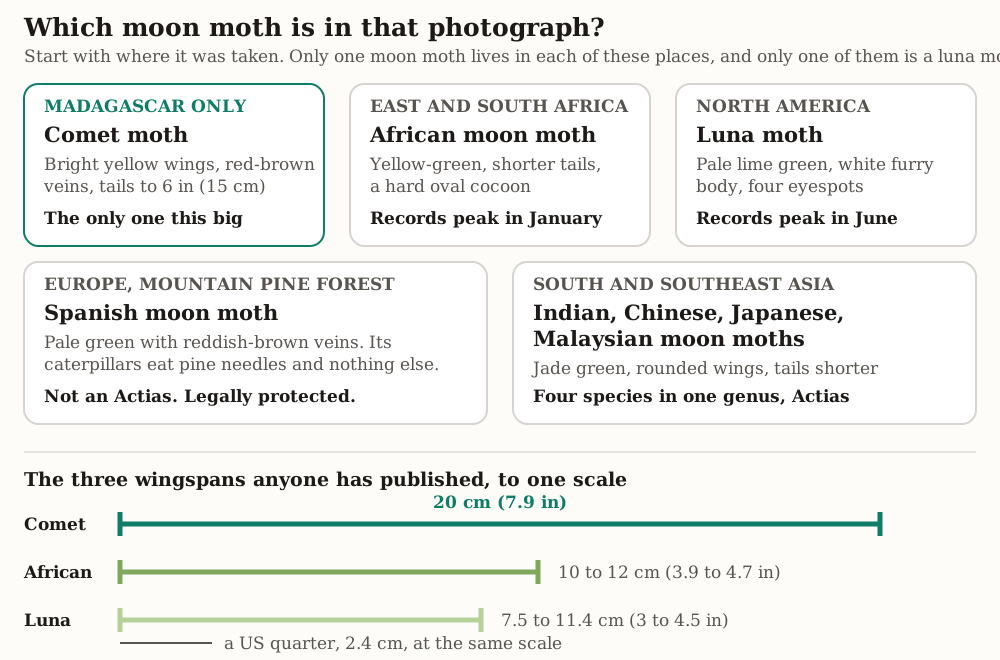
Two things make this harder than it should be. First, the common names are used loosely, so at least one British supplier lists the African species as both the African moon moth and the comet moth. Second, the photographic record is wildly lopsided, which is why people guess wrong in a particular direction. Public iNaturalist records hold 68,719 sightings of the luna moth and only 229 of this species. Any long-tailed green moth therefore gets called a luna, and often it really is one.
One more distinction helps anyone searching by size alone. If the moth in the picture is about an inch across, it is an emerald rather than any moon moth. Our round-up of every giant moth in the United States sorts sixteen species by size and colour. The american moon moth is the one that actually visits American gardens.
The Spanish moon moth is not an Actias
It sits in a genus of its own, and plenty of sources still get this wrong. Graellsia isabellae was once named Actias isabellae, and older books file it there, but it was moved out and Wikipedia’s own synonym list records the move. On sight the giveaway is the wing pattern: pale green crossed by reddish-brown veins, which no true moon moth in Actias shows.
Three other things set it apart. Its caterpillars eat pine needles and almost nothing else, which is unique in this group, and they struggle even on pine species they did not evolve with. It survives high in the Pyrenees and other cold ranges as an Ice Age relict. And it is the only moon moth with real legal protection, as a Habitats Directive species in the European Union.
The Chinese moon moth and the Chinese luna moth
These are two different species, one word apart. Actias ningpoana is the Chinese moon moth. Actias dubernardi is the Chinese luna moth, and it is the pink and green one that breeders sell. Two large social accounts were using the two names for the same animal in the same week, so this confusion is live rather than historical. If a photograph shows pink, you are looking at the second of the two.
How many moon moths there are
More than any published list admits. Actias holds the Asian and American moon moths and runs to dozens of described species. Argema holds five, all Sub-Saharan African. Graellsia holds one. Then come two genera almost nobody names: Copiopteryx, from Mexico and Central and South America, and Eudaemonia, from Sub-Saharan Africa. So the luna moth is not even the only New World moon moth.
Part 2 of 4
How it works
Why a comet moth has tails, and the two ways they beat a bat
The tails are an anti-bat device, and this moth carries a second one in its wings. Work on the related luna moth measured the first effect: bats caught 81% of moths whose tails had been cut off, against only 35% of those left intact. A comet moth has the longest tails of any of them, at 15 cm.
The mechanism is not a decoy in the simple sense. The tails spin as the moth flies, which scatters the returning sound rather than merely shifting it, and the bat ends up closing on a streamer. Losing one costs the moth almost nothing, because it does not need the tails to fly and has about a week left in any case.
The second defence is less known and it belongs to the whole family. In 2016 Athanasios Ntelezos and colleagues measured how much ultrasound moth wings soak up, writing in Biology Open. The wings of nocturnal silk moths absorb far more than those of day-flying moths. So the echo comes back quieter before the tails do anything at all. Two defences then, working at different moments in the same attack.
No working mouth, and about a week to live
An adult comet moth lives six to eight days, and it cannot eat on any of them. The Natural History Museum is precise about why, and the popular phrasing gets it slightly wrong. The moth has both a mouth and a gut, and neither of them functions. Everything it spends was stored as fat by the caterpillar.
That figure is worth pinning down, because the sources disagree and one disagrees with itself. Wikipedia’s opening sentence says 4 to 5 days. Its own section on the adult says six to eight, which is also the Natural History Museum’s figure. Wildlife Madagascar says a few days, a week at most, while Google’s AI summary offers 4 to 10 days, which is nobody’s number. Treat six to eight days as the best supported, and anything under four as unusual.
How long each comet moth stage lasts
Egg
- How long
- 10 to 20 days
- What happens
- Laid on the host plant, 100 to 150 per female
Caterpillar
- How long
- About two months
- What happens
- Eats, and turns bright green as it grows
Cocoon
- How long
- Five to six months
- What happens
- Hangs from a stem in a perforated silk sack
Adult
- How long
- Six to eight days
- What happens
- Cannot feed. Finds a mate, lays, and dies
Short as that week is, it explains the behaviour people photograph. The female barely moves at all. Curators at the Natural History Museum find her resting on the cocoon she came out of, sometimes for days, simply waiting. Meanwhile the male does every bit of the travelling, and his antennae pick her scent out of the air from a long way off. For a sense of how unusual that is among moths, see how long do moths live across the order as a whole.
Are comet moths rare, or endangered?
Rarely recorded, and not an endangered species in the legal sense. Public iNaturalist records hold 229 research-grade sightings of a comet moth worldwide, from 195 separate observers, which makes it the second least recorded of the eight moon moths. Yet it has never been assessed for the IUCN Red List at all.
What the records actually show
Those 229 sightings are the entire global total, and they say as much about photographers as about moths. The luna moth, for comparison, has 68,719, which is more than eleven times every other moon moth put together. Madagascar has far fewer people uploading insect photographs than the eastern United States does. So read the number as scarcity of observers first, and scarcity of moths second.
Even allowing for that, one ratio stands out. Nearly every record comes from a different person: 195 observers for 229 sightings. Almost nobody logs a second one.
What the IUCN says, and what Wikipedia says
Here the published record needs correcting. Wikipedia’s first sentence calls the comet moth endangered in the wild. There is no citation on that clause, and no conservation status in the article’s own data box. GBIF mirrors Red List categories, and it returns no threat status for the species across three separate records. Run the identical check on the Spanish moon moth and Data Deficient comes straight back, so the method does find a listing when one exists.
None of that means the moth is fine. It means nobody has assessed it. The threat is well documented even without a category. The Natural History Museum reports that deforestation has now destroyed more than 90% of Madagascar’s forests. More than 80% of Madagascan species live nowhere else on Earth. A rainforest endemic on an island that has lost most of its rainforest is in trouble whether or not a committee has said so.
When comet moths fly, and what the month tells you
Records of a comet moth peak in November, with 49% falling between September and December. The luna moth peaks in June, with 76% between May and August. So the two sit six months apart, which makes the date on a photograph a real clue to which moon moth it shows.
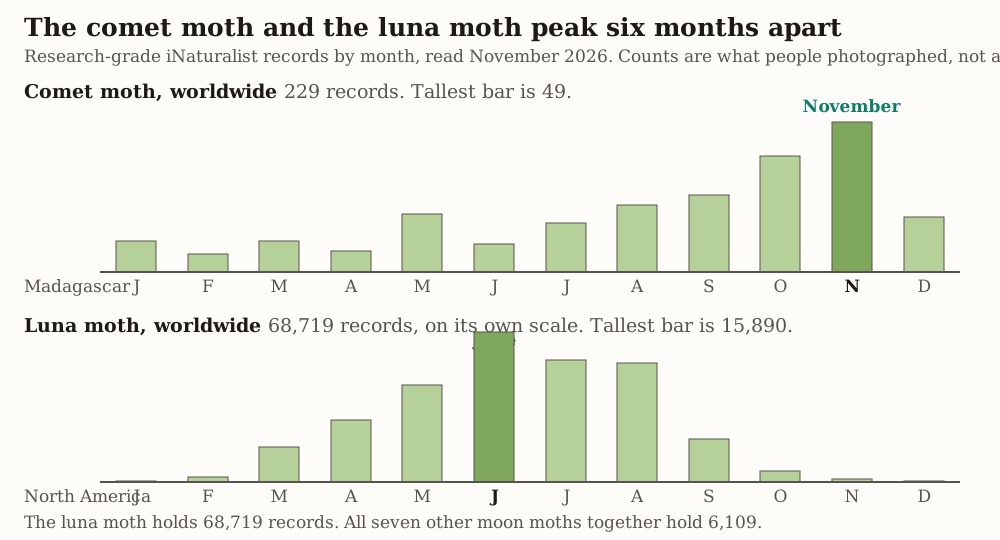
Two more species fall into place on the same data. The African moon moth peaks in January, holds half its records across December, January and February, and is close to absent from May to September. So the two African-genus moths, which look more like each other than like anything else, peak about two months apart. The Spanish moon moth is tighter still: 87% of its records land in April, May and June, matching the single April to July flight the literature describes.
The Malaysian moon moth, by contrast, sits almost flat across the year, which is what a lowland tropical species should look like. Treat all of these curves carefully, though, since they measure where people are as well as when moths fly. Madagascar’s monthly totals run between six and forty-nine, so one active observer can move a month.
Part 3 of 4
The life cycle
The cocoon with holes in it
A comet moth cocoon is a silvery, loose-fitting sack tied to a stem, and its whole surface is covered in holes. The pupa waits inside for five to six months. The usual explanation is drainage, and it is a good one, but the museum curators who give it are careful to say that it is not settled.
Alessandro Giusti, the Lepidoptera curator at the Natural History Museum, puts it carefully. The holes may be very helpful in the tropics, because rain runs straight through and the pupa does not drown. Then he adds the part that every other page drops. Cocoons come in nearly as many shapes as there are species spinning them, and in many cases nobody knows why they are built the way they are. That hedge is worth more than the certainty around it.
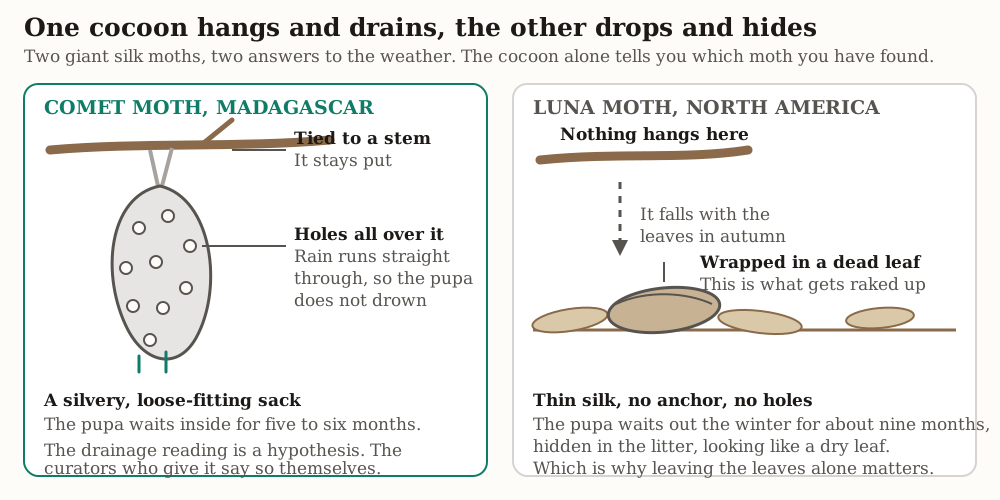
Set it beside a luna moth cocoon and the contrast is clean. That one is thin silk wrapped in dead leaves, and nothing anchors it to a twig. So it drops with the leaves in autumn, then waits out about nine months in the litter. One hangs and drains. The other falls and hides. Same family, opposite weather. If the difference between a cocoon and chrysalis is what you came for, that is a separate question with a clearer answer.
The caterpillar, and what it eats
A comet moth caterpillar feeds for about two months and turns bright green as it grows. In the wild it eats the leaves of Eugenia and Weinmannia, two rainforest genera. A female lays 100 to 150 eggs, which hatch in 10 to 20 days, and most of the brood never reaches adulthood.
Host plants in the wild, and the trees breeders substitute
In the wild, Madagascar
- The plants
- Eugenia and Weinmannia
- Why it matters
- The only foliage wild caterpillars are recorded on
In captivity
- The plants
- Sweetgum, eucalyptus, sumac, pistachio
- Why it matters
- Substitutes that work in a rearing cage
Reported but not wild food
- The plants
- Eucalyptus alone
- Why it matters
- Australian, introduced to Madagascar, and often misreported
That last row is a correction, and it matters because people rear this species. Wildlife Madagascar says the eggs are laid on host plants, mainly eucalyptus. Eucalyptus is Australian, introduced to Madagascar, and it is a rearing substitute rather than a wild food plant. Wikipedia separates the two properly, listing Eugenia and Weinmannia for the forest and eucalyptus among the trees breeders use.
The egg count carries its own small disagreement. Wikipedia and the Natural History Museum both give 100 to 150. Wildlife Madagascar says 120 to 170, and Google’s summary follows it. Either way the point for a reader stays the same. The female spends every remaining night of her life laying, and she began with no way to feed herself.
Part 4 of 4
Seeing one
Where to see a comet moth in the United States
In a butterfly house, which is the only realistic option. Several venues turn up again and again in sighting posts. Four are worth knowing: the Chicago Botanic Garden, the Florida Museum of Natural History, Hershey Gardens in Pennsylvania and the Houston Museum of Natural Science. In Britain the Natural History Museum and Sussex Butterfly Gardens both fly them.
Those lists change, so ring ahead rather than driving on the strength of a social post. Butterfly houses buy pupae in batches, and an adult is on the wing for barely a week. So a species is present for a few weeks rather than a season. Ask specifically whether they currently have Argema on display.
The point is worth making, because every article about this moth describes a rainforest and then stops. Quite a few readers could see a living one this month, a couple of hours from home.
Should you buy a comet moth cocoon or a framed specimen?
It turns on one thing, and it is not the price. A captive-bred comet moth from a seller who says where it came from is a defensible purchase. A wild-caught specimen from a seller who will not say is not. For the Spanish moon moth it may be illegal as well, since that species is protected across the European Union.
Three questions sort most listings. Ask whether the animal was captive bred or wild caught, and expect a straight answer rather than a shrug. Ask which country it came from, since a vague answer is itself informative. Then ask for the scientific name, because the common names are used so loosely that African moon moths get sold as comet moths.
Cocoons raise a further problem, and this one is practical rather than ethical. A pupa needs five to six months of steady tropical humidity and no handling. It then gives you a moth that cannot eat and lives barely a week. We publish no rearing instructions here. For a species whose wild population has never been assessed, the honest advice is to visit a butterfly house instead.
How to tell which moon moth you are looking at
Five checks, in this order. The first does most of the work, because no two moon moths share a region. The last two settle the awkward cases, where a photograph gives you nothing but the moth.
Five checks, in order
Ask where the photograph was taken
Do this before you look at the moth. No two moon moths share a region. Madagascar means a comet moth, North America means a luna moth, and mainland Africa means an African moon moth.
Read the colour, not the shape
Bright yellow with red-brown veins is this species. Pale lime green is a luna moth. Yellow-green is the African one. Pale green crossed by reddish-brown veins is the Spanish moon moth.
Compare the tails against the wing
Here the comet moth is unmistakable. Its tails run about three quarters of its 20 cm wing span. Every other moon moth carries tails well under half that, and the Asian species are shorter again.
Check the month
A long-tailed moth photographed in November is very unlikely to be a luna moth, since luna records collapse after August. A June photograph from a garden is very unlikely to be this species.
Ask whether the moth was wild or behind glass
Butterfly houses fly several of these species together, so a venue photograph tells you nothing about range. A garden or forest photograph does, and that makes it the more useful clue.
Still not sure what you have?
Photograph it from directly above, with the whole moth in frame and something familiar beside it for scale. Then run the picture through our free identifier, which answers what bug is this from the photo you already took. If the moth turned out to be small and beige and indoors rather than huge and yellow and tropical, the answer is a different page entirely.
Pest control disclaimer. Photo-based identification can help, but it is not always perfect. For dangerous spiders, large infestations, or anything you are unsure about, contact a licensed pest control professional.
Comet moth FAQ
What does the comet moth symbolize?
Is a comet moth the same as a moon moth?
Can a comet moth bite or sting?
How long are the tails on a comet moth?
Do comet moths live in Africa?
Is the big green moth in my garden a comet moth?
Can you keep a comet moth as a pet?
Related guides
Luna moth
The American moon moth, pale green with tails, and what to do with the one on your porch light.
Moths
What moths are, what they eat, why they come to your light, and which few damage a home.
Types of moths
Name the moth you found by size and colour, with sixteen common US species and the feature that confirms each.
Rosy maple moth
The small pink and yellow silk moth from the same family, and the six moths mistaken for it.
Hummingbird moth
The day-flying hawk moth people report as a baby hummingbird or a strange bee.
Pupa
What happens inside a cocoon, and how a cocoon differs from a chrysalis.
Caterpillars
Identify the caterpillar you found, and work out which ones are worth leaving alone.
Bug identifier by picture
Upload the photograph you already took and get a name back.
Sources
- Natural History Museum, Spotlight: the Madagascan moon moth, for the cocoon hedge and the Madagascar deforestation figures
- Ntelezos, Guarato and Windmill 2016, Biology Open, on ultrasound absorption by nocturnal moth wings
- GBIF, Argema mittrei, checked for an IUCN Red List category and returning none
- iNaturalist, Argema mittrei, for the observation records quoted above
- Wikipedia, Comet moth, for the measurements and the host-plant list
- Wildlife Madagascar, Comet moth
- Wikipedia, Graellsia isabellae, for the Spanish moon moth's genus and its protected status