Part 1 of 4
What it is
What caterpillars are
Caterpillars are the larval stage of the order Lepidoptera, which holds the butterflies and the moths. More than 150,000 species have been described worldwide, and roughly 11,000 moths and 700 to 750 butterflies live in the United States. Every one of them passes through a caterpillar stage, and that stage exists to do one job: eat.
A caterpillar is an insect, not a worm. It has a hard head capsule, chewing jaws, three body regions and jointed legs, and a worm has none of those. People reach for “caterpillar bug” or “caterpillar insect” when they search. Both are fair. The animal is a true insect in its juvenile form, in the same way a tadpole is a frog.
Size runs further than almost any other insect group. The smallest leaf-mining larvae are about 1 mm long, less than a twentieth of an inch, and the largest reach 14 cm, about 5.5 inches. The biggest in the United States is the hickory horned devil. Ohio State University Extension measures it at five to six inches long and nearly three quarters of an inch thick. Despite the horns, that one is harmless to pick up.
The shape is the same across all of them once you know what to look for. The head carries the jaws and about twelve tiny simple eyes. Three thoracic segments follow, each with one pair of jointed legs. Then come ten abdominal segments, which carry the soft stumps that do most of the walking. That body plan is the next section, because it is what proves you have a caterpillar at all.
Is it really a caterpillar? The leg count that settles it
Count the legs. A caterpillar has three pairs of jointed true legs behind the head. Along the abdomen it has five pairs of soft prolegs or fewer, usually four in the middle plus one at the tail. Anything with six or more pairs in an unbroken line is a sawfly larva, which belongs to the wasps.
The true legs never settle it, because sawfly larvae have three pairs too. The answer is in the soft stumps under the back half of the body. Look for a bare gap between the middle ones and the pair at the tail. Caterpillars have that gap. Sawfly larvae do not, because their prolegs run straight through to the end.
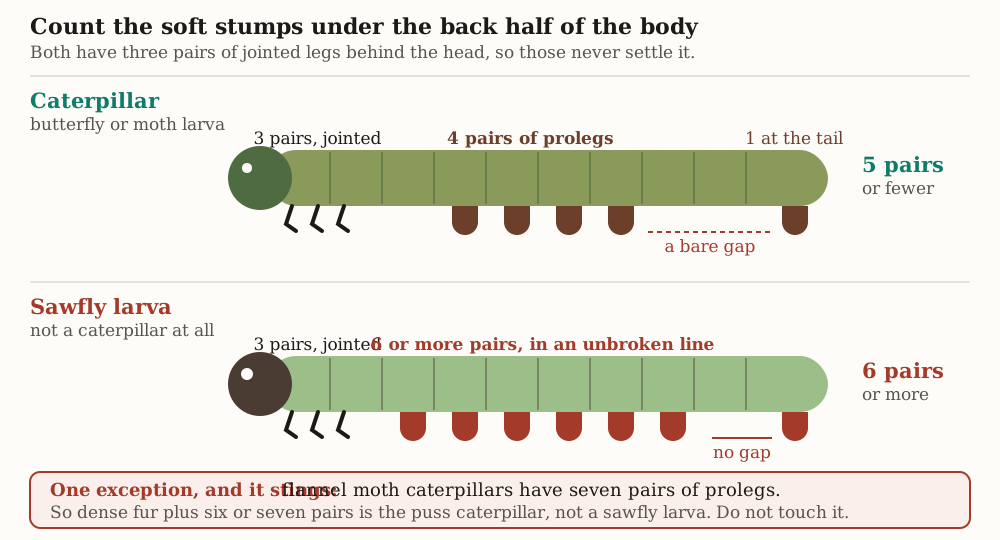
Two more checks confirm it if the count is awkward. Caterpillar prolegs carry rings of tiny hooks called crochets, which grip a leaf like velcro and which sawfly prolegs lack entirely. The front of a caterpillar head carries an inverted Y or V line, while a sawfly larva head capsule is smooth. Caterpillars also have about twelve stemmata, six little dark eyes on each side, against a sawfly larva’s single large pair.
The look-alikes, and the feature that separates each
Caterpillar, sawfly larva, beetle grub or worm
Pairs of soft prolegs
- Caterpillar
- 5 or fewer, with a bare gap before the tail pair
- Sawfly larva
- 6 or more, in an unbroken line
- Beetle grub
- None
- Earthworm
- None
Hooks (crochets) on the prolegs
- Caterpillar
- Yes, rings of them
- Sawfly larva
- No
- Beetle grub
- Not applicable
- Earthworm
- Not applicable
Jointed true legs
- Caterpillar
- 3 pairs
- Sawfly larva
- 3 pairs
- Beetle grub
- 3 pairs, right at the front
- Earthworm
- None
Front of the head
- Caterpillar
- An inverted Y or V line
- Sawfly larva
- Smooth, no line
- Beetle grub
- Hardened, with large jaws
- Earthworm
- No head capsule
Eyes
- Caterpillar
- About 12 tiny dark spots, 6 a side
- Sawfly larva
- One large pair
- Beetle grub
- None or faint spots
- Earthworm
- None
Where you find it
- Caterpillar
- On leaves, usually on top
- Sawfly larva
- On leaves, often curled over the edge
- Beetle grub
- In soil, compost or rotting wood
- Earthworm
- In soil
What it becomes
- Caterpillar
- A moth or a butterfly
- Sawfly larva
- A wasp relative
- Beetle grub
- A beetle
- Earthworm
- Nothing, it is already adult
The grub row matters outdoors, because a fat pale C-shaped larva in your lawn is a beetle larva and the treatment is nothing like the treatment for a caterpillar. Our guide to white grubs covers those. Indoors, the bristly little larva in a wool rug is usually a black carpet beetle rather than anything with prolegs.
The one exception to the leg rule, and it matters
There is a single exception in the United States, and it is the one you would least want to get wrong. Missouri Department of Conservation states that flannel moth caterpillars have seven pairs of prolegs, while all other butterfly and moth caterpillars have five or fewer. So a strict reading of “six or more means a sawfly” puts the puss caterpillar on the wrong side of the line. That is the most painful sting of any caterpillar in the country.
So treat the count as a strong rule with one named exception. If something has six or seven pairs of prolegs and is covered in soft fur, it is not a sawfly larva and you must not touch it. Google’s own identification summary states the six-or-more rule without this exception, which is worth knowing before you trust it on a fuzzy animal.
Part 2 of 4
Is it dangerous?
Can caterpillars sting or bite you?
Caterpillars do not bite people. Their jaws are built to shear leaves, and only a very large one can even pinch if you squeeze it. What people call a bite is almost always a sting, and it comes from hollow spines or barbed hairs rather than from the mouth. Roughly a dozen US groups can do it.
The sting is passive, which is the part that surprises people. You do not get stung because a caterpillar attacks you. You get stung because you brushed against one, or picked one off a shoulder, or sat on a fence rail where one had been. The spines break off in the skin and release venom on their own.
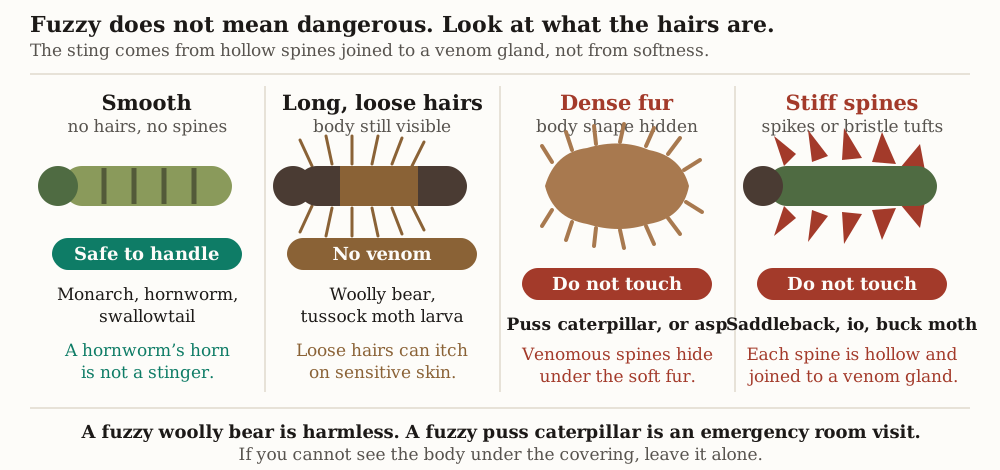
Fuzziness is not the warning sign most people think it is. A woolly bear is famously harmless to roll around your palm. The puss caterpillar looks like the softest thing in the yard, and it is the worst sting in the country. The real question is whether you can still see the body shape under the covering. If you cannot, leave it alone.
The stinging caterpillars, and what each one does
The US stinging caterpillars, by the feature that warns you
Dense fur hiding the body shape
- Species
- Puss caterpillar, or asp (Megalopyge opercularis)
- What it looks like
- A tan to grey tuft of cat-like hair, about an inch long
- What the sting does
- NC State Extension reports pain for several hours and swelling for days, plus possible nausea, headache, fever, chest pain, difficulty breathing, numbness and vision problems
A green back with a brown saddle
- Species
- Saddleback (Acharia stimulea)
- What it looks like
- About 3/4 inch, bright green with a brown oval and four spiny knobs
- What the sting does
- NC State Extension reports immediate pain spreading to nearby lymph nodes, with swelling and redness lasting over a week
Rows of spiny bumps on a black body
- Species
- Buck moth (Hemileuca maia)
- What it looks like
- Almost 2.5 inches, black and spiny, often flecked white
- What the sting does
- Immediate pain into the lymph nodes, and swelling that can last more than a week
Clusters of green branched spines
- Species
- Io moth (Automeris io)
- What it looks like
- Up to 3 inches, pale green with red and white side stripes
- What the sting does
- Ohio State University Extension compares it to a stinging nettle, lasting minutes to hours
Black tufts and long black pencils
- Species
- Hickory tussock and white-marked tussock
- What it looks like
- 1 to 1.7 inches, white or yellow with black tufts front and back
- What the sting does
- Penn State Extension reports a localised itchy rash, with most people recovering within 48 hours
Pale yellow fuzz with black pencils
- Species
- American dagger (Acronicta americana)
- What it looks like
- Up to 2 inches, yellow or white fuzz on hardwood trees
- What the sting does
- NC State Extension is careful here: the toxins are supposedly present and the caterpillar reputed to sting, so treat the usual claim as unconfirmed and still avoid handling it
Missouri Department of Conservation puts it plainly for the flannel moths: their stings “can be intense, to the point of requiring medical attention”. Because the pain from a puss caterpillar can radiate into the chest, people have gone to hospital believing they were having a heart attack.
What to do about a caterpillar sting
Do not rub the area and do not scratch it, because both push the spines deeper. Lift them out first, then treat the skin.
- Lift the hairs out with tape. Press the sticky side down over the skin and pull it up. Poison Control advises repeating with fresh pieces of tape as often as needed, and Penn State Extension adds that fine tweezers can take out anything the tape leaves behind.
- Wash with soap and water once the spines are gone, then let the skin air dry.
- Use a cold pack for the pain and the swelling.
- Treat the itch with an over-the-counter antihistamine or hydrocortisone cream if you need to, following the product’s own directions.
Never try to identify a caterpillar from a photograph of a sting, including with an app. Marks on skin do not carry enough information to name what caused them, and the species matters less than how the reaction is behaving.
Part 3 of 4
Putting a name to it
How to identify a caterpillar, in six steps
Work through six features in order: the legs, the covering, the colour, the adornments, the way it walks, and the plant it was on. The legs prove it is a caterpillar, the covering decides whether you can touch it, and the host plant is usually the single strongest clue to the species.
That order is not ours. Google publishes the same six steps in its own identification summary. For two of them it has to cite a University of Illinois Extension video, because no article writes them out as a numbered check. Here they are as one table.
The six-step check, in order
1. Legs
- What you are counting or looking for
- 3 pairs of jointed true legs, then count the soft prolegs: 5 pairs or fewer
- What it tells you
- Confirms a caterpillar. 6 or more in an unbroken line means a sawfly larva, with the flannel moths as the one exception
2. Covering
- What you are counting or looking for
- Smooth, long loose hairs, dense fur, or stiff spines and bristle tufts
- What it tells you
- Decides whether you can handle it. Dense fur or stiff spines: do not touch
3. Colour and pattern
- What you are counting or looking for
- Solid, striped, banded, spotted or mottled, and how bold it is
- What it tells you
- Bright red, yellow or black-and-orange is usually a warning aimed at birds
4. Adornments
- What you are counting or looking for
- A horn at the tail, a horn on the head, humps, twin tails, or large false eyespots
- What it tells you
- Narrows it fast. A fleshy horn at the tail end means a hawk moth
5. How it walks
- What you are counting or looking for
- Whether it arches its middle into a loop with each step
- What it tells you
- A looper, also called an inchworm. It has no mid-body prolegs, which is why it loops
6. Host plant
- What you are counting or looking for
- The name of the plant you found it on
- What it tells you
- Often decisive. A monarch caterpillar accepts milkweed and nothing else
Those six steps prove what you are holding and whether you can touch it. To put a name to it, our caterpillar identification chart runs through 21 common US species sorted by colour, each with the one marking that names it, its host plant and whether it stings.
Step 4 answers a question with real search volume behind it. A caterpillar that looks like a snake is almost always a hawk moth larva showing false eyespots. Those are large paired markings on a swollen front end, which it rears up and displays. Our page on the tomato hornworm life cycle covers the commonest US example. The viral snake-caterpillar photographs that circulate are usually tropical species, not anything in a North American garden.
Two honest limits are worth stating. Caterpillars change colour between moults, so the same species can look like two different animals a week apart. That is why extension entomologists often call an identification possible but not certain. And some species genuinely cannot be named from a photograph at all. If you want a quick first answer, our free identifier handles what bug is this from a photo, and the result is a starting point rather than a verdict.
Will it turn into a moth or a butterfly?
The odds are about 19 in 20 that it becomes a moth. The United States has roughly 11,000 moth species against about 700 to 750 butterflies, so moths outnumber butterflies by about fifteen to one. Sources disagree slightly on the butterfly figure, and either number gives the same answer.
That is worth saying because almost everybody assumes the opposite. The butterflies get the posters and the garden kits, so “my caterpillar will be a butterfly” is the default guess, and it is wrong nineteen times out of twenty. Our guide to butterfly species covers the one in twenty, and our list of common types of moths covers the rest.
Which one it will become
Dense fur or long loose hairs
- Moth caterpillar
- Common. Woolly bears, tussocks, flannel moths
- Butterfly caterpillar
- Essentially never. No US butterfly larva is furry
Branched spines
- Moth caterpillar
- Some, including the io moth
- Butterfly caterpillar
- Some, including the fritillaries and the buckeye
A fleshy horn at the tail
- Moth caterpillar
- Yes, the hawk moths
- Butterfly caterpillar
- No
A forked orange gland behind the head
- Moth caterpillar
- No
- Butterfly caterpillar
- Yes, the swallowtails. It flicks out when the larva is poked
Builds a silk tent or a portable bag
- Moth caterpillar
- Yes
- Butterfly caterpillar
- No
How it pupates
- Moth caterpillar
- Usually a silk cocoon, in soil or leaf litter
- Butterfly caterpillar
- A bare chrysalis, hung from a stem or a wall
So if it is fuzzy, it is a moth. If it has a horn at the tail, it is a moth. If it shoots out a forked orange gland that smells of pineapple when you touch it, you have a swallowtail. For everything else, what happens next is the same process either way.
What caterpillars eat
Leaves, overwhelmingly. Most species eat the foliage of a short list of plants, and many accept only one plant genus for their whole larval life. A monarch takes milkweed and nothing else. A small minority eat something other than leaves, and a handful of species eat other insects.
Fussiness is the useful part. Because a caterpillar cannot wander far, the plant it is sitting on is usually the plant it was born to eat, and that narrows thousands of candidates to a few. Knowing the plant is often faster than knowing the colour.
The exceptions are short and specific. Clothes moth larvae eat wool, silk, fur and feathers, which is why they live in closets rather than gardens. Pantry moth larvae eat flour, cereal, nuts, dried fruit and dry pet food. Wax moth larvae eat beeswax inside a hive. Our guide to carpet moths covers the fabric eaters, which are the only caterpillars most people ever find indoors.
Caterpillars drink too, mostly from the water in the leaves they chew. A healthy one on a living plant does not need a dish of water, and a wet dish in a container is a drowning risk.
The caterpillars that eat meat, and the strangest one on record
A tiny number of species are carnivores. The bone collector caterpillar is the one worth knowing about. Rubinoff and colleagues described it formally in Science in 2025, after more than twenty years of fieldwork on Oahu.
It is a Hawaiian moth larva in the genus Hyposmocoma. It lives inside a spider’s web and eats the insects trapped there. Then it glues the chewed body parts of its meals onto its own silk case. Nothing else in the world is known to do that. The case appears to hide it from the spider whose web it is squatting in, and captive larvae refuse other materials, which suggests the decoration is not optional. The team found just 62 individuals in more than twenty years, all inside about six square miles, in a lineage estimated to be at least six million years old.
Meanwhile, plenty of things eat caterpillars. Birds take enormous numbers, and most songbird chicks are raised on caterpillars rather than on seed. Parasitic wasps and flies lay eggs inside them, lacewings and ground beetles and spiders take the small ones, and viruses and fungi finish off outbreaks. That is the reason the control section further down starts by asking whether you need to do anything.
The life cycle, and why the caterpillar stage exists
Four stages: egg, larva, pupa and adult. The larva is the caterpillar, and it is the growing stage. Most species shed their skin four or five times, and each stage between two moults is called an instar. A tobacco hornworm multiplies its weight roughly ten thousandfold in under twenty days.
Eggs are usually laid directly on the host plant, singly or in neat clusters, and they are small, round or barrel-shaped, and often ribbed. People find them as a patch of tiny beads on the underside of a leaf and assume they are an insect in their own right.
Then the eating starts, and it does not stop. A caterpillar cuticle will only stretch so far, so growth happens in jumps: feed, split the skin, feed again. The new instar often looks nothing like the last one. A black bristly first instar can become a smooth green fifth instar, which is why the same species gets reported as two different animals.
When the last instar has finished feeding, it stops eating and starts walking. That wandering phase is when most people meet a caterpillar on a driveway or a wall. It is also when control measures stop being useful, because the damage is already done. What it builds next, and what happens inside it, is covered in our guide to pupa vs chrysalis vs cocoon. Adults live anywhere from a few days to a few months, and for most of the big silk moths the adult cannot eat at all, which the moth life cycle explains.
Part 4 of 4
What to do
The signs that caterpillars are feeding
Three signs, and the droppings are the most reliable. Frass is the word for caterpillar poop, and it looks like small dark pellets whose size scales with the animal that made them. Finding frass under a plant proves something is feeding above it, even when you cannot see a single caterpillar.
Butterfly Conservation teaches a trick worth copying. If you suspect a plant is being eaten, spread an old white sheet underneath it overnight and look at the sheet in the morning. The pellets show up against the white, and their size tells you roughly how big the feeder is.
The chewing itself has a pattern. Very young larvae graze the underside of a leaf and leave the top surface intact, which makes pale windows in the leaf. Older ones chew through, taking irregular holes out of the middle and the edges, and the biggest strip a leaf back to its midrib. Hornworms are famous for being invisible until you notice the frass, which is exactly how most gardeners find them.
What the silk in your tree actually is
Four different animals make silk in a tree, they appear at different times of year, and the right answer is different for each. Two more things people send in are not caterpillars at all. One is a case from a stream. The other is the white fluff on tree branches left by aphids.
Silk in a tree, and what it means
A thick tent in the fork of a branch
- What it is
- Eastern or forest tent caterpillar
- When you see it
- Spring, as the leaves come out
- What to do
- Prune the nest out on a dry morning, or leave it. A healthy tree releafs
Branch tips wrapped in loose, baggy webbing
- What it is
- Fall webworm
- When you see it
- Late summer into autumn
- What to do
- Leave it. The leaves were nearly finished for the year, so the damage is cosmetic
A small hanging bag of silk stuck with needles or leaf bits
- What it is
- Bagworm
- When you see it
- Summer, and the bags stay all winter
- What to do
- Pick the bags off through the winter, before the eggs inside hatch
Leaves rolled or folded and stitched shut
- What it is
- Leafroller
- When you see it
- Spring into summer
- What to do
- Prune off the rolled leaves, or squash them closed. The larva drops on a thread if disturbed
A silk case carried about in a stream or on a lake shore
- What it is
- Not a caterpillar: a caddisfly
- When you see it
- Summer
- What to do
- Nothing. They are an aquatic insect and a sign of clean water
Fine webbing and clumping inside a flour packet
- What it is
- Pantry moth larvae, not a garden caterpillar
- When you see it
- Any time of year
- What to do
- Find the packet, bin it outdoors, and clean the shelf cracks
The fifth row is the one people get wrong most often, because a caddisfly case looks like something a caterpillar built. It is an aquatic insect, it only turns up near water, and it means the water is clean.
Caterpillars in the house
Nothing in your house attracts a garden caterpillar. Two things explain almost every one found indoors: it is a full-grown larva wandering to find somewhere to pupate, or it arrived inside something you carried in. Only two groups actually breed indoors, and neither looks like a garden caterpillar.
The wanderer is the common case. A last-instar larva stops feeding and walks, sometimes a long way, to look for leaf litter, a crevice or loose soil. If it meets your wall, it climbs it. One caterpillar on a hallway wall in September is an animal that took a wrong turn, not an infestation. Carry it outside and put it under a shrub.
The hitchhiker is the next case. Caterpillars come in on cut flowers, on a nursery plant, in a bundle of firewood, on garden produce, and on a coat. A cluster that suddenly appeared on a deck or a wall is usually a brood that hatched on the tree above it and dropped.
The two that genuinely live indoors are the fabric eaters and the food eaters, and both are moth larvae rather than anything you would call a caterpillar on sight. Clothes moth larvae are small, cream coloured and found in wool, silk, fur and feathers, often under a collar or inside a folded garment. Pantry moth larvae are similar and live in dry goods. If you have a repeating supply of small larvae indoors, it is one of those two and not the garden.
What to do about caterpillars on your plants
Start by deciding whether the damage matters, because for most plants it does not. UC IPM notes that many plants, especially perennials, tolerate substantial leaf loss, so a few caterpillars are usually not a problem. Then work in order: look, pick, prune, and only then consider a spray.
Every step below that costs nothing comes before every step that costs anything. That is deliberate, and it is also what works. Handpicking a dozen larvae off a tomato plant beats a spray that has to be eaten to do anything.
Clearing caterpillars, in order
Decide whether the damage is worth acting on
Look at what is actually lost. Chewed leaves on an established shrub, a tree in autumn, or a perennial that has already flowered cost you nothing. Damage to a seedling, a growing tip, a fruit or a vegetable you plan to eat is a different matter. If the plant is a host you deliberately planted for butterflies, the caterpillars are the point.
Find the caterpillar, not just the holes
Look on the undersides of leaves, inside rolled or webbed leaves, and in the crown of the plant. Check for frass below. Many species feed at night, so a torch after dark finds what a daytime search misses. If you cannot find the feeder, the white sheet trick will tell you how big it is.
Pick them off, wearing gloves
Handpicking is the most effective thing you can do on a small plot, and gloves make it safe whatever the species turns out to be. Drop what you collect into soapy water. Doing this twice a week for two weeks usually ends the problem.
Prune out nests, rolled leaves and egg clusters
Cut off tented branch forks, stitched-up leaves and the beads of eggs on leaf undersides. Pruning takes out a whole brood in one cut, before they spread along the plant.
Leave the natural enemies alone
Parasitic wasps and flies, birds, lacewings, ground beetles and spiders take large numbers. A caterpillar with small white rice-shaped cases stuck to its back is already parasitised and will not survive, so leaving it in place releases more wasps. Broad-spectrum insecticides kill these helpers and the outbreak gets worse.
If you must spray, use Btk, and only on small larvae
Bacillus thuringiensis subspecies kurstaki, sold as Btk, is the targeted option. UC IPM describes it as killing caterpillars only and safe around bees, beneficial insects and wildlife. It has to be eaten to work, it works best on newly hatched larvae, and it breaks down quickly, so timing decides whether it does anything. Btk and spinosad are EPA-registered pesticides, so the label is the law. If handpicking and pruning are working, no spray is needed at all.
Keep every spray off the plants you grew for butterflies
Milkweed, parsley, fennel, dill and spicebush exist in a garden to be eaten. Treating them kills the caterpillars you were trying to raise.
What does not work, or is not proven. Neem oil is widely recommended and the evidence for it against caterpillars is weak: it mostly deters feeding rather than killing larvae, and it harms bees while it is wet. Carbaryl, malathion and pyrethroid sprays such as bifenthrin do kill caterpillars. UC IPM still advises against them in a garden, because they kill the natural enemies and the pollinators too. That leaves you worse off next month. Never use rubbing alcohol, kerosene or gasoline on a plant or an insect.
Not everything chewing a leaf is a caterpillar, and the treatment differs. Skeletonised leaves with the veins left behind usually mean japanese beetle damage. Ragged edges on a lawn or a border in late summer can be grasshoppers, and what do grasshoppers eat covers far more plants than any caterpillar does.
Lawns are a separate calculation, and it has real numbers. Yellow or brown patches have many causes and caterpillars are rarely the one. Confirm them first with a drench: mix dishwashing liquid into water and pour it over a square yard, then count what comes up. UC IPM gives the thresholds as more than 5 armyworms or cutworms per square yard, or more than 15 lawn moth larvae, and below those numbers there is nothing to treat.
When to leave them alone, and when to get help
Of the thirteen sections on this page, this is the one most readers actually need, and the answer is usually to do nothing. Ohio State University Extension puts it simply on a large caterpillar: observe it, then let it find its normal place to transform. It adds that control is not worth doing on a full-grown larva that has finished feeding.
Four lists decide it.
Leave it alone when
- it is on a tree or an established shrub.
- it is autumn and the leaves are nearly done.
- the plant is one you grew as a host.
- the larva is wandering on a path or a wall.
- it is parasitised.
- there are only a few of them.
Act when
- a seedling or a growing tip is being eaten.
- a vegetable or fruit crop is being damaged.
- the same plant is being stripped repeatedly.
- a young evergreen is carrying bagworms, which do not releaf.
- lawn counts are above the thresholds above.
Call a licensed professional when
- a large tree needs treating, which takes equipment and a pesticide licence.
- an outbreak covers a property and you need a firm identification first.
Ask for the species name in writing before you agree to a treatment.
See a doctor, or call Poison Control on 1-800-222-1222, when
- there is trouble breathing.
- the face, lips or throat swell.
- there is chest pain, or pain spreading up a limb.
- redness is spreading, or there is fever or pus.
- hairs got into an eye, or were swallowed.
- a young child reacts at all.
A sting that is sore, red and settling over a few days is the normal course. A sting that is getting worse hour by hour is not.
When and where you see caterpillars
Across most of the United States the caterpillar season runs from spring to the first frost. There are two peaks. The tent builders come in spring, as the leaves open. The big wandering larvae come in late summer and autumn, as the last generation finishes feeding. Stings cluster in that second peak.
Region changes the length of it rather than the pattern. In the northern states the season is a hard summer, roughly May to October. In the Gulf states and the Southwest the window is much longer. Florida has barely a gap at all, and people report caterpillars there in every month. The puss caterpillar manages two generations a year across the South.
Where you look matters as much as when. The tent builders are in the forks of fruit trees, cherries and crab apples in spring. Hornworms turn up on tomatoes, peppers and tobacco in high summer. The tussocks and daggers are on oak, maple, willow and hickory in autumn, which is why so many autumn stings happen to people raking leaves or carrying firewood. Oak is the single richest tree for caterpillars in North America, which is also why an oak is so good for nesting birds.
Caterpillar myths, corrected
Six things get repeated about caterpillars that are not true, and two of them are repeated by pages Google ranks on the first page in the United States. The two worth knowing before you touch anything are that fuzziness does not mean venom, and that a sawfly larva is not a caterpillar however many sites file it as one.
Myth 1
Myth: “A fuzzy one stings and a smooth one is safe.”
Truth: It is close to the reverse of a useful rule. Woolly bears are fuzzy and harmless, and the puss caterpillar is the fuzziest-looking larva in the country and carries hollow venomous spines under the fur. The question is whether you can see the body shape through the covering, not whether it looks soft.
Myth 2
Myth: “Caterpillars are worms.”
Truth: They are insects. A caterpillar has a hard head capsule, chewing jaws and three pairs of jointed legs, and a worm has none of the three. The names stuck because of words like armyworm, cutworm and hornworm, all of which are caterpillars.
Myth 3
Myth: “Sawfly larvae are caterpillars.”
Truth: They are not. Identification sites repeat it anyway, filing them under sawfly caterpillars. One is NatureSpot, which Google ranks on the first page in the United States for this topic. A sawfly is a wasp relative. Count the prolegs: six or more pairs in an unbroken line is a sawfly.
Myth 4
Myth: “The woolly bear's bands predict the coming winter.”
Truth: There is no evidence for it. The width of the brown band tracks how old the caterpillar is, and how wet the previous season was. So it records the weather that has already happened, not the weather coming.
Myth 5
Myth: “All caterpillars turn into butterflies.”
Truth: About 19 in 20 US species become moths. The butterfly is the exception, not the rule.
Myth 6
Myth: “A caterpillar indoors means an infestation.”
Truth: Almost never. It is a wandering last-instar larva looking for somewhere to pupate, or it came in on a plant, a bouquet or firewood. The only caterpillars that breed indoors are clothes moth and pantry moth larvae, and both live in fabric or dry food rather than on your walls.
Medical disclaimer. This page is for general information only. It is not a medical diagnosis. If you have severe symptoms, trouble breathing, swelling of the face or throat, fast spreading redness, fever, severe pain, pus, or signs of infection, contact a doctor or your local emergency number.
Frequently asked questions
How long do caterpillars live?
Do caterpillars have eyes?
Do caterpillars sleep?
Do caterpillars need water?
Do butterflies remember being caterpillars?
Can I take a picture of a caterpillar to identify it?
Related guides
Tomato hornworm
The big green caterpillar on your tomatoes, the frass that finds it, and the moth it becomes.
Butterflies
The adults that one in twenty become, and the two features that tell one from a moth.
Pupa
What happens inside, and how a chrysalis differs from a cocoon.
Moths
What the adults are, what they eat, and which few damage a home.
Types of moths
16 common US moths sorted by size and colour, with the feature that names each one.
Lawn grubs
The fat C-shaped larvae in your turf, which are beetles rather than caterpillars.
Sources
- Poison Control, caterpillar stings and first aid
- NC State Extension, Puss Caterpillar
- NC State Extension, Saddleback Caterpillar
- Penn State Extension, Hickory Tussock Moth Caterpillar
- Missouri Department of Conservation, Flannel Moths field guide
- UC IPM, Leaf-feeding Caterpillars
- Ohio State University Extension, Giant Caterpillars