This page is the catalog. Caterpillar identification starts one step earlier, with a check you have probably already done. Three pairs of jointed legs sit behind the head, then five pairs of soft stumps or fewer along the back half. Our hub covers how many legs does a caterpillar have and the sawfly larvae that break the rule. If you have a photograph and want a first answer before reading anything, our free identifier handles what bug is this.
Part 1 of 3
The chart
The caterpillar identification chart
Twenty-one species, each with the one feature that names it. This is the caterpillar identification table the ranking pages promise and do not deliver. The Stings? column is the one to read first if the caterpillar is somewhere a child or a dog can reach it. Lengths are last-instar figures, which is the point of the section further down on why length misleads.
Caterpillar identification chart: 21 common US species
Green, eight white V marks, BLACK horn
- Species
- Tomato hornworm
- Length
- 3 to 4 in (76 to 102 mm)
- Usually found on
- Tomato, pepper, eggplant
- Stings?
- No
- Becomes
- Five-spotted hawk moth
Green, seven white diagonal stripes, RED horn
- Species
- Tobacco hornworm
- Length
- 3 to 4 in (76 to 102 mm)
- Usually found on
- Tomato, tobacco
- Stings?
- No
- Becomes
- Carolina sphinx moth
Green with black bands dotted yellow
- Species
- Black swallowtail
- Length
- 2 in (51 mm)
- Usually found on
- Parsley, dill, fennel, carrot
- Stings?
- No
- Becomes
- Black swallowtail butterfly
Lime green, faint yellow side line, red-orange dots
- Species
- Luna moth larva
- Length
- 2.5 to 3.5 in (64 to 89 mm)
- Usually found on
- Walnut, sweetgum, hickory
- Stings?
- No
- Becomes
- Luna moth
Small, smooth green, arches into a loop to walk
- Species
- Cabbage looper
- Length
- 1 to 1.5 in (25 to 38 mm)
- Usually found on
- Cabbage, broccoli, kale
- Stings?
- No
- Becomes
- Cabbage looper moth
Pale green, branched spines, red-and-white side stripe
- Species
- Io moth larva
- Length
- up to 3 in (76 mm)
- Usually found on
- Many trees and shrubs
- Stings?
- Yes
- Becomes
- Io moth
Green with a brown saddle inside a white ring
- Species
- Saddleback
- Length
- 3/4 in (19 mm)
- Usually found on
- Many plants
- Stings?
- Yes, severe
- Becomes
- Saddleback moth
Black with one white stripe down the back
- Species
- Eastern tent caterpillar
- Length
- 2 to 2.5 in (51 to 64 mm)
- Usually found on
- Cherry, apple, crabapple
- Stings?
- No
- Becomes
- Eastern tent moth
Glossy black bristles, red bands show when it curls
- Species
- Giant leopard moth larva
- Length
- 2 to 3 in (51 to 76 mm)
- Usually found on
- Many broadleaf plants
- Stings?
- No
- Becomes
- Giant leopard moth
Black and spiny, flecked with white
- Species
- Buck moth larva
- Length
- 2.5 in (64 mm)
- Usually found on
- Oak
- Stings?
- Yes
- Becomes
- Buck moth
Brown-black with a white saddle, a bird-dropping mimic
- Species
- Spicebush swallowtail, early
- Length
- 1 in (25 mm)
- Usually found on
- Spicebush, sassafras
- Stings?
- No
- Becomes
- Spicebush swallowtail butterfly
Black at both ends, rust-brown band in the middle
- Species
- Woolly bear
- Length
- 2 in (51 mm)
- Usually found on
- Grasses and low plants
- Stings?
- No
- Becomes
- Isabella tiger moth
A teardrop of dense tan fur, no body shape visible
- Species
- Puss caterpillar, or asp
- Length
- 1 in (25 mm)
- Usually found on
- Oak, elm
- Stings?
- Yes, the worst in the US
- Becomes
- Southern flannel moth
Pale tan, long fine hairs, in baggy branch-tip webs
- Species
- Fall webworm
- Length
- 1 in (25 mm)
- Usually found on
- Many hardwoods
- Stings?
- No
- Becomes
- Fall webworm moth
Pale yellow or white fuzz, long black pencils
- Species
- American dagger larva
- Length
- 2 in (51 mm)
- Usually found on
- Maple, oak, ash
- Stings?
- Unconfirmed, avoid
- Becomes
- American dagger moth
White-yellow, black tufts front and back
- Species
- Hickory tussock
- Length
- 1 to 1.7 in (25 to 43 mm)
- Usually found on
- Hickory, walnut, oak
- Stings?
- Yes, an itchy rash
- Becomes
- Hickory tussock moth
Orange body, black branched spines
- Species
- Gulf fritillary larva
- Length
- 1.5 in (38 mm)
- Usually found on
- Passionflower
- Stings?
- No
- Becomes
- Gulf fritillary butterfly
Red head, four white brush tufts, black back stripe
- Species
- White-marked tussock
- Length
- 1.5 in (38 mm)
- Usually found on
- Many trees
- Stings?
- Yes, an itchy rash
- Becomes
- White-marked tussock moth
Black, white and yellow bands, TWO pairs of filaments
- Species
- Monarch
- Length
- 2 in (51 mm)
- Usually found on
- Milkweed only
- Stings?
- No
- Becomes
- Monarch butterfly
Like a monarch but THREE pairs of filaments
- Species
- Queen
- Length
- 2 in (51 mm)
- Usually found on
- Milkweed
- Stings?
- No
- Becomes
- Queen butterfly
Blue-green, long orange-and-black horns
- Species
- Hickory horned devil
- Length
- 5 to 6 in (127 to 152 mm)
- Usually found on
- Hickory, walnut, persimmon
- Stings?
- No
- Becomes
- Regal moth
Part 2 of 3
By the colour you see first
Green caterpillars
Green is the commonest answer and the least useful on its own, because it is the default colour for anything that spends its life on a leaf. Seven of the 21 species here are green. What separates them is what the green carries: a horn, a band, a saddle or a spine.
A horn at the tail means a hawk moth, and in a vegetable garden that is almost always a hornworm. Horn colour tells the two apart. The tomato hornworm has a black horn and eight white V marks. The tobacco hornworm has a red one and seven plain diagonal stripes. Most published charts get that pair the wrong way round at least once.
Black bands dotted with yellow, on parsley, dill or fennel, is a black swallowtail. Poke it gently and a forked orange gland flicks out and smells faintly of pineapple, which no moth larva does. A plain lime-green body the size of your finger on walnut or sweetgum is a luna moth larva. A small smooth green one that arches its middle into a loop as it walks is a cabbage looper. It is the only one of the seven likely to cost you a crop.
The two green species that sting get their own section below. Telling them from the harmless spiny ones is the single most useful piece of caterpillar identification on this page.
Black caterpillars
Four of the 21 read as black, and the useful question is whether the black is bristly, spiny or smooth. Bristly and glossy, with red showing between the segments when it curls into a ring, is a giant leopard moth larva. It is harmless, despite looking like it should not be.
Spiny and flecked with white, on oak, is a buck moth larva and it stings. Black with a single white stripe down the back, in spring, in a silk tent in the fork of a branch, is an eastern tent caterpillar. A small brown-black lump with a white saddle that looks like a bird dropping is an early spicebush swallowtail, which later turns green and grows false eyespots.
One thing to know before you go looking. Much of what gets photographed and called a black caterpillar is a woolly bear with an unusually wide black band, which is the next section.
Brown and tan caterpillars
Three species cover most brown sightings, and two of them are the most-searched caterpillars in the country. Black at both ends with a rust band in the middle is a woolly bear, which is harmless and does not predict the winter. The band tracks how old the larva is and how wet the previous season was.
⚠️ A teardrop of dense tan fur with no body shape showing underneath is a puss caterpillar, and it delivers the worst caterpillar sting in the United States. It looks softer than the woolly bear, not spikier, which is exactly why people pick it up. The test is whether you can see the body under the covering. If you cannot, leave it alone.
Pale tan with long fine hairs, inside baggy webbing over a branch tip in late summer, is a fall webworm. It is harmless, and the damage is cosmetic because the leaves were nearly finished for the year. Where the web sits is what separates it from the spring tent caterpillar.
Yellow and orange caterpillars
Three species, and two of them are irritants rather than stingers. Pale yellow or white fuzz with a few long black pencils, on maple, oak or ash in autumn, is an American dagger larva. It is the species most often listed as a stinger on evidence its own source hedges.
White-yellow with black tufts at both ends is a hickory tussock. Contact causes an itchy rash, and Penn State Extension reports most people recover within 48 hours. An orange body with black branched spines, on passionflower, is a gulf fritillary larva, and despite looking the part it does not sting at all.
White caterpillars
Genuinely white caterpillars are uncommon, and one species accounts for most reports. A red head, four white brush tufts standing up like a toothbrush, and a black stripe down the back is a white-marked tussock. It causes an itchy rash and it is worth keeping children away from, which matters because the tufts are exactly what a child reaches for.
The other common white answer is a pale fall webworm, covered above. It may also be a very young larva of almost any species, because first instars are often pale before the colour comes in.
Striped and banded caterpillars
Bold crosswise bands of black, white and yellow on milkweed is a monarch, and it is the most recognised larva in the country. The detail almost nobody checks is the filament count: a monarch has two pairs of black filaments, one pair at each end. A queen caterpillar is marked almost identically but carries three pairs, with an extra pair in the middle of the body.
That difference matters most in the southern states, where both fly. It is also the kind of detail a chart with one photograph per species cannot show you. If the markings say monarch and the filaments say three, you have a queen.
Fuzzy and hairy caterpillars, read across the colours
Hair cuts across every colour section above, which is why colour alone is a weak basis for caterpillar identification. What matters is the kind of hair, and there are three.
Long loose hairs with the body visible between them, as on a woolly bear or a tussock larva, carry no venom, though tussock hairs can itch. Dense fur that hides the body outline completely is the puss caterpillar and nothing else common, and it is a hospital-grade sting. Short bristles in tight tufts, as on the hickory tussock and the white-marked tussock, cause a rash rather than a sting.
The practical rule is the one the hub states and it is worth repeating here: fuzziness is not the warning sign people think it is. A fuzzy woolly bear is harmless, and a fuzzy puss caterpillar is an emergency room visit.
Spiny caterpillars, and which two actually sting
Four spiny species get confused with each other constantly, and only two of them sting. Spines alone decide nothing: the saddle and the side stripe are what name the dangerous pair.
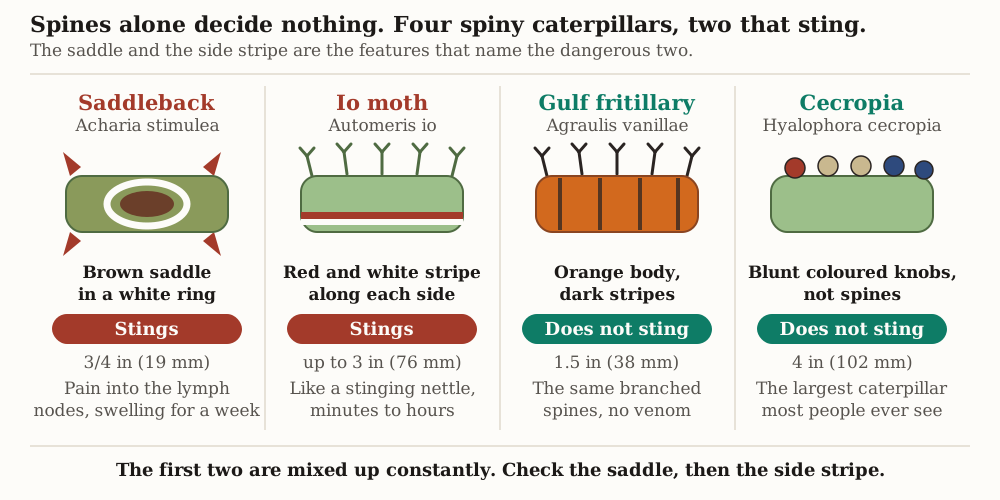
This confusion is not hypothetical. A widely shared thread posted a caterpillar as a saddleback, and its own comments corrected it to an io moth larva. Those are two green, spiny, stinging species the poster could not separate. The brown saddle inside a white ring is unmistakable once you know to look for it. The io moth has no saddle at all, only a red-and-white line down each side.
Ruling those two out leaves the harmless pair, and they are easy. A gulf fritillary carries the same branched spines on an orange body. A cecropia larva is large, blue-green, and carries blunt coloured knobs rather than spines. At four inches it is the biggest caterpillar most Americans will ever see.
Why length is the weakest field in any chart
Every caterpillar identification chart lists a length, including the one above, and every one of those figures describes a fully grown larva. A caterpillar changes size roughly twentyfold between hatching and pupating, so a length only matches if you happen to have caught it in its last instar.
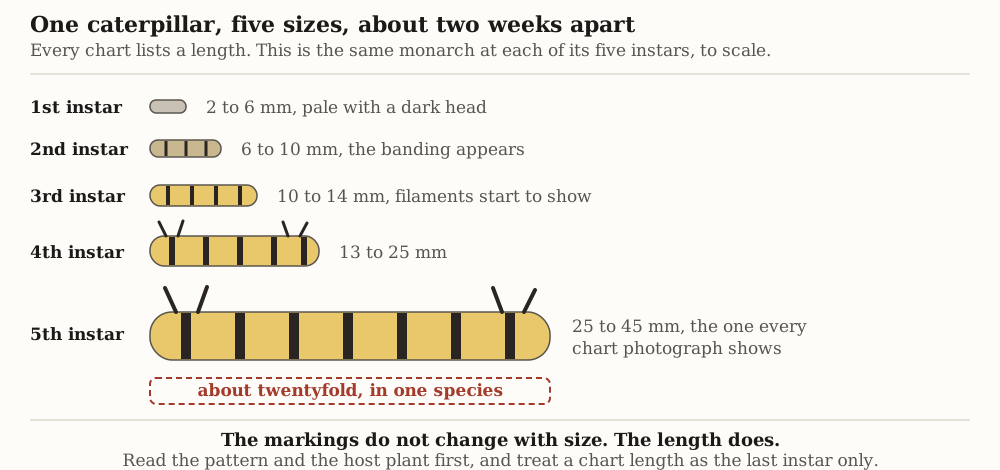
A monarch runs from about 2 to 6 mm in its first instar to 25 to 45 mm in its fifth, over roughly two weeks. The markings are different. They are there from the second instar onwards and do not change, so the banding and the filament count name a monarch at 8 mm as reliably as at 45 mm.
There is a second trap in the same place. Many species darken and turn brown in their last day or two of feeding. A green caterpillar you have been watching can turn up brown and look like a different animal. If your caterpillar does not match any picture, an early instar and a pre-pupal colour change are the two commonest reasons.
Part 3 of 3
What is not on the chart
The ones that are not caterpillars at all
Three animals get posted to identification forums as caterpillars every week, and none of them is one. Getting this wrong matters, because the treatment for each is different.
Not a caterpillar, and what names each one
Pairs of soft prolegs
- Caterpillar
- 5 or fewer, with a bare gap before the tail pair
- Sawfly larva
- 6 or more, in an unbroken line
- Beetle grub
- None at all
Hooks on the prolegs
- Caterpillar
- Yes, rings of crochets
- Sawfly larva
- None
- Beetle grub
- Not applicable
Eyes
- Caterpillar
- About 12 tiny spots, 6 a side
- Sawfly larva
- One large pair
- Beetle grub
- None or faint
Body posture
- Caterpillar
- Straight along a leaf
- Sawfly larva
- Often curled over a leaf edge
- Beetle grub
- C-shaped, in soil
What it becomes
- Caterpillar
- A moth or a butterfly
- Sawfly larva
- A wasp relative
- Beetle grub
- A beetle
The sawfly deserves real attention, because it looks so convincingly like a caterpillar. NatureSpot, which Google ranks on the first page in the United States for this topic, files them under “sawfly caterpillars”. Count the fleshy stumps under the back half of the body. A fat, pale, C-shaped larva in your lawn or compost is a beetle larva instead, and grub worms is a different problem with a different fix.
One honest exception, and it matters because of which species it is. Flannel moth caterpillars carry seven pairs of prolegs, so the six-or-more rule would clear the puss caterpillar as a sawfly larva. Dense fur plus six or seven pairs is a flannel moth, not a sawfly, and you must not touch it.
Where the big caterpillar charts get it wrong
This is worth saying plainly, because three of the pages Google ranks above this one for caterpillar identification contain errors a reader cannot see. We checked them rather than assumed.
Mistake 1
Mistake: A chart length will tell you the species.
Reality: Only if your caterpillar happens to be fully grown. A monarch runs from about 2 mm to 45 mm through its five instars, so a published length describes the last one and nothing else. Read the markings first.
Mistake 2
Mistake: Green means a garden pest.
Reality: Most green caterpillars in a US yard are swallowtails, hornworms, loopers or luna moth larvae, and only a few of those damage anything you planted. Two green species sting, and neither is a pest.
Mistake 3
Mistake: The hairy ones are the dangerous ones.
Reality: The woolly bear is the hairiest common species in the country and it is harmless. The puss caterpillar looks softer still and is the worst sting in the United States. Whether you can see the body under the covering is the real question.
Mistake 4
Mistake: Sawfly larvae are a kind of caterpillar.
Reality: They are wasp relatives. Count the fleshy prolegs: a caterpillar has five pairs or fewer with a bare gap before the tail pair, a sawfly larva has six or more in an unbroken line. NatureSpot, which Google ranks on the first page in the United States, files them as caterpillars anyway.
Mistake 5
Mistake: Caterpillar charts are checked before they are published.
Reality: Not reliably. The page titled 67 Types of Caterpillars with Identification Chart has no chart in it. It also lists one species twice with two different host plants, and converts 0.6 inches to 2.5 cm.
None of that makes those pages useless, and two of them are genuinely good on host plants. It does mean any single source of caterpillar identification is worth checking against a second one before you act on it. That goes double for the stinging column, the only field where being wrong costs anything.
The adults are a separate problem and an easier one, because an adult never changes size after it emerges. Our list of moth species sorts the common US moths by size and colour. Our butterfly guide covers what do butterflies eat, along with the two checks that tell a butterfly from a moth. What any of these larvae builds next is a chrysalis or a cocoon, depending on which it becomes.
Pest control disclaimer. Photo-based identification can help, but it is not always perfect. For dangerous spiders, large infestations, or anything you are unsure about, contact a licensed pest control professional.
Frequently asked questions
How can I tell what kind of caterpillar I have?
Can I identify a caterpillar using a picture for free?
What is the most common caterpillar in the United States?
What are the top poisonous caterpillars to avoid?
Why does my caterpillar not match any picture?
Does the colour tell me what it turns into?
Related guides
Caterpillars
The hub: the leg count that proves it is one, which ones sting, and what to do about them.
Tomato hornworm
The big green caterpillar on your tomatoes, the frass that finds it, and the moth it becomes.
Types of moths
16 common US moths sorted by size and colour, which is what most of these larvae become.
Butterflies
The one in twenty that becomes a butterfly, and the two features that tell one from a moth.
Pupa
What happens inside, and how a chrysalis differs from a cocoon.
Lawn grubs
The fat C-shaped larvae in turf, which are beetles rather than anything with prolegs.
Sources
- Poison Control, caterpillar stings and first aid
- NC State Extension, Puss Caterpillar
- NC State Extension, Saddleback Caterpillar
- Penn State Extension, Hickory Tussock Moth Caterpillar
- Missouri Department of Conservation, Flannel Moths field guide
- UC IPM, Leaf-feeding Caterpillars
- Ohio State University Extension, Giant Caterpillars